
Showing 20 items matching "mt pilot"
-
 Wooragee Landcare Group
Photograph, 12th September 2004 or 15rh September 2004
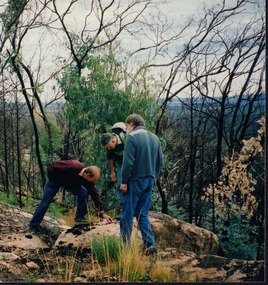
... ...Mt Pilot...This photograph was taken at Wooragee Landcare workshop (Quoll), field day in Mt Pilot park on Bush Recovery: After the Fires. ...This photograph was taken at Wooragee Landcare workshop (Quoll), field day in Mt Pilot park on Bush Recovery: After the Fires. ...This photograph was taken at Wooragee Landcare workshop (Quoll), field day in Mt Pilot park on Bush Recovery: After the Fires. This is part of the Biodiversity Month on September 2004. The Bush Recovery workshop was held on Sunday 12th September 2-4pm with Christine Watson, Sue Berwick and Natasha Schedvin, and another workshop on Wednesday, 15th September, 9am to 12 noon with local biologist Glen Johnson and botanists Gill Earl and Christine Watson. The topics involved in the training involved what species have returned, what species haven't, what recovery studies are being carried out, how are the barking owls and phascogales faring, and why is Mt Pilot important. The photograph shows L-R: Colin Payne; Jerry Alexander; Geoff Galbraith. Bush fires are common in Australia due to several reasons. One is due to the geographic spread of fire's seasons, secondly, the absence of El Nino conditions are also linked to fires. Climate change also affected Australia's hot and dry seasons. Australia's climate began warming since the 1970s. Human-induced fires also contributed to this increase in temperatures across the nation. Bush fires happened in Mt Pilot in 2003 but it has recovered well since. This makes Mt Pilot an important site to understand bushfire recovery. This photograph contributes to the scientific and historical records on bushfire recovery in Victoria. It creates a picture of Victorian community activities and efforts on biodiversity, climate change, and environmental care.Landscape coloured photograph printed on gloss paperReverse: WAN NA 0A2A0N0 NN2 0 163 / (No. 2)wooragee, wooragee landcare group, wooragee landcare, bush fires, bush recover, mt pilot, biodiversity month, botany, botanists, bush recovery, quoll, foxy, fox, forest, environment, climate change, bushfire recovery, bushfires, 2004 bushfire, field work, after the fires, fire, biodiversity -
 Wooragee Landcare Group
Photograph, 28th April 2004
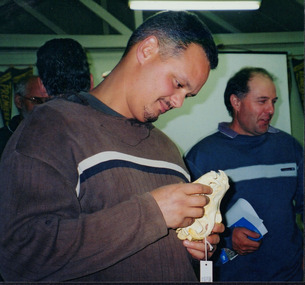
... ...mt pilot...Spotted-tail or Tiger quolls were known to have lived in the Mt Pilot and Stanley Plateau region previously but habitat encroachment, competitor species such as foxes and natural disasters had reduced sightings in recent years. ...Spotted-tail or Tiger quolls were known to have lived in the Mt Pilot and Stanley Plateau region previously but habitat encroachment, competitor species such as foxes and natural disasters had reduced sightings in recent years. ...Wooragee Landcare was formed in 1989 to promote sustainable conservation and land-use practices in the North-East region of Victoria. The organisation's work has included public awareness and education campaigns to control invasive, introduced species and protect native wildlife, such as campaigns to bait or trap foxes and to identify and monitor quoll populations in the region. The organisation has drawn on the work of a variety of Government and academic experts to inform best practice approaches are utilised. In 2004 Andrew Murray, a leading quoll expert from Parks Victoria, conducted training for Wooragee Landcare members and the local community in how to identify potential quoll habitat and populations (through identifying scat and other methods). Spotted-tail or Tiger quolls were known to have lived in the Mt Pilot and Stanley Plateau region previously but habitat encroachment, competitor species such as foxes and natural disasters had reduced sightings in recent years. The Spotted-Tail quoll (formerly known as the Tiger Quoll) is the largest of four species of native marsupial carnivore on mainland Australia, and the second-largest carnivore (after the dingo). The species' scientific name, Dasyurus maculatus, references its' 'hairy tail'. Adults are approximately 125cm long, including their long tail, and weigh around 5 kilograms. The Spotted-tail quoll is currently considered to be a threatened species, but other species are currently listed as endangered. This photograph is significant as an example of wildlife protection awareness programs undertaken by Wooragee Landcare Group in the 2000s in Indigo Shire.Landscape coloured photograph printed on gloss paper.Reverse: WAN NA 0ANA2N0 NNN+ 2 8743 / [PRINTED] (No.22) / 268wooragee, wooragee landcare, kiewa landcare, indigo shire, north-east victoria, farming, conservation, wildlife, quoll, quolls, marsupials, predators, simon feillafe, andy murray, south-east forests, spotted tail quoll, mt pilot, stanley plateau, andrew murray -
 Wooragee Landcare Group
Photograph, 28th April 2004
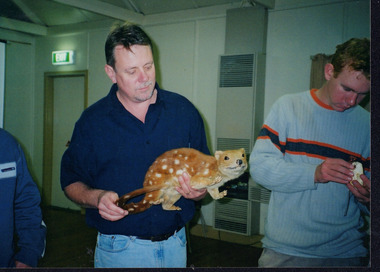
... ...mt pilot...Spotted-tail or Tiger quolls were known to have lived in the Mt Pilot and Stanley Plateau region previously but habitat encroachment, competitor species such as foxes and natural disasters had reduced sightings in recent years. ...Spotted-tail or Tiger quolls were known to have lived in the Mt Pilot and Stanley Plateau region previously but habitat encroachment, competitor species such as foxes and natural disasters had reduced sightings in recent years. ...Wooragee Landcare was formed in 1989 to promote sustainable conservation and land-use practices in the North-East region of Victoria. The organisation's work has included public awareness and education campaigns to control invasive, introduced species and protect native wildlife, such as campaigns to bait or trap foxes and to identify and monitor quoll populations in the region. The organisation has drawn on the work of a variety of Government and academic experts to inform best practice approaches are utilised. In 2004 Andrew Murray, a leading quoll expert from Parks Victoria, conducted training for Wooragee Landcare members and the local community in how to identify potential quoll habitat and populations (through identifying scat and other methods). Spotted-tail or Tiger quolls were known to have lived in the Mt Pilot and Stanley Plateau region previously but habitat encroachment, competitor species such as foxes and natural disasters had reduced sightings in recent years. The Spotted-Tail quoll (formerly known as the Tiger Quoll) is the largest of four species of native marsupial carnivore on mainland Australia, and the second-largest carnivore (after the dingo). The species' scientific name, Dasyurus maculatus, references its' 'hairy tail'. Adults are approximately 125cm long, including their long tail, and weigh around 5 kilograms. The Spotted-tail quoll is currently considered to be a threatened species, but other species are currently listed as endangered.This photograph is significant as an example of wildlife protection awareness programs undertaken by Wooragee Landcare Group in the 2000s in Indigo Shire.Landscape coloured photograph printed on gloss paper.Reverse: WAN NA 0ANA2N0 NNN+ 1 8743 / [PRINTED] (No.23) / 269wooragee, wooragee landcare, indigo shire, north-east victoria, andrew murray, queries about quolls, wildlife, conservation, farming, predators, spotted tail quolls, quolls, marsupials, south-east forests, mt pilot, stanley plateau -
 Wooragee Landcare Group
Photograph, 28th April 2004
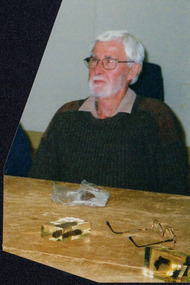
... ...mt pilot...This photograph is significant as an example of events used by the Wooragee Landcare Group to inform the public on local environmental issues, and for its link to the hunt for the spotted-tailed quoll. quoll South East Forest Spotted-tailed Quoll Working Group spotted-tailed quoll tiger mt pilot Andrew Murray quolls Andy Murray quolls Andrew Murray Mount Pilot Chiltern National Park foxes endangered quoll queries about quolls quoll species Wooragee Wooragee Hall Wooragee Landcare Wooragee Landcare Group owen gemmill Reverse: WAN NA 0ANA0N0 NN2+ 1 1636917 Portrait colour photograph printed on gloss paper. ... This photograph was taken at Wooragee Hall on the 28th of April, 2004, during an general information event titled "Questions About Quolls." The event was hosted by Andy Murray, then president of the South East Forests Spot-Tailed Quoll Working Group. Information provided included quoll characteristics, habitats, and how to find them. This event was partially prompted by a desire to find out if quolls still lived in Mount Pilot-Chiltern National Park, as there had been no confirmed sightings since the 2003 bushfires. Andy Murray helped lead the efforts to find them. Currently, landcare group efforts have found evidence of a small but present spot-tailed quoll population in the park. Reasons for the decrease in population include fox populations in the area and destruction of habitat. The man pictured in the photograph is Owen Gemmill(?) The spotted-tailed quoll, also called the Tiger Quoll, is an endangered Australian animal. It is the largest carnivorous mammal in Australia, and is native to Victoria, New South Wales, Queensland, and Tasmania. Slightly larger than a cat, the animals fur is normally brown, with black marking and white spots. Currently, there are approximately 14,000 spotted-tailed quolls in the wild. This photograph is significant as an example of events used by the Wooragee Landcare Group to inform the public on local environmental issues, and for its link to the hunt for the spotted-tailed quoll. Portrait colour photograph printed on gloss paper. Reverse: WAN NA 0ANA0N0 NN2+ 1 1636 quoll, south east forest spotted-tailed quoll working group, spotted-tailed quoll, tiger, mt pilot, andrew murray quolls, andy murray quolls, andrew murray, mount pilot chiltern national park, foxes, endangered quoll, queries about quolls, quoll species, wooragee, wooragee hall, wooragee landcare, wooragee landcare group, owen gemmill -
 Wooragee Landcare Group
Photograph
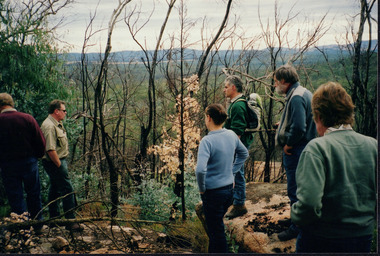
... ...mt pilot...This photograph is significant as an example of events used by the Wooragee Landcare Group to inform the public on local environmental issues, and for its link to the hunt for the spotted-tailed quoll. quoll South East Forest Spotted-tailed Quoll Working Group spotted-tailed quoll tiger mt pilot Andrew Murray quolls Andy Murray quolls Andrew Murray Mount Pilot Chiltern National Park foxes endangered quoll queries about quolls quoll species Wooragee Wooragee Landcare Wooragee Landcare Group Jerry Alexander Geoff Galbraith Mary prowse bushfire chiltern Reverse (partial) WANLandscape colour photgraph printed on gloss paper. ... This photograph was taken in April 2004, on the field day in Mount Pilot-Chiltern National Park as part of a workshop on quolls, led by Andrew Murray, then president of the South East Forests Spot-Tailed Quoll Working Group. IThis event was prompted by a desire to find out if quolls still lived in Mount Pilot-Chiltern National Park, as there had been no confirmed sightings since the 2003 bushfires. Andy Murray helped lead the efforts to find them. Currently, landcare group efforts have found evidence of a small but present spot-tailed quoll population in the park. Reasons for the decrease in population include fox populations in the area and destruction of habitat. Pictured, L-R: unknown, Andy Murray, unknown, Jerry Alexander, Geoff Galbraith, Mary Prowse The spotted-tailed quoll, also called the Tiger Quoll, is an endangered Australian animal. It is the largest carnivorous mammal in Australia, and is native to Victoria, New South Wales, Queensland, and Tasmania. Slightly larger than a cat, the animals fur is normally brown, with black marking and white spots. Currently, there are approximately 14,000 spotted-tailed quolls in the wild.This photograph is significant as an example of events used by the Wooragee Landcare Group to inform the public on local environmental issues, and for its link to the hunt for the spotted-tailed quoll.Landscape colour photgraph printed on gloss paper. Reverse (partial) WAN quoll, south east forest spotted-tailed quoll working group, spotted-tailed quoll, tiger, mt pilot, andrew murray quolls, andy murray quolls, andrew murray, mount pilot chiltern national park, foxes, endangered quoll, queries about quolls, quoll species, wooragee, wooragee landcare, wooragee landcare group, jerry alexander, geoff galbraith, mary prowse, bushfire, chiltern -
 Wooragee Landcare Group
Photograph, 28th April 2004
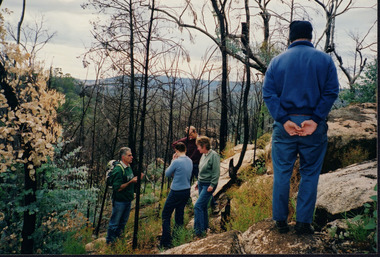
... This photograph was taken at Wooragee Hall on Wednesday the 28th of April 2004 called 'Queries about Quolls' and shows a Quoll Presentation by Andrew Murray at Mt Pilot, Chiltern Mt Pilot National Park. The photograph shows (L - R) Jerry Alexander, Unknown, Unknown, Mary Prowse, Tony Prowse. ...This photograph was taken at Wooragee Hall on Wednesday the 28th of April 2004 called 'Queries about Quolls' and shows a Quoll Presentation by Andrew Murray at Mt Pilot, Chiltern Mt Pilot National Park. The photograph shows (L - R) Jerry Alexander, Unknown, Unknown, Mary Prowse, Tony Prowse. ...This photograph was taken at Wooragee Hall on Wednesday the 28th of April 2004 called 'Queries about Quolls' and shows a Quoll Presentation by Andrew Murray at Mt Pilot, Chiltern Mt Pilot National Park. The photograph shows (L - R) Jerry Alexander, Unknown, Unknown, Mary Prowse, Tony Prowse. The event was hosted by the Wooragee Landcare Group and was led by Andrew Murray (of Parks Victoria), President of the South-East Forest Spotted-tailed Quoll Working Group and one of Victoria's leading authorities in quolls. As the name of the event would suggest, this session provided attendees with insight and general information on quolls, including the characteristics of quolls, the habitat of quolls and the techniques that can be used when searching for quolls which was part of a wider project aimed at protecting the endangered species of the tiger quoll, also known as the spotted-tailed quoll, an animal that once inhabited Mount Pilot-Chiltern National Park. This particular photo shows a group of attendees looking at a typical quoll nesting site in a rock crevice. According to an article included in the Wooragee Landcare group coordinators annual report 2004 and 2005 album (record 00001), Andrew Murray had been tasked to train a team of Department of Sustainability and Environment staff and volunteers from the local area (Beechworth and Wooragee) in the detection skills needed to establish whether the tiger quoll still inhabited the Mount Pilot-Chiltern National Park and had survived after a bush fire in 2003 had burned through the area where they would normally have been found. The Tiger Quoll is the largest of the quoll species. Largely resembling a cross between a possum and a cat, the quoll is distinctive due to the white spots that are often found all over its brown fur.This photograph is significant as it provides evidence of a project undertaken by the Wooragee Landcare Group to educate themselves and members of the public on the tiger quoll in the early 2000s in an attempt to better understand and protect the species. The Wooragee Landcare Group has been instrumental in the co-ordination of programs relating to biodiversity protection in the local area, providing great assistance to landholders.Landscape coloured photograph printed on gloss paperReverse: WAN NA 0ANA2N0 AN2 0 1636 / [PRINTED] (No.4) / 918wooragee, wooragee hall, wooragee landcare, wooragee landcare group, quoll, spotted-tailed quoll, tiger quoll, queries about quolls, south east forest spotted-tailed quoll working group, andrew murray quolls, mount pilot chiltern national park, quoll species, endangered quoll, andrew murray, beechworth, landcare group, mount pilot -
 Wooragee Landcare Group
Photograph, circa April 2003
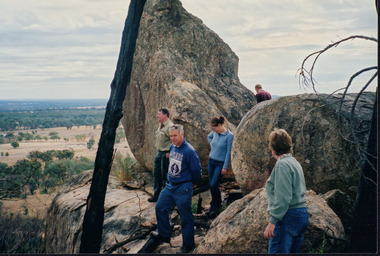
... It's most notable landmarks include Mt Pilot and Woolshed Falls. It also has many mines from the Gold Rush in the late 1800s. ...It's most notable landmarks include Mt Pilot and Woolshed Falls. It also has many mines from the Gold Rush in the late 1800s. ...This photograph was taken in the Mount Pilot Chiltern National Park. It was taken during a search for the tiger quoll conducted by a team of volunteers from the Wooragee Landcare Group. The tiger quoll is also known as the spotted-tail quoll and is found in the national park. The 2003 bushfires caused worry for the safety of the tiger quoll, hence the need for a search for it. Mount Pilot Chiltern National Park is located near Chiltern in Victoria. It's most notable landmarks include Mt Pilot and Woolshed Falls. It also has many mines from the Gold Rush in the late 1800s. It is home to much flora and fauna, including the tiger quoll. The park is also home to the box-ironbark forest that once was present in most of north-eastern Victoria. The park is a large tourist destination as in there are many bushwalks and other attractions for visitors. In 2003, bushfires raged through Mount Pilot National Park and destroyed much of the environment. Some of this damage can be seen in the burnt trees in the picture. This photograph represents the work that goes into protecting a important species like the tiger quoll and there has been much work done to preserve it. This photograph was taken when the Wooragee Landcare group went to ensure the survival of this species, highlighting how the tiger quoll is being protected. This photograph also demonstrates the significance of Mount Pilot Chiltern National Park. The park has many special flora and fauna that can only be found in this area. For example, the box-ironbark forest and the tiger quoll. The forest used to stretch over much of north-eastern Victoria and is therefore reminiscent of what that area of Victoria was once like. This park is historical for this reason but it is also historical through it being once goldfields from the Gold Rush in the 1800s.Landscape coloured photograph printed on gloss paperReverse: WAN NA 0ANA2N0 NNN- 1 1636 / [PRINTED] (No.8) / 922mount pilot, mount pilot chiltern national park, chiltern, victoria, landmark, woolshed falls, gold rush, tiger quoll, flora, fauna, spotted tail quoll, marsupial, andy murray, andy murray quolls, carnivorous marsupial, forests, rainforests, coastal heathlands, woodlands, photograph, species, wooragee, wooragee landcare group, wooragee landcare, bushfires, identification, search, dna, droppings, box ironbark forest, ironbark, box iron bark -
 Department of Energy, Environment and Climate Action
Branding Hammer issued to FCV overseer Jim Browning at Beechworth
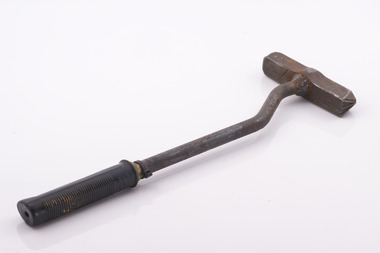
... Russel Pritchard from the Beechworth Depot replaced the handle with a new metal one and put a dog leg in it It mainly branded forest produce cut in Mt. Pilot and Reedy Creek areas. The main logging contractors were Gordon Habeck from Chiltern and Steven Goldsworthy from Beechworth...Russel Pritchard from the Beechworth Depot replaced the handle with a new metal one and put a dog leg in it It mainly branded forest produce cut in Mt. Pilot and Reedy Creek areas. The main logging contractors were Gordon Habeck from Chiltern and Steven Goldsworthy from Beechworth Branding Hammer issued to FCV overseer Jim Browning at Beechworth. ...Metal branding hammers were the most common way to control the sale and movement of hardwood timber produce like logs, railway sleepers, fence posts, and poles from Victorian State forests. Royalty was also paid on this basis. The hammer has a crown stamp on one end with a unique number in the middle (453) which identified its owner, and a crows foot or broad arrow on the other. The broad arrow was a symbol traditionally used in Britain and its colonies to mark government property. Forest regulations state that an authorised officer may use the crown mark to identify produce which has been sold and may be removed from the forest, whereas the broad arrow can be used to brand and mark trees which are not to be felled, or to indicate forest produce which has been seized. Hammers were traditionally only ever issued to forest officers and were an important, and closely guarded tool-of-trade. They were not transferred between staff and lending hammers was not permitted. But it was an onerous task for staff to hammer and tally hundreds of logs, or thousands of fence posts each week, so in about 1990 a system was introduced whereby hammers were allocated to logging contractors to grade logs and tally them instead. But there was still spot checking by authorised officers. A register was kept, and contractors paid a substantial deposit to make sure they didn't lose them, but they occasionally turn up by fossickers with metal detectors. While branding hammers are still used in some smaller locations, plastic tags and barcodes are now more common.Metal log branding hammer with a crown stamp on one end with a unique number (453) in the middle which identified its owner, and a crows foot or broad arrow on the other. The unusual bent metal handle was designed to protect user from banging their fingers on the log. It was also fitted with a rubber hand grip. Most FCV branding hammers were issued with wooden handles. The branding hammer 453 was initially issued to Wally Cowell at Beechworth. It was reissued to Jim Browning upon Wally’s retirement The hammer still had a wooden handle, but the it broke and became loose inside hammer head. Russel Pritchard from the Beechworth Depot replaced the handle with a new metal one and put a dog leg in it It mainly branded forest produce cut in Mt. Pilot and Reedy Creek areas. The main logging contractors were Gordon Habeck from Chiltern and Steven Goldsworthy from BeechworthCrown mark one end (453) and Crows foot other endforest harvesting, forests commission victoria (fcv) -
 Wooragee Landcare Group
Photograph, circa April 2003
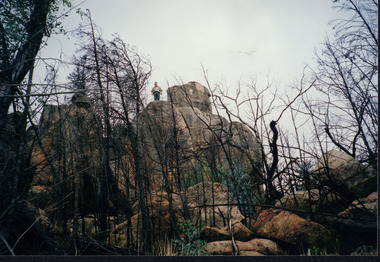
... It's most notable landmarks include Mt Pilot and Woolshed Falls. It also has many mines from the Gold Rush in the late 1800s. ...It's most notable landmarks include Mt Pilot and Woolshed Falls. It also has many mines from the Gold Rush in the late 1800s. ...This photograph was taken in the Mount Pilot Chiltern National Park. This park is located near Chiltern in Victoria. It's most notable landmarks include Mt Pilot and Woolshed Falls. It also has many mines from the Gold Rush in the late 1800s. It is home to much flora and fauna, including the tiger quoll. The tiger quoll, also known as the spotted-tail quoll, is a marsupial that gives in the Mount Pilot Chiltern National Park. It is also main land Australia's largest carnivorous marsupial. It can weigh up too four kilograms and looks similar to either a possum or a spotted cat. It has red and brown fur with distinct spots. The tiger quoll is found along the Great Dividing Range, which includes Victoria, New South Wales and also near the border of Queensland. It lives in forests, rainforests and coastal heathlands and woodlands. In 2004 a team of volunteers from the Wooragee Landcare group as well as some of the Department of Sustainability and Environment staff set out to find the tiger quoll following the 2003 bushfires. Since the bushfires, concern had arisen for it because it hadn't been seen since the bushfires. They attempted to find traces of the quoll through finding and identifying their droppings as well as DNA testing. This photograph was taken during this search. This photograph represents the work that goes into protecting a important species like the tiger quoll. The tiger quoll is a significant species because it is main land Australia's largest carnivorous marsupial. As a result of this, there has been much work done to preserve and protect it. This photograph was taken when the Wooragee Landcare group went to ensure the survival of this species, highlighting how the tiger quoll is being protected. This photograph also demonstrates the impacts of the 2003 bushfires in the Mount Pilot Chiltern National Park. This is seen through the burnt trees featured in the picture. Landscape coloured photograph printed on gloss paperReverse: WAN NA 0ANA0N0 NNN 0 1636 / [PRINTED] (No.7) / 921quoll, mount pilot chiltern national park, national park, 2003 bushfires, search, endangered, beechworth, wooragee landcare group, wooragee landcare, wooragee, possum, australia, victoria, department of sustainability and environment, photograph, 2004, spotted-tailed quoll, great dividing range, spots, fur, forests, rainforests, woodlands, coastal heathlands, spotted quoll, spotted quoll habitat -
 Victorian Aboriginal Corporation for Languages
Book, Aldo Massola, Journey to Aboriginal Victoria, 1969
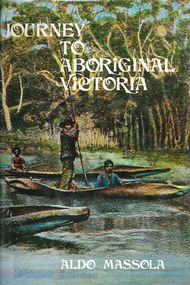
... intertribal fights, articles traded; painted shelters; Koetong Ck. Valley, near Mt. Pilot &? near Barwidgee Ck.; Chap.19; Dandenong - water holes, list of 8 holes in Beaumaris - Black Rock area; camps, middens, stone implements (microliths), legend of Angels Cave, stone axes, Native Police Force, Narre Narre Warren Station, legend about rocks on Bald Hill, kangaroo totemic site; Chap.20; Wonthaggi- Yarram - natives visit Phillip Is., murder of William Cook and Yankee by five Tasmanians (listed as Bon Small Boy, Jack Napoleon Timninaparewa, Fanny Waterpoordeyer, Matilda Nattopolenimma and Truganini) near Cape Patterson, men; camp sites, middens, legend of White Rock; Chap.21; Sale - Bairnsdale, The Lakes Country middens, camps; legend at Wulrunjeri; story of a white woman supposedly living with with the Tutangolung tribe, efforts made to prove story; canoe trees; Chap.22; Sale-Bairnsdale, The Inland Braiakolung tribe, camps, implements, canoe &? ...intertribal fights, articles traded; painted shelters; Koetong Ck. Valley, near Mt. Pilot &? near Barwidgee Ck.; Chap.19; Dandenong - water holes, list of 8 holes in Beaumaris - Black Rock area; camps, middens, stone implements (microliths), legend of Angels Cave, stone axes, Native Police Force, Narre Narre Warren Station, legend about rocks on Bald Hill, kangaroo totemic site; Chap.20; Wonthaggi- Yarram - natives visit Phillip Is., murder of William Cook and Yankee by five Tasmanians (listed as Bon Small Boy, Jack Napoleon Timninaparewa, Fanny Waterpoordeyer, Matilda Nattopolenimma and Truganini) near Cape Patterson, men; camp sites, middens, legend of White Rock; Chap.21; Sale - Bairnsdale, The Lakes Country middens, camps; legend at Wulrunjeri; story of a white woman supposedly living with with the Tutangolung tribe, efforts made to prove story; canoe trees; Chap.22; Sale-Bairnsdale, The Inland Braiakolung tribe, camps, implements, canoe &? ...Looks at the Aboriginal community from the time of white contact, across many parts of Victoria. Chap.1; Melbourne - early missions, camp of Native Police, corroboree trees, canoe trees, grave &? headstone of Derrimut; quarries at Keilor, excavation sites at Green Gully &? Keilor; quarry at Mt. William, notes on inheritance of quarries Coranderrk settlement - Barraks grave, notes on his life; Chap.2; Geelong - Yawangi group of the Wothowurong tribe, camping grounds in area quarries; Notes on William Buckley, Gellibrand (a notable Aboriginal), graves in the Western Cemetery; Chap.3; Colac - war between Colac &? Geelong tribes; Mission at Birregurra, reason for failure of Buntingdale Mission; brass plate to Coc-coc-coine; reserve at Elliminyt, native ovens, camp sites, initiation site &? ritual; quarry sites, axegrinding factory, rock pecking &? engraving; dried hand &? 3 Aboriginal skulls found; Chap.4; The south-west coast - middens, camp sites notes on Framlingham Stn., fish traps at Tyrendarra; Chap.5; The far west - massacres of Aborigines near Casterton; camp sites, oven mounds; the first cricket team formed; Aboriginal cemetery; Chap.6; Hamilton - camps; Mount Rouse Station, axegrinding grooves at Nareeb Nareeb, shelters described, fish traps, massacre at Lake Condah; mission; canoes; Chap.7; Camperdown - legend about Lake Bullen Merri; obelisk erected in memory of Aborigines of district especially chief Wombeetch Puyuun; Jarcoort tribe; fish weirs, camps, intertribal fights between Booluc-burrers, Jarcoorts &? Ellengermote groups; bartering place at Mount Noorat; articles traded, legend of Flat-Top Hill; Chap.8; Ballarat - camp at Lake Wendouree; White Stone Lagoon; legends concerning Mt. Buninyong &? waterfalls at Lal-lal; camp sites; pygmy-type implements near Meredith, quarry at Glue Pot Rocks near Durdidwarrah; brass plate of King Billy; Chap.9; Ararat - Tjapwurong territory; camp sites, quarries, shield &? canoe trees; Bunyip belief at Lake Buninjon of Muk-jarawaint &? Pirtkopen-noot tribes, gives legend; stone implements; mill stones; fish weirs; stone arrangement near Lake Wongan; ground drawing of a bunyip, paintings in rock shelter near Mt. Langi Ghiran; Chap.10; Maryborough - camps, oven mounds, rock wells, stone arrangement at Carisbrook; camp sites at Mt. Franklin; Chap.11; Charlton - belief in Mindye (snake); canoe trees, ovens, camp sites, water holes, rock wells, stone implements; method of rainmaking; Chap.12; Horsham-Stawell, The Wimmera - Wotjobaluk land; camps, fish traps at Toolondo; Black Range cave paintings, Flat Rock shelters (detailed account of these paintings); Bunjils Cave; Chap.13; Horsham-Stawell, The Mallee - camp sites, implements; Ebenezer Mission, Willie Wimmera taken to England by Rev. Chase to become a missionary, died in England; Chap.14; The Murray River, Mildura Swan Hill - Battle of the Rufus; ceremonial ground, Lake Gol Gol, canoe &? shield trees; stone implements; camp sites, fire place arrangements; fish traps; oven mounds; Chap.15; The Murray River, Swan Hill-Echuca - legend about Lake Boga; camps, oven mounds, the Cohuna skull, Kow Swamp, method of burial; Chap.16; Shepparton ovens; brass plates of King Paddy of Kotupna &? King Tattambo of Mulka Stn., native well, camps; Chap.17; Wangaratta -camps, quarry, rock holes, the Faithful massacre; grinding rocks at Earlston; Chap.18; The High Plains - Ya-itma-thang; camps, Bogong moth feasts, native paths for trade &? intertribal fights, articles traded; painted shelters; Koetong Ck. Valley, near Mt. Pilot &? near Barwidgee Ck.; Chap.19; Dandenong - water holes, list of 8 holes in Beaumaris - Black Rock area; camps, middens, stone implements (microliths), legend of Angels Cave, stone axes, Native Police Force, Narre Narre Warren Station, legend about rocks on Bald Hill, kangaroo totemic site; Chap.20; Wonthaggi- Yarram - natives visit Phillip Is., murder of William Cook and Yankee by five Tasmanians (listed as Bon Small Boy, Jack Napoleon Timninaparewa, Fanny Waterpoordeyer, Matilda Nattopolenimma and Truganini) near Cape Patterson, men; camp sites, middens, legend of White Rock; Chap.21; Sale - Bairnsdale, The Lakes Country middens, camps; legend at Wulrunjeri; story of a white woman supposedly living with with the Tutangolung tribe, efforts made to prove story; canoe trees; Chap.22; Sale-Bairnsdale, The Inland Braiakolung tribe, camps, implements, canoe &? shield trees; Ramahyuck Mission, grinding rocks, fights with Omeo tribe; native tracks, death through enemy magic - procedure, belief in ghosts; Chap.23; Lakes Entrance and the Country to the east - Kroatungolung people, legend of Kalimna Valley; camps, stones of Nargun, bunyip, devils at Lake Tyers, excavation at Buchan, carbon dates; middens, ochre at Cape Conrad, stone fish-hook file at Thurra River; note on Bidwel tribe; Each chapter gives historical details, early contacts, relationships with settlers; Aboriginal place names and detailed description of sites and geographical features.b&w photographs, b&w illustrations, colour illustrationsgeelong, colac, hamilton, camperdown, ballarat, ararat, maryborough, charlton, horsham, stawell, murray river, shepparton, wangaratta, dandenong, wonthaggi, yarram, sale, bairnsdale, lakes entrance -
 Federation University Historical Collection
Book - Book - Scrapbook, Ballarat College of Advanced Education: Scrapbook of newspaper cutting, Book 5; March 1979 to August 1979
... mt stromlo observatory...energy seminar...minister for minerals and energy...teacher union may put ban on bcae...bcae director replies...bcae indoor sports facilities popular...chemical institute branch formed...great hall takes shape...educationalists in ballarat...another degree for frank hurley...dr mosley on barrier reef...posters depict conservation...bcae gets gift of logo...bcae's first annual council meeting...pilot...The cuttings cover the period from 21 March 1979 to 4 August 1979. . employment advertisements application for enrolment outline of courses scholarships for bcae students western mining corporation gunther jahnks stephen fernee jim stringer robert withers former student earthquakes new men at bcae geoff westcott garry kinnane jeffrey leeuwenberg study of muscle power dr alan roberts mark heuston new at bcae cao duc thac - school of business bruce cossins - civil engineering val lloyd - librarianship department prof hilda elkins - librarianship department for 6 months community support vital to colleges inquiry committee in ballarat growing concern for sports injuries shortage of qualified metallurgists 400 graduate graeme jeffries engineering accountancy prize to belinda tantau john wach appointed to mt stromlo observatory energy seminar minister for minerals and energy teacher union may put ban on bcae bcae director replies bcae indoor sports facilities popular chemical institute branch formed great hall takes shape educationalists in ballarat another degree for frank hurley dr mosley on barrier reef posters depict conservation bcae gets gift of logo bcae's first annual council meeting pilot fatigue significant factor management training - business survey better decision makers industrial safety engineering heritage display why people take risks vtu boycott suspended prof david klein u.s.a. prof praises bcae course swimming instructors 2-day course david jelbart retires gunther jahnke wins arblaster award bcae library expands regional colleges Book with grey cover, front. ...Newspaper cuttings relating to Ballarat College of Advanced Education. These are from various newspapers and include The Age, Ballarat Courier, The Australian, The Herald. The cuttings cover the period from 21 March 1979 to 4 August 1979. . Book with grey cover, front. Spiral bound.employment advertisements, application for enrolment, outline of courses, scholarships for bcae students, western mining corporation, gunther jahnks, stephen fernee, jim stringer, robert withers former student, earthquakes, new men at bcae, geoff westcott, garry kinnane, jeffrey leeuwenberg, study of muscle power, dr alan roberts, mark heuston, new at bcae, cao duc thac - school of business, bruce cossins - civil engineering, val lloyd - librarianship department, prof hilda elkins - librarianship department for 6 months, community support vital to colleges, inquiry committee in ballarat, growing concern for sports injuries, shortage of qualified metallurgists, 400 graduate, graeme jeffries engineering, accountancy prize to belinda tantau, john wach appointed to mt stromlo observatory, energy seminar, minister for minerals and energy, teacher union may put ban on bcae, bcae director replies, bcae indoor sports facilities popular, chemical institute branch formed, great hall takes shape, educationalists in ballarat, another degree for frank hurley, dr mosley on barrier reef, posters depict conservation, bcae gets gift of logo, bcae's first annual council meeting, pilot fatigue significant factor, management training - business survey, better decision makers, industrial safety, engineering heritage display, why people take risks, vtu boycott suspended, prof david klein u.s.a., prof praises bcae course, swimming instructors 2-day course, david jelbart retires, gunther jahnke wins arblaster award, bcae library expands, regional colleges -
 Bendigo Military Museum
Award - MEDAL DFC, C.1944 - 46
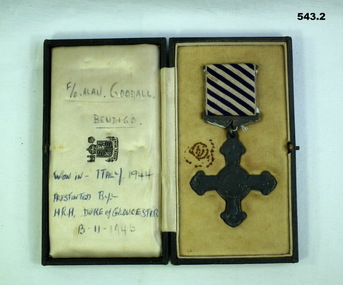
... On 21.12.1943 on a non operational flight from Africa to Italy his flight crashed into Mt Etna, they were coming out of a cloud when the Pilot saw Etna. Allan as least injured made sure his mates were okay and sheltered he walked down to a nearby village (Maletto) to get help. ...On 21.12.1943 on a non operational flight from Africa to Italy his flight crashed into Mt Etna, they were coming out of a cloud when the Pilot saw Etna. Allan as least injured made sure his mates were okay and sheltered he walked down to a nearby village (Maletto) to get help. ...Allan Frederick GOODALL DFC. (Born Ringwood, enlisted Melbourne) in the RAAF on 10.10.1941 No 409828 age 18 years. He was mustered as Aircrew on elisted and was designated as WO/AG ( Wireless operator Air Gunner) on 23.7.1942. he rose through the ranks from AC2, LAC, Sgt, F/Sgt, W/O, F/O to Flt/Lt on 1.3.1945. Embarked for England on 24.8.1942 and posted to RAF Station Bournemouth on 18 .11.1942, posted to MEC (Middle East Command) with 150 Sqd RAF flying Wellingtons from North Africa. On 21.12.1943 on a non operational flight from Africa to Italy his flight crashed into Mt Etna, they were coming out of a cloud when the Pilot saw Etna. Allan as least injured made sure his mates were okay and sheltered he walked down to a nearby village (Maletto) to get help. Allan spent from 21.12.1943 to 5.1.1944 in hospital with Abrasions. He was awarded the DFC (Distinguished Flying Cross) in 1944 for operations over Italy, at the time he was classed as Sqd Signals Leader. According to his records he flew 37 Operational sorties. He was discharged from the RAAF on 3.1.1946. The crew of the Plane were; Bruce Hayman (NZ) Pilot, Fractured leg. Allan Goodall Aust (WOP/AG) abrasions and injured wrist. Alan Warner (Aust) Navigator, Fractured Ankle. Y.F.Redknap (UK) injured shoulder. C.A. Carr (UK) Fractured Dorsal Spine. J.E. Ward (UK) Dislocated shoulder. Alfred Dugdale (UK) Deceased. Tony Moore (UK) Deceased. Both are buried at the Catania War Cemetery Sicily. Refer Cat No 1025P for his photo.543.1 Medal-Distinguished FLying Cross won by FO Alan F Goodall. Rear of medal is engraved "Italy FO Alan Goodall 1944" 543.2 Case-to suit DFC above. Case rear has a note "Alan's sister Jean, Mrs R.T Mitchell, 22 O'Dea Cres Kangaroo Flat 3555 471428." Written inside case in pen "F/O Alan Goodall Bendigo Won in Italy 1944 Presented by HRH Duke of Gloucester 13-11-1946"awards, dfc ww2, raaf -
 Bendigo Military Museum
Award - MEDALS RAAF, Post 1945
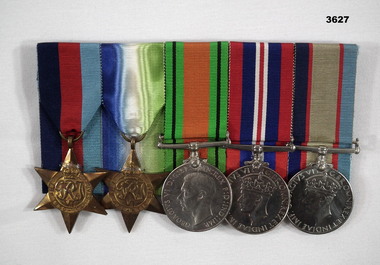
... Mt Gambier, Pt Cook, Camp Miles Standish USA. Finally he is stationed in England at Pembroke with 461 Sqd RAAF with the rank of Sgt on 10.10.1943. This was a Sunderland Sqd which was a large long range patrol Flying Boat. The unit was mainly Australians from many nations. He rises through the ranks to T/F/Sgt, Officer, Pilot...Mt Gambier, Pt Cook, Camp Miles Standish USA. Finally he is stationed in England at Pembroke with 461 Sqd RAAF with the rank of Sgt on 10.10.1943. This was a Sunderland Sqd which was a large long range patrol Flying Boat. The unit was mainly Australians from many nations. He rises through the ranks to T/F/Sgt, Officer, Pilot ...Reginald Charles ALLARDICE enlisted first in the CMF on 10.8.1940 age 21 years Regt No V40236. During this time he applied to join the RAAF so was discharged from the Army on 21.5.1942 as a Pte in the 24/39th Bn. Two days later he is in the RAAF as a Trainee Aircrew WEF No 418577. On 31.12.1942 he is listed as a LAC (Leading Aircraftsman. Ongoing training sees him at Benalla, Mallala in SA, Mt Gambier, Pt Cook, Camp Miles Standish USA. Finally he is stationed in England at Pembroke with 461 Sqd RAAF with the rank of Sgt on 10.10.1943. This was a Sunderland Sqd which was a large long range patrol Flying Boat. The unit was mainly Australians from many nations. He rises through the ranks to T/F/Sgt, Officer, Pilot Officer, Flying Officer and last Flight Lieutenant on 10.3.1945. He is discharged from the RAAF on 7.12.1945 at RAF Station Beecles Suffolk England. 461 Sqd was a Coastal Command unit mostly involved in submarine detection and hunting in the Atlantic and Bay of Biscay. They were involved in the D Day landings. The Sqd lost 20 aircraft to enemy action and accidents. A total of 86 Sqd members were lost of which 64 were Australian.Medals, individual with ribbons re R.C.Allardice. (1) 1939 - 45 Star, original not engraved. (2) Atlantic Star, original not engraved. (3) Defence Medal. (4) British War Medal 1939 - 45. (5) Australian Service Medal 1939 - 45. (.3, .4, .5) “418577 R.C.ALLARDICE”medals, campaign, service, world war2 -
 Bendigo Military Museum
Memorabilia - PHOTOGRAPH & SOUVENIR, C.1943 - 45
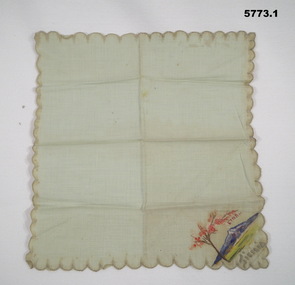
... (W/Op 2nd), F/Lt Doug Egan (Pilot), F/O Peter Ellis (Navigator), F/O Allan Goodall (1st W/Op)" .1) B & W photo of a Wellington Bomber in the rear with six Aircrew in Flying gear standing in front. Inscription on rear in faint black pen. .2) Handkerchief with hand painted scene of Mt ...Item re Allan Frederick Goodall DFC, RAAF, refer Cat No 543.2 for his service details. These items were in a wallet, refer Cat No 5772 for the story and connection. This would be a multi Commonwealth Aircrew. Crew members were L to R, Bill Jones, Tony White, Nobby Norris, Doug Eden, Peter Ellis, Alan Goodall..1) B & W photo of a Wellington Bomber in the rear with six Aircrew in Flying gear standing in front. Inscription on rear in faint black pen. .2) Handkerchief with hand painted scene of Mt Etna in Sicily.On Rear , "left to right, F/Sgt Bill Jones (Gunner), F/Sgt Tony White (Bomb aimer), F/Sgt Nobby Norris ? (W/Op 2nd), F/Lt Doug Egan (Pilot), F/O Peter Ellis (Navigator), F/O Allan Goodall (1st W/Op)"photographs, souvenirs, memorabilia, dfc -
 Bendigo Historical Society Inc.
Photograph - BASIL WATSON COLLECTION: 50TH ANNIVERSARY OF MT GAMBIER-MELBOUNRE FLIGHT (CHEROKEE AIRCRAFT AT ESSENDON AIRPORT), 1967
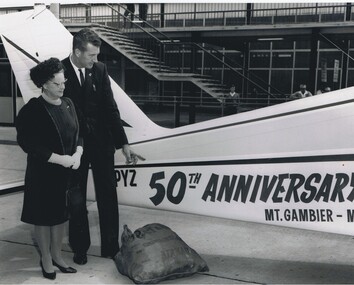
... 50th Anniversary of Mt Gambier-Melbourne flight, Feb. 1917 (Cherokee aircraft at Essendon Airport), Re-enactment of flight by pilot John Hardingham. ...PERSON Individual basil watson 50th Anniversary of Mt Gambier-Melbourne flight, Feb. 1917 (Cherokee aircraft at Essendon Airport), Re-enactment of flight by pilot John Hardingham. ...50th Anniversary of Mt Gambier-Melbourne flight, Feb. 1917 (Cherokee aircraft at Essendon Airport), Re-enactment of flight by pilot John Hardingham. A. Cherokee aircraft on tarmac, on back b. Cherokee aircraft with Mrs V I Perkin (Basil's sister), Mr Luscombe (PMG Department) and a mailbag sitting on tarmac. Handwritten ID on backs plus PMG stamp with negative ID number, V1867/2person, individual, basil watson -
 Uniting Church Archives - Synod of Victoria
Photograph, C. 1950s
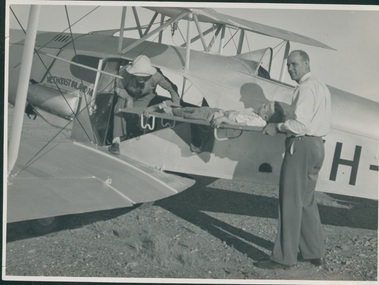
... In addition to the pilot there is room for three passengers, and a stretcher is installed whereby urgent cases of sickness or accident can be flown to the nearest hospital. In this machine, Mr Lanham proposes to cover the whole of S. W. Queensland and a portion of the Northern Territory from his headquarters at Mt...In addition to the pilot there is room for three passengers, and a stretcher is installed whereby urgent cases of sickness or accident can be flown to the nearest hospital. In this machine, Mr Lanham proposes to cover the whole of S. W. Queensland and a portion of the Northern Territory from his headquarters at Mt ...Extract from The Spectator of June 12, 1946: "From the Queensland 'Methodist Times'. Dreams do come true. At any rate, that is what the Rev. Cliff Lanham believes, who after the lapse of several years finds that his early dream of a Flying Patrol for the Inland is now an actuality. The Methodist Inland Mission Board has purchased from the Disposals Commission of the R.A.A.F. a De Haviland Fox Moth Biplane. Indeed, two machines have been bought, but one will be broken up for spare parts. This 'new angel of the air' is fitted with a 130 h.p. engine and possesses a cruising speed of 100 miles per hour. The petrol consumption is only that of a big six-cylinder car—18 miles per gallon. In addition to the pilot there is room for three passengers, and a stretcher is installed whereby urgent cases of sickness or accident can be flown to the nearest hospital. In this machine, Mr Lanham proposes to cover the whole of S. W. Queensland and a portion of the Northern Territory from his headquarters at Mt Isa. It takes little imagination to realise what a boon the 'flying parson' will be to those of the great outback." …. "Before [Mr Lanham] inaugurated the scheme [the idea of a flying parson] he spent his first furlough from inland mission work (and incidentally £60) learning to fly. 'In a month,' he says whimsically, 'I was a pilot of sorts.' Mr Lanham is a son of the Church. His parents were staunch Methodists, and their home offered generous hospitality to mininsters and preachers. His brother, the Rev. Percy Lanham, M.A., died in Libya when on active service as a chaplain. His widowed mother must be proud of her tall, stalwart son, whom the Church now sends forth on his flying mission for the Lord. May he ever be wafted through inland skies on two wings and a prayer." It is of interest to note that although Cliff Lanham's brother, Percy, is listed in the Methodist Church of Australasia's Ministerial Index (9th Edition, Revised to 1961) Cliff Lanham himself is not listed as either active or deceased.Three B&W identical photographs of Lanham standing next to a Methodist Inland Mission bi-plane. Lanham and an unidentified man are holding a stretcher between them with a boy of about 10-11 on it. They seem to be exiting the plane. The original photograph F69-1 is a 110x65 mm Kodak print; the other two are 195x145 mm enlargements. Lanham is wearing a white shirt and grey trousers, the other person is wearing a safari helmet.All three photos identify "Rev. Cliff Lanham" on the back. They seem to have been originally used or intended for use by The Spectator.lanham, cliff, queensland, methodist inland mission, flying parson -
 Mt Dandenong & District Historical Society Inc.
Photograph, Plaque on Kyeema Cairn, 1988
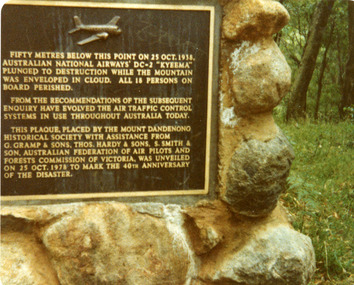
... Mt Dandenong. The text reads: FIFTY METRES BELOW THIS POINT ON 25 OCT. 1938, AUSTRALIAN NATIONAL AIRWAYS' DC-2 'KYEEMA' PLUNGED TO DESTRUCTION WHILE THE MOUNTAIN WAS ENVELOPED IN CLOUD. ALL 18 PERSONS ON BOARD PERISHED. FROM THE RECOMMENDATIONS OF THE SUBSEQUENT ENQUIRY HAVE EVOLVED THE AIR TRAFFIC CONTROL SYSTEMS IN USE THROUGHOUT AUSTRALIA TODAY. THIS PLAQUE, PLACED BY THE MOUNT DANDENONG HISTORICAL SOCIETY, WITH ASSISTANCE FROM G. GRAMP & SONS, THOS. HARDY & SONS, S. SMITH & SON, AUSTRALIAN FEDERATION OF AIR PILOTS...Mt Dandenong. The text reads: FIFTY METRES BELOW THIS POINT ON 25 OCT. 1938, AUSTRALIAN NATIONAL AIRWAYS' DC-2 'KYEEMA' PLUNGED TO DESTRUCTION WHILE THE MOUNTAIN WAS ENVELOPED IN CLOUD. ALL 18 PERSONS ON BOARD PERISHED. FROM THE RECOMMENDATIONS OF THE SUBSEQUENT ENQUIRY HAVE EVOLVED THE AIR TRAFFIC CONTROL SYSTEMS IN USE THROUGHOUT AUSTRALIA TODAY. THIS PLAQUE, PLACED BY THE MOUNT DANDENONG HISTORICAL SOCIETY, WITH ASSISTANCE FROM G. GRAMP & SONS, THOS. HARDY & SONS, S. SMITH & SON, AUSTRALIAN FEDERATION OF AIR PILOTS ...Close up photograph of the plaque on the Kyeema cairn at Mt Dandenong. The text reads: FIFTY METRES BELOW THIS POINT ON 25 OCT. 1938, AUSTRALIAN NATIONAL AIRWAYS' DC-2 'KYEEMA' PLUNGED TO DESTRUCTION WHILE THE MOUNTAIN WAS ENVELOPED IN CLOUD. ALL 18 PERSONS ON BOARD PERISHED. FROM THE RECOMMENDATIONS OF THE SUBSEQUENT ENQUIRY HAVE EVOLVED THE AIR TRAFFIC CONTROL SYSTEMS IN USE THROUGHOUT AUSTRALIA TODAY. THIS PLAQUE, PLACED BY THE MOUNT DANDENONG HISTORICAL SOCIETY, WITH ASSISTANCE FROM G. GRAMP & SONS, THOS. HARDY & SONS, S. SMITH & SON, AUSTRALIAN FEDERATION OF AIR PILOTS AND FORESTS COMMISSION OF VICTORIA, WAS UNVEILED ON 25TH OCT. 1978 TO MARK THE 40TH ANNIVERSARY OF THE DISASTER.kyeema, cairn, plaque, mt dandenong, air crash -
 Mt Dandenong & District Historical Society Inc.
Photograph, Kyeema Cairn 2003, 2003
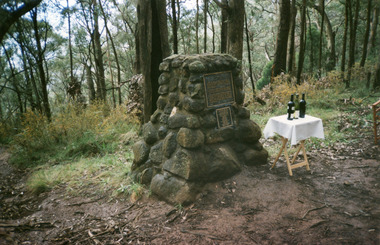
... Mt Dandenong & District Historical Society members observed a minute's silence and drank a toast of South Australian wine, produced by vineyards with which some of the victims were associated, in memory of all those who lost their lives. The plaque reads: KYEEMA VH-UYC CREW AND PASSENGERS CAPTAIN ALFRED WEBB JUNIOR CAPTAIN ALLAN STEEN AIR HOSTESS ALVA JONES CADET PILOT...Mt Dandenong & District Historical Society members observed a minute's silence and drank a toast of South Australian wine, produced by vineyards with which some of the victims were associated, in memory of all those who lost their lives. The plaque reads: KYEEMA VH-UYC CREW AND PASSENGERS CAPTAIN ALFRED WEBB JUNIOR CAPTAIN ALLAN STEEN AIR HOSTESS ALVA JONES CADET PILOT ...The cairn commemorating the Kyeema aircraft disaster with the addition of a smaller plaque listing the names of those who perished in the accident. This additional plaque was suggested by relatives of the victims who had attended earlier commemorations of the accident at the site. Mt Dandenong & District Historical Society members observed a minute's silence and drank a toast of South Australian wine, produced by vineyards with which some of the victims were associated, in memory of all those who lost their lives. The plaque reads: KYEEMA VH-UYC CREW AND PASSENGERS CAPTAIN ALFRED WEBB JUNIOR CAPTAIN ALLAN STEEN AIR HOSTESS ALVA JONES CADET PILOT PHILIP PRING LEONARD ABRAHAMS K.C. ALFRED GAIN HANS GLOE STELLA GLOE GORDON GODDARD HUGO GRAMP THOMAS HARDY CHARLES HAWKER M.H.R. GEORGE LING JAMES MASSIE VAUGHAN PATE ELIZABETH SCHRADER LANCELOT SHIRLEY SIDNEY HILL SMITHkyeema, air crash, mt dandenong, cairn, plaque, captain alfred webb, allan steen, elva jones, philip pring, leonard abrahams, alfred gain, hans gloe, stella gloe, gordon goddard, hugo gramp, thomas hardy, george ling, charles hawker, james massie, vaughan pate, elizabeth schrader, lancelot shirley, sidney hill smith -
 Mt Dandenong & District Historical Society Inc.
Photograph, Kyeema Crash Cairn, 1988
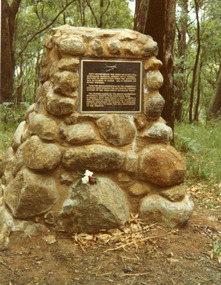
... Mt Dandenong on October 25th, 1938. Photograph taken in 1988. Text on plaque reads: FIFTY METRES BELOW THIS POINT ON 25 OCT. 1938, AUSTRALIAN NATIONAL AIRWAYS' DC-2 'KYEEMA' PLUNGED TO DESTRUCTION WHILE THE MOUNTAIN WAS ENVELOPED IN CLOUD. ALL 18 PERSONS ON BOARD PERISHED. FROM THE RECOMMENDATIONS OF THE SUBSEQUENT ENQUIRY HAVE EVOLVED THE AIR TRAFFIC CONTROL SYSTEMS IN USE THROUGHOUT AUSTRALIA TODAY. THIS PLAQUE, PLACED BY THE MOUNT DANDENONG HISTORICAL SOCIETY, WITH ASSISTANCE FROM G. GRAMP & SONS, THOS. HARDY & SONS, S. SMITH & SON, AUSTRALIAN FEDERATION OF AIR PILOTS...Mt Dandenong on October 25th, 1938. Photograph taken in 1988. Text on plaque reads: FIFTY METRES BELOW THIS POINT ON 25 OCT. 1938, AUSTRALIAN NATIONAL AIRWAYS' DC-2 'KYEEMA' PLUNGED TO DESTRUCTION WHILE THE MOUNTAIN WAS ENVELOPED IN CLOUD. ALL 18 PERSONS ON BOARD PERISHED. FROM THE RECOMMENDATIONS OF THE SUBSEQUENT ENQUIRY HAVE EVOLVED THE AIR TRAFFIC CONTROL SYSTEMS IN USE THROUGHOUT AUSTRALIA TODAY. THIS PLAQUE, PLACED BY THE MOUNT DANDENONG HISTORICAL SOCIETY, WITH ASSISTANCE FROM G. GRAMP & SONS, THOS. HARDY & SONS, S. SMITH & SON, AUSTRALIAN FEDERATION OF AIR PILOTS ...Cairn commemorating the crash of the aircraft Kyeema on the western slope of Mt Dandenong on October 25th, 1938. Photograph taken in 1988. Text on plaque reads: FIFTY METRES BELOW THIS POINT ON 25 OCT. 1938, AUSTRALIAN NATIONAL AIRWAYS' DC-2 'KYEEMA' PLUNGED TO DESTRUCTION WHILE THE MOUNTAIN WAS ENVELOPED IN CLOUD. ALL 18 PERSONS ON BOARD PERISHED. FROM THE RECOMMENDATIONS OF THE SUBSEQUENT ENQUIRY HAVE EVOLVED THE AIR TRAFFIC CONTROL SYSTEMS IN USE THROUGHOUT AUSTRALIA TODAY. THIS PLAQUE, PLACED BY THE MOUNT DANDENONG HISTORICAL SOCIETY, WITH ASSISTANCE FROM G. GRAMP & SONS, THOS. HARDY & SONS, S. SMITH & SON, AUSTRALIAN FEDERATION OF AIR PILOTS AND FORESTS COMMISSION OF VICTORIA, WAS UNVEILED ON 25TH OCT. 1978 TO MARK THE 40TH ANNIVERSARY OF THE DISASTER.kyeema, cairn, mt dandenong, air crash -
 Falls Creek Historical Society
Equipment - Tyrol Leather Ski Boots
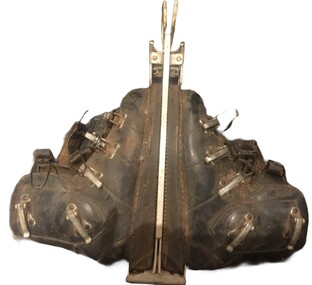
... pilot Hans Martin patented the ski boot buckle as shown on this pair of boots. The real revolution in boot design occurred in 1966, when the Canadian ski team were equipped with plastic boots for the Alpine World Championships. Since then manufacturers have competed to further refine designs to meet a range of needs from the weekend skier to elite athletes. These boots were donated by Mt...pilot Hans Martin patented the ski boot buckle as shown on this pair of boots. The real revolution in boot design occurred in 1966, when the Canadian ski team were equipped with plastic boots for the Alpine World Championships. Since then manufacturers have competed to further refine designs to meet a range of needs from the weekend skier to elite athletes. These boots were donated by Mt ...These boots show an early design of ski boots. The design of boots, materials and closures have changed dramatically as technology has evolved. Early ski boots were little more than lace-up work boots. in 1928, the Swiss ski racer Guido Reuge invented a cable binding designed to hold the heel down for alpine skiing. He named the binding after the Kandahar series of alpine ski races. After World War II, custom bootmakers developed the double boot, with a soft and comfy lace-up inner boot protected and stiffened by a thick bull-hide outer casing laced with heavy-duty corset hooks. A solution towards making boots stiffer and more durable arrived in 1954, when Swiss bike racer and stunt pilot Hans Martin patented the ski boot buckle as shown on this pair of boots. The real revolution in boot design occurred in 1966, when the Canadian ski team were equipped with plastic boots for the Alpine World Championships. Since then manufacturers have competed to further refine designs to meet a range of needs from the weekend skier to elite athletes. These boots were donated by Mt. Beauty Rotary Club President Bob Flower.These boots are significant because they demonstrate a stage in the evolving technology of designs for the ski sport industry.Black leather ski boots with five metal clips on each boot and black lining. A carry case is included. Tyrol is a family owned specialty outdoor store selling quality gear. It was started in 1965 by Jerry and Barb Schliep in Rochester, Minnesota, USA. In 2003 the store was purchased by their daughter and son-in-law, Kristin & Robb Welch.TYROL is imprinted on the carry case.ski equipment, ski boot design, vintage ski boots
