
Showing 9 items matching "narrative panels"
-
 Villa Alba Museum
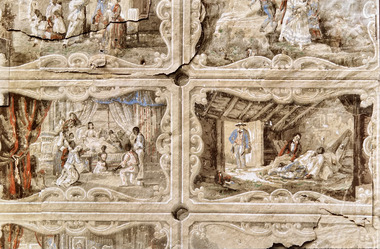
Wallpaper sample - Historical scene, c.1850
... ...Narrative panels...Heritage interiors Wallpapers 19th century interior design Narrative panels Uncle Tom's Cabin Uncle Tom's Cabin wallpaper (Black Rock House) reconstructed from fragments by PCM Wallpaper sample - Historical scene ...Part of a collection of historic wallpapers collected by Phyllis Murphy, most of whose wallpapers were donated to the collection of Historic Houses Sydney. This wallpaper sample, annotated and encased in mylar was used by Phyllis for educational purposes, and donated by her son to Villa Alba Museum's collection in 2025.Uncle Tom's Cabin wallpaper (Black Rock House) reconstructed from fragments by PCMheritage interiors, wallpapers, 19th century interior design, narrative panels, uncle tom's cabin -
 Villa Alba Museum
Wallpaper sample - Narrative scene, mid 19th century
... ...Narrative panels...Heritage interiors Wallpapers 19th century design architectural friezes classical motif Narrative panels Wallpaper sample featuring scenes adapted from Harriet Beecher Stowe's 1852 anti-slavery novel, Uncle Tom's Cabin. ...Part of a collection of historic wallpapers collected by Phyllis Murphy, most of whose wallpapers were donated to the collection of Historic Houses Sydney. This wallpaper sample, annotated and encased in mylar was used by Phyllis for educational purposes, and donated by her son to Villa Alba Museum's collection in 2025.Wallpaper sample featuring scenes adapted from Harriet Beecher Stowe's 1852 anti-slavery novel, Uncle Tom's Cabin. The scenic/narrative printed wallpaper comprised of visual vignettes depicting various characters and narrative moments from the highly influential novel. heritage interiors, wallpapers, 19th century design, architectural friezes, classical motif, narrative panels -
 Eltham District Historical Society Inc
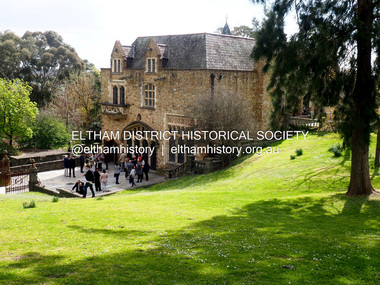
Photograph - Digital Photograph, Jim Connor, Eltham Cemetery Trust's launch at Montsalvat of Our Eltham - Artistic Recollections, 21 September 2017
... panels collaboratively created by artist Nerina Lascelles and ceramicist Linda Detoma. The project was designed and constructed by Leigh Wykes using Australian stone with ironwork by Neil Carter. All contributors to this installation, located adjacent to the car park near Metery Road, are residents of the Eltham area. Our Eltham - Artistic Recollections is described as a celebration of life in the Shire since the opening of the Eltham Cemetery more than 150 years ago. Depicting scenes of life in and around Eltham, the collection offers deeper connections to the Eltham area through a series of visual narratives...panels collaboratively created by artist Nerina Lascelles and ceramicist Linda Detoma. The project was designed and constructed by Leigh Wykes using Australian stone with ironwork by Neil Carter. All contributors to this installation, located adjacent to the car park near Metery Road, are residents of the Eltham area. Our Eltham - Artistic Recollections is described as a celebration of life in the Shire since the opening of the Eltham Cemetery more than 150 years ago. Depicting scenes of life in and around Eltham, the collection offers deeper connections to the Eltham area through a series of visual narratives ...Our Eltham - Artistic Recollections by Jim Connor, EDHS newsletter No. 236 October 2017 The Eltham Cemetery Trust, established in 1858, selected the existing burial site at Mount Pleasant Road on high ground overlooking the village of Eltham. The first recorded burial took place in 1861 in the Church of England section. Headstones depict the names of many early and well known local families. In recent years the Trust has encouraged the use of creative artistic elements within the natural bushland environment in their landscaped grounds adjoining Montsalvat. Their ongoing vision has been to offer the local communty a fresh and unique relationship to the Cemetery. On Thursday 21st September 2017 their latest commissioned art project titled ‘Our Eltham - Artistic Recollections’ was unveiled. It is a collection of panels collaboratively created by artist Nerina Lascelles and ceramicist Linda Detoma. The project was designed and constructed by Leigh Wykes using Australian stone with ironwork by Neil Carter. All contributors to this installation, located adjacent to the car park near Metery Road, are residents of the Eltham area. Our Eltham - Artistic Recollections is described as a celebration of life in the Shire since the opening of the Eltham Cemetery more than 150 years ago. Depicting scenes of life in and around Eltham, the collection offers deeper connections to the Eltham area through a series of visual narratives of Eltham’s past, environment and community. The project involves the artistic interpretation by Nerina Lascelles of historic and current images symbolically intermixed with locally indigenous flowers and plants. These are displayed on thirty-one ceramic panels by Linda Detoma, mounted within an iron fence by Neil Carter, upon an attractive rock wall constructed by Leigh Wykes. The Eltham District Historical Society is pleased to have contributed to this project. Russell Yeoman and Jim Connor from our Society have collaborated with Liz Pidgeon, Local and Family History Librarian at Yarra Plenty Regional Library on a selection of photographs, many from the Shire of Eltham Pioneers Collection we hold in partnership, located at Eltham Library. We also provided information on the images chosen. The Eltham Cemetery Trust has produced a booklet about this artwork, which can be viewed on the Cemetery website at: http://www.elthamcemetery.com/oureltham/#1 Our Eltham - Artistic Recollections is a significant monumental installation, which will encourage visitors to come to view this outstanding combination of local creative skills, set within the attractive grounds of the Eltham Cemetery. jim connor collection, eltham cemetery trust, montsalvat, our eltham artistic recollections, 2017-09-21 -
 Bendigo Military Museum
Book, Saved by Angels, 2002
... Soft cover - shades of red with front panel depicting a soldier and bombers, and rear panel depicts jungle trail. 80 pages plus appendix. A narrative story base on WW 2. ...books-military-history books Soft cover - shades of red with front panel depicting a soldier and bombers, and rear panel depicts jungle trail. 80 pages plus appendix. A narrative story base on WW 2. ...Soft cover - shades of red with front panel depicting a soldier and bombers, and rear panel depicts jungle trail. 80 pages plus appendix. A narrative story base on WW 2. Illustrated with black and white photos.books-military-history, books -
 National Wool Museum
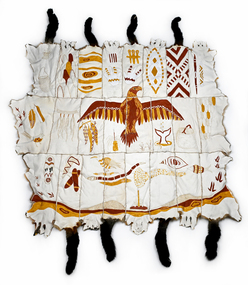
Textile - walert walert, Tammy Gilson, 2025
... Each design panel holds a visual voice, a narrative that speaks to identity and kinship. ...Each design panel holds a visual voice, a narrative that speaks to identity and kinship. ...My name is Tammy Gilson and I am a descendant of Wadawurrung people on Mums side, Marlene Gilson and my dear Nan, Rita Fagan from the Dalton line of our apical ancestor, John Robinson. For that I pay my respects and acknowledge my ancestors and all Elders. In Wadawurrung wurru, meaning language, the wurru name of a cloak walert walert signifies the reclaiming of language that hasn’t been spoken fluently since colonisation. Wadawurrung kinkinbil people relied on possum fur to create cloaks to wear for warmth, ceremony, adornments and medicine. Possum fur was used widely amongst neighbouring First Peoples particularly from colder parts of Victoria given the harshness of climate and particularly in Gordon where the elevation is 650m above sea level. The walert walert denotes a continuum of cultural practice and identity, can be viewed as secret and sacred and today viewed as contemporised practice of history acknowledging transfer of knowledge, practice and kinship. My experience of possum skin cloak revival was in 2014 through Traditional Ceremony, Tanderrum, where I was chosen to make several cloaks to be worn by the Elders including my Mum. This is where I learnt technique and design elements that remain present and relevant to lived experience. My work is an example of how culture and connection gives purpose and embeds a beautiful sense of belonging. Each design panel holds a visual voice, a narrative that speaks to identity and kinship. Symbols and line work are found on old artefacts that indicate belonging to Wadawurrung people. The water marks and mountain patterns were passed on to me from Mum and her grandma. Continuing this practice is for future generations as the walert walert holds significant healing properties. Making them and sharing knowledge aims to strengthen our Culture and bring family together. There is nothing like a good yarn while sewing or weaving and this is what the Elders do, and my ancestors always did together, sitting around sharing their way and teaching. Possum skin cloak consisting of twenty four pelts, stitched together with thread. Cloak features Wadawurrung designs in red, orange, white and black ochre.possum skin cloak, wadawurrung, first peoples, culture, tammy gilson, identity, tradition, design, walert walert -
 National Wool Museum
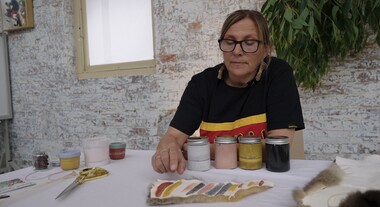
Film - walert walert, Tammy Gilson, 2026
... Each design panel holds a visual voice, a narrative that speaks to identity and kinship. ...Each design panel holds a visual voice, a narrative that speaks to identity and kinship. ...My name is Tammy Gilson and I am a descendant of Wadawurrung people on Mums side, Marlene Gilson and my dear Nan, Rita Fagan from the Dalton line of our apical ancestor, John Robinson. For that I pay my respects and acknowledge my ancestors and all Elders. In Wadawurrung wurru, meaning language, the wurru name of a cloak walert walert signifies the reclaiming of language that hasn’t been spoken fluently since colonisation. Wadawurrung kinkinbil people relied on possum fur to create cloaks to wear for warmth, ceremony, adornments and medicine. Possum fur was used widely amongst neighbouring First Peoples particularly from colder parts of Victoria given the harshness of climate and particularly in Gordon where the elevation is 650m above sea level. The walert walert denotes a continuum of cultural practice and identity, can be viewed as secret and sacred and today viewed as contemporised practice of history acknowledging transfer of knowledge, practice and kinship. My experience of possum skin cloak revival was in 2014 through Traditional Ceremony, Tanderrum, where I was chosen to make several cloaks to be worn by the Elders including my Mum. This is where I learnt technique and design elements that remain present and relevant to lived experience. My work is an example of how culture and connection gives purpose and embeds a beautiful sense of belonging. Each design panel holds a visual voice, a narrative that speaks to identity and kinship. Symbols and line work are found on old artefacts that indicate belonging to Wadawurrung people. The water marks and mountain patterns were passed on to me from Mum and her grandma. Continuing this practice is for future generations as the walert walert holds significant healing properties. Making them and sharing knowledge aims to strengthen our Culture and bring family together. There is nothing like a good yarn while sewing or weaving and this is what the Elders do, and my ancestors always did together, sitting around sharing their way and teaching. 9144.1 - Digital colour film featuring Wadawurrung woman Tammy Gilson speaking about the walert walert (possum skins cloak) she made for the National Wool Museum Collection, and the cultural practice of making cloaks. Film is 7 minutes and 3 seconds in length. 9144.2 - Digital colour film featuring Wadawurrung woman Tammy Gilson speaking about the designs which feature on the walert walert she made for the National Wool Museum Collection. Film is 14 minutes in length.possum skin cloak, wadawurrung, first peoples, culture, tammy gilson, identity, tradition, design, walert walert -
 Embroiderers Guild, Victoria
Textile - Chinese Silk Panel, c 1900
... narrative scenes from classical stories or legends. The choice of motifs allowed women to express personal desires, cultural values, and aesthetic preferences, reflecting a more personal and informal style than official court attire. Cream silk panel ...Chinese sleeve embroidery bands, or wanxiu became popular in the late 19th century during the Qing Dynasty, evolving from the traditional Han cuff embroidery and Manchu styles. These detachable, decorated bands were added to women's informal jackets and robes, often featuring symbolic motifs like landscapes, flowers, and auspicious symbols. They served both a decorative function, displaying artistic skill and personal wishes, and a practical one by covering the sleeves when hands were folded at the waist. History and evolution: Origins: The practice of embroidering cuffs on robes existed during the previous Ming Dynasty for Han women, and this was adopted by the Manchu rulers who founded the Qing Dynasty. Qing Dynasty (1644-1911): The practice was popularized and elaborated upon during this era, with detachable bands becoming a fashionable element for informal wear. Symbolism: The embroidery included a complex visual vocabulary of wishes for a long life, many offspring, and a happy marriage, derived from nature, mythology, and classical literature. Functionality: Women would fold their arms, often with their hands inside the sleeves, so the embroidered bands, which were sewn to hang down the back of the jacket, would be displayed prominently down the front. 19th century peak: The late 19th century was the peak of their popularity, with intricate designs becoming fashionable and even influenced by court tastes, such as those favoured by the Empress Dowager Cixi. Later developments: The late 19th century saw the introduction of chemical 'aniline' dyes from Europe, leading to brighter, bolder colours in embroidery. Motifs and their Meanings: Auspicious symbols: Designs often included symbols for good fortune, wealth, and longevity. Natural imagery: Birds, flowers, and landscapes were common motifs that could represent natural beauty or convey specific symbolic meanings. Figurative scenes: Bands could also feature narrative scenes from classical stories or legends. The choice of motifs allowed women to express personal desires, cultural values, and aesthetic preferences, reflecting a more personal and informal style than official court attire.Cream silk panel with floral design - four circles surrounded by floral border. Blues, greens, pinks and cream silk in Pekin stitch bordered with fine couched gold passing thread. Traditional Chinese embroidered panel - possibly a sleeve band. -
 Kew Historical Society Inc
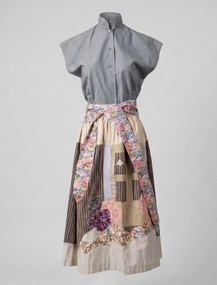
Clothing - Blouse and Scenic Patchwork Skirt Ensemble, Prue Acton, 1971–1975
... narrative applique landscape. The pieced design represents a stylized house or cottage set within a garden. Fabric sections are arranged into vertical stripe configurations mimicking window panes, alongside curved, layered patch elements in multi-colored floral calicos that form bushes and ground structures. The lower tier terminates in a broad, contrasting cream-colored patterned base hem panel...narrative applique landscape. The pieced design represents a stylized house or cottage set within a garden. Fabric sections are arranged into vertical stripe configurations mimicking window panes, alongside curved, layered patch elements in multi-colored floral calicos that form bushes and ground structures. The lower tier terminates in a broad, contrasting cream-colored patterned base hem panel ...This ensemble is a highly representative example of the pioneering textile artistry of Prue Acton, an iconic figure in Australian fashion history often celebrated for injecting the energy of the 1960s and '70s "Youthquake" movement into the domestic market. The piece belongs to Acton’s critically acclaimed 1970s "Patch" era. During this period, Acton moved away from the slick synthetics of the Mod era toward natural fibers and whimsical, story-driven collections inspired by the global folk revival and bohemian styles. According to historical archival provenance from similar surviving museum garments, these conversational, pictorial patchwork designs were often ingeniously engineered utilizing high-quality end-of-roll textile remnants. This specific garment beautifully encapsulates the early 1970s pastoral "cottagecore" fantasy, exhibiting how Acton blended commercial garment production with playful, illustrative textile collage.A two-piece daywear ensemble comprising a structured blouse and an elaborate, narrative-driven midi skirt with a coordinating waist sash. Comprised of a semi-fitted blouse of medium-weight slate gray plain-weave fabric. It features brief, extended cap sleeves, a high mandarin-style band collar, and a center-front button closure secured by five self-colored small round buttons. The high-waisted skirt is a full A-line midi-length skirt featuring an intricate, illustrative folk-art narrative applique landscape. The pieced design represents a stylized house or cottage set within a garden. Fabric sections are arranged into vertical stripe configurations mimicking window panes, alongside curved, layered patch elements in multi-colored floral calicos that form bushes and ground structures. The lower tier terminates in a broad, contrasting cream-colored patterned base hem panel. A wide, detachable self-tie waist sash executed in a dense, small-scale floral calico print is intended to be cinched around the high-fitted waistband to form a statement bow at the front.Label: "Prue Acton"prue acton, fashion -- melbourne -- 1970s
