
Showing 5 items matching "national emblem march"
-
 Flagstaff Hill Maritime Museum and Village
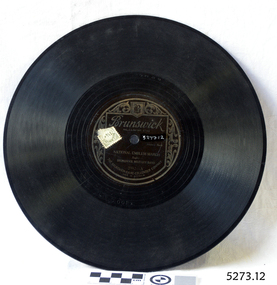
Audio - Gramophone Record, Brunswick Records, National Emblem March, Early-to-mid 20th century
... National Emblem March......National Emblem March...Shellac gramophone record with a black and gold label. Title: National Emblem March Artist: Brunswick Military Band Publisher: Brunswick Number: A2002 Size: 10 inch...Title: National Emblem March Artist: Brunswick Military Band Publisher: Brunswick Number: A2002 Size: 10 inch National Emblem March Audio Gramophone Record Brunswick Records ...Thomas Edison (1847–1931), an American, invented the phonograph in 1877, making it possible to record sound waves vertically and reproduce them on a wax cylinder so they could be heard again. Later, the German American, Emile Berliner (1851-1929), improved on Edison’s principles, greatly increasing the quality of the reproduced sounds with his invention of the gramophone in 1887, which recorded the sound waves laterally onto a flat shellac disc, or ‘record’. Records could be mass-produced in a factory where audio recordings were converted to a physical copy of that recording on a plate-sized disc. A gramophone machine reproduced the sound by spinning the record on a turntable at a specified number of rotations per minute (RPM) and using a stylus or needle to transfer the vibration via a membrane to a speaker, which amplified the sound. Berliner helped set up affiliated businesses overseas. One of his representatives was William Barry Owen (1860–1914), who, on 23 February 1889, partnered with Edmund Trevor Lloyd Williams (1859–1946) in England to register The Gramophone Company. His Master’s Voice (HMV) soon became the company’s major recording label, popular worldwide. The business based the label's logo of a dog looking into a gramophone horn for ‘his master’s voice’ was based on a painting by English artist Francis Barraud, which featured a terrier called Nipper beside a gramophone. Early gramophone records were mostly made from a material referred to as shellac, a natural ingredient combined with slate powder, and a filler of manilla copal, wood resin, carnauba wax, and carbon black. Although Bakelite seemed a useful, synthetic product, it was unsuccessful as a product for records. Around the time of World War II, lightweight, flexible synthetic vinyl records began replacing shellac records. Common diameters of records: 7 inch, 10 inch, 12 inch and 16 inch Revolutions Per Minute include: 33 1/3, 45, 78 Minutes per side of record: 3, 5.5, 7, 8, 9, 12, 15 and 22 Labels, in minutes per side: Single Play 3-5 min, Extended Play (EP) 7-12 min, Long Play (LP) 12-22 min This gramophone represents a step in the evolution of recording sound. In the 19th century, the human voice was first recorded on wax cylinders and replayed. It was the beginning of a new era in sound. Then, in the 1880s, voice could be recorded onto flat discs like this record, reliably reproduced and replayed many times, even on portable devices. Later, in the mid-20th century the following generation of electronic audio recording began, and later that century, digital recording gave even better reproduction. The record represents a popular means of entertainment for personal and social activities, as well as in some businesses. Shellac gramophone record with a black and gold label. Title: National Emblem March Artist: Brunswick Military Band Publisher: Brunswick Number: A2002 Size: 10 inchOn the label is a cream coloured stamp with printed detailsflagstaff hill, warrnambool, maritime village, maritime museum, flagstaff hill maritime museum and village, shipwreck coast, great ocean road, gramophone, phonograph, sound waves, record, reproduction, audio record, music, sound, thomas edison, emile berliner, 1887, shellac, rpm, william barry owen, edmund trevor lloyd williams, the gramophone company, his master’s voice, hmv, francis barraud, nipper, 10 inch, brunswick records, a2002, national emblem march, brunswick military band -
 Royal Australian Air Force Band
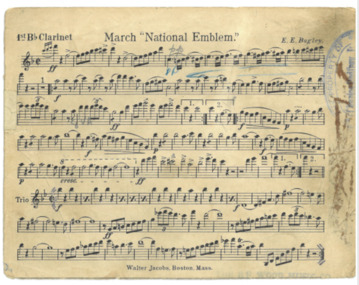
March Card, Bagley, E. E. (Composer), March "National Emblem", Composed: 1906
... March "National Emblem"...On envelope: QM137, March National Emblem Bagley, Q122, scrubbed out 396 4 Apr 1940, 8 Sep 1941, 14 Apr 1942, 27 Oct 1942 (twice), 15 Nov 1943 Stamped on the reverse of each card: Australian Broadcasting Co. & The Property of Musical Director & Arranger Charles Godfrey...Brass Band Australian Broadcasting Commission Marching Band Concert Band On envelope: QM137, March National Emblem Bagley, Q122, scrubbed out 396 4 Apr 1940, 8 Sep 1941, 14 Apr 1942, 27 Oct 1942 (twice), 15 Nov 1943 Stamped on the reverse of each card: Australian Broadcasting Co. & The Property of Musical Director & Arranger Charles Godfrey 20 parts Concert Band Instrumentation Quick March Key Signature: Eb Major Instrumentation: Solo or 1st Bb Cornet (Conductor handwritten at the top) Piccolo (Db handwritten) Eb Clarinet 1st Bb Clarinet 2nd Bb Clarinet 3rd Bb Clarinet Bassoon 1st & 2nd Eb Altos (crossed out and Horns) 3rd & 4th Eb Altos Eb Cornet 1st Bb Cornet (solo scrubbed out) 2nd & 3rd Bb Cornets 1st & 2nd Trombones 3rd Trombone 1st & 2nd Trombones (Treble Clef) 3rd Trombone (Treble Clef) Baritone (scrubbed out and written Euphonium) Baritone (treble clef) March "National Emblem" March Card Bagley, E. ...In 1932 the call was put out to the ABC to start a military band. The band’s task was to record music to play on air four times a week, and to perform live concerts for the public. By November 1933 a band was put together with 40 musicians from around Australia. The band was initially conducted by Captain H. E. Adkins, Director of the Royal Military School of Music, Kneller Hall, London. After the tour, Adkins returned to his position at Kneller Hall, and Stephen Yorke, a retired bandmaster of the Gloucestershire Regiment, was brought out to Australia to become the permanent director and conductor of the band, which he did until the band closed in 1951. During the band’s 17 year history they presented a sizable program of music. Their final concert received a standing ovation from its audience of 1500, with a teary-eyed Yorke. 20 parts Concert Band Instrumentation Quick March Key Signature: Eb Major Instrumentation: Solo or 1st Bb Cornet (Conductor handwritten at the top) Piccolo (Db handwritten) Eb Clarinet 1st Bb Clarinet 2nd Bb Clarinet 3rd Bb Clarinet Bassoon 1st & 2nd Eb Altos (crossed out and Horns) 3rd & 4th Eb Altos Eb Cornet 1st Bb Cornet (solo scrubbed out) 2nd & 3rd Bb Cornets 1st & 2nd Trombones 3rd Trombone 1st & 2nd Trombones (Treble Clef) 3rd Trombone (Treble Clef) Baritone (scrubbed out and written Euphonium) Baritone (treble clef) On envelope: QM137, March National Emblem Bagley, Q122, scrubbed out 396 4 Apr 1940, 8 Sep 1941, 14 Apr 1942, 27 Oct 1942 (twice), 15 Nov 1943 Stamped on the reverse of each card: Australian Broadcasting Co. & The Property of Musical Director & Arranger Charles Godfreybrass band, australian broadcasting commission, marching band, concert band -
 Bendigo Historical Society Inc.
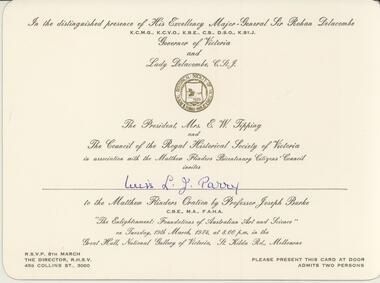
Document - INVITATION, 1974
... A large cream coloured card printed with the Royal Historical Society emblem in gold in the upper section and printed with the following words in black script: In the distinguished presence of His Excellency Major-General Sir Rohan Delacombe Governor of Victoria and Lady Delacombe, The President Mrs E W Tipping and the Council of the Royal Historical Society of Victoria in association with the Matthew Flinders Bicentenary Citizens Council invites Miss L J Parry to the Matthew Flinders Oration by Professor Joseph Burke, "The Enlightenment: Foundations of Australian Art and Science" on Tuesday 19 March 1974 at 8:00pm in the Great Hall, National Gallery of Victoria St Kilda Rd Melbourne. ...A large cream coloured card printed with the Royal Historical Society emblem in gold in the upper section and printed with the following words in black script: In the distinguished presence of His Excellency Major-General Sir Rohan Delacombe Governor of Victoria and Lady Delacombe, The President Mrs E W Tipping and the Council of the Royal Historical Society of Victoria in association with the Matthew Flinders Bicentenary Citizens Council invites Miss L J Parry to the Matthew Flinders Oration by Professor Joseph Burke, "The Enlightenment: Foundations of Australian Art and Science" on Tuesday 19 March 1974 at 8:00pm in the Great Hall, National Gallery of Victoria St Kilda Rd Melbourne. ...Official invitation to Miss L J Parry from The Council of the Royal Historical Society of Victoria. A large cream coloured card printed with the Royal Historical Society emblem in gold in the upper section and printed with the following words in black script: In the distinguished presence of His Excellency Major-General Sir Rohan Delacombe Governor of Victoria and Lady Delacombe, The President Mrs E W Tipping and the Council of the Royal Historical Society of Victoria in association with the Matthew Flinders Bicentenary Citizens Council invites Miss L J Parry to the Matthew Flinders Oration by Professor Joseph Burke, "The Enlightenment: Foundations of Australian Art and Science" on Tuesday 19 March 1974 at 8:00pm in the Great Hall, National Gallery of Victoria St Kilda Rd Melbourne. In the lower left hand corner is printed RSVP 8th March The Director RHSV 459 Collins St 3000 and in the lower right hand corner Please present this card at door Admits two persons.event, official -
 Bendigo Historical Society Inc.
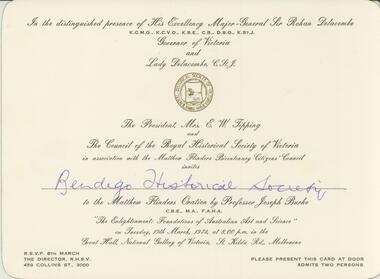
Document - INVITATION, 1974
... A large cream coloured card printed with the Royal Historical Society emblem in gold in the upper section and printed with the following words in black script: In the distinguished presence of His Excellency Major-General Sir Rohan Delacombe Governor of Victoria and Lady Delacombe, The President Mrs E W Tipping and the Council of the Royal Historical Society of Victoria in association with the Matthew Flinders Bicentenary Citizens Council invites Bendigo Historical Society to the Matthew Flinders Oration by Professor Joseph Burke, "The Enlightenment: Foundations of Australian Art and Science" on Tuesday 19 March 1974 at 8:00pm in the Great Hall, National Gallery of Victoria St Kilda Rd Melbourne. ...A large cream coloured card printed with the Royal Historical Society emblem in gold in the upper section and printed with the following words in black script: In the distinguished presence of His Excellency Major-General Sir Rohan Delacombe Governor of Victoria and Lady Delacombe, The President Mrs E W Tipping and the Council of the Royal Historical Society of Victoria in association with the Matthew Flinders Bicentenary Citizens Council invites Bendigo Historical Society to the Matthew Flinders Oration by Professor Joseph Burke, "The Enlightenment: Foundations of Australian Art and Science" on Tuesday 19 March 1974 at 8:00pm in the Great Hall, National Gallery of Victoria St Kilda Rd Melbourne. ...Official invitation to Bendigo Historical Society from The Council of the Royal Historical Society of Victoria. A large cream coloured card printed with the Royal Historical Society emblem in gold in the upper section and printed with the following words in black script: In the distinguished presence of His Excellency Major-General Sir Rohan Delacombe Governor of Victoria and Lady Delacombe, The President Mrs E W Tipping and the Council of the Royal Historical Society of Victoria in association with the Matthew Flinders Bicentenary Citizens Council invites Bendigo Historical Society to the Matthew Flinders Oration by Professor Joseph Burke, "The Enlightenment: Foundations of Australian Art and Science" on Tuesday 19 March 1974 at 8:00pm in the Great Hall, National Gallery of Victoria St Kilda Rd Melbourne. In the lower left hand corner is printed RSVP 8th March The Director RHSV 459 Collins St 3000 and in the lower right hand corner Please present this card at door Admits two persons.event, official -
 National Vietnam Veterans Museum (NVVM)
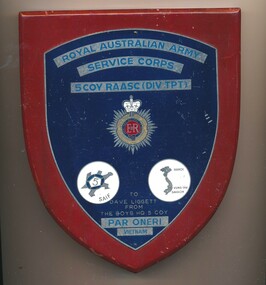
Plaque - 5 COY RAASC plaque
... National Serviceman Corporal D Liggett, who served in 5 Company, Royal Australian Army Service Corps 1969-70. 5 Company was a vital logistics and transport unit deployed to South Vietnam during the Vietnam War. Headquartered in Vung Tau from March 2, 1967, to March 12, 1972, the company supported Australian forces with troop transport, heavy haulage, and supply distribution Dave Liggett 3793526 5 COY RAASC (Div TPT) Royal Australian Army Service Corps Par Oneri Vietnam Liggett shield plaque emblem Royal Australian Army Service Corps 5 Coy RAASC (Div tpt)/ E11R/ Honi Soit Qui Mal Y Pense/ To Dave Liggett 3793526 from the boys HQ 5 Coy/ Par Oneri/ Vietnam Wood with metal insert, blue background with Royal Australian Army Service Corps badge, 5 COY RAASC (Div tpt) / Logo of tortoise with a 5 on its shell / map of Vietnam Plaque 5 COY RAASC plaque ...This item commemorates the war in Vietnam. It was donated by National Serviceman Corporal D Liggett, who served in 5 Company, Royal Australian Army Service Corps 1969-70. 5 Company was a vital logistics and transport unit deployed to South Vietnam during the Vietnam War. Headquartered in Vung Tau from March 2, 1967, to March 12, 1972, the company supported Australian forces with troop transport, heavy haulage, and supply distributionWood with metal insert, blue background with Royal Australian Army Service Corps badge, 5 COY RAASC (Div tpt) / Logo of tortoise with a 5 on its shell / map of VietnamRoyal Australian Army Service Corps 5 Coy RAASC (Div tpt)/ E11R/ Honi Soit Qui Mal Y Pense/ To Dave Liggett 3793526 from the boys HQ 5 Coy/ Par Oneri/ Vietnamdave liggett 3793526, 5 coy raasc (div tpt), royal australian army service corps, par oneri, vietnam, liggett, shield, plaque, emblem
