
Showing 6 items matching "natural history - biology"
-
 Bendigo Military Museum
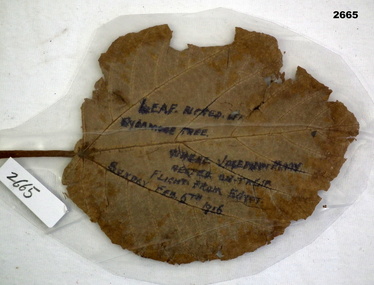
Plant specimen - LEAF, C. Pre 1916
... natural history - biology...natural history - biology military history - souvenirs Passchendaele barracks trust “Leaf picked off Sycamore tree where Joseph & Mary rested on their flight from Egypt. ...Dry leaf from a Sycamore tree. One side has some words written in ink. The whole leaf has been laminated, the plastic then trimmed roughly same shape as leaf.“Leaf picked off Sycamore tree where Joseph & Mary rested on their flight from Egypt. Sunday Feb 6th 1916”natural history - biology, military history - souvenirs, passchendaele barracks trust -
 Marysville & District Historical Society
Document (Item) - Research Document, Rene de Koning, Darwin Street Named After Charles Robert Darwin (1809 - 1882), 13-08-2022
... biology. His theory that all species of life have descended from a common ancestor is now generally accepted and considered a fundamental concept in science. In a joint publication with Alfred Russel Wallace, he introduced his scientific theory that this branching pattern of evolution resulted from a process he called natural selection, in which the struggle for existence has a similar effect to the artificial selection involved in selective breeding. Charles Darwin has been described as one of the most influential figures in human history ...An account of the life of Charles Robert Darwin whom Darwin Street in Marysville in Victoria is named for.An account of the life of Charles Robert Darwin whom Darwin Street in Marysville in Victoria is named for. Charles Robert Darwin was an English naturalist, geologist, and biologist, widely known for his contributions to evolutionary biology. His theory that all species of life have descended from a common ancestor is now generally accepted and considered a fundamental concept in science. In a joint publication with Alfred Russel Wallace, he introduced his scientific theory that this branching pattern of evolution resulted from a process he called natural selection, in which the struggle for existence has a similar effect to the artificial selection involved in selective breeding. Charles Darwin has been described as one of the most influential figures in human history and is buried in Westminster Abbey. charles robert darwin, darwin street, marysville, victoria -
 Marysville & District Historical Society
Photograph (Item) - Colour photograph, Unknown
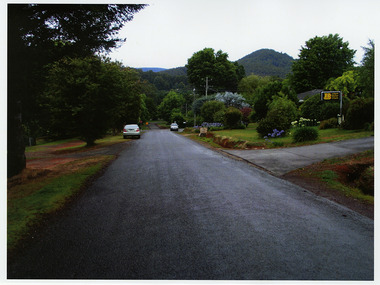
... biology. His theory that all species of life have descended from a common ancestor is now generally accepted and considered a fundamental concept in science. In a joint publication with Alfred Russel Wallace, he introduced his scientific theory that this branching pattern of evolution resulted from a process he called natural selection, in which the struggle for existence has a similar effect to the artificial selection involved in selective breeding. Charles Darwin has been described as one of the most influential figures in human history ...A colour photograph of Darwin Street in Marysville in Victoria.A colour photograph of Darwin Street in Marysville in Victoria. Darwin Street was named after Charles Robert Darwin. Charles Robert Darwin was an English naturalist, geologist, and biologist, widely known for his contributions to evolutionary biology. His theory that all species of life have descended from a common ancestor is now generally accepted and considered a fundamental concept in science. In a joint publication with Alfred Russel Wallace, he introduced his scientific theory that this branching pattern of evolution resulted from a process he called natural selection, in which the struggle for existence has a similar effect to the artificial selection involved in selective breeding. Charles Darwin has been described as one of the most influential figures in human history and is buried in Westminster Abbey. charles robert darwin, darwin street, marysville, victoria, photograph -
 Marysville & District Historical Society
Photograph (Item) - Colour photograph, Unknown
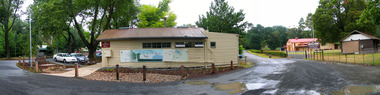
... biology. His theory that all species of life have descended from a common ancestor is now generally accepted and considered a fundamental concept in science. In a joint publication with Alfred Russel Wallace, he introduced his scientific theory that this branching pattern of evolution resulted from a process he called natural selection, in which the struggle for existence has a similar effect to the artificial selection involved in selective breeding. Charles Darwin has been described as one of the most influential figures in human history ...A colour photograph of Darwin Street in Marysville in Victoria.A colour photograph of Darwin Street in Marysville in Victoria. Darwin Street was named after Charles Robert Darwin. Charles Robert Darwin was an English naturalist, geologist, and biologist, widely known for his contributions to evolutionary biology. His theory that all species of life have descended from a common ancestor is now generally accepted and considered a fundamental concept in science. In a joint publication with Alfred Russel Wallace, he introduced his scientific theory that this branching pattern of evolution resulted from a process he called natural selection, in which the struggle for existence has a similar effect to the artificial selection involved in selective breeding. Charles Darwin has been described as one of the most influential figures in human history and is buried in Westminster Abbey. charles robert darwin, darwin street, marysville, victoria, the country cupboard cafe, the marysville museum, photograph -
 Marysville & District Historical Society
Photograph (Item) - Colour photograph, Unknown
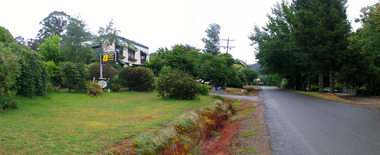
... biology. His theory that all species of life have descended from a common ancestor is now generally accepted and considered a fundamental concept in science. In a joint publication with Alfred Russel Wallace, he introduced his scientific theory that this branching pattern of evolution resulted from a process he called natural selection, in which the struggle for existence has a similar effect to the artificial selection involved in selective breeding. Charles Darwin has been described as one of the most influential figures in human history ...A colour photograph of Darwin Street in Marysville in Victoria.A colour photograph of the Scenic Bed and Breakfast in Darwin Street in Marysville in Victoria. The Scenic Bed and Breakfast, along with all the guest houses in Marysville, was destroyed in the 2009 Black Saturday bushfires. Darwin Street was named after Charles Robert Darwin. Charles Robert Darwin was an English naturalist, geologist, and biologist, widely known for his contributions to evolutionary biology. His theory that all species of life have descended from a common ancestor is now generally accepted and considered a fundamental concept in science. In a joint publication with Alfred Russel Wallace, he introduced his scientific theory that this branching pattern of evolution resulted from a process he called natural selection, in which the struggle for existence has a similar effect to the artificial selection involved in selective breeding. Charles Darwin has been described as one of the most influential figures in human history and is buried in Westminster Abbey. charles robert darwin, darwin street, marysville, victoria, scenic b&b, 2009 black saturday bushfires, photograph -
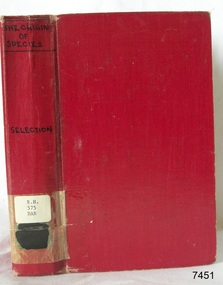 Flagstaff Hill Maritime Museum and Village
Book - Reference Book/Biology/Scientific, Charles Darwin, The Origin of Species or The Preservation of Favoured Races in the Struggle for Life, 1859
... natural selection transformed biology. Born in Shrewsbury, he gained fame from his five year voyage on HMS Beagle (1831–1836), where Galapagos observations sparked his ideas on species adaptation. The full title is “On the Origin of Species by Means of Natural Selection”, or the “Preservation of Favoured Races in the Struggle for Life”, the book was first published on 24th November 1859. Darwin's early life led him to study medicine and theology but he found his calling in natural history...natural selection transformed biology. Born in Shrewsbury, he gained fame from his five year voyage on HMS Beagle (1831–1836), where Galapagos observations sparked his ideas on species adaptation. The full title is “On the Origin of Species by Means of Natural Selection”, or the “Preservation of Favoured Races in the Struggle for Life”, the book was first published on 24th November 1859. Darwin's early life led him to study medicine and theology but he found his calling in natural history ...The Origin of Species is Charles Darwin’s landmark 1859 book, and it introduced the idea that species change over time through natural selection. Darwin drew on observations from his voyage on the HMS Beagle, especially evidence from the Galapagos Islands, to argue that living things share common ancestry and adapt through inherited variation. Darwin’s central claim argues that individuals with traits better suited to their environment are more likely to survive and reproduce, so those traits become more common over generations. The book challenged the idea of special creation and became the foundation of modern evolutionary biology. The book is considered one of the most influential scientific works ever written because it provided a unifying explanation for the diversity of life. It also sparked major scientific and religious debate that continues to this day.The Origin of Species Author: Charles Darwin Publisher: John Murray Date: 1860non-fiction The Origin of Species is Charles Darwin’s landmark 1859 book, and it introduced the idea that species change over time through natural selection. Darwin drew on observations from his voyage on the HMS Beagle, especially evidence from the Galapagos Islands, to argue that living things share common ancestry and adapt through inherited variation. Darwin’s central claim argues that individuals with traits better suited to their environment are more likely to survive and reproduce, so those traits become more common over generations. The book challenged the idea of special creation and became the foundation of modern evolutionary biology. The book is considered one of the most influential scientific works ever written because it provided a unifying explanation for the diversity of life. It also sparked major scientific and religious debate that continues to this day. warrnambool, shipwrecked-coast, flagstaff-hill, flagstaff-hill-maritime-museum, maritime-museum, shipwreck-coast, shipwrecked-artefact, book, warrnambool mechanics’ institute, the origin of species, charles darwin, pattison collection
