
Showing 177 items matching "navy sailor"
-
 Whitehorse Historical Society Inc.
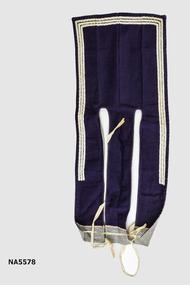
Uniform - Royal Australian Navy, Sailor Collar, C 1942
... Royal Australian Navy, Sailor Collar...Date of birth 6 Nov. 1913 - Box Hill Place of enlist - Melbourne- leading wireman Died 29 January 1981 Buried: Springvale Botanical Cemetery Copy of research - National Archives of Australia WW2 Royal Australian Navy Uniform Allan Edward Beach Allan Beach Nil - Service uniform collar - Hand detailing, 3 white stripes - Gabardine fabric, plain dark navy face - Gabardine fabric, plain dark navy/white back - Cotton tape ties front & rear See also NA5582 Tunic, NA5585 Trousers, NA5581 Dicky front, NA5578 Collar, NA5586 Lanyard, NA5589 Two Ribbons, NA5591 Hat band (HMAS), NA5583 Hat band (HMAS Cerberus), NA5593 Ribbon (HMS Repulse), NA5590 Ribbon Uniform Royal Australian Navy, Sailor Collar ...Part of the uniform worn by Beach, Allan Edward, Service no. 25718. Date of birth 6 Nov. 1913 - Box Hill Place of enlist - Melbourne- leading wireman Died 29 January 1981 Buried: Springvale Botanical Cemetery Copy of research - National Archives of Australia- Service uniform collar - Hand detailing, 3 white stripes - Gabardine fabric, plain dark navy face - Gabardine fabric, plain dark navy/white back - Cotton tape ties front & rear See also NA5582 Tunic, NA5585 Trousers, NA5581 Dicky front, NA5578 Collar, NA5586 Lanyard, NA5589 Two Ribbons, NA5591 Hat band (HMAS), NA5583 Hat band (HMAS Cerberus), NA5593 Ribbon (HMS Repulse), NA5590 RibbonNilww2, royal australian navy, uniform, allan edward beach, allan beach -
 Running Rabbits Military Museum operated by the Upwey Belgrave RSL Sub Branch
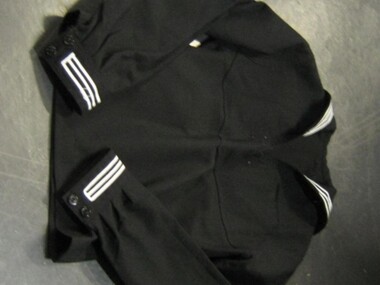
Shirt
... USA Navy Sailors Shirt...Uniform 2000 USA Navy Sailors Shirt Shirt ...USA Navy Sailors Shirtuniform, 2000 -
 Beechworth RSL Sub-Branch
Hat, 1972
... navy...sailor...Sailor's hat with removable ribbon which sits on exterior band with machine embroidered inscriptions, tied in a bow at the back. Hat is piqued, stiffened white cotton with two white eyelets on both left and right side. Dark navy...Leeuwin. royal australian navy navy sailor leeuwin melville cape leeuwin On ribbon, "H.M.A.S. ...This hat was worn by D. P. Bright, whilst serving in the Royal Australian Navy, presumably on the H.M.A.S. Leeuwin.Sailor's hat with removable ribbon which sits on exterior band with machine embroidered inscriptions, tied in a bow at the back. Hat is piqued, stiffened white cotton with two white eyelets on both left and right side. Dark navy band on exterior with brown leather lining on the interior, with cotton bow on interior back. On interior of hat, the hat contains a plastic lining on which there is an inscription. On either side of the inscription is a strip of beige coloured cotton lining in the shape of a semi circle (see photos).On ribbon, "H.M.A.S. LEEUWIN" On interior, "BRIGHT. D.P. HONDEN"; crossed out is the inscription "D.P. BRIGHT" Manufacturer's label reads "HILLS HATS PTY.LTD./SYDNEY N.S.W. 1972/R.A.N. 20476 6 5/8 /No./NAME/MADE IN AUSTRALIA"royal australian navy, navy, sailor, leeuwin, melville, cape leeuwin -
 Bendigo Historical Society Inc.
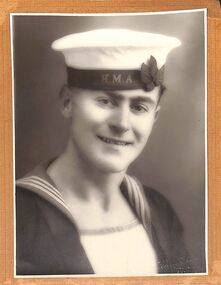
Photograph - Thomas and Valda Staley Collection: Photograph
... ...Navy sailor...Bendigo Staley Navy sailor World War 2 Thomas Woodward Staley. 11.2.1922 - 22.6.2004. ...Thomas Woodward Staley was a Seaman during World War 2, enrolling at Port Melbourne, in 1941. Service Number: PM4134. He served on several ships/depots before being demobilised in 1946. Black and white photograph of man (Thomas Woodward Staley) in sailor's uniform. Bust photograph. Photographer's name embossed to bottom right of photograph - 'Kalma Studio', Pall Mall, Bendigo. H.M.A [S] visible at base of cap. Thomas Woodward Staley written on reverse of images. Photograph mounted onto cardboard mount. Two identical copies of this photo catalogued under the one number - 11260.23.Thomas Woodward Staley. 11.2.1922 - 22.6.2004.bendigo, staley, navy sailor, world war 2 -
 Bendigo Historical Society Inc.
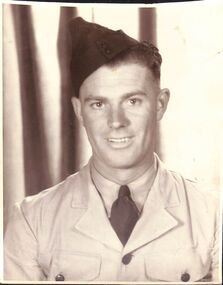
Photograph - Thomas and Valda Staley Collection: Photograph
... ...Navy sailor...Medically discharged after 222 days of service; but later for service in the Royal Australian Navy in May, 1942. Bendigo Navy sailor World War 2 Sayers Len Sayers. Black and white photograph of a man (Len Sayers) in service uniform. ...Leonard Clyde Sayers was the son of Vera Sayers, and born in Bendigo. He enlisted in September, 1941. Service number V280275. Medically discharged after 222 days of service; but later for service in the Royal Australian Navy in May, 1942. Black and white photograph of a man (Len Sayers) in service uniform. Bust shot. Light-colored button up jacket, with dark tie. Side cap worn. Man is looking straight art camera. Photographer's stamp (Rene Studios) stamped to back of image. Len Sayers.bendigo, navy sailor, world war 2, sayers -
 Lilydale RSL Sub Branch
Uniform - Sailor Uniform Cap
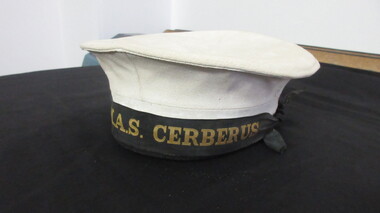
... Australian Navy sailors cap with tally band ' HMAS Cerberus'...HMAS Cerberus Australian Navy sailors cap with tally band ' HMAS Cerberus' Uniform Sailor Uniform Cap ...Australian Navy sailors cap with tally band ' HMAS Cerberus'HMAS Cerberus -
 Whitehorse Historical Society Inc.
Headwear - Hat band, 1940s
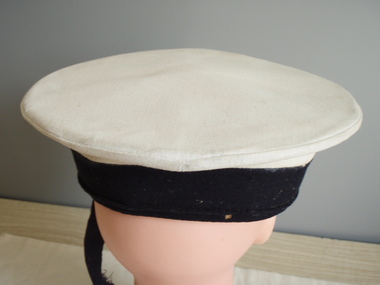
... Navy...Headwear...Sailor...World War 2 uniform Navy Headwear Sailor Allan Edward Beach HMAS Black hat band with a bow on one side and has 'HMAS' in gold lettering belonging to Allan Edwards Beach. ...World War 2 uniformBlack hat band with a bow on one side and has 'HMAS' in gold lettering belonging to Allan Edwards Beach. See also NA5582 Tunic, NA5585 Trousers, NA5581 Dicky Front, NA5578 Collar, NA5586 Lanyard, NA5589 Ribbons, NA5590 Two Ribbons, NA5593 Ribbon HMAS Cerberus, NA5593 Ribbon HMS Repulse, NA 5591 Hat Ribbon.HMASnavy, headwear, sailor, allan edward beach -
 Frankston RSL Sub Branch
Kit, Uniform Repair
... Linen holdall containing a sewing and repair kit issued to Royal Australian Navy sailors. The holdall is navy blue. The kit contains a variety of spare buttons, cottons and sewing needles and a thimble. ...Linen holdall containing a sewing and repair kit issued to Royal Australian Navy sailors. The holdall is navy blue. The kit contains a variety of spare buttons, cottons and sewing needles and a thimble. ...Linen holdall containing a sewing and repair kit issued to Royal Australian Navy sailors. The holdall is navy blue. The kit contains a variety of spare buttons, cottons and sewing needles and a thimble. The holldall has an embroidered label with the following 'MADE IN AUSTRALIA, R.E.V. YARD, R.A.N." -
Tatura Irrigation & Wartime Camps Museum
Hat Band, 1940's
... Navy Blue Sailors' hat band. Tied with a bow. "HMAS Sydney" embroidered on band...Hat band from "HMAS Sydney" hat band hmas sydney tatura ww2 uniforms navy Navy Blue Sailors' hat band. Tied with a bow. "HMAS Sydney" embroidered on band Hat Band ...Hat band from "HMAS Sydney"Navy Blue Sailors' hat band. Tied with a bow. "HMAS Sydney" embroidered on bandhat band, hmas sydney, tatura, ww2, uniforms, navy -
 Port Fairy Historical Society Museum and Archives
Uniform - Sailor Hat, c. 1890s
... Sailor's cap: Navy and white topped sailor's cap with grey lining and navy ribbon...RAN reserves local history uniforms navy robertson mr or captain william s.s.casino royal australian naval reserve hats 6 7/8 size marking / 157 red inking marking on crown lining Sailor's cap: Navy and white topped sailor's cap with grey lining and navy ribbon Uniform Sailor Hat ...Part of Capt. William Robertson's collection. Early career in navy. Captain of S.S.Casino. RAN reservesSailor's cap: Navy and white topped sailor's cap with grey lining and navy ribbon6 7/8 size marking / 157 red inking marking on crown lininglocal history, uniforms, navy, robertson, mr or captain william, s.s.casino, royal australian naval reserve, hats -
 Bendigo Military Museum
Tool - SHIPS BELL, c.1900
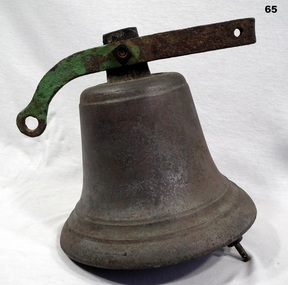
... This bell was apparently salvaged from a Freighter by Syd Storrie a Merchany Navy Sailor. The Freighter had been torpedoed by a German Submarine in WW1....This bell was apparently salvaged from a Freighter by Syd Storrie a Merchany Navy Sailor. The Freighter had been torpedoed by a German Submarine in WW1. maritime technology ship relics military history - navy ships fittings souvenirs Ship's bell, rough cast bronze? ...This bell was apparently salvaged from a Freighter by Syd Storrie a Merchany Navy Sailor. The Freighter had been torpedoed by a German Submarine in WW1.Ship's bell, rough cast bronze? Clapper is rough cast steel. There is an old steel mounting bracket at the top, painted green. maritime technology, ship relics, military history - navy, ships fittings, souvenirs -
 Lilydale RSL Sub Branch
Memorabilia - Framed display of Naval Appeal Buttons
... Framed Display of various Naval Appeal buttons and badges. 7 Merchant Navy, 7 Sailors, 2 Jacks Day ....Framed Display of various Naval Appeal buttons and badges. 7 Merchant Navy, 7 Sailors, 2 Jacks Day . Memorabilia Framed display of Naval Appeal Buttons ...Framed Display of various Naval Appeal buttons and badges. 7 Merchant Navy, 7 Sailors, 2 Jacks Day . -
 Melbourne Legacy
Leisure object - Toy Bear, Legacy Bear $20 - Salty, 2021
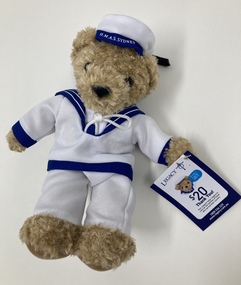
... This bear is in an Australian navy sailor outfit and white cap with the band saying HMAS Sydney. ...This bear is in an Australian navy sailor outfit and white cap with the band saying HMAS Sydney. ...In the 2000s Legacy released a range of Legacy Bears to expand the merchandise available for sale during Legacy Week and at other fundraising opportunities during the year. This bear is in an Australian navy sailor outfit and white cap with the band saying HMAS Sydney. He was given the name Salty. A previous edition had The Australian Navy on the cap band. Sometimes special editions of the bears were produced. In 2021 the price was increased to $20 per bear.An example of the type of products sold along with Legacy Badges for fundraising in the 2010-2020s.Legacy bear dressed in a white navy uniform with HMAS on his cap band with a printed cardboard tag.Printed tag gives the price as $20.legacy appeal, fundraising, legacy bear -
 Mission to Seafarers Victoria
Book, Nicholas Monsarrat, The Cruel Sea, 1953
... It follows the lives of a group of Royal Navy sailors fighting the Battle of the Atlantic during the Second World War. ...It follows the lives of a group of Royal Navy sailors fighting the Battle of the Atlantic during the Second World War. ...Based on the author's own vivid experiences, The Cruel Sea is the nail-biting story of the crew of HMS Compass Rose, a corvette assigned to protect convoys in World War Two. Darting back and forth across the icy North Atlantic, Compass Rose played a deadly cat and mouse game with packs of German U-boats lying in wait beneath the ocean waves. Packed with tension and vivid descriptions of agonizing U-boat hunts, this tale of the most bitter and chilling campaign of the war tells of ordinary, heroic men who had to face a brutal menace which would strike without warning from the deep . .non-fictionBased on the author's own vivid experiences, The Cruel Sea is the nail-biting story of the crew of HMS Compass Rose, a corvette assigned to protect convoys in World War Two. Darting back and forth across the icy North Atlantic, Compass Rose played a deadly cat and mouse game with packs of German U-boats lying in wait beneath the ocean waves. Packed with tension and vivid descriptions of agonizing U-boat hunts, this tale of the most bitter and chilling campaign of the war tells of ordinary, heroic men who had to face a brutal menace which would strike without warning from the deep . . nicholas montsarrat, ww2, royal navy, battle of the atlantic, corvette, frigate -
 Williamstown Historical Society Inc
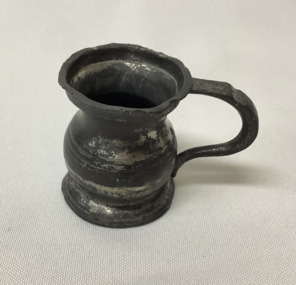
Domestic object - Pewter rum measure
... A tot of rum measered an 1/8 of a pint or 71 ml, and was traditionally the daily ration issued to British Royal Navy sailors, a tradition that was common on many ships. ...A tot of rum measered an 1/8 of a pint or 71 ml, and was traditionally the daily ration issued to British Royal Navy sailors, a tradition that was common on many ships. ...The lighthouse Tender "Lady Loch" was built in 1886 by Campbell, Sloss & McCann in Footscray, for the Victorian Dept of Public Works. It was an iron steamship of 531 tons. The ship was named after Lady Elizabeth Loch, wife of Sir Henry Loch, Governor of Victoria from 1884 -1889. Built for use as a lighthouse tender, it serviced lighthouses around the south east coast and Tasmania and was docked at Williamstown. Owned by Victorian Ports and Harbours Dept. Register closed in September 1935 when the vessel was converted to a hulk at Brisbane. Official Number: 88946. A tot of rum measered an 1/8 of a pint or 71 ml, and was traditionally the daily ration issued to British Royal Navy sailors, a tradition that was common on many ships. Small pewter measure for a tot of rum, shaped like a flagon, with a handle. From SS Lady Loch, Tasmanian lighthouse tender. -
 Flagstaff Hill Maritime Museum and Village
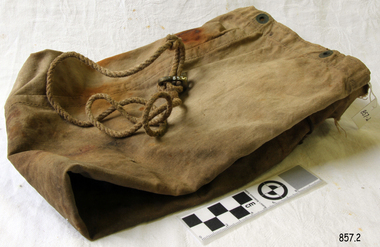
Functional object - Ditty Bag, Late 19th century
... Before World War I, the Navy issued ditty boxes made of wood and styled after footlockers. These carried the personal gear and some clothes of the sailor. ...Before World War I, the Navy issued ditty boxes made of wood and styled after footlockers. These carried the personal gear and some clothes of the sailor. ...A Ditty Bag (or box) was originally called “ditto bag” because it contained at least two of everything, two needles, two spools of thread, two buttons, etc. With the passing of years, the “ditto” was dropped in favour of "ditty" and remains so today. Before World War I, the Navy issued ditty boxes made of wood and styled after footlockers. These carried the personal gear and some clothes of the sailor. Today, the ditty bag is still issued to recruits and contains a sewing kit, toiletry articles and personal items such as writing paper and pens. Another source says a Ditty Box or Ditty Bag is possibly from the Saxon word “dite”, meaning tidy or from the English word “dittis”, a type of canvas material. A small box or bag in which a sailor kept his valuables such as letters, small souvenirs and sewing supplies.An item that is socially significant as it gives insight into a sailors life aboard ship and is another part of marine history. Items such as these although they were regarded at the time as everyday objects help us now to map various aspects of marine archaeology thorough the ages.Sailors Ditty Bag, canvas bag for holding all the sail making and roping tools, with tie and brass clasp. Holed.Noneflagstaff hill, warrnambool, shipwrecked-coast, flagstaff-hill, flagstaff-hill-maritime-museum, maritime-museum, shipwreck-coast, flagstaff-hill-maritime-village -
 Flagstaff Hill Maritime Museum and Village
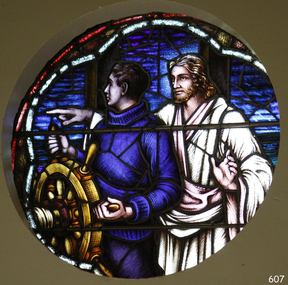
Artwork, other - Window, Brooks, Robinson & Co, Christ Showing the Helmsman the Way, circa August 1947
... sailor...christ showing the helmsman the way...quartermaster’s hand on the wheel...stained glass window...church window...religious window...sanctuary window...memorial window...war memorial window...victorian war heritage inventory...victorian heritage database...merchant navy.... & a. bank williamstown christ directing a sailor christ showing the helmsman the way quartermaster’s hand on the wheel stained glass window church window religious window sanctuary window memorial window war memorial window victorian war heritage inventory victorian heritage database merchant navy ww2 1939-1945 anglican church bishop mckie mrs musther brooks robinson & co flying angel club williamstown lightkeepers' auxiliary ladies' harbour lights guild commemorative window Window, stained glass, circular, with reinforcing bars. ...This round, stained glass window, titled "Christ Showing the Helmsman the Way", was also referred to as the Sanctuary Window or Memorial window. It was installed in the St Nicholas Seamen's Church at 139 Nelson Place, Williamstown, Victoria, inside the chapel above the altar. This memorial window has significance as a part of Victoria's War Heritage and is listed on the Victorian Heritage Database. The window and subsequent plaque were donated to St Nicholas Seamen’s Church as a memorial to the members of the Merchant Navy whose lives were lost in the Second World War, 1939-1945. The donor was the Williamstown Lightkeepers Auxiliary, an independent ladies' association working with the Williamstown Missions to Seamen (the Missions to Seamen organisation was re-named the Mission to Seafarers in the year 2000). The window was officially dedicated on December 14, 1947, by Geelong's Anglican Bishop, Rt. Rev. J.D. McKie. In the early months of 1948, a bronze plaque was also placed in the chapel above the altar. It recognises the lost souls of the Merchant Navy during World War 2, as well as the donor of the window, the Williamstown Lightkeepers Auxiliary. The inscription impressed on the rectangular bronze plaque, 20.4 x 10.2cm, is as follows: “IN MEMORY OF THE MEMBERS OF THE MERCHANT NAVY WHO WERE LOST IN THE SECOND WORLD WAR 1939-1945 FAITHFUL UNTO DEATH. THE WINDOW ABOVE THE ALTAR WAS ERECTED BY THE WILLIAMSTOWN LIGHTKEEPERS AUXILIARY 1947.” The Williamstown St Nicholas Seamen’s Church ceased operation in 1966. In 1979, the Victoria Missions to Seamen donated this round, stained glass window and the memorial plaque to Flagstaff Hill Maritime Village, along with many other items and furnishings. These items have been used to simulate the Williamstown Mission and Chapel as much as possible. The round space that formerly displayed the window can still be seen at the back of the old St Nicholas Seamen’s Church, previously the ES&A bank, in Williamstown. THE MISSIONS TO SEAMEN (Brief History): - The Missions to Seamen was an Anglican charity in Great Britain that has served the world's seafarers since 1856. Its symbol is a Flying Angel, inspired by a Bible verse. Today, there are centres in over 200 ports worldwide where seamen of all backgrounds are offered a warm welcome and provided with a wide range of facilities. In Victoria, the organisation began in Williamstown in 1857 as a Sailors’ Church, also known as ‘Bethel’ or the ‘Floating Church’ in an old hulk floating in Hobson’s Bay, Port of Melbourne. It soon became part of the Missions to Seamen, Victoria. In 2000, the organisation, now named Mission to Seafarers, still operated locally in Melbourne, Portland, Geelong and Hastings. The Ladies’ Harbour Lights Guild was formed in 1906 to support the Missions to Seamen in Melbourne and other centres, such as Williamstown. Two of the most significant ladies of the Guild were founder Ethel Augusta Godfrey and foundation member Alice Sibthorpe Tracy (who established a branch of the Guild in Warrnambool in 1920). The Guild continued its work until the 1960s. In 1943, a former Williamstown bank was purchased for the Missions to Seamen Club. The chapel was named St Nicholas’ Seamen’s Church and was supported by the Ladies’ Harbour Lights Guild, the Williamstown Lightkeepers’ Auxiliary and the League of Soldiers’ and Sailors’ Friends. It ceased operation in 1966. A Missions to Seamen Chapel and Recreation Room was a significant feature of ports during the late 1800s and 1900s. It seemed appropriate for Flagstaff Hill to include such a representation within the new Maritime Village, and the Melbourne Board of Management of Missions to Seamen Victoria gave its permission on 21st May 1979 for the entire furnishings of the Williamstown chapel to be transferred to Flagstaff Hill. The St Nicholas Seamen’s Church was officially opened on October 11, 1981, and resembles the Williamstown chapel. This stained glass window is historically significant for its connection to the St Nicholas Mission to Seamen's Church in Williamstown, established in 1857 to cater for the physical, social, and spiritual needs of seafarers. It was donated to the Mission by the Lightkeepers Auxiliary (Ladies Harbour Lights Guild, which was formed in 1905). The Missions to Seamen organisation had its origins in Bristol, England, when a Seamen's Mission was formed in 1837. The first Australian branch was started in 1856 by the Rev. Kerr Johnston, a Church of England clergyman, and operated from a hulk moored in Hobson’s Bay. Later, the Mission occupied buildings in Williamstown and Port Melbourne. The connection of this window, the Mission to Seamen and the Ladies Harbour Lights Guild highlights the strong community awareness of the life of people at sea, their dangers and hardships, and their need for physical, financial, spiritual and moral support. This memorial window is significant as a part of Victoria's War Heritage and is listed on the Victorian Heritage Database, Heritage Number 196973.Window, stained glass, circular, with reinforcing bars. The window represents Christ showing the helmsman the way. It shows a man in blue knitted jumper holding onto a ship's wheel, looking over his right shoulder. Behind him stands a man in a white robe, pointing to his right and looking to his left, his left hand gesturing to pause. The background has various shapes and patterns of blue glass, bordered by two arcs; the outer one is white, the inner one is red. This beautiful window is in our St Nicholas Seamen's Church Collection and was brought to Warrnambool from the original St Nicholas Seamen’s Church in Williamstown. flagstaff hill, warrnambool, shipwrecked coast, flagstaff hill maritime museum, maritime museum, shipwreck coast, flagstaff hill maritime village, great ocean road, mission to seamen williamstown, st nicholas seaman’s church williamstown, missions to seamen victoria, mission to seafarers, lightkeepers auxiliary, ladies harbour light guild, 139 nelson place williamstown, religion, religious service, sailors rest, bethel sailors’ church, bethel floating church, e. s. & a. bank williamstown, christ directing a sailor, christ showing the helmsman the way, quartermaster’s hand on the wheel, stained glass window, church window, religious window, sanctuary window, memorial window, war memorial window, victorian war heritage inventory, victorian heritage database, merchant navy ww2, 1939-1945, anglican church, bishop mckie, mrs musther, brooks robinson & co, flying angel club, williamstown lightkeepers' auxiliary, ladies' harbour lights guild, commemorative window -
 Flagstaff Hill Maritime Museum and Village
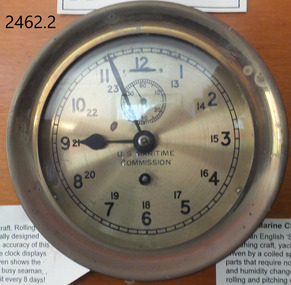
Clocks, 1939-1946
... navy’s during the Second World War. The item is a part of our social history that reminds us of these dark times. The loses of family members, along with the trauma that many sailors had endured and had to live with for the rest of their lives once they were released from service and allowed to go home. flagstaff hill warrnambool shipwrecked-coast flagstaff-hill flagstaff-hill-maritime-museum maritime-museum shipwreck-coast flagstaff-hill-maritime-village clock us maritime commission chelsea clock company horology maratime clock The clock is an 8 day marine clock with US Maritime Commission inscribed on face in black lettering. ...Chelsea Clock Company History: The Chelsea Clock Company is an American clock manufacturing company that started before 1880 with Joseph Henry Eastman who founded the Harvard Clock Company and produced 800 clocks of marine, carriage, shelf and banjo types. He went on to change the company name to the Boston Clock Company in 1884. After several name changes in 1897, the Chelsea Clock Company was finally founded. Clocks produced by Chelsea Clock Company have been found in the White House, on US Naval Ships, and in homes and offices around the world. After the company first began life as the Harvard Clock Company, it was named the Boston Clock Company, the Eastman Clock Company before finally becoming the Chelsea Clock Company in July of 1897. The company had developed many patents and innervations over these years and between 1939 and 1946 during World War II they were awarded contracts by the U.S Maritime Commission and produced vast numbers of clocks for both merchant and naval ships. U.S Maritime Commission History: The United States Maritime Commission (MARCOM) was an independent executive agency of the U.S. federal government that was created by the Merchant Marine Act of 1936, and replaced the United States Shipping Board which had existed since World War I. It was intended to formulate a merchant shipbuilding program to design and build five hundred modern merchant cargo ships to replace the World War I vintage vessels that comprised the bulk of the United States Merchant Marine, and to administer a subsidy system authorized by the Act to offset the cost differential between building in the U.S. and operating ships under the American flag. It also formed the United States Maritime Service for the training of seagoing ship's officers to man the new fleet. The purpose of the Maritime Commission was to formulate a merchant shipbuilding program to design and then have built over a ten-year period 900 modern fast merchant cargo ships which would replace the World War I-vintage vessels Those ships were intended to be then leased to U.S. shipping companies for their use in the foreign seagoing trades the aim was to offer better and more economical freight services. The ships were also intended to serve as a reserve naval auxiliary force in the event of armed conflict which was a duty the U.S. merchant fleet had often filled throughout the years since the Revolutionary War. From 1939 through the end of World War II, the Maritime Commission funded and administered the largest and most successful merchant shipbuilding effort in world history, producing ships for both navy and merchant marine. By the end of the war, U.S. shipyards working under Maritime Commission contracts had built a total of 5,777 ocean-going merchant and naval ships. In early 1942 both the training and licensing was transferred to the U.S. Coast Guard for administration, then later to the Maritime Service final responsibility was conveyed to the newly created War Shipping Administration which was created to oversee the operation of merchant ships being built by the Emergency Program to meet the needs of the U.S. Armed Services. With the end of World War II, both the Emergency and Long Range shipbuilding programs were terminated as there were far too many merchant vessels now for the Nation's peacetime needs. In 1946, the Merchant Ship Sales Act was passed to sell off a large portion of the ships built during the war to commercial buyers, both domestic and foreign. The U.S Maritime Commission was officially disbanded on May 24th 1950. These clocks were to be found on all ships made in American for the war effort between 1939 and 1946. They are a significant reminder of the sacrifice by those who served in the merchant marine and the navy’s during the Second World War. The item is a part of our social history that reminds us of these dark times. The loses of family members, along with the trauma that many sailors had endured and had to live with for the rest of their lives once they were released from service and allowed to go home.American Clock is an 8-day marine clock made by the Chelsea clock Co for the “US Maritime Commission” . There is a second smaller dial for the seconds and 24-hour markings. Also a fast-slow adjuster to the top of the dial. The clock is an 8 day marine clock with US Maritime Commission inscribed on face in black lettering. flagstaff hill, warrnambool, shipwrecked-coast, flagstaff-hill, flagstaff-hill-maritime-museum, maritime-museum, shipwreck-coast, flagstaff-hill-maritime-village, clock, us maritime commission, chelsea clock company, horology, maratime clock -
 Federation University Historical Collection
Plan, White Horse Range Ballarat, 1885, 06/1885
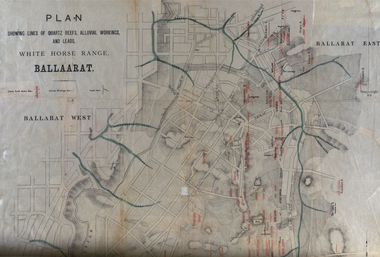
... Leads include: Navy jacks, Gays, Canadian, Prince Regent, Sailors Gully, White Horse, Little White Horse, Milkmans, Nightingale, Golden Point, Gravel Pits. ...Leads include: Navy jacks, Gays, Canadian, Prince Regent, Sailors Gully, White Horse, Little White Horse, Milkmans, Nightingale, Golden Point, Gravel Pits. ...Two plans .1) Plan of the Ballarat Goldfields showing leads, rivers, streets and topography. Quartz reefs include: Yorkshire, Try Again, Promised Land, Western Slates, Norwegian, Robert's Lode, Finn's, Band and albion, Rothschild, Old Post Office, Queen Lode. Leads include: Navy jacks, Gays, Canadian, Prince Regent, Sailors Gully, White Horse, Little White Horse, Milkmans, Nightingale, Golden Point, Gravel Pits. Scale is 8 Chains to 1 inch .2) Plan showing lines of quartz reefs, alluvial workings and leads, White Horse Range, Ballarat. Leads include White Horse LEad, Little White Horse Lead, One Eye Gully, Terrible Lead, Sailor's Gully, Canadian Lead, Prince Regent Gully, Canadian Lead, Cavs Lead, Navy jacks Lead, Eureka Lead, Old Gravel Pits Lead, Gravel Pits Lead, Nightingale Lead, Malakoff Lead, Milkmans Lead, Redan Lead, Woolshed Lead, Jacksons Lead, Winters Lead, SCtochman's Lead, Canadian Lead. Reefs include: Promised Land, Daniash, Sir Garnet Wolsley, Norwegian, Rothschile, Band and Albion, Finns, Llanberis, Roberts Lode, Tynworths and Black Hill, Oregan, Yorkshire, Try Again, Yorkshire, Post Office, Clarke's, Western Slates, Black Slate, Danks Slates, Eastern Slates, Queen's Lode, Fire Brigade. Mines include Red Streak, New Chum, Tinworths, Woah Hawp, Normanby, Speedwell, Llanberris Extended, Llanberis, Last Chance, Major, Countess, Pioneer and a number of batteries along Main Road Hills include: Mount Clear, Pennyweight Hill, Sovereign Hillballarat, plan, white horse range, white horse, goldfields, mines, reefs, indicators, leigh river, cgt, tinworth, mining -
 Flagstaff Hill Maritime Museum and Village
Domestic object - Can Opener, Bottle Opener & Corkscrew
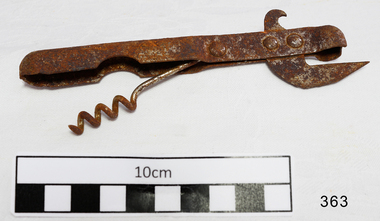
... navy. The canning process, with its hours of boiling and steaming, its scrupulous cleanliness, its heated metal, and its need for a great deal of disposable material, made canned food far too expensive for anyone but the military. No can openers were needed or even possible. The metal of early cans was too thick to make openers practical. Soldiers and sailors...navy. The canning process, with its hours of boiling and steaming, its scrupulous cleanliness, its heated metal, and its need for a great deal of disposable material, made canned food far too expensive for anyone but the military. No can openers were needed or even possible. The metal of early cans was too thick to make openers practical. Soldiers and sailors ...It took 15 years to invent the can. It took 100 more to invent a standard way to open it. In the 19th century, decades after the invention of canning, there were virtually no can openers. Canned food, such as sardines, came with its own "key" to peel back the tin lid. Birth of the can One of the oddest things about the can opener is that the can predates it by almost 150 years. Though common today, cans were once military-grade technology. In 1795, Napoleon, to whom the phrase "an army marches on its stomach" is attributed, offered 12,000 francs to anyone who could find a way to preserve food. Without any knowledge of bacteria or their role in food spoilage, scientists didn't even know where to begin. It took 15 years before a chef named Nicholas Appert claimed the prize after successfully jarring food. Soon after that, his countryman Philippe de Girard came up with a variant on Appert's method—metal tins—and sold the idea to the British. Spoiled food, and the sickness it caused, was a widespread problem. The public would have benefited from canned food, but for decades cans were almost exclusively for the army and the navy. The canning process, with its hours of boiling and steaming, its scrupulous cleanliness, its heated metal, and its need for a great deal of disposable material, made canned food far too expensive for anyone but the military. No can openers were needed or even possible. The metal of early cans was too thick to make openers practical. Soldiers and sailors had plenty of sharp objects on hand and made ample use of them when they wanted to eat. During the 19th century, the process of canning was refined and mechanised, and the metal wall of the average can slimmed down enough that a civilian could get it open—if that civilian had the right tool. No one had that tool yet, so early cans had to open themselves. In other words, they came with built-in openers. The result was a confusing but pleasing free-for-all, in terms of product engineering. Each type of food came with its own kind of can, and each kind of can came with its own kind of opener. Tinned fish and meat were often sold in rectangular cans. These cans were fitted with a "key" that would roll down the top of the can. Coffee, beans, and other types of meat were packaged in cylinders with metal strips that could be peeled back with their own kinds of built-in keys. Cans of milk, which didn't need to be completely opened, came with puncture devices. As tinned food became more common, its containers became more regular. A nice cylindrical can became the norm, and, as these cans filled kitchens, more engineers put their minds to finding a convenient way to open all of them. The first standalone can opener worked on a simple principle: point, stab, and pull. From the mid-19th century to the end of World War I, the typical can opener looked roughly like a wrench, if the lower 'jaw' of the wrench were replaced with a blade. People used the blade to puncture the top of the can near its edge, push the upper jaw against the side of the can, and drag the blade through the metal along the rim. Because meat was the first and most popular canned substance, these can openers were often shaped to look like cows and given the nickname 'bully beef can openers'. The bully beef can opener, popular in the mid-19th century, resulted in many lost fingers. Later, a corkscrew was added that was seated in the handle, and could be pulled out for use. Bully beef can openers were so common, effective, and sturdy that they are still frequently available on collectors' sites. Some are advertised as “still working,” and every last one of them is, without a doubt, soaked in the blood of our ancestors. Dragging a sharp blade along the edge of a can is certain to cause injury sooner or later. So once people got a reliable can shape and a reliable way to get the can open, the search was on for a reliable way to get a can open without the possibility of losing a finger. The answer came in 1925, from the Star Can Opener Company of San Francisco. This is probably the first can opener that resembles the one people have in their kitchens today. Instead of using a blade to pry open a metal can, buyers could clamp the edge of the can between two wheels and twist the handle of one of the wheels to move the blade around the lip. The Star can openers weren't perfect. Compared to the bully beef model, they were flimsy and breakable, but they probably prevented a few injuries. Six short years after the Star model came to market, the first electric can opener was invented. It was patented in 1931 by the Bunker Clancey Company of Kansas City, who had already been sued by the Star Can Opener Company for trying sell a double-wheeled can opener like the Star model (the case was dismissed). The electric can opener must have seemed like the wave of the future and a sure-fire seller, but it proved to be too far ahead of its time. In 1931 not that many households had electricity, and those that did weren't interested in buying can openers. The Bunker Clancey Company was subsequently bought by the Rival Company, which still makes small appliances like can openers today. It took another 25 years for electrically powered can openers to become practical. In the 1950s, Walter Hess Bodle and his daughter, Elizabeth Bodle, developed an electric can opener in the family garage. Walter came up with the opener's blades and motor, and Elizabeth sculpted the outside. Their can opener was a free-standing unit that could sit on the kitchen counter. The Udico brand of the Union Die Casting Company put it on the market in time for Christmas in 1956 and had great success with it. Over the next few years it came out in different styles and colours, and, like the bully beef can opener, has become a collector's item. Also like the bully beef model, Udico can openers often still work. They don't make 'em like they used to. Although there have been some design changes and refinements over the last sixty years, there have yet to be any more leaps forward in can opener technology. If you're resentfully opening a can, you are almost certainly doing it using the Star design, manually forcing the can between two wheels, or the Bodle design, clamping the can into a free-standing electrical opener. Whether or not you enjoy your holiday meals, at least you can be happy that you are not getting poisoned by your own food or cutting open your hand with the blade you use to get at it. That's something, right?The can opener, Bottle opener and the corkscrew are still very important and essential items in most kitchens.Metal can opener, chromed, with bottle opener, and a corkscrew seated in the handle.None.flagstaff hill, warrnambool, shipwrecked-coast, flagstaff-hill, flagstaff-hill-maritime-museum, maritime-museum, shipwreck-coast, flagstaff-hill-maritime-village, canning, can opener, corkscrew, bottle opener, kitchen equipment -
 Flagstaff Hill Maritime Museum and Village
Domestic object - Can Opener
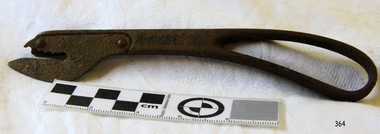
... navy. The canning process, with its hours of boiling and steaming, its scrupulous cleanliness, its heated metal, and its need for a great deal of disposable material, made canned food far too expensive for anyone but the military. No can openers were needed or even possible. The metal of early cans was too thick to make openers practical. Soldiers and sailors...navy. The canning process, with its hours of boiling and steaming, its scrupulous cleanliness, its heated metal, and its need for a great deal of disposable material, made canned food far too expensive for anyone but the military. No can openers were needed or even possible. The metal of early cans was too thick to make openers practical. Soldiers and sailors ...It took 15 years to invent the can. It took 100 more to invent a standard way to open it. In the 19th century, decades after the invention of canning, there were virtually no can openers. Canned food, such as sardines, came with its own "key" to peel back the tin lid. Birth of the can One of the oddest things about the can opener is that the can predates it by almost 150 years. Though common today, cans were once military-grade technology. In 1795, Napoleon, to whom the phrase "an army marches on its stomach" is attributed, offered 12,000 francs to anyone who could find a way to preserve food. Without any knowledge of bacteria or their role in food spoilage, scientists didn't even know where to begin. It took 15 years before a chef named Nicholas Appert claimed the prize after successfully jarring food. Soon after that, his countryman Philippe de Girard came up with a variant on Appert's method—metal tins—and sold the idea to the British. Spoiled food, and the sickness it caused, was a widespread problem. The public would have benefited from canned food, but for decades cans were almost exclusively for the army and the navy. The canning process, with its hours of boiling and steaming, its scrupulous cleanliness, its heated metal, and its need for a great deal of disposable material, made canned food far too expensive for anyone but the military. No can openers were needed or even possible. The metal of early cans was too thick to make openers practical. Soldiers and sailors had plenty of sharp objects on hand and made ample use of them when they wanted to eat. During the 19th century, the process of canning was refined and mechanised, and the metal wall of the average can slimmed down enough that a civilian could get it open—if that civilian had the right tool. No one had that tool yet, so early cans had to open themselves. In other words, they came with built-in openers. The result was a confusing but pleasing free-for-all, in terms of product engineering. Each type of food came with its own kind of can, and each kind of can came with its own kind of opener. Tinned fish and meat were often sold in rectangular cans. These cans were fitted with a "key" that would roll down the top of the can. Coffee, beans, and other types of meat were packaged in cylinders with metal strips that could be peeled back with their own kinds of built-in keys. Cans of milk, which didn't need to be completely opened, came with puncture devices. As tinned food became more common, its containers became more regular. A nice cylindrical can became the norm, and, as these cans filled kitchens, more engineers put their minds to finding a convenient way to open all of them. The first standalone can opener worked on a simple principle: point, stab, and pull. From the mid-19th century to the end of World War I, the typical can opener looked roughly like a wrench, if the lower 'jaw' of the wrench were replaced with a blade. People used the blade to puncture the top of the can near its edge, push the upper jaw against the side of the can, and drag the blade through the metal along the rim. Because meat was the first and most popular canned substance, these can openers were often shaped to look like cows and given the nickname 'bully beef can openers'. The bully beef can opener, popular in the mid-19th century, resulted in many lost fingers. Bully beef can openers were so common, effective, and sturdy that they are still frequently available on collectors' sites. Some are advertised as “still working,” and every last one of them is, without a doubt, soaked in the blood of our ancestors. Dragging a sharp blade along the edge of a can is certain to cause injury sooner or later. So once people got a reliable can shape and a reliable way to get the can open, the search was on for a reliable way to get a can open without the possibility of losing a finger. The answer came in 1925, from the Star Can Opener Company of San Francisco. This is probably the first can opener that resembles the one people have in their kitchens today. Instead of using a blade to pry open a metal can, buyers could clamp the edge of the can between two wheels and twist the handle of one of the wheels to move the blade around the lip. The Star can openers weren't perfect. Compared to the bully beef model, they were flimsy and breakable, but they probably prevented a few injuries. Six short years after the Star model came to market, the first electric can opener was invented. It was patented in 1931 by the Bunker Clancey Company of Kansas City, who had already been sued by the Star Can Opener Company for trying sell a double-wheeled can opener like the Star model (the case was dismissed). The electric can opener must have seemed like the wave of the future and a sure-fire seller, but it proved to be too far ahead of its time. In 1931 not that many households had electricity, and those that did weren't interested in buying can openers. The Bunker Clancey Company was subsequently bought by the Rival Company, which still makes small appliances like can openers today. It took another 25 years for electrically powered can openers to become practical. In the 1950s, Walter Hess Bodle and his daughter, Elizabeth Bodle, developed an electric can opener in the family garage. Walter came up with the opener's blades and motor, and Elizabeth sculpted the outside. Their can opener was a free-standing unit that could sit on the kitchen counter. The Udico brand of the Union Die Casting Company put it on the market in time for Christmas in 1956 and had great success with it. Over the next few years it came out in different styles and colours, and, like the bully beef can opener, has become a collector's item. Also like the bully beef model, Udico can openers often still work. They don't make 'em like they used to. Although there have been some design changes and refinements over the last sixty years, there have yet to be any more leaps forward in can opener technology. If you're resentfully opening a can, you are almost certainly doing it using the Star design, manually forcing the can between two wheels, or the Bodle design, clamping the can into a free-standing electrical opener. Whether or not you enjoy your holiday meals, at least you can be happy that you are not getting poisoned by your own food or cutting open your hand with the blade you use to get at it. That's something, right?The can opener is still a very important and essential item in most kitchens.Can opener, right handed, metal, upper blade section serrated, inscription 'Peerless Pat.Feb 11-90'.Peerless Pat.Feb 11-90flagstaff hill, warrnambool, shipwrecked-coast, flagstaff-hill, flagstaff-hill-maritime-museum, maritime-museum, shipwreck-coast, flagstaff-hill-maritime-village, cannning, can opener, kitchen equipment -
 Flagstaff Hill Maritime Museum and Village
Uniform - Sailor's Collar, Early to mid-20th century
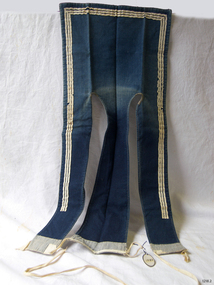
... Sailors in the Royal Australian Navy wore collars of this design from the early 20th century. ...Sailor's collar. A square collar of blue cotton fabric with three flaps or strips. Three white stripes make a border on the outside edges and two flaps; the centre flap that has no stripes. There is an inscription. The underside is lined with white cotton fabric that has thin blue stripes. Tapes are attached for fastening the collar. The Royal Australian Navy... collar represents the uniform of a rating sailor in the Royal Australian Navy in the early to mid-20th century, connecting it to the maritime history of Australia and the evolution of the uniform of the navy. ...This sailor's collar is part of a naval uniform. It once belonged to R S Wallace, who served in the RAN (Royal Australian Navy) and on the HMAS Warrnambool for three years. After the war he made several ship models including the sailing ship Cutty Sark. From January 1857 the Australian Navy uniform was formally established. The uniform, referred to as a 'sailor's suit', includes a blue flap collar such as this one. Sailors in the Royal Australian Navy wore collars of this design from the early 20th century. The rating personnel of the Royal Canadian Navy were issued with a very similar collar from 1910 to the 1950s. The blue denim collars were buttoned or died inside their tops with the back and the striped portion of the front flaps showing.The square sailor's collar represents the uniform of a rating sailor in the Royal Australian Navy in the early to mid-20th century, connecting it to the maritime history of Australia and the evolution of the uniform of the navy. The collar is the only one in this museum's collection and is connected to a sailor who service in the RAN on the HMAS Warrnambool for three years.Sailor's collar. A square collar of blue cotton fabric with three flaps or strips. Three white stripes make a border on the outside edges and two flaps; the centre flap that has no stripes. There is an inscription. The underside is lined with white cotton fabric that has thin blue stripes. Tapes are attached for fastening the collar. The Royal Australian Navy collar once belonged to R S Wallace."R.S. Wallace"flagstaff hill, flagstaff hill maritime museum and village, warrnambool, maritime museum, maritime village, great ocean road, shipwreck coast, sailor’s collar, sailor’s uniform, uniform, military, navy, ran, royal australian navy, r s wallace, seamen's collar, australian defence forces, naval force, sailor's rig, flap collar, naval collar, robert s wallace, collar, sailor's uniform, world war, hmas warrnambool, sailor's suit -
 Mission to Seafarers Victoria
Magazine - Bimonthly, Navy Days. See the ships - Meet the Men, 1953
... The item came from the collection of a merchant sailor who presumably visited the Portsmouth open day in 1953. The booklet reveals much about the traditions of the Royal Navy and the ships on display. ...The item came from the collection of a merchant sailor who presumably visited the Portsmouth open day in 1953.The booklet reveals much about the traditions of the Royal Navy and the ships on display. It presents a picture from time. A 36-page magazine designed for the Royal Nay's open days on April 4, 5 and 6, 1953, at Portsmouth.Portsmouth Programme. Easter 1953.booklet, royal navy, ships, portsmouth, allan quinn -
 Mission to Seafarers Victoria
Album - Photographic album, Allan Charles Quinn
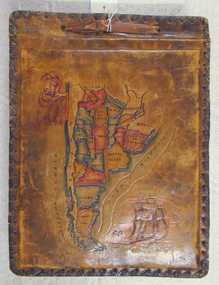
... navy. The album and photos give a view of Quinn's trips around the world and the many places he visited. album photos allan quinn tourism seafarers sailors seamen ships The cover contains the map of South America with a picture of a man with a pipe in his mouth in the top left-hand corner and a picture of a sailing ship in the bottom right. ...This photo album documents the voyage of Allan Quinn while he was in the merchant navy. The album and photos give a view of Quinn's trips around the world and the many places he visited. Leather-bound photo album. Cover is embossed with a colour map of South America.The cover contains the map of South America with a picture of a man with a pipe in his mouth in the top left-hand corner and a picture of a sailing ship in the bottom right. The inside front cover lists in handwritten columns: ports of call during 1947-48. There are three loose photos inside the front cover. album, photos, allan quinn, tourism, seafarers, sailors, seamen, ships -
 Mission to Seafarers Victoria
Container - Box, The Missions to Seamen Christmas Greetings 1943, 1943
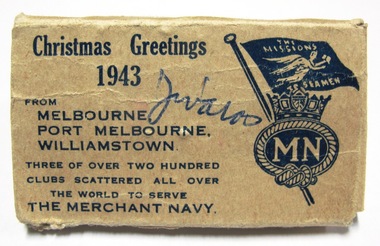
... The gift was sent by Mariner Merrylees to sister Marjorie in Manitoulin Island, Canada This everyday practical object represents in its function an acknowledgement by the Mission to Seamen organisation of the need for sailors and seafarers to stay in touch with friends and family at Christmas time and this sample box of a wartime Christmas marks a particularly difficult time in history for seafarers to stay in touch and connected with loved ones. cardboard box christmas gift mission to seamen bracelet canada manatoulin island seamen's mission mission to seafarers 1943 ww2 christmas siblings melbourne port melbourne williamstown coins robert leighton marjorie merrylees mn merchant navy Top side of the box, Christmas Greetings/1943/FROM/MELBOURNE/PORT MELBOURNE/WILLIAMSTOWN/THREE OF OVER TWO HUNDRED/CLUBS SCATTERED ALL OVER/THE WORLD TO SERVE/THE MERCHANT NAVY. ...The box was presumably made in Australia to be used as a gift container for Christmas gifts or greetings by people associated with the Mission or their acquaintances or family members. The box is dated and has the Mission to Seamen logo and description as a promotional way to describe and inform people of the Mission's purpose. The gift was sent by Mariner Merrylees to sister Marjorie in Manitoulin Island, CanadaThis everyday practical object represents in its function an acknowledgement by the Mission to Seamen organisation of the need for sailors and seafarers to stay in touch with friends and family at Christmas time and this sample box of a wartime Christmas marks a particularly difficult time in history for seafarers to stay in touch and connected with loved ones.Cardboard beige rectangular box in a small size, with blue stamped inscriptions on it detailing promotional information about The Missions To Seamen. The object also has a blue hand written inscription on it on the top side and also another hand written inscription at the back side detailing the recipient’s name "Marjorie". This object was sent to recipient with a coin bracelet inside (Reference: 600.2). Top side of the box, Christmas Greetings/1943/FROM/MELBOURNE/PORT MELBOURNE/WILLIAMSTOWN/THREE OF OVER TWO HUNDRED/CLUBS SCATTERED ALL OVER/THE WORLD TO SERVE/THE MERCHANT NAVY. Top right side of the box a flag crown and attached cord logo image, THE MISSIONS TO SEAMEN/MN Hand written inscription top side of the box, Jivaros Hand written underlined inscription back side of the box, for Marjoriecardboard box, christmas gift, mission to seamen, bracelet, canada, manatoulin island, seamen's mission, mission to seafarers, 1943, ww2, christmas, siblings, melbourne, port melbourne, williamstown, coins, robert leighton, marjorie merrylees, mn, merchant navy -
 Mission to Seafarers Victoria
Card - Invitation card, The Victoria Missions to Seamen, 1959
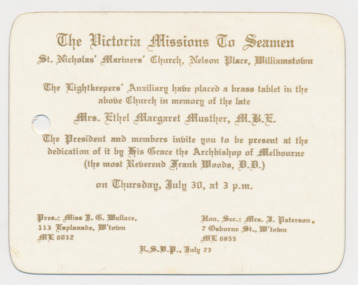
... Navy. They had two daughters: Rosamund Janet Musther(born 1903) and Nanoya Gwendoline Musther (born 1906). She was the principal of the Ladies' College in Footscray. She was involved in many philantropic associations especially for sailors...Navy. They had two daughters: Rosamund Janet Musther(born 1903) and Nanoya Gwendoline Musther (born 1906). She was the principal of the Ladies' College in Footscray. She was involved in many philantropic associations especially for sailors ...A Williamstown local, Ethel Margaret Musther nee Barber (1872-1956) was the daughter of Captain John Henry Barber (1842-1924), a sea pilot and Janet Lidell (1846-1891) Her grandfather, Captain Lidell, was also a seaman. In 1900, she married Nathan George Musther,(18..-1933) a chemist, and dentist in the Navy. They had two daughters: Rosamund Janet Musther(born 1903) and Nanoya Gwendoline Musther (born 1906). She was the principal of the Ladies' College in Footscray. She was involved in many philantropic associations especially for sailors but also during WWI and WW2. She worked for the Anzac Club, the Red Cross, She formed: 1941: the R.A.N. Friendly Union of Sailor's Wives and Mothers. 1943: the Lightkeepers Auxiliary to help the Mission raised funds. The plaque was a gift of the Lightskeeper Auxiliaire and unveiled on 30 July 1959 at the St Nicholas Chapel, by her eldest daughter, Mrs Jean McDonald.It was originally on stained and polished hardwood mount made by Mrs Murdoch (AR1959, page 24). On the day, a desk service-book was also dedicated in memory of Dr John Thompson at the request of his daughter, Mrs Sparrow.In early 1943, Ethel Margaret Musther formed the Lightkeepers' Auxiliaire and raised funds for the third building purchased for the Williamstown branch of the Victorian Seamen's Mission, the former E,S & A Bank. Thanks to her philanthropic work, she was rewarded with a Medal of the British Empire in 1953 for all her charitable work.Invitation card to the dedication of a brass plaque in memory of Ethel Margaret Mustherethel margaret musther, st nicholas' mariners' chapel, nelson place, williamstown, lightkeepers' auxiliary -
 Mission to Seafarers Victoria
Booklet - Chapel service, The Victoria Missions to Seamen, Dedication of Ethel Musther, 1959
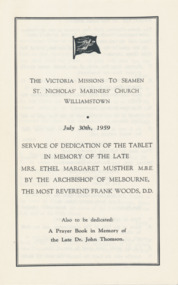
... Navy. They had two daughters: Rosamund Janet Musther(born 1903) and Nanoya Gwendoline Musther (born 1906). She was the principal of the Ladies' College in Footscray. She was involved in many philantropic associations especially for sailors...Navy. They had two daughters: Rosamund Janet Musther(born 1903) and Nanoya Gwendoline Musther (born 1906). She was the principal of the Ladies' College in Footscray. She was involved in many philantropic associations especially for sailors ...A Williamstown local, Ethel Margaret Musther nee Barber (1872-1956) was the daughter of Captain John Henry Barber (1842-1924), a sea pilot and Janet Lidell (1846-1891) Her grandfather, Captain Lidell, was also a seaman. In 1900, she married Nathan George Musther,(18..-1933) a chemist, and dentist in the Navy. They had two daughters: Rosamund Janet Musther(born 1903) and Nanoya Gwendoline Musther (born 1906). She was the principal of the Ladies' College in Footscray. She was involved in many philantropic associations especially for sailors but also during WWI and WW2. She worked for the Anzac Club, the Red Cross, She formed: 1941: the R.A.N. Friendly Union of Sailor's Wives and Mothers. 1943: the Lightkeepers Auxiliary to help the Mission raised funds. The plaque was a gift of the Lightskeeper Auxiliaire and unveiled on 30 July 1959 at the St Nicholas Chapel, by her eldest daughter, Mrs Jean McDonald. It was originally on stained and polished hardwood mount made by Mrs Murdoch (AR1959, page 24). On the day, a desk service-book was also dedicated in memory of Dr John Thompson at the request of his daughter, Mrs Sparrow.In early 1943, Ethel Margaret Musther formed the Lightkeepers' Auxiliaire and raised funds for the third building purchased for the Williamstown branch of the Victorian Seamen's Mission, the former E,S & A Bank. Thanks to her philanthropic work, she was rewarded with a Medal of the British Empire in 1953 for all her charitable work.Folded booklet on creamy colour paper and black inkethel margaret musther, st nicholas' mariners' chapel, nelson place, williamstown, lightkeepers' auxiliary, dr john thompson -
 Mission to Seafarers Victoria
Plaque - Memorial Plaque, Ethel Margaret Musther, 1959
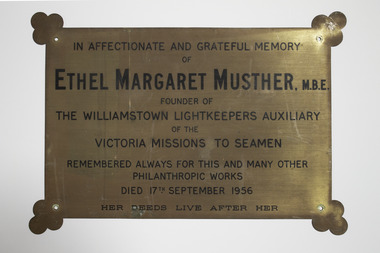
... Navy. They had two daughters: Rosamund Janet Musther(born 1903) and Nanoya Gwendoline Musther (born 1906). She was the principal of the Ladies' College in Footscray. She was involved in many philantropic associations especially for sailors...Navy. They had two daughters: Rosamund Janet Musther(born 1903) and Nanoya Gwendoline Musther (born 1906). She was the principal of the Ladies' College in Footscray. She was involved in many philantropic associations especially for sailors ...A Williamstown local, Ethel Margaret Musther nee Barber (1872-1956) was the daughter of Captain John Henry Barber (1842-1924), a sea pilot and Janet Lidell (1846-1891) Her grandfather, Captain Lidell, was also a seaman. In 1900, she married Nathan George Musther,(18..-1933) a chemist, and dentist in the Navy. They had two daughters: Rosamund Janet Musther(born 1903) and Nanoya Gwendoline Musther (born 1906). She was the principal of the Ladies' College in Footscray. She was involved in many philantropic associations especially for sailors but also during WWI and WW2. She worked for the Anzac Club, the Red Cross, She formed: 1941: the R.A.N. Friendly Union of Sailor's Wives and Mothers. 1943: the Lightkeepers Auxiliary to help the Mission raised funds. The plaque was a gift of the Lightskeeper Auxiliaire and unveiled on 30 July 1959 at the St Nicholas Chapel, by her eldest daughter, Mrs Jean McDonald. It was originally on stained and polished hardwood mount made by Mrs Murdoch (AR1959, page 24). On the day, a desk service-book was also dedicated in memory of Dr John Thompson at the request of his daughter, Mrs Sparrow.In early 1943, Ethel Margaret Musther formed the Lightkeepers' Auxiliaire and raised funds for the third building purchased for the Williamstown branch of the Victorian Seamen's Mission, the former E,S & A Bank. Thanks to her philanthropic work, she was rewarded with a Medal of the British Empire in 1953 for all her charitable work. Large rectangular with decorative clover corner Engraved: "In affectionnante and grateful memory / of / Ethel Margaret Musther, M.B.E. / Founder of / The Williamstown Lightkeepers Auxiliary / Of the / Victoria Missions to Seamen / Remembered always for this and many other / Philantropic works / Died 17th of September 1956 / Her deeds live after her.1956, ethel margaret musther, m.b.e., medal of the british empire, 1953, lightkeepers' auxiliary, williamstown, seamen's mission -
 Mission to Seafarers Victoria
Book, Ian Dear, The Tattie Lads, The untold story of the Rescue Tug Service in two world wars and its battles to save cargoes, ships and lives, 2016
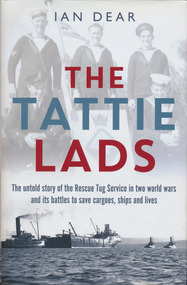
... sailors ww2 world war 2 merchant navy second world war australia gunner tug boat wwi first world war great war The Tattie Lads, The untold story of the Rescue Tug Service in two world wars and its battles to save cargoes, ships and lives Book Ian Dear ...non-fictionsailors, ww2, world war 2, merchant navy, second world war, australia, gunner, tug boat, wwi, first world war, great war -
 Mission to Seafarers Victoria
Photograph - Photograph, Sepia, Mr and Mrs Gurney Goldsmith, Picnic at Orchard House, Cup Day 1909, 2 Novembre 1909
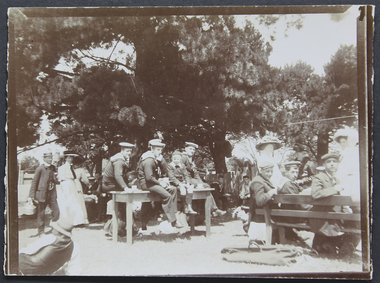
... George Higgins and the Malvern members of the Ladies' Harbour Lights Guild entertained some 110 sailors from the Royal Navy and Merchant Service. A football match, sports, and "costume" races were indulged in by the more active members of the party, while others enjoyed the unusual pleasure of sitting on the green grass under the trees. ...George Higgins and the Malvern members of the Ladies' Harbour Lights Guild entertained some 110 sailors from the Royal Navy and Merchant Service. A football match, sports, and "costume" races were indulged in by the more active members of the party, while others enjoyed the unusual pleasure of sitting on the green grass under the trees. ...This photograph depicts a picnic for Cup Day (Tuesday 2 November 1909) organised by the Mission and the LHLG members at Orchard House. The property belongs to Mr George Higgins, engineer and his wife, Beatrice who was the LHLG Malvern branch secretary. Beatrice nee Shuter was the daughter of Charles Shuter. In the Punch published on 11 November 1909, we could read: "The pretty garden of "Orchard House," and the paddock adjoining (kindly lent by Mr. and Mrs. Singleton), was the scene on Cup Day of a most successful sailors' picnic, when Mr. and Mrs. George Higgins and the Malvern members of the Ladies' Harbour Lights Guild entertained some 110 sailors from the Royal Navy and Merchant Service. A football match, sports, and "costume" races were indulged in by the more active members of the party, while others enjoyed the unusual pleasure of sitting on the green grass under the trees. Mrs. MacLeod, Mrs. Knight, Mrs. Simon Fraser, Mrs. H. B. Higgins, Mrs. Albert Keep, Miss Ethel Godfrey, the Misses Wollaston, and a number of other ladies assisted to wait on the "tars." One "Jack," from H.M.S. Cambrian, voted it the "nicest day he had had since leaving the Old Country." Hearty cheers for the kind hostesses closed the proceedings. The evening was spent at the Institutes of the Missions to Seamen on the Australian Wharf and at Port Melbourne respectively, where prizes were distributed to the successful competitors. "Small monochrome photograph1909, malvern, cup day, mr george higgins, mce, beatrice elizabeth higgins (nee shuter), h.m.s. cambrian, ethel augusta godfrey, orchard house, ina higgins, rica godfrey, rita godfrey, reverend alfred gurney goldsmith, picnics, social events, frederica godfrey, entertainments, sailors, seafarers, seamen, goldsmith album
