
Showing 10 items matching "needle work tool"
-
 Embroiderers Guild, Victoria
Tool - Scissors
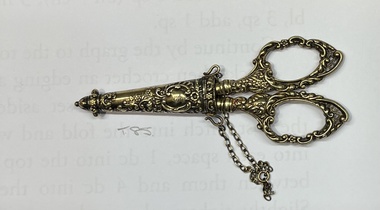
... Needle work tool...Decorative scissors with decorative sheath to protect fine points Needle work tool Flowers, leaves and scrolls. Pair of scissors with embossed silver gilt handles, with matching sheath. ...Decorative scissors with decorative sheath to protect fine pointsPair of scissors with embossed silver gilt handles, with matching sheath. Flowers, leaves and scrolls. needle work tool -
 Embroiderers Guild, Victoria
Tool - Scissors sheath
... Needle work tool...Decorative scissors with decorative sheath to protect fine points Needle work tool Flowers, leaves and scrolls. Decorative (matching scissors) sheath with chain loop Tool Scissors sheath ...Decorative scissors with decorative sheath to protect fine pointsDecorative (matching scissors) sheath with chain loop Flowers, leaves and scrolls. needle work tool -
 Flagstaff Hill Maritime Museum and Village
Textile - Twine, 20th century
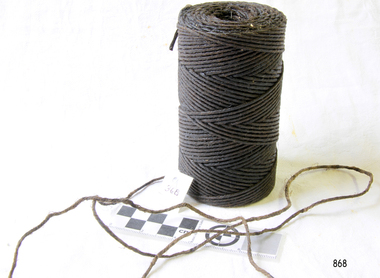
... work from fraying. Sailmakers use twine and needles to sew sails and many other canvas items such as bags and covers. Special tools...work from fraying. Sailmakers use twine and needles to sew sails and many other canvas items such as bags and covers. Special tools ...Sailmaker's twine is usually stored on a reel. It is wax coated and ready to use. The twine is made from strands of fibres that are plied together. The wax waterproofs the twine and smooths out the fine hairs of the fibres, making it easier to work with. The waxed twine helps prevent the ends of the rope work from fraying. Sailmakers use twine and needles to sew sails and many other canvas items such as bags and covers. Special tools, equipment, benches and seats are needed to work with the large heavy and thick pieces of canvas. Sometimes the sailmaker with have special-purpose tools made for his unique work. The place of work on shore is often called a sailmaker's loft. However, sailmakers also work on the job, on sailing ships and boats. This twine is an example imperative equipment for sailmakers. Sailmaking was an essential trade in the shipping industry of the 17th to 19th and early 20th centuries. Sailmakers were often part of a ship's crew, making repairs as needed and using their skills for other work such as net making.Twine; reel of brown waxed sailmaker's twine.warrnambool, shipwreck coast, flagstaff hill, flagstaff hill maritime museum, flagstaff hill maritime village, twine, waxed twine, sailmaker's twine, sailmaker's equipment, sailmaking, canvas work -
 Flagstaff Hill Maritime Museum and Village
Education kit - Knot Board, Tom Long, DSM (Member of International Guild of Knot Tyers), ca 1975 to 1986
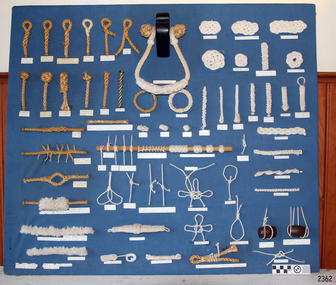
... work. The sailmakers, travelling as part of the ship’s crew, stored their tool kit in a canvas ditty bag. It contained needles...work. The sailmakers, travelling as part of the ship’s crew, stored their tool kit in a canvas ditty bag. It contained needles ...The Display Board of Konts was handmade in Kings Lynn, Devon, England, by Tom Long DSM, a member of the International Guild of Knot Tyers. Tom Long more recently lived in a suburb of Melbourne. This display board shows the knots and joins used in ropework performed by a sailmaker and other skilled knot tyers and ropeworkers. It demonstrates the uses of some of the knots, such as knobs and handles, suspending lengths of wood, reinforcing spliced rope and even for decorative work. The sailmakers, travelling as part of the ship’s crew, stored their tool kit in a canvas ditty bag. It contained needles, awls, a sailmaker’s leather-palmed glove with a heavily reinforced palm, a shuttle to mend and make nets, fids, knives, mallets, brushes, rulers, and rope gauges. Sailmakers used their ropework and knot-making skills for various purposes and chose the type of rope fibre for its particular properties. For example, Italian hemp rope was preferred for the light line used in shore-to-ship rescues because it was lightweight, not easily knotted, and absorbed less water. A supply of various types of rope was a commodity on board a ship and on land in the new colonies. It was flexible, easily stored, and could be worked to create an endless variety of objects on its own or with other materials like wood. An example is a simple rope ladder. Lengths could be combined to make various thicknesses, and pieces could be skilfully joined together by splicing. The importance of knots in seafaring cannot be overestimated. When ships relied on only the wind for power and speed, there were a huge number of various ropes in use, particularly about the sails and rigging. Seafarers would be judged on their ability to tie knots speedily and correctly. A mounted display of authentic seamen's knots is on a board covered in blue fabric. Various rope grades and fibres were used to work numerous knots and splices. Some of the uses are familiar, such as the toggle, the pineapple knot, and the Turk’s head. A selection of rope grades and fibres was used to work numerous knots and splices. Some of the uses are familiar, such as the toggle, the pineapple knot, and the Turk’s head. The name or purpose of the knot is on the label below it. Labels below each knot give its name or use.flagstaff hill, warrnambool, maritime museum, maritime village, great ocean road, shipwreck coast, knot display, knot making, ropework, marine technology, sailmaker's work, sailor's knots, ship's rigging, seamen's knots, handmade, rope craft, knots, splices, display board of knots, knot board, tom long, sailmaker's knots, mariner's knots -
 Geoffrey Kaye Museum of Anaesthetic History
Education kit - Model, Acupuncture
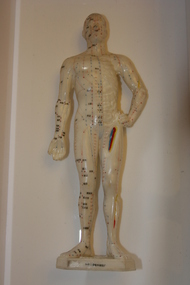
... tool for guiding acupuncturists in their work. Acupuncture Reference model Educational model White rubber human model, with acupuncture points annotated across the model. Stored in lidded in a brown cardboard box with a decorated envelope which presumably held acupuncture needles. ...This model is used as an educational or reference tool for guiding acupuncturists in their work.White rubber human model, with acupuncture points annotated across the model. Stored in lidded in a brown cardboard box with a decorated envelope which presumably held acupuncture needles.acupuncture, reference model, educational model -
 Embroiderers Guild, Victoria
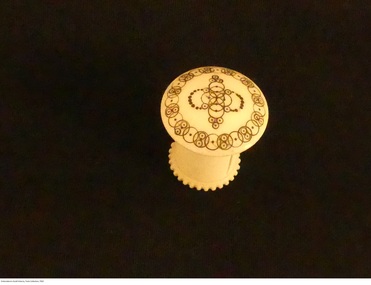
Tool - Ivory tape measure, 1840-1860's
... The style of decoration is similar to and maybe one of the Indian ivory sewing tools produced in Vizagapatam, East India Company factory. Exemplifies the hot needle decoration of madras work created in early 19th century in India and then copied in England Tape measure ivory Top is decorated with black border of interlocking circles with matching central motif. ...Decorative ivory needlework tools were prized possessions. The style of decoration is similar to and maybe one of the Indian ivory sewing tools produced in Vizagapatam, East India Company factory.Exemplifies the hot needle decoration of madras work created in early 19th century in India and then copied in EnglandIvory tape measure holder. mushroom shape, decorated with black incised border of interlocking circles with matching central motif. Body of case is decorated with 27 parallel lines and a vertical slit to allow tape to pass. Base has a cogged edging. Top is decorated with black border of interlocking circles with matching central motif. (Hot needle decoration)tape measure, ivory -
 Embroiderers Guild, Victoria
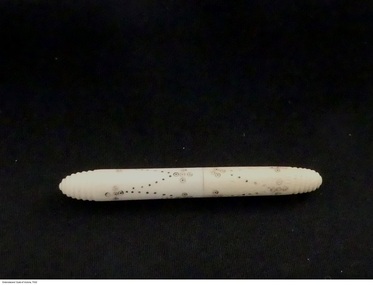
Tool - Ivory needle case, Needle case, 19th century
... needle work accessory to demonstrate owner's wealth This style of motifs was popular for carved needlework accessories in 19th century. Dots and circles are created by pressing hot coloured wax into dots and circles carved into the ivory. Needleholder Anglo_Indian Decorative style of black dots and circles now known as 'madras work' or 'dot and circle decoration. Cylindrical ivory needlecase with incised pattern of black circles and dots. Both ends have seven bands on the tapered ends. unscrews near the middle. Needle case Tool ...English ivory needlecase made when sewing needles when needles were expensiv - needle work accessory to demonstrate owner's wealthThis style of motifs was popular for carved needlework accessories in 19th century. Dots and circles are created by pressing hot coloured wax into dots and circles carved into the ivory. Cylindrical ivory needlecase with incised pattern of black circles and dots. Both ends have seven bands on the tapered ends. unscrews near the middle.Decorative style of black dots and circles now known as 'madras work' or 'dot and circle decoration. needleholder, anglo_indian -
 Federation University Art Collection
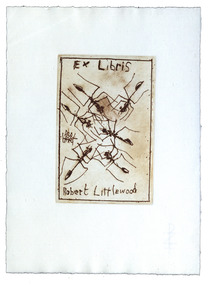
Work on paper - Bookplate, Hart, Pro, Bookplate for Robert Littlewood by Pro Hart, 1999
... needled by the artist using a make-shift tool cut from mild steel. This Bookplate is the subject of a small Private Press book written by Professor Karal Ann Marling (retired), of the University of Minnesota, to be published by The Lytlewode Press, 2010. Bookplate for Robert Littlewood by Pro Hart Work ...Pro (Kevin Charles) HART (30 May 1928 – 28 March 2006) Born Broken Hill, New South Wales Pro Hart drew upon a variety of techniques in his paintings, including layering, chiaroscuro, glazing, scumbling, scratching and Alla prima. Insects, particularly ants and dragonflies, are among Hart’s most popular and most identifiable images. This item is part of the Federation University Art Collection. The Art Collection features over 2000 works and was listed as a 'Ballarat Treasure' in 2007.Etched bookplate featuring ants. This is the only etched Bookplate Pro Hart created, and one of only two Ex Libris designs created by the artist. It was made in Broken Hill, New South Wales in 1999 for his friend Robert Littlewood. Printed on fine art paper in the intaglio method directly from the original copper plate. The plate was needled by the artist using a make-shift tool cut from mild steel. This Bookplate is the subject of a small Private Press book written by Professor Karal Ann Marling (retired), of the University of Minnesota, to be published by The Lytlewode Press, 2010.pro hart, ex libris, bookplate, robert littlewood, keith wingrove memorial trust, ant -
Embroiderers Guild, Victoria
Tool - Tunisian Crochet hooks
... needles in that they hold several active loops at once and these are worked in a technique which combines both knitting and crochet. Origins of the technique are not known but it was popular in Europe in 19th century Tunisian crochet is also known as Afghan crochet but the origins of the technique are lost. Tunisian Crochet hook Handcrafts-Needlework equipment Wooden Tunisian crochet hooks (2) with a hook on one end and knob on the other Tool ...Tunisian (or Afghan) hooks are similar to knitting needles in that they hold several active loops at once and these are worked in a technique which combines both knitting and crochet. Origins of the technique are not known but it was popular in Europe in 19th century Tunisian crochet is also known as Afghan crochet but the origins of the technique are lost.Wooden Tunisian crochet hooks (2) with a hook on one end and knob on the othertunisian crochet hook, handcrafts-needlework equipment -
Embroiderers Guild, Victoria
Tool - Tunisian Crochet hooks
... needles in that they hold several active loops at once and these are worked in a technique which combines both knitting and crochet. Origins of the technique are not known but it was popular in Europe in 19th century Tunisian crochet is also known as Afghan crochet but the origins of the technique are lost. Tunisian Crochet hook Handcrafts-Needlework equipment Wooden Tunisian crochet hooks (2) with a hook on one end and knob on the other Tool ...Tunisian (or Afghan) hooks are similar to knitting needles in that they hold several active loops at once and these are worked in a technique which combines both knitting and crochet. Origins of the technique are not known but it was popular in Europe in 19th century Tunisian crochet is also known as Afghan crochet but the origins of the technique are lost.Wooden Tunisian crochet hooks (2) with a hook on one end and knob on the othertunisian crochet hook, handcrafts-needlework equipment
