
Showing 4 items matching "negative pressure"
-
 Royal District Nursing Service (now known as Bolton Clarke)
Photograph - Photograph, black and white, c.1960
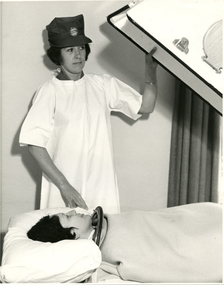
... mdns nursing care - negative pressure ventilator, 'iron lung'...In this photograph, the Sister is visiting the home of a lady who is confined to a Negative Pressured Ventilator, also known as an 'Iron Lung', which assists her to breathe. ...She is attending to a female patient who is lying in a Negative Pressure Ventilator in her home. The Sister is standing behind the Negative Pressure Ventilator, known as an 'Iron Lung', with her left arm extended holding the lid open. ...In this photograph, the Sister is visiting the home of a lady who is confined to a Negative Pressured Ventilator, also known as an 'Iron Lung', which assists her to breathe. ...This photograph depicts one of the forms of nursing care given by Melbourne District Nursing Service (MDNS), Sisters in the home of a patient. In this photograph, the Sister is visiting the home of a lady who is confined to a Negative Pressured Ventilator, also known as an 'Iron Lung', which assists her to breathe. The Sister gave both physical and emotional care to the patient, as well as support and advice to those who were caring for her. The Trained nurses of the Melbourne District Nursing Society (MDNS), later known as Royal District Nursing Service (RDNS), visited patients in their home and gave best practice care in many fields of nursing, and to people of many cultures, throughout its 130 years of expansion. Initial visits not only assessed the specific nursing situation but the situation as a whole. Their patients ranged in age from babes, children, adults to the elderly and referrals were taken from Hospitals, General Practitioners and allied Health facilities. Some of the care the Sisters provided is as follows: – Post-Natal care given to mother and babe, Wound Care following various types of surgery, accidents, burns, cancer, leg ulcers etc. Supervising and teaching Diabetic Care, including teaching and supervising people with Diabetes to administer their own Insulin, and administering Insulin to those unable to give their own injections. Administering other injections and setting up weekly medication boxes. The Sisters performed Catheterizations on adults suffering from conditions such as Quadriplegia, Paraplegia, Multiple Sclerosis (MS), Motor Neurone Disease (MND) and Guillan-Barre Syndrome, and when required at school on children for e.g. those with Spina Bifida. The Sisters visited those requiring Cystic Fibrosis support and care; those requiring Haemo-Oncology care, including visiting children at school; those requiring Home Enteral Feeding care, and those requiring IV therapy at home and home Dialysis. Palliative Care was given including pain relief with the use of syringe drivers, personal care as needed, and advice and support to both patient and family. The Sisters provided Stoma management to those needing Urostomy, Ileostomy and Colostomy care and those requiring Continence care. HIV/AIDS nursing care was provided; visits to Homeless Persons were made. Personal care was given to patients ranging in age and with varying mobility problems, such as those with MS, MND, Guillan-Barre Syndrome, Poliomyelistis, Quadriplegia, Paraplegia, Acquired Brain Injury, to those following a Cerebrovascular Accident (Stroke), those with severe Arthritis and those with a form of Dementia. When necessary the elderly were assisted with personal care and advice given on safety factors with the use of hand rails, bath or shower seats, and hand showers. Rehabilitation with an aim towards independence remained at the forefront of the Sister’s minds and when possible using aids and instruction on safe techniques enabled the person to become fully independent. All care included giving advice and support to the patient and their Carers. The Sisters liaised with the persons Doctor, Hospital and allied Health personal when necessary. Black and white photograph showing a Melbourne District Nursing Service (MDNS) Sister, who has short dark hair; is wearing a white gown over her uniform and her grey peaked hat with attached RDNS badge. She is attending to a female patient who is lying in a Negative Pressure Ventilator in her home. The Sister is standing behind the Negative Pressure Ventilator, known as an 'Iron Lung', with her left arm extended holding the lid open. The lady is in the foreground, and is lying with her head towards the left of the photograph. She has short dark hair and lies on the bed of the Ventilator with a neck ring visible. Her head is resting on a white covered pillow. Part of a dark coloured pleated curtain can be seen in the right hand side background of the photograph Photographer's stamp rdns, royal district nursing service, patient care, mdns, melbourne district nursing service, mdns nursing care - negative pressure ventilator, 'iron lung' -
 Geoffrey Kaye Museum of Anaesthetic History
Equipment - Draeger Pulmotor, c.1920
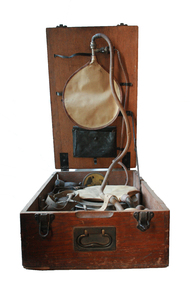
... ...Negative pressure...Expiration was an active process and gases were sucked from the lungs by negative pressure created by a Venturi effect. This device came with a facemask and harness, with a caution that the operator should take care to prevent air entering the stomach....Inspiratory Expiratory Pulmotor Negative pressure Draeger resuscitation kit, inside wooden case with handle. ...The Dräeger Pulmotor was developed in 1907. It addressed previous concerns about lung injury, by limiting both the inspiratory and expiratory pressures. Although still controversial, the Pulmotor was widely distributed and commercially successful. Oxygen from cylinders provided both the inspiratory gas flow and the driving mechanism. Expiration was an active process and gases were sucked from the lungs by negative pressure created by a Venturi effect. This device came with a facemask and harness, with a caution that the operator should take care to prevent air entering the stomach. Draeger resuscitation kit, inside wooden case with handle. Case contains small heavy gas cylinder with large beige handwritten 'S. M E' inscription on one side. Due to water damage case missing pieces of plywood in corner and floor of case bubbled and swollen.|Rubber decomposed rigid inspiratory, expiratory, pulmotor, negative pressure -
 Alfred Hospital Nurses League - Nursing History Collection
Equipment - Suction apparatus, Wangensteen suction apparatus, Unknown
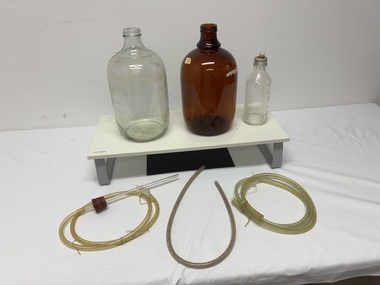
... The Wangensteen suction apparatus is a modified siphon used to maintain constant negative pressure to treat small bowel obstruction. ...The Wangensteen suction apparatus is a modified siphon used to maintain constant negative pressure to treat small bowel obstruction. ...The Wangensteen suction apparatus was developed by Owen Harding Wangensteen, the Chief of Surgery at the University of Minnesota. The Wangensteen suction apparatus is a modified siphon used to maintain constant negative pressure to treat small bowel obstruction. It is attached to a duodenal tube and relieves gastric and intestinal distention caused by retention of fluid. This is the only suction apparatus in the collection and was used by nurses when caring for some patients following bowel surgery. Two large glass flagons, one brown, one clear in colour. One 500 ml glass bottle with graduated markings and metal screw top lid with broken spigot glued into hole in lid. Three pieces of tubing, one with broken spigot inserted in one end, one with radio opaque markings and one with intact spigot in one end and rigid plastic tubing with bevelled end inserted through one hole of a two hole rubber bung. Brown glass flagon has raised printing on base - ISM 539, trade mark G over M above number, below number is 1, previous catalogue number on label on bottle and remnants of another label. Clear glass flagon has raised printing on base - IS 2013 with trade mark G over M above number, below number is 5. The 500 ml glass bottle has capital I on base with number 7 below I and unknown marking above I. DIN ml on neck of bottle, 100 - 500 graduated markings on body of bottle. wangensteen suction apparatus, bowel surgery, alfred hospital -
 Sunshine and District Historical Society Incorporated
Photograph - Newspower Newsagency 282 Hampshire Road Sunshine 1999 Photographs, Chris Scott, 5th May 1999
... pressure on day-to-day business operations within Sunshine's shopping precinct. Newspower Newsagency Hampshire Road Sunshine 7688.01 - Newspower Newsagency 282 Hampshire Road Sunshine 1999 Photographs (Advocate 191).JPG 7688.02 - Newspower Newsagency 282 Hampshire Road Sunshine 1999 Photographs (Advocate 191).JPG Collection of digitally scanned coloured negative Photograph Newspower Newsagency 282 Hampshire Road Sunshine 1999 Photographs Chris Scott Sunshine Advocate ...These photographs, taken by The Advocate in 1999, feature Phil Barkley, proprietor of Newspower Newsagency, located at 282 Hampshire Road, Sunshine. At the time, Phil Barkley was among a number of traders in Hampshire Road and nearby Devonshire Road who were voicing concerns about ongoing roadworks undertaken by the council. Local business owners argued that traffic congestion, restricted access, and prolonged construction activity were adversely affecting customer access and placing significant pressure on day-to-day business operations within Sunshine's shopping precinct. 7688.01 - Newspower Newsagency 282 Hampshire Road Sunshine 1999 Photographs (Advocate 191).JPG 7688.02 - Newspower Newsagency 282 Hampshire Road Sunshine 1999 Photographs (Advocate 191).JPG newspower newsagency, hampshire road, sunshine
