
Showing 8 items matching "network ten"
-
 Returned Nurses RSL Sub-branch
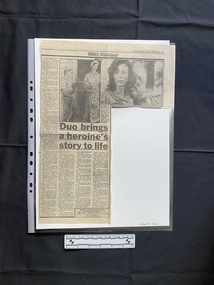
Newspaper - Newspaper clipping, Pat Bowring, Duo brings a heroine's story to life, 19880312
... ...Network Ten...WW2 WWII World War Two Network Ten Vyner Brooke Bangka Island Vivian Statham (nee Bullwinkel) Dramatisation Television Mike Willesee's Australians A newspaper clipping consisting of a title, four columns of text and two black and white photos. ...Short interview with Rachel Ward and Barry Quin, on playing the roles of Vivian Bullwinkel and Private Kingsley in an episode of 'Mike Willesee's Australians'.A newspaper clipping consisting of a title, four columns of text and two black and white photos. The first photo depicts a man in military uniform standing near a young woman. The second photo depicts the same young woman with a different man's head on her shoulder.ww2, wwii, world war two, network ten, vyner brooke, bangka island, vivian statham (nee bullwinkel), dramatisation, television, mike willesee's australians -
 Marysville & District Historical Society
Ephemera (Item) - Information sheet, Disney Entertainment Pty Ltd, JIM BROWN VISITS MARYSVILLE, 1995
... It was shown on Network Ten and was aired from 1992 until 1998. ...It was shown on Network Ten and was aired from 1992 until 1998. ...An information sheet about Episode 12 of the television program Healthy Wealthy and Wise from May 1995. Healthy, Wealthy and Wise was a lifestyle television program shown in Australia. It was shown on Network Ten and was aired from 1992 until 1998. Jim Brown was the program's travel presenter.An information sheet pertaining to Episode 12 of the television program healthy wealthy & wise from May, 1995.EP. 12. MONDAY, 1st May, 1995marysville, victoria, australia, information sheet, healthy wealthy and wise, jim brown, stevensons falls, steavenson falls, lady talbot drive, lady talbot forest drive, cumberland reserve, valley of the giants, david rackman, dalrymples guest cottages, maryton park, mathilde's of marysville, lake mountain, disney entertainment pty ltd -
 Musculoskeletal Health Australia (now held by the Glen Eira Historical Society)
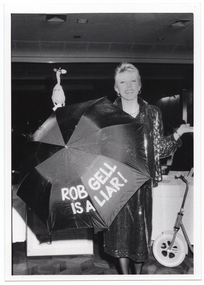
Photograph - Solo photo, 05/05/1986
... They both worked for Network Ten news....They both worked for Network Ten news. arthritis foundation of victoria afv national arthritis week afv fundraising celebrities dinner auction jo pearson newsreader rob gell weather presenter channel 10 network 10 umbrella donation 1986 [Typed directly onto the photo in black ink] JO PEARSON HOLDING HER DONATION TO THE AUCTION. ...On Monday, the 5th of May 1986, the Arthritis Foundation of Victoria (AFV) held a special fundraising dinner and auction during National Arthritis Week. The Celebrities Dinner was held to fund the foundation's strategic plan for the next three years. In this photo, television newsreader, Jo Pearson, holds up her donation for the auction - an umbrella marked with the text "ROB GELL IS A LIAR". This photo appears on the cover (page 1) of the No 41, August 1986 issue of the Arthritis Foundation of Victoria's News Review. It is captioned: "Jo Pearson holding her donation to the Auction. This is the umbrella Jo takes to all her garden parties and outdoor engagements! The umbrella raised $60.00." Rob Gell was a television news weather presenter and, at the time, Jo Pearson's husband. They both worked for Network Ten news.B&W photo of a woman holding up an open dark coloured umbrella. The words "ROB GELL IS A LIAR" have been written on the umbrella in large text. Behind her is a long table covered with a tablecloth. There is a scooter leaning against the table. Behind and above the umbrella, there is a plastic chicken.[Typed directly onto the photo in black ink] JO PEARSON HOLDING HER DONATION TO THE AUCTION. THIS IS THE UMBRELLA JO TAKES TO ALL HER GARDEN PARTIES AND OUTDOOR ENGAGEMENTS! THE UMBRELLA RAISED $60.00. [Handwritten in red ink] IC [Handwritten in black ink] 80%arthritis foundation of victoria, afv, national arthritis week, afv, fundraising, celebrities dinner, auction, jo pearson, newsreader, rob gell, weather presenter, channel 10, network 10, umbrella, donation, 1986 -
 Monbulk RSL Sub Branch
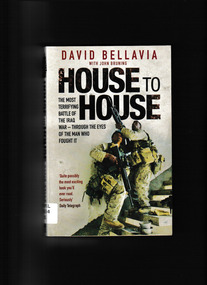
Book, Pocket Books et al, House to house : an epic memoir of war, 2008
... n 8 November 2004, the largest battle of the War on Terror began, with the US Army's assault on Fallujah and its network of tens of thousands of insurgents hiding in fortified bunkers, on rooftops, and inside booby-trapped houses. ...n 8 November 2004, the largest battle of the War on Terror began, with the US Army's assault on Fallujah and its network of tens of thousands of insurgents hiding in fortified bunkers, on rooftops, and inside booby-trapped houses. ...Ill, p.320.non-fictioniraq war - personal narratives, iraq war - battle of fallujah -
 Bendigo Historical Society Inc.
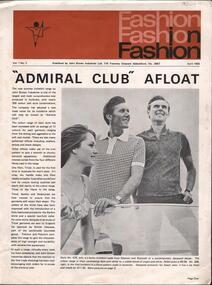
Magazine - HANRO COLLECTION: JOHN BROWN FASHION NEWS LETTER VOL 1NO. 2, April 1968
... Network Expanded* an article on sales covering Brisbane and a new office in Townsville. Top right is an article about Anne Hine an employee of John Brown, runner up of the Miss Victoria Quest enjoying herself in Queensland on the Gold Coast which was part of her prize. A photo of Anne with a dolphin is included. Other topics include *Ten...Network Expanded* an article on sales covering Brisbane and a new office in Townsville. Top right is an article about Anne Hine an employee of John Brown, runner up of the Miss Victoria Quest enjoying herself in Queensland on the Gold Coast which was part of her prize. A photo of Anne with a dolphin is included. Other topics include *Ten ...BHS CollectionJohn Brown Fashion News Letter Vol 1, No 2.: A paper newsletter on a white back ground printed in black and tan colour box at the top, 20 x 5.2cm with fashion repeated three times filling the area on the right side. A stylized figure appears on the left hand side with its left leg pointed upwards. Underneath is Vol 1, No.2, Published by John Brown Industries Ltd. 110 Trennery Crescent Abbotsford, Vic. 3067. April 1968, (underlined). Page 1. The article is headed *Admiral Club Afloat* which is a new trade name for knit shirts, that has 300 colours and style combinations. Tricel is a new fibre introduced for the first time in Australia. On the right hand side is a black and white photo of two men wearing Tetoron and Polycott in a contemporary design wearing Bermuda shorts standing on a boat. On the left of the photo is a girl in a bikini top. On page 2 is a report on the increase on imports of knitted garments against local production. Also an article on quality control in Bendigo and a photo showing Mr Frank Harris viewing a fabric through an industrial magnifying glass. Page 3 shows knitwear from *The Admiral Club Range* Second item on page 2 is of The successful Kyneton Mill being established in 1921 bringing employment from the extended district. A photo of an original employee Mr Jim Roberts is at the bottom. Last page is an article top left side is The Welmar Men's Dress Shirt proved very popular and sold out before Christmas. Under that is a photo of the busy pressing room in Bendigo. Bottom left : *Sales Network Expanded* an article on sales covering Brisbane and a new office in Townsville. Top right is an article about Anne Hine an employee of John Brown, runner up of the Miss Victoria Quest enjoying herself in Queensland on the Gold Coast which was part of her prize. A photo of Anne with a dolphin is included. Other topics include *Ten pin Bowling trophy to Victoria* and New President announced*, Mrs Molly Lapsley Retires. Box 116AAssociated World Public Relations Pty Ltd. Printed by Aldine Press.bendigo, industry, john brown knitting mills, john brown industries. mr frank harris. mr jim roberts. michael robinson. welmar plant bendigo. norma gardner. mrs molly lapsley -
 Ballarat Heritage Services
Photograph - Digital photograph, Winter's Swamp surrounds, April 2014
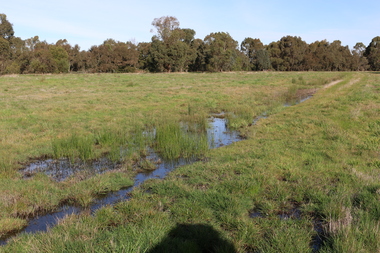
... Some eight or ten years ago he sold his Bonshaw pre-emption to the Bonshaw Gold mining Company for £20,000, and a few years later the ground belonging now to Winter's Freehold Company brought him £50,000 more, the payment being made at the requisition of the deceased in sovereigns. In these relations Mr. Winter has been closely identified with the mining industry at Ballarat. The deceased was a native of Lauder, in Berwickshire, and landed in Victoria several years before the gold discovery. BHS were commissioned by Ballarat Environment Network ...The swamp was named after John (Jock) Winter. John Winter (Jock) was born in Berwickshire, Scotland. He married Janet Margaret Irving the daughter of Robert Irving, advocate, Bonshaw, Dumfries, Scotland. Winter died in Ballarat in 1875 and was buried at the Ballaarat Old Cemetery. He took up the run Bonshaw from 1841; Leigh River Buninyong 1842-46; Junction, Delatite, March 1851 to September 1862; with sons: Carag Carag and Corop, April 1857 to September 1872; Colbinabbin and Stewart’s Plains, April 1857 to December 1872; St Germains February 1867 to March 1871. (The name became Winter-Irving in 1890). Mr John Winter, who died on August 22 at the age of 72, was a man of some note it the mining community of Ballarat. He was a self-made man, and one of our oldest colonists, it being over a quarter of a century age since he took up county about Ballarat and settled at Bonshaw. He died very rich. It is calculated that if he had retained an interest in all his runs, his income must have been not less than £10,000 or £50,000 a year. Some eight or ten years ago he sold his Bonshaw pre-emption to the Bonshaw Gold mining Company for £20,000, and a few years later the ground belonging now to Winter's Freehold Company brought him £50,000 more, the payment being made at the requisition of the deceased in sovereigns. In these relations Mr. Winter has been closely identified with the mining industry at Ballarat. The deceased was a native of Lauder, in Berwickshire, and landed in Victoria several years before the gold discovery. BHS were commissioned by Ballarat Environment Network for a project on Winter's Swamp and Skipton Common. Winter's Swamp was part of Ballarat West Common. The principle task of this project was the delivery of a report outlining the history of European settlement in the Skipton and Cardigan/Ballarat districts as pertinent to the use of and impact on the natural environment of the two reserves Skipton Common and Winter Swamp. The report was delivered in digital form only. The report, upon completion, was presented to the Network’s Committee in order to discuss the project. The report identified and described the uses of Skipton Common and Winter Swamp, and their impacts. In particular, this report examined farming/grazing (official and informal), mining, vegetation removal (including the removal of woodlands for timber, grasslands for pasture improvement) & use of riparian areas for access to water and timber removal. Recording the more benign and environmentally friendly uses such as picnicking, community activities, nature walks and the roles of organisations such as Field Naturalists’ and Bird Observers’ clubs, school and scout/guide groups will be relevant in helping to depict overall community attitudes towards the reserves; e.g.: has the Common generally been viewed as little more than a grazing paddock and fire hazard; has Winter Swamp always been the unknown natural asset that seems to have been its lot for at least the past 40 years? In this regard, the more contemporary history of actions surrounding the use and management of the reserves is of particular interest, in view of the extant evidence at both reserves; e.g. the actions of the Shire of Ballarat in the 1980s in establishing Winter Swamp as something of a competitor to Lake Wendouree but with a more environmental bent (although almost none of the plants used are indigenous species, but that is part of the story); the trotting track constructed on Skipton Common in the 1960s following representations to Premier Henry Bolte and the cropping of the western section of the Common to raise funds for the town’s new swimming pool, the fertilizing of the land putting an end to the native grassland vegetation. There are obviously multiple sources of information to source in preparing the report, however sources that the contractor is specifically requested to consult are the Skipton Historical Society, the former Skipton Common managers (specifically Graeme Pett), the Cardigan Windermere Landcare Group and the Learmonth Historical Society (believed to hold many of the former Shire of Ballarat’s records pertaining to the Council’s role as the Committee of Management for both Winter Swamp and the Ballarat West Town Common – Winter Swamp was split between 2 separate Crown Land tenures). The contractor is also encouraged but not required to utilise community newsletters, such as the Skipton Community Newsletter, to publicise and seek information about the project. Skipton Historical Society (Mary Bradshaw) contacted on Thursday 12 June 2.30pm. Mary lived on a farm out of Skipton but is currently living in the township. She remembers walking along the creek of the Common especially in spring and autumn in bare feet and that it was a very pretty place. There were a few snakes around the waterway in summer. People put cows and a couple of horses on the commonage to graze. Graeme Pett has always lived close to the Common and would know a lot about it. Other possible contacts would be Nicole Petress, Secretary of the Progress Association, and the Corangamite Council, Camperdown. Mary can’t remember any photos in the Skipton Historical Society that pertain to the Common. Digital photos of Winter's swamp surrounds, later known as Mullawullah.winter, winter's swamp surrounds, winter's swap, john winter, ballarat environmental network, ballarat, mullawullah -
Whitehorse Historical Society Inc.
Article, In Poll Position, 2009
... ten top spots to visit. Mitcham Eastlink Schwerkolt Cottage Rangeview Shopping Centre Eastern Emergency Relief Network Mitcham Hotel Migrant Services Yarran Dheran Mitcham wins the family vote for its quality schools. ...Mitcham wins the family vote for its quality schools.Mitcham wins the family vote for its quality schools, health care and public transport with a population of 14,221 in 2006. Listed are ten top spots to visit.Mitcham wins the family vote for its quality schools. mitcham, eastlink, schwerkolt cottage, rangeview shopping centre, eastern emergency relief network, mitcham hotel, migrant services, yarran dheran -
 Department of Energy, Environment and Climate Action
Dugout sign, Post 1966
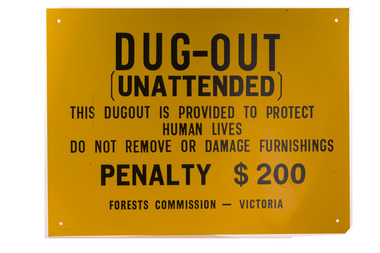
... Ten years later there were 8 new Commission dugouts and 21 new ones built by other interests. By 1960-61 the rate of new builds was declining but the Commission still managed 103 dugouts while 127 were looked after by others. However, as the forest road network...Ten years later there were 8 new Commission dugouts and 21 new ones built by other interests. By 1960-61 the rate of new builds was declining but the Commission still managed 103 dugouts while 127 were looked after by others. However, as the forest road network ...Considered in terms of both loss of property and loss of life, the Black Friday bushfires on 13 January 1939 were one of the worst disasters to have occurred in Australia and certainly the worst bushfire up to that time. The fires burnt 2 million hectares, 69 sawmills were destroyed, 71 people died, and several towns and sawmills were entirely obliterated. Among those killed were four men from the Commission The subsequent Royal Commission conducted by Judge Leonard Stretton has been described as one of the most significant inquiries in the history of Victorian public administration. Its recommendations led to sweeping changes. In addition to building dams and water points, the Stretton Royal Commission recommended expanding and controlling the use of bushfire dugouts at forest sawmills. Well-constructed dugouts had saved the lives of many sawmill workers and their families during the 1939 bushfires. But in some locations, they had proved fatal. Dugouts became mandatory for those few sawmills that remained in the forest after the 1939 fires. Many remote logging coupes and FCV roading camps also had dugouts. The local District Forester was required to make annual pre-season inspections of all dugouts on State forests and those within the Fire Protected Area (FPA). Some were built privately on private land. Most were primitive construction with a log or corrugated iron roof covered with earth. A hessian bag often hung at the entrance to keep the heat and smoke out. But they were dark and damp with snakes and other creepy crawlies often lurking inside. By 1940-41 there were 19 new dugouts constructed by the Commission and a further 128 by forest licensees. Ten years later there were 8 new Commission dugouts and 21 new ones built by other interests. By 1960-61 the rate of new builds was declining but the Commission still managed 103 dugouts while 127 were looked after by others. However, as the forest road network improved and gave all-weather access to modern two-wheel-drive vehicles the reliance on dugouts receded.Large metal sign that was positioned near forest dugoutsbushfire, forest signs, forests commission victoria (fcv)
