
Showing 13 items matching "nevill"
-
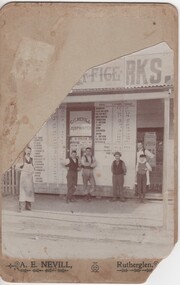 Rutherglen Historical Society
Photograph - Image, A. E. Nevill, June 1904
... nevill...Photograph is of a group of men standing in front of shop "C.G. Nevill, Job Printer". Posters in the window are showing the results of "The Referendum", which has been identified as the Scripture Referendum held in Victoria on 1st June 1904. ...On bottom of mount: "A.E. Nevill, Rutherglen" Written on back of mount: "Mr M. ...A. E. Nevill...Photograph Image A. E. Nevill ...Information about the dating of this photograph was provided by the 'Ask A Librarian' service of the State Library of Victoria. The Scripture Referendum was held on the same day as the Victorian Parliamentary Elections, in which J. Bowser ran against A.K. Buckley for a seat in the legislative assembly in the electoral district of Wangaratta and Rutherglen. The Scripture Referendum had three questions: "1. Are you in favour of the Education Act remaining as at present, strictly secular? 2. Are you in favour of such legislation as shall cause the scheme of Scripture lessons recommended by the Royal Commission on Religious Instruction to be taught in State schools during school hours to children whose parents desire the teaching (such lessons would be given subject to a conscience clause exempting teachers who object)? 3. Are you in favour of the prayers and hymns selected by the Royal Commission being used?" [source of text - Victorian Year-Book 1904. page 29]Black and white postcard sized photograph mounted on light cardboard. Photograph is of a group of men standing in front of shop "C.G. Nevill, Job Printer". Posters in the window are showing the results of "The Referendum", which has been identified as the Scripture Referendum held in Victoria on 1st June 1904. Poster in window at the right of the photo advertises a performance of Maggie Moore in Struck Oil, to be performed in the Town Hall on Saturday, 18th February 1904.On bottom of mount: "A.E. Nevill, Rutherglen" Written on back of mount: "Mr M. Pascoe, Rutherglen, Vic."nevill, printer, referendum, scripture in schools, secular education, victorian state elections, wangaratta rutherglen electoral district, maggie moore, struck oil -
 Flagstaff Hill Maritime Museum and Village
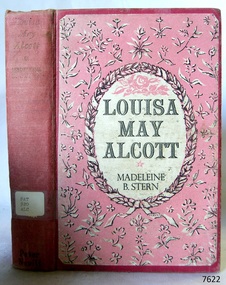
Book, Louisa May Alcott
... Louisa May Alcott Author: Madeleine B Stern Publisher: Peter Nevill Date: 1952...Louisa May Alcott Author: Madeleine B Stern Publisher: Peter Nevill Date: 1952 Louisa May Alcott Book ...This item is from the ‘Pattison Collection’, a collection of books and records that was originally owned by the Warrnambool Mechanics’ Institute, which was founded in Warrnambool in 1853. By 1886 the Warrnambool Mechanics’ Institute (WMI) had grown to have a Library, Museum and Fine Arts Gallery, with a collection of “… choice productions of art, and valuable specimens in almost every branch and many wonderful national curiosities are now to be seen there, including historic relics of the town and district.” It later included a School of Design. Although it was very well patronised, the lack of financial support led the WMI in 1911 to ask the City Council to take it over. In 1935 Ralph Pattison was appointed as City Librarian to establish and organise the Warrnambool Library as it was then called. When the WMI building was pulled down in 1963 a new civic building was erected on the site and the new Warrnambool Library, on behalf of the City Council, took over all the holdings of the WMI. At this time some of the items were separated and identified as the ‘Pattison Collection’, named after Ralph Pattison. Eventually the components of the WMI were distributed from the Warrnambool Library to various places, including the Art Gallery, Historical Society and Flagstaff Hill. Later some were even distributed to other regional branches of Corangamite Regional Library and passed to and fro. It is difficult now to trace just where all of the items have ended up. The books at Flagstaff Hill Maritime Village generally display stamps and markings from Pattison as well as a variety of other institutions including the Mechanics’ Institute itself. RALPH ERIC PATTISON Ralph Eric Pattison was born in Rockhampton, Queensland, in 1891. He married Maude Swan from Warrnambool in 1920 and they set up home in Warrnambool. In 1935 Pattison accepted a position as City Librarian for the Warrnambool City Council. His huge challenge was to make a functional library within two rooms of the Mechanics’ Institute. He tirelessly cleaned, cleared and sorted a disarrayed collection of old books, jars of preserved specimens and other items reserved for exhibition in the city’s museum. He developed and updated the library with a wide variety of books for all tastes, including reference books for students; a difficult task to fulfil during the years following the Depression. He converted all of the lower area of the building into a library, reference room and reading room for members and the public. The books were sorted and stored using a cataloguing and card index system that he had developed himself. He also prepared the upper floor of the building and established the Art Gallery and later the Museum, a place to exhibit the many old relics that had been stored for years for this purpose. One of the treasures he found was a beautiful ancient clock, which he repaired, restored and enjoyed using in his office during the years of his service there. Ralph Pattison was described as “a meticulous gentleman whose punctuality, floorless courtesy and distinctive neat dress were hallmarks of his character, and ‘his’ clock controlled his daily routine, and his opening and closing of the library’s large heavy doors to the minute.” Pattison took leave during 1942 to 1945 to serve in the Royal Australian Navy, Volunteer Reserve as Lieutenant. A few years later he converted one of the Museum’s rooms into a Children’s Library, stocking it with suitable books for the younger generation. This was an instant success. In the 1950’s he had the honour of being appointed to the Victorian Library Board and received more inspiration from the monthly conferences in Melbourne. He was sadly retired in 1959 after over 23 years of service, due to the fact that he had gone over the working age of council officers. However he continued to take a very keen interest in the continual development of the Library until his death in 1969. WARRNAMBOOL PUBLIC LIBRARY The Warrnambool Mechanics’ Institute (WMI) was formed by a voluntary community group in 1863, within six years of Warrnambool’s beginnings, and its Reading Room opened in 1854. The WMI operated until 1963, at which time it was one of the oldest Mechanics’ Institutes in Victoria. Mechanics’ Institutes offered important services to the public including libraries, reading rooms and places to display and store collections of all sorts such as curiosities and local historical relics. In 1886 a Museum and Fine Arts Gallery were added to the WMI and by the beginning of the 20th century there was also a billiards room and a School of Art. By this time all Mechanics’ Institutes in country Victoria had museums attached. Over the years the Warrnambool Mechanics’ Institute Library was also known as the Warrnambool Public Library the Warrnambool Library and the Free Library. Early funding from the government was for the “Free Library”. The inscription in a book “Science of Man” was for the “Warrnambool Public Library”, donated by Joseph Archibald in 1899. Another inscription in the book “Catalogue of Plants Under Cultivation in the Melbourne Botanic Gardens 1 & 2, 1883” was presented to the “Warrnambool Library” and signed by the author W.R. Guilfoyle. In 1903 the Warrnambool Public Library decided to add a Juvenile Department to library and stock it with hundreds of books suitable for youth. In 1905 the Public Library committee decided to update the collection of books and added 100 new novels plus arrangements for the latest novels to be included as soon as they were available in Victoria. In July 1911 the Warrnambool Council took over the management of the Public Library, Art Gallery, Museum and Mechanics’ Institute and planned to double the size of the then-current building. In 1953, when Mr. R. Pattison was Public Librarian, the Warrnambool Public Library’s senior section 10,000 of the 13,000 books were fiction. The children’s section offered an additional 3,400 books. The library had the equivalent of one book per head of population and served around 33 percent of the reading population. The collection of books was made up of around 60 percent reference and 40 percent fiction. The library was lending 400 books per day. In 1963 the Warrnambool City Council allocated the site of the Mechanics’ Institute building, which included the Public Library, Museum and Art Gallery, for the new Municipal Offices and the Collections were dispersed until 1971. The Warrnambool Library took over the Mechanics’ Institute Library’s holdings on behalf of the Warrnambool City Council. Since the closure of the Warrnambool Mechanics’ Institute the exact location and composition of the original WMI books and items has become unclear. Other materials have been added to the collection, including items from Terang MI, Warrnambool Court House and Customs House. Many of the books have been identified as the Pattison Collection, named after the Librarian who catalogued and numbered the books during his time as Warrnambool Public Librarian in the time before the Mechanics’ Institute closed. It seems that when Warrnambool became part of the Corangamite Regional Library some of the books and materials went to its head office in Colac and then back to Warrnambool where they were stored at the Art Gallery for quite some time. Some then went to the Warrnambool Historical Society, some stayed at the Art Gallery and some were moved to Flagstaff Hill Maritime Village. The various stamps and labels on the books held at Flagstaff Hill show the variety of the collection’s distribution and origin. The books in the collection at Flagstaff Hill Maritime Village date from the 1850’s to the late 1950’s and include rare and valuable volumes. Many of the books are part of the “Pattison Collection” after the Warrnambool’s Public Librarian, Mr. R. Pattison. The Pattison Collection, along with other items at Flagstaff Hill Maritime Village, was originally part of the Warrnambool Mechanics' Institute’s collection. The Warrnambool Mechanics’ Institute Collection is primarily significant in its totality, rather than for the individual objects it contains. Its contents are highly representative of the development of Mechanics' Institute libraries across Australia, particularly Victoria. A diversity of publications and themes has been amassed, and these provide clues to our understanding of the nature of and changes in the reading habits of Victorians from the 1850s to the middle of the 20th century. The collection also highlights the Warrnambool community’s commitment to the Mechanics’ Institute, reading, literacy and learning in the regions, and proves that access to knowledge was not impeded by distance. These items help to provide a more complete picture of our community’s ideals and aspirations. The Warrnambool Mechanics Institute book collection has historical and social significance for its strong association with the Mechanics Institute movement and the important role it played in the intellectual, cultural and social development of people throughout the latter part of the nineteenth century and the early twentieth century. The collection of books is a rare example of an early lending library and its significance is enhanced by the survival of an original collection of many volumes. The Warrnambool Mechanics' Institute’s publication collection is of both local and state significance. The Warrnambool Mechanics' Institute Collection is primarily significant in its totality, rather than for the individual objects it contains. Its contents are highly representative of the development of Mechanics' Institute libraries across Australia, particularly Victoria. A diversity of publications and themes has been amassed, and these provide clues to our understanding of the nature of and changes in the reading habits of Victorians from the 1850s to the middle of the 20th century. The collection also highlights the Warrnambool community’s commitment to the Mechanics’ Institute, and to reading, literacy and learning in the regions, and proves that access to knowledge was not impeded by distance. These items help to provide a more complete picture of our community’s ideals and aspirations. As with many Mechanics' Institutes in Australia, the one which operated in Warrnambool was established and overseen for many years by key individuals associated with the development of the city itself. The WMI publication collection is historically significant because of its association with local people, places and the key historical themes in the development of Warrnambool of rural development, industry, farming, education, and community. The collection documents and illustrates the changing interests, focus and tastes of Victorians, especially those in regional cities. Generally the individual items in the collection are not particularly rare, as examples of all probably exist in other public collections in Victoria. It is primarily because there are so very few surviving Mechanics' Institute collections in Victoria, which lends this overall collection its significance. Many items in the WMI Collection have the potential to support further research, both as individual objects and through the collection in its entirety. This material is significant for its ability to assist in the interpretation of the history of the area and adds to the general understanding of the development of the township. Many components of the WMI publication collection complement and reinforce the Flagstaff Hill Maritime Museum Collection, the Warrnambool Art Gallery Collection, and that in the Warrnambool Historical Society, and also contribute to a clearer understanding of the original Warrnambool Mechanics' Institute collections. This will greatly enhance the appreciation of the few surviving Mechanics' Institute collections across Victoria, and also in New South Wales. The similarities and differences between the small number of collections that have survived can provide further insights into how the people of Victoria in general, and Warrnambool in particular, constructed a civic culture of adult learning to foster an informed citizenry. The Warrnambool Mechanics' Institute publication collection is of both local and state significance. (This Statement of Significance is quoted from the Significance Assessment : Warrnambool Mechanics’ Institute Book Collection at Flagstaff Hill Maritime Museum, February 2009, by Annette Welkamp, Cultural Connections, for Delise Oldfied, FHMV) References Juvenile Department in Warrnambool Public Library In August 1903 The Age newspaper reported in its Warrnambool news section that “With the object of discouraging boys from reading literature of the “penny dreadful” class, the committee of the local public library has decided to open a juvenile department and to stock it with hundreds of suitable books attractive to the youthful mind.” 100 new novels added to Warrnambool Public Library Shelves In November 1905 The Argue newspaper’s Warrnambool news section announced “The committee of the Public Library is bringing the collection of books more up to date. It has recently added 100 new novels to the shelves, and arrangements have been made for a supply of the latest novels immediately they arrive in the state.” Warrnambool Town Council takes over Mechanics’ Institute, Art Gallery, Public Library, Museum – and will double the building’s size In 1912 The Age reported in its Warrnambool news section “Considerable improvements are being effected by the town council in the most picturesque part of Liebig Street. Between the fire brigade station and the mechanics’ institute and art gallery a vacant block of land is being transformed a garden for carpet bedding and flowering plants. The council, which recently took over the control of the art gallery, public library, museum and mechanics’ institute, is doubling the size of the substantial stone building containing these institutions. The new building will contain a supper room for use in conjunction with functions in the town hall, adjoining, and a new reading room.” Mr Pattison, Public Librarian, says Library has a book per head of population In 1953 The Age reported an interview with the Public Librarian, Mr. R. Pattison, who said “Warrnambool has an insatiable thirst for reading. And its reading recipe contains a strong dash of fiction – 73 percent of it. Fiction makes up 10,000 of the 13,000 books in the senior section of the public library. That works out at a book per head of population. Warrnambool today is really book minded. This city has an almost insatiable thirst for knowledge as well as fiction. We’re lending 400 books a day. We supply 33 percent of the reading population of Warrnambool.” The reporter goes on to say “Warrnambool Public Library also has an ultra-modern children’s section of 3,400 books, open to every boy and girl attending school in Warrnambool. Mr Pattison hopes to show travel-talk films and install a radiogram in the children’s section “later on”. But it won’t disturb adult reading next door because the junior section is sound proof. “ Mechanics’ Institutes and Museums Mechanics’ Institutes were important sites for collecting in country Victoria … Warrnambool … all had museums attached to Mechanics’ Institutes before the end of the twentieth century” Warrnambool Mechanics’ Institute Ms Tierney said FHMV holds the collection of the Warrnambool Mechanics’ Institute in three different locations on its site. “The Mechanics’ Institute opened in 1871, was demolished in the 1960s and was one of the oldest in Victoria. “FHMV intends to create a new storage area and bring the collection together in one place which will greatly facilitate access and research. “The collection consists of books and archives dating from the 1850s to 1959s. “Some of the books are rare and valuable but it is unclear as to their relevance to the history of Warrnambool or Victoria,” Ms Tierney said. Warrnambool TAFE History South West TAFE has a long and proud history of providing technical and specialist education, with links back to the formation of the Mechanic’s Institute in 1853. Warrnambool Art Gallery’s History The Warrnambool Art Gallery began in 1886 when retired police officer Joseph Archibald opened its doors in a building behind the mechanics institute in Liebig Street. The Gallery began with an eclectic mix of artworks and museum curios. Before long Archibald mobilised public support and paid for a new gallery annex. Loans and grants allowed the Gallery collection to grow with significant early acquisitions by French, German, and Belgian artists, which were less expensive than British works. Despite its enthusiastic start the economic downturn of the 1890s brought the Collection to a halt. In 1910 the Council took control of the Mechanics Institute and ran the Gallery there until 1963 when the building was allocated for municipal offices. The Collection was dispersed on loan to galleries in Shepparton and Hamilton and not reunited until 1971. In 1986 the Gallery’s Centenary year, a permanent home was built next to the ‘Civic Green’ and named in memory of one its champions Sir Fletcher Jones O.B.E. 2016 Warrnibald Entries Joseph Archibald established the Warrnambool Museum and Art Gallery in 1886 while his son Jules Francois Archibald founded the Archibald Prize through his bequest of 1919. His aim was to foster portraiture, as well as support artists, and perpetuate the memory of great Australians. Louisa May Alcott Author: Madeleine B Stern Publisher: Peter Nevill Date: 1952Label on spine cover with typed text PAT 920 ALC Pastedown front endpaper has sticker from Warrnambool Mechanics Institute and Free Library covered by a sticker from Corangamite Regional Library Service Front endpaper has a small sticker that reads " F. W. Cheshire Pty. Ltd., 338 Little Collins Street, Melbourne."warrnambool, shipwrecked-coast, flagstaff-hill, flagstaff-hill-maritime-museum, maritime-museum, shipwreck-coast, flagstaff-hill-maritime-village, shipwrecked-artefact, book, pattison collection, warrnambool library, warrnambool mechanics’ institute, ralph eric pattison, corangamite regional library service, warrnambool city librarian, mechanics’ institute library, victorian library board, warrnambool books and records, warrnambool children’s library, great ocean road, louisa may alcott, peter nevill -
 Royal Australian and New Zealand College of Obstetricians & Gynaecologists (RANZCOG)
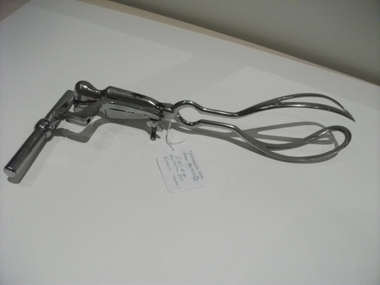
Forceps, Neville-Barnes
... Forceps, Neville-Barnes with Nevill's axis traction handles, c 1886. Engraved on the inside blade and on the traction handle "Frank Forster 1952"....These forceps were owned and used by Dr Frank Foster Obstetric delivery Forceps Neville-Barnes Forceps, Neville-Barnes with Nevill's axis traction handles, c 1886. Engraved on the inside blade and on the traction handle "Frank Forster 1952". ...These forceps were owned and used by Dr Frank FosterForceps, Neville-Barnes with Nevill's axis traction handles, c 1886. Engraved on the inside blade and on the traction handle "Frank Forster 1952".obstetric delivery, forceps, neville-barnes -
 Rutherglen Historical Society
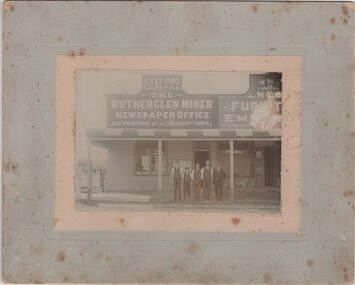
Image, 1902 (Approximate)
... On sign on front of building: "Estb. 1902 | GG Nevill | The Rutherglen Miner | Newspaper | Job printing of all Descriptions" On back of mount: "Jim Pascoe | High St."...rutherglen miner newspapers printing business On sign on front of building: "Estb. 1902 | GG Nevill | The Rutherglen Miner | Newspaper | Job printing of all Descriptions" On back of mount: "Jim Pascoe | High St." ...Mounted black and white photograph of the Rutherglen Miner Newspaper OfficeOn sign on front of building: "Estb. 1902 | GG Nevill | The Rutherglen Miner | Newspaper | Job printing of all Descriptions" On back of mount: "Jim Pascoe | High St."rutherglen miner, newspapers, printing business -
 Narre Warren and District Family History Group
Album - Janet Roberts, Narre Warren, 1932, 1932
... Janet ceased teaching when she married Nevill Reid Westwood and moved to Western Australia. ...Janet ceased teaching when she married Nevill Reid Westwood and moved to Western Australia. ...Photo album compiled by Janet Muir Roberts who taught at the Hallam Valley State School No. 4407 between 1931 and 1934. Janet ceased teaching when she married Nevill Reid Westwood and moved to Western Australia. The photographs depict groups of school children, likely the pupils Janet taught at Hallam Valley State School. There are also photos of family groups; they are probably relatives of Jan Roberts.Photo album containing 57 photographs. They are mainly black and white photographs, with some of them colorised.Some of the photographs have inscriptions on the backjanet muir roberts, jan westwood, janet muir westwood (nee roberts), hallam valley state school no. 4407 -
 Surrey Hills Historical Society Collection
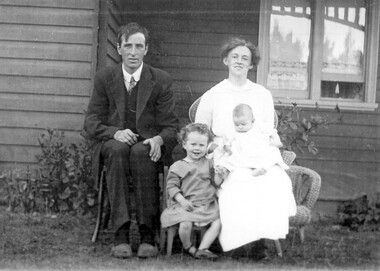
Photograph, Albert and Hazel Crump in 1916 with their daughters Thelma and Joyce
... Pictured with their daughters Thelma and Joyce Joyce Kathleen Crump - BIRTH 1916, Surrey Hills; DEATH 16 MAY 1990, Pakenham [Married Thelma Osborne Crump - BIRTH 5 June, 'Hazeldene', Surrey Hills; DEATH 25 JULY 1943, Richmond [Married Reginald Thomas Elvish] Not pictured: Betty Nevill Crump....Pictured with their daughters Thelma and Joyce Joyce Kathleen Crump - BIRTH 1916, Surrey Hills; DEATH 16 MAY 1990, Pakenham [Married Thelma Osborne Crump - BIRTH 5 June, 'Hazeldene', Surrey Hills; DEATH 25 JULY 1943, Richmond [Married Reginald Thomas Elvish] Not pictured: Betty Nevill Crump. (Mrs) Hazel crump (Mr) albert Crump (Miss) thelma Crump (Miss) joyce Crump house names hazeldene leopold crescent surrey hills federation style grocer clothing and dress 1916 albert henry crump hazel may crump hazel may ordish A sepia coloured photograph of a family group seated outside a house. ...Albert and Hazel Crump at their home ‘Hazeldene’, 1 Leopold Crescent in 1916. ‘Hazeldene’ was opposite the end of Albert Crescent. Albert and Hazel lived here from the time of their marriage in 1913 until 1918 when they moved back to Dandenong. This Federation house is of rather unusual design with verandas on the front corners and the centre room projecting. It was demolished in the 1960s and replaced by units. From 1913-1918 Albert was proprietor of the grocery store in Canterbury Road (next to the present Surrey Lodge). This was owned by Alfred Geer and had opened in 1885 by George Sim. Pictured with their daughters Thelma and Joyce Joyce Kathleen Crump - BIRTH 1916, Surrey Hills; DEATH 16 MAY 1990, Pakenham [Married Thelma Osborne Crump - BIRTH 5 June, 'Hazeldene', Surrey Hills; DEATH 25 JULY 1943, Richmond [Married Reginald Thomas Elvish] Not pictured: Betty Nevill Crump.A sepia coloured photograph of a family group seated outside a house. The baby is seated on the ladies lap.(mrs) hazel crump, (mr) albert crump, (miss) thelma crump, (miss) joyce crump, house names, hazeldene, leopold crescent, surrey hills, federation style, grocer, clothing and dress, 1916, albert henry crump, hazel may crump, hazel may ordish -
 Sunshine and District Historical Society Incorporated
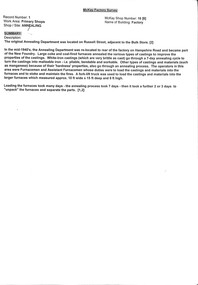
Document - Ken Porter Collection - McKay Massey Ferguson - Factory Survey
... Annealing Workshop - Key Names Sam Boreham, Alex Saunders, Jack Nevill, J. Evans, S. Hunter, F. Currow, J. Bird, E. ...McKay Massey Harris Sunshine Harvester Works Annealing Workshop - Key Names Sam Boreham, Alex Saunders, Jack Nevill, J. Evans, S. Hunter, F. Currow, J. Bird, E. ...These stores were complied by the Museum Victoria as a part of their McKay ProjectAnnealing Workshop - Key Names Sam Boreham, Alex Saunders, Jack Nevill, J. Evans, S. Hunter, F. Currow, J. Bird, E. Lauders|Power House or Electrical Department - Key Names Raymond Bult, Roy Smellie, Norm Harvey, Brian Polly, Walter Harry Shildton, Vern Bult. Sunshine Electrical Company - Electricity supply to Sunshine|Shafting Shop (Cold Drawn & Cold Rolled, Bright Steel Mill) - Key Names Charlie Carter, Don Devison (Deveson), Jim Eason, Derek Craggs, Ern Nichols, Keirl Gardiner, Charlie Condon, Norm Innes, Dick Tyers. Rivits made on contract from MacPhersons for the Sydney Habour Bridge|Sydney Branch George Street Concord West|Hugh Victor McKay C.B.E. 70 Years Of Developmenth.v. mckay massey harris, sunshine harvester works -
 City of Kingston
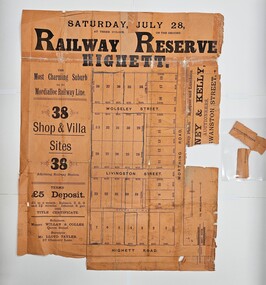
Pamphlet - Colour, Duffus Bros, Railway Reserve Highett, c. 1923
... Handwritten in grey pencil: assumed sale price recorded on subdivisions 1-7, 10, 22, 23 and 34 Handwritten in grey pencil on subdivision 4: C. Nevill / City of Melbourne bank Handwritten in grey pencil across subdivision 7: 49' Handwritten in grey pencil across subdivision 21 and 22: 134' Handwritten in grey pencil across subdivision 25 and 26: 200' Handwritten in grey pencil across subdivision 36 and 37 and both top and bottom: 120' Hand drawn in blue pencil: outline of subdivision 4 Hand drawn in blue pencil: outline of subdivisions 7, 23, 28, 37, 38 along left hand side, subdivisions 38, 37 and 36 on Wolseley Street, subdivisions 30 and 29 along Wolseley Street, subdivisions 29 and 24 along the middle of the plan, subdivisions 24 and half of 25 along Livingston Street, half of subdivision 20 along the middle of the plan, subdivisions 21 and 22 along the Right of Way between Livingston Street and Highett Road, and along the right hand border of subdivision 7. ...Land sales Highett Handwritten in grey pencil: assumed sale price recorded on subdivisions 1-7, 10, 22, 23 and 34 Handwritten in grey pencil on subdivision 4: C. Nevill / City of Melbourne bank Handwritten in grey pencil across subdivision 7: 49' Handwritten in grey pencil across subdivision 21 and 22: 134' Handwritten in grey pencil across subdivision 25 and 26: 200' Handwritten in grey pencil across subdivision 36 and 37 and both top and bottom: 120' Hand drawn in blue pencil: outline of subdivision 4 Hand drawn in blue pencil: outline of subdivisions 7, 23, 28, 37, 38 along left hand side, subdivisions 38, 37 and 36 on Wolseley Street, subdivisions 30 and 29 along Wolseley Street, subdivisions 29 and 24 along the middle of the plan, subdivisions 24 and half of 25 along Livingston Street, half of subdivision 20 along the middle of the plan, subdivisions 21 and 22 along the Right of Way between Livingston Street and Highett Road, and along the right hand border of subdivision 7. ...Sales plan for land in the suburb of Highett, titled Railway Reserve, incorporating properties along Wolseley Street, Livingston Street, Highett Road and Worthing Road. The developing urban area of Highett within the City of Kingston. This land sale pamphlet illustrates the subdivision of land within the municipality and the changing demographic of the district as new houses and shops are constructed close to infrastructure.Colour pamphlet advertising thirty eight shop and villa sites for sale at the Railway Reserve, Highett. Incorporates a map of the reserve with properties available on Wolseley Street, Livingston Street, Highett Road and Worthing Road. Handwritten in grey pencil: assumed sale price recorded on subdivisions 1-7, 10, 22, 23 and 34 Handwritten in grey pencil on subdivision 4: C. Nevill / City of Melbourne bank Handwritten in grey pencil across subdivision 7: 49' Handwritten in grey pencil across subdivision 21 and 22: 134' Handwritten in grey pencil across subdivision 25 and 26: 200' Handwritten in grey pencil across subdivision 36 and 37 and both top and bottom: 120' Hand drawn in blue pencil: outline of subdivision 4 Hand drawn in blue pencil: outline of subdivisions 7, 23, 28, 37, 38 along left hand side, subdivisions 38, 37 and 36 on Wolseley Street, subdivisions 30 and 29 along Wolseley Street, subdivisions 29 and 24 along the middle of the plan, subdivisions 24 and half of 25 along Livingston Street, half of subdivision 20 along the middle of the plan, subdivisions 21 and 22 along the Right of Way between Livingston Street and Highett Road, and along the right hand border of subdivision 7. Handwritten in ink adjacent to the subdivision plan, updside down, in the bottom right hand corner: 276 / 54 / 280 / 45 / 320 / 202 / 200 / 134 / horizontal line / 11/14 Handwritten in ink adjacent to the subdivision plan, updside down, in the bottom right hand corner: 1714)2200(15 / 1714 / horizontal line / 486land sales, highett -
 Mission to Seafarers Victoria
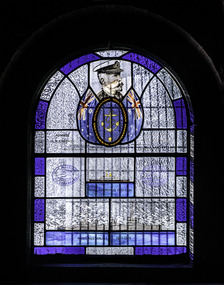
Artwork, other - Stained glass window, Dacre Smyth, Australian Navy Window, 2007
... He was the son of the distinguished British general Nevill Maskelyne Smyth. st peter chapel flinders street mission to seafarers seamen's mission mission to seamen st peter sailors seamen stained glass windows WIN memorial chapel commodore dacre smyth (1923-2008) royal australian navy ran d-day landing battle of the coral sea william rooke creswell (1852-1933) hmas cerberus hmas australia 1 Arched windows depicting HMAS Australia 1 (1913-1924) , HMAS Cerberus (1870-1924), and a portrait of Admiral W.R. ...Commodore Dacre Smyth (1923-2008), designed the two memorial windows for the 106th Anniversary of the Australian Navy and coinciding with the 150th anniversary of the Missions to Seafarers in Melbourne. The windows were dedicated by Reverend Bishop Jeremy Ashton on the 1st of March 2007. A plaque was also erected under the windows.Arched windows depicting HMAS Australia 1 (1913-1924) , HMAS Cerberus (1870-1924), and a portrait of Admiral W.R. Creswell, Father of the Australian Navy.st peter chapel, flinders street, mission to seafarers, seamen's mission, mission to seamen, st peter, sailors, seamen, stained glass windows, win, memorial chapel, commodore dacre smyth (1923-2008), royal australian navy, ran, d-day landing, battle of the coral sea, william rooke creswell (1852-1933), hmas cerberus, hmas australia 1 -
 Mission to Seafarers Victoria
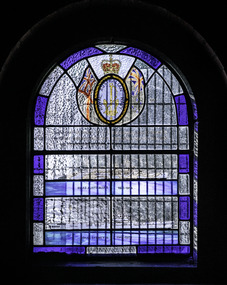
Artwork, other - Stained glass window, Dacre Smyth, Australian Navy Window, 2007
... He was the son of the distinguished British general Nevill Maskelyne Smyth. st peter chapel flinders street mission to seafarers seamen's mission mission to seamen st peter sailors seamen stained glass windows WIN memorial chapel commodore dacre smyth (1923-2008) royal australian navy ran d-day landing battle of the coral sea william rooke creswell (1852-1933) hmas australia 2 hmas sydney 3 Arched windows depicting HMAS Australia 11 (1928-1954) , HMAS Sydney 111 (1948-1975). ...Commodore Dacre Smyth (1923-2008), designed the two memorial windows for the 106th Anniversary of the Australian Navy and coinciding with the 150th anniversary of the Missions to Seafarers in Melbourne. The windows were dedicated by Reverend Bishop Jeremy Ashton on the 1st of March 2007. A plaque was also erected under the windows.Arched windows depicting HMAS Australia 11 (1928-1954) , HMAS Sydney 111 (1948-1975).st peter chapel, flinders street, mission to seafarers, seamen's mission, mission to seamen, st peter, sailors, seamen, stained glass windows, win, memorial chapel, commodore dacre smyth (1923-2008), royal australian navy, ran, d-day landing, battle of the coral sea, william rooke creswell (1852-1933), hmas australia 2, hmas sydney 3 -
 Bendigo Historical Society Inc.
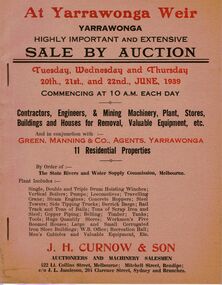
Document - IAN DYETT COLLECTION: AUCTION CATALOGUE - YARRAWONGA WEIR
... BUSINESS Auctioneers j h curnow & son pty ltd Ian Dyett Collection - Auction Catalogue - Yarrawonga Weir Green Manning & Co the State Rivers and Water Supply Commission J H Curnow & Son J L Jamieson Messrs A Challingsworth Pty Ltd Jaques Bros Austral Otis Eng Co Mr E D Shaw R G Knight H H C Williams F A Nevill The Cambridge Press Two beige coloured auction catalogues with red and black printing for a sale on the 20th, 21st and 22nd June 1939. ...Two beige coloured auction catalogues with red and black printing for a sale on the 20th, 21st and 22nd June 1939. For sale were Contractors, Engineers & Mining Machinery, Plant, Stores, Buildings and Houses for Removal, Valuable Equipment, etc and 11 Residential Properties By Order of the State Rivers and Water Supply Commission, Melbourne. H. Curnow & Son in conjunction with Green, Manning & Co, Agents, Yarrawonga were the auctioneers. Contains some information about the Yarrawonga Weir and a black and white photo of the bank.business, auctioneers, j h curnow & son pty ltd, ian dyett collection - auction catalogue - yarrawonga weir, green manning & co, the state rivers and water supply commission, j h curnow & son, j l jamieson, messrs a challingsworth pty ltd, jaques bros, austral otis eng co, mr e d shaw, r g knight, h h c williams, f a nevill, the cambridge press -
 Glen Eira Historical Society
Article - Miller, Hon Henry, MLC
... Miller Septimus Miller Helen Mary Muriel Henderson John Miller Henry Miller Ronald Nevill Damien ‘Cantala’ Housenames Dandenong Road Caulfield Wills Article Miller, Hon Henry, MLC ...Three items about other Miller family members: 1/Photocopied article and photograph of Muriel Miller (born 1890 approx.), wife of Septimus ‘Money’ Miller. Article from ‘who’s who in the world of women’, c1930s, giving brief family history, the charities she was involved with and her hobbies and interests. 2/Reprinted article from Argus newspaper dated 30/06/2013, regarding the will of the late Septimus Miller, husband of Murie Miller. 3/Photocopied copy of Miller family tree (1784 – 1990), where Muriel becomes Mrs. Miller 1912.miller septimus, miller helen mary muriel, henderson john, miller henry, miller ronald nevill damien, ‘cantala’, housenames, dandenong road, caulfield, wills -
Tatura Irrigation & Wartime Camps Museum
Book, Fieldcraft Sniping and Intelligence
... Fieldcraft sniping Major Nevill A D Armstrong OBE FRGS Used by Corporal T Bock whilst in the VDC. inside front cover: T Bock Toolamba (in pencil) page 1: Technical book and Magazine Co (stamp) C.PL. ...Used by Corporal T Bock whilst in the VDC.Red cover with black rectangular border on front and title, authors name and printers name in the rectangle. 213 pagesnon-fictionUsed by Corporal T Bock whilst in the VDC.fieldcraft sniping, major nevill a d armstrong obe frgs
