
Showing 151 items matching "new arrivals"
-
 Bendigo Historical Society Inc.
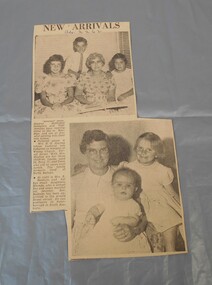
Newspaper - Lydia Chancellor collection: New arrivals
... Lydia Chancellor collection: New arrivals...Newspaper Lydia Chancellor collection: New arrivals ...1. Rev Harry George Mackay (30/5/1914 - 9/9/1988) was born in Sheffield, Tasmania. He served part time as a chaplain during WW2 (V517227) After the war he married Thelma Muriel Phillips (10/6/1920 - 13/7/2008) in 1946. They are both buried at the Mornington Cemetery. 2. Mr John Brown Hamlett was born in England. In 1951 he married Audrey Sommerville in in Scottsdale, Tasmania. Their first son, David was born in Tasmania in 1952. In 1954, John was preaching in the Launceston Methodist circuit.Bendigo Advertiser from 02/02/1962 and 05/02/1964. Two articles introducing three new families who have moved to Bendigo. These are the family of H.G. Mackay minister of the Wesley church in Forest Street, Rev, Baldwin of the Arnold Street circuit and Rev. J.B. Hamlett in charge of the Eaglehawk Methodist Circuit.bendigo advertiser, rev. hamlett, minister mackay, rev. baldwin -
 Darebin Art Collection
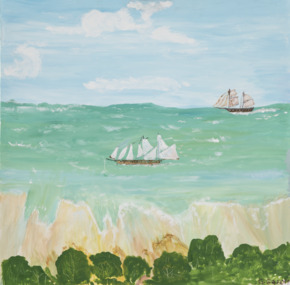
Painting, Aunty Gwen Garoni, 'New Arrivals', 2012
... 'New Arrivals'...painting 'New Arrivals' Painting Aunty Gwen Garoni ...painting -
 National Vietnam Veterans Museum (NVVM)
Photograph, Gibbons, Denis, 365 And A Wakey
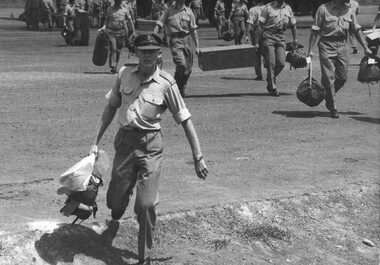
... ...New Arrivals...A black and white photograph of "Nobody has 365 and a wakey" so was the chant of the Old Timers at 1st ATF Base, Nui Dat as new arrivals about to commence their tour of duty. ...Photograph 1st ATF Base Nui Dat C-130 Hercules Gibbons Collection Catalogue New Arrivals Denis Gibbons A black and white photograph of "Nobody has 365 and a wakey" so was the chant of the Old Timers at 1st ATF Base, Nui Dat as new arrivals about to commence their tour of duty. ...Denis Gibbons (1937 – 2011) Trained with the Australian Army, before travelling to Vietnam in January 1966, Denis stayed with the 1st Australian Task Force in Nui Dat working as a photographer. For almost five years Gibbons toured with nine Australian infantry battalions, posting compelling war images from within many combat zones before being flown out in late November 1970 after sustaining injuries. The images held within the National Vietnam Veterans Museum make up the Gibbons Collection. A black and white photograph of "Nobody has 365 and a wakey" so was the chant of the Old Timers at 1st ATF Base, Nui Dat as new arrivals about to commence their tour of duty. These replacments were delivered by a US C130 aircraftphotograph, 1st atf base, nui dat, c-130 hercules, gibbons collection catalogue, new arrivals, denis gibbons -
 Flagstaff Hill Maritime Museum and Village
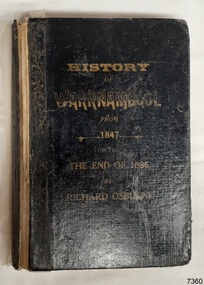
Book - Historical, Warrnambool, Richard Osburne, The History of Warrnambool, 1887
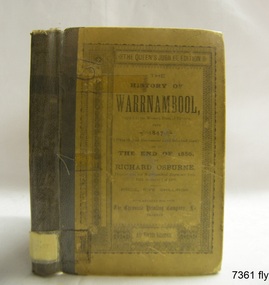
... ...new arrivals...TO OLD COLONISTS AND YOUNG AUSTRALIANS, OR NEW ARRIVALS, THIS HISTORY OF THE RISE AND PROGRESS OF THE CAPITAL OF WESTERN VICTORIA, IS DEDICATED AS INTERESTING AND USEFUL, BY "THE FATHER OF THE WARRNAMBOOL PRESS" RICHARD OSBURNE."...The book was dedicated to the early colonists as well as to the new arrivals by the writer, Richard Osburne, who entitles himself as "The father of the Warrnambool Press". ...This copy of the book is personally signed and dated by the Curator of the first Warrnambool Museum, which was also the Warrnambool Public Library. This copy also has many hand written notes in the margins. This little book is one of only 1000 books published of the original Queen's Jubilee Edition. It spans fifty years of the history of Warrnambool from the time that the first Government Land Sales commenced. It also deliberately coincides with the 1887 celebrations of Queen Victoria's Jubilee Year of her ascension to the British Throne. The book is an invaluable reference for researchers of local Warrnambool history and has been used as a textbook and reference book for local students. After the closure of the Warrnambool Museum, the book was held by the Warrnambool City Council until, in 1974, it was transferred to the newly established Flagstaff Hill Maritime Museum and Village. The author, Richard Osburne, (1825-1895) was born in Australia. He moved to Warrnambool in 1847 as the first local Journalist. In 1851 he founded the Warrnambool Examiner newspaper which he operated until the end of 1880. Osburne was much involved in civic and community affairs of the town, and he set himself the task of recording the history of the city's early pioneers. In the introductory pages of the book the author refers to himself as "The Father of the Warrnambool Press". Only 1,000 copies of this edition of the book were printed. In September 1980 a facsimile edition was printed with the addition of illustrations from the period, an index and relevant annotations by local historian T.A. Wicking (Tom Wicking). This later book was named the Premier Town Edition, due to Warrnambool being awarded the title of Premier Town in Victoria in 1979-82 by the Premier of Victoria; it also received the inaugural award in 1959 and a later award in 1988-91.This book has strong significance for being signed in 1887 by Joseph Archibald, the Curator of the first museum and library in Warrnambool, the Warrnambool Museum. It is also significant for the annotations added to many of the pages, perhaps for the Facsimile edition that followed many years later. This book is rare. It is one of only 1000 copies printed, and one of three in the Collection of Flagstaff Hill Maritime Museum and Village. The book was dedicated to the early colonists as well as to the new arrivals by the writer, Richard Osburne, who entitles himself as "The father of the Warrnambool Press". The content of the book is invaluable as a reference for Warrnambool and District's local history in its early colonial and pioneering days. It provides the information that helps in an understanding the foundation that the city was built on, connecting the people of today to the pioneers of the past.The History of Warrnambool: Capital of the Western Ports of Victoria, From1847 up to the end of 1886 (when the first Government Land Sales took place) Author: Richard Osburne, "Proprietor of the Warrnambool Examiner from 1851 to the close of 1880" Publisher: The Chronicle Printing and Publishing Company Limited Date: 1887 (MDCCCLXXXVII) (Roman numerals are covered in tape) Edition: Original: Queen's Jubilee Edition Black fabric covered hardcover book with embossed gold titles on spine and front cover. Inscriptions include stamps and handwriting. It once belonged to the Warrnambool Public Museum and is signed by the first Curator, Joseph Archibald, in 1887. The first fly page has a message to the readers, as shown in the Inscriptions of this record. Many of the pages in this book have handwritten notes in the margins and within the text and some of the lines are crossed out.Handwritten: "Warrnambool Museum" Signed: "J Archibald / 1887" Stamped: "WARRNAMBOOL PUBLIC MUSEUM" Printed on fly page: "PRICE, FIVE SHILLINGS" First fly page: "THE QUEEN'S JUBILEE EDITION. TO OLD COLONISTS AND YOUNG AUSTRALIANS, OR NEW ARRIVALS, THIS HISTORY OF THE RISE AND PROGRESS OF THE CAPITAL OF WESTERN VICTORIA, IS DEDICATED AS INTERESTING AND USEFUL, BY "THE FATHER OF THE WARRNAMBOOL PRESS" RICHARD OSBURNE."warrnambool, shipwreck coast, flagstaff hill, maritime museum, maritime village, the history of warrnambool, richard osburne, osturne's history of warrnambool, queen's jubilee edition, 1847-1887, warrnambool history, the chronicle printing and publishing company, capital of the western ports of victoria, first government land sales, warrnambool examiner, five shillings, warrnambool's first reporter, warrnambool public library, 1887, 1979, premier town, premier edition, queen's jubliee, queen victoria's jubilee, western ports of victoria, 1847, government land sales, chronicle publishing and printing co., 1000 copies, t a wicking, old colonists, young australians, new arrivals, rise and progress, capital of western victoria, interesting and useful, the father of the warrnambool press -
 Flagstaff Hill Maritime Museum and Village
Book - Historical, Warrnambool, Richard Osburne, The History of Warrnambool, 1887
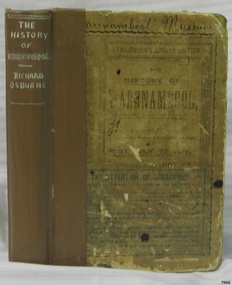
... ...new arrivals...TO OLD COLONISTS AND YOUNG AUSTRALIANS, OR NEW ARRIVALS, THIS HISTORY OF THE RISE AND PROGRESS OF THE CAPITAL OF WESTERN VICTORIA, IS DEDICATED AS INTERESTING AND USEFUL, BY "THE FATHER OF THE WARRNAMBOOL PRESS" RICHARD OSBURNE." ...The book was dedicated to the early colonists as well as to the new arrivals by the writer, Richard Osburne, who entitles himself as "The father of the Warrnambool Press". ...This little book is one of only 1000 books published of the original Queen's Jubilee Edition. It spans fifty years of the history of Warrnambool from the time that the first Government Land Sales commenced. It also deliberately coincides with the 1887 celebrations of Queen Victoria's Jubilee Year of her ascension to the British Throne. The book is an invaluable reference for researchers of local Warrnambool history and has been used as a text book and reference book for local students. The book had two owners before it became part of the Warrnambool Public Library, and when the library closed down, the book was held by the Warrnambool City Council until, in 1974, it was transferred to the newly established Flagstaff Hill Maritime Museum and Village. The author, Richard Osburne, (1825-1895) was born in Australia. He moved to Warrnambool in 1847 as the first local Journalist. In 1851 he founded the Warrnambool Examiner newspaper which he operated until the end of 1880. Osburne was much involved in civic and community affairs of the town, and he set himself the task of recording the history of the city's early pioneers. In the introductory pages of the book the author refers to himself as "The Father of the Warrnambool Press". Only 1,000 copies of this edition of the book were printed. In September 1980 a facsimile edition was printed with the addition of illustrations from the period, an index and relevant annotations by local historian T.A. Wicking (Tom Wicking). This later book was named the Premier Town Edition, due to Warrnambool being awarded the title of Premier Town in Victoria in 1979-82 by the Premier of Victoria; it also received the inaugural award in 1959 and a later award in 1988-91. This book is rare. It is one of only 1000 copies printed, and one of three in the Collection of Flagstaff Hill Maritime Museum and Village. The book was dedicated to the early colonists as well as to the new arrivals by the writer, Richard Osburne, who entitles himself as "The father of the Warrnambool Press". The content of the book is invaluable as a reference for Warrnambool and District's local history in its early colonial and pioneering days. It provides the information that helps in an understanding the foundation that the city was built on, connecting the people of today to the pioneers of the past. The inscriptions of two previous owners of the book, at least one of whom was a local resident, gives additional significance to this copy. The History of Warrnambool: Capital of the Western Ports of Victoria From1847 (when the first Government Land Sales took place) up to the end of 1886, By Richard Osburne, Proprietor of the Warrnambool Examiner from 1851 to the close of 1880. Author: Richard Osburne Publisher: Prahran: The Chronicle Printing & Publishing Company Limited Date: 1887 (MDCCCLXXXVII) Edition: Original: Queen's Jubilee Edition Small book with hard cover and reinforced spine. Dust jacket front has been pasted over front hard cover. The hardcovers are covered with clear adhesive plastic covering. Inscriptions include a typed label on the spine, a stamp at base of the fly page, on the loose page inside front cover, on inside back cover, and two hand written names on the second fly page; Jackson Giblett and G. M. Potter. The first fly page has a message to the readers, as shown in the Inscriptions of this record.Label on spine "R.A. 994.57 OSB" Inscriptions on second fly page: "Jackson Giblett / 1886" and "G.M. Potter, 70 Japan Street" Printed on fly page: "PRICE, FIVE SHILLINGS" Stamp of front end paper: WARRNAMBOOL / PUBLIC LIBRARY", "000336" and in a rectangular border " - - - - - - / WARRNAMBOOL / PUBLIC LIBRARY" First fly page: "THE QUEEN'S JUBILEE EDITION. TO OLD COLONISTS AND YOUNG AUSTRALIANS, OR NEW ARRIVALS, THIS HISTORY OF THE RISE AND PROGRESS OF THE CAPITAL OF WESTERN VICTORIA, IS DEDICATED AS INTERESTING AND USEFUL, BY "THE FATHER OF THE WARRNAMBOOL PRESS" RICHARD OSBURNE." Stamp inside back cover: "WARRNAMBOOL LIBRARY/ Liebig Street / Warrnambool 3280 / (055) 6- 2258"warrnambool, shipwreck coast, flagstaff hill, maritime museum, maritime village, the history of warrnambool, richard osburne, osturne's history of warrnambool, queen's jubilee edition, 1847-1887, warrnambool history, the chronicle printing and publishing company, capital of the western ports of victoria, first government land sales, warrnambool examiner, five shillings, warrnambool's first reporter, warrnambool public library, 1887, 1979, premier town, premier edition, queen's jubliee, queen victoria's jubilee, western ports of victoria, 1847, government land sales, chronicle publishing and printing co., g m potter, 1000 copies, t a wicking, jackson giblett, 1886, japan street, old colonists, young australians, new arrivals, rise and progress, capital of western victoria, interesting and useful, the father of the warrnambool press -
 Flagstaff Hill Maritime Museum and Village
Book - Historical, Warrnambool, Richard Osburne, The History of Warrnambool, 1887
... ...new arrivals...The book was dedicated to the early colonists as well as to the new arrivals by the writer, Richard Osburne, who entitles himself as "The father of the Warrnambool Press". ...This little book is one of only 1000 books published of the original Queen's Jubilee Edition. It spans fifty years of the history of Warrnambool from the time that the first Government Land Sales commenced. It also deliberately coincides with the 1887 celebrations of Queen Victoria's Jubilee Year of her ascension to the British Throne. The book is an invaluable reference for researchers of local Warrnambool history and has been used as a textbook and reference book for local students. The book became part of the Warrnambool Public Library, and when the library closed down, the book was held by the Warrnambool City Council until, in 1974, it was transferred to the newly established Flagstaff Hill Maritime Museum and Village. The author, Richard Osburne, (1825-1895) was born in Australia. He moved to Warrnambool in 1847 as the first local Journalist. In 1851 he founded the Warrnambool Examiner newspaper which he operated until the end of 1880. Osburne was much involved in civic and community affairs of the town, and he set himself the task of recording the history of the city's early pioneers. In the introductory pages of the book the author refers to himself as "The Father of the Warrnambool Press". Only 1,000 copies of this edition of the book were printed. In September 1980 a facsimile edition was printed with the addition of illustrations from the period, an index and relevant annotations by local historian T.A. Wicking (Tom Wicking). This later book was named the Premier Town Edition, due to Warrnambool being awarded the title of Premier Town in Victoria in 1979-82 by the Premier of Victoria; it also received the inaugural award in 1959 and a later award in 1988-91.This book is rare. It is one of only 1000 copies printed, and one of three in the Collection of Flagstaff Hill Maritime Museum and Village. The book was dedicated to the early colonists as well as to the new arrivals by the writer, Richard Osburne, who entitles himself as "The father of the Warrnambool Press". The content of the book is invaluable as a reference for Warrnambool and District's local history in its early colonial and pioneering days. It provides the information that helps in an understanding the foundation that the city was built on, connecting the people of today to the pioneers of the past.The History of Warrnambool: Capital of the Western Ports of Victoria, From1847 up to the end of 1886 (when the first Government Land Sales took place) Author: Richard Osburne, "Proprietor of the Warrnambool Examiner from 1851 to the close of 1880" Publisher: The Chronicle Printing and Publishing Company Limited Date: 1887 (MDCCCLXXXVII) (Roman numerals are covered in tape) Edition: Original: Queen's Jubilee Edition Hardcover book with titles on the spine and front cover. The front and back covers have been coated in a clear substance, the spine has fabric reinforcing with titles handwritten in white. Inscriptions include stamps and handwriting. A library label has been pasted onto the front cover, then the cover has been lacquered. The first fly page has a message to the readers, as shown in the Inscriptions of this record. Many of the pages in this book have handwritten notes in the margins and within the text and some of the lines are crossed out.The Pastedown front endpaper has a sticker from Warrnambool Mechanics Institute and Free Library Front loose endpaper has a stamp from "Warrnambool Mechanics Institute" Handwritten Iin black pen on from cover are the words "Warrnambool Museum" Label on the front cover: "THE ATTENTION OF SUBSCRIBERS ..."warrnambool, shipwreck coast, flagstaff hill, maritime museum, maritime village, the history of warrnambool, richard osburne, osturne's history of warrnambool, queen's jubilee edition, 1847-1887, warrnambool history, the chronicle printing and publishing company, capital of the western ports of victoria, first government land sales, warrnambool examiner, five shillings, warrnambool's first reporter, warrnambool public library, 1887, 1979, premier town, premier edition, queen's jubliee, queen victoria's jubilee, western ports of victoria, 1847, government land sales, chronicle publishing and printing co., 1000 copies, old colonists, young australians, new arrivals, rise and progress, capital of western victoria, interesting and useful, the father of the warrnambool press -
 National Vietnam Veterans Museum (NVVM)
Slide - Sims Image Collection
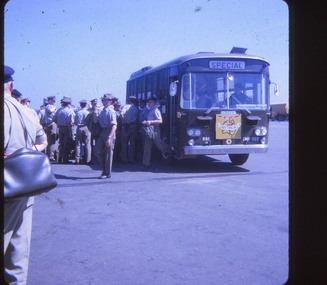
... New arrivals at Saigon airport 1969: Australian soldiers in full uniform board a bus on a tarmac....Peter Stanley Sims 44304 Slides Royal Australian Army Medical Corps Vietnam War Sims Saigon 1969 arrivals airport New arrivals at Saigon airport 1969: Australian soldiers in full uniform board a bus on a tarmac. ...A collection of 253 images on slides taken while on deployment in Vietnam, by Corporal Peter Stanley Sims (44304) who served in the Royal Australian Army Medical Corps, 1969 - 1970.New arrivals at Saigon airport 1969: Australian soldiers in full uniform board a bus on a tarmac.peter stanley sims, 44304, slides, royal australian army medical corps, vietnam war, sims, saigon, 1969, arrivals, airport -
 National Vietnam Veterans Museum (NVVM)
Photograph, Snoopy Cartoon, C1968 - 1973
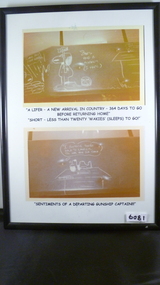
... 'A Lifer- A new arrival in the country - 364 Days to go before returning home ' 'Short - Less than Twenty 'Wakies '(sleeps ) to go! ...Caricatures and Cartoons Photograph 'A Lifer- A new arrival in the country - 364 Days to go before returning home ' 'Short - Less than Twenty 'Wakies '(sleeps ) to go! ...Two colour photos in a black frame of Snoopy, the dog. Both appear to be chalk artwork onto unknown surface.'A Lifer- A new arrival in the country - 364 Days to go before returning home ' 'Short - Less than Twenty 'Wakies '(sleeps ) to go! " Sentiments of a Departing Gunship Captain"caricatures and cartoons, photograph -
 National Vietnam Veterans Museum (NVVM)
Slide - Sims Image Collection
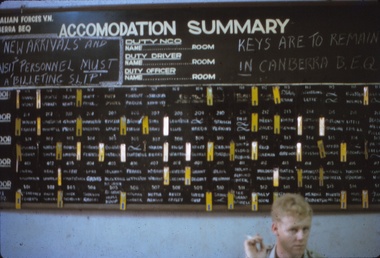
... Canberra BEQ (Bachelor and enlisted men's quarters) accommodation board with names of new arrivals and visiting personnel with keys to allocated rooms, Cholon, Vietnam 1969. ...Peter Stanley Sims 44304 Slides Royal Australian Army Medical Corps Vietnam War Sims Cho Lon Cholon Canberra BEQ Bachelors and Enlisted Men's Quarters Arrivals Board accommodation Canberra BEQ (Bachelor and enlisted men's quarters) accommodation board with names of new arrivals and visiting personnel with keys to allocated rooms, Cholon, Vietnam 1969. ...From a collection of 253 images on slides taken while on deployment in Vietnam, by Corporal Peter Stanley Sims (44304), who served in the Royal Australian Army Medical Corps, 1969 - 1970.Canberra BEQ (Bachelor and enlisted men's quarters) accommodation board with names of new arrivals and visiting personnel with keys to allocated rooms, Cholon, Vietnam 1969. Corporal Peter Stanley Sims room 207.peter stanley sims, 44304, slides, royal australian army medical corps, vietnam war, sims, cho lon, cholon, canberra beq, bachelors and enlisted men's quarters, arrivals board, accommodation -
 Ringwood and District Historical Society
Newspaper, Ringwood Secondary College - Four senior students are appointed as prefects. - The Post - Tuesday, February 17, 1998 Page 13
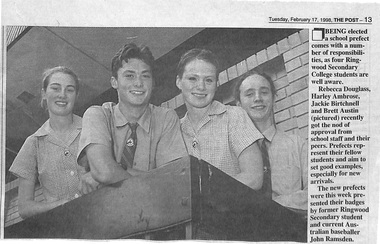
... Prefects represent their fellow students and aim to set good examples, especially for new arrivals....Prefects represent their fellow students and aim to set good examples, especially for new arrivals. Clipping glued to A4 sheet of paper Ringwood Secondary College - Four senior students are appointed as prefects. - The Post - Tuesday, February 17, 1998 Page 13 Newspaper ...Clipping glued to A4 sheet of paperRebecca Douglass, Harley Ambrose, Jackie Birtchnell and Brett Austin recently got the nod of approval from school staff and their peers. Prefects represent their fellow students and aim to set good examples, especially for new arrivals. -
 National Vietnam Veterans Museum (NVVM)
Photograph, Gibbons, Denis, Three Hundred And Sixty Five And A Wakey
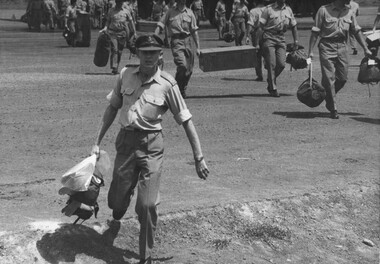
... A black and white photograph of - "Nobody has three hundred and sixty five and a wakey" so was the chant of the Old Timers at 1st Australian Task Field Base, Nui Dat as new arrivals about to commence their tour of duty "in country". ...Photograph 1st ATF Base Nui Dat C-130 Hercules Gibbons Collection Catalogue 1st Australian Task Force Denis Gibbons A black and white photograph of - "Nobody has three hundred and sixty five and a wakey" so was the chant of the Old Timers at 1st Australian Task Field Base, Nui Dat as new arrivals about to commence their tour of duty "in country". ...Denis Gibbons (1937 – 2011) Trained with the Australian Army, before travelling to Vietnam in January 1966, Denis stayed with the 1st Australian Task Force in Nui Dat working as a photographer. For almost five years Gibbons toured with nine Australian infantry battalions, posting compelling war images from within many combat zones before being flown out in late November 1970 after sustaining injuries. The images held within the National Vietnam Veterans Museum make up the Gibbons Collection.A black and white photograph of - "Nobody has three hundred and sixty five and a wakey" so was the chant of the Old Timers at 1st Australian Task Field Base, Nui Dat as new arrivals about to commence their tour of duty "in country". These replacments were delivered by a US C130 aircraftphotograph, 1st atf base, nui dat, c-130 hercules, gibbons collection catalogue, 1st australian task force, denis gibbons -
 Surrey Hills Historical Society Collection
Book, Michael Dugan et al, There goes the Neighbourhood, 1984
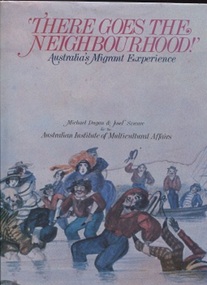
... It also looks at the new arrivals - those accepted and those rejected - from the points of view of people already established in the country....It also looks at the new arrivals - those accepted and those rejected - from the points of view of people already established in the country. ...The book presents a rich picture of a nation in the making. It is a portrait of Australia's development during the 19th and 20th centuries seen through the eyes of people arriving to make their homes here. It also looks at the new arrivals - those accepted and those rejected - from the points of view of people already established in the country.The book has a place in this collection by virtue of Michael Dugan having been a local resident.34 cm H; 200 p; includes chronology, List of sources and texts for each chapterTitle page: signed by one of the authors: Michael Dugansocial interaction--australia--history, australia - social life and customs, australia - social conditions, australia - emigration and immigration - history, minorities - australia - history, (mr) michael dugan, (mr) josef szware -
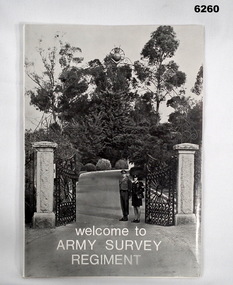 Bendigo Military Museum
Booklet - Welcome to the Army Survey Regiment, Army Survey Regiment, Circa late 1970's
... An information booklet provided to new arrivals at the Army Svy Regt. It contains information on daily routine, unit facilities and services, accommodation options, sports policy, Regimental Appointments, recreational facilities and places of interest around Bendigo. ...An information booklet provided to new arrivals at the Army Svy Regt. It contains information on daily routine, unit facilities and services, accommodation options, sports policy, Regimental Appointments, recreational facilities and places of interest around Bendigo. ...An information booklet provided to new arrivals at the Army Svy Regt. It contains information on daily routine, unit facilities and services, accommodation options, sports policy, Regimental Appointments, recreational facilities and places of interest around Bendigo. Cover photo of the gate entrance to the Army Survey Regiment on the cover. WO1 Ken and Cpl Heather Slater stand at the gate. A4 soft covered booklet, paper pages held together with "ARNOS" an Fastenerroyal australian survey corps, rasvy, fortuna, army survey regiment, army svy regt, asr -
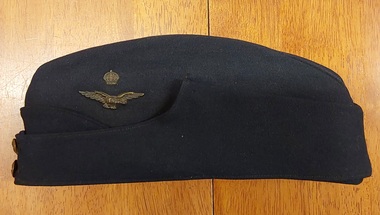 Mont De Lancey
Uniform - Officer's Forage Cap, 1940's
... In bomber and fighter squadrons, a well-worn, battered forage cap became an informal badge of honor, distinguishing seasoned veterans from new arrivals ("sprogs")....In bomber and fighter squadrons, a well-worn, battered forage cap became an informal badge of honor, distinguishing seasoned veterans from new arrivals ("sprogs"). WW11 uniform WW11 badge WW11 WW11RAAF WW11 cap Inside the cap is stamped: 'MV(faded unknown letter)D 58' A navy blue woolen WW11 Officer's Forage Cap with shaped folded sides. ...The blue forage cap (frequently referred to as a side cap, wedge cap, or garrison cap) during World War II was a practical, foldable soft cap widely adopted by air forces and naval units, most notably by the Royal Australian Air Force (RAAF) and Commonwealth aircrews. In bomber and fighter squadrons, a well-worn, battered forage cap became an informal badge of honor, distinguishing seasoned veterans from new arrivals ("sprogs").A navy blue woolen WW11 Officer's Forage Cap with shaped folded sides. It has a fastening at the front with two small brass buttons with wings and a crown insignia attached. Inside is a brown lining with a brown velvet band at the top. A large safety pin on the lining holds the crown closed from the outside. The clips to hold the badges on the outside can be seen inside on the lining. It was issued in 1943.Inside the cap is stamped: 'MV(faded unknown letter)D 58'ww11 uniform, ww11 badge, ww11, ww11raaf, ww11 cap -
 Eltham District Historical Society Inc
Document - Folder, O'Malley, Stephen
... Eltham resident, Stephen O'Malley, as Melbourne Fire Brigade's multicultural liaison officer, teaches new arrivals to Australia about fire safety and emergency services in Australia. ...Eltham resident, Stephen O'Malley, as Melbourne Fire Brigade's multicultural liaison officer, teaches new arrivals to Australia about fire safety and emergency services in Australia. ...Eltham resident, Stephen O'Malley, as Melbourne Fire Brigade's multicultural liaison officer, teaches new arrivals to Australia about fire safety and emergency services in Australia. He was awarded an Australian Fire Service Medal in the 2010 Australia Day Awards. Contents Newspaper article: "A great honour for firefighter Stephen O'Malley", Diamond Valley Leader, 27 January 2010, Stephen O'Malley awarded an Australian Fire Service Medal in 2010 Australia Day Awards.Newspaper clippings, A4 photocopies, etcstephen o'malley, metropolitan fire brigade -
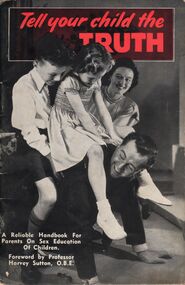 Bendigo Historical Society Inc.
Book - AILEEN AND JOHN ELLISON COLLECTION: BOOKLET - TELL YOUR CHILD THE TRUTH
... Part 3: The primary school years - Explaining father's part, preparing the family for the new arrival, a period of dormancy, problems of this stage. ...Part 3: The primary school years - Explaining father's part, preparing the family for the new arrival, a period of dormancy, problems of this stage. ...Small booklet (44 pages) "Tell your child the truth" A reliable handbook for parents on sex education of children. Foreword by Professor Harvey Sutton O.B.E. The booklet was published by the father and son welfare movement of Australia in January, 1959. This is the fourth edition. Contents: Foreword - Introduction - Part 1: Sex education and the parent - the need for sex education, sex education what does it mean? Part 2: The nursery years - The home atmosphere, early interest, the first questions. Part 3: The primary school years - Explaining father's part, preparing the family for the new arrival, a period of dormancy, problems of this stage. Part 4: Puberty and adolescence - Puberty and its changes, the changing feelings of youth, masturbation, some moral and social factors. Conclusion - Glossary - Reliable graded books.books, school, sex education -
Glenelg Shire Council Cultural Collection
Document - Letter, Patience Whitmore, 1853
... From an ABC article about and exhibition containing the letter from Patience Whitmore: The hardships and tragedies often faced by new arrivals are also detailed in this exhibition, especially in a letter written by Patience Whitmore who arrived in 1853... ...From an ABC article about and exhibition containing the letter from Patience Whitmore: The hardships and tragedies often faced by new arrivals are also detailed in this exhibition, especially in a letter written by Patience Whitmore who arrived in 1853... ...From an ABC article about and exhibition containing the letter from Patience Whitmore: The hardships and tragedies often faced by new arrivals are also detailed in this exhibition, especially in a letter written by Patience Whitmore who arrived in 1853... Widowed before she left Britain, she made the trip to Australia with her second husband and children, although two of those children and her second husband died on the way out. She married for a third time after arriving, and that husband also passed away fairly early on, with Patience following not long after. The remaining children were sent off to an orphanage. Even though that sounds like a terrible life, apparently, compared with the life she might've had back in Britain, Patience considered herself to be very lucky, which gives you some insight into what life in Britain must've been like at the time.Letter written by Patience Whitmore in 1853.emigration, 1853, patience whitmore, letter -
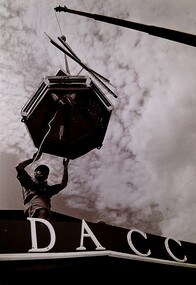 Sunshine and District Historical Society Incorporated
Photograph - Dutch Club Sunshine 1989 Photographs, C. McGee, 5th March 1989
... Activities included Dutch‑language evenings, card nights, Sinterklaas celebrations, folk dancing, shared meals, and community support for new arrivals. The club served as an important cultural anchor for Dutch families employed in local industries such as HV McKay, ICI Deer Park, and the rail workshops. ...Activities included Dutch‑language evenings, card nights, Sinterklaas celebrations, folk dancing, shared meals, and community support for new arrivals. The club served as an important cultural anchor for Dutch families employed in local industries such as HV McKay, ICI Deer Park, and the rail workshops. ...These photographs, taken by The Advocate in 1989, are of Bob Sibson, from the Dutch Club Sunshine fitting a windmill to the top of a building. The Sunshine Dutch Club was a social and cultural organisation formed by Dutch migrants who settled in Sunshine, St Albans, and Deer Park during the post‑war period. The club did not operate from a dedicated building; instead, it met in rented halls, RSL rooms, and church spaces throughout Sunshine. Activities included Dutch‑language evenings, card nights, Sinterklaas celebrations, folk dancing, shared meals, and community support for new arrivals. The club served as an important cultural anchor for Dutch families employed in local industries such as HV McKay, ICI Deer Park, and the rail workshops. Windmills are central to Dutch heritage due to their role in shaping the country’s physical and economic development. They enabled large‑scale land reclamation, allowing communities to create polders and transform wetlands into productive farmland. Windmills also supported early industry, contributing to economic growth and technological innovation. Beyond their practical functions, windmills hold cultural importance as symbols of resilience, engineering ingenuity, and the Dutch relationship with water. The Sunshine Dutch Club is significant for its role in supporting Dutch migrant identity and community cohesion in Melbourne’s western suburbs. It provided a space for cultural continuity, language maintenance, and intergenerational connection during a period of rapid suburban growth and demographic change. Although informal and unincorporated, the club contributed to Sunshine’s multicultural heritage and reflects the broader pattern of migrant community organisations that shaped social life in the region. Its activities preserve memory of Dutch settlement and cultural expression in Sunshine from the 1950s to the 1980s.7476.01 - Dutch Club Sunshine 1989 Photographs (Advocate 837).JPG Bob Sibson 7476.02 - Dutch Club Sunshine 1989 Photographs (Advocate 837).JPG Bob Sibson 7476.03 - Dutch Club Sunshine 1989 Photographs (Advocate 837).JPG Bob Sibson 7476.04 - Dutch Club Sunshine 1989 Photographs (Advocate 837).JPG Bob Sibson 7476.05 - Dutch Club Sunshine 1989 Photographs (Advocate 837).JPG Bob Sibsondutch club sunshine -
 Federation University Art Collection
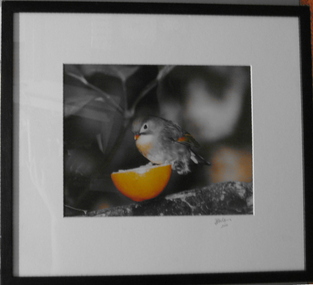
Photograph, Frank Golding, 'Three-quarter Time' - by Frank Golding, 2001
... Frank Golding was employed as Principal at three schools including a multi-site English language centre for refugees and other new arrivals. Later he taught in and managed curriculum and equity programs in education departments and universities. ...Frank Golding was employed as Principal at three schools including a multi-site English language centre for refugees and other new arrivals. Later he taught in and managed curriculum and equity programs in education departments and universities. ...Frank Patrick Golding (1938 - ) This item is part of the Federation University Art Collection. The Art Collection features over 1000 works and was listed as a 'Ballarat Treasure' in 2007. Frank Golding is an author, researcher, historian, consultant: Honorary Senior Research Fellow at Federation University in Victoria, Australia. His formal qualifications are TPTC (Ballarat), BA (Melb), BEd (Melb), Dip MT (UNE), MA (Hons) (London). He has taught English and History in several schools. Frank Golding was employed as Principal at three schools including a multi-site English language centre for refugees and other new arrivals. Later he taught in and managed curriculum and equity programs in education departments and universities. Finally he is the author of 12 published books including a memoir, An Orphan’s Escape: Memories of a Lost Childhood (Lothian, 2005) which describes his childhood as a Ward of the State of Victoria in the ‘care’ of three foster mothers and three institutions. Golding lived in the Ballarat Orphanage from 1943 to 1953. It is his childhood experiences that underpin Golding's active involvement in ‘care’ leaver issues as an advocate and lobbyist. Golding is a Life Member of CLAN (Care Leavers of Australasia Network) the peak body of Care Leavers for Care leavers run by Care Leavers.Image of bird on 1/2 orange citrus fruit - a play on childhood memory of oranges at 3/4 timeSignature on label on backart, artwork, frank golding, bird, federation college, photography, colour photography, alumni -
 Sunshine and District Historical Society Incorporated
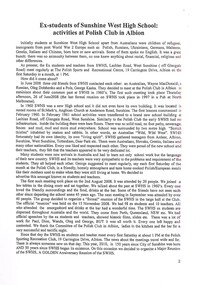
Archive - Sunshine West High School Thistle Club
... Initially, the student population comprised approximately 50 percent of children from refugee backgrounds (post-World War 2 Europe), such as people of Polish, Russian, Ukrainian, German, Maltese, Greek, Italian and Chinese descent, both born in Australia or new arrivals. Many of them could not speak English. ...Initially, the student population comprised approximately 50 percent of children from refugee backgrounds (post-World War 2 Europe), such as people of Polish, Russian, Ukrainian, German, Maltese, Greek, Italian and Chinese descent, both born in Australia or new arrivals. Many of them could not speak English. ...With the rapid growth of primary school enrolments in the 1950s (baby boomers), the need for an additional high school in Sunshine was identified. Planning got underway to build a new school but, in the meantime, the Education Department secured alternative premises at St Mark’s in Anderson Road. At the start of 1960, 85 pupils enrolled at the school. There were four full-time teachers; one part-time teacher; a Headmaster; and a secretary. Initially, the student population comprised approximately 50 percent of children from refugee backgrounds (post-World War 2 Europe), such as people of Polish, Russian, Ukrainian, German, Maltese, Greek, Italian and Chinese descent, both born in Australia or new arrivals. Many of them could not speak English. In April 2008, three old friends (students of Australian, Russian and Polish descent) decided to meet at the Polish Club in Ardeer to reminisce about their time as students of Sunshine West High School during the 1960s. Following the successful get-together, the three men agreed to meet regularly on the first Saturday of the month at the same venue. By August 2008, the meeting had attracted 20 people, and by September 2008, 40 people were in attendance. An official reunion was held in November 2008, attended by 98 ex-students and 10teachers. And so, the Thistle Club was born. The Club has become a valuable resource for the school and individuals who have stayed connected to their alumni network.The Thistle Club has been active over the last 18-years with ex-students and teachers meeting monthly at 12 noon at the Polish Sporting Recreation Club in Albion. Membership to the Club is open to alumni from the six decades the school has been in existence. It is considered a valuable social network, with former students also assisting the welfare office with funding for disadvantaged students and the provision of an annual scholarship.5889.01 - Sunshine West High School Thistle Club - Ex Students Of Sunshine West High School Activities At Polish Club 5889.02 - Sunshine West High School Thistle Club - Establishment Of Their Alumni The Thistle Club Sunshine (Extract from Sunshine & District Historical Society Newsletter No 64 March 2023 Page 5)sunshine west high school, lachlan road, sunshine west, thistle club -
 Flagstaff Hill Maritime Museum and Village
Book - Religious Book, Oxford University Press, The Holy Bible, 1859
... The immigrants on board the British Trident were mostly new arrivals to Australia. Like Henry, they planned to make Australia their new home. ...The immigrants on board the British Trident were mostly new arrivals to Australia. Like Henry, they planned to make Australia their new home. ...Young Henry Pitts sailed from Liverpool, England, in about October 1860, on a ship called the 'British Trident'. About three months later, on January 7th 1861, he arrived in Sydney, Australia. While he travelled from one side of the world to the other, Henry attended lessons on the ship with his onboard teacher, Joseph Benton. On the day before the ship arrived at Sydney, Henry was given a Holy Bible by his teacher. The small black book had a hardcover and many printed pages of very thin paper. Henry must have felt special when he read his teacher’s beautifully written message that said the gift was a ‘mark of respect’ towards Henry. Maybe Mr Benton taught Henry to write with a pen and ink because Henry wrote his name several times inside the front of the book and again below his teacher’s message. Henry may have even learned to read from a Bible, which many passengers included in their luggage. The immigrants on board the British Trident were mostly new arrivals to Australia. Like Henry, they planned to make Australia their new home. Many also hoped to find work in this new country. Some passengers had family and friends waiting for them, people who deposited money towards their trip. Henry’s relative, Charles Pitts, had helped him pay for the ship’s passage, and William Oberthan paid money towards Joseph Benton’s fare. He may have planned for Joseph to work as a teacher in Australia. The Single Females were allowed to leave the ship the day after it docked at Sydney, but the Families and Single Men, including Henry and Joseph, had to stay onboard until Thursday. This Holy Bible is significant for its age, as it was published in 1859. The inscriptions within this small Bible are significant as they show that during a ship's voyage passengers had the opportunity to teach and to learn. They also show a relationship of encouragement had been built between the teacher and pupil. The Holy Bible containing the Old and New Testaments: Translated out of the original tongues: and with the former translations diligently compared and revised by His Majesty's Special Command. approved to be read in churches. Publisher and printed at the Oxford University Press, Sold by E. Gardner and Son, at the Oxford Bible Warehouse, Paternoster Row, London; and by J. and C. Mozley, Derby. Date: 1859 (in Roman Numerals) Handwritten black ink inscriptions are inside the front and back covers. The book once belonged to Henry Pitts and was presented to him by Joseph Benton in 1861.Front left side: " H Pitts H Pitts / - - - - - - of this Book / C - - - - - - - - -K " Front right side: "Given / to / Henry Pitts / As / A Mark of Respect / From / His Teacher on Board / the / British Trident / January 6th 1861 / Joseph Benton" "Henry" Back left: (indecipherable character)warrnambool, flagstaff hill maritime museum, holy bible, henry pitts, joseph benton, immigrant ship, 1861, single male, single female, charles pitts, william oberthan, british trident, hyde partk -
 Bendigo Historical Society Inc.
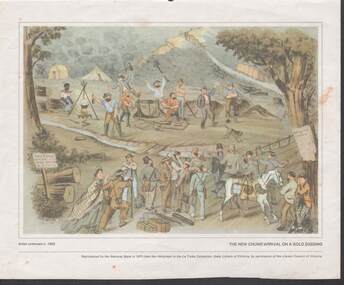
Painting - CAROL HOLSWORTH COLLECTION: 1970 NATIONAL BANK PAINTING 'THE NEW CHUMS ARRIVAL ON A GOLD DIGGING'
... CAROL HOLSWORTH COLLECTION: 1970 NATIONAL BANK PAINTING 'THE NEW CHUMS ARRIVAL ON A GOLD DIGGING'...1970 NATIONAL BANK PAINTING REPRODUCTION The New Chums Arrival on a Gold Digging .Artist unknown c. 1855 Below the picture title the words - Reproduced by the National Bank in 1970 from the lithograph in the La Trobe Collection , State Library of Victoria , by permission of the Library Council of Victoria .Bottom left corner shows a rough sign nailed to an upright post saying The Star Concert Hall Gus Hatton To night.The painting is divided lengthways by a stream with a two plank crossing apparently to show the differences between the seasoned miners above the stream and the new chums below the stream .The above centre of the picture is a windlass surrounded by men - an Aboriginal sitting by a fire , two men with bottles in hand depicting the proliferation of drink .The New Chums below the stream show men and a woman all wearing smart hats and clothes , some carrying unneeded items such as Umbrellas...PAINTING Watercolour gold diggers 1970 NATIONAL BANK PAINTING REPRODUCTION The New Chums Arrival on a Gold Digging .Artist unknown c. 1855 Below the picture title the words - Reproduced by the National Bank in 1970 from the lithograph in the La Trobe Collection , State Library of Victoria , by permission of the Library Council of Victoria .Bottom left corner shows a rough sign nailed to an upright post saying The Star Concert Hall Gus Hatton To night.The painting is divided lengthways by a stream with a two plank crossing apparently to show the differences between the seasoned miners above the stream and the new chums below the stream .The above centre of the picture is a windlass surrounded by men - an Aboriginal sitting by a fire , two men with bottles in hand depicting the proliferation of drink .The New Chums below the stream show men and a woman all wearing smart hats and clothes , some carrying unneeded items such as Umbrellas Painting CAROL HOLSWORTH COLLECTION: 1970 NATIONAL BANK PAINTING 'THE NEW CHUMS ARRIVAL ON A GOLD DIGGING' ...1970 NATIONAL BANK PAINTING REPRODUCTION The New Chums Arrival on a Gold Digging .Artist unknown c. 1855 Below the picture title the words - Reproduced by the National Bank in 1970 from the lithograph in the La Trobe Collection , State Library of Victoria , by permission of the Library Council of Victoria .Bottom left corner shows a rough sign nailed to an upright post saying The Star Concert Hall Gus Hatton To night.The painting is divided lengthways by a stream with a two plank crossing apparently to show the differences between the seasoned miners above the stream and the new chums below the stream .The above centre of the picture is a windlass surrounded by men - an Aboriginal sitting by a fire , two men with bottles in hand depicting the proliferation of drink .The New Chums below the stream show men and a woman all wearing smart hats and clothes , some carrying unneeded items such as Umbrellaspainting, watercolour, gold diggers -
 Ballarat Heritage Services
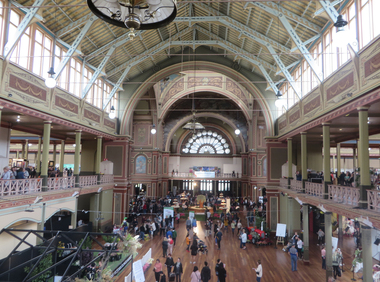
Photograph - Photograph -Colour, Clare Gervasoni, Interior of the Melbourne Exhibition Building, 2019, 31/03/2019
... The centre provided temporary accomodation for thousands of new arrivals from Britain. On 01 July 2004 the Royal Exhibition Building and Carlton Gardens were inscribed on the World Heritage List. ...The centre provided temporary accomodation for thousands of new arrivals from Britain. On 01 July 2004 the Royal Exhibition Building and Carlton Gardens were inscribed on the World Heritage List. ...A competition was announced to design a suitable building for the proposed Melbourne International Exhibition in December 1877. Eighteen entries were received. The winner of 300 pounds was Joseph Reed of the architectual firm Reed and Barnes. The foundation stone was laid by Governor Sir George Bowen on 19 February 1879. Prominent Melbounre builder David Mitchell, father of Dame Nellie Melba, won the tender to construct the main building. Exhibitors were able to move in by May 1880. On 01 October 1880 the Melbourne International Exhibition opened, when over 6000 people entered the main hall to see the Governor, the Marquess of Normanby open the show. Thirty three nations participated and ofver 32,000 exhibits were displayed. At the close of the exhibition on 30 April 1881 over 1.3 million people had visited the exhibition. In 1881 Victoria's population was just over 250,000. The management of the Exhibition Building and eight hectares of the Carlton Gardens was handed to the Exhibition Trustees by the Melbourne International Exhibition Commissioners on 01 OCtober 1881. The Trustees maintained the building for 'future public exhibitions and ... general public instruction and recreation' until 1996 when management of the building was transferred to Museum Victoria. In 1901 when the Australian colonies federated there was no capital and no federal parliament building. The Federal Parliament moved into the Victorian State Parliament building, and the State Parliament moved into the Western Annexe of the Exhibition Building for 26 years. After World War One, on 04 February 1919, the exhibition Building was turned into a hospital to treat Melbournians struck down with the Spanis 'Flu'. Initially housing 500 beds, the hospital grew to accomodate 2000 patients. Femals were located between the concert platform in the western nave and the done; male patients occupied the spaces beyond. The basement was used a a morgue. With the departure of the State Parliament in 1927 the western annexe became home to the Country Roads Board. In 1932 it was joined by the MOtor Registration Branch, and the Transport Regulation Board in 1934. They co-existedin cramped offices until the 1960s. In 1949 the oval at the rear of the ExhibitionBuilding was leased to the Commonealth Government for the establishment of the Migrant Reception Centre. When it closed in 1961-62, the centre comrised 29 bungalows over 1.4 hectare. The centre provided temporary accomodation for thousands of new arrivals from Britain. On 01 July 2004 the Royal Exhibition Building and Carlton Gardens were inscribed on the World Heritage List. It is the only 19th century Great Hall to survive largely intact, still in its original landscape setting, and still used as a palace of industry. The Melbourne International Flower and Garden Show is a flower show held annually since 1995 in early April each year, in Melbourne, Australia. It is located in the World Heritage Site of Carlton Gardens and the Royal Exhibition Building.[1] It is the largest horticultural event in the southern hemisphere, attracting over 100,000 visitors. It is rated among the top five flower and garden shows in the world. (Wikipedia)Colour photograph of the interior of the Melbourne Exhibition Buildings during the 2019 Melbourne Flower and Garden Show.melbourne international flower and garden show, carlton gardens, melbourne exhibition building, royal exhibition buildings -
 Ballarat Heritage Services
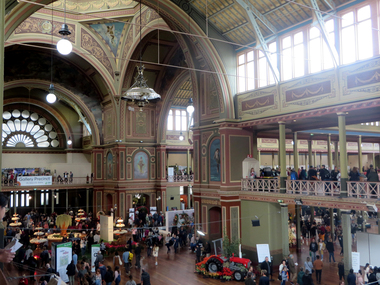
Photograph -Colour, Clare Gervasoni, Interior of the Melbourne Exhibition Building, 2019, 31/03/2019
... The centre provided temporary accomodation for thousands of new arrivals from Britain. On 01 July 2004 the Royal Exhibition Building and Carlton Gardens were inscribed on the World Heritage List. ...The centre provided temporary accomodation for thousands of new arrivals from Britain. On 01 July 2004 the Royal Exhibition Building and Carlton Gardens were inscribed on the World Heritage List. ...A competition was announced to design a suitable building for the proposed Melbourne International Exhibition in December 1877. Eighteen entries were received. The winner of 300 pounds was Joseph Reed of the architectual firm Reed and Barnes. The foundation stone was laid by Governor Sir George Bowen on 19 February 1879. Prominent Melbounre builder David Mitchell, father of Dame Nellie Melba, won the tender to construct the main building. Exhibitors were able to move in by May 1880. On 01 October 1880 the Melbourne International Exhibition opened, when over 6000 people entered the main hall to see the Governor, the Marquess of Normanby open the show. Thirty three nations participated and ofver 32,000 exhibits were displayed. At the close of the exhibition on 30 April 1881 over 1.3 million people had visited the exhibition. In 1881 Victoria's population was just over 250,000. The management of the Exhibition Building and eight hectares of the Carlton Gardens was handed to the Exhibition Trustees by the Melbourne International Exhibition Commissioners on 01 OCtober 1881. The Trustees maintained the building for 'future public exhibitions and ... general public instruction and recreation' until 1996 when management of the building was transferred to Museum Victoria. In 1901 when the Australian colonies federated there was no capital and no federal parliament building. The Federal Parliament moved into the Victorian State Parliament building, and the State Parliament moved into the Western Annexe of the Exhibition Building for 26 years. After World War One, on 04 February 1919, the exhibition Building was turned into a hospital to treat Melbournians struck down with the Spanis 'Flu'. Initially housing 500 beds, the hospital grew to accomodate 2000 patients. Femals were located between the concert platform in the western nave and the done; male patients occupied the spaces beyond. The basement was used a a morgue. With the departure of the State Parliament in 1927 the western annexe became home to the Country Roads Board. In 1932 it was joined by the MOtor Registration Branch, and the Transport Regulation Board in 1934. They co-existedin cramped offices until the 1960s. In 1949 the oval at the rear of the ExhibitionBuilding was leased to the Commonealth Government for the establishment of the Migrant Reception Centre. When it closed in 1961-62, the centre comrised 29 bungalows over 1.4 hectare. The centre provided temporary accomodation for thousands of new arrivals from Britain. On 01 July 2004 the Royal Exhibition Building and Carlton Gardens were inscribed on the World Heritage List. It is the only 19th century Great Hall to survive largely intact, still in its original landscape setting, and still used as a palace of industry. The Melbourne International Flower and Garden Show is a flower show held annually since 1995 in early April each year, in Melbourne, Australia. It is located in the World Heritage Site of Carlton Gardens and the Royal Exhibition Building.[1] It is the largest horticultural event in the southern hemisphere, attracting over 100,000 visitors. It is rated among the top five flower and garden shows in the world. (Wikipedia)Colour photograph of the interior of the Melbourne Exhibition Buildings during the 2019 Melbourne Flower and Garden Show. Four mottoes are painted under teh windows of the dome: Dei Grecia (By the grace of God), Carpe diem (Make the most of the day), Aude sapere (Dare to be wise) and Benigno numine (With benighn power)melbourne international flower and garden show, carlton gardens, melbourne exhibition building, royal exhibition buildings -
 Ballarat Heritage Services
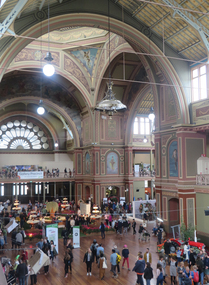
Photograph - Photograph -Colour, Clare Gervasoni, Interior of the Melbourne Exhibition Building, 2019, 31/03/2019
... The centre provided temporary accomodation for thousands of new arrivals from Britain. On 01 July 2004 the Royal Exhibition Building and Carlton Gardens were inscribed on the World Heritage List. ...The centre provided temporary accomodation for thousands of new arrivals from Britain. On 01 July 2004 the Royal Exhibition Building and Carlton Gardens were inscribed on the World Heritage List. ...A competition was announced to design a suitable building for the proposed Melbourne International Exhibition in December 1877. Eighteen entries were received. The winner of 300 pounds was Joseph Reed of the architectual firm Reed and Barnes. The foundation stone was laid by Governor Sir George Bowen on 19 February 1879. Prominent Melbounre builder David Mitchell, father of Dame Nellie Melba, won the tender to construct the main building. Exhibitors were able to move in by May 1880. On 01 October 1880 the Melbourne International Exhibition opened, when over 6000 people entered the main hall to see the Governor, the Marquess of Normanby open the show. Thirty three nations participated and ofver 32,000 exhibits were displayed. At the close of the exhibition on 30 April 1881 over 1.3 million people had visited the exhibition. In 1881 Victoria's population was just over 250,000. The management of the Exhibition Building and eight hectares of the Carlton Gardens was handed to the Exhibition Trustees by the Melbourne International Exhibition Commissioners on 01 OCtober 1881. The Trustees maintained the building for 'future public exhibitions and ... general public instruction and recreation' until 1996 when management of the building was transferred to Museum Victoria. In 1901 when the Australian colonies federated there was no capital and no federal parliament building. The Federal Parliament moved into the Victorian State Parliament building, and the State Parliament moved into the Western Annexe of the Exhibition Building for 26 years. After World War One, on 04 February 1919, the exhibition Building was turned into a hospital to treat Melbournians struck down with the Spanis 'Flu'. Initially housing 500 beds, the hospital grew to accomodate 2000 patients. Femals were located between the concert platform in the western nave and the done; male patients occupied the spaces beyond. The basement was used a a morgue. With the departure of the State Parliament in 1927 the western annexe became home to the Country Roads Board. In 1932 it was joined by the MOtor Registration Branch, and the Transport Regulation Board in 1934. They co-existedin cramped offices until the 1960s. In 1949 the oval at the rear of the ExhibitionBuilding was leased to the Commonealth Government for the establishment of the Migrant Reception Centre. When it closed in 1961-62, the centre comrised 29 bungalows over 1.4 hectare. The centre provided temporary accomodation for thousands of new arrivals from Britain. On 01 July 2004 the Royal Exhibition Building and Carlton Gardens were inscribed on the World Heritage List. It is the only 19th century Great Hall to survive largely intact, still in its original landscape setting, and still used as a palace of industry. The Melbourne International Flower and Garden Show is a flower show held annually since 1995 in early April each year, in Melbourne, Australia. It is located in the World Heritage Site of Carlton Gardens and the Royal Exhibition Building.[1] It is the largest horticultural event in the southern hemisphere, attracting over 100,000 visitors. It is rated among the top five flower and garden shows in the world. (Wikipedia)Colour photograph of the interior of the Melbourne Exhibition Buildings during the 2019 Melbourne Flower and Garden Show. Four mottoes are painted under teh windows of the dome: Dei Grecia (By the grace of God), Carpe diem (Make the most of the day), Aude sapere (Dare to be wise) and Benigno numine (With benighn power)melbourne international flower and garden show, carlton gardens, melbourne exhibition building, royal exhibition buildings -
 Wodonga & District Historical Society Inc
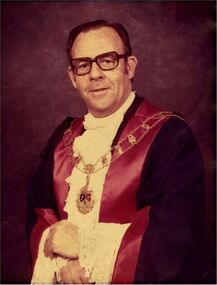
Photograph - Les Stone, Last Shire President and first Mayor of the Rural City of Wodonga
... Les established a strong network in the local migrant community, helping many new arrivals at Bonegilla Migrant Reception Centre with language issues and settling them into their new environment. ...Les established a strong network in the local migrant community, helping many new arrivals at Bonegilla Migrant Reception Centre with language issues and settling them into their new environment. ...Les Stone was the last Shire President of Wodonga and first Mayor of the Rural City of Wodonga. Born in Collingwood, Victoria on 24th August 1919, he was the first of his family to obtain a post-secondary education. He became a Christian Brother but left the ministry after 10 years and became a trained primary school teacher. Les held various teaching appointments in and around country Victoria and Wodonga, the last as Principal of Wodonga West Primary School. It was in Wodonga that Les and his wife Pam settled with their family. Their contribution to the Wodonga community and local government was outstanding. Les established a strong network in the local migrant community, helping many new arrivals at Bonegilla Migrant Reception Centre with language issues and settling them into their new environment. He worked in support of all underprivileged people in the community. In 1967 Les was elected as a Councillor for the West Riding of Wodonga Council. The following year he was elected Deputy Shire President. He was the last Shire President of Wodonga and in 1971 became the inaugural Mayor of the Rural City of Wodonga. The City of Wodonga was proclaimed on 14th March 1973 and Les was re-elected as Mayor. He chose to serve one full term as Mayor having previously served two terms as Shire President. Les Stone passed away at the Mercy Hospital Albury on 28th December 1974 at 54 years of age. He left behind an enduring legacy which included the proactive encouragement of industry to Wodonga. He also championed the selection of Wodonga as a Growth Centre. A champion and defender of local government, Les served as Chairman of the North East Region of Municipalities which comprised 13 Councils including Wodonga and Wangaratta. He also played a critical role on the Albury Wodonga Development Corporation for five years in the early period of the Whitlam decentralization scheme. Les Stone’s life of giving wasn’t just about local government and teaching. He was an old-fashioned community activist who gave far more than he took from the community. Les worked tirelessly for numerous organizations including the Royal Children’s Hospital, Royal Melbourne Hospital (he was made a Life Governor of both), the Wodonga Good Neighbour Council, and Knights of the Southern Cross, Rotary, the St. Vincent de Paul Society and St. Augustine’s Parish Council. However it is in local government that he remains best remembered. He was an active and vocal councillor and gave over 16 years of service to the people of Wodonga - his election and re-election was never once opposed. Les Stone was interned in the Lawn Cemetery in Wodonga. He was aged 54 years. The naming and dedication of the Les Stone Park in West Wodonga is an important acknowledgement of Les Stone’s life. The inscription reads: '’Leslie Edwin Stone JP was the first Mayor of Wodonga from 1972 to 1974 and a former Shire President (1972). A school teacher and principal by profession Les had a long history of involvement with the migrant community and Catholic Church. He was an acknowledged champion of decentralisation’’. These photos are significant because they document the service of an important civic leader in Wodonga.A collection of coloured images related to Les Stone, Mayor of Wodongales stone, wodonga civic leaders, wodonga council -
 Ballarat Tramway Museum
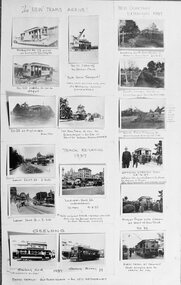
Photograph - Photograph of a Framed group of Photographs, George Netherway, TRACK RE-LAYING 1937, 1930's late
... Photograph of framed set of 17 No. 60mm x 38mm black and white photographs (see 588 - 604) showing arrival of new trams ex Melbourne in 1930, construction of Lydiard St North track relaying in Ballarat during 1937, opening of Lydiard St. extension in 1937 and two Geelong trams in 1937. ...North New Trams Photograph of framed set of 17 No. 60mm x 38mm black and white photographs (see 588 - 604) showing arrival of new trams ex Melbourne in 1930, construction of Lydiard St North track relaying in Ballarat during 1937, opening of Lydiard St. extension in 1937 and two Geelong trams in 1937. ...Photograph of framed set of 17 No. 60mm x 38mm black and white photographs (see 588 - 604) showing arrival of new trams ex Melbourne in 1930, construction of Lydiard St North track relaying in Ballarat during 1937, opening of Lydiard St. extension in 1937 and two Geelong trams in 1937. Mounted on a white cardboard based with captions written under photos in brown ink, red ink underline contained within a brown stained wooden frame with glass front and cardboard backing sheet, held with small nails. For photo of opening of Lydiard St. Nth extension, has a piece of tape over date, corrected from 28-9-37 to 30-8-37. Also in pencil on rear of frame. For details of individual photographs see prints of photos items 588 - 604. Photos taken with a Kodak Vest Pocket camera. See Kings, Ballarat Tramwaystrams, tramways, ballarat, geelong, lydiard st. north, new trams -
 Ballarat Tramway Museum
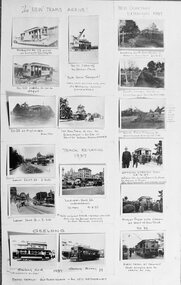
Photograph - Framed Photographs, George Netherway, 1930's late
... Framed set of 17 No. 60mm x 38mm black and white photographs (see 588 - 604) showing arrival of new trams ex Melbourne in 1930, construction of Lydiard St North track relaying in Ballarat during 1937, opening of Lydiard St. extension in 1937 and two Geelong trams in 1937. ...New Trams In pencil on rear "Lydiard St. Nth from Aug. 30/37" Framed set of 17 No. 60mm x 38mm black and white photographs (see 588 - 604) showing arrival of new trams ex Melbourne in 1930, construction of Lydiard St North track relaying in Ballarat during 1937, opening of Lydiard St. extension in 1937 and two Geelong trams in 1937. ...Framed set of 17 No. 60mm x 38mm black and white photographs (see 588 - 604) showing arrival of new trams ex Melbourne in 1930, construction of Lydiard St North track relaying in Ballarat during 1937, opening of Lydiard St. extension in 1937 and two Geelong trams in 1937. Mounted on a white cardboard based with captions written under photos in brown ink, red ink underline contained within a brown stained wooden frame with glass front and cardboard backing sheet, held with small nails. Also see Item No. 587A, AS Box 56 - 5" x 8" photo of same. For photo of opening of Lydiard St. Nth extension, has a piece of tape over date, corrected from 28-9-37 to 30-8-37. Also in pencil on rear of frame. For details of individual photographs see prints of photos items 588 - 604. Photos taken with a Kodak Vest Pocket camera. See Kings, Ballarat TramwaysIn pencil on rear "Lydiard St. Nth from Aug. 30/37"trams, tramways, ballarat, geelong, lydiard st. north, new trams -
 Royal Brighton Yacht Club
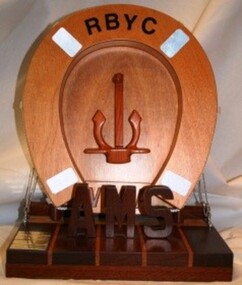
Life Ring, Vega Trophy (Mounted Wooden Life Ring)
... The military demanded first pick of all foodstuffs and kept meticulous records of all livestock forcing farmers even to show newborn calves and piglets to them, then claiming the new arrivals for their dinner tables. However there are many stories of farmers outwitting their masters when twin calves or suchlike arrived! ...The military demanded first pick of all foodstuffs and kept meticulous records of all livestock forcing farmers even to show newborn calves and piglets to them, then claiming the new arrivals for their dinner tables. However there are many stories of farmers outwitting their masters when twin calves or suchlike arrived! ...Vega Trophy (Mounted Wooden Life Ring) Donor: Graham Noel During World War II when the Germans occupied the Channel Islands the local people went through very severe food rationing and were on the verge of starvation. Near the end of the war, the Swedish ship Vega was allowed by the Germans to deliver several shipments of food to the civilian population, easing the critical shortages of food on the islands. Further background detail can be found below. Graham Noel was born on the Islands and lived there during this harsh period. The trophy is awarded to the winner of the Combined Division AMS Aggregate Series. First Winner: Under Capricorn, P. Bedlington 2005/06 Vega – Further historical background Early in the Second World War Jersey was declared “unarmed” and the German military took over, taking quite a few lives in the process, through strafing the main harbour and a few other places which they needlessly considered threatening. A considerable number of locals evacuated to England before the Germans arrived, but more than 60% of the population remained and endured 5 years of very strict and difficult conditions. Not only was the population unable to contact relatives in the UK or elsewhere, but very quickly they found themselves subject to harsh curfews, strictly rationed foodstuffs, no fuel for vehicles, radios confiscated, and homes and hotels commandeered by the military. The military demanded first pick of all foodstuffs and kept meticulous records of all livestock forcing farmers even to show newborn calves and piglets to them, then claiming the new arrivals for their dinner tables. However there are many stories of farmers outwitting their masters when twin calves or suchlike arrived! Lawbreakers were quickly dealt with, mostly with lengthy prison terms in Jersey, but the more serious crimes were punished by being sent to some horrible French prisons, or even some of the notorious German concentration camps. All local Jews were dispatched to concentration camps, and even English born families were similarly shipped through France and on to Germany. Sadly, a considerable number of those deported did not make it back safely to Jersey. In June 1944 the locals were delighted to hear that the Allies had invaded Normandy and very soon they could hear the battles as the Allies worked their way along the French coast. Little did they know they would still have to wait another 11 months for freedom, having to put up with a very demanding German occupation force which was still determined to obey Hitler’s order to “Defend the Channel Islands to the death”. Now that France was in Allied Hands the local military commanders were unable to supplement their food supplies from France and even harsher demands were made on the local population to ensure that all branches of their still very substantial military force were reasonably well fed. As well as the military, Jersey farmers had to provide food for the Allied POWs and the many “forced labourers”, mainly of Russian, Polish and Italian backgrounds who had been directed to the island to build all the concrete bunkers. This included an underground hospital, all this complying with Hitler’s orders to ensure that the Channel Islands would never again be part of Britain. Many requests by the Jersey authorities for Red Cross assistance were rejected, but finally in December 1944 they agreed and on 30th December the Red Cross vessel “Vega” (Swedish Registry) arrived and delivered parcels to the civilian population. These parcels contained a variety of foodstuffs supplied mainly by Canadian authorities, desperately needed medical supplies, flour, oils and soaps, as well as tobacco from New Zealand. Vega made a further 3 or 4 trips and most certainly eased the desperate situation being faced by the locals. In fact, it resulted in the locals having slightly better food supplies than the military and many local farmers tell stories of having to protect their stock from marauding soldiers. Understandably Churchill was reluctant to send in an invading force to retake the Channel Islands, but by May 1945 it was clear that the Third Reich was finished and on May 9th the German Military surrendered, without a fight, to a large British landing force. On a slightly lighter note … in January 1945 Jersey stonemasons were seen in the main town square repairing flagstones … the Germans had never noticed that the name “Vega” had been formed in those flagstones! As a side note Vega is the name of the brightest star in the universe. Furthermore, throughout the occupation, despite German law that demanded confiscation of all radio sets, punishable by long prison terms or deportation to Germany, there were still many sets being listened to. The locals had a well refined news system for the dissemination of news of what was happening in the outside world. vega, graham noel, ams, combined division, aggregate -
 Eltham District Historical Society Inc
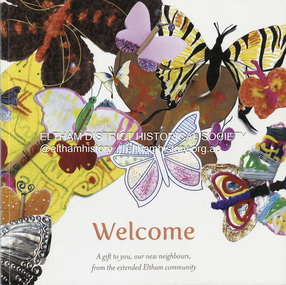
Book, Nina Kelabora, Welcome : a gift to you, our new neighbours, from the extended Eltham community / produced by Nina Kelabora (graphic designer) and Lara McKinley (principal photographer), December 2016
... Butterflies • 148 images of handcrafted butterflies and artwork of butterflies edited for reproduction throughout the Welcome to Eltham book and for use on other placards, gift cards and promotional materials including the original source photographs (232 total) • 128 other images of butterflies submitted or photographed installed at various locations around Eltham • 11 images of metal butterfly artworks created by Linda MacAulay and Tim Read showing the works during creation at Bend of Isles and at initial install at the roundabout on Main Road at Luck Street then at the final install to greet the new arrivals and residents alike at St Vincents Aged Care Services (since demolished). 6. ...Butterflies • 148 images of handcrafted butterflies and artwork of butterflies edited for reproduction throughout the Welcome to Eltham book and for use on other placards, gift cards and promotional materials including the original source photographs (232 total) • 128 other images of butterflies submitted or photographed installed at various locations around Eltham • 11 images of metal butterfly artworks created by Linda MacAulay and Tim Read showing the works during creation at Bend of Isles and at initial install at the roundabout on Main Road at Luck Street then at the final install to greet the new arrivals and residents alike at St Vincents Aged Care Services (since demolished). 6. ...In 2016 the Welcome to Eltham community project started to welcome Syrian refugees into the community and made Welcome Butterflies to say welcome to them. In addition to the physical book, EDHS also holds several hundred digital images pertaining to the development of the Welcome to Eltham campaign, photographs, artworks and graphic designs, which resulted in the publication of this book. EDHS also holds further material from the period 2016 to 2017 associated with the Welcome to Eltham campaign group. Contents: 1. Welcome Book Welcome Book includes selected page extracts and images as published December 2016 Contents: • Greetings to our Country P2 • Offering P8 • Your neighbours P10 • Rotary P39 • Eltham Baptist Church P44 • Eltham Farmers Market stall holders P48 • The Eltham community P54 • Surrounding communities P60 • Our Lady Help of Christians Primary School P64 • Nillumbik Greens P66 • Our Lady Help of Christians Church Eltham P68 • Catholic Care Eltham P70 • St Vincent’s P71 • Montmorency South Primary School P72 • Victoria Police P73 • Catholic Ladies College P74 • Warrandyte P76 • Eltham Toy Library P78 • Eltham-Montmorency Uniting Church P82 • Gingerbread P84 • Scouts P86 • Eltham businesses P89 • Surrounding communities P96 • The Seed P101 2. Administration 1. Welcome to Eltham Infant Plan, Purpose and Scope (Aug. 2016) 2. Circle of Friends; A draft proposal from Welcome to Eltham, 26 August 2016 3. Welcome to Eltham; a resident support group for refugees settling in Eltham (Sep. 2016) 4. Welcome to Eltham; Purpose and Scope (Sep. 2016) 5. Welcome to Eltham Plan (Sep. 2016); 10 pages typed of tasks broken into four categories, 10 pages 6. Welcome to Eltham Team/Volunteer organisation structure, volunteers’ skills assessment and role assignments, strategies, 11 pages 7. Briefing Document: Refugees being welcomed in Eltham, 2 Oct. 2016; 5 pages 8. Public Engagement Plan, 2 Oct. 2016; 2 pages 9. Welcome to Eltham 2016 Review, Values and Structure, 2017 10. Welcome to Eltham Incorporated Financial Report July 2016 – June 2017; 3 pages 11. Letter: Nina Kelabora and Welcome to Eltham Team to Bolton Street Fruit Market re offer to provide fresh fruit, 30 Jun. 2017 12. Welcome to Eltham Incorporated Annual Report 2016–2017; Oct. 2017; 4 pages 13. Certificate: Jagajaga Community Australia Day Award 2018 to Nina Kelabora, signed Jenny Macklin MP, Federal Member for Jagajaga 14. Certificate: Jagajaga Community Australia Day Award 2018 to Welcome to Eltham, signed Jenny Macklin MP, Federal Member for Jagajaga 15. Letter: Simon Le Plastrier, Principal, Eltham College to Nina Kelabora, 20 April 2018 offering congratulations for the work achieved by Welcome to Eltham group 16. Photo: River pebble covered in spray paint of multiple colours. The rock was used to hold down templates for painting butterflies on the footpaths near Andrew park as a counter to protesters assembling for the ‘Battle for Eltham’ demonstration on 5 November 2016 17. Photo: Welcome to Eltham team member, Gillian Essex 18. Photo: Welcome to Eltham team member, Kirsten Bate 19. Photo: Welcome to Eltham team member, Lara McKinley 20. Photo: Welcome to Eltham team member, Nina Kelabora 21. Photo: Welcome to Eltham team member, Sarah Hooten 22. Incorporation • AGM-minutes-2017 • Certificate of Incorporation • Mission and Values • Ordinary Business of the AGM 2017 • Welcome to Eltham Rules 23. Advocacy • Eltham Butterfly Effect Corflute panel design 5 November 2016 Rally • MemeFest PowerPoint presentation 23 November 2016 • Oxfam PowerPoint presentation 16 June 2017 • Eltham Rotary PowerPoint presentation 1 June 2017 • Welcome to Eltham Gift Card artwork 3. Artwork • Logo: Welcome to Eltham • 12 artworks by children of the Eltham Child Care Co-Operative (ECCC) o Me at the Immigration Museum by Ethan B. o Immigration Museum by Edie o Me with my family and lots of hearts by Charlotte o My suitcase like the refugees we learnt about with Bec by Jarvis o Me at the football with my friends by Harley o My suitcase if I had to leave the country by Ellen o Me at the park near the library by Chloe o Books at the library by Addison o Ethan’s grandfather who died in the war and this is him in his grave by Ethan o A nursery by Annabel o The age care home we visit by Ari o This is my mum the Ranger by Mia • Butterfly Effect, Ona Henderson 2016, inscribed “Dedicated to Nina, in appreciation of your butterfly effect for ‘Welcome to Eltham’; reproduced p1 • Ona and Sid gifting her artwork for use by the campaign; reproduced p1 • Duat and Iuk, Mandy Nicholson, Wurundjeri woman; reproduced p3 • These hands welcome you to Australia, Mungo, Warrandyte resident; reproduced p9 • The Library by Rose; reproduced p15 • Welcome to Eltham from Maia; reproduced p19 • Billy, Warrandyte resident; reproduced p20 • Through my window, Janet Boddy; reproduced p23 • Eryn and Lachie, Eltham residents; reproduced p25 • Eva, Eltham resident; reproduced p29 • This is the community hall across from my house by Cinta; reproduced p30 • Welcome, Brenda, Eltham resident; reproduced p34 • Flying over Kerry Crescent, Kerry, Eltham resident; reproduced p38 • A dragon called 'fat' from Joe, 6; reproduced p42 • A rainbow-heart-welcome from Trixie, 8; reproduced p42 • A lovely message from Sarah; reproduced p53 • Monique; reproduced p56 • Tom; reproduced p56 • Josh; reproduced p56 • Chloe; reproduced p56 • Jack; reproduced p57 • Mia; reproduced p57 • Ann Curry, Montmorency resident; reproduced p60 • From Mia: "Keep your head up high and be confident. I'm sure that you will soon find that Eltham is a very nice place and I hope you can have a happy life."; reproduced p77 • Amy; reproduced p79 • Ben; reproduced p80 • Welcome, Kayla, Warrandyte resident; reproduced p94 • Lucas; reproduced p98 • Ale; reproduced p98 • Grace; reproduced p99 • Hugo; reproduced p99 4. Australian-Syrian Charity • ASC – Certificate of Appreciation; Awarded from Australian-Syrian Charity presented to Welcome to Eltham Group by Rev. Fr. Samir Haddad, ASC president, 30 Sep. 2016 including two images of Father Samir and WTE organiser, Nina Kelabora 5. Butterflies • 148 images of handcrafted butterflies and artwork of butterflies edited for reproduction throughout the Welcome to Eltham book and for use on other placards, gift cards and promotional materials including the original source photographs (232 total) • 128 other images of butterflies submitted or photographed installed at various locations around Eltham • 11 images of metal butterfly artworks created by Linda MacAulay and Tim Read showing the works during creation at Bend of Isles and at initial install at the roundabout on Main Road at Luck Street then at the final install to greet the new arrivals and residents alike at St Vincents Aged Care Services (since demolished). 6. Eltham and Surrounds Residents and Local Businesses • 195 photos (157 published in book) submitted by local residents and businesses with people holding Welcome to Eltham placards including: Eltham Farmer’s Market, Eltham Baptist Church, CatholicCare Eltham, Nillumbik Greens, Hurstbridge Wattle Festival, Our Lady Help of Christians Eltham, Our Lady Help of Christians Primary School, Montmorency South Primary School, Warrandyte Primary School, Bronnie Hattam, Mayor, Nillumbik Shire Council, Vicki Ward, MP for Eltham, Jenny Macklin, Member for Jagajaga, Bend of Isles, Eltham Toy Library, Eltham Library, Eltham-Montmorency Uniting Church, Catholic Ladies College (CLC), First Eltham North Scouts, Warrandyte Primary School, Ona Henderson and many individuals and businesses. 7. Events • Alistair Knox Park, 12 August 2016 • Syrian Community Dinner, 30 September 2016 • Pop up Picnic, Eltham North Adventure Playground, 1 October 2016 • Alistair Knox Park, 7 October 2016 • At Our Lady of Help of Christians, 7 October 2016 • Andrew Park Butterfly Effect v Battle for Eltham, 5 November 2016 • City Rally, 5 November 2016 • Eltham Library Children’s Garden, 12 November 2016 • Eltham Festival, 13 November 2016 • Welcome Book Fundraiser, St Margaret’s Church, 11 December 2016 • Nillumbik International Women’s Day Dinner 9 March 2017 • Bush Dance, 17 June 2017 • Eltham Police Morning Tea, 29 July 2017 8. House warmers • Approximately 40 images of gift care items donated (food, drink, blankets, etc) intended as housewarming hampers 9. Media Media Releases • Eltham elders take to social media to welcome refuges, video goes viral; Wednesday 28 October 2016 • Eltham locals use their bodies to say WELCOME to refugees; 1 October 2016 • Community group welcomes Minister’s decision so refugees can call Eltham home; 5 October 2016 • Locals answer far-right “Battle for Eltham” with butterflies: thousand of them; 5 November 2016 Newspaper articles • Group fosters goodwill; organisation works to assist refugees; Brittany Shanahan; Diamond Valley Leader, Wednesday, August 17, 2016, p3 • Refugees are welcome (Gillian); Care is for the elderly alone (Fred); Plenty of positives in plan (Kirstin); Open your hearts and doors (Alison); Flood of families a worry (Cath), Conversations, Diamond Valley Leader, Wednesday, August 17, 2016, p11 • Support refugee housing; Diamond Valley Leader, Pamela Nash via Facebook, Janet R. Body, Eltham, Glenise Michaelson, Montmorency; Letters (online), 5 October 2016 • Refugees find a haven, and, Groups to fundraise for arrivals; Wednesday, October 12, 2016, p5 • Site for resettlement of refugees on a flood plane (Jacquie Bellchambers); Accommodating young families from a foreign culture in an established western culture retirement home will only lead to both parties feeling …. (Margit Alm); Great news for our community … (Nean Tatnal); Conversations, Diamond Valley Leader, Wednesday, October 12, 2016, p19 • Refugee scrap looms; daughter of Eltham aged-care resident upset as extreme group hijacks debate; Brittany Shanahan. Diamond Valley Leader, Wednesday, October 26, 2016, p1 • Many ready to welcome refugees into community (Megan Anne) and others; Conversations, Diamond Valley Leader, Wednesday, October 26, 2016, p20 • On a wing and a prayer; Chris Vedelago, Tammy Mills and Mark Hawthorne; Sunday Age, November 6, 2016, p3. – It was billed as the “Battle for Eltham”, but in te end the butterflies carried the day. • Rally hits trade; Diamond Valley Leader, Wednesday, November 9, 2016, p1 • Protests bad for business; Brittany Shanahan; Diamond Valley Leader, Wednesday, November 9, 2016, p8 • Police earn praise for keeping protest calm; Re: Battle for Eltham rally (Maree Quinlan) and others; Conversations, Diamond Valley Leader, Wednesday, November 9, 2016, p14 • Butterflies to counter anti-Muslim protest; Bianca Hall and Marissa Calligeros, The Age, November 5, 2016 • Rally created challenges but it’s time to move on; Re: Battle for Eltham rally (Local Area Commander Acting Inspector Danielle Leemon) and others; Conversations, Diamond Valley Leader, Wednesday, November 16, 2016, p19 • Praise for warm welcome (Linda Jajawi) and others also photo “Officers from Eltham police station welcomed newly arrived refugees to the community”; Conversations, Diamond Valley Leader, Wednesday, August 9, 2017, p15 • Refugees welcomed; Diamond Valley Leader, n.d. 2017, p12 • Refugee plan riles; Retirement centre residents voice concerns; Brittany Shanahan, Diamond Valley Leader; n.d. 2016 Facebook Responses • Responses top frequent Facebook comments regarding the housing of refugees in aged care at Eltham 10. Placards and Promotional Flyers • Selection of placard images and Welcome to Eltham Gift Card artwork 11. St Vincents • Two hand drawn sketches showing plan views of proposed front and rear units at St Vincents to be used by refugees 12. Videos • Feisties; several local seniors read online comments made by objectors and offer their own opinions; 00.02.28 • Tour of unit at St Vincents, 31 July 2016; 00.00.44 • Drone view of people creating Welcome sign at Eltham North Adventure Playground, 14 September 2016; 00.00.14 • Launching of the butterflies (campaign); Nina Kelabora releases the first butterfly into the wild; 00.00.24 • Gillian Essex, Welcome to Eltham, discussing counter strategy to protest demonstration (Battle for Eltham) scheduled for later in the day; 5 November 2016; 00.01.45 • Glenise Michaelson, Eltham local for 69 years discussing counter strategy to protest demonstration (Battle for Eltham) scheduled for later in the day; 5 November 2016; 00.01.30 • The Butterfly Effect, counter strategy to protesters 5 November 2016 Battle for Eltham rally; 00.02.24 with ten associated photos of the seniors involved; 31 October 2016 • Butterfly art ninjas 1 (15 secs), 2 (26 secs) and 3 (14 secs), showing the butterflies remaining in existence on the paths around Andrew Park, 16 November 2016 • Butterfly capture and release with Nina Kelabora– butterflies around Andrew Park relocated to the Children’s garden at Eltham Library, 17 November 2016; 00.00.28eltham (vic.), welcome to eltham (vic.), syrian refugees, refugees, social life and customs, butterflies, welcome butterflies, nina kelabora collection
