
Showing 4 items matching "new shapes in the sky"
-
 Moorabbin Air Museum
Book - Aviation history, Jet Planes Work Like This
... ...New shapes in the sky...How a jet engine works The first jets Putting back the propeller The jet family New shapes in the sky The future for jets Into space Overview of how jet aircraft work for young readers, circa 1958 Jet Planes Work Like This Book Aviation history ...Overview of how jet aircraft work for young readers, circa 1958non-fictionOverview of how jet aircraft work for young readers, circa 1958the jet age arrives, who invented the jet engine ?, how a jet engine works, the first jets, putting back the propeller, the jet family, new shapes in the sky, the future for jets, into space -
 Glenelg Shire Council Cultural Collection
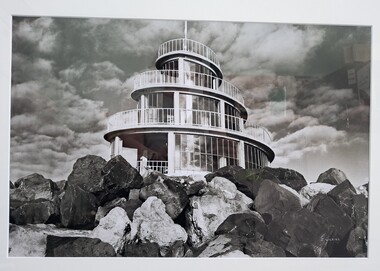
Photograph, John Wilkins, Photographer, Corkscrew, n.d
... new corkscrew is a similar size and has been based on the same spiral shape of the original structure. The corkscrew has been constructed using mild steel, heavily coated in marine grade paint (similar to what is used on ships). Heavy duty plastic has been used for the walkway section which will withstand the harsh elements of the marine environment. Portland seafront maritime Portland landmark corkscrew Port of Portland Portland photography Photography Bottom right: J WILKINS Photograph of the Portland Corkscrew in the 1980s. Image is in black and white. The corkscrew is in front of a sky ...From the Port of Portland website: The original corkscrew was built as a gift to the Portland Harbour Trust by the contractors who constructed the port. It was designed in 1960 and fabricated shortly after the completion of the Main Breakwater. The corkscrew was built as an observatory, with the observation deck approximately 13 metres above sea level. Its original design life was less than 25 years. The original structure was dilapidated, extremely unsafe and in danger of collapse. Understanding the historical and community importance of the original structure, in 2016 Port of Portland began the process of designing and building a replacement. The new corkscrew is a similar size and has been based on the same spiral shape of the original structure. The corkscrew has been constructed using mild steel, heavily coated in marine grade paint (similar to what is used on ships). Heavy duty plastic has been used for the walkway section which will withstand the harsh elements of the marine environment.Photograph of the Portland Corkscrew in the 1980s. Image is in black and white. The corkscrew is in front of a sky which is dotted with fluffy clouds. To the front of the Corkscrew are large rocks. The building is a spiral with glass windows. There is a white metal fence around it and a white pole at the top which reaches to the top of the image.Bottom right: J WILKINSportland, seafront, maritime, portland landmark, corkscrew, port of portland, portland photography, photography -
 Geoffrey Kaye Museum of Anaesthetic History
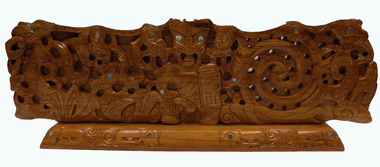
Sculpture - Carving, Heke Collier, Mauri Ora, May - July 2016
... New Zealand Rimu timber. Heke named this carving Mauri Ora which translates to vitality, well-being or the healing life-force. Tihei Mauri Ora (breath of life) is a well-known Māori saying that was uttered by the first human being. Māori believe that all people and all things have mauri. This carving symbolises the many shapes and forms of mauri with reference to the Māori creation story, and the spiritual and natural worlds. Māori refer to the heavens as Ranginui the sky...New Zealand Rimu timber. Heke named this carving Mauri Ora which translates to vitality, well-being or the healing life-force. Tihei Mauri Ora (breath of life) is a well-known Māori saying that was uttered by the first human being. Māori believe that all people and all things have mauri. This carving symbolises the many shapes and forms of mauri with reference to the Māori creation story, and the spiritual and natural worlds. Māori refer to the heavens as Ranginui the sky ...Professor Alan Merry commissioned the work from New Zealand artist Heke Collier as a gift to the College at his retirement from Council. This artwork was carved by Heke Collier in May-July 2016. It is made from native New Zealand Rimu timber. Heke named this carving Mauri Ora which translates to vitality, well-being or the healing life-force. Tihei Mauri Ora (breath of life) is a well-known Māori saying that was uttered by the first human being. Māori believe that all people and all things have mauri. This carving symbolises the many shapes and forms of mauri with reference to the Māori creation story, and the spiritual and natural worlds. Māori refer to the heavens as Ranginui the sky-father and according to the Māori creation story, Ranginui was pressed against Papatūānuku the earth mother. Their children did not like living in the cramped, dark space between them. One of their sons Tāne separated Ranginui and Papatūānuku to allow light and life into the world. The central male figure carved into Mauri Ora (above) is Tāne. To his right (far right) is his mother Papatūānuku and to his left (far left) is his father Ranginui. Papatūānuku gives birth to all things including human kind and provides the physical and spiritual basis for life. The takarangi (spiral) design in the carving (to the left of Tāne) symbolises the life cycle. Whenua, the word for land also means placenta - organ that nourishes the baby in the womb. Women are associated with the land (whenua) because the land gives birth to people and so do women. In tribal history women have had influence over land and men. Papatūānuku is depicted in the carving to the right of Tāne. Ranginui played a pivotal role in the birth of the sun, moon, planets, stars and constellations – collectively called Te Whānau Mārama (the family of light). Human life and knowledge were said to originate in the realm of Ranginui. Tāne ascended the heavens to retrieve three baskets of knowledge: te kete-tuatea (basket of light), te kete-tuauri (basket of darkness) and te kete-aronui (basket of pursuit). Ranginui is depicted in the carving to the left of Tāne. Tāne had many different roles, and he was given different names to reflect these roles. He is called Tāne-mahuta as god of the forest, Tāne-te-wānanga as the bringer of knowledge, and Tāne-te-waiora as the bringer of life, prosperity, and welfare. His teachings and knowledge are relevant in contemporary times, and the cell-phone carved into his left hand represents this. Tuatara feature in the Māori creation story and some tribes view Tuatara as kaitiaki (guardians) of knowledge. Given that they have lived for more than 220million years. There are birds or manu surrounding Tāne in the carving, who represent Tane’s voice or the voice of the forest. The flax or harakeke depicted in the carving represent the family unit and reinforce the importance of kinship ties. There are plants, ferns, and birds carved into Mauri Ora play an integral role in the life-cycle which represent rongoa Māori or Māori medicine. Traditional Māori carving in Rimu, a native New Zealand wood, with paua insets.merry, alan, anzca council, collier, heke, kaiwhakairo, master carver, rimu -
 Falls Creek Historical Society
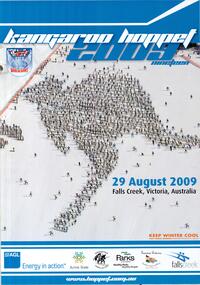
Poster - Kangaroo Hoppet 2009
... New Zealand in a time of 1:07:48.9. Due to the poor weather, and in view of skier safety and poor snow cover, a modified course was set. he Hoppet was reduced from 42 to 25 kms. This poster is significant because it documents an event which brings international attention to Falls Creek and the surrounding region. Kangaroo Hoppet Worldloppet events Falls Creek Mt. Beauty At the top: KANGAROO HOPPET 2009 NINETEEN At the foot of the kangaroo shape ...The Kangaroo Hoppet is Australia’s premier long distance cross country ski race, and a member of the Worldloppet series of international cross country ski events. The first race at Falls Creek was held in 1979 under the name of “Australian Birkebeiner”. It was a 21km race with about 80 participants organised by the Birkebeiner Nordic Ski Club of Mount Beauty. The course started and finished at Falls Creek Alpine Resort and took participants out into the Bogong High Plains. After running the event for 10 years, it was decided they should become part of the Worldloppet series of marathon ski races. Representatives from the Birkebeiner Nordic Ski Club and the Australian Ski Federation attended the Worldloppet Annual Meeting in Finland in June 1990 to put the case for the acceptance of an Australian event into the Worldloppet series. Before being admitted, they had to demonstrate that the Birkebeiner Club could run a world class event, so three months later in August 1990 a 42km event named the Australian International Ski Marathon was held at Falls Creek together with a 21km Birkebeiner race and a 7km event called the Birkebeiner Lite. The event was approved by delegates from USA, Norway and Austria, in 1991 Australia became the 12th member of Worldloppet, with the condition that there had to be a name change. After some late night discussion allegedly involving red wine from North East Victoria the main event became the 42km Kangaroo Hoppet, with the minor events being the 21km Australian Birkebeiner, and 7km Joey Hoppet. In the winter of 1991, the first Kangaroo Hoppet was held. It was a great success and has been a regular fixture on the international ski calendar ever since. It features the main 42km event as well as a 21km event and a 7km event. The Hoppet brings the Australian snowfields to an international audience. In 2009 the Men's Winner was Ben Sim from Australia in a time of 0:58:39.4. The winner of the Women's event was Kate Calder of New Zealand in a time of 1:07:48.9. Due to the poor weather, and in view of skier safety and poor snow cover, a modified course was set. he Hoppet was reduced from 42 to 25 kms. This poster is significant because it documents an event which brings international attention to Falls Creek and the surrounding region.A poster with an aerial photo of a large number of skiers in the formation of the shape of a kangaroo. The colour of the border is blue, white and orange text is used. The Worldloppet logo is at the top left. The logos of AGL, Alpine Shire, Birkebeiner Nordic Ski Club, Parks Victoria, Tourism Victoria and Falls Creek are across the bottom of the poster. At the top: KANGAROO HOPPET 2009 NINETEEN At the foot of the kangaroo shape: 29 AUGUST 2009 FALLS CREEK, VICTORIA, AUSTRALIA In orange text: KEEP WINTER COOL FIGHT GLOBAL WARMING WWW.KEEPWINTER COOL.COM.AU At bottom in white text: www.hoppet.com.au kangaroo hoppet, worldloppet events, falls creek, mt. beauty
