
Showing 13 items matching "new zealand's maori wars"
-
 Returned Nurses RSL Sub-branch
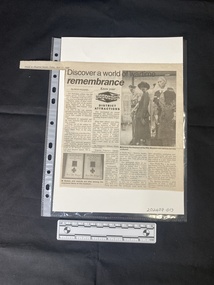
Newspaper - Newspaper clipping, Riverine Herald, Discover a world of wartime remembrance, Friday, April 17, 1998
... ...New Zealand's Maori Wars...World War 2 WWII WW2 World War II New Zealand's Maori Wars Boer War Africa Sergeant Lindsay Ferguson Manggar Indonesia New Guinea Corporal Daniel Fitzgerald Australian Defense Force United Nations UN Commission Netherlands A newspaper clipping consisting of four columns of text and two black and white photos. ...The story outlines what is on display at the Echuca-Moama RSL and Citisen' Club War Museum. One item on display is a World War Two nurse's uniform.A newspaper clipping consisting of four columns of text and two black and white photos. The larger photo is of three service uniforms displayed on mannequins, one of which is a WW2 nurse's uniform, while the smaller photo is of two medals on display.world war 2, wwii, ww2, world war ii, new zealand's maori wars, boer war, africa, sergeant lindsay ferguson, manggar, indonesia, new guinea, corporal daniel fitzgerald, australian defense force, united nations, un commission, netherlands -
 Federation University Historical Collection
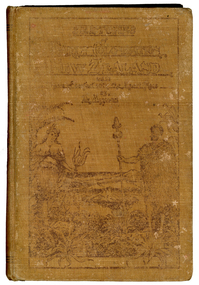
Book, Sketches of Early Colonisation in New Zealand and its Phases of Contact with the Maori Race, 1907
... Maori schoolfellows. Of particular interest in this book are the inscriptions and drawings by former Ballarat School of Mines Student Edwin (Ted) Cannon who was killed during World War One. .2) A New Year card inside the books is from Eileen Doolan of Invermay, Launceston, Tasmania, Christmas 1936. Sketches of Early Colonisation in New Zealand ...Author Te Manuwir was also known as Albert Edward Davidson. This book is also associated with Edwin J. Cannon whose inscriptions and drawings appear on some pages.Hard cloth covered book of 194 pages. The book tells stories from the 19th century by a man, who, as young migrant in the 1840s, was educated with Maori schoolfellows. Of particular interest in this book are the inscriptions and drawings by former Ballarat School of Mines Student Edwin (Ted) Cannon who was killed during World War One. .2) A New Year card inside the books is from Eileen Doolan of Invermay, Launceston, Tasmania, Christmas 1936.Inside front: 'January 2nd 1908. To Edwin Joseph Cannon 610 Acot St Ballarat Victoria Australia from his dear father.' 'E.J. Cannon Ascot St Ballarat south' E. Cannon (with sketch) 'S.E. Doolan' Stamped 'F. Cannon' Inside back cover: '2nd January 1908 Presented to:- Master Edwin Joseph Cannon by his father.new zealand, maori, te manuwir, albert edward davidson, ted cannon, e.j. cannon, edwin j. cannon -
 Flagstaff Hill Maritime Museum and Village
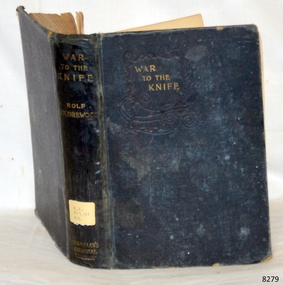
Book - Fictional Novel, Rolf Boldrewood (Pen Name), War to The Knife, 1899
... (For more information on the Pattison Collection see item 3678 Flagstaff Hill collections) https://victoriancollections.net.au/items/5580c7e72162f114d8b758db flagstaff hill warrnambool shipwrecked coast flagstaff hill maritime museum maritime museum shipwreck coast flagstaff hill maritime village great ocean road book pattison collection warrnambool library warrnambool mechanics’ institute ralph eric pattison corangamite regional library service warrnambool city librarian mechanics’ institute library victorian library board warrnambool books and records warrnambool children’s library war to the knife rolf bolderwood War to the Knife; or, Tangata Maori is a late 19th-century historical romance novel written by the prominent Australian author Rolf Boldrewood (the pen name of Thomas Alexander Browne) and published by the historic house Macmillan & Co. in 1899. Unlike most of Boldrewood's work, which is rooted deeply in the Australian outback, War to the Knife shifts its setting to New Zealand ...War to the Knife; or, Tangata Maori is a late 19th-century historical romance novel written by the prominent Australian author Rolf Boldrewood (the pen name of Thomas Alexander Browne) and published by the historic house Macmillan & Co. in 1899. Unlike most of Boldrewood's work, which is rooted deeply in the Australian outback, War to the Knife shifts its setting to New Zealand during the Waikato War of the 1860s, which was part of the New Zealand Land Wars. The story follows Sir Roland Massinger, a cultured English squire who suffers a devastating heartbreak at home when the woman he loves, Hypatia Tollemache, rejects him to pursue a life dedicated to social reform. Distraught, Sir Roland leaves his ancestral estate and emigrates to New Zealand in search of adventure and a fresh start. Upon arriving, he finds himself caught squarely in the middle of the violent clash between the Pakeha (British colonial settlers) and the indigenous Maori tribes over the ownership of the Waitara land block. Written in a late-Victorian style that heavily blends high-stakes adventure with a romanticised "frontier" view, the book attempts to explore colonial identity and the cultural friction of the era.War to The Knife Author: Pen Name Rolf Boldrewood For (Thomas Alexander Browne) Publisher: Macmillan And Co Printer: Robert Clark Date: 1899 Blue cloth hardcover and spine with spine lettering in gilt. The spine has a Library label with inscription.fictionWar to the Knife; or, Tangata Maori is a late 19th-century historical romance novel written by the prominent Australian author Rolf Boldrewood (the pen name of Thomas Alexander Browne) and published by the historic house Macmillan & Co. in 1899. Unlike most of Boldrewood's work, which is rooted deeply in the Australian outback, War to the Knife shifts its setting to New Zealand during the Waikato War of the 1860s, which was part of the New Zealand Land Wars. The story follows Sir Roland Massinger, a cultured English squire who suffers a devastating heartbreak at home when the woman he loves, Hypatia Tollemache, rejects him to pursue a life dedicated to social reform. Distraught, Sir Roland leaves his ancestral estate and emigrates to New Zealand in search of adventure and a fresh start. Upon arriving, he finds himself caught squarely in the middle of the violent clash between the Pakeha (British colonial settlers) and the indigenous Maori tribes over the ownership of the Waitara land block. Written in a late-Victorian style that heavily blends high-stakes adventure with a romanticised "frontier" view, the book attempts to explore colonial identity and the cultural friction of the era. flagstaff hill, warrnambool, shipwrecked coast, flagstaff hill maritime museum, maritime museum, shipwreck coast, flagstaff hill maritime village, great ocean road, book, pattison collection, warrnambool library, warrnambool mechanics’ institute, ralph eric pattison, corangamite regional library service, warrnambool city librarian, mechanics’ institute library, victorian library board, warrnambool books and records, warrnambool children’s library, war to the knife, rolf bolderwood -
 Orbost & District Historical Society
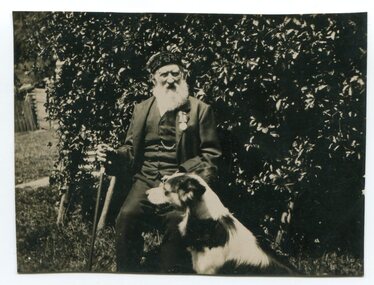
black and white photograph, early 20th century
... When the Victoria arrived in Melbourne in 1861 after having landed soldiers in New Zealand for the Maori War, the crew was given a civil reception, and each member was presented with a sovereign in honor of the birth of the Victorian Navy. cape-everard point-hicks smith-samuel on back - "Samuel Smith, Head Lighthouse Keeper at C. ...This is a photograph of Samuel Smith, aged 92, with his dog outside his home, Gloucester House, near Cann River. He was the keeper at CapeEverard (Point Hicks) for five years.He retired from the lighthouse position in 1904. His life story was written in The Snowy River Mail, Orbost, Wednesday Evening – 27 January 1937 as "LIFE STORY OF SAMUEL SMITH". He was born in Gloucestershire in 1844 and died in 1937 at the the Orbost Hospital. There was an obituary in The Argus (Melbourne) on Saturday 18 February, 1939. Samuel Smith, of Noorinbee, East Gippsland, was the last survivor of the original crew of the frigate Victoria, the first vessel of the old Victorian Navy. When the Victoria arrived in Melbourne in 1861 after having landed soldiers in New Zealand for the Maori War, the crew was given a civil reception, and each member was presented with a sovereign in honor of the birth of the Victorian Navy. A black / white photograph of a bearded elderly man sitting and holding a cane. A dog is sitting at his knee. The photograph has ben taken outside in a garden.on back - "Samuel Smith, Head Lighthouse Keeper at C. Everard, retired 1904"cape-everard point-hicks smith-samuel -
 Bendigo Military Museum
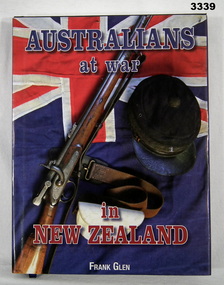
Book - BOOK, MAORI WAR, Frank Glen, Australians at War in New Zealand, 2011
... Maori Wars Book New zealand Hand written in black ink on front fly leaf: “F? ...Maori WarsHard cardboard cover, dark blue buckram silver printing on front & spine. Dust cover front background colour photo of flag with rifle with a peaked cap in foreground. Spine & back black & white photos of soldiers in uniform. Spine single full length portrait, back group. 299 pages, cut, plain, white. Illustrated with black & white photos, maps & illustrations.Hand written in black ink on front fly leaf: “F? Glen, Bendigo 17. May. 2013” Underneath: “Signed by author”book, new zealand -
 Warrnambool and District Historical Society Inc.
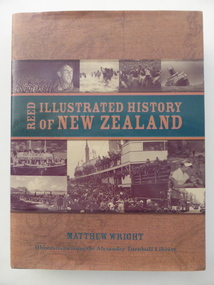
Book, Illustrated history of New Zealand, 2004
... New Zealand. Since the foundation of Warrnambool in 1847 up to the present day there has been regular and important contact between the people of Warrnambool and New Zealand. In the 19th and early 20th centuries many people in Warrnambool moved either temporarily or permanently to New Zealand for marriage or economic reasons. Some residents of Warrnambool and district were involved in the Maori Wars...New Zealand. Since the foundation of Warrnambool in 1847 up to the present day there has been regular and important contact between the people of Warrnambool and New Zealand. In the 19th and early 20th centuries many people in Warrnambool moved either temporarily or permanently to New Zealand for marriage or economic reasons. Some residents of Warrnambool and district were involved in the Maori Wars ...This is an illustrated history of New Zealand. Since the foundation of Warrnambool in 1847 up to the present day there has been regular and important contact between the people of Warrnambool and New Zealand. In the 19th and early 20th centuries many people in Warrnambool moved either temporarily or permanently to New Zealand for marriage or economic reasons. Some residents of Warrnambool and district were involved in the Maori Wars and there was regular shipping between the two places with much timber imported from New Zealand, especially for the McGennan butter box factory and for building purposes (e.g. St. Joseph’s Church). The builder of theWarrnambool Breakwater, Arthur Dudley Dobson, came to Warrnambool after having practised his surveying and engineering skills in New Zealand (South Island – Trans Alpine Railway etc). This book is very useful for research into the Warrnambool/New Zealand connection, especially in the 19th century. There is information in this book on Arthur Dudley Dobson who was important in the history of both Warrnambool and New Zealand. This is a hard cover book of 488 pages. The cover is green with gold lettering on the front and spine. There is also a dust cover with a brown and green background with gold and green lettering and sepia-coloured photographs on the front and back covers. The book has illustrations from the Alexander Turnbull Library, an introduction, ten chapters of text, notes, glossary, bibliography and index. new zealand, arthur dudley dobson, history of warrnambool -
 National Vietnam Veterans Museum (NVVM)
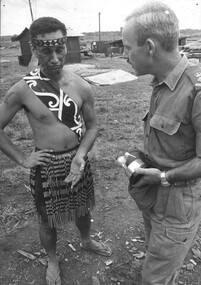
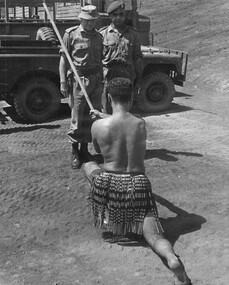
Photograph, Gibbons, Denis, Maori Challenge 1
... For almost five years Gibbons toured with nine Australian infantry battalions, posting compelling war images from within many combat zones before being flown out in late November 1970 after sustaining injuries. The images held within the National Vietnam Veterans Museum make up the Gibbons Collection. Photograph Lt Col A.L. Morrison 9 RAR New Zealand Maori ...Denis Gibbons (1937 – 2011) Trained with the Australian Army, before travelling to Vietnam in January 1966, Denis stayed with the 1st Australian Task Force in Nui Dat working as a photographer. For almost five years Gibbons toured with nine Australian infantry battalions, posting compelling war images from within many combat zones before being flown out in late November 1970 after sustaining injuries. The images held within the National Vietnam Veterans Museum make up the Gibbons Collection.A black and white photograph of Lt Col Alan Morrison, Woodside, South Australia, Commanding Officer, 9th Battalion. The Royal Australian Regiment, discusses the "Maori Challenge" that had just been completed by a New Zealand Maori gunner.photograph, lt col a.l. morrison, 9 rar, new zealand maori, gibbons collection catalogue, 9th battalion, commanding officer, the royal australian regiment, maori challenge, new zealand maori gunner, denis gibbons -
 National Vietnam Veterans Museum (NVVM)
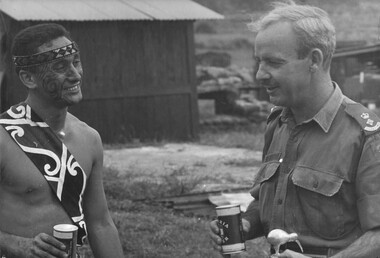
Photograph, Gibbons, Denis, Kiwi Gift
... war images from within many combat zones before being flown out in late November 1970 after sustaining injuries. The images held within the National Vietnam Veterans Museum make up the Gibbons Collection. Photograph Lt Col A.L. Morrison 9 RAR 161 Battery New Zealand Maori ...Denis Gibbons (1937 – 2011) Trained with the Australian Army, before travelling to Vietnam in January 1966, Denis stayed with the 1st Australian Task Force in Nui Dat working as a photographer. For almost five years Gibbons toured with nine Australian infantry battalions, posting compelling war images from within many combat zones before being flown out in late November 1970 after sustaining injuries. The images held within the National Vietnam Veterans Museum make up the Gibbons Collection.A black and white photograph of the Commanding Officer of 9 RAR, Lt Col Alan Morrison, of Woodside, South Australia has a cold beer with a Maori member of the New Zealand 161 Battery, Royal New Zealland Artillery on 24/11/1969. 161 Battery had been the main supporting arm of 9 RAR, which was finishing its first tour of duty in Vietnam. Lt. Col. Morrison had also been presented with a parting Kiwi gift farewelling his Battalion. 161 Battery had been continously in Vietnam since 1966.photograph, lt col a.l. morrison, 9 rar, 161 battery, new zealand maori, royal nz artillery 161, gibbons collection catalogue, commanding officer, maori soldier, the royal australian regiment, denis gibbons -
 National Vietnam Veterans Museum (NVVM)
Photograph, Gibbons, Denis, Maori Challenge 2
... war images from within many combat zones before being flown out in late November 1970 after sustaining injuries. The images held within the National Vietnam Veterans Museum make up the Gibbons Collection. Photograph 1st Australian Task Force Brig Sandy Pearson Padre Vercoe (New Zealand) 4 RAR NZ New Zealand Maori ...Denis Gibbons (1937 – 2011) Trained with the Australian Army, before travelling to Vietnam in January 1966, Denis stayed with the 1st Australian Task Force in Nui Dat working as a photographer. For almost five years Gibbons toured with nine Australian infantry battalions, posting compelling war images from within many combat zones before being flown out in late November 1970 after sustaining injuries. The images held within the National Vietnam Veterans Museum make up the Gibbons Collection.A black and white photograph of 1st Australian Task Force Commander, Brig C.M "Sandy" Pearson, accompanied by the New Zealand Padre Varcoe of 4 RAR/NZ (ANZAC) Battalion, is given the traditional Maori Challenge before being allowed to enter the Battalion's area attend the farewell concert organized by the Officers and other ranks within the Battalion.photograph, 1st australian task force, brig sandy pearson, padre vercoe (new zealand), 4 rar nz, new zealand maori, gibbons collection catalogue, 4 rar/nz (anzac), maori challenge, denis gibbons -
 National Vietnam Veterans Museum (NVVM)
Photograph, Gibbons, Denis, Taking A Letter
... war images from within many combat zones before being flown out in late November 1970 after sustaining injuries. The images held within the National Vietnam Veterans Museum make up the Gibbons Collection. Photograph 1st Australian Field Hospital Vung Tau Mary Gaynor Red Cross Maori Soldier New Zealand ...Denis Gibbons (1937 – 2011) Trained with the Australian Army, before travelling to Vietnam in January 1966, Denis stayed with the 1st Australian Task Force in Nui Dat working as a photographer. For almost five years Gibbons toured with nine Australian infantry battalions, posting compelling war images from within many combat zones before being flown out in late November 1970 after sustaining injuries. The images held within the National Vietnam Veterans Museum make up the Gibbons Collection.A black and white photograph at the 1st Australian Field Hospital, Vung Tau, South Vietnam, Mary Gaynor from the hospital Red Cross writes a letter for a wounded Maori soldier from th New Zealand contingent attached to the 1st Australian Task Force at Nui Dat, Phuoc Tuy Provincephotograph, 1st australian field hospital, vung tau, mary gaynor, red cross, maori soldier, new zealand, 1st australian task force, phuoc tuy province, gibbons collection catalogue, denis gibbons -
 National Vietnam Veterans Museum (NVVM)
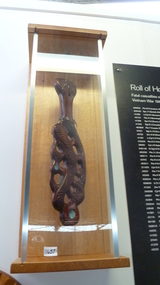
Memorabilia, Framed Club
... Club Wooden War Club Hand Carved New Zealand Carved Maori Wooden Club in Glass Fronted Case with PUA Shell Framed Club Memorabilia Memorabilia ...Carved Maori Wooden Club in Glass Fronted Case with PUA Shellclub, wooden war club, hand carved, new zealand -
 Narre Warren and District Family History Group
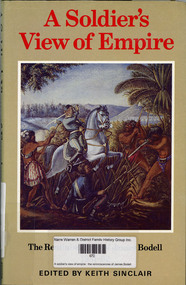
Book, James Bodell, A soldier's view of empire : the reminiscences of James Bodell, 1831-92, 1982
... In 1863 he volunteered to serve in New Zealand in the Maori wars. Discharged in 1866, he was given a town lot of land as well as farming land by the government at the town of Tauranga, where he was an outstanding pioneer, making money and becoming Mayor. ...James Bodell was born in 1831 near Nottingham, the son of poor parents. At sixteen he enlisted in the army and was sent first to Ireland, then slowly recovering from the great potato famine, and then to Hong Kong, where most of his regiment died of malaria or other tropical diseases. He bought himself out of the army and went to Van Doiemen's Land (later Tasmania) where he kept a hotel, but eventually became disgusted with the atmosphere of a recent convict settlement. In 1856 he moved to Victoria, where the great gold rush had begun, prospered, but finally lost his money in unwise speculation during a period of excessive drinking. In 1863 he volunteered to serve in New Zealand in the Maori wars. Discharged in 1866, he was given a town lot of land as well as farming land by the government at the town of Tauranga, where he was an outstanding pioneer, making money and becoming Mayor. He later made two return trips to England to visit his family in Leicester. In about 1881 he began to write his reminiscences, an ambitious undertaking for a man with so little formal education, and in 1978, on the death of one of his English descendants, the original manuscript was offered to the Bodley Head for publication. It has been edited by Keith Sinclair and presents a unique picture of how the British Empire was colonised and what life in the British army of the time was like. This is a frank, often amusing and colourful account of the Empire seen from below. (Inside cover)non-fictionJames Bodell was born in 1831 near Nottingham, the son of poor parents. At sixteen he enlisted in the army and was sent first to Ireland, then slowly recovering from the great potato famine, and then to Hong Kong, where most of his regiment died of malaria or other tropical diseases. He bought himself out of the army and went to Van Doiemen's Land (later Tasmania) where he kept a hotel, but eventually became disgusted with the atmosphere of a recent convict settlement. In 1856 he moved to Victoria, where the great gold rush had begun, prospered, but finally lost his money in unwise speculation during a period of excessive drinking. In 1863 he volunteered to serve in New Zealand in the Maori wars. Discharged in 1866, he was given a town lot of land as well as farming land by the government at the town of Tauranga, where he was an outstanding pioneer, making money and becoming Mayor. He later made two return trips to England to visit his family in Leicester. In about 1881 he began to write his reminiscences, an ambitious undertaking for a man with so little formal education, and in 1978, on the death of one of his English descendants, the original manuscript was offered to the Bodley Head for publication. It has been edited by Keith Sinclair and presents a unique picture of how the British Empire was colonised and what life in the British army of the time was like. This is a frank, often amusing and colourful account of the Empire seen from below. (Inside cover)james bodell, maori wars -
 Uniting Church Archives - Synod of Victoria
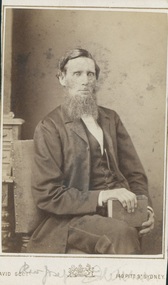
Photograph, Undated c.1880s
... New Zealand, where he became the founding principal of Wesley College. In 1856 poor health obliged him to take up circuit work in Auckland and New Plymouth, where he witnessed the Maori war. ...New Zealand, where he became the founding principal of Wesley College. In 1856 poor health obliged him to take up circuit work in Auckland and New Plymouth, where he witnessed the Maori war. ...Born 1823 West Indies, commenced ministry 1847, died 1890 in Rookwood, NSW. Joseph Horner Fletcher (1823-1890), Wesleyan minister, was born at St Vincent, Windward Islands, the eldest son of Rev. Joseph Fletcher, Wesleyan missionary, and his wife Mary, née Horner. In 1830-37 he attended a Methodist school in Kingswood, England, and then his uncle's school in Bath. He entered business but in July 1842 became a local preacher. He was accepted for the Wesleyan ministry in 1845 and after training at Richmond College, Surrey, he married Kate Green in December 1848. He was sent to Auckland, New Zealand, where he became the founding principal of Wesley College. In 1856 poor health obliged him to take up circuit work in Auckland and New Plymouth, where he witnessed the Maori war. He moved to Queensland and in 1861-64 was on circuit in Brisbane. In 1863 he became the first chairman of the Queensland Wesleyan District. In 1865 Fletcher was serving at Ipswich when invited to succeed Rev. John Manton as president of Newington College, Sydney. He acknowledged that the main business of the school was secular education in a Christian atmosphere and believed that education could help to overcome sectarianism. He invited distinguished academics to examine Newington students and strongly supported (Sir) Henry Parkes's education policies. He opposed the formation of a Methodist university college until a strong secondary school was established. He believed that boys should be taught to appreciate orderly conduct rather than to fear punishment and that corporal punishment was degrading and to be used only in extreme circumstances. Under Fletcher Newington developed a high moral tone and a tradition of order and respect. After he retired in 1887 the old boys gave him an address of appreciation and a portrait in oils to be hung in the hall. In addition to his normal duties from 1883 he had taught resident theological students. From 1887 he was an effective and progressive full-time theological tutor. As a preacher Fletcher had exceptional power: he expressed his thoughts in a fresh way with sparkling illustrations and characteristic humour. He combined humility with great spiritual power, prophetic vision and administrative ability. He encouraged the development of institutional church work which grew into the Central Methodist Mission in Sydney. Fletcher was elected as the first president of the New South Wales and Queensland Wesleyan Methodist Conference in 1874 and again in 1884, when he was also president of the General Conference of the Australasian Wesleyan Methodist Church. As conference editor in 1868, 1871 and 1873, Fletcher contributed more than fifty articles, numerous essays and reviews of books to the Weekly Advocate. He read widely, deeply and with discrimination. Never robust in health, he suffered months of illness before he died aged 66 at Stanmore, Sydney, on 30 June 1890. He was survived by three sons and two daughters, and buried in the Wesleyan section of Rookwood cemetery. In 1892 his eldest son, Joseph, edited a memorial edition of his Sermons, Addresses & Essays. Information from Australian Dictionary of Biography, Vol. 4, 1972. Sepia toned carte de visite. Seated studio portrait of the Rev. Joseph Fletcher.Rev Joseph Fletcherrev. joseph fletcher, joseph horner, wesleyan minister, newington college sydney, new zealand, queensland, president general conference, wesleyan methodist church, central methodist mission
