
Showing 14 items matching "no. 2 australian casualty clearing station"
-
 Returned Nurses RSL Sub-branch
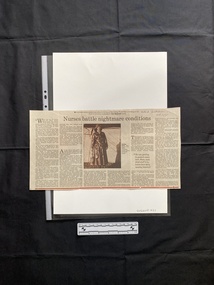
Newspaper - Newspaper clipping, [Weekend Australian], Nurses battle nightmare conditions, [November 1993]
... No. 2 Australian Casualty Clearing Station...WWII World War Two WW2 WWI WW1 World War One Korea Vietnam Pacific War Evelyn Davies Alice Davies Healesville Armistice Salonika Luna Park Cairo Melbourne Nellie Gould Jane Bell Evelyn Conyers No. 1 AGH Lemnos Spanish Influenza India British Peshawar Carrel-Dakin method Abbeville AG Butler Hardelot Mimie Proctor No. 2 Australian Casualty Clearing Station Messines Elsie Tranter ACCS Alice Ross King Alice Ross-King University of Melbourne 'Weekend Australian. / Nov. 1993' [blue ink, top right] A large newspaper clipping consisting of a title, six columns of text and a black and white photo of a woman in the winter nurse's uniform of the AIF. ...Book review of "Guns and brooches: Australian Army Nursing from the Boer War to the Gulf War" by Jan Bassett Australia's army nurses were often in the line of fire during World War 1, working at the front in atrocious conditions. About 2300 members of the Australian Army Nursing Service (AANS) were the only women to serve overseas in an official capacity with the Australian Imperial Forces (AIF). They nursed in hospitals in Egypt, Greece, England, France, Italy and Belgium. They were all qualified nurses and virtually all were single or widowed, between twenty-five and forty years old. The nurses were subject to clumsy attempts to impose military way upon them, such as having a group of nurses from No. 3 Australian General Hospital (AGH), wearing ankle-length dresses and bonnets, led by a piper, marching several kilometres to their hospital site on the island of Lemnos, Greece. Only to find hundreds of sick and wounded patients from Gallipoli lying on the ground waiting for them, but no equipment.A large newspaper clipping consisting of a title, six columns of text and a black and white photo of a woman in the winter nurse's uniform of the AIF.'Weekend Australian. / Nov. 1993' [blue ink, top right]wwii, world war two, ww2, wwi, ww1, world war one, korea, vietnam, pacific war, evelyn davies, alice davies, healesville, armistice, salonika, luna park, cairo, melbourne, nellie gould, jane bell, evelyn conyers, no. 1 agh, lemnos, spanish influenza, india, british, peshawar, carrel-dakin method, abbeville, ag butler, hardelot, mimie proctor, no. 2 australian casualty clearing station, messines, elsie tranter, accs, alice ross king, alice ross-king, university of melbourne -
 Bendigo Military Museum
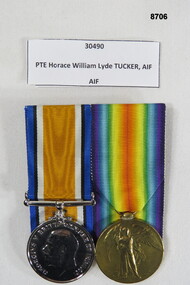
Award - MEDAL SET WW1, Post 1919
... (Born Kangaroo Flat, enlisted in Melbourne) Enlisted 7.6.1916 in Field Artillery Brigade 8, Reinforcements 8, embarked for overseas 23.11.1916, transfers later to No 2 Casualty Clearing Station, Returns to Australia 8.10.1919....(Born Kangaroo Flat, enlisted in Melbourne) Enlisted 7.6.1916 in Field Artillery Brigade 8, Reinforcements 8, embarked for overseas 23.11.1916, transfers later to No 2 Casualty Clearing Station, Returns to Australia 8.10.1919. Pbt701 H.W.L. ...Horace William Syde Tucker. (Born Kangaroo Flat, enlisted in Melbourne) Enlisted 7.6.1916 in Field Artillery Brigade 8, Reinforcements 8, embarked for overseas 23.11.1916, transfers later to No 2 Casualty Clearing Station, Returns to Australia 8.10.1919.Medals, set of two (2) mounted. British War Medal 1914-18, (replica). Victory Medal 1914-19.On Victory medal, "30490 DVR PTE H.W.L. TUCKER A.M.O. A.I.F."pbt701, h.w.l. tucker, bob english collection, ww1, medals, passchendaele barracks trust -
 Bendigo Military Museum
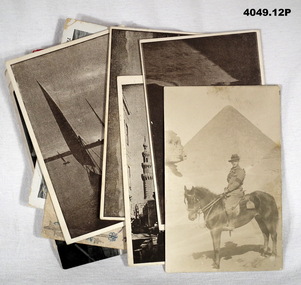
Postcard - POSTCARDS, PHOTOGRAPHIC WW1, C.WW1
... The date on card is unclear. .11) On rear in red "No 33 - some of the nurses in their quarters at an Australian Casualty Clearing Station". .12) On rear in fine print "Patriotic Series No. 22" Across both 4048.10P & 4049.12P there is two other addresses for "MISS H. FIRTH". 1. 28 Young St Fitzroy, Melbourne. 2...The date on card is unclear. .11) On rear in red "No 33 - some of the nurses in their quarters at an Australian Casualty Clearing Station". .12) On rear in fine print "Patriotic Series No. 22" Across both 4048.10P & 4049.12P there is two other addresses for "MISS H. FIRTH". 1. 28 Young St Fitzroy, Melbourne. 2 ...The cards revolve around "Hannah FIRTH". See also Cat. No. 4048.10P for more cards. .1) Addressed to "Hannah" from "Clarry (Peanuts)". .2) To "Dear Hannah, April 13th 7.30pm". Not signed off but from same person as .1) & .3). .3) Addressed "Dear" from "Dillon (Clarry)". .4) To "Dear Hannah" from "Yours ERIC". .5) There is no to or from but mentions "ERIC". .6) - .9) all are written on rear in large purple writing with the following: "Love to Hannah x x" "To Hannah with Love x x x" "With the Australian Contingent in Eygpt" "Love to Hannah x x" .10) Addressed to "Mrs H. FIRTH 18 Brunswick St Morley Leeds Yorkshire". The date on card is unclear. .11) On rear in red "No 33 - some of the nurses in their quarters at an Australian Casualty Clearing Station". .12) On rear in fine print "Patriotic Series No. 22" Across both 4048.10P & 4049.12P there is two other addresses for "MISS H. FIRTH". 1. 28 Young St Fitzroy, Melbourne. 2. 2 Turner St Abbotsford, Melbourne.Twelve photograph postcards of different scenes revolving around “Hannah”.1) & .2) Postcards, colour, centre has oval shape with British flag and all around are 11 smaller flags with country name on. In gold speckled writing top & bottom "From A. 10th Field Coy Engineers. On rear in black pen extensive letters. .3) Postcard, colour, centre has horse shoe with Australian & British flags. In same speckled gold writing as .1) & .2). On horseshoe in black pen "Good luck to Hannah & Clarence". .4) Postcard, black & white, showing a ship, at the bottom printed "TROOPSHIP HORORATA". On rear short letter in purple. .5) Postcard, sepia, showing soldier on horseback at the Pyramids & Sphinx. On rear brief letter in pencil. .6) Postcard, sepia, showing a street scene which appears to be a place called "Muski" in Eygpt. Brief note on rear in purple. .7) Postcard, sepia, showing domed building, re the "Blue Mosque". Brief note on back in purple. .8) Postcard, sepia, scene over buildings being "View from the Citadel". Brief note on the back in purple. .9) Postcard, sepia, showing a sailing craft on a river being "Felluca on the Nile". .10) Postcard, colour, hand drawn, shown a flag flower arrangement, centre in an arrow through a heart. Address on rear in black. .11) Postcard, black & white, showing a group of nurses. Card was put out by the "Aust Comforts Fund". .12) Postcard, colour, drawn showing six different nations soldiers carrying flags.photographs, postcards, hannah -
 Bendigo Military Museum
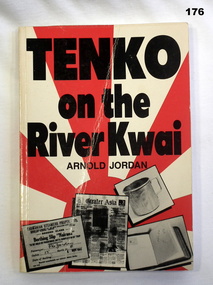
Book - POW BOOK, TENKO ON THE RIVER KWAI, 1987
... Posted to 2/40th Bn 25.6.1940, hospital with Influenza 24.8.1940, rejoin unit 9.9.1940, appointed group 3 Nursing Orderly and posted to 2/4 ACCS, embarked for Singapore 1.2 1941, hospital 23.5.1941 with Acute Tonsilitis, hospital 24.12.1941 with Malaria, rejoin unit 17.1.1942, reported missing 16.2.1942 (POW) Malaya, reported alive in Siam 22.8.1945, recovered in Siam 22.8.1945, embark for Australia 18.10.1945, evacuated to 111 AGH then 2/1st Con Depot, discharged from the 2nd AIF 23.1.1946. ACCS (Aust Casualty Clearing Station...Posted to 2/40th Bn 25.6.1940, hospital with Influenza 24.8.1940, rejoin unit 9.9.1940, appointed group 3 Nursing Orderly and posted to 2/4 ACCS, embarked for Singapore 1.2 1941, hospital 23.5.1941 with Acute Tonsilitis, hospital 24.12.1941 with Malaria, rejoin unit 17.1.1942, reported missing 16.2.1942 (POW) Malaya, reported alive in Siam 22.8.1945, recovered in Siam 22.8.1945, embark for Australia 18.10.1945, evacuated to 111 AGH then 2/1st Con Depot, discharged from the 2nd AIF 23.1.1946. ACCS (Aust Casualty Clearing Station ...The Author Arnold Oakley JORDAN (born Tasmania, enlisted Tasmania) in the 2nd AIF No TX3528 on 21.6.40 age 28 years 9 months. Posted to 2/40th Bn 25.6.1940, hospital with Influenza 24.8.1940, rejoin unit 9.9.1940, appointed group 3 Nursing Orderly and posted to 2/4 ACCS, embarked for Singapore 1.2 1941, hospital 23.5.1941 with Acute Tonsilitis, hospital 24.12.1941 with Malaria, rejoin unit 17.1.1942, reported missing 16.2.1942 (POW) Malaya, reported alive in Siam 22.8.1945, recovered in Siam 22.8.1945, embark for Australia 18.10.1945, evacuated to 111 AGH then 2/1st Con Depot, discharged from the 2nd AIF 23.1.1946. ACCS (Aust Casualty Clearing Station) AGH (Aust General Hospital) Siam (Thailand) Con Depot (Convalescent Depot)Paperback book written by Arnold Jordan. Japanese flag on front cover. Handwriting on page 3. Gift inscription inside.books, military, pow’s, ww2 -
 Returned Nurses RSL Sub-branch
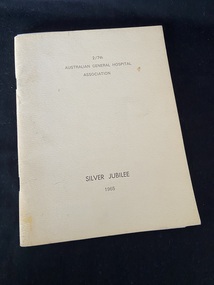
Booklet, 2/7th Australian General Hospital Assiciation, Silver Jubilee : 1965, 1965
... Returned Nurses RSL Sub-branch ANZAC House Level 3 4 Collins Street Melbourne Contains a unit history (including anecdotes, but very precise about the order of events as the unit assembled), extracts from what appears to be the official unit diary (1/7/1940 - 24/12/1945), statistics for the 2/7th (May 1941- August 1945), List of hospitals on active service (including casualty clearing stations, camp hospitals 46 and 66, field ambulances and hospital ships).The booklet also contains a list of members of the 2/7th AGH Association, notes regarding AANS and AAMWS, and a list of appointmenta available in the AAMC (medical offices, pharmacists, etc.). 2/7th Australian General Hospital World War II medical care WW2 WWII 2/7th 'Foreword / The Australian Army Nursing Service, 1939-45. / Compiled by VFX 47777 / This small volume represents a brief account of the work done by its members, at home, and abroad.' ...Contains a unit history (including anecdotes, but very precise about the order of events as the unit assembled), extracts from what appears to be the official unit diary (1/7/1940 - 24/12/1945), statistics for the 2/7th (May 1941- August 1945), List of hospitals on active service (including casualty clearing stations, camp hospitals 46 and 66, field ambulances and hospital ships).The booklet also contains a list of members of the 2/7th AGH Association, notes regarding AANS and AAMWS, and a list of appointmenta available in the AAMC (medical offices, pharmacists, etc.).Cream coloured booklet with two staples. The title and author are typed in black ink on the cover.non-fiction'B88' [Handwritten in pencil on the first page] 2/7th australian general hospital, world war ii medical care, ww2, wwii, 2/7th -
 Returned Nurses RSL Sub-branch
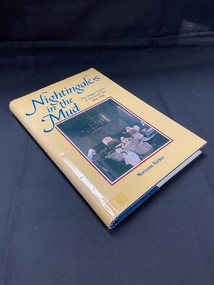
Book - Hardcover book, Marianne Barker, Nightingale in the mud : the Digger Sisters of the Great War 1914-1918, 1989
... Returned Nurses RSL Sub-branch ANZAC House Level 3 4 Collins Street Melbourne History of Nursing World War One 1914-1918 WW1 WWI Nurses Australia Great War Nurses 'Draws on many first-hand and previously unpublished accounts of the work of Australian nurses in the Great War to tell an extraordinary story of courage and companionship under conditions of great hardship - in the mud of Flanders, among the cholera cases in India, on the hospital ships during the Gallipoli campaign, on Afghanistan border, in Vladivostok, in mosquito infested Macedonia, and in the Sinai Desert. - from inside dustjacket. Contents note: pt. 1. The Middle East -- 1. Enlistment -- 2. Egypt -- 3. Hospital ships -- 4. Lemnos -- 5. Malta -- 6. Palestine -- 7. Mesopotamia -- 8. India -- 9. Serbia and Salonika -- pt. 2. The Western Front -- 10. The Australian base hospitals in France -- 11. The casualty clearing stations ...'Draws on many first-hand and previously unpublished accounts of the work of Australian nurses in the Great War to tell an extraordinary story of courage and companionship under conditions of great hardship - in the mud of Flanders, among the cholera cases in India, on the hospital ships during the Gallipoli campaign, on Afghanistan border, in Vladivostok, in mosquito infested Macedonia, and in the Sinai Desert. - from inside dustjacket. Contents note: pt. 1. The Middle East -- 1. Enlistment -- 2. Egypt -- 3. Hospital ships -- 4. Lemnos -- 5. Malta -- 6. Palestine -- 7. Mesopotamia -- 8. India -- 9. Serbia and Salonika -- pt. 2. The Western Front -- 10. The Australian base hospitals in France -- 11. The casualty clearing stations -- 12. Transport in France -- 13. Home hospitals in England -- 14. Repatriation -- Epilogue -- Appendix: Roll of Nurses. - from Trove record.Blue hardcover book with a yellow dustjacket. The title is printed down the spine in blue text. The front cover shows an image of an oil painting of nurses tending the beds of the wounded, it is surrounded by a dark red border. Above the image the title is printed in blue, with 1914-1918 printed in smaller red print.non-fiction'Draws on many first-hand and previously unpublished accounts of the work of Australian nurses in the Great War to tell an extraordinary story of courage and companionship under conditions of great hardship - in the mud of Flanders, among the cholera cases in India, on the hospital ships during the Gallipoli campaign, on Afghanistan border, in Vladivostok, in mosquito infested Macedonia, and in the Sinai Desert. - from inside dustjacket. Contents note: pt. 1. The Middle East -- 1. Enlistment -- 2. Egypt -- 3. Hospital ships -- 4. Lemnos -- 5. Malta -- 6. Palestine -- 7. Mesopotamia -- 8. India -- 9. Serbia and Salonika -- pt. 2. The Western Front -- 10. The Australian base hospitals in France -- 11. The casualty clearing stations -- 12. Transport in France -- 13. Home hospitals in England -- 14. Repatriation -- Epilogue -- Appendix: Roll of Nurses. - from Trove record.history of nursing, world war one 1914-1918, ww1, wwi, nurses australia, great war nurses -
 Returned Nurses RSL Sub-branch
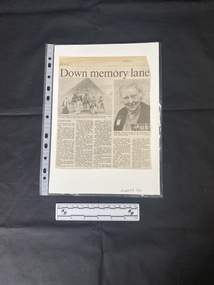
Newspaper - Newspaper clipping, Manuela Cifra, Down memory lane, [1995]
... Australia to nurse sick and wounded from New Guinea. In April 1945 Jean went to another tent hospital in Borneo, where she cared for civilians and POW's, including a survivor of the Sandakan death march. Discharged in 1946, Jean joined the Alfred Hospital again until her retirement in 1962. World War 2 WWII WW2 World War II Middle East 2/1st Casualty Clearing Station ...Jean Hanna was one of a group of old collegians who presented a book containing the names of eighty former students who served World War II to Presbyterian Ladies College, Burwood. Jean, 93, had seen war firsthand, working twelve hour shifts in tent hospitals, nursing sick, wounded, amputees and POW's. By 1937 Jean was the sister-in-charge of the Alfred Hospital's operating theatre and after a European tour where she witnessed Germany arming, displaying swastikas everywhere and restricting movement in and out of Germany, Jean registered with the Australian Nursing Service and were called up. April 1940 saw Jean amoung the first Victorian nursing sisters to go overseas. Jean nursed in tent hospitals in Gaza, Mersa Matruh, Nazareth and Colombo before heading home to Australia to nurse sick and wounded from New Guinea. In April 1945 Jean went to another tent hospital in Borneo, where she cared for civilians and POW's, including a survivor of the Sandakan death march. Discharged in 1946, Jean joined the Alfred Hospital again until her retirement in 1962. A newspaper clipping of a story of five columns of text beneath two black and white photos. The photo on the left is of four women in uniform, two on camels and two on donkeys, with three men on foot, in front of a pyramid. The photo on the right os on an older woman wearing service medals.'NEWS'[graphite pencil, left top] 'AANS'[graphite pencil, right top]world war 2, wwii, ww2, world war ii, middle east, 2/1st casualty clearing station, nan schofield, egypt, battle of bardia, greece, syrian campaign, syria, japanese, american barrack hospital, ipswitch, labuan island, children's health bureau, melbourne -
 Returned Nurses RSL Sub-branch
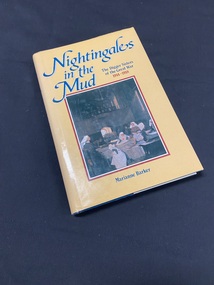
Book - Hardcover book, Marianne Barker, Nightingales in the mud : the Digger Sisters of the Great War 1914-1918, 1989
... History of Nursing World War One 1914-1918 WW1 WWI Nurses Australia Great War Nurses 'Draws on many first-hand and previously unpublished accounts of the work of Australian nurses in the Great War to tell an extraordinary story of courage and companionship under conditions of great hardship - in the mud of Flanders, among the cholera cases in India, on the hospital ships during the Gallipoli campaign, on Afghanistan border, in Vladivostok, in mosquito infested Macedonia, and in the Sinai Desert. - from inside dustjacket. Contents note: pt. 1. The Middle East -- 1. Enlistment -- 2. Egypt -- 3. Hospital ships -- 4. Lemnos -- 5. Malta -- 6. Palestine -- 7. Mesopotamia -- 8. India -- 9. Serbia and Salonika -- pt. 2. The Western Front -- 10. The Australian base hospitals in France -- 11. The casualty clearing stations ...'Draws on many first-hand and previously unpublished accounts of the work of Australian nurses in the Great War to tell an extraordinary story of courage and companionship under conditions of great hardship - in the mud of Flanders, among the cholera cases in India, on the hospital ships during the Gallipoli campaign, on Afghanistan border, in Vladivostok, in mosquito infested Macedonia, and in the Sinai Desert. - from inside dustjacket. Contents note: pt. 1. The Middle East -- 1. Enlistment -- 2. Egypt -- 3. Hospital ships -- 4. Lemnos -- 5. Malta -- 6. Palestine -- 7. Mesopotamia -- 8. India -- 9. Serbia and Salonika -- pt. 2. The Western Front -- 10. The Australian base hospitals in France -- 11. The casualty clearing stations -- 12. Transport in France -- 13. Home hospitals in England -- 14. Repatriation -- Epilogue -- Appendix: Roll of Nurses. - from Trove record.Blue hardcover book with a yellow dustjacket. The title is printed down the spine in blue text. The front cover shows an image of an oil painting of nurses tending the beds of the wounded, it is surrounded by a dark red border. Above the image the title is printed in blue, with 1914-1918 printed in smaller red print.non-fiction'Draws on many first-hand and previously unpublished accounts of the work of Australian nurses in the Great War to tell an extraordinary story of courage and companionship under conditions of great hardship - in the mud of Flanders, among the cholera cases in India, on the hospital ships during the Gallipoli campaign, on Afghanistan border, in Vladivostok, in mosquito infested Macedonia, and in the Sinai Desert. - from inside dustjacket. Contents note: pt. 1. The Middle East -- 1. Enlistment -- 2. Egypt -- 3. Hospital ships -- 4. Lemnos -- 5. Malta -- 6. Palestine -- 7. Mesopotamia -- 8. India -- 9. Serbia and Salonika -- pt. 2. The Western Front -- 10. The Australian base hospitals in France -- 11. The casualty clearing stations -- 12. Transport in France -- 13. Home hospitals in England -- 14. Repatriation -- Epilogue -- Appendix: Roll of Nurses. - from Trove record.history of nursing, world war one 1914-1918, ww1, wwi, nurses australia, great war nurses -
 Alfred Hospital Nurses League - Nursing History Collection
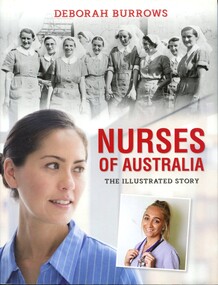
Book - Illustrated book, Deborah Burrows 1959, Nurses of Australia: The illustrated story, 2018
... Title and authors name printed on front cover and spine (red ink on front and white ink on red background on spine) Background of front cover has three photographs: black and white photograph of a group of nurses (Malaya 1941 group portrait of Australian Army Nursing Service nurses of the 2/4th Casualty Clearing Station), colour photo of a nurse looking over her shoulder, and a coloured photo of an Indigenous nurse. ...Title and authors name printed on front cover and spine (red ink on front and white ink on red background on spine) Background of front cover has three photographs: black and white photograph of a group of nurses (Malaya 1941 group portrait of Australian Army Nursing Service nurses of the 2/4th Casualty Clearing Station), colour photo of a nurse looking over her shoulder, and a coloured photo of an Indigenous nurse. ...From the First Nation caregivers who healed, birthed and nursed for millennia to the untrained and ill-equipped convict men and women who cared for the sick in the fledgling colony of New South Wales, nursing has been practised in Australia since the beginning. It would take the arrival of a group of dedicated Irish nuns, followed by Florence Nightingale-trained nurses - and decades of constant and continuing campaigning - to transform nursing into what it is today: the most trusted profession in Australia. Nurses will recognise their own lived experience in stories about training days, nurses' quarters, changing uniforms, changing roles, the arrival of male nurses and current pathways to nursing. Produced in collaboration with the Australian College of Nursing and the Congress of Aboriginal and Torres Strait Islander Nurses and Midwives, with additional information provided by the Australian Nursing and Midwifery Federation, this is the story of nursing in Australia.Illustrated book. Title and authors name printed on front cover and spine (red ink on front and white ink on red background on spine) Background of front cover has three photographs: black and white photograph of a group of nurses (Malaya 1941 group portrait of Australian Army Nursing Service nurses of the 2/4th Casualty Clearing Station), colour photo of a nurse looking over her shoulder, and a coloured photo of an Indigenous nurse. The back cover has a summary of the book along with four coloured photographs: Portrait of a nun with constitution and quill (Sister Mary Augustine Aikenhead by Nicholas Joseph Cowley), A nurse in uniform with veil (Vivian Bull winkel 1941), an indigenous woman (Lois O'Donoghue) an enrolled nurse (Samuel Yenui)non-fictionFrom the First Nation caregivers who healed, birthed and nursed for millennia to the untrained and ill-equipped convict men and women who cared for the sick in the fledgling colony of New South Wales, nursing has been practised in Australia since the beginning. It would take the arrival of a group of dedicated Irish nuns, followed by Florence Nightingale-trained nurses - and decades of constant and continuing campaigning - to transform nursing into what it is today: the most trusted profession in Australia. Nurses will recognise their own lived experience in stories about training days, nurses' quarters, changing uniforms, changing roles, the arrival of male nurses and current pathways to nursing. Produced in collaboration with the Australian College of Nursing and the Congress of Aboriginal and Torres Strait Islander Nurses and Midwives, with additional information provided by the Australian Nursing and Midwifery Federation, this is the story of nursing in Australia.nurses-australia-history, nursing-australia-history -
 Hume City Civic Collection
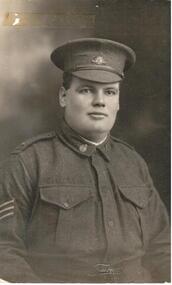
Photograph, 2/11/1915
... Australian Casualty Clearing Station world war 1 martin h. j. (private) soldiers armed forces uniforms clothing and dress postcards george evans collection Typewritten on front: Private H. Martin Printed on front: TALMA MELBOURNE Handwritten on back: PRIVATE H.J. MARTIN, 2ND AUST CASUALTY CLEARING STATION A.M.C. (ON ACTIVE SERVICE) 2 ...Sargent Medical Corps. 2nd Australian Casualty Clearing StationA b/w postcard portrait of soldier H. Martin.Typewritten on front: Private H. Martin Printed on front: TALMA MELBOURNE Handwritten on back: PRIVATE H.J. MARTIN, 2ND AUST CASUALTY CLEARING STATION A.M.C. (ON ACTIVE SERVICE) 2/11/15world war 1, martin, h. j. (private), soldiers, armed forces, uniforms, clothing and dress, postcards, george evans collection -
 Wangaratta RSL Sub Branch
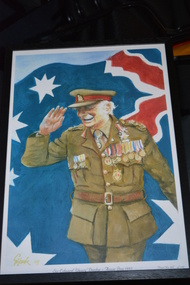
Print - Framed print
... 2 July 1993) was an Australian surgeon who was renowned for his leadership while being held prisoner by the Japanese during World War II. Born 12 July 1907 Major Plains, Victoria Died 2 July 1993 (aged 85) Service/branch Australian Army Years of service 1935–1946 Rank Colonel Unit Royal Australian Army Medical Corps 2/2nd Casualty Clearing Station Commands held No.1 Allied General Hospital Battles/wars World War II Battle of Greece North African Campaign Syria-Lebanon campaign South West Pacific New Guinea Campaign South East Asia Campaign Awards Companion of the Order of Australia Knight Bachelor Companion of the Order of St Michael and St George Officer of the Order of the British Empire Knight of the Venerable Order of Saint John Mentioned in Despatches ...2 July 1993) was an Australian surgeon who was renowned for his leadership while being held prisoner by the Japanese during World War II. Born 12 July 1907 Major Plains, Victoria Died 2 July 1993 (aged 85) Service/branch Australian Army Years of service 1935–1946 Rank Colonel Unit Royal Australian Army Medical Corps 2/2nd Casualty Clearing Station Commands held No.1 Allied General Hospital Battles/wars World War II Battle of Greece North African Campaign Syria-Lebanon campaign South West Pacific New Guinea Campaign South East Asia Campaign Awards Companion of the Order of Australia Knight Bachelor Companion of the Order of St Michael and St George Officer of the Order of the British Empire Knight of the Venerable Order of Saint John Mentioned in Despatches colonel sir ernest edward dunlop "weary" dunlop surgeon Sir Edward "Weary" Dunlop - Anzac Day 1993 Print No 455 of 500 Black timber frame containing coloured caricature of saluting Army Officer with flag in background. ...Colonel Sir Ernest Edward "Weary" Dunlop, AC, CMG, OBE (12 July 1907 – 2 July 1993) was an Australian surgeon who was renowned for his leadership while being held prisoner by the Japanese during World War II. Born 12 July 1907 Major Plains, Victoria Died 2 July 1993 (aged 85) Service/branch Australian Army Years of service 1935–1946 Rank Colonel Unit Royal Australian Army Medical Corps 2/2nd Casualty Clearing Station Commands held No.1 Allied General Hospital Battles/wars World War II Battle of Greece North African Campaign Syria-Lebanon campaign South West Pacific New Guinea Campaign South East Asia Campaign Awards Companion of the Order of Australia Knight Bachelor Companion of the Order of St Michael and St George Officer of the Order of the British Empire Knight of the Venerable Order of Saint John Mentioned in Despatches Black timber frame containing coloured caricature of saluting Army Officer with flag in background.Sir Edward "Weary" Dunlop - Anzac Day 1993 Print No 455 of 500colonel sir ernest edward dunlop, "weary" dunlop, surgeon -
 Melbourne Legacy
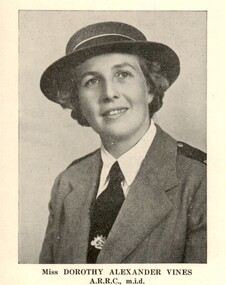
Article, Melbourne Legacy, Miss Dorothy Vines, 1955
... 2 as a Major with the Royal Australian Army Nursing Corps. At the beginning of 1940 she went to the Middle East and served as Senior Sister of No.1 Casualty Clearing Station and shortly afterwards was appointed Sister-in-charge of the No.3 Casualty Clearing Station. ...2 as a Major with the Royal Australian Army Nursing Corps. At the beginning of 1940 she went to the Middle East and served as Senior Sister of No.1 Casualty Clearing Station and shortly afterwards was appointed Sister-in-charge of the No.3 Casualty Clearing Station. ...The newsletter from August 1955. It featured photos of the Legacy staff, including Miss Dorrie Vines the Matron of Stanhope. It summarises her life before joining Stanhope on 11 November 1946. She had served with distinction overseas during World War 2 as a Major with the Royal Australian Army Nursing Corps. At the beginning of 1940 she went to the Middle East and served as Senior Sister of No.1 Casualty Clearing Station and shortly afterwards was appointed Sister-in-charge of the No.3 Casualty Clearing Station. She returned to Australian in 1943 and was appointed Matron of a hospital in Alice Springs and in 1944 she again left Australia for New Guinea as Matron of the 2/11 Australian General Hospital. For her war service she was awarded the medal of an Associate of the Royal Red Cross in 1943 and was also mentioned in despatches. Miss Vines remained at Stanhope until her retirement in December 1966.Newsletter outlining news of Junior Legatee activities also occassionally contained information about staff.Black and white printed article about Miss Vines from Newsletter published August 1955. Volume 9 Number 2staff, residences, dorothy vines -
 Returned Nurses RSL Sub-branch
Document - Typed document, Sister J Langham, 2/3 Aust C.C.S
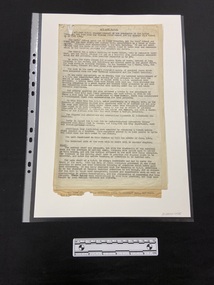
... An account of the 2/3 Austrailan Casualty Clearing Station (C.C.S.) in 1941-42 including information on staff, equipment, movements, patients, evacuations and conditions. Australian ...An account of the 2/3 Austrailan Casualty Clearing Station (C.C.S.) in 1941-42 including information on staff, equipment, movements, patients, evacuations and conditions.'2/3 AUST C.C.S.' typed and underlined at the top of the page followed by a full page of typed print. There are twelve pages in total, of varying sizes. 'by Sister J Langham' [Lightly written in pencil in the top right corner of the first page]australian army nurses, world war 1939-1945, ww2, wwii, 2/3 australian casual clearing station, jess langham -
 Returned Nurses RSL Sub-branch
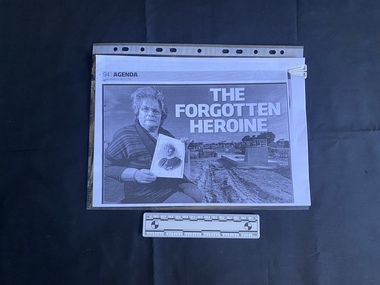
Document - Photocopy of newspaper clipping and related documents, Sunday Herald, The forgotten heroine, 5 December 1914 - May 20 2012
... 2 - photocopy of 'Austraalian Imperial Force - Nominal Roll' page 7 (Lee-Archer, Estelle Frances listed) Document 3 - photocopy of unknown document (Sis. Lee-Archer, Estelle (RRC) listed) Dr Collopy Kildonian Castle London Caulfield Tasmania John Lee Archer Mary Anne Lyons Joseph Lyons Parlianment House Hobart Ross Bridge Alfred Hospital Kyarra 1st Australian General Hospital Swanage Dorset Gallipoli 2nd Australian General Hospital 3rd Australian General Hospital 25th Australian General Hospital 47th Australian Casualty Clearing Station 3rd Australian Casualty Clearing Station 7th Australian General Hospital John Saddington Five photocopied pages held together with a plastic paperclip. ...Newspaper - 'The forgotten heroine' Visitors to New Cheltenham Cemetery in Melbourne would not know that a highly decorated and dedicated nurse was buried there. Her grave is unmarked, there is no reference to her achievements or selfless dedication. Estelle Lee Archer died in 1960, at the Repatriation General Hospital, Heidelberg, age 78 from a perforated ulcer. Margaret Leyden wants the Office of Australian War Graves to recognise that her great-aunt died from war-related injuries and to restore and maintain her grave. Margaret, who never met her aunt, has pieced together her history, including that Estelle's medals, including the prestigious Royal Red Cross 2nd Class for services in support of our ANZACs have ended up in the MAryborough Military & Colonial Museum after they were bought at a second hand shop. Estelle served in seven army units and was in the Middle East, England and France for the duration of World War 1. After the war she continued to dedicate her life to the care of soldiers. Document 1 - digitised copy of 'First Wold War Embarkation Roll' for Estelle Frances Lee-Archer Document 2 - photocopy of 'Austraalian Imperial Force - Nominal Roll' page 7 (Lee-Archer, Estelle Frances listed) Document 3 - photocopy of unknown document (Sis. Lee-Archer, Estelle (RRC) listed) Five photocopied pages held together with a plastic paperclip. Two pages are of a newspaper story, the first showing a full page black and white photo of a seated older woman holding a photo of a woman in nurse's uniform. The second page of the newspaper story has four columns of text with a photo of a war medal and a photo of a standing woman in nurse's uniform beside them. The final three pages are war-time documents.dr collopy, kildonian castle, london, caulfield, tasmania, john lee archer, mary anne lyons, joseph lyons, parlianment house, hobart, ross bridge, alfred hospital, kyarra, 1st australian general hospital, swanage, dorset, gallipoli, 2nd australian general hospital, 3rd australian general hospital, 25th australian general hospital, 47th australian casualty clearing station, 3rd australian casualty clearing station, 7th australian general hospital, john saddington
