
Showing 13 items matching "no. 3181"
-
 Flagstaff Hill Maritime Museum and Village
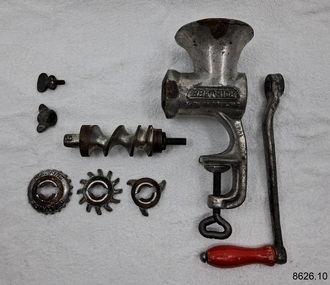
Domestic object - Food Mincer, John Harper & Co, Early - Mid 20th Century
... ...No. 3181...Metal food mincer labelled Harper No. 3181, Beatrice. Made in England. The object is part of the W.R. ...Harper. No 3181. Beatrice. Made in England. No 3 Fine. ...Flagstaff Hill Maritime Museum and Village Great Ocean Road Shipwreck Coast Mincer Grinder Meat Cooking Beatrice Made in England Harper No. 3181 W.R. Angus Harper. No 3181. Beatrice. ...A meat grinder, commonly known as the meat mincer, is used for chopping meat into fine pieces. Alternatively, it can be used for the mixing of raw or cooked meat, fish and vegetables. It is the best way to process meat, and is a widely used piece of equipment by butchers and in the home.. Butchers have been known to use either mincing knives or meat cleavers in the kitchen for years to produce a quantity of minced meat. This was a slow and laborious process. The advent of the meat mincer has not only made the mincing process easier but also faster. The meat mincer has slowly evolved over the years into what it is today. The first meat mixer or meat mincer was invented in the 19th century by a German inventor named Baron Karl Drais. Although some versions of the device date back to much earlier. The oldest form of meat mincer was hand cranked which forced meat through a metal plate with several small holes in it, which resulted in long and thin strands of the meat. The meat was fed into the funnel that was placed at the top of the mixer. This meat would pass through a hand cranked screw conveyor that would squash and mix the meat before passing it through the metal plate. Needless to say, this was again a slow and laborious procedure to follow to produce large quantity of meat. With passage of time, this hand cracked machine became powered by electricity. The meat mincer has a great adaptability and efficiency now. The huge variety in mincer plates allows a butcher to produce different types of minced meat in any shape desired. However, traditional manual meat mincers have not really changed a lot. They are manually operated and made of cast iron, as earlier. They are similar to the original mincer designs, dating back to the early 1900s. Some butchers still prefer using a variety of mincer knives. Adapted from: https://brennan-group.com/blogs/news/history-of-the-meat-mincer This meat mincer belonged to the family of Dr.William Roy Angus, Surgeon and Oculist. It was donated to Flagstaff Hill Maritime Village by his daughter, Bernice McDade. It is part of the “W.R. Angus Collection” that includes historical medical equipment, surgical instruments and material once belonging to Dr Edward Ryan and Dr Thomas Francis Ryan, (both of Nhill, Victoria) as well as Dr Angus’ own belongings. The Collection’s history spans the medical practices of the two Doctors Ryan, from 1885-1926 plus that of Dr Angus, up until 1969. ABOUT THE “W.R.ANGUS COLLECTION” Doctor William Roy Angus M.B., B.S., Adel., 1923, F.R.C.S. Edin.,1928 (also known as Dr Roy Angus) was born in Murrumbeena, Victoria in 1901 and lived until 1970. He qualified as a doctor in 1923 at University of Adelaide, was Resident Medical Officer at the Royal Adelaide Hospital in 1924 and for a period was house surgeon to Sir (then Mr.) Henry Simpson Newland. Dr Angus was briefly an Assistant to Dr Riddell of Kapunda, then commenced private practice at Curramulka, Yorke Peninsula, SA, where he was physician, surgeon and chemist. In 1926, he was appointed as new Medical Assistant to Dr Thomas Francis Ryan (T.F. Ryan, or Tom), in Nhill, Victoria, where his experiences included radiology and pharmacy. In 1927 he was Acting House Surgeon in Dr Tom Ryan’s absence. Dr Angus had become engaged to Gladys Forsyth and they decided he would take time to further his studies overseas in the UK in 1927. He studied at London University College Hospital and at Edinburgh Royal Infirmary and in 1928, was awarded FRCS (Fellow from the Royal College of Surgeons), Edinburgh. He worked his passage back to Australia as a Ship’s Surgeon on the on the Australian Commonwealth Line’s T.S.S. Largs Bay. Dr Angus married Gladys in 1929, in Ballarat. (They went on to have one son (Graham 1932, born in SA) and two daughters (Helen (died 12/07/1996) and Berenice (Berry), both born at Mira, Nhill ) Dr Angus was a ‘flying doctor’ for the A.I.M. (Australian Inland Ministry) Aerial Medical Service in 1928 . The organisation began in South Australia through the Presbyterian Church in that year, with its first station being in the remote town of Oodnadatta, where Dr Angus was stationed. He was locum tenens there on North-South Railway at 21 Mile Camp. He took up this ‘flying doctor’ position in response to a call from Dr John Flynn; the organisation was later known as the Flying Doctor Service, then the Royal Flying Doctor Service. A lot of his work during this time involved dental surgery also. Between 1928-1932 he was surgeon at the Curramulka Hospital, Yorke Peninsula, South Australia. In 1933 Dr Angus returned to Nhill where he’d previously worked as Medical Assistant and purchased a share of the Nelson Street practice and Mira hospital from Dr Les Middleton one of the Middleton Brothers, the current owners of what was once Dr Tom Ryan’s practice. Dr L Middleton was House Surgeon to the Nhill Hospital 1926-1933, when he resigned. [Dr Tom Ryan’s practice had originally belonged to his older brother Dr Edward Ryan, who came to Nhill in 1885. Dr Edward saw patients at his rooms, firstly in Victoria Street and in 1886 in Nelson Street, until 1901. The Nelson Street practice also had a 2 bed ward, called Mira Private Hospital ). Dr Edward Ryan was House Surgeon at the Nhill Hospital 1884-1902 . He also had occasions where he successfully performed veterinary surgery for the local farmers too. Dr Tom Ryan then purchased the practice from his brother in 1901. Both Dr Edward and Dr Tom Ryan work as surgeons included eye surgery. Dr Tom Ryan performed many of his operations in the Mira private hospital on his premises. He too was House Surgeon at the Nhill Hospital 1902-1926. Dr Tom Ryan had one of the only two pieces of radiology equipment in Victoria during his practicing years – The Royal Melbourne Hospital had the other one. Over the years Dr Tom Ryan gradually set up what was effectively a training school for country general-practitioner-surgeons. Each patient was carefully examined, including using the X-ray machine, and any surgery was discussed and planned with Dr Ryan’s assistants several days in advance. Dr Angus gained experience in using the X-ray machine there during his time as assistant to Dr Ryan. Dr Tom Ryan moved from Nhill in 1926. He became a Fellow of the Royal Australasian College of Surgeons in 1927, soon after its formation, a rare accolade for a doctor outside any of the major cities. He remained a bachelor and died suddenly on 7th Dec 1955, aged 91, at his home in Ararat. Scholarships and prizes are still awarded to medical students in the honour of Dr T.F. Ryan and his father, Dr Michael Ryan, and brother, John Patrick Ryan. ] When Dr Angus bought into the Nelson Street premises in Nhill he was also appointed as the Nhill Hospital’s Honorary House Surgeon 1933-1938. His practitioner’s plate from his Nhill surgery states “HOURS Daily, except Tuesdays, Fridays and Saturday afternoons, 9-10am, 2-4pm, 7-8pm. Sundays by appointment”. This plate is now mounted on the doorway to the Port Medical Office at Flagstaff Hill Maritime Village, Warrnambool. Dr Edward Ryan and Dr Tom Ryan had an extensive collection of historical medical equipment and materials spanning 1884-1926 and when Dr Angus took up practice in their old premises he obtained this collection, a large part of which is now on display at the Port Medical Office at Flagstaff Hill Maritime Village in Warrnambool. During his time in Nhill Dr Angus was involved in the merging of the Mira Hospital and Nhill Public Hospital into one public hospital and the property titles passed on to Nhill Hospital in 1939. In 1939 Dr Angus and his family moved to Warrnambool where he purchased “Birchwood,” the 1852 home and medical practice of Dr John Hunter Henderson, at 214 Koroit Street. (This property was sold in1965 to the State Government and is now the site of the Warrnambool Police Station. ). The Angus family was able to afford gardeners, cooks and maids; their home was a popular place for visiting dignitaries to stay whilst visiting Warrnambool. Dr Angus had his own silk worm farm at home in a Mulberry tree. His young daughter used his centrifuge for spinning the silk. Dr Angus was appointed on a part-time basis as Port Medical Officer (Health Officer) in Warrnambool and held this position until the 1940’s when the government no longer required the service of a Port Medical Officer in Warrnambool; he was thus Warrnambool’s last serving Port Medical Officer. (The duties of a Port Medical Officer were outlined by the Colonial Secretary on 21st June, 1839 under the terms of the Quarantine Act. Masters of immigrant ships arriving in port reported incidents of diseases, illness and death and the Port Medical Officer made a decision on whether the ship required Quarantine and for how long, in this way preventing contagious illness from spreading from new immigrants to the residents already in the colony.) Dr Angus was a member of the Australian Medical Association, for 35 years and surgeon at the Warrnambool Base Hospital 1939-1942, He served as a Surgeon Captain during WWII1942-45, in Ballarat, Victoria, and in Bonegilla, N.S.W., completing his service just before the end of the war due to suffering from a heart attack. During his convalescence he carved an intricate and ‘most artistic’ chess set from the material that dentures were made from. He then studied ophthalmology at the Royal Melbourne Eye and Ear Hospital and created cosmetically superior artificial eyes by pioneering using the intrascleral cartilage. Angus received accolades from the Ophthalmological Society of Australasia for this work. He returned to Warrnambool to commence practice as an ophthalmologist, pioneering in artificial eye improvements. He was Honorary Consultant Ophthalmologist to Warrnambool Base Hospital for 31 years. He made monthly visits to Portland as a visiting surgeon, to perform eye surgery. He represented the Victorian South-West subdivision of the Australian Medical Association as its secretary between 1949 and 1956 and as chairman from 1956 to 1958. In 1968 Dr Angus was elected member of Spain’s Barraquer Institute of Barcelona after his research work in Intrasclearal cartilage grafting, becoming one of the few Australian ophthalmologists to receive this honour, and in the following year presented his final paper on Living Intrasclearal Cartilage Implants at the Inaugural Meeting of the Australian College of Ophthalmologists in Melbourne In his personal life Dr Angus was a Presbyterian and treated Sunday as a Sabbath, a day of rest. He would visit 3 or 4 country patients on a Sunday, taking his children along ‘for the ride’ and to visit with him. Sunday evenings he would play the pianola and sing Scottish songs to his family. One of Dr Angus’ patients was Margaret MacKenzie, author of a book on local shipwrecks that she’d seen as an eye witness from the late 1880’s in Peterborough, Victoria. In the early 1950’s Dr Angus, painted a picture of a shipwreck for the cover jacket of Margaret’s book, Shipwrecks and More Shipwrecks. She was blind in later life and her daughter wrote the actual book for her. Dr Angus and his wife Gladys were very involved in Warrnambool’s society with a strong interest in civic affairs. Their interests included organisations such as Red Cross, Rostrum, Warrnambool and District Historical Society (founding members), Wine and Food Society, Steering Committee for Tertiary Education in Warrnambool, Local National Trust, Good Neighbour Council, Housing Commission Advisory Board, United Services Institute, Legion of Ex-Servicemen, Olympic Pool Committee, Food for Britain Organisation, Warrnambool Hospital, Anti-Cancer Council, Boys’ Club, Charitable Council, National Fitness Council and Air Raid Precautions Group. He was also a member of the Steam Preservation Society and derived much pleasure from a steam traction engine on his farm. He had an interest in people and the community He and his wife Gladys were both involved in the creation of Flagstaff Hill, including the layout of the gardens. After his death (28th March 1970) his family requested his practitioner’s plate, medical instruments and some personal belongings be displayed in the Port Medical Office surgery at Flagstaff Hill Maritime Village, and be called the “W. R. Angus Collection”.The English-made food mincer is an example of kitchenware available to households from the early 20th century. The W.R. Angus Collection is significant for still being located at the site it is connected with, Doctor Angus being the last Port Medical Officer in Warrnambool. The collection of medical instruments and other items and equipment is culturally significant, being an historical example of medicine from late 19th to mid-20th century. Dr Angus assisted Dr Tom Ryan, a pioneer in the use of X-rays and in ocular surgery.Metal food mincer labelled Harper No. 3181, Beatrice. Made in England. The object is part of the W.R. Angus Collection. Harper. No 3181. Beatrice. Made in England. No 3 Fine. Also a leaflet of instructions headed up: 'Harper No.3181 "Beatrice" Food Mincer. Instuctions for Use.'flagstaff hill maritime museum and village, great ocean road, shipwreck coast, mincer, grinder, meat, cooking, beatrice, made in england, harper, no. 3181, w.r. angus -
 Kiewa Valley Historical Society
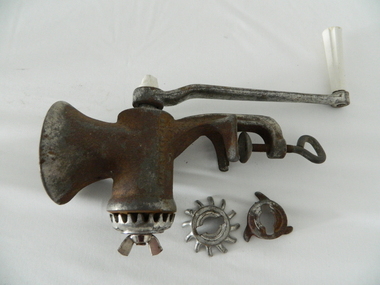
Mincer Meat, early to mid 1900's
... "BEATRICE No. 3" and "MADE IN ENGLAND", "P 3181"...It was a period before mass food processing factories were established and roads constructed up to the standard for distribution to semi remote regions such as Kiewa Valley was in the beginning of the 1900's. household cast iron appliances food processors "BEATRICE No. 3" and "MADE IN ENGLAND", "P 3181" This cast iron (malleable iron) mincer for meat products has a large "funnel" to direct "chunks" of meat to the grinding "wheels". ...This cast iron kitchen appliance was made in England in the early 1900's and shipped to the "colony" Australia. This was before World War II and the "growing up" of a colony to an independent member of "the British Commonwealth". It was a period when most appliances (be they household) where manufactured in England and shipped to Australian ports. It was not until the late 1960's that the Asian manufacturing giant woke up and started to dominate the market palce.This domestic kitchen appliance is very significant to the Kiewa Valley because it highlights the "made at home" period when food processing was made "in house" due to inability to source food from specialised shops e.g. the butcher or slaughter houses. It was a period before mass food processing factories were established and roads constructed up to the standard for distribution to semi remote regions such as Kiewa Valley was in the beginning of the 1900's.This cast iron (malleable iron) mincer for meat products has a large "funnel" to direct "chunks" of meat to the grinding "wheels". These "star" shaped wheels with "teeth" of three different cutting surfaces (fine, medium and coarse) provide for texture types of the final meat product. The meat is placed into the "loading" funnel and push downwards(gravity feed) through the mincing chamber and out through the front side. There is a long "screw worm" which is rotated by turning the handle. The appliance is table mounted by a vice "G" screw on clamp (hand operated). "BEATRICE No. 3" and "MADE IN ENGLAND", "P 3181"household cast iron appliances, food processors -
 Federation University Historical Collection
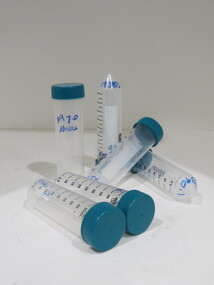
Scientifc Object, Edwards Instrument Company, Centrifuge Tubes, c2010
... The Edwards Instrument Company product number is 3181-345-008...The Edwards Instrument Company product number is 3181-345-008 Centrifuge Tubes Scientifc Object Edwards Instrument Company. ...These items were removed from the Mt Helen Campus S-Building before the refurbishment in September 2015.Polypropylene clear cylindrical containers with a pointed end and a polyethylene teal screw-top lid. On one side it has measurements from 5 to 45mL. The Edwards Instrument Company product number is 3181-345-008centrifuge tubes, science, scientific equipment, laboratory. -
 Melbourne Tram Museum
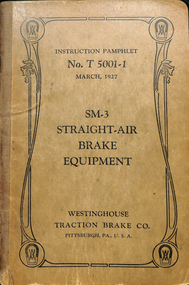
Document - Instruction, Westinghouse Traction Brake Co, "Westinghouse - T5001-1 SM3 Straight-Air Brake Equipment", Mar. 1927
... On inside cover "Bob Prentice 13 High Street Prahran Vic 3181" and on top of first page "W. Armstrong"...Trams tramways Electrical Engineering Electrical Equipment Westinghouse Air Compressors Brakes Instructions Maintenance On inside cover "Bob Prentice 13 High Street Prahran Vic 3181" and on top of first page "W. Armstrong" Instruction - 64 pages + light brown card cover centre stapled with cloth binding on outer edge + fold out drawing inside the rear cover, titled "Westinghouse - T5001-1 SM3 Straight-Air Brake Equipment". ...Instruction - 64 pages + light brown card cover centre stapled with cloth binding on outer edge + fold out drawing inside the rear cover, titled "Westinghouse - T5001-1 SM3 Straight-Air Brake Equipment". Dated March 1927. Has a table of contents, outlines the rules of operating brake equipment fitted to tramcars, the SM3 and PV brake valves, SX2 brake valve, locomotive straight air, installation piping, wiring, maintenance - piston travel, lubrication, car tests, hints to Motormen and Conductors and General Hints. Includes instructions on compressors, air intakes, valves, cylinders and governors.On inside cover "Bob Prentice 13 High Street Prahran Vic 3181" and on top of first page "W. Armstrong"trams, tramways, electrical engineering, electrical equipment, westinghouse, air compressors, brakes, instructions, maintenance -
 Melbourne Tram Museum
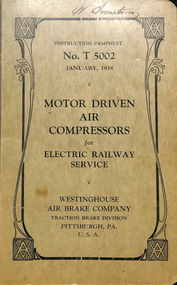
Document - Instruction, Westinghouse Air Brake Co, "Westinghouse - T5002 - Motor Driven Air Compressors for Electric Railway Service", Jan. 1938
... On inside cover "Bob Prentice 13 High Street Prahran Vic 3181" and on top of first page "W. Armstrong"...Trams tramways Electrical Engineering Electrical Equipment Westinghouse Air Compressors Instructions Maintenance On inside cover "Bob Prentice 13 High Street Prahran Vic 3181" and on top of first page "W. Armstrong" Instruction - 92 pages + light brown card cover centre stapled with cloth binding on outer edge, titled "Westinghouse - T5002 - Motor Driven Air Compressors for Electric Railway Service". ...Instruction - 92 pages + light brown card cover centre stapled with cloth binding on outer edge, titled "Westinghouse - T5002 - Motor Driven Air Compressors for Electric Railway Service". Dated January 1938". Has a table of contents, giving details for motor driven compressors, DH, D-EG, D-F, D-K, D-4-P, XQ-27, C. air strainers and installation. Includes instructions on compressors, air intakes, inspection and maintenance and disorders - causes and remedies.On inside cover "Bob Prentice 13 High Street Prahran Vic 3181" and on top of first page "W. Armstrong"trams, tramways, electrical engineering, electrical equipment, westinghouse, air compressors, instructions, maintenance -
 National Wool Museum
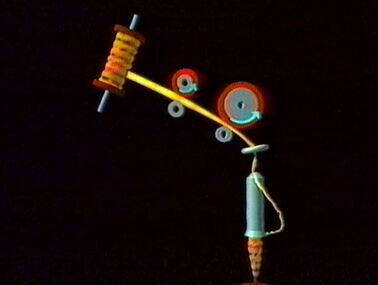
Film - Cap Spinning Machine, Les Gilbert, 1989
... Label on tape: VIDEO VISION / VHS / SPINNING / COMPILE / SOUND / DESIGN / STUDIO / LES GILBERT/DIRECTOR / 9A GARDEN STREET PRAHRAN / VICTORIA 3181 AUSTRALIA / TELEPHONE (03) 529 3086...Film wool processing factory mill cap spinning machine machinery industrial machines Label on tape: VIDEO VISION / VHS / SPINNING / COMPILE / SOUND / DESIGN / STUDIO / LES GILBERT/DIRECTOR / 9A GARDEN STREET PRAHRAN / VICTORIA 3181 AUSTRALIA / TELEPHONE (03) 529 3086 Black VHS tape with yellow and white stickers and hand written and printed text. ...Tape shows a short film depicting the operation of a cap spinning machine, interspersed with explanatory animated graphics. Probably used in previous displays at the National Wool Museum.Black VHS tape with yellow and white stickers and hand written and printed text. Tape is housed in a black plastic case. Film includes colour footage and audio. 00:04 - animated graphic of cap spinning machine 00:26 - cap spinning machine 06:04 - end Film loops until 01:03:57Label on tape: VIDEO VISION / VHS / SPINNING / COMPILE / SOUND / DESIGN / STUDIO / LES GILBERT/DIRECTOR / 9A GARDEN STREET PRAHRAN / VICTORIA 3181 AUSTRALIA / TELEPHONE (03) 529 3086film, wool processing, factory, mill, cap spinning machine, machinery, industrial machines -
 National Wool Museum
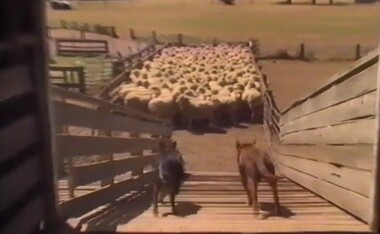
Film - Herding Sheep, Sound Design Studio, c.2000
... Label on tape: VIDEO VISION / VHS / NATIONAL WOOL MUSEUM / SHEEP DOG / COMPILE / SOUND / DESIGN / STUDIO / LES GILBERT/DIRECTOR / 9A GARDEN STREET PRAHRAN / VICTORIA 3181 AUSTRALIA / TELEPHONE (03) 529 3086...Film Sheep rural industries farm farming cattle dogs herding property farmer Label on tape: VIDEO VISION / VHS / NATIONAL WOOL MUSEUM / SHEEP DOG / COMPILE / SOUND / DESIGN / STUDIO / LES GILBERT/DIRECTOR / 9A GARDEN STREET PRAHRAN / VICTORIA 3181 AUSTRALIA / TELEPHONE (03) 529 3086 Black VHS tape with white stickers and hand written and printed text. ...Tape shows farmer working with cattle dogs to herd sheep on a property. Probably used in previous displays at the National Wool Museum.Black VHS tape with white stickers and hand written and printed text. Tape is housed in a black plastic case with stickers. Film includes colour footage and audio. 00:04 - Herding sheep on a property, featuring farmer, cattle dogs, sheep, motorbike and a horse. 04:49 - end Film loops four times.Label on tape: VIDEO VISION / VHS / NATIONAL WOOL MUSEUM / SHEEP DOG / COMPILE / SOUND / DESIGN / STUDIO / LES GILBERT/DIRECTOR / 9A GARDEN STREET PRAHRAN / VICTORIA 3181 AUSTRALIA / TELEPHONE (03) 529 3086film, sheep, rural industries, farm, farming, cattle dogs, herding, property, farmer -
 Jewish Museum of Australia
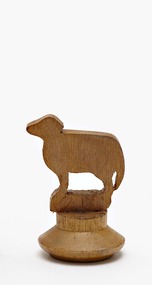
Chess set
... PATKIN Flat (printed 2 corrected in pen and ink 4) 313a Dandenong Road Windsor 3181 Victoria Australia Tel: Home 51 - 5671 Bus 63 - 8959"...PATKIN Flat (printed 2 corrected in pen and ink 4) 313a Dandenong Road Windsor 3181 Victoria Australia Tel: Home 51 - 5671 Bus 63 - 8959" Chess set ...This chess set was carved from local wood with bases made from halved cotton reels. The chess pieces take the shape of Australian animals, and Aboriginal men and women. The set was presented to Mr. Benzion Patkin, Honorary Secretary of the Zionist Federation of Australia, by Tatura internees in recognition of his assistance, in particular, his assistance in facilitating the emigration to Palestine. According to Mr. Patkin, he received the chess set in a wooden box inscribed, "With our sincerest thanks from your Zionist friends - Tatura, on the way to Eretz Israel, per Leonhard Levin, 20.11.1942.".Written in pencil UR corner, upside down: (22) Printed in black ink: "B. & H. PATKIN Flat (printed 2 corrected in pen and ink 4) 313a Dandenong Road Windsor 3181 Victoria Australia Tel: Home 51 - 5671 Bus 63 - 8959"dunera, wwii, internees, jewish history & people -
 Vision Australia
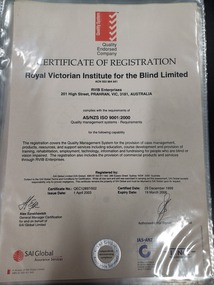
Certificate - Text, Certificate of Quality Assurance System registration, April 2003 : 201 High Street, 1 April 2003
... RVIB Enterprises, 201 High Street, Prahran, VIC 3181 Australia complies with the requirements of AS/NZS ISO 9001:2000 Quality Management Systems Requirements for the following capability: This registration covers the Quality Management System for the provision of case management, production, resources, and support services including education, course development and provision of training, rehabilitation, employment, technology, information and fundraising for people who are blind or vision impaired. ...RVIB Enterprises, 201 High Street, Prahran, VIC 3181 Australia complies with the requirements of AS/NZS ISO 9001:2000 Quality Management Systems Requirements for the following capability: This registration covers the Quality Management System for the provision of case management, production, resources, and support services including education, course development and provision of training, rehabilitation, employment, technology, information and fundraising for people who are blind or vision impaired. ...Certificate reads "Certificate of Registration. RVIB Enterprises, 201 High Street, Prahran, VIC 3181 Australia complies with the requirements of AS/NZS ISO 9001:2000 Quality Management Systems Requirements for the following capability: This registration covers the Quality Management System for the provision of case management, production, resources, and support services including education, course development and provision of training, rehabilitation, employment, technology, information and fundraising for people who are blind or vision impaired. The registration also includes the provision of commercial products and services through RVIB Enterprises." Signed: Alex Ezrakhovich, General Manager Certification. Certificate #: QEC12897/002. Issue Date: 1st April 2003. Certified Date: 29th December 1999. Expiry Date 19th March 2006.1 certificate with black writingroyal victorian institute for the blind, registration -
 Melbourne Legacy
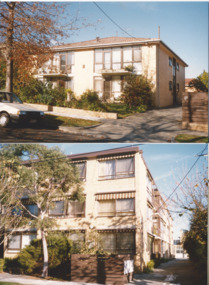
Photograph, Widows' Flats, c.1989
... The other has 'Pic 4 / Miriam and Frederick Ramsey Lodge / 9 The Avenue Windsor 3181' in black pen. Yellow paper label was a note from Terry to Susie listing photos of widows flats in Hawthorn, Windsor and Clubrooms but only the Hawthorn and Windsor flat photos are attached....The other has 'Pic 4 / Miriam and Frederick Ramsey Lodge / 9 The Avenue Windsor 3181' in black pen. Yellow paper label was a note from Terry to Susie listing photos of widows flats in Hawthorn, Windsor and Clubrooms but only the Hawthorn and Windsor flat photos are attached. ...A photo of a block of flats in Sellwood St Hawthorn (top photo) and a block at 9 The Avenue, Windsor (bottom photo) that Legacy owned and leased at reasonable rates to widows in their care. It was with a group of photos from 1988 to 1990 in a folio with paper labels (see items 01042 to 01053). The September 1975 edition the widows newsletter mentions the 20 flats purchased by Legacy at 9 The Avenue and they are being renovated for widows to live in. Two options were presented, an 'ingoing' amount of $5,000 then a week maintenance charge of $7 a week; or on a rental basis of approximately $20 a week. A photo of the Windsor units in 1976 is at 01412. This photo of the Windsor flats was taken after 1981 when sun blinds were added to the building (from a Highlights of President report in 1981). The group of flats was known as 'Windsor Lodge' until 1987 when it was renamed 'The Miriam and Frederick James Ramsay Lodge'. From copies of the Title Deeds; 9 The Avenue Windsor was purchased on 7 February 1975, and 22 Selwood St Hawthorn was purchased on 28 June 1974. It was decided the Windsor units, and the ones in Hawthorn, would be sold in 2003 and announced by President Tony Parkes. The decision was published in Leader newspapers and Jellis Craig approached Legacy about the sale, see items at 01089.A record of Legacy supporting widows throughout their lives.Colour photo x 2 of widows' flats in Hawthorn and Windsor.Handwritten on back "Hawthorn Court / 22 Selwood St / Hawthorn East 3123". The other has 'Pic 4 / Miriam and Frederick Ramsey Lodge / 9 The Avenue Windsor 3181' in black pen. Yellow paper label was a note from Terry to Susie listing photos of widows flats in Hawthorn, Windsor and Clubrooms but only the Hawthorn and Windsor flat photos are attached.widows, properties -
 Vision Australia
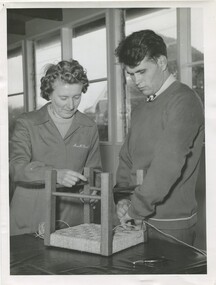
Photograph - Image, Alex Momot, 1962
... No 1. 3" wide all in, full depth, Hayer top + Bottom, 3178, 45, 16B. 12 - 3181...No 1. 3" wide all in, full depth, Hayer top + Bottom, 3178, 45, 16B. 12 - 3181 12 b/w photographs of Alex Mamot Alex Momot Photograph Image ...Alex Mamot was a White Russian immigrant from China, sponsored by the Association of the Blind. Despite initial language barriers, his determination to succeed was an inspiration to those around him, who developed new ways of teaching which took into account his growing knowledge of English. In these images Alex Momot is showing with a Russian typewriter, being shown how to make stools by Mollie McDowell, feeling texture of a new suit held up by Matron Agar, being taught English by Carole Laird, learning the alphabet with H. Mackenzie and greeted at Brighton reception by Ms A. Mann. In addition, there are two typed notes without images: - The ship Tjiluwak, carrying Alexander Momot and other White Russian refugees approaching the wharf in Melbourne. - On the wharf, Alex 2nd from left, is greeted by Mrs W Christian (left) a blind Committee member of the Association for the Blind and Miss Constance Duncan of the Australian Council of Churches. At the right is Sergie Bankovski, also a blind White Russian who acted as interpreter. Miss Duncan also initiated the move which resulted in the Association for the Blind giving refuge to Sergie and his mother. Standing at the rear is Major General S.F. Legge, Director of Public Relations for the Association of the Blind.12 b/w photographs of Alex Mamot1 - No 4, 3" wide all in full depth, Hayer top + Bottom, #85, 3178 3 - P14. Reduce to 3" wide. Hayer top + Bottom, #85. 3178 4 - Volunteer Carole Opperman teaches English to White Russian refugee Alex Momot, who has been sponsored by the Association for the Blind. 2/8 9 - Celine Mann & Alex Mamot at point of arrival. No 1. 3" wide all in, full depth, Hayer top + Bottom, 3178, 45, 16B. 12 - 3181association for the blind, elanora home (brighton), alex mamot -
 Vision Australia
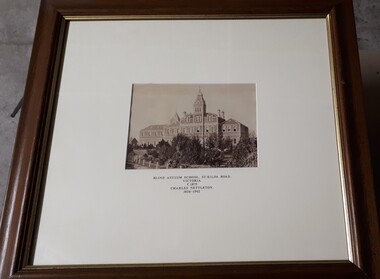
Photograph - Image, Charles Nettleton, Blind Asylum School, St Kilda Road, circa 1875
... Blind Asylum School, St Kilda Road Victoria c. 1875 Charles Nettleton 1826-1902 Spencer Scott Sandilands 546 High Street, East Preson, 3181 Melbourne, Victoria, Australia, Tel: (03) 529 8011 Fax: (03) 521 1754 33 George Street, The Rocks, 2000 Sydney, New South Wales, Australia, Tel: (02) 241 4251 Fax: (02) 2414535 Rare Prints, Antiquarian Books, Old Maps, Australiana, Antiques, Photographs, Framing c.1875 Charles Nettleton School from the Blind Original Photograph $65 Guaranteed over 100 years old...Royal Victorian Institute for the Blind Buildings Blind Asylum School, St Kilda Road Victoria c. 1875 Charles Nettleton 1826-1902 Spencer Scott Sandilands 546 High Street, East Preson, 3181 Melbourne, Victoria, Australia, Tel: (03) 529 8011 Fax: (03) 521 1754 33 George Street, The Rocks, 2000 Sydney, New South Wales, Australia, Tel: (02) 241 4251 Fax: (02) 2414535 Rare Prints, Antiquarian Books, Old Maps, Australiana, Antiques, Photographs, Framing c.1875 Charles Nettleton School from the Blind Original Photograph $65 Guaranteed over 100 years old 2 black and white images of the Guiding Light at Elanora Blind Asylum School, St Kilda Road Photograph Image Charles Nettleton ...Unsubstantiated photograph of the Asylum for the Blind in 1875. The four storey bluestone building rises above a group of trees planted in the garden. A picket and wire/string fence border the unpaved circular driveway. 2 black and white images of the Guiding Light at Elanora Blind Asylum School, St Kilda Road Victoria c. 1875 Charles Nettleton 1826-1902 Spencer Scott Sandilands 546 High Street, East Preson, 3181 Melbourne, Victoria, Australia, Tel: (03) 529 8011 Fax: (03) 521 1754 33 George Street, The Rocks, 2000 Sydney, New South Wales, Australia, Tel: (02) 241 4251 Fax: (02) 2414535 Rare Prints, Antiquarian Books, Old Maps, Australiana, Antiques, Photographs, Framing c.1875 Charles Nettleton School from the Blind Original Photograph $65 Guaranteed over 100 years oldroyal victorian institute for the blind, buildings -
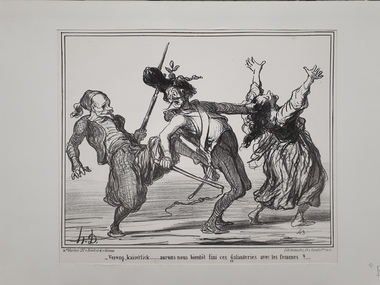 Bass Coast Shire Council - Robert Smith Collection
Artwork, other - 3181 Voyons, kaiserlick, Honore Daumier
... 3181 Voyons, kaiserlick ......French 1808 - 1879 Initialled l.l in stone Lithograph Honore Daumier Artwork, other 3181 Voyons, kaiserlick ... ...French 1808 - 1879LithographInitialled l.l in stone
