
Showing 85 items matching "norman brothers"
-
 Moorabbin Air Museum
Book - HANDLING THE BIG JETS, DAVID DAVIES, 1967
... ...NORMAN BROTHERS LIMITED...HANDLING THE BIG JETS Book HANDLING THE BIG JETS DAVID DAVIES BRABAZON HOUSE NORMAN BROTHERS LIMITED ... -
 Bendigo Historical Society Inc.
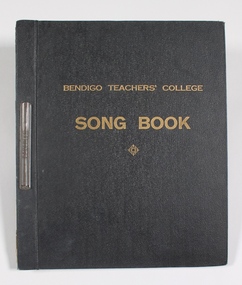
Book - Dorothy Comer Collection: Bendigo Teachers' Collage Song Book, 1910s
... ...Norman Brothers...Bendigo Teachers College Song Book Norman Brothers Dorothy Comer A black binder holding 45 sheets of cream coloured Paper with black printing. ...Bendigo Teacher's College, along with the Ballarat Teacher's College were the first non-metropolitan teacher colleges. The Bendigo College was established in 1926 and operated out of the Long Gully Primary School. During the depression, from 1930 to 1945 the college closed because of the economic climate. The college reopened in 1945 in temporary accommodation adjacent to the Camp Hill Primary School. In 1959 the college moved into purpose built premises in Osbourne St., Flora Hill where it remained until closing in 1973.A black binder holding 45 sheets of cream coloured Paper with black printing. The cover has gold printing - BENDIGO TEACHERS COLLEGE SONG BOOK. Inside there is an alphabetical Index. a table of contents and 42 sheets with one song on each side. Inside the front cover handwritten in blue ink- Dorothy Comer and printed in red No 0210H NORMAN DROS. 60-62 ELIZABETH St. MELBOURNE bendigo teachers college, song book, norman brothers, dorothy comer -
Lara RSL Sub Branch
Minute Book, Lara RSL Minute Book, 1988
... On Cover Norman Brothers Series 3 Inside Cover Minute Book 12/9/1988 to 12/12/94...Used to record minutes at the Lara RSL Sub Branch Used to record minutes at the Lara RSL Sub Branch Lara RSL Sub Branch RSL Minute Book 12th September 1988 On Cover Norman Brothers Series 3 Inside Cover Minute Book 12/9/1988 to 12/12/94 Minute Book Lara RSL Minute Book Minute Book ...Used to record minutes at the Lara RSL Sub BranchUsed to record minutes at the Lara RSL Sub BranchMinute BookOn Cover Norman Brothers Series 3 Inside Cover Minute Book 12/9/1988 to 12/12/94lara rsl sub branch, rsl, minute book, 12th september 1988 -
Ithacan Historical Society
Administrative record, IPS Minute Book, 7 November 1972 - 1985
... The inside covers are covered with plain light blue paper and a dark blue reinforcement pasted and stitched on the inner spine with details of Norman Brothers' products printed on the inner cover and fly leaf. ...The inside covers are covered with plain light blue paper and a dark blue reinforcement pasted and stitched on the inner spine with details of Norman Brothers' products printed on the inner cover and fly leaf. ...The minute book is a record of the activities of the Ithacan Philanthropic Society from November 1972 to 1985. The minutes are written in Greek.The minutes of meetings contained in the minute books document the decisions and the status and direction of the society during those years.A foolscap size bound book with a tan suede leather binding on the spine and corners with a green cloth cover and a white sticker on the front with the number '86' written in purple. A red label with 'Minute Book' is on the spine. The inside covers are covered with plain light blue paper and a dark blue reinforcement pasted and stitched on the inner spine with details of Norman Brothers' products printed on the inner cover and fly leaf. minute books, ithacan philanthropic society, meetings, decisions -
Clunes Museum
Postcard - POST CARD, 1917
... FEB. 24,1917 FRANCE TO MY DEAR SISTER WITH LOVE FROM BROTHER NORMAN. XXXXXX...LOCAL HISTORY DOCUMENT POST CARD W.W.1 MEMORABILIA FEB. 24,1917 FRANCE TO MY DEAR SISTER WITH LOVE FROM BROTHER NORMAN. XXXXXX POST CARD WITH EMBROIDERED FABRIC INSERT WAS SEND FROM NORMAN THOMAS DURING W.W.1 FROM FRANCE TO HIS SISTER HANNAH Postcard POST CARD ...POST CARD WITH EMBROIDERED FABRIC INSERT WAS SEND FROM NORMAN THOMAS DURING W.W.1 FROM FRANCE TO HIS SISTER HANNAHFEB. 24,1917 FRANCE TO MY DEAR SISTER WITH LOVE FROM BROTHER NORMAN. XXXXXXlocal history, document, post card, w.w.1 memorabilia -
Glen Eira Historical Society
Document - Rosenbaum, Yankel
... The article also describes the effects of Norman Rosenbaum, Yankel’s brother and a corporation lawyer in Melbourne to Islam justice in this matter....The article also describes the effects of Norman Rosenbaum, Yankel’s brother and a corporation lawyer in Melbourne to Islam justice in this matter. ...This file contains an article in the Good Weekend supplement dated 28/12/91, date hand written, concerning the circumstances surrounding the death of Yankel Rosenbaum in Ney York during August 1991. Yankel, who was a resident of Caulfield who lived with his parents Maxwell and Fay, was studying at the time of his death in New York. The article also describes the effects of Norman Rosenbaum, Yankel’s brother and a corporation lawyer in Melbourne to Islam justice in this matter.rosenbaum yankel, rosenbaum norman, rosenbaum maxwell, rosenbaum fay, caulfield -
 Rutherglen Historical Society
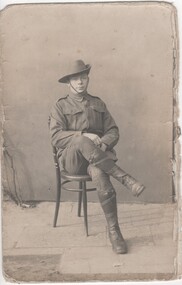
Photograph - Image, R. Cuilleremot, Boespflug et Cie, 1914-1918
... He is the older brother of Norman Hooke who was KIA in France 1916. ...He is the older brother of Norman Hooke who was KIA in France 1916. ...Soldier has been identified as PTE Alan George William Hooke (11513). Alan was a Baker by trade. His father was William Hugh Hooke and his mother was Margaret Holloway Hooke. Alan was born in Rutherglen in 1893 and died in Melbourne in 1978. He is the older brother of Norman Hooke who was KIA in France 1916. Alan belonged to 3rd Field Bakery Unit, AIF.Black and white portrait photograph, on a postcard, of Alan George Hooke in AIF uniformWritten on back: "Alan"world war 1, world war i, alan hooke -
 City of Moorabbin Historical Society (Operating the Box Cottage Museum)
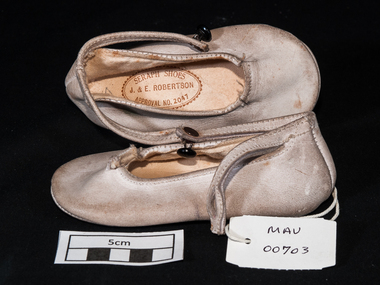
Clothing, Child's cream 'Seraph Shoes', c1928
... Badorf Shoe Company, Inc. was started in Lititz, PA, by brothers Norman and Paul Badorf. The company was owned and operated by the Badorf family for nearly 40 years until its purchase by Ura Gingerich in 1967. ...Badorf Shoe Company, Inc. was started in Lititz, PA, by brothers Norman and Paul Badorf. The company was owned and operated by the Badorf family for nearly 40 years until its purchase by Ura Gingerich in 1967. ...‘Seraph Shoes’ possibly manufactured by the Badorf Shoe Company Inc. Pensylvania USA Badorf Shoe Company, Inc. has been producing and distributing the finest children’s footwear brands since 1928. Badorf Shoe Company, Inc. was started in Lititz, PA, by brothers Norman and Paul Badorf. The company was owned and operated by the Badorf family for nearly 40 years until its purchase by Ura Gingerich in 1967. Forty six years later, the family tradition has continued and the company is now operated by Ura’s son Duane Gingerich and grandsons, Justin and Brandon Gingerich. A pair of child's cream leather shoes.SERAPH SHOES / J.E. ROBERTSON / APPROVAL No. 2047boots, shoes, footwear, bootmakers, leatherworkers, early settlers, pioneers, market gardeners, moorabbin, bentleigh, cheltemham -
 Mentone Grammar School
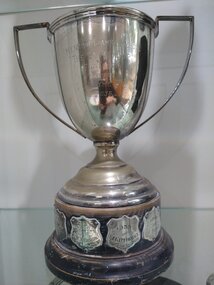
The Syme Cup for Tennis, 1937
... When Cecil’s brother Norman died in 1927, he left a wife and a six-year-old son, Leslie. ...When Cecil’s brother Norman died in 1927, he left a wife and a six-year-old son, Leslie. ...Cecil F. Syme was a 1930s Melbourne-based explorer and prospector. He was a son of David Syme, founder of The Age Newspaper, Melbourne. When Cecil’s brother Norman died in 1927, he left a wife and a six-year-old son, Leslie. Records suggest Cecil paid for his nephew, Leslie, to attend Mentone Grammar from 1936 – and that he donated the Syme Cup the following year. It was first awarded to Keith Goode. After leaving school, Leslie Syme enlisted with the Australian Navy. In I942, during World War II, he was killed when his warship, the HMAS Yarra, came under intense enemy fire. He was 21. Leslie Syme is remembered in our Avenue of Honour.Silver Cup on wood base -
 Bendigo Military Museum
Postcard - POSTCARDS WW1, c.1914
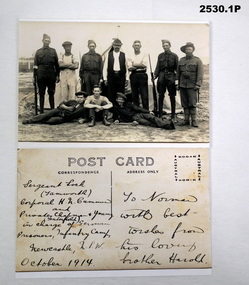
... Refer 2535P re his brother Alexander Norman. The photo obviously refers to his previous service as the photo is dated “Oct 1914”. ....1) Photo of 4 armed Australian Soldiers with 6 civilians, verso postcard has hand written description. .2) Generic postcard from Egypt to a brother, verso letter from Harold to Norman. .3) Photo of 2 WWI German Servicemen with no headgear, verso addressed to a German lady - see Inscriptions & Markings. ...Address: To Norman with best wishes from his loving brother Harold. .2) Dated 5.10.1917 Dear Norman, .... 17 lines .... ...Address: To Norman with best wishes from his loving brother Harold. .2) Dated 5.10.1917 Dear Norman, .... 17 lines .... ....1) H.N.Cummin. Harold Nesbit Cummin had prior Military service (unclear) to joining the AIF. No 1239 he enlisted on 17.8.1915 in the 6th reinforcements to the 11th Light Horse Regt age 20 years. Embark for Egypt 27.10.1915, hospital 3.1.1916 with Bronvhitis, rejoin unit 15.1.1916, over some 7 months from 4.4.1916 he transfers 4 times until 2.11.1916 and listed as 4th Australian Camel Regt, by 16.2.1917 he is classed as being with 11th Coy 3rd Anzac Batt 1st Camel Brigade, WIA 1.12.1917 GSW’s, DOW’s at 2nd L.H.Brigade Field Ambulance 1.12.1917 in Jaffa. Refer 2535P re his brother Alexander Norman. The photo obviously refers to his previous service as the photo is dated “Oct 1914”. The Germans are possibly people interned after outbreak of the war. .1) Photo of 4 armed Australian Soldiers with 6 civilians, verso postcard has hand written description. .2) Generic postcard from Egypt to a brother, verso letter from Harold to Norman. .3) Photo of 2 WWI German Servicemen with no headgear, verso addressed to a German lady - see Inscriptions & Markings. .1) SGT LOCK (Tamworth), CPL H N CUMMIN & PTES CHAPMAN & YOUNG (Tenterfield) in charge of German prisoners, Infantry Camp, Newcastle, NSW, October 1914. Address: To Norman with best wishes from his loving brother Harold. .2) Dated 5.10.1917 Dear Norman, .... 17 lines .... Your loving brother Harold. .3) To Frau A Muxfeldt Niendorf (Kr Tinneberg) Gaustedterueg No 19, Gesebrieben d 18 Juli 1918. Absender Hugu Muxfeldt No 252 15 Prisoner of War Coy France C/o GPO London Englandpostcards, photographs, 38th -
 Uniting Church Archives - Synod of Victoria
Colour photo, Prior to 1977
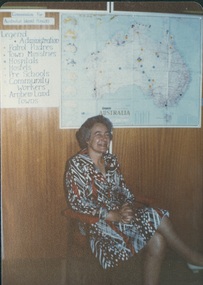
... She was the eldest of four children with three brothers, Jock, Norman and Rod. After Year 10, Frances took a job in Camperdown as a dental nurse. ...She was the eldest of four children with three brothers, Jock, Norman and Rod. After Year 10, Frances took a job in Camperdown as a dental nurse. ...Everyone seemed to know Frances – it was November 1985 – I met Frances at the Victorian Synod office as she lent me her office to interview staff for St Philip’s which I was taking over in 1986. The interviews completed, she took me to a nearby coffee shop where we had a delightful chat. I came away much the richer, more informed about St Philip’s and feeling I had known Frances forever. And so started our 23 year friendship, with me hearing the first of many stories – for Frances was a wonderfully gifted story teller with a capacity to turn the past into life, and its characters into real people. It seems fitting that a person destined to add to Australia’s history should be born down the beach from Mendonca’s Mahogany ship – Port Fairy on the 28 January 1924. There she went to school – first to primary school then to Camperdown’s Higher Elementary School which went to Year 10. She was the eldest of four children with three brothers, Jock, Norman and Rod. After Year 10, Frances took a job in Camperdown as a dental nurse. She tackled this successfully until deciding to study at Rolland House in Carlton to become a Deaconess. Jock, her brother, recalls asking Frances what made her decide to be a Deaconess. At a Presbyterian Fellowship camp at Warrnambool, Frances and the others were sleeping in the Church Hall on palliases. During the night she awoke and her eye was drawn to a stained glass window, unusually brightly lit. On the window were the words “Follow Me”. Without flinching Frances took the words to heart and decided to serve God as a Deaconess, and during her time with the Australian Inland Mission she became quite a legend. What a patriot Frances was! She loved the stories of pioneers and knew well the history of where she had come from – the Western District. A keen follower of cricket, she would be right up with the last test and the issues of the team. Originally a Melbourne football supporter, she became an avid Geelong supporter and would often score at the annual self destruct St Philip’s vs Flynn Church match. She loved the gladiatorial, albeit often suicidal display. And though an Aussie through and through she loved her Scottish roots. Through her stories, she could easily transport a person in the Centralian landscape onto the heather of the Highlands. In spite of her love for Scotland, the city which was her favourite was New York. Frances – truly a citizen of the world. As a citizen of the world Frances fought for Indigenous and migrant women’s rights and was active in the World Council of Churches, sponsoring local and overseas women to study in Australia and to return to their homes as trained teachers and theologians. Up until recently she was involved in the Spina Bifida and Hydro Cephalis Association of SA. By the time she had taken up with the AIM Frances had a well tuned desire for social justice. To her it was important that the poor and less fortunate were given a go. She felt that the Labor Party provided her best avenue to push her social justice desires. After joining the party in 1956, she quickly became a respected member of the party and worked tirelessly for it, being honoured in the end with life membership. In the party she knew everyone and everyone knew her. She introduced me to Bob Hawke and when I spoke to Gough Whitlam once on a plane, he affirmed to me his friendship with Frances. In her cottage was a picture of her with Kevin Rudd with his arm around her. She is remembered by her party colleagues as someone who had a real compassion for helping people. She believed in the traditional ethic of the Labor Party which is to help those who are less fortunate. Interestingly, she supported St Philip’s moving from solely being a residential college to a school because we had chosen a relatively low fee base to enable maximum access for people and our boarding house continued to, and still does, offer accommodation to any student wishing to attend schools in Alice. Having supported the outback for years from the engine rooms of the mission arm of the church in Victoria, Frances then decided to move to Alice for her retirement. Settling in the little cottage at the far south eastern corner of Old Timers, this became to me, my family and I’m sure to plenty of people, Frances’ Cottage. But moving to Alice was hardly moving into retirement. She quickly became Chaplain at St Philip’s where she clearly showed her love for the children and staff and a real belief in St Philip’s role – to provide access to education for isolated children. She became a stalwart of the Adelaide House Museum, a wonderful member of the congregation, a powerful contributor to the Presbytery and the Annual Synod. Frances was strong, never flinched on a point of principle and discussed things face to face so that you truly knew where you stood with her. She had a great feeling for the pastoralists and knew many of them well. As Chaplain of the College she related well to the children and in addition, knew many of their families. She also felt deeply for the Indigenous people and regularly tackled the issue of how conditions could be improved for them. As we developed the school at St Philip’s, Frances worked with me on so many things. She would visit the College each week for Chapel, run a Sunday school for little kids and the service for all the boarders. When the school was ready to start she wrote the College prayer, said now every week by all students. The prayer says so much about Frances. She pioneered the RE program, teaching RE and in addition to Sunday, visited staff and students every Wednesday. At Presentation Night she presented a homily and provided the blessing – always a strong presence in front of the College community. She was so much part of St Philip’s that when we built the new boarding house in 1990 it seemed so obvious to call it McKechnie House. As a faithful servant of Adelaide House for years and an enthusiastic member of the National Trust, Frances was the first chairperson of the committee, a driving force to redevelop Adelaide House and she worked tirelessly to present John Flynn’s Hospital in the best light. She helped to deliver the stories of Flynn and McKay and the Outback missionaries to so many people and was instrumental in producing meaningful displays. I enjoyed walking around the museum with her intensely, enjoying her detailed stories of the past missionary era and I know many others would have as well. As a loyal and loving member of the Flynn Church, and being such a comrade of Fred McKay’s, Frances understood intricately the symbols which lie within the architecture. Once again, as a story teller, each one had a yarn attached to it. Over her twenty-three years as a member of the Flynn Church she has made a wonderful contribution. As a charismatic personality people were naturally attracted to Frances and were touched and affected by her. Peter Robson, twenty-two years at St Philip’s, remembers her asking him why he had stayed so long at the College. He explained to her that it was her address one day in Chapel in the early times that inspired him to keep going. With great wisdom she had said, “You can’t conquer something, unless you allow it to conquer you.” St Philip’s had conquered him. Wherever she went, whomever she was with, she had a real and lasting impact. Frances brought the reality of the Outback to so many as she addressed congregations around Victoria. She started the Australian Church Women’s Fellowship in the Northern Territory in 1997. She was also involved in setting up the Institute for Aboriginal Development. I believe that Frances should have been recognised nationally for her work with an AM. However, she was the Northern Territory finalist in the Senior Australian of the Year Awards in 2003. In 2004 she was awarded an OBE – not from the Queen but at Old Timers. This is a coveted award which means “Over Bloody Eighty”. Frances was part of it all, in the river, at a bush dance, at a dinner, at a service, at a party, at a meeting, at a footy game, at a cricket game, at Synod, at Presbytery, at Labour meetings, I could go on. Frances McKechnie, what a wonderful Australian. (Eulogy by Chris Tudor) Frances McKechnie died mid-2008. Deaconess Frances McKechnie is seated in front of a map of Australia marked with Australian Inland Mission places identified.At the time the photo was taken, McKechnie was the Victorian Regional Officer for the Australian Inland Mission (Presbyterian). At one stage, she worked for National Mission Frontier Services from 1968 to 1986. See below for the eulogy at her funeral by Chris Tudor. (Frances died May or June 2008.)deaconess frances mckechnie; australian inland mission; presbyterian church -
 Ballarat Base Hospital Trained Nurses League
Priscilla Wardle - Trainee Ballarat District Hospital, 27/02/1905 to 01/03/1908 and WW1 Nurse. Also Edith Popplewell & Lily MacKenzie
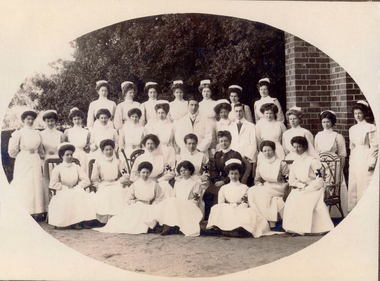
... Poppy is at age 33 years of age in this photograph.Bobbie is Priscilla’s brother Robert Norman “Bobbie” Wardle (1895-1979). ...Poppy is at age 33 years of age in this photograph.Bobbie is Priscilla’s brother Robert Norman “Bobbie” Wardle (1895-1979). ...No 1: Matron Eagleton with Nursing Staff, Ballarat & District Hospital. Priscilla Wardle, far right - trainee nurse 1905-1908. No 2: This could be a group of trainee nurses at Ballarat Hospital. Circa 1906/1907. The nurses with the grey looking sleeves in this black and white photograph may be wearing the lilac uniform of Trainee nurses. The sitting nurse on the far right may already be qualified because she appears to be wearing the white of a trained nurse. Sitting in the middle with the cheeky grin could be Priscilla and the standing nurse on the far left could be Edith Popplewell. No 3: This photograph is labelled 1907 and Priscilla would have just commenced her training. She appears to be “fanning” a female patient presumably to cool her down. This could be upstairs in the Queen Victoria’s Women’s Ward. Priscilla graduated as a nurse in 1908. In this photograph Priscilla was at age 23 years. No 5: Sheila Kelly (left) and Priscilla Wardle. This photograph is labelled 1909 and shows Priscilla in an all white uniform indicating she has qualified as a nurse. Sheila Kelly appears to have darker sleeves/blouse (lilac) and may still be a trainee. No 6: There is a very good chance that this photograph is Edith Popplewell, standing left, Lily MacKenzie , standing on the right and Priscilla seated. Writing in her album is very hard to read but it appears to be “Pop McK & I”. The arm bands with the St John Cross denote they are “charge nurses” maybe in charge of a ward. Taking all this into account the photograph could be circa 1909/1910. No 8 & 9: Priscilla painting what appears to be a gate while wearing her nurse uniform. She has a big grin on her face. Together with Lily MacKenzie they were the principals in the Mount Stuart Private Hospital at 18 Duke Street. Daylesford. This property is now known as Mount Stuart House. Priscilla appears to be on Central Spring Road with the Daylesford Post Office in the background. Photograph 9 is labelled 1914 which would make it near the end of their tenancy between 1911 and 1914. No 10: This photograph raises some questions. Priscilla appears to have darker sleeves /blouse (lilac) which may indicate she is still a trainee however Priscilla is also wearing a “charge nurse” arm band. While my research shows trainee nurses can be a “charge nurse” this is not common practise. The scene appears to be at the door of a house/home. I am not sure if the children’s ward/orphanage at the Ballarat Hospital at this time was in such a building. It could be that it is at the Mount Stuart Hospital but this would mean Priscilla and Lily have duplicated the wearing of the “charge nurse” arm band. The St John’s logo looks different too. Priscilla Isabel “Pearl” Wardle (1884-1967). The armband indicates Priscilla is a Charge Nurse at the Ballarat Hospital. Nothing else known. No 11: Mary & I at Mount Stuart – House Daylesford – This is probably the nursery at the Mount Stuart House Private Hospital being run by Priscilla Isabel “Pearl” Wardle (1884 – 1967) and Selina Lily (Lil) MacKenzie or McKenzie (1882 – 1975) between 1910 and 1914. Mary is certainly Mary Young MacKenzie or McKenzie (1865- 1942) Lily’s stepsister who trained at Ballarat Hospital as “Mary Young “at the same time as Priscilla and Lily. Mount Stuart House still stands at 18 Duke Street Daylesford. Photo date 1912. No 12: Priscilla wearing her distinctive Queen Alexandra’s Imperial Military Nursing Service Reserve cape and badge. Possibly while nursing in London for a month in 1919 after the war. No 12A: Priscilla Wardle - WW1 Diary, OCR enabled. No 13: Priscilla and friends at No. 7 General Hospital, Malassises, Saint Omer, France in July 1915 The old monastery being used as a hospital can be seen in the background. The tents are the nurses quarters. This photograph may have been taken at the same time as the group photograph on page 250 of the diary transcription. Priscilla is thought to be the nurse at the centre in the QAIMNSR uniform. The nurses quarters at the No 7 General Hospital in Saint Omer in France where Priscilla worked for most of the first year of her Diary. Their Monastery (Hospital) at Malassises can be seen in the background. No 15: Priscilla is an Acting Sister working at the 2nd General Hospital for Officers in Havre, France, between March and July 1918. The nurses were enjoying their “tea party”. (see also page 253 of the Diary transcription) No 17: Priscilla at Havre - at 2nd General Hospital (Officers Hospital) in Havre., France Friday 29 March 1918 to Monday 29 July 1918 note the two dark bands on her right sleeve denoting that she is an “Acting Sister”. Priscilla is 34 years of age in this picture and in the three weeks prior to this posting she met Cyril Terence Charles Kirby (1892-1968) her future husband at the 42nd Stationary Hospital in Flixecourt while he was serving with the British Army during the battle and evacuation of Amiens. No 18: Priscilla Wardle at No 8 Stationary Hospital Wimereux, France - from Saturday 24 June 1916 to Tuesday 18 September 1917, Priscilla worked at this hospital for 15 months her longest time in one hospital. during the war. While at Wimereux on Sunday 1 July 1917 she was appointed an Acting Sister. Priscilla once said she disliked nursing in her cape and badges and here she is in her favourite “uniform” for work “the robe” as she called it. She may be leaving the “operating theatre” at Wimereux in this photograph. No 19: Priscilla worked in various operating theatres throughout France. This could be after she became an anaesthetist in 1918 and worked with this team. She is wearing her favourite uniform which is more comfortable. She did not like the collars and capes that were required to be worn. No 20: Priscilla and Sister Michael Meeke? (details not found) are having a quiet drink at the 2nd General Hospital for Officers in Havre, France. Note the dark bands on their sleeves denote their rank as nursing “Sisters”. While it looks like they are smoking look more closely they are in fact holding a “flute” style probably “cocktail” glass. Tea parties and cocktails, Havre could almost have been fun. No 22: 1913 – Ballarat nurse Priscilla Isabell “Pearl” Wardle (1884-1967) in Cannes on the French Riviera during leave from between Friday 20 February 1918 and Friday 6 March 1918.Priscilla is second from the left wearing her distinctive QAIMNSR cape of grey with dark “wine” coloured border. The other nurses are wearing their “travelling” army uniform. They were rudely called “Salvation Army Lassies” by American nurses for the way they were dressed. (see page 232 of Priscilla’s War Diary) The description of 1913 on this photograph is confusing. No 23: Priscilla with her best friend Edith Victoria Donaldson somewhere in the “mysterious far east” on their trip on the Orontes. Priscilla is second from left - this may have been taken at Durban during Priscilla's return to Australia in 1919. No 25: Priscilla Wardle, Ballarat nurse in her Queen Alexandra’s Imperial Military Nursing Service Reserve (QAIMNSR) uniform. Notice the distinctive grey cape with “wine coloured” border Priscilla is also wearing her QAIMNSR qualification badge (medal) on the right side. Because she has no dark (wine coloured) bands on her sleeves so this photograph may be before 1 July 1918. No 26: Priscilla met her husband to be English army Lieutenant Cyril Terrence Charles Kirby during the battle and subsequent evacuation of Amiens in France. As an army nursing “Sister” Priscilla also held the rank of Lieutenant. Priscilla was stationed at the 42nd Stationary Hospital between 7/3/18 and 23/3/18. She had just completed a fortnight break at Cannes on the French Riviera. They were married at Priscilla’s home “Waverley" at 215 Dawson Street Ballarat on Saturday 15 November 1919. Nov 15, 1919 – Mr and Mrs Kirby. The bride Priscilla Isabell “Pearl” Kirby (nee Wardle) (1884-1967) and the groom Cyril Terence Charles Kirby (1892– 1968) on their wedding day. Priscilla was 34 years of age and Cyril 27 years of age however their marriage certificate states that they were both 34 years of age. Their marriage certificate states they were married at Waverley, Dawson St, South, Ballarat in a Presbyterian service conducted by the Rev. John Walker, a Minister of the Presbyterian Church of Australia and the Moderator General of the Church we think for Victoria. Was it in an outdoor setting as the surrounds in this photograph seem to indicate. Their witnesses were Robert and Olive, Priscilla’s brother and sister. Cyril signed as C. Terence. C. Kirby and Priscila signed as Priscilla I. Wardle. The certificate lists Cyril (Terence) as a Bachelor, Born at sea on a British ship and his occupation as Sailor. His father interestingly is listed as Charles John Kirby, of independent means and his mother as Emily Newman. Priscilla is listed as a Spinster, born in Ballarat with occupation as a Nurse. Her father is listed as Henry Thomas Wardle, Timber Merchant and her mother as Isabella Allan. They are both resident at 215 Dawson St. Ballarat which was Waverley the Wardle family home. No 28: Reverse in Poppy’s handwriting: “Lovingly yours Poppy, Dec 1908” Taken the year after Poppy qualified at BBH. No 29: Reverse in Poppy’s handwriting: “With much love to you Cilla, Poppy 1915” This picture was taken in the same year as the Marquette sinking incident. Edith Catheina Popplewell RRC (1884-1972) in her New Zealand Army Nursing Service (NZANS) Uniform. Poppy is at age 29 years in this photograph. Poppy was awarded the Royal Red Cross (RRC) medal for her heroism during the sinking of the Marquette transport ship. She lost her best friend NZ nurse Lorna Ratray. No 30: Taken in Cairo. Poppy is in the centre and wearing her New Zealand army badge and cape. The two nurses on either side are Australian nurses probably wearing their unique silver Australian Army sunrise badge and cape. No 31: Reverse in Poppy’s handwriting: “Ward 7 on Xmas day 1917, with my love, Poppy, A Happy New Year to you – had the sweetest letter from Bobbie”. (Bobbie is Priscilla’s brother Robert). It is thought the nurse in the centre of the three on the left is Poppy. It is 1917 two years after the Marquette sinking. Poppy appears to be a “sister” note the two dark bands on her sleeve. The uniform also matches that of Poppy 2. This photograph is in Post Card form very common during WWI. Edith Popplewell RRC is the “Sister” in the middle of the group of three nurses on the left. She is a sister not a general nurse because of the two bands on her left wrist denoting her rank. She was in fact the Charge Nurse ( in charge) of Ward 7 at this time. Note the Christmas decorations. Poppy is at age 33 years of age in this photograph.Bobbie is Priscilla’s brother Robert Norman “Bobbie” Wardle (1895-1979). No 32: Lilly MacKenzie & Poppy – Otaki - Australian nurse Selina Lily (Lil) MacKenzie sometimes McKenzie (1882– 975) grew up and trained as a nurse in Ballarat Victoria. After completing her training Lily and Priscilla Isabell “Pearl” Wardle (1884 – 1967) conducted the Mount Stuart House Private Hospital in Daylesford Victoria. In late 1913 Lily travelled to Otaki, 32 kms north of Wellington in New Zealand and worked at the Otaki Cottage Hospital with close friend Edith Catheina Popplewell “Poppy” (1884-1976) who also grew up and trained as a nurse at the Ballarat Hospital. In 1914 Lily was matron of a private hospital in Taihape 150kms north of Wellington. Both Lily and Poppy volunteered for New Zealand but as New Zealand were not accepting Australian trained nurses she returned to Australia and enlisted in the Australian Army Nursing Service (AANS) in October 1915. Lily went on to serve in Egypt, England, France and Italy where she was awarded the Royal Red Cross (RRC) medal for her service. This photograph is while Lily and Poppy were working at Otaki Cottage Hospital in New Zealand. Circa 1914. trainee, charge sister, ballarat, hospital, 1905, 1908, ww1, mount stuart house, sleeman, wardle, popplewell, mackenzie, military, queen alexandra's imperial military nursing service reserve, daylesford, nurses, private hospital, edith popplewell, france, cairo, diary, ww1 diary, havre, lily mackenzie, eagleton, matron, otaki, new zealand, donaldson, malassises, kelly, young, kirby, priscilla -
 Federation University Historical Collection
Magazine, Extra Muros: Journal of the Ballarat Teachers' College, 1929, 1929
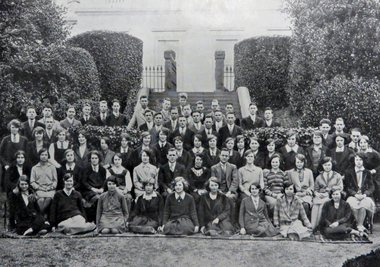
... Norman Povey; Joan McKebery; Monica J. Monaghan; Elsie E. Bruhn; Muriel E. McDonald; Kathleen Fitzgerald; Mary Fogarty; Peggy Skene; Frances Craig; Andrew B. Morton; Ron E. Mosman; Rex Braben; Doris Jarman; A.R. Gready; Monica J. Monahan; Ina Dickman; Himmie Brothers...Norman Povey; Joan McKebery; Monica J. Monaghan; Elsie E. Bruhn; Muriel E. McDonald; Kathleen Fitzgerald; Mary Fogarty; Peggy Skene; Frances Craig; Andrew B. Morton; Ron E. Mosman; Rex Braben; Doris Jarman; A.R. Gready; Monica J. Monahan; Ina Dickman; Himmie Brothers ...The 1929 Magazine Committee were John H. McNaughton (President and Editor), Miss I. Dickman (Secretary) , Mr E.B. Tregoning (Business Manager) and Miss P. Bunnett. John McNaughton was also president of the 1929 Ballarat Teachers' College Dramatic Club. The 1929 Ballarat Teachers' College Council comprised of Miss A. Ballinger, Mr R. Broben, John H. McNaughton, Mr R.P. Warriner and Miss Monahan.Crimson soft covered booklet of 50 pages relating to the Ballarat Teachers' College. It belonged to John McNaughton. The magazine includes the following images: Ballarat Teachers' College Staff and Students; women's tennis; football, men's tennis; hockey; Ballarat Teachers' College Council; visit of Bendigo Teachers' College. The Ballarat Teachers' College Football team included: C. Goltz (Captain), A.M. McPherson (Vice-captain), S.C. Hender, Rex Broben, N. Povey, F. Hickey, J. Heard, J. Johnson, J. Thomas, R. Watson, J. Braden, F. Spencer, H. Parker, I. Young, J. McNaughton, E. Errey, R. Moosman, G. Neumann, R. Nicholls and R. Warriner. The magazine reported "There are undoubtedly three outstanding players in the team - C. Goltz, R. Broben , and A. McPherson. 'The last page is autographed by members and staff of the Ballarat Teachers' College. The autographs include: W.H. Elwood (Principal), A.P. Hamano, H.B. Jones; M.H. Miller; W. Braden, Rose Battye; Jean Renkin; Mabel Roll; Nancy Schroeter; O.K. McLeod; George E. Neumann; Z. Zerby; Ada J. Looney; O. Van Bertel; R.P. Warriner; R.R. Watson; C. Goltz; Charles Hender; E.B. Tregoning; Bunnett; Henry J. Parker; H. Duggan; C.F. Kirk; Gladys Dunstan; Clare M. Cummin; J.B. Hickey; Norman Povey; Joan McKebery; Monica J. Monaghan; Elsie E. Bruhn; Muriel E. McDonald; Kathleen Fitzgerald; Mary Fogarty; Peggy Skene; Frances Craig; Andrew B. Morton; Ron E. Mosman; Rex Braben; Doris Jarman; A.R. Gready; Monica J. Monahan; Ina Dickman; Himmie Brothers; Jean Green; Alex A. Brown; Eva Varae; H.A. Frost; E.O. Jones; Florence Old; C.A. Harrison; J. Leath-Kingsley; Jack Heard; A.M. McPherson; W. Ian Youngballarat teachers' college, mcnaughton, john mcnaughton, dickman, tregoning, bunnett, ellwood, j. brown, a. ballinger, warriner, g. goltz, a.m. mcppherson, s.c. hender, rex broben, n. povey, f. hickey, j. heard, j. johnson, j. thomas, r. watson, j. braden, f. spencer, h. parker, i. young, j.mcnaughton, e. errey, r. moosman, g. neumann, r. nicholls, r. warriner -
 Federation University Historical Collection
Photograph - Colour, Memorial to Francis Davis in the grounds of Federation University, SMB Campus, 2012, 20/09/2012
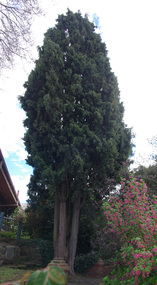
... brother 2/A.M. E.H. Davis (A.F.C Leighterton), officer of the A.F.C. Leighterton, Gloucester, Cadets of A.F.C. and many other personal friends of the deceased. The "Last Post" was sounded at the graveside, and the Rev. Major K.D. Norman...brother 2/A.M. E.H. Davis (A.F.C Leighterton), officer of the A.F.C. Leighterton, Gloucester, Cadets of A.F.C. and many other personal friends of the deceased. The "Last Post" was sounded at the graveside, and the Rev. Major K.D. Norman ...Francis Gordon Davis was born in Ballarat on 09 August 1899. He is the only former student of the Ballarat Junior Technical School who was killed on service during World War One. Davis enlisted into the Australian Flying Corps, Laverton, on 12 April 1918 at which time he was 18 and 8 months and served as a second class Air Mechanic. His service number was 3310. He died accidentally from shock resulting from an accident resulting from skidding a Leyland Motor Lorry at Leighterton, Tetbury, Gloucester, England on 28 January 1919 and is buried in Grave 6 in the Soldiers Corner of the Leighterton Cemetery. Francis Davis was accorded a full military funeral, firing party, bugler and pallbearers. The coffin was draped in the Union Jack and surmounted in several beautiful wreathes sent from his brother 2/A.M. E.H. Davis (A.F.C Leighterton), officer of the A.F.C. Leighterton, Gloucester, Cadets of A.F.C. and many other personal friends of the deceased. The "Last Post" was sounded at the graveside, and the Rev. Major K.D. Norman C. of E. A.I.F. officiated. The grave was to be turfed and an oak cross erected by the A.I.F. London. Administrative Headquarters A.I.F. London were represented at the funeral. (http://bih/index.php/Francis_G._Davis) In June 1922 Alfred Davis, the father of Francis Davis, planted a tree in the grounds of the Ballarat Junior Technical School in honour of hos son. It was the first tree of six planted in the grounds of the Ballarat School of Mines on Arbor Day 1922. Speaking of the planting of the tree by Mr Davis the Chief Secretary (Mr M. Baird M.L.A.), said he trusted the memory would ever remain green at the school. Had he and others not given their lives nothing that we could have done to-day could have retrieved the time. Australians had indeed done splendidly, but they should take a wider outlook than Australia, and reading the history of the Genoa Conference he had been struck by what had been done ... We should honor such men as he in whose memory that tree was planted, and the schools that sent them out to fight for us. He hoped the empire would always be able to produce such men, so that the Empire would always be able to lead the World's struggle for the benefit of humanity. The last post was then sounded by Mr. H. Green. ... (Ballarat Courier, 19 June 1922)A number of photographs of a tree and marble plaque in the grounds of the Ballarat School of Mines. It was a memorial to Francis Davis, a former student of the Ballarat Junior Technical School, who died on active service during World War One.ballarat school of mines, ballarat junior secondary school, world war one, memorial, marble plaque, marble memorial, tree, memorial tree, davis, francis davis -
 Federation University Historical Collection
Book, Ballarat Junior Technical School Certificates, 1914-1939, 1914-1939
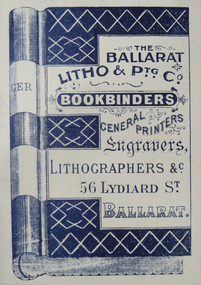
... P [Peter] Chatham was the brother of Philip Chatham's father, John [Jack] Chatham ballarat junior technical school certificates guido brelaz noel brelaz harold adair norman anstis howard beanland allan bernaldo g. g. callister francis capuano j.e. capuano peter chatham arthur coates leslie crouch richard dale francis davis henry dodds jack dulfer john dulfer donald furlong john garner bennett gluyas otto hauser r, haymes graham hopwood arthur h. hoskin r.m. kittelty carl krahnert larkin, michael leask, james leech, george fred longhurst john martin john mcnabb harold morton g.g. netherway harry o'bern h. pitman keith rash percival a. trompf percy trompf harold g. wakeling harold waller robert h. warnock thomas wasley george webb albert williams john a. garner walter button jack kopke b. bernaldo a. snowden g.c. callister a.l. brittain w.j. bassett j.k. kneeshaw ronald ditchfield l.a. chung Foolscap, charcoal green book with red leather binding and marbled edges. ...The Ballarat Junior Technical School was part of the Ballarat School of Mines.P [Peter] Chatham was the brother of Philip Chatham's father, John [Jack] ChathamFoolscap, charcoal green book with red leather binding and marbled edges. In date order each student who received a certificate from the Ballarat Junior Technical School between 1914 and 1939 is listed, along with their results. ballarat junior technical school, certificates, guido brelaz, noel brelaz, harold adair, norman anstis, howard beanland, allan bernaldo, g. g. callister, francis capuano, j.e. capuano, peter chatham, arthur coates, leslie crouch, richard dale, francis davis, henry dodds, jack dulfer, john dulfer, donald furlong, john garner, bennett gluyas, otto hauser, r, haymes, graham hopwood, arthur h. hoskin, r.m. kittelty, carl krahnert, larkin, michael, leask, james, leech, george, fred longhurst, john martin, john mcnabb, harold morton, g.g. netherway, harry o'bern, h. pitman, keith rash, percival a. trompf, percy trompf, harold g. wakeling, harold waller, robert h. warnock, thomas wasley, george webb, albert williams, john a. garner, walter button, jack kopke, b. bernaldo, a. snowden, g.c. callister, a.l. brittain, w.j. bassett, j.k. kneeshaw, ronald ditchfield, l.a. chung -
 Federation University Historical Collection
Photograph - Photograph - black and white, Ballarat Junior Technical School Cadet Team, 1916, 1916
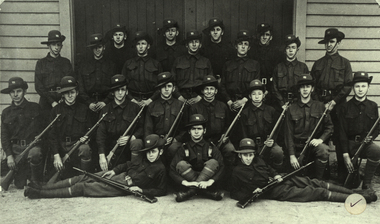
... brother 2/A.M. E.H. Davis (A.F.C Leighterton), officer of the A.F.C. Leighterton, Gloucester, Cadets of A.F.C. and many other personal friends of the deceased. The "Last Post" was sounded at the graveside, and the Rev. Major K.D. Norman...brother 2/A.M. E.H. Davis (A.F.C Leighterton), officer of the A.F.C. Leighterton, Gloucester, Cadets of A.F.C. and many other personal friends of the deceased. The "Last Post" was sounded at the graveside, and the Rev. Major K.D. Norman ...Francis Davis was the only former student of the Ballarat Junior Technical School to die during World War One. "Francis Davis was accorded a full military funeral, firing party, bugler and pallbearers. The coffin was draped in the Union Jack and surmounted in several beautiful wreathes sent from his brother 2/A.M. E.H. Davis (A.F.C Leighterton), officer of the A.F.C. Leighterton, Gloucester, Cadets of A.F.C. and many other personal friends of the deceased. The "Last Post" was sounded at the graveside, and the Rev. Major K.D. Norman C. of E. A.I.F. officiated. The grave was to be turfed and an oak cross erected by the A.I.F. London. Administrative Headquarters A.I.F. London were represented at the funeral. (http://naa12.naa.gov.au/scripts/Imagine.asp?B=1858392, accessed 24 January 2014.) According to Neil Leckie, Manager of the Ballarat Ranger Military Museum: * Originally 12 – 14 year olds went to Junior Cadets attached to their school. * From age 14 – 17 they were Senior Cadets attached to the local militia unit. * After 1 July of the year a Cadet turned 18, the Cadet left the Senior Cadets and became a member of the Citizen Military Force. * In October 1918 the AIF, Militia and Cadets were renamed to give some connection to the AIF battalion raised in the area. Ballarat saw: 8th Australian Infantry Regiment comprising: * 8th Battalion AIF renamed 1st Battalion 8th Australian Infantry Regiment * 70th Infantry Militia renamed 2nd Battalion 8th Australian Infantry Regiment * 70th Infantry Cadets renamed 3rd B, 8th Australian Infantry. 39th Australian Infantry Regiment comprising: * 39th Battalion AIF renamed 1st Battalion 39th Australian Regiment * 71st Infantry Militia renamed 2nd Bn, 39th Australian Infantry Regiment * 71st Infantry Cadets renamed 3rd Bn, 39th Australian Infantry Regiment Prior to the reorganisation in 1918 the 18th Brigade was the 70th, 71st and 73rd Infantry. It is thought that the 18th Brigade Cadet units in 1920 were those that came from the old: * 69th Infantry (Geelong/Queenscliff) * 70th Infantry (Ballarat/Colac) * 71st Infantry (Ballarat West) * 72nd Infantry Warrnambool) * 73rd Infantry (NW Vic) The next name change came in 1921!Black and white photograph of a group of school boys in army uniform. They are members of the Ballarat Junior Technical School Cadets. Back Row: D.O. Taylor, Albert E. Williams, B. Burrows, J.B. Hobba Standing: Francis Davis, Miller, A. Burge, P. [Peter] Chatham. J. Minster, H. Witter, H. Siemering Kneeling: T.G. Wasley, Alan Riley, A.H. Hoskin. N.C. Carmichael, Harold G. Wakeling, T. Rees, W.H. Shattock, F.N. Gibbs Front: S.J. Chambers, F.J. Procter, Charles H. Beanland francis davis, frank davis, ballarat junior technical school cadets, cadets, d.o. taylor, albert e. williams, b. burrows, j.b. hobba, miller, a. burge, p. chatham, j. minster, h. witter, h. siemering, t.g. wasley, a. riley, a.h. hoskin, n.c. carmichael, harold wakeling, t. rees, w.h. shattock, f.n. gibbs, s.j. chambers, f.j. procter, charles h. beanland, alan riley -
 Marysville & District Historical Society
Photograph (Item) - Black and white photograph, 1940s
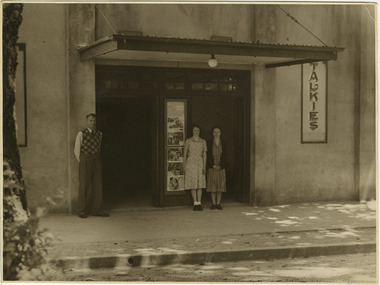
... This building, along with most of the town, was destroyed in the 2009 Black Saturday bushfires. marysville theatre marysville victoria harold cuzens jim wallace darmody family norman fiske rosemary fiske the pumpernickel 2009 black saturday bushfires marj wallace marie wallace jill wallace barton brothers clarrie smith Front of Theatre, with Dad, Mum & Marie/ Taken in '40's. ...A black and white photograph of three members of the Wallace Family standing in front of the Marysville Theatre in Marysville in Victoria in the 1940s.A black and white photograph of three members of the Wallace Family standing in front of the Marysville Theatre in Marysville in Victoria in the 1940s. Jim Wallace was born in Dumfries in Scotland and emigrated to Australia with his family at age 6. He arrived and settled in Marysville in 1922 and ended up working for the Barton Brothers looking after their touring cars and their garage. He met Marj in 1928 and they married in 1930. Jim and another well-known local, Clarrie Smith, had spoken about showing the 'talkies' in the local hall and then subsequently had local builder, Harold Cuzens, build the Marysville Theatre in 1932. The Marysville Theatre was located on Murchison Street. The solid concrete building was used as a Theatre from 1932 to 1970. The building was then purchased by The Darmody Family and was used as an Arts and Crafts Centre for two years from 1975. The building was then purchased by Norman and Rosemary Fiske in 1977 and converted into a restaurant called The Pumpernickel. This building, along with most of the town, was destroyed in the 2009 Black Saturday bushfires.Front of Theatre, with Dad, Mum & Marie/ Taken in '40's.marysville theatre, marysville, victoria, harold cuzens, jim wallace, darmody family, norman fiske, rosemary fiske, the pumpernickel, 2009 black saturday bushfires, marj wallace, marie wallace, jill wallace, barton brothers, clarrie smith -
Marysville & District Historical Society
Document (Item), Mountain News, The Wallaces Leave Marysville, 07-05-1980
... The Wallaces departed Marysville in 1980 for a new life in Ringwood, Victoria. marysville theatre marysville victoria harold cuzens jim wallace darmody family norman fiske rosemary fiske the pumpernickel 2009 black saturday bushfires marj wallace marie wallace jill wallace barton brothers clarrie smith A document outlining the departure of The Wallaces from Marysville in Victoria. ...A document outlining the departure of The Wallaces from Marysville in Victoria.A document outlining the departure of The Wallaces from Marysville in Victoria. Jim Wallace was born in Dumfries in Scotland and emigrated to Australia with his family at age 6. He arrived and settled in Marysville in 1922 and ended up working for the Barton Brothers looking after their touring cars and their garage. He met Marj in 1928 and they married in 1930. Jim and another well-known local, Clarrie Smith, had spoken about showing the 'talkies' in the local hall and then subsequently had local builder, Harold Cuzens, build the Marysville Theatre in 1932. The Marysville Theatre was located on Murchison Street. The solid concrete building was used as a Theatre from 1932 to 1970. The building was then purchased by The Darmody Family and was used as an Arts and Crafts Centre for two years from 1975. The building was then purchased by Norman and Rosemary Fiske in 1977 and converted into a restaurant called The Pumpernickel. This building, along with most of the town, was destroyed in the 2009 Black Saturday bushfires. The Wallaces departed Marysville in 1980 for a new life in Ringwood, Victoria.marysville theatre, marysville, victoria, harold cuzens, jim wallace, darmody family, norman fiske, rosemary fiske, the pumpernickel, 2009 black saturday bushfires, marj wallace, marie wallace, jill wallace, barton brothers, clarrie smith -
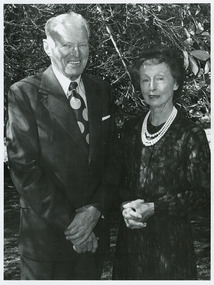 Marysville & District Historical Society
Photograph (Item) - Black and white photograph, 1980
... The Wallaces departed Marysville in 1980 for a new life in Ringwood, Victoria. marysville theatre marysville victoria harold cuzens jim wallace darmody family norman fiske rosemary fiske the pumpernickel 2009 black saturday bushfires marj wallace marie wallace jill wallace barton brothers clarrie smith Jim and Marj Wallace 1980 A black and white photograph of Jim and Marj Wallace from Marysville in Victoria. ...A black and white photograph of Jim and Marj Wallace from Marysville in Victoria.A black and white photograph of Jim and Marj Wallace from Marysville in Victoria. Jim Wallace was born in Dumfries in Scotland and emigrated to Australia with his family at age 6. He arrived and settled in Marysville in 1922 and ended up working for the Barton Brothers looking after their touring cars and their garage. He met Marj in 1928 and they married in 1930. Jim and another well-known local, Clarrie Smith, had spoken about showing the 'talkies' in the local hall and then subsequently had local builder, Harold Cuzens, build the Marysville Theatre in 1932. The Marysville Theatre was located on Murchison Street. The solid concrete building was used as a Theatre from 1932 to 1970. The building was then purchased by The Darmody Family and was used as an Arts and Crafts Centre for two years from 1975. The building was then purchased by Norman and Rosemary Fiske in 1977 and converted into a restaurant called The Pumpernickel. This building, along with most of the town, was destroyed in the 2009 Black Saturday bushfires. The Wallaces departed Marysville in 1980 for a new life in Ringwood, Victoria.Jim and Marj Wallace 1980marysville theatre, marysville, victoria, harold cuzens, jim wallace, darmody family, norman fiske, rosemary fiske, the pumpernickel, 2009 black saturday bushfires, marj wallace, marie wallace, jill wallace, barton brothers, clarrie smith -
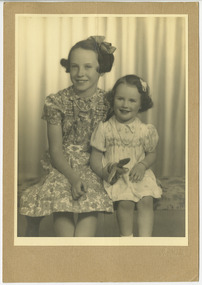 Marysville & District Historical Society
Photograph (Item) - Black and white photograph, Unknown
... The Wallaces departed Marysville in 1980 for a new life in Ringwood, Victoria. marysville theatre marysville victoria harold cuzens jim wallace darmody family norman fiske rosemary fiske the pumpernickel 2009 black saturday bushfires marj wallace marie wallace jill wallace barton brothers clarrie smith Jill and Marie Wallace/ Marysville. ...A black and white photograph of Jill and Marie Wallace from Marysville in Victoria.A black and white photograph of Jill and Marie Wallace from Marysville in Victoria. Jim Wallace was born in Dumfries in Scotland and emigrated to Australia with his family at age 6. He arrived and settled in Marysville in 1922 and ended up working for the Barton Brothers looking after their touring cars and their garage. He met Marj in 1928 and they married in 1930. Jim and another well-known local, Clarrie Smith, had spoken about showing the 'talkies' in the local hall and then subsequently had local builder, Harold Cuzens, build the Marysville Theatre in 1932. The Marysville Theatre was located on Murchison Street. The solid concrete building was used as a Theatre from 1932 to 1970. The building was then purchased by The Darmody Family and was used as an Arts and Crafts Centre for two years from 1975. The building was then purchased by Norman and Rosemary Fiske in 1977 and converted into a restaurant called The Pumpernickel. This building, along with most of the town, was destroyed in the 2009 Black Saturday bushfires. The Wallaces departed Marysville in 1980 for a new life in Ringwood, Victoria. Jill and Marie Wallace/ Marysville.marysville theatre, marysville, victoria, harold cuzens, jim wallace, darmody family, norman fiske, rosemary fiske, the pumpernickel, 2009 black saturday bushfires, marj wallace, marie wallace, jill wallace, barton brothers, clarrie smith -
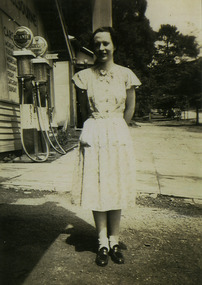 Marysville & District Historical Society
Photograph (Item) - Black and white photograph, 1950s
... The Wallaces departed Marysville in 1980 for a new life in Ringwood, Victoria. marysville theatre marysville victoria harold cuzens jim wallace darmody family norman fiske rosemary fiske the pumpernickel 2009 black saturday bushfires marj wallace marie wallace jill wallace barton brothers clarrie smith Jill Wallace/ early 1950s/ Oldest daughter of/ Jim + Marjorie Wallace Outside/ McKenzies/ Tourist Depot/ Main Street A black and white photograph of Jill Wallace in Marysville in Victoria. ...A black and white photograph of Jill Wallace in Marysville in Victoria.A black and white photograph of Jill Wallace in Marysville in Victoria. Jim Wallace was born in Dumfries in Scotland and emigrated to Australia with his family at age 6. He arrived and settled in Marysville in 1922 and ended up working for the Barton Brothers looking after their touring cars and their garage. He met Marj in 1928 and they married in 1930. Jim and another well-known local, Clarrie Smith, had spoken about showing the 'talkies' in the local hall and then subsequently had local builder, Harold Cuzens, build the Marysville Theatre in 1932. The Marysville Theatre was located on Murchison Street. The solid concrete building was used as a Theatre from 1932 to 1970. The building was then purchased by The Darmody Family and was used as an Arts and Crafts Centre for two years from 1975. The building was then purchased by Norman and Rosemary Fiske in 1977 and converted into a restaurant called The Pumpernickel. This building, along with most of the town, was destroyed in the 2009 Black Saturday bushfires. The Wallaces departed Marysville in 1980 for a new life in Ringwood, Victoria.Jill Wallace/ early 1950s/ Oldest daughter of/ Jim + Marjorie Wallace Outside/ McKenzies/ Tourist Depot/ Main Streetmarysville theatre, marysville, victoria, harold cuzens, jim wallace, darmody family, norman fiske, rosemary fiske, the pumpernickel, 2009 black saturday bushfires, marj wallace, marie wallace, jill wallace, barton brothers, clarrie smith -
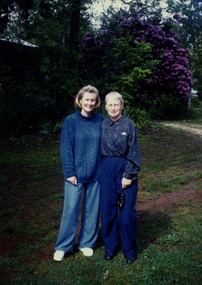 Marysville & District Historical Society
Photograph (Item) - Colour photograph, Unknown
... The Wallaces departed Marysville in 1980 for a new life in Ringwood, Victoria. marysville theatre marysville victoria harold cuzens jim wallace darmody family norman fiske rosemary fiske the pumpernickel 2009 black saturday bushfires marj wallace marie wallace jill wallace barton brothers clarrie smith Marie + Jill Standing/ in front of our old home. ...A colour photograph of Marie and Jill Wallace in Marysville in Victoria.A colour photograph of Marie and Jill Wallace in Marysville in Victoria. Jim Wallace was born in Dumfries in Scotland and emigrated to Australia with his family at age 6. He arrived and settled in Marysville in 1922 and ended up working for the Barton Brothers looking after their touring cars and their garage. He met Marj in 1928 and they married in 1930. Jim and another well-known local, Clarrie Smith, had spoken about showing the 'talkies' in the local hall and then subsequently had local builder, Harold Cuzens, build the Marysville Theatre in 1932. The Marysville Theatre was located on Murchison Street. The solid concrete building was used as a Theatre from 1932 to 1970. The building was then purchased by The Darmody Family and was used as an Arts and Crafts Centre for two years from 1975. The building was then purchased by Norman and Rosemary Fiske in 1977 and converted into a restaurant called The Pumpernickel. This building, along with most of the town, was destroyed in the 2009 Black Saturday bushfires. The Wallaces departed Marysville in 1980 for a new life in Ringwood, Victoria.Marie + Jill Standing/ in front of our old home.marysville theatre, marysville, victoria, harold cuzens, jim wallace, darmody family, norman fiske, rosemary fiske, the pumpernickel, 2009 black saturday bushfires, marj wallace, marie wallace, jill wallace, barton brothers, clarrie smith -
 Marysville & District Historical Society
Photograph (Item) - Black and white photograph, Unknown
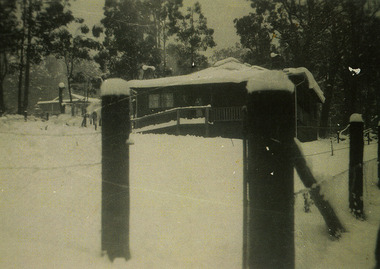
... The Wallaces departed Marysville in 1980 for a new life in Ringwood, Victoria. marysville theatre marysville victoria harold cuzens jim wallace darmody family norman fiske rosemary fiske the pumpernickel 2009 black saturday bushfires marj wallace marie wallace jill wallace barton brothers clarrie smith Snow in Marysville A black and white photograph of the Wallace house in Marysville in Victoria during winter. ...A black and white photograph of the Wallace house in Marysville in Victoria during winter.A black and white photograph of the Wallace house in Marysville in Victoria during winter. Jim Wallace was born in Dumfries in Scotland and emigrated to Australia with his family at age 6. He arrived and settled in Marysville in 1922 and ended up working for the Barton Brothers looking after their touring cars and their garage. He met Marj in 1928 and they married in 1930. Jim and another well-known local, Clarrie Smith, had spoken about showing the 'talkies' in the local hall and then subsequently had local builder, Harold Cuzens, build the Marysville Theatre in 1932. The Marysville Theatre was located on Murchison Street. The solid concrete building was used as a Theatre from 1932 to 1970. The building was then purchased by The Darmody Family and was used as an Arts and Crafts Centre for two years from 1975. The building was then purchased by Norman and Rosemary Fiske in 1977 and converted into a restaurant called The Pumpernickel. This building, along with most of the town, was destroyed in the 2009 Black Saturday bushfires. The Wallaces departed Marysville in 1980 for a new life in Ringwood, Victoria.Snow in Marysvillemarysville theatre, marysville, victoria, harold cuzens, jim wallace, darmody family, norman fiske, rosemary fiske, the pumpernickel, 2009 black saturday bushfires, marj wallace, marie wallace, jill wallace, barton brothers, clarrie smith -
 Marysville & District Historical Society
Photograph (Item) - Black and white photograph, Unknown
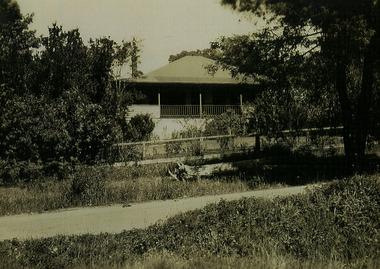
... The Wallaces departed Marysville in 1980 for a new life in Ringwood, Victoria. marysville theatre marysville victoria harold cuzens jim wallace darmody family norman fiske rosemary fiske the pumpernickel 2009 black saturday bushfires marj wallace marie wallace jill wallace barton brothers clarrie smith Wallace Home A black and white photograph of the Wallace Family home in Marysville in Victoria. ...A black and white photograph of the Wallace Family home in Marysville in Victoria.A black and white photograph of the Wallace Family home in Marysville in Victoria. Jim Wallace was born in Dumfries in Scotland and emigrated to Australia with his family at age 6. He arrived and settled in Marysville in 1922 and ended up working for the Barton Brothers looking after their touring cars and their garage. He met Marj in 1928 and they married in 1930. Jim and another well-known local, Clarrie Smith, had spoken about showing the 'talkies' in the local hall and then subsequently had local builder, Harold Cuzens, build the Marysville Theatre in 1932. The Marysville Theatre was located on Murchison Street. The solid concrete building was used as a Theatre from 1932 to 1970. The building was then purchased by The Darmody Family and was used as an Arts and Crafts Centre for two years from 1975. The building was then purchased by Norman and Rosemary Fiske in 1977 and converted into a restaurant called The Pumpernickel. This building, along with most of the town, was destroyed in the 2009 Black Saturday bushfires. The Wallaces departed Marysville in 1980 for a new life in Ringwood, Victoria.Wallace Homemarysville theatre, marysville, victoria, harold cuzens, jim wallace, darmody family, norman fiske, rosemary fiske, the pumpernickel, 2009 black saturday bushfires, marj wallace, marie wallace, jill wallace, barton brothers, clarrie smith -
Federation University Historical Collection
Document, New premises for the school's central library
... Norman Curry Fr. Tom Doyle Peter Kirby Ken McKinnon Bernard Rechter Helen Praetz Marion Russell J.K. Matthews Therese Scanlon Jan Reeves Carole Seymour Francis Miller Helen Fairhall Anne Fennell Steven Mendelson Peter Shiells Geoffrey Blainey Earnest Scott K.J. Flecknoe Bruce McKnight Graham H. Beanland R.W. Richards E.J. Barker Jack Barker Nancye Kent Perry Alfred Leahy W.T. Ryan E.J. T. Tippett Peter Alsop J.W. Sutherland David Avery Ian R. Duggan Ronaldson Brothers ...School of Mines Ballarat is a predecessor of Federation University.A4 typed document of 26 pages on white paper being draft No. 1 pf New premises fopr the school's central library Original copy to W. Perry 18/05/1993 written on the topcentral library, new building, school of mines ballarat, w. perry, brian webber, b.c. mclennan, n. mroczkowski, r.c. morgan, a.g. peart, p. mcnulty, rocky hazlett, l.wallis, a.j. smail, john sullivan, jean blackburn, norman curry, fr. tom doyle, peter kirby, ken mckinnon, bernard rechter, helen praetz, marion russell, j.k. matthews, therese scanlon, jan reeves, carole seymour, francis miller, helen fairhall, anne fennell, steven mendelson, peter shiells, geoffrey blainey, earnest scott, k.j. flecknoe, bruce mcknight, graham h. beanland, r.w. richards, e.j. barker, jack barker, nancye kent perry, alfred leahy, w.t. ryan, e.j. t. tippett, peter alsop, j.w. sutherland, david avery, ian r. duggan, ronaldson brothers, w.h. middleton, n.w. titheridge, d.a. wynach, ricky car, joanna harris, john bastin, edgar james bartrop, rodney smart, grant gilbert, bruce miller, john nathan, leo shannon, w.t.h. corbould, jimmy corbould, bryan crebbin, j.d. mccaughey, james oddie, graeme hood, ian smith, tom cragg, alfred mica smith, f.m. krause, thomas stephen hart, fiona watson, justice barry, robert charles morgan, roger murchison, a.m praetz, john van dreven, davis mccaughey, r.c. lovett, b.f. crebbin, morgan william beven john, charles howard beanland, ballarat school of mines history -
 Ballarat Clarendon College
Memorial plaque
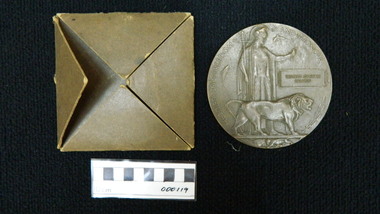
... 'Wiff' was reputedly the first person to die defending London from a foreign invader since the time of the Norman Conquest. His brother Robert Arthur Salmon was also an old collegian. ...The WWI Death Plaque (Death Penny) was issued to the next of kin of servicemen/women who fell in the Great War 1914 -1918.The memorial plaque would be accompanied by a Memorial Scroll, a letter from Buckingham Palace and often a letter from the deceased's commanding officer. They would not usually arrive as a single package, but as a series of separate mailings. In this case we have the letter from Buckingham Palace. Wilfred (Wiff) Graham Salmon attended Ballarat College 1902 - 1910. He enlisted in 1915 and embarked as a driver with the 4th Field Artillery Brigade. He transferred to the Royal Flusing Corps in 1916. He was killed fighting raiders over the Thames Valley near London on 7 July 1917. 'Wiff' was reputedly the first person to die defending London from a foreign invader since the time of the Norman Conquest. His brother Robert Arthur Salmon was also an old collegian. Other possible family members who are old collegians include Nellie Florence Salmon (ent CPLC 1907; DB 1.8.1899), John Walter Salmon (ent BC 1898; DB 22.11.1889), Geoffrey Salmon (ent BC 1910; DB 3/11/1896). Wilfred's brother Robert (Bob) Salmon is mentioned in the school's 1964 history by Gordon Meins p.68..."Captain (then Lieut) Bob Salmon M.C. on one occasion worked for 7 nights straight in No Man's Land and is credited with rescuing nearly 300 of our wounded." Round disk cast in bronze gunmetal, which incorporates the following; an image of Britannia holding an oak spray with leaves and acorns, an imperial lion, two dolphins representing Britain's sea power, the emblem of Imperial Germany's eagle being torn to pieces by another lion. The medallion is incased in a heavy card envelope and is accompanied by a letter signed by King George Inscribed around face of medallion: He died for freedom and honour A rectangular tablet cast on front of medallion inscribed 'Wilfred Graham Salmon'.wiff-salmon, world-war-one, death-penny, king-george, war-memorabilia, ballarat-college, royal-flying-corps, 1912, wilfred-graham-salmon -
Ballarat Clarendon College
Book, Stories from the Aeneid, 1909
... Gavin Shaw entered Ballarat College in 1917 [Family Links] Son of Henry Shaw 6 Pleasant Str Sth, Brother of Henry Norman (Norman), Parent of John,David,Robert, Marg, Philip & others. ...Gavin Shaw entered Ballarat College in 1917 [Family Links] Son of Henry Shaw 6 Pleasant Str Sth, Brother of Henry Norman (Norman), Parent of John,David,Robert, Marg, Philip & others. ...Book gifted to the CPLC library in 1962 by Mrs Gavin Shaw. Gavin Shaw entered Ballarat College in 1917 [Family Links] Son of Henry Shaw 6 Pleasant Str Sth, Brother of Henry Norman (Norman), Parent of John,David,Robert, Marg, Philip & others. (School Involvt) BC Council 1952-73; E McGowan signature on flyleaf may refer to Edith McGowan who entered the girls school in 1882. Edith's sister, Margaret Steele, donated prizes from her days at Mrs Kennedy's School for Girls.Dark blue calf-bound book with embossed illustration on cover and gold markings on spineBook plate on flyleaf: Clarendon Presbyterian / Ladies' College / Ballarat / crest / Presented by / Mrs Gavin Shaw / date: 21/6/62 Handwritten signature on flyleaf: E McGowangavin-shaw, ballarat-college-council, ballarat-college, clarendon-presbyterian-ladies-college, library, 1962 -
 Federation University Historical Collection
Photograph, Clare Gervasoni, Memorial to Francis Davis in the grounds of Federation University, SMB Campus, 2019, 20/01/2019
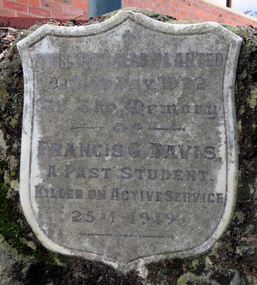
... brother 2/A.M. E.H. Davis (A.F.C Leighterton), officer of the A.F.C. Leighterton, Gloucester, Cadets of A.F.C. and many other personal friends of the deceased. The "Last Post" was sounded at the graveside, and the Rev. Major K.D. Norman...brother 2/A.M. E.H. Davis (A.F.C Leighterton), officer of the A.F.C. Leighterton, Gloucester, Cadets of A.F.C. and many other personal friends of the deceased. The "Last Post" was sounded at the graveside, and the Rev. Major K.D. Norman ...Francis Gordon Davis was born in Ballarat on 09 August 1899. He is the only former student of the Ballarat Junior Technical School who was killed on service during World War One. Davis enlisted into the Australian Flying Corps, Laverton, on 12 April 1918 at which time he was 18 and 8 months and served as a second class Air Mechanic. His service number was 3310. He died accidentally from shock resulting from an accident resulting from skidding a Leyland Motor Lorry at Leighterton, Tetbury, Gloucester, England on 28 January 1919 and is buried in Grave 6 in the Soldiers Corner of the Leighterton Cemetery. Francis Davis was accorded a full military funeral, firing party, bugler and pallbearers. The coffin was draped in the Union Jack and surmounted in several beautiful wreathes sent from his brother 2/A.M. E.H. Davis (A.F.C Leighterton), officer of the A.F.C. Leighterton, Gloucester, Cadets of A.F.C. and many other personal friends of the deceased. The "Last Post" was sounded at the graveside, and the Rev. Major K.D. Norman C. of E. A.I.F. officiated. The grave was to be turfed and an oak cross erected by the A.I.F. London. Administrative Headquarters A.I.F. London were represented at the funeral. (http://bih/index.php/Francis_G._Davis) In June 1922 Alfred Davis, the father of Francis Davis, planted a tree in the grounds of the Ballarat Junior Technical School in honour of hos son. It was the first tree of six planted in the grounds of the Ballarat School of Mines on Arbor Day 1922. Speaking of the planting of the tree by Mr Davis the Chief Secretary (Mr M. Baird M.L.A.), said he trusted the memory would ever remain green at the school. Had he and others not given their lives nothing that we could have done to-day could have retrieved the time. Australians had indeed done splendidly, but they should take a wider outlook than Australia, and reading the history of the Genoa Conference he had been struck by what had been done ... We should honor such men as he in whose memory that tree was planted, and the schools that sent them out to fight for us. He hoped the empire would always be able to produce such men, so that the Empire would always be able to lead the World's struggle for the benefit of humanity. The last post was then sounded by Mr. H. Green. ... (Ballarat Courier, 19 June 1922)A number of photographs of a tree and marble plaque in the grounds of the Ballarat School of Mines. It was a memorial to Francis Davis, a former student of the Ballarat Junior Technical School, who died on active service during World War One.ballarat school of mines, ballarat junior secondary school, world war one, memorial, marble plaque, marble memorial, tree, memorial tree, davis, francis davis, centenary -
 Greensborough Historical Society
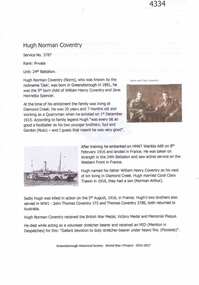
Article, Greensborough Historical Society et al, Hugh Norman Coventry, 1914-1918
... At the time of Hugh Norman Coventry's enlistment, he was living at Diamond Creek. He and his brothers are commemorated on the Greensborough State School Honor Board....At the time of Hugh Norman Coventry's enlistment, he was living at Diamond Creek. He and his brothers are commemorated on the Greensborough State School Honor Board. world war 1 project hugh norman coventry 2 Pages, text and colour images. ...A short article about Hugh Norman Coventry and his service in World War 1. At the time of Hugh Norman Coventry's enlistment, he was living at Diamond Creek. He and his brothers are commemorated on the Greensborough State School Honor Board.2 Pages, text and colour images.world war 1 project, hugh norman coventry -
 Greensborough Historical Society
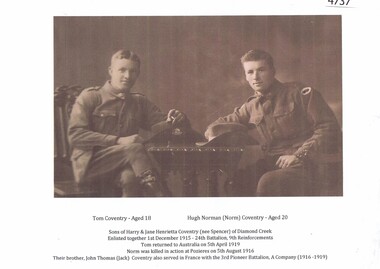
Photograph - Digital image, Tom and Hugh (Norm) Coventry, 1915, 1915_
... Photograph of Hugh Norman (Norm) Coventry age 20 and his brother Tom age 18 after their enlistment 1 December 1915. ...Photograph of Hugh Norman (Norm) Coventry age 20 and his brother Tom age 18 after their enlistment 1 December 1915. ...Photograph of Hugh Norman (Norm) Coventry age 20 and his brother Tom age 18 after their enlistment 1 December 1915. Coventry Street [Montmorency] is named after Tom Coventry, who lived in the area.1page, sepia photograph and notescoventry family
