City of Melbourne Libraries
Photograph, Bull, Hugh Jones, 1897-1993, Poultry Club, Wales Street School, Northcote
... Research by project volunteer, Louise McKenzie:
From the text of the newspaper article we know this is the Wales Street Primary School, in Northcote. It opened in 1891 when it was known as the Prince of Wales Park State School. ...Research by project volunteer, Louise McKenzie:
From the text of the newspaper article we know this is the Wales Street Primary School, in Northcote. It opened in 1891 when it was known as the Prince of Wales Park State School. ...
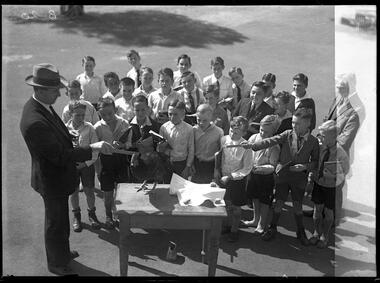
Wales Street State School poultry club lesson
“Fresh eggs for breakfast will be available now in many Northcote homes. Mr Taylor of the Wales Street School, is explaining the points of a good hen to the members of the school poultry club.”
Mr Taylor of Ballarat was founder of the largest Young Farmers’ Club in Western Victoria. He was also in charge of Grade 6 at Northcote’s Wales Street State School No. 3139 and president of their poultry club. The chook under inspection is the Australorp, an Australian breed developed from the UK Black Orpington and the US Rhode Island Red. It achieved world-wide popularity in the 1920s for its laying ability: in a 1922/23 world record, six hens laid an average of 309.5 eggs per hen during a 365 consecutive day trial.
MCK 059 Published: The Age 16 March 1934
Featured in "Newsworthy: Melbourne in photographs 1933-1936" exhibition at East Melbourne Library, October to December 2023. Exhibition caption by project volunteer, Louise McKenzie.
Photographer notations on slide: "B20"
Published: 16 March 1934 The Age p3
Published title: SUBURBAN BOYS' POULTRY CLUB
Published caption: Fresh eggs for breakfast will be available now in many Northcote homes. Mr. Taylor, of the Wales-street school, is explaining the points of a good hen to the members of the school poultry club.
Trove article identifier: http://nla.gov.au/nla.news-article203841415
Description:
The scene is outside in a school playground. 25 schoolboys and one teacher stand around a wooden table on which a large live chicken is standing. An instructor stands beside the chicken, holding a ruler, which rests lightly on the chicken’s neck. The boys wear shorts and shirts. Mostly they wear shoes or boots and socks, although one has bare feet. Some wear a jacket, some wear ties; one has braces. Their hair has been freshly brushed. One boy stands out from the group: he appears older than the others and wears a tie, shirt and blazer, with two badges on the lapel. The young teacher wears a slightly scruffy short suit with shirt and tie; the instructor wears a dark suit with tie and hat. The boys are carrying exercise books. They look to be around 10 years of age.
Research by project volunteer, Louise McKenzie:
From the text of the newspaper article we know this is the Wales Street Primary School, in Northcote. It opened in 1891 when it was known as the Prince of Wales Park State School. As a result of economic depression it closed in 1892, but reopened in 1900, and in 1920 reached its peak with 1232 pupils. The instructing teacher is Mr James Taylor, who was leader of the school’s Poultry Club. He wrote articles for the Age explaining that “since 1927 when the Young Farmers Clubs were first established in Victorian State schools, poultry keeping as a school project and a hobby has become extremely popular.” He encouraged girls and boys to become involved for profit and pleasure. White Leghorn and Australorp breeds were good egg producers, but most important were,
“the 4 G’s of poultry farming:— grains, greens, grit and gumption — the latter being extremely important. One might be excused also for asking that the word "grit" be read with a double meaning. Brain sees through a thing, but grit sees it through. The successful person in poultry keeping is he or she who continues to work well with the birds long after the novelty has died off.”
According to a visitor to the Poultry Club, expert farmer Mr Buscomb of NUPHA, the key features of a good bird were that it should be "as wide as possible across the saddle, have a clean face, close feathers, bayonet shaped legs, and fine textured combs and wattles."
The Australorp is a chicken breed of Australian origin, developed out of Black Orpington (UK) and Rhode Island Red birds. White Leghorn, Langshan and Minorca elements were also added, resulting in a very utilitarian bird known as the Australian Black Orpington (Austral-orp). It achieved world-wide popularity in the 1920s for its laying ability. In 1922-23 a team of six hens set a world record by laying 1857 eggs for an average of 309.5 eggs per hen during a 365 consecutive day trial. In Australia the Australorp is recognised in black, white and blue colouring.
The Weekly Times of Saturday 24 February 1934 reported that Mr James Taylor of Ballarat, founder of the largest Young Farmers’ club in Victoria (at Murtoa) was now in charge of Grade 6 at the Wales Street State School No. 3139 and was president of their poultry club. This feature followed in The Age of 16 March 1934, with another in 28 December 1934. The topic is again featured in the Weekly Times of April 1935 – Mr Taylor was making quite an impact!
References:
SUBURBAN BOYS' POULTRY CLUB--PREMIERSHIP CRICKET TEAM--AROUND THE SUN DIAL--"EYES LEFT !" (1934, March 16). The Age (Melbourne, Vic. : 1854 - 1954), p. 3. Retrieved September 19, 2023, from http://nla.gov.au/nla.news-article203841415
Poultry at Northcote (1935, April 27). Weekly Times (Melbourne, Vic. : 1869 - 1954), p. 47. Retrieved September 19, 2023, from http://nla.gov.au/nla.news-article223353807
POCKET MONEY FROM POULTRY. (1934, December 28). The Age (Melbourne, Vic. : 1854 - 1954), p. 14. Retrieved September 19, 2023, from http://nla.gov.au/nla.news-article205074190
A City Club (1934, February 24). Weekly Times (Melbourne, Vic. : 1869 - 1954), p. 49. Retrieved September 19, 2023, from http://nla.gov.au/nla.news-article223202561
Australorp, Wikipedia, https://en.wikipedia.org/wiki/AustralorpPhotographer notations on slide: "B20".schools, poultry, clubs, 1930-1939

 Uniting Church Archives - Synod of Victoria
 Uniting Church Archives - Synod of Victoria
 Uniting Church Archives - Synod of Victoria
 Uniting Church Archives - Synod of Victoria
 City of Melbourne Libraries