
Showing 19 items matching "notice of rules and regulations"
-
 Marysville & District Historical Society
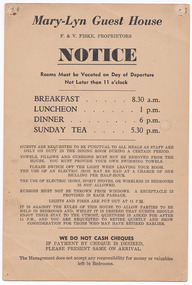
Ephemera (item) - Notice of rules and regulations, Mary-Lyn Guest House, Unknown
... Notice of rules and regulations.......notice of rules and regulations...A notice outlining the rules and regulations as set by the proprietors, for guests staying at Mary-Lyn Guest House in Marysville. ...A notice outlining the rules and regulations as set by the proprietors, for guests staying at Mary-Lyn Guest House in Marysville. ...Mary-Lyn Guest House Ephemera Notice of rules and regulations. ...A notice outlining the rules and regulations as set by the proprietors, for guests staying at Mary-Lyn Guest House in Marysville. Mary-Lyn was a part of the Mary Chain of guest houses built by Eric Dowdle in the Depression years.A notice outlining the rules and regulations as set by the proprietors, for guests staying at Mary-Lyn Guest House in Marysville.marysville, victoria, australia, mary chain guest houses, mary-lyn, eric dowdle, mr. f. fiske, mrs. v. fiske, notice of rules and regulations -
 University of Melbourne, Burnley Campus Archives
Administration, Department of Agriculture, Student Discipline S22, 1955-1976
... Memoranda and notices re College Rules, Prefects Pledge 16.02.1955-16.02.1976. 2. ...administration students discipline college rules prefects pledge prospectus longerenong agricultural college statutory rules agricultural colleges act agricultural colleges regulations Manila folder, shoelace tie. 1. Memoranda and notices re College Rules, Prefects Pledge 16.02.1955-16.02.1976. 2. ...administration, students, discipline, college rules, prefects pledge, prospectus longerenong agricultural college, statutory rules, agricultural colleges act, agricultural colleges regulations -
 Federation University Historical Collection
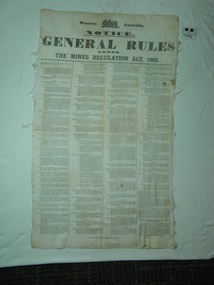
Poster, Western Australia Government Printer, Western Australia Notice. General Rules under the Mines Regulation Act 1906, c1906
... The cloth appears to be a woven lawn, with black ink regulations printed onto it. Western Australia Notice. ...Quite possibly the mining regulations were printed onto material so they could be displayed in harsh conditions without deteriorating like paper. The 1906 mining regulations were enacted on 01 June 1907. (See http://www.dmp.wa.gov.au/documents/Magazine/MSH_MineSafe_Dec09v18no3_LookingBack.pdf)Cloth mining regulations. The cloth appears to be a woven lawn, with black ink regulations printed onto it.mining, mines regulations, mining regulation actw m simpson -
 Flagstaff Hill Maritime Museum and Village
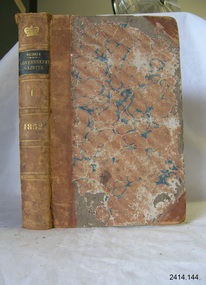
Book - Reference/Legal Statutes, John Ferres, Government Printer, The Victorian Government Gazette Vol 1 (January 1st to 30th June), 1852
... In early colonial administration, government gazettes published official land grants, goldfield regulations, judicial appointments, police notices, and public finances. ...In early colonial administration, government gazettes published official land grants, goldfield regulations, judicial appointments, police notices, and public finances. ...This volume is a primary historical document recording the foundational legal acts, official proclamations, and government notices that established the administration of the newly independent Colony of Victoria. Volume 1, one of the earliest Victorian Statutes, contains the initial Acts passed by the newly formed Legislative Council of Victoria following its formal separation from New South Wales on 1 July 1851. The inclusion of Charles Joseph La Trobe, Victoria's first Lieutenant-Governor, appointed in July 1851, signifies that this volume records official proclamations establishing colonial courts, administrative divisions, civil service appointments, and public order measures.Hard cover book,The Victorian Statutes Vol 1. Author: Corporate Author Charles Joseph L A Trobe “The Colony of Victoria” Publisher: John Ferres Government Printer Melbourne. Date: 1852 Three quarter leather, patterned covers. Top section of leather on spine frayed, lettering in gilt. No Library labels. Pencil text to flyleaf unreadable.non-fictionThis volume is a primary historical document recording the foundational legal acts, official proclamations, and government notices that established the administration of the newly independent Colony of Victoria. Volume 1, one of the earliest Victorian Statutes, contains the initial Acts passed by the newly formed Legislative Council of Victoria following its formal separation from New South Wales on 1 July 1851. The inclusion of Charles Joseph La Trobe, Victoria's first Lieutenant-Governor, appointed in July 1851, signifies that this volume records official proclamations establishing colonial courts, administrative divisions, civil service appointments, and public order measures.flagstaff hill, warrnambool, shipwrecked coast, flagstaff hill maritime museum, maritime museum, shipwreck coast, flagstaff hill maritime village, great ocean road, book, pattison collection, warrnambool library, warrnambool mechanics’ institute, ralph eric pattison, corangamite regional library service, warrnambool city librarian, mechanics’ institute library, victorian library board, warrnambool books and records, warrnambool children’s library -
 Flagstaff Hill Maritime Museum and Village
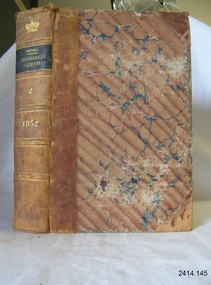
Book - Reference/Legal Statutes, John Ferres, Government Printer, The Victorian Government Gazette Vol 2 (July 1st to 31st December), 1852
... In early colonial administration, government gazettes published official land grants, goldfield regulations, judicial appointments, police notices, and public finances. ...In early colonial administration, government gazettes published official land grants, goldfield regulations, judicial appointments, police notices, and public finances. ...This volume is a primary historical document recording the foundational legal acts, official proclamations, and government notices that established the administration of the newly independent Colony of Victoria. Volume 1, one of the earliest Victorian Statutes, contains the initial Acts passed by the newly formed Legislative Council of Victoria following its formal separation from New South Wales on 1 July 1851. The inclusion of Charles Joseph La Trobe, Victoria's first Lieutenant-Governor, appointed in July 1851, signifies that this volume records official proclamations establishing colonial courts, administrative divisions, civil service appointments, and public order measures.Hard cover book,The Victorian Statutes Vol 2. Author: Corporate Author Charles Joseph L A Trobe “The Colony of Victoria” Publisher: John Ferres Government Printer Melbourne. Date: 1852 Further information: Three quarter leather, patterned covers. Top section of leather on spine frayed at top, lettering in gilt. No Library labels.non-fictionThis volume is a primary historical document recording the foundational legal acts, official proclamations, and government notices that established the administration of the newly independent Colony of Victoria. Volume 1, one of the earliest Victorian Statutes, contains the initial Acts passed by the newly formed Legislative Council of Victoria following its formal separation from New South Wales on 1 July 1851. The inclusion of Charles Joseph La Trobe, Victoria's first Lieutenant-Governor, appointed in July 1851, signifies that this volume records official proclamations establishing colonial courts, administrative divisions, civil service appointments, and public order measures.flagstaff hill, warrnambool, shipwrecked coast, flagstaff hill maritime museum, maritime museum, shipwreck coast, flagstaff hill maritime village, great ocean road, book, pattison collection, warrnambool library, warrnambool mechanics’ institute, ralph eric pattison, corangamite regional library service, warrnambool city librarian, mechanics’ institute library, victorian library board, warrnambool books and records, warrnambool children’s library -
 Mission to Seafarers Victoria
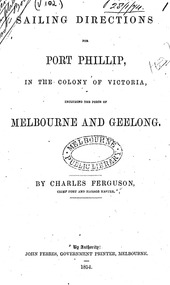
Booklet - Manual, Sailing directions for Port Phillip, in the colony of Victoria including the ports of Melbourne and Geelong, 1854
... notice. Already in 1852, when the overflowing of our gaol and stockade rendered the adoption of other methods of restraint absolutely necessary, and addition to the existing buildings could not be thought of, it was Captain Ferguson who first suggested the employment of hulks; and it was with his personal assistance and supervision, and under his unflagging energy, that the three first of these – the Success, the President, and the Sacramento – were purchased, fitted up, and made available for the purpose in view, and the rules and regulations for the employment and safety of the men afloat and ashore prescribed and carried out. ...notice. Already in 1852, when the overflowing of our gaol and stockade rendered the adoption of other methods of restraint absolutely necessary, and addition to the existing buildings could not be thought of, it was Captain Ferguson who first suggested the employment of hulks; and it was with his personal assistance and supervision, and under his unflagging energy, that the three first of these – the Success, the President, and the Sacramento – were purchased, fitted up, and made available for the purpose in view, and the rules and regulations for the employment and safety of the men afloat and ashore prescribed and carried out. ...Captain Charles Ferguson was born in Scotland in 1813. He was the Master of the "Rajah" from 1838 to 1850 on voyages from England to Australia and vice versa. He became the First Chief Harbour Master for the port of Melbourne in 1852 after being the first Harbour Master and Water Police Officer in Geelong for 12 months. On the 5th of April 1841, the Rajah sailed with James Donovan M.D. as Surgeon Superintendent, and the Rajah sailed from Woolwich with 180 female convicts. The Rajah arrived on the 19th of July in Hobart, with 179 females (one died during the voyage) and 10 children. Miss Kezia Elizabeth Hayter was the matron on board. On page 28 of the "Sailing directions for Port Phillip, in the colony of Victoria including the ports of Melbourne and Geelong", a mention is made of the Mariner's Hospital and Floating Church soon to be established. There were discussions to built the hospital in Williamstown but instead the Government decided to build it in Melbourne. The Harbour Master and a commiittee decided to use the water police hulk, Emily, left unsold in 1856, to create a floating church: the Bethel was open in July 1857 with Reverend Kerr Johnston as Chaplain. Latrobe wrote a letter to Captain Cole in 1869, a few months after learning his death : "To Captain George Ward Cole † [from a draft in another’s hand] Clapham House, Lewes, Sussex, January 28th, 1869. My dear Captain Cole, Last mail will have taken out the sad intelligence of the death of our excellent old friend, Captain Ferguson. This will have been a terrible blow to his children and to his friends in the colony, who may have held reason to expect his early return to his home, with a not unreasonable prospect of ultimate restoration to health and activity. In the course of last October I went up to town with one of my children, mainly with the purpose of finding my way to Pinner, where he and Mrs. Ferguson were staying with an intimate friend. I found him in excellent health and spirits, and enjoying the prospect of a speeding resumption of the service to which he had devoted his best days, and upon the furtherance of which his entire energy was still directed. A week or two later Captain and Mrs. Ferguson went to Dover for change of air, and being still under the impression received from the advisers by whom they had been guided during their residence at a hydropathic establishment at Matlock, felt encouraged to plan almost immediate return to the colony by the Jerusalem early in December. However, certain misgivings in the mind of a medical gentleman, then in England, under whose care Captain Ferguson had at one time placed himself in Williamtown, led them to consider it judicious before departure to take the advice of some surgeon of eminence in London. Accordingly they came up to town at the close of November. The first London practitioners they consulted shook their heads, and advised consultation with Sir Wm. Ferguson. The result was that amputation, without loss of time, was pronounced necessary. The rest is soon told. He received the painful intelligence with calmness and full resignation to God's will, and underwent the operation at King's College Hospital with exemplary firmness and Courage on the 28th of November. Perfect success seemingly attended it, and there seemed, humanly speaking, to be every prospect of a prompt cure and early convalescence; everything seemed in his favour. A few days later, however, all was clouded by symptoms of hospital fever (pyoe æm ia). This resisted all control, and finally carried him off on the 27th of December, just one month after the operation. He had lived a Christian life, and his death was the peaceful and resigned death of a Christian. It was a melancholy satisfaction to me to be able to join a few friends in following his remains to their resting place in one of the outlying London cemeteries on the last day of the year. You know Mrs Ferguson well, and will be prepared to hear me say that her whole conduct and demeanour throughout this period of suspense and bitter trial has been worthy of her high character and steadfast principle. Come what will, and happen what may, I have the fullest conviction that neither the widow nor the children will be forsaken, however doubtful and clouded the future may appear, in consequence of the irreparable loss which, they have sustained. And now, dear Captain Cole, it is possible that you may already have heard all this from other sources, but I have dictated it to you under strong impulse, for I feel assured that there is no member of the community in which you live who will more sincerely deplore the loss of Captain Ferguson on private grounds; at the same time that there is no one who, from long acquaintance with his official character and services, will be in a better position to estimate their real value or the loss which the colony has sustained. The circumstances in which Captain Ferguson's family are left not only demands the utmost display of sympathy and interest on the part of friends, but may call for decided and prompt action; therefore I cannot rest satisfied without discharging what I consider my duty, and seeking to strengthen your hands as far as I may in bringing the character of his long services before the existing colonial authorities. Of his private career previous to his entering the service of the Colonial Government in 1851 nothing need be said. Captain Ferguson was appointed as the Harbour Master at Geelong in April, 1851 – a few months before the separation of the colony from New South Wales. He there did excellent service in a variety of ways calculated to advance the interests of the port, and to introduce www.latrobesociety.org.au 27 order, where, from circumstances, but little order had hitherto prevailed. His was the first appointment of this class in that locality. The separation of the colony from New South Wales took place in the month of July following. Shortly after, the late Captain Bunbury resigned the Harbour Mastership of Port Phillip. Captain Ferguson was at once (February, 1852) appointed to succeed him, and from that time performed all duties of Chief Harbour Master of the colony. The previous year (May 1851) the first gold discoveries in New South Wales had taken place, and in the month of August those of our colony followed. At the time of Captain Ferguson’s taking charge of the Port of Melbourne their influence had begun to be fully felt, and in no department more seriously than in that of the Harbour Master. This is no place for statistical details, but they must bear me out in reminding you of a few facts connected with our late friend’s career. At the time of separation that department comprised only 30 individuals of all ranks, and when he took charge the number was much reduced. There were at that time, according to the returns, no fewer than 54 vessels, registering 26,785 tons, in Hobson’s Bay alone. The crews on arrival numbered 1,235 men. Of this number only 463 remained on board, 500 having deserted, and the rest having been discharged by arrangement or pure necessity. For the first six months after Captain Ferguson’s assumption of office as Harbour Master the duties of Police Magistrate and Chief of the Water Police were superadded, and how much labour they involved may be surmised from the fact that from 1st of April to the 31st July, 1852, four months only, no less than 236 marine cases were brought before the bench at Williamstown - sometimes as many as 30 in a day. A year later (March 1853) the returns show that the number of vessels in the harbour in Hobson’s Bay alone were 91, tonnage 43,754; and passing on to the still later returns of May, 1853, two years after Captain Ferguson’s assumption of office, we find from the records that the number of ships in port had increased to 129; tonnage, 63,292; crew on board on arrival, 2872, and at the date of report, 1628; the amount of desertions at that time having, however, proportionally diminished, in consequence of the abatement of the gold fever, caused by the non-success attendant upon the labours of thousands at the goldfields. The above numbers take no account of the large number of vessels and amount of tonnage lying at the wharves at Melbourne or elsewhere. From these figures alone it may be judged what must have been a struggle in which the Chief Harbour Master was engaged from the very outset to secure order, and answer the innumerable calls on every branch of his department, at the same time that there was for many months an almost complete impossibility of securing subordinate agency, such as boatmen, pilots, and police, at any price. But I may bear witness to the untiring diligence, energy, and self-devotion with which Captain Ferguson grappled with the difficulties of his position, and the seemingly insurmountable obstacles which stood in his way. Ashore and afloat he was always ready, showing the same directness of purpose, intelligence, and forgetfulness of self. He shunned no responsibility, and turned his hand from no work, whether within or beyond the ordinary scope of his duty, which the hard necessity of the times forced the Government to bring under his notice. Already in 1852, when the overflowing of our gaol and stockade rendered the adoption of other methods of restraint absolutely necessary, and addition to the existing buildings could not be thought of, it was Captain Ferguson who first suggested the employment of hulks; and it was with his personal assistance and supervision, and under his unflagging energy, that the three first of these – the Success, the President, and the Sacramento – were purchased, fitted up, and made available for the purpose in view, and the rules and regulations for the employment and safety of the men afloat and ashore prescribed and carried out. He carried the same energy into every branch of his department, and his influence was soon apparent. His subordinates of every class became actuated by his spirit. As time moved on, the range of his duties, both ordinary and extraordinary, increased. In the formation of the quarantine station at the heads, in the management if not the erection of lighthouses, sailing directions, port and wharf regulations, buoys, signal stations, www.latrobesociety.org.au 28 steam dredging &c., he was the main and most active agent. The whole pilot establishment and regulations, men, and vessels, were under his charge; and when I left the colony in May, 1854, the entire range of ports outside Port Phillip Heads from Point Lonsdale to Portland, as well as that of Geelong had felt the influence of his intelligent supervision and care. The entire department of Chief Harbour Master, which I have numbered at the period of separation about thirty individuals, then numbered 230. The character of Captain Ferguson’s unbroken service during the fourteen years which have elapsed since I left the colony must be well known to the Government and the people he has served so long and so faithfully. I confine myself to recalling to mind those earlier, and what must have been the hardest and most difficult, period – none can know how difficult but those who were in that fierce struggle for the maintenance of order under so many disadvantages; and on this subject I have spoken advisedly and with reason, for I may truly say he worked under my own eye. I had sincere regard for the man, and just pride in the qualities of his heart, head, and hand. Whatever mistakes may have been made by the Government of the colony in those hard and difficult times (and I am quite ready to admit that there were many, especially if the past is to be judged by the light of the present), I never have hesitated in believing that, in appointing Captain Ferguson to the office he has so long filled, it was the right man in the right place. I shall be heartily rejoiced to find that the Government and inhabitants of the colony admit that this has been the case, and to learn that they have not forgotten the strong claims of one who has served them so long and so faithfully, and who, removed by God’s providence, so to say, in the maturity of his powers, has left a widow and young family behind him. I have done, I leave you to make use of this communication, or any portion of it, which you may think judicious and called for. There may be among Ferguson’s friends those who may not be sorry to be reminded of facts. By-the-bye, I may mention as a proof how completely Captain Ferguson’s mind was engrossed by devotion to his public duty, that while in Dover, only ten days before the operation, he took an opportunity to drag himself up into the lantern of the S. Foreland Lighthouse, and made a most careful scrutiny of the whole apparatus and arrangement, with a view of the adoption of any hint for the perfection of those under his charge in the colony. And now, goodbye. I trust this will find you in good health, and in comparative vigour. Believe me ever, dear Captain Cole, Yours very truly, C. J. La Trobe"The attempt for a floating church was made as early as 1853 following similar examples in London like the Seamen's Hospital. Captain Ferguson was instrumental in the foundation of the Bethel Church.Digital copies of the 37 pages ; 22 cm.1854, hobsons bay, geelong, melbourne, williamstown, sandridge, mariner's hospital, floating church, seamen's hospital, captain charles ferguson (1813-1868), kezia elizabeth hayter (1818-1885), rajah quilt, prison hulks, water police, harbour master, harbor master, gaols -
Bendigo Historical Society Inc.
Document - The Victorian Country Volleyball Council (VCVC) Correspondence and Country Chapionship Reports, 1975
... Source: 2022 Country Championship regulations The management of the Country Championships by the Victorian Country Championship Commission certainly achieved the objective of raising the standard of presentation, and delivering a consistently high quality event. ...Volleyball has been played in regional Victoria since the early-1960’s. During those early days, most competitions, like the founders of our great sport, were run by, or in conjunction with, the YMCA. Competitions were running at the Ballarat School of Mines and the YMCA’s of Bendigo, Geelong and Warrnambool. In August 1966, an invitation was extended by the Victorian Amateur Volleyball Association to play in the first State-wide event at Monash University. Geelong and Bendigo accepted the invitation with Melbourne represented by Sisu. For Bendigo players at least, this was the first exposure to ‘international rules’, which prevented upward scoops with open hands, introduced an action called a ‘dig’ and seemed to penalise most overhead actions using the fingers as ‘double hits’! Over the next few years, the sport expanded through the YMCA movement with weekly competitions starting up in Ararat, Warrnambool and Latrobe Valley. The Victorian Regional Council of YMCA’s proposed the first Victorian YMCA Championship in Warrnambool on 30th March 1968 with an entry fee of $4.00 per team. The sport continued to grow with additional regional associations affiliating with the Victorian Amateur Volleyball Association (now VVI) who provided the coaching and refereeing assistance needed to raise the standard of play. In 1970, the YMCA Championships started to give way to the Victorian Country Championships with the first ever event held in Bendigo. In 1973, a re-organisation of the VAVA saw the proposal to create separate Victorian Country and Metropolitan Volleyball Councils. The VCVC was established in 1974 and took over the organisation of the Victorian Country Championships. For the next 10-12 years, the Country Championships grew in stature with the inclusion of two divisions for open men and women and junior divisions for boys and girls. Representative teams successfully contested Australian Country Championships between Victoria, South Australia and New South Wales on several occasions. In October 1985, the VCVC voluntarily wound up the Council and handed the responsibility for the Country Championships back to Volleyball Victoria, who by that time had full-time State Executive and Coaching Directors. Since that time, the Long Weekend in June has continued to be the date of the major annual volleyball event for most regional associations, even though in 1986 the Junior Country Championships were wound up in favour of state and national schools events. A number of regional associations have ceased to exist, as have a number of regional tournaments. Regional leagues were created in both the Gippsland and Central, North-West regions, with Gippsland the only one to survive. Some associations have successfully competed in the State League competitions at various times. Following the experience gained by a number of regional administrators working on the Sydney Olympic Games, a proposal to revamp the Victorian Country Championship was put to VVI in early 2002. Later that year, the Volleyball Victoria Country Championships Commission was formed to implement the recommendations of the review and take control of the event into the future. These championships now provide regional players and officials an opportunity to participate in a consistently well-managed event, using many international protocols and a high standard of presentation. Without doubt, this event now ranks as one of the best volleyball events in Australia. Source: 2022 Country Championship regulations The management of the Country Championships by the Victorian Country Championship Commission certainly achieved the objective of raising the standard of presentation, and delivering a consistently high quality event. However, the demands on Host Associations began to take their toll, with several Associations declining the opportunity to host the event due to the high workload. Similarly, the workload of the volunteer Commissioners also took its toll, with the Commission unable to fill casual vacancies. In 2023, the Commission handed the organisation of the Championships back to VVI, who with paid staff, were better equipped to manage the event.This item contains Correspondence of the Council in 1975 andreports on the Country Championships for that year; it include. the following documents: 11171.4a Three letters from VAVA Secretary Wolfgang Gollong 11171.4b Letter from Ballarat YMCA Volleyball Association 11171.4c Letter from Swan Hill Volleyball Association 11171.4d Letter from Geelong Amateur Volleyball Association 11171.4e Letter from Latrobe Valley Volleyball Association April 1975 11171.4f Letter from the Ballarat YMCA Volleyball Association 11171.4g Three letters from VAVA Secretary Wolfgang Gollong 11171.4h Letter to Joe Hiller re refereeing at the Country Championships 11171.4i Letter to Eric Hayman President of VAVA re Asian Championships 11171.4j Letter from Ballarat Volleyball re registration of players 11171.4k Letter from Bendigo YMCA Volleyball association list of office bearers 11171.4l Letter from Ballarat Volleyball re rule books 11171.4m Letter from Ballarat re referees for finals 11171.4n Letter from VAVA apology from Eric Hayman 11171.4o 1975 Country Championships Conditions 11171.4p 1975 Country Championships Teams Registration forms 11171.4q 1975 Country Championships Team entry forms 11171.4r Letters from VAVA re State Coaches 11171.4s Treasurer Report Sept 1975 11171.4t Letter to all associations re contact information 11171.4u Telegram from Swan Hill Volleyball 11171.4v Letter to VAVA Secretary re Meeting Wangaratta June 1975 11171.4w Notices from VAVA re Australian Tournaments 11171.4x List of Accommodation for Bendigo Country Championships 11171.4y VCVC Financial Statement 32 Aug 1976 11171.4z Two letters from VAVA Olympic team Appeal and Coaches Course 11171.4aa Agenda VCVC Meetings Morwell Dec 1975 11171.4ab Letter from Ballarat Volleyball re Australian Volleyball Constitution 11171.4ac VCVC List of Executive Contactsvictorian country volleyball council, vcvc, victorian amateur volleyball association, volleyball victoria -
Bendigo Historical Society Inc.
Document - The Victorian Country Volleyball Council (VCVC) Correspondence and Country Championship Reports, 1977
... Source: 2022 Country Championship regulations The management of the Country Championships by the Victorian Country Championship Commission certainly achieved the objective of raising the standard of presentation, and delivering a consistently high quality event. ...Volleyball has been played in regional Victoria since the early-1960’s. During those early days, most competitions, like the founders of our great sport, were run by, or in conjunction with, the YMCA. Competitions were running at the Ballarat School of Mines and the YMCA’s of Bendigo, Geelong and Warrnambool. In August 1966, an invitation was extended by the Victorian Amateur Volleyball Association to play in the first State-wide event at Monash University. Geelong and Bendigo accepted the invitation with Melbourne represented by Sisu. For Bendigo players at least, this was the first exposure to ‘international rules’, which prevented upward scoops with open hands, introduced an action called a ‘dig’ and seemed to penalise most overhead actions using the fingers as ‘double hits’! Over the next few years, the sport expanded through the YMCA movement with weekly competitions starting up in Ararat, Warrnambool and Latrobe Valley. The Victorian Regional Council of YMCA’s proposed the first Victorian YMCA Championship in Warrnambool on 30th March 1968 with an entry fee of $4.00 per team. The sport continued to grow with additional regional associations affiliating with the Victorian Amateur Volleyball Association (now VVI) who provided the coaching and refereeing assistance needed to raise the standard of play. In 1970, the YMCA Championships started to give way to the Victorian Country Championships with the first ever event held in Bendigo. In 1973, a re-organisation of the VAVA saw the proposal to create separate Victorian Country and Metropolitan Volleyball Councils. The VCVC was established in 1974 and took over the organisation of the Victorian Country Championships. For the next 10-12 years, the Country Championships grew in stature with the inclusion of two divisions for open men and women and junior divisions for boys and girls. Representative teams successfully contested Australian Country Championships between Victoria, South Australia and New South Wales on several occasions. In October 1985, the VCVC voluntarily wound up the Council and handed the responsibility for the Country Championships back to Volleyball Victoria, who by that time had full-time State Executive and Coaching Directors. Since that time, the Long Weekend in June has continued to be the date of the major annual volleyball event for most regional associations, even though in 1986 the Junior Country Championships were wound up in favour of state and national schools events. A number of regional associations have ceased to exist, as have a number of regional tournaments. Regional leagues were created in both the Gippsland and Central, North-West regions, with Gippsland the only one to survive. Some associations have successfully competed in the State League competitions at various times. Following the experience gained by a number of regional administrators working on the Sydney Olympic Games, a proposal to revamp the Victorian Country Championship was put to VVI in early 2002. Later that year, the Volleyball Victoria Country Championships Commission was formed to implement the recommendations of the review and take control of the event into the future. These championships now provide regional players and officials an opportunity to participate in a consistently well-managed event, using many international protocols and a high standard of presentation. Without doubt, this event now ranks as one of the best volleyball events in Australia. Source: 2022 Country Championship regulations The management of the Country Championships by the Victorian Country Championship Commission certainly achieved the objective of raising the standard of presentation, and delivering a consistently high quality event. However, the demands on Host Associations began to take their toll, with several Associations declining the opportunity to host the event due to the high workload. Similarly, the workload of the volunteer Commissioners also took its toll, with the Commission unable to fill casual vacancies. In 2023, the Commission handed the organisation of the Championships back to VVI, who with paid staff, were better equipped to manage the event.This item contains Correspondence of the Council in 1977 and reports on the Country Championships for that year; it includes the following documents: 11171.6a Letter from the Broken Hill YMCA Volleyball Association re tournament 11171.6b Letter from VAVA re State Coaches costs 11171.6c Circular of Fund Raising Proposals 11171.6d Letter from VAVA re Broken Hill Tournament 11171.6e Letter re amendments to the VAVA constitution 11171.6f Letter from Albury Wodonga wishing to enter the Country Championships 11171.6g Letter from Geelong Volleyball registration for Country Championships 11171.6h Circular - Sale of Rule Books 11171.6i Letter from VAVA re Rothmans Coaches Tour 11171.6j Letter from VAVA Secretary re championships, coaching and etc. 11171.6k VCVC Notice of AGM 11171.6l Letter from Latrobe Valley Volleyball with proposals for running the Country Championships 11171.6m Letters from Swan Hill and Ballarat re country Championships 11171.6n Letter from Goulburn Valley Volleyball 11171.6o Quotation from Waterwheel Press Shepparton 11171.6p Letters from VAVA to VCVC 11171.6q VCVC President's Report 1976-1977 11171.6r Letter from the Goulburn Valley Amateur Volleyball Association 11171.6s Letter from the Ararat and District YMCA Youth Clubs 11171.6t Letter from VAVA re Swan Hill Volleyball Association 11171.6u Letter to VAVA re Horsham and Warracknabeal Volleyball 11171.6v Letter to VCVC from Swan Hill Volleyball 11171.6w Letter from Wanganui Park High School 11171.6x Letter from the Ballarat Association 11171.6y Letter from Goulburn Valley Volleyball re coaching assistance 11171.6z Letter from Mrs Lozenicins re her son Arijs death 11171.6aa Letter from Ballarat Volleyball re Thomas Santamaria Coaching 11171.6ab Letter from Bob Kenter Latrobe Valley Volleyball Association (contact the BHS for details) 11171.6ac Letter from the Australian Volleyball Federation to VCVC President - news 11171.6ad Letter from VAVA to VCVC 11171.6ae Letter from VCVC President re coaching calendar for the year 11171.6af Letter from Wallabies Volleyball Club re Morwell tournament Grand Final 11171.6ag Letter from Goulburn Valley re Under 17 Country Championships 11171.6ah Letter from Warrnambool Association re services of Thomas Santamaria 11171.6ai Wallabies Volleyball Club re Russell Newman elected as Secretary 11171.6aj Letter from the Hamilton Memorial Stadium re their competition 11171.6ak Letter from Bendigo re rules of the Country Chamionships (Contact BHS for details) 11171.6al Letter to albury Wodonga Association re VCVC office bearers 11171.6am Letter from Murray Mansfield accepting his nomination for the VCVC Executive 11171.6an Letter to Tom Stevens Bendigo - thanks for his eork on the VCVC Constitution 11171.6ao Country Chamionships Entry and Registration forms 11171.6ap Procedure and Report on the VCVC 1977 Country Championships 11171.6aq Men's and Women's Volleyball Drawvictorian country volleyball council, vcvc, victorian amateur volleyball association, volleyball victoria -
Bendigo Historical Society Inc.
Document - The Victorian Country Volleyball Council (VCVC) Correspondence and Country Championship Reports, 1979
... Source: 2022 Country Championship regulations The management of the Country Championships by the Victorian Country Championship Commission certainly achieved the objective of raising the standard of presentation, and delivering a consistently high quality event. ...Volleyball has been played in regional Victoria since the early-1960’s. During those early days, most competitions, like the founders of our great sport, were run by, or in conjunction with, the YMCA. Competitions were running at the Ballarat School of Mines and the YMCA’s of Bendigo, Geelong and Warrnambool. In August 1966, an invitation was extended by the Victorian Amateur Volleyball Association to play in the first State-wide event at Monash University. Geelong and Bendigo accepted the invitation with Melbourne represented by Sisu. For Bendigo players at least, this was the first exposure to ‘international rules’, which prevented upward scoops with open hands, introduced an action called a ‘dig’ and seemed to penalise most overhead actions using the fingers as ‘double hits’! Over the next few years, the sport expanded through the YMCA movement with weekly competitions starting up in Ararat, Warrnambool and Latrobe Valley. The Victorian Regional Council of YMCA’s proposed the first Victorian YMCA Championship in Warrnambool on 30th March 1968 with an entry fee of $4.00 per team. The sport continued to grow with additional regional associations affiliating with the Victorian Amateur Volleyball Association (now VVI) who provided the coaching and refereeing assistance needed to raise the standard of play. In 1970, the YMCA Championships started to give way to the Victorian Country Championships with the first ever event held in Bendigo. In 1973, a re-organisation of the VAVA saw the proposal to create separate Victorian Country and Metropolitan Volleyball Councils. The VCVC was established in 1974 and took over the organisation of the Victorian Country Championships. For the next 10-12 years, the Country Championships grew in stature with the inclusion of two divisions for open men and women and junior divisions for boys and girls. Representative teams successfully contested Australian Country Championships between Victoria, South Australia and New South Wales on several occasions. In October 1985, the VCVC voluntarily wound up the Council and handed the responsibility for the Country Championships back to Volleyball Victoria, who by that time had full-time State Executive and Coaching Directors. Since that time, the Long Weekend in June has continued to be the date of the major annual volleyball event for most regional associations, even though in 1986 the Junior Country Championships were wound up in favour of state and national schools events. A number of regional associations have ceased to exist, as have a number of regional tournaments. Regional leagues were created in both the Gippsland and Central, North-West regions, with Gippsland the only one to survive. Some associations have successfully competed in the State League competitions at various times. Following the experience gained by a number of regional administrators working on the Sydney Olympic Games, a proposal to revamp the Victorian Country Championship was put to VVI in early 2002. Later that year, the Volleyball Victoria Country Championships Commission was formed to implement the recommendations of the review and take control of the event into the future. These championships now provide regional players and officials an opportunity to participate in a consistently well-managed event, using many international protocols and a high standard of presentation. Without doubt, this event now ranks as one of the best volleyball events in Australia. Source: 2022 Country Championship regulations The management of the Country Championships by the Victorian Country Championship Commission certainly achieved the objective of raising the standard of presentation, and delivering a consistently high quality event. However, the demands on Host Associations began to take their toll, with several Associations declining the opportunity to host the event due to the high workload. Similarly, the workload of the volunteer Commissioners also took its toll, with the Commission unable to fill casual vacancies. In 2023, the Commission handed the organisation of the Championships back to VVI, who with paid staff, were better equipped to manage the event.This item contains Correspondence of the Council in 1979 and reports on the Country Championships for that year; it includes the following documents: 11171.8a Department of Youth Sport and Recreation Courses for 1979 11171.8b From VAVA General Coaches Course Level 2 11171.8c VAVA Executive Officers List 11171.8d Letter from Ballarat asking for promotional posters 11171.8e To Mildura Volleyball re affiliation 11171.8f To Wangaratta Volleyball re costs for Country Championships 11171.8g To all associations re tournament rules and registration fees 11171.8h To all associations re VCVC Meeting March 1979 11171.8i Calendar of events for the VAVA Referee's Commission 11171.8j To VAVA re possible grant for U17 Championships at Wangaratta 11171.8k To Ann Mansfield re Volleyball Equipment stock 11171.8l Estonia Sports Club South Australia notication of annual tournament 11171.8m Country Volleyball Championships Team Entry Form 11171.8n From Geelong Volleyball asking for promotional posters 11171.8o To Kyneton Volleyball information for affiliation 11171.8p Australian Volleyball Federation advertising for coaches 11171.8q Wangaratta Volleyball Executive Details 11171.8r From J. A. Sporting Goods Price list 11171.8s To Horsham Volleyball re affiliation 11171.8t To Ararat Volleyball re affiliation 11171.8u Wangaratta U7 Championship referee's list and accomodation 11171.8v Notice of change of date of General Meeting 11171.8w Latrobe Valley Volleyball Association team colours 11171.8x 1979 Country Championships Shepparton list of accomodation 11171.8y Warrnambool Country Championships Team Entry Form 11171.8z From Goulburn Valley Volleyball contact details 11171.8aa From Kyneton Volleyball deference of affiliation 11171.8ab Notice of General Meeting at Wangaratta 11171.8ac Stawell Volleyball possible affiliation 11171.8ad Men's Volleyball draw 21-22 April 11171.8ae Wangaratta Volleyball U17 Championships Costs and schedule 11171.8af To Stawell Association re affiliation 11171.8ag VCVC Financial Statement 1978-79 11171.8ah VCVC Letter to the Shire of Nathalia 11171.8ai Letter re Fort Street Volleyball Club poaching players 11171.8aj Letter re Fort Street Volleyball Club poaching players 11171.8ak Letter to Coaches Commission re tournament 11171.8al VCVC Notice of general meeting in April 11171.8am VCVC re AGM Dates 1979 11171.8an VCVC re AGM Dates 1979 11171.8ao VCVC re AGM Dates 1979 11171.8ap Letter to Sports Services re design for tracksuit badge 11171.8aq VAVA Minutes of Executive Meeting Nov 1979 11171.8ar Country Championships Shaepparton Report 1979victorian country volleyball council, vcvc, victorian amateur volleyball association, volleyball victoria -
Bendigo Historical Society Inc.
Document - The Victorian Country Volleyball Council (VCVC) Correspondence and Country Championship Reports, 1982
... Source: 2022 Country Championship regulations The management of the Country Championships by the Victorian Country Championship Commission certainly achieved the objective of raising the standard of presentation, and delivering a consistently high quality event. ...Volleyball has been played in regional Victoria since the early-1960’s. During those early days, most competitions, like the founders of our great sport, were run by, or in conjunction with, the YMCA. Competitions were running at the Ballarat School of Mines and the YMCA’s of Bendigo, Geelong and Warrnambool. In August 1966, an invitation was extended by the Victorian Amateur Volleyball Association to play in the first State-wide event at Monash University. Geelong and Bendigo accepted the invitation with Melbourne represented by Sisu. For Bendigo players at least, this was the first exposure to ‘international rules’, which prevented upward scoops with open hands, introduced an action called a ‘dig’ and seemed to penalise most overhead actions using the fingers as ‘double hits’! Over the next few years, the sport expanded through the YMCA movement with weekly competitions starting up in Ararat, Warrnambool and Latrobe Valley. The Victorian Regional Council of YMCA’s proposed the first Victorian YMCA Championship in Warrnambool on 30th March 1968 with an entry fee of $4.00 per team. The sport continued to grow with additional regional associations affiliating with the Victorian Amateur Volleyball Association (now VVI) who provided the coaching and refereeing assistance needed to raise the standard of play. In 1970, the YMCA Championships started to give way to the Victorian Country Championships with the first ever event held in Bendigo. In 1973, a re-organisation of the VAVA saw the proposal to create separate Victorian Country and Metropolitan Volleyball Councils. The VCVC was established in 1974 and took over the organisation of the Victorian Country Championships. For the next 10-12 years, the Country Championships grew in stature with the inclusion of two divisions for open men and women and junior divisions for boys and girls. Representative teams successfully contested Australian Country Championships between Victoria, South Australia and New South Wales on several occasions. In October 1985, the VCVC voluntarily wound up the Council and handed the responsibility for the Country Championships back to Volleyball Victoria, who by that time had full-time State Executive and Coaching Directors. Since that time, the Long Weekend in June has continued to be the date of the major annual volleyball event for most regional associations, even though in 1986 the Junior Country Championships were wound up in favour of state and national schools events. A number of regional associations have ceased to exist, as have a number of regional tournaments. Regional leagues were created in both the Gippsland and Central, North-West regions, with Gippsland the only one to survive. Some associations have successfully competed in the State League competitions at various times. Following the experience gained by a number of regional administrators working on the Sydney Olympic Games, a proposal to revamp the Victorian Country Championship was put to VVI in early 2002. Later that year, the Volleyball Victoria Country Championships Commission was formed to implement the recommendations of the review and take control of the event into the future. These championships now provide regional players and officials an opportunity to participate in a consistently well-managed event, using many international protocols and a high standard of presentation. Without doubt, this event now ranks as one of the best volleyball events in Australia. Source: 2022 Country Championship regulations The management of the Country Championships by the Victorian Country Championship Commission certainly achieved the objective of raising the standard of presentation, and delivering a consistently high quality event. However, the demands on Host Associations began to take their toll, with several Associations declining the opportunity to host the event due to the high workload. Similarly, the workload of the volunteer Commissioners also took its toll, with the Commission unable to fill casual vacancies. In 2023, the Commission handed the organisation of the Championships back to VVI, who with paid staff, were better equipped to manage the event.This item contains Correspondence of the Council in 1982 and reports on the Country Championships for that year; it include. the following documents: 11171.13a Castlemaine Volleyball association acceptance of affiliation 11171.13b Mildura and Albury Wodonga Minutes of two day conference 11171.13c VAVA Executive Meeting Minutes Feb 1982 11171.13d VAVA Office bearers of the Stawell Volleyball Association 11171.13e VAVA to Albury Wodonga re Open Country Championships at Shepparton 11171.13f VAVA Notice on regionalisation 11171.13g VAVA re Olympic appeal 11171.13h VAVA Minutes o Executive Meeting May 1982 11171.13i VAVA Minutes of executive meeting June 1982 11171.13j VCVC Letter to Secretary re U17 Championships etc. 11171.13k VAVA re planning for future growth 11171.13l To all associations re registratiopn forms for completion 11171.13m To student re international rules book 11171.13n VCVC refund of bond for the country championships 11171.13o From Waveley Sisu Volleball Club re U15 Country Championships 11171.13p VCVC list of office bearers 11171.13q VCVC Claim for petty cah and etc. 11171.13r Letter of complaint from Latrobe Valley re draw for U20 Championships 11171.13s Goulburn Valley re fine for late application U20 Championships 11171.13t Bendigo YMCA Volleyball suggesting rules for eligibility to compete in championships 11171.13u To Warrnambool seeking report on the open country championships 11171.13v To Associations - flashes for representative playersvictorian country volleyball council, vcvc, victorian amateur volleyball association, volleyball victoria -
Bendigo Historical Society Inc.
Document - The Victorian Country Volleyball Council (VCVC) Correspondence and Country Championship Reports, 1983
... Source: 2022 Country Championship regulations The management of the Country Championships by the Victorian Country Championship Commission certainly achieved the objective of raising the standard of presentation, and delivering a consistently high quality event. ...Volleyball has been played in regional Victoria since the early-1960’s. During those early days, most competitions, like the founders of our great sport, were run by, or in conjunction with, the YMCA. Competitions were running at the Ballarat School of Mines and the YMCA’s of Bendigo, Geelong and Warrnambool. In August 1966, an invitation was extended by the Victorian Amateur Volleyball Association to play in the first State-wide event at Monash University. Geelong and Bendigo accepted the invitation with Melbourne represented by Sisu. For Bendigo players at least, this was the first exposure to ‘international rules’, which prevented upward scoops with open hands, introduced an action called a ‘dig’ and seemed to penalise most overhead actions using the fingers as ‘double hits’! Over the next few years, the sport expanded through the YMCA movement with weekly competitions starting up in Ararat, Warrnambool and Latrobe Valley. The Victorian Regional Council of YMCA’s proposed the first Victorian YMCA Championship in Warrnambool on 30th March 1968 with an entry fee of $4.00 per team. The sport continued to grow with additional regional associations affiliating with the Victorian Amateur Volleyball Association (now VVI) who provided the coaching and refereeing assistance needed to raise the standard of play. In 1970, the YMCA Championships started to give way to the Victorian Country Championships with the first ever event held in Bendigo. In 1973, a re-organisation of the VAVA saw the proposal to create separate Victorian Country and Metropolitan Volleyball Councils. The VCVC was established in 1974 and took over the organisation of the Victorian Country Championships. For the next 10-12 years, the Country Championships grew in stature with the inclusion of two divisions for open men and women and junior divisions for boys and girls. Representative teams successfully contested Australian Country Championships between Victoria, South Australia and New South Wales on several occasions. In October 1985, the VCVC voluntarily wound up the Council and handed the responsibility for the Country Championships back to Volleyball Victoria, who by that time had full-time State Executive and Coaching Directors. Since that time, the Long Weekend in June has continued to be the date of the major annual volleyball event for most regional associations, even though in 1986 the Junior Country Championships were wound up in favour of state and national schools events. A number of regional associations have ceased to exist, as have a number of regional tournaments. Regional leagues were created in both the Gippsland and Central, North-West regions, with Gippsland the only one to survive. Some associations have successfully competed in the State League competitions at various times. Following the experience gained by a number of regional administrators working on the Sydney Olympic Games, a proposal to revamp the Victorian Country Championship was put to VVI in early 2002. Later that year, the Volleyball Victoria Country Championships Commission was formed to implement the recommendations of the review and take control of the event into the future. These championships now provide regional players and officials an opportunity to participate in a consistently well-managed event, using many international protocols and a high standard of presentation. Without doubt, this event now ranks as one of the best volleyball events in Australia. Source: 2022 Country Championship regulations The management of the Country Championships by the Victorian Country Championship Commission certainly achieved the objective of raising the standard of presentation, and delivering a consistently high quality event. However, the demands on Host Associations began to take their toll, with several Associations declining the opportunity to host the event due to the high workload. Similarly, the workload of the volunteer Commissioners also took its toll, with the Commission unable to fill casual vacancies. In 2023, the Commission handed the organisation of the Championships back to VVI, who with paid staff, were better equipped to manage the event.This item contains Correspondence of the Council in 1983 and reports on the Country Championships for that year; it include. the following documents: 11171.14a Reports on the State U17 Championships 1983 11171.14b Constitution of the VCVC 1983 11171.14c Draft Inter Association transfers 11171.14d Volunteer Co-ordinators' Workshop Notice 11171.14e A proposal for the development of the Victorian Volleyball League 11171.14f National Volleyball League Proposal 11171.14g Executive Director's annual report and AGM minutes 11171.14h VAVA Executive Meeting April 1983 11171.14i Victorian Coaches Commission Course 11171.14j VCVC Annual report to VAVA Oct 1983 11171.14k State U15 Championship Entry form 11171.14l Kanyana Television Series Rules 11171.14m Kanyana Television Series invitation and glossary of sporting terms 11171.14n VAVA Meeting dates 11171.14o Notices of motion consitution changes VAVA 11171.14p VAVA Review of Budget Oct 1983 11171.14q Australia v Chinese Universities Volleyball Information 11171.14r Lightning Spike Cup Final Report 11171.14s VAVA Minutes of Executive Meeting May 1983 11171.14t VAVA Minutes of Executive Meeting Nov 1983 11171.14u VAVA Minutes of Executive Meeting July 1983 11171.14v VAVA Minutes of Executive Meeting Sept 1983 11171.14w VAVA Minutes of Executive Meeting Aug 1983 11171.14x VAVA Minutes of Executive Meeting June 1983 11171.14y VAVA Minutes of Executive Meeting Oct 1983 11171.14z VAVA Minutes of Executive Meeting Feb 1983 11171.14aa Notice of VAVA March 1983 11171.14ab Minutes of VAVA Executive Meeting Dec 1983 11171.14ac VAVA Minutes of Executive Meeting Dec 1983 11171.14ad VAVA Finacial Statement Dec 1983 11171.14ae VCVC Annual Report to VAVA 1982 to 1983victorian country volleyball council, vcvc, victorian amateur volleyball association, volleyball victoria -
Bendigo Historical Society Inc.
Document - The Victorian Country Volleyball Council (VCVC) Correspondence and Country Championship Reports, 1985
... 11171.16l VVI Finacial Statement March 1985 11171.16m VVI Financial Statement April 1985 11171.16n ERE Embroidery order 11171.16o To Seymour Volleyball account for trophy engraving 11171.16p Notice of AGM April 1985 11171.16q Bendigo YMCA Volleyball list of executive 11171.16r To all associations re executive lists update 11171.16s South Australian Volleyball requesting feedback 11171.16t Secretary petty cash advance 11171.16u Australain Volleyball Federation re National Country Championships 11171.16v NSW Volleyball association re Australian Country Volleyball Championships 11171.16w Kanyana Volleyball Club re Lightning Spike Cup clash 11171.16x Australian volleyball Federation re regulations 11171.16y Volleyball Victoria Newsletter June 1985 11171.16z VAVA to AVF Change of Address 11171.16aa VAVA Re Asian Qualifying Tournament Oct 1985 11171.16ab Back line spiker and serve rules 11171.16ac List of Country Associations and statistics 11171.16ad Albury Wodonga Association Australian Country Championships Report 11171.16ae NSW Volleyball Association re Wagga Wagga National Country Championships 11171.16af U20 Country Volleyball Championships report 1985 11171.16ah U20 Country Volleyball Championships Team entry forms - contact the BHS for details 11171.16ai VCVC AGM Agenda 11171.16aj VAVA Minutes of Executive Meeting April 1985 11171.16ak VAVA Minutes of Executive Meeting August 1985 11171.16al VAVA Minutes of Executive Meeting March 1985 11171.16am VAVA Minutes of Executive Meeting July1985 11171.16an VAVA Minutes of Executive Meeting June 1985 11171.16ao VAVA Minutes of Executive Meeting May 1985 11171.16ap VAVA Minutes of AGM Meeting April 1985 11171.16aq VAVA Financial Statement Aug 1985 11171.16ar VAVA Executive Meeting Agenda Sept 1985...Source: 2022 Country Championship regulations The management of the Country Championships by the Victorian Country Championship Commission certainly achieved the objective of raising the standard of presentation, and delivering a consistently high quality event. ...Volleyball has been played in regional Victoria since the early-1960’s. During those early days, most competitions, like the founders of our great sport, were run by, or in conjunction with, the YMCA. Competitions were running at the Ballarat School of Mines and the YMCA’s of Bendigo, Geelong and Warrnambool. In August 1966, an invitation was extended by the Victorian Amateur Volleyball Association to play in the first State-wide event at Monash University. Geelong and Bendigo accepted the invitation with Melbourne represented by Sisu. For Bendigo players at least, this was the first exposure to ‘international rules’, which prevented upward scoops with open hands, introduced an action called a ‘dig’ and seemed to penalise most overhead actions using the fingers as ‘double hits’! Over the next few years, the sport expanded through the YMCA movement with weekly competitions starting up in Ararat, Warrnambool and Latrobe Valley. The Victorian Regional Council of YMCA’s proposed the first Victorian YMCA Championship in Warrnambool on 30th March 1968 with an entry fee of $4.00 per team. The sport continued to grow with additional regional associations affiliating with the Victorian Amateur Volleyball Association (now VVI) who provided the coaching and refereeing assistance needed to raise the standard of play. In 1970, the YMCA Championships started to give way to the Victorian Country Championships with the first ever event held in Bendigo. In 1973, a re-organisation of the VAVA saw the proposal to create separate Victorian Country and Metropolitan Volleyball Councils. The VCVC was established in 1974 and took over the organisation of the Victorian Country Championships. For the next 10-12 years, the Country Championships grew in stature with the inclusion of two divisions for open men and women and junior divisions for boys and girls. Representative teams successfully contested Australian Country Championships between Victoria, South Australia and New South Wales on several occasions. In October 1985, the VCVC voluntarily wound up the Council and handed the responsibility for the Country Championships back to Volleyball Victoria, who by that time had full-time State Executive and Coaching Directors. Since that time, the Long Weekend in June has continued to be the date of the major annual volleyball event for most regional associations, even though in 1986 the Junior Country Championships were wound up in favour of state and national schools events. A number of regional associations have ceased to exist, as have a number of regional tournaments. Regional leagues were created in both the Gippsland and Central, North-West regions, with Gippsland the only one to survive. Some associations have successfully competed in the State League competitions at various times. Following the experience gained by a number of regional administrators working on the Sydney Olympic Games, a proposal to revamp the Victorian Country Championship was put to VVI in early 2002. Later that year, the Volleyball Victoria Country Championships Commission was formed to implement the recommendations of the review and take control of the event into the future. These championships now provide regional players and officials an opportunity to participate in a consistently well-managed event, using many international protocols and a high standard of presentation. Without doubt, this event now ranks as one of the best volleyball events in Australia. Source: 2022 Country Championship regulations The management of the Country Championships by the Victorian Country Championship Commission certainly achieved the objective of raising the standard of presentation, and delivering a consistently high quality event. However, the demands on Host Associations began to take their toll, with several Associations declining the opportunity to host the event due to the high workload. Similarly, the workload of the volunteer Commissioners also took its toll, with the Commission unable to fill casual vacancies. In 2023, the Commission handed the organisation of the Championships back to VVI, who with paid staff, were better equipped to manage the event.This item contains Correspondence of the Council in 1985 and reports on the Country Championships for that year; it include. the following documents: 11171.16a Victorian Open Country Championships Report 1985 11171.16b Victorian Open Country Championships Team Entries 1985 - Contact BHS for Details 11171.16c Seymour Volleyball invitation to BBQ 11171.16d VCVC to Australian Volleyball federation re Australian Country Championships 11171.16e To NSW Volleyball association re National Country Championships 11171.16f VAVA Executive List 11171.16g VCVC AGM List of attendees 11171.16h From Rosedale and District Volleyball Apology for AGM 11171.16i From TVA re non attendance at AGM 11171.16j Volleyball Victoria proposal for petrol reimbursements 11171.16k VVI Where did my fees go? 11171.16l VVI Finacial Statement March 1985 11171.16m VVI Financial Statement April 1985 11171.16n ERE Embroidery order 11171.16o To Seymour Volleyball account for trophy engraving 11171.16p Notice of AGM April 1985 11171.16q Bendigo YMCA Volleyball list of executive 11171.16r To all associations re executive lists update 11171.16s South Australian Volleyball requesting feedback 11171.16t Secretary petty cash advance 11171.16u Australain Volleyball Federation re National Country Championships 11171.16v NSW Volleyball association re Australian Country Volleyball Championships 11171.16w Kanyana Volleyball Club re Lightning Spike Cup clash 11171.16x Australian volleyball Federation re regulations 11171.16y Volleyball Victoria Newsletter June 1985 11171.16z VAVA to AVF Change of Address 11171.16aa VAVA Re Asian Qualifying Tournament Oct 1985 11171.16ab Back line spiker and serve rules 11171.16ac List of Country Associations and statistics 11171.16ad Albury Wodonga Association Australian Country Championships Report 11171.16ae NSW Volleyball Association re Wagga Wagga National Country Championships 11171.16af U20 Country Volleyball Championships report 1985 11171.16ah U20 Country Volleyball Championships Team entry forms - contact the BHS for details 11171.16ai VCVC AGM Agenda 11171.16aj VAVA Minutes of Executive Meeting April 1985 11171.16ak VAVA Minutes of Executive Meeting August 1985 11171.16al VAVA Minutes of Executive Meeting March 1985 11171.16am VAVA Minutes of Executive Meeting July1985 11171.16an VAVA Minutes of Executive Meeting June 1985 11171.16ao VAVA Minutes of Executive Meeting May 1985 11171.16ap VAVA Minutes of AGM Meeting April 1985 11171.16aq VAVA Financial Statement Aug 1985 11171.16ar VAVA Executive Meeting Agenda Sept 1985victorian country volleyball council, vcvc, victorian amateur volleyball association, volleyball victoria -
Bendigo Historical Society Inc.
Document - The Victorian Country Volleyball Council (VCVC) Australian Volleyball Federation (AVF) Reports, 1975-80
... Source: 2022 Country Championship regulations The management of the Country Championships by the Victorian Country Championship Commission certainly achieved the objective of raising the standard of presentation, and delivering a consistently high quality event. ...Volleyball has been played in regional Victoria since the early-1960’s. During those early days, most competitions, like the founders of our great sport, were run by, or in conjunction with, the YMCA. Competitions were running at the Ballarat School of Mines and the YMCA’s of Bendigo, Geelong and Warrnambool. In August 1966, an invitation was extended by the Victorian Amateur Volleyball Association to play in the first State-wide event at Monash University. Geelong and Bendigo accepted the invitation with Melbourne represented by Sisu. For Bendigo players at least, this was the first exposure to ‘international rules’, which prevented upward scoops with open hands, introduced an action called a ‘dig’ and seemed to penalise most overhead actions using the fingers as ‘double hits’! Over the next few years, the sport expanded through the YMCA movement with weekly competitions starting up in Ararat, Warrnambool and Latrobe Valley. The Victorian Regional Council of YMCA’s proposed the first Victorian YMCA Championship in Warrnambool on 30th March 1968 with an entry fee of $4.00 per team. The sport continued to grow with additional regional associations affiliating with the Victorian Amateur Volleyball Association (now VVI) who provided the coaching and refereeing assistance needed to raise the standard of play. In 1970, the YMCA Championships started to give way to the Victorian Country Championships with the first ever event held in Bendigo. In 1973, a re-organisation of the VAVA saw the proposal to create separate Victorian Country and Metropolitan Volleyball Councils. The VCVC was established in 1974 and took over the organisation of the Victorian Country Championships. For the next 10-12 years, the Country Championships grew in stature with the inclusion of two divisions for open men and women and junior divisions for boys and girls. Representative teams successfully contested Australian Country Championships between Victoria, South Australia and New South Wales on several occasions. In October 1985, the VCVC voluntarily wound up the Council and handed the responsibility for the Country Championships back to Volleyball Victoria, who by that time had full-time State Executive and Coaching Directors. Since that time, the Long Weekend in June has continued to be the date of the major annual volleyball event for most regional associations, even though in 1986 the Junior Country Championships were wound up in favour of state and national schools events. A number of regional associations have ceased to exist, as have a number of regional tournaments. Regional leagues were created in both the Gippsland and Central, North-West regions, with Gippsland the only one to survive. Some associations have successfully competed in the State League competitions at various times. Following the experience gained by a number of regional administrators working on the Sydney Olympic Games, a proposal to revamp the Victorian Country Championship was put to VVI in early 2002. Later that year, the Volleyball Victoria Country Championships Commission was formed to implement the recommendations of the review and take control of the event into the future. These championships now provide regional players and officials an opportunity to participate in a consistently well-managed event, using many international protocols and a high standard of presentation. Without doubt, this event now ranks as one of the best volleyball events in Australia. Source: 2022 Country Championship regulations The management of the Country Championships by the Victorian Country Championship Commission certainly achieved the objective of raising the standard of presentation, and delivering a consistently high quality event. However, the demands on Host Associations began to take their toll, with several Associations declining the opportunity to host the event due to the high workload. Similarly, the workload of the volunteer Commissioners also took its toll, with the Commission unable to fill casual vacancies. In 2023, the Commission handed the organisation of the Championships back to VVI, who with paid staff, were better equipped to manage the event.This item contains Correspondence of the Council in 1979 and 1980 and reports from the Australian Volleyball Federation; it include. the following documents: 11171.20a AVF 2nd Oceania Championships New Zealand - National Coach required 1976 11171.20b AVF 2nd Oceania Championships New Zealand - Team Managers required 1976 11171.20c AVF Newsletter 7/75 11171.20d AVF Newsletter 6/75 11171.20e AVF Info sheet 1st Asian Volleyball Championships Aug 1975 11171.20f AVF Statements June 1977 11171.20g AVF Order form for Volleyball publications 11171.20h Notice for Australian Championships Mar-Apr 1975 Albert Park 11171.20i First Asian Volleyball Championships Guidelines 11171.20j AVF By-laws 11171.20k AVF Record Secretary's Report 1976-77 and Executive Meeting Jan 1977 11171.20l AVF Constitution and By-laws 11171.20m AVF Statements 1977 to 1978 11171.20n AVF notices of Rule interpretation from international 11171.20o Executive Meeting Minutes Nov 1979 11171.20p Executive Meeting Minutes June 1980 11171.20q General assembly, Bahrain Report Dec 1979 11171.20r AVF Executive Meeting Feb 1979 11171.20s AVF Executive Meeting March 1979 11171.20t AVF Planning Seminar Feb 1980 11171.20u AVF Discussion Paper by John Ostermweyer, National Executive Director, April 1980 11171.20v Report on australian Tour of Japan National Women's team April 1980 11171.20w Referees Commission Newsletter Jan 1980 11171.20x General Newsletter 1980 11171.20y Bahrain General Assembly Report Dec 1979 11171.20z AVF General Meeting 1980victorian country volleyball council, vcvc, victorian amateur volleyball association, volleyball victoria -
 Bendigo Historical Society Inc.
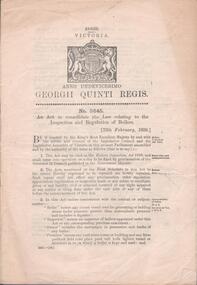
Document - MINING REPORTS - BOILERS INSPECTION ACT 1928
... Printed document Inspection and Regulation of Boilers, dated 12th February 1929, No 3645 which sets out rules and regulations for the ownership and use of boilers. ...DOCUMENT Mining Reports Boilers Inspection Act 1928 T Rider Printed document Inspection and Regulation of Boilers, dated 12th February 1929, No 3645 which sets out rules and regulations for the ownership and use of boilers. ...Printed document Inspection and Regulation of Boilers, dated 12th February 1929, No 3645 which sets out rules and regulations for the ownership and use of boilers. Items mentioned are: Inspectors, Registration of Boilers, Inspection of Boilers, Certificate of Inspection, Powers and Duties of Inspectors, Necessity for Certificate, Notice f Alterations, Duties and Liabilities of Owners of Boilers and Others, Explosions and Accidents and Miscellaneous. Also Schedules. First Schedule is the Number and Title of Act, Second Schedule is Notice of Registration, Third Schedule is Certificate of Inspection, Fourth Schedule is certificate stating the number of lbs. per square inch the safety valve blows off, Fifth Schedule is Notice to Owner that Boiler is Dangerous and Sixth Schedule is a Report with regard to Explosion of or Accident causing damage or injury to a Steam Boiler. Document is part of the Albert Richardson Collection. document, mining reports, boilers inspection act 1928, t rider -
 Stawell Historical Society Inc
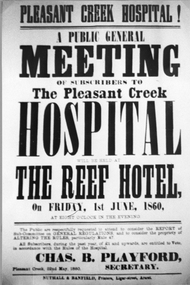
Photograph, Stawell Hospital Meeting Notice 1860
... Notice on Friday 1st June 1860. stawell Pleasant Creek Hospital ! A Public General MEETING of subscribers to The Pleasant Creek HOSPITAL will be held at THE REEF HOTEL, on Friday. 1st June, 1860. at eight o'clock in the evening The public are respectfully requested to attend to consider the REPORT of Sub-Committee on GENERAL REGULATIONS and to consider the property of ALTERNING THE RULES PARTICULARLU Rule 47. ...Photograph of Stawell Hospital Meeting Notice on Friday 1st June 1860. Photograph of a public meeting notice Pleasant Creek Hospital ! A Public General MEETING of subscribers to The Pleasant Creek HOSPITAL will be held at THE REEF HOTEL, on Friday. 1st June, 1860. at eight o'clock in the evening The public are respectfully requested to attend to consider the REPORT of Sub-Committee on GENERAL REGULATIONS and to consider the property of ALTERNING THE RULES PARTICULARLU Rule 47. All Subscribers during the past year of One pound and upwards are entitled to Vote in accordance with the Rules of the Hospital. CHAS. B. PLAYFORD, Secretary. Pleasant Creek, 22nd May, 1860. Nuthall & Banfield, Printers, Ligar-Street, Ararat. stawell -
 Clunes Museum
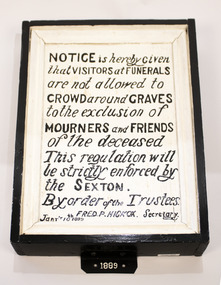
Memorabilia - NOTICE BOARD, 1889
... Hickox, Secretary, Janry 10th 1889" Wooden notice board, painted, black border, cream background, with raised black writing, stating rules of conduct of visitors to cemetery funerals. ...Notice at cemetery 1889Wooden notice board, painted, black border, cream background, with raised black writing, stating rules of conduct of visitors to cemetery funerals. Signed by F. Hickox, Secretary, 1889. Metal angle brackets, painted black, situated top and bottom, year painted on bottom bracket."Notice is hereby given that visitors at funerals are not allowed to crowd around graves to the exclusion of mourners and friends of the deceased. This regulation will be strickly enforced by the Sexton. By Order of the trustees, Fred P. Hickox, Secretary, Janry 10th 1889"clunes cemetery, noticeboard -
Clunes Museum
Manual - CONSTITUTION AND RULES
... .1 BOOKLET, MT PROSPECT DISTRICT TENNIS ASS, CONSTITUTION AMD RULES .2 NOTICE OF EXTRAORDINARY GENERAL MEETING 6 OCTOBER 1988 .3 BASIC RULES AND REGULATIONS MT. ...TENNIS CONSTITUTION JUNIOR RULES AND REGULATION MT PROSPECT DISTRICT TENNIS ASSOCIATION .1 BOOKLET, MT PROSPECT DISTRICT TENNIS ASS, CONSTITUTION AMD RULES .2 NOTICE OF EXTRAORDINARY GENERAL MEETING 6 OCTOBER 1988 .3 BASIC RULES AND REGULATIONS MT. ....1 BOOKLET, MT PROSPECT DISTRICT TENNIS ASS, CONSTITUTION AMD RULES .2 NOTICE OF EXTRAORDINARY GENERAL MEETING 6 OCTOBER 1988 .3 BASIC RULES AND REGULATIONS MT. PROSPECT TENNIS ASSOCIATION .4 EMPTY RESULT SHEET MT PROSPECT TENNIS ASStennis constitution, junior rules and regulation, mt prospect district tennis association -
 Tarnagulla History Archive
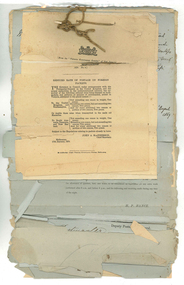
Stack of circulars & notices, Sandy Creek Post Office, 1860-1880
... for correspondence and other regulations. Bound together at top by a piece of twine....Contents relate to rates and fees, rules for correspondence and other regulations. Bound together at top by a piece of twine. Stack of circulars & notices, Sandy Creek Post Office ...Donald Clark Collection. A stack of circulars, letters and notices pertaining to post office operations which was used at Sandy Creek Post Office, most dating to the 1860s and 1870s. Contents relate to rates and fees, rules for correspondence and other regulations. Bound together at top by a piece of twine.tarnagulla, sandy creek, post office, postal regulations, correspondence -
 City of Melbourne Libraries
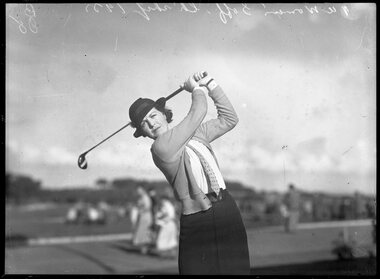
Photograph, Bull, Hugh Jones, 1897-1993, Miss Katherine Rymill
... rule regarding the wearing of stockings in official associates’ golf matches. Though the Long Reef competitor’s long skirt and golf socks almost hid her sun-tanned legs from view, an eagle-eyed official had noticed the absence of regulation covering and she and her partner were disqualified. ...rule regarding the wearing of stockings in official associates’ golf matches. Though the Long Reef competitor’s long skirt and golf socks almost hid her sun-tanned legs from view, an eagle-eyed official had noticed the absence of regulation covering and she and her partner were disqualified. ...Stylishly dressed in trilby, neck-tie and leather belt, champion Adelaidian golfer Katherine Rymill practises her drive at Royal Melbourne Golf Course. Katherine Rymill (1913-2008) won the Royal Adelaide championships in 1934, 1935 and 1937. Commenting on the NSW “no stockings” controversy of 1935, she said, “In England, players are allowed to appear without stockings in summer and to wear “slacks” in the winter… Playing without stockings makes no difference to one’s performance and it is certainly cooler...” Katherine worked for the Red Cross during WWII and continued to play golf throughout her life. MCK116 Published The Age 29 August 1935 Featured in "Newsworthy: Melbourne in photographs 1933-1936" exhibition at East Melbourne Library, October to December 2023. Exhibition caption by project volunteer, Fiona Collyer. Published: The Age 29 August 1935 p. 11 Published title: SIX STATE CHAMPIONS IN NATIONAL GOLF CHAMPIONSHIP. Published caption: Six State champions for the first time in the history of women’s golf are competing in the matches for the Australian title. — 1. Miss B. Sale (Tas.). 2. Miss J. Hood-Hammond (N.S.W.). 3. Miss J. Gardiner (Qld,) 4. Miss K. Rymill (S.A.). 5. Mrs. O. J. Negus (W.A.). 6. Mrs. S. Morpeth (Vic.) RESEARCHER'S NOTE: The Age listed Golfer 1 as Miss B. Sale and Golfer 4 as Miss K. Rymill. We verified that these should in fact be the other way around: 1 is Miss K. Rymill, 4 is Miss B. Sale. Description: Action shot of woman driving golf ball Research by project volunteer, Fiona Collyer: MISS KATHERINE LUCY RYMILL (1913–2008) Katherine was a champion South Australian golfer. She won the Royal Adelaide championships in 1934, 1935 and 1937. She competed in the Australian Women’s Golf Championships at Royal Melbourne in 1935 against British women golfers and was eliminated by Mrs T S McKay nee Odette Lebebvre. Katherine was from a prominent and wealthy Adelaide family and her social activities and golfing career was closely followed in the local papers. Her mother, Shylee Rymill, was the S.A. Girl Guides’ Commissioner from 1935-1950. Her father H.L. (Cargie) Rymill grew up in a Dutch Renaissance style mansion called “The Firs” in East Terrace, Adelaide (now called Rymill House and State heritage listed), and designed Kooyonga, Seaton, Grange, Glenelg and Mount Lofty golf courses. Both parents were champion golfers and have tournaments named after them. Katherine worked for the Red Cross during WWII. In 1935, for the first time in NSW, the Ladies Golf Union (L.G.V.) enforced their rule regarding the wearing of stockings in official associates’ golf matches. Though the Long Reef competitor’s long skirt and golf socks almost hid her sun-tanned legs from view, an eagle-eyed official had noticed the absence of regulation covering and she and her partner were disqualified. Commenting on the Long Reef “no stockings” controversy, Katherine said “In England, players are allowed to appear without stockings in summer and to wear “slacks” in the winter.” “Playing without stockings makes no difference to one’s performance and it is certainly cooler. However, rules which are formed must be obeyed and that seems all there is to say about it.” Katherine continued to play golf throughout her life and died in 2008.Photographer notations on slide: "Vic Womens Golf Ch'ship 1935 B98".golf, women golfers, royal melbourne golf club
