
Showing 9 items matching "nurses-attitudes"
-
 Alfred Hospital Nurses League - Nursing History Collection
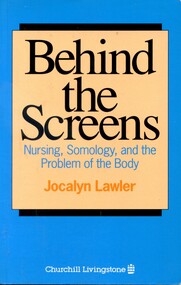
Book - Textbook, Jocalyn Lawler 1949-2026, Behind the screens: nursing, somology, and the problem of the body, 1991
... ...Nurses-attitudes...The term somology provides nursing with a language to describe the crucial social components of skilled nursing care Of significance as it explores an aspect of nursing not often discussed Nursing-psychological aspects Somesthesia Somology Nurse and patient Nurses-attitudes nusrses-psychology nursing kinesics body image Behind the screens is a book about nursing. ...Behind the screens is a book about nursing. It sheds light on the fundamental aspects of basic nursing that have previously been hidden, or taken for granted. The essence of these practices has not been regarded as formal knowledge, partly because there has been no formal language to describe them. Experienced and beginning practitioners will identify with many aspects of this discussionBook with blue binding. Front cover has publisher's name and logo printed at base [white ink] Title [black and blue ink] and author [orange ink] are printed on a pale orange square with a thick black line above and below.Title, author's surname and publisher's logo printed on spine [white ink] non-fiction Behind the screens is a book about nursing. It sheds light on the fundamental aspects of basic nursing that have previously been hidden, or taken for granted. The essence of these practices has not been regarded as formal knowledge, partly because there has been no formal language to describe them. Experienced and beginning practitioners will identify with many aspects of this discussion nursing-psychological aspects, somesthesia, somology, nurse and patient, nurses-attitudes, nusrses-psychology, nursing, kinesics, body image -
 The Beechworth Burke Museum
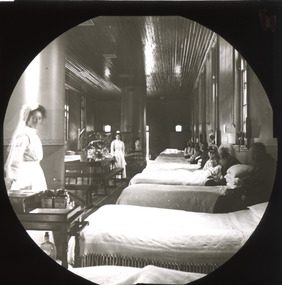
Photograph - Lantern Slide, c1900
... This glass slide is socially and historically significant as it is representative of the lives of the nurses and patients at Beechworth Mayday Hills Asylum in the early twentieth century. It is also historically significant as it is representative of the changing style of treatments and attitudes towards mental illness. ...This glass slide captures a scene from a male hospital ward at Mayday Hills Mental Asylum. Also known as the Beechworth Lunatic Asylum, Mayday Hills was officially opened on the twenty-fourth of October 1867 and was commissioned following lobbying from Beechworth Municipal Council concerning a need for better living conditions for individuals confined to the town's gaol. These individuals, as well as many others who were brought from surrounding institutions, exhibited behaviours that were deemed to be unfit for mainstream society. At its peak, the asylum consisted of sixty-seven buildings and housed over twelve-hundred patients and five-hundred staff. At the time of Australian Federation in 1901 - just a year after this photograph was taken - the patient population numbered six-hundred and seventy-four. The asylum was officially closed in 1996. It is listed on the Victorian Heritage Register as being architecturally significant. The extensive complex of buildings are examples of Italianate-style, which is strongly associated with asylums of the 1860s - the period in which construction of this particular asylum began. Today the asylum offers tours to visitors, including daytime history tours and night-time ghost tours. Lantern slides, sometimes called 'magic lantern' slides, are glass plates on which an image has been secured for the purpose of projection. Glass slides were etched or hand-painted for this purpose from the Eighteenth Century but the process became more popular and accessible to the public with the development of photographic-emulsion slides used with a 'Magic Lantern' device in the mid-Nineteenth Century. Photographic lantern slides comprise a double-negative emulsion layer (forming a positive image) between thin glass plates that are bound together. A number of processes existed to form and bind the emulsion layer to the base plate, including the albumen, wet plate collodion, gelatine dry plate and woodburytype techniques. Lantern slides and magic lantern technologies are seen as foundational precursors to the development of modern photography and film-making techniques. This glass slide is socially and historically significant as it is representative of the lives of the nurses and patients at Beechworth Mayday Hills Asylum in the early twentieth century. It is also historically significant as it is representative of the changing style of treatments and attitudes towards mental illness. Thin translucent sheet of glass with a circular image printed on the front and framed in a black backing. It is held together by metal strips to secure the edges of the slide. Obverse: h / lantern slide, slide, glass slide, plate, burke museum collection, photograph, monochrome, mayday hills, mayday hills hospital, mayday hills asylum, beechworth lunatic asylum, beechworth mental asylum, psychiatric hostpital, beechworth, burke museum, beechworth municipal council, beechworth patients, psychiatric patients, victorian heritage register, 1900, 1900 mayday hills, italianate style, 19th century asylums, asylums victoria, male ward mayday hills -
 Bendigo Historical Society Inc.
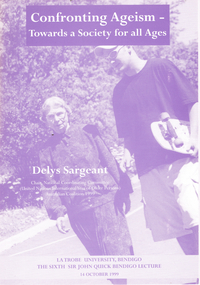
Book - LONG GULLY HISTORY GROUP COLLECTION: CONFRONTING AGEISM
... The book mentions the attitudes to aging from various members of the community including health care workers, nurses and nursing teachers and doctors....The book mentions the attitudes to aging from various members of the community including health care workers, nurses and nursing teachers and doctors. ...Book titled Confronting Ageism - Towards a Society for all Ages. By Delys Sargeant, Chair, National Coordinating Committee (United Nations International Year of Older Persons) Australian Coalition 1999. La Trobe University, Bendigo. The Sixth Sir John Quick Bendigo Lecture 14 October 1999. Book has a purple tone front cover with an older lady and a young man with a skateboard walking along a path. The book mentions the attitudes to aging from various members of the community including health care workers, nurses and nursing teachers and doctors. bendigo, history, long gully history group, the long gully history group - confronting ageism - towards a society for all ages, delys sargeant, united nations international year of older persons, la trobe university, the sixth sir john quick bendigo lecture, kofi annan, institute of family studies, ageism & nursing practice in australia, john stevens, jan herbert, valerie braithwaite, robert lynd-stevenson, derek pigrak, paul coulthard, d g le couteur, a s bansal, d a price, university of queensland, victor minichiello, colette browning, rosalie aroni, loris alexander, deidre ones, prentice hall, beissner, luscz, palmore, chris phillipson, alan walker, john stevens, jan herbert, royal college of nursing, bradley fisher, constance peterson, lindsay gething, university of melbourne, social biology resources centre now the centre for social health, allen & unwin, john sargeant -
 National Vietnam Veterans Museum (NVVM)
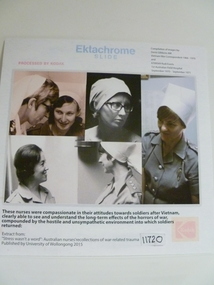
Film, Stress wasn't a word, 1970-71 (estimate)
... These nurses were compassionate in their attitudes towards solders after Vietnam, clearly able to see and understand the long-term effects of the horrors of war, compounded by the hostile and unsympathetic environment into which soldiers returned. ...1st Australian Field Hospital Nurses - Vietnam These nurses were compassionate in their attitudes towards solders after Vietnam, clearly able to see and understand the long-term effects of the horrors of war, compounded by the hostile and unsympathetic environment into which soldiers returned. ...Ektachrome slide image. A compilation of Photograph of nurses (5), 6 nursing staff, pictured in various poses/occupations. Photographed by War Correspondent 1966-1970 Denis Gibbons & Rudi Everts. These nurses were compassionate in their attitudes towards solders after Vietnam, clearly able to see and understand the long-term effects of the horrors of war, compounded by the hostile and unsympathetic environment into which soldiers returned. (Estract from: "Stress wasn't a word" Australian nurses' recollections of ware related trauma.) 1st australian field hospital, nurses - vietnam -
 Kew Historical Society Inc
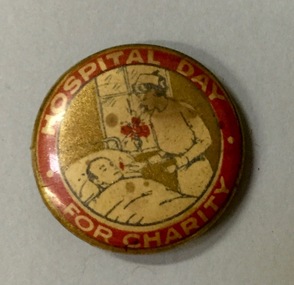
Badge - Fundraising Button, Hospital Day for Charity, 1916
... attitudes and values of the period in which they were produced. Their widespread distribution means that they are frequently significant at a local, state, national and international level. hospital day for charity fundraising buttons badges "Hospital Day/ for Charity" This patriotic fundraising button was produced in 1916 and released on 20 October on behalf of hospitals. The organisers intended to release a quarter of a million buttons at a cost of 1/ each. The badge has a red outer rim with the name of the appeal in white. The image at the centre of the button includes a nurse ...Frances Rigg was a local business identity in Kew, at one stage managing the local branch of the English, Scottish and Australian (ES&A) Bank at 175 High Street from c. 1920 until the 1940s. After Francis Rigg’s death, the collection of buttons and medallions was inherited by his son, Ken Rigg (1922-2014). The collection was subsequently donated to the Kew Historical Society in 2015 by Francis' grandson, Adrian Rigg, at the time of the Gallipoli & Beyond Commemoration in 2015. The collection covers a period of almost 40 years. The majority of the buttons are patriotic buttons, issued and sold during and immediately after the First World World War (1914-1918) to raise funds for national and overseas causes. The collection also includes a number of locally significant sporting event buttons and sporting club medallions, issued in the 1920s and 1930s. Patriotic and other pressed tin buttons and badges were produced in large numbers in the first decades of the twentieth century. By nature, insubstantial and ephemeral, they have not always survived. The collections of badges, buttons and medallions in the Kew Historical Society collection is homogenous and yet diverse, ranging from buttons sold to raise funds for the war efforts in 1914-18 and 1939-45, to those used at festivals and sporting events. Because of the manufacturing process, many surviving buttons and badges have been affected by inadequate storage, suffering from oxidisation and physical damage. These survivors are now historically and socially significant artefacts, revealing much about the attitudes and values of the period in which they were produced. Their widespread distribution means that they are frequently significant at a local, state, national and international level. This patriotic fundraising button was produced in 1916 and released on 20 October on behalf of hospitals. The organisers intended to release a quarter of a million buttons at a cost of 1/ each. The badge has a red outer rim with the name of the appeal in white. The image at the centre of the button includes a nurse bending over a patient in a sick bed. "Hospital Day/ for Charity" hospital day for charity, fundraising buttons, badges -
 Kew Historical Society Inc
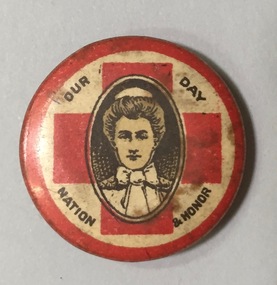
Badge - Fundraising Button, Our Day Nation & Honor, 1915-1919
... attitudes and values of the period in which they were produced. Their widespread distribution means that they are frequently significant at a local, state, national and international level. patriotic buttons first world war (1914-18) badges "Our Day / Nation & Honor" A First World War button inscribed ‘Our Day Nation & Honour’, and featuring an image of British nurse Edith Louisa Cavell, who died at the hands of a German firing squad in 1915. ...Frances Rigg was a local business identity in Kew, at one stage managing the local branch of the English, Scottish and Australian (ES&A) Bank at 175 High Street from c. 1920 until the 1940s. After Francis Rigg’s death, the collection of buttons and medallions was inherited by his son, Ken Rigg (1922-2014). The collection was subsequently donated to the Kew Historical Society in 2015 by Francis' grandson, Adrian Rigg, at the time of the Gallipoli & Beyond Commemoration in 2015. The collection covers a period of almost 40 years. The majority of the buttons are patriotic buttons, issued and sold during and immediately after the First World World War (1914-1918) to raise funds for national and overseas causes. The collection also includes a number of locally significant sporting event buttons and sporting club medallions, issued in the 1920s and 1930s. Patriotic and other pressed tin buttons and badges were produced in large numbers in the first decades of the twentieth century. By nature, insubstantial and ephemeral, they have not always survived. The collections of badges, buttons and medallions in the Kew Historical Society collection is homogenous and yet diverse, ranging from buttons sold to raise funds for the war efforts in 1914-18 and 1939-45, to those used at festivals and sporting events. Because of the manufacturing process, many surviving buttons and badges have been affected by inadequate storage, suffering from oxidisation and physical damage. These survivors are now historically and socially significant artefacts, revealing much about the attitudes and values of the period in which they were produced. Their widespread distribution means that they are frequently significant at a local, state, national and international level. A First World War button inscribed ‘Our Day Nation & Honour’, and featuring an image of British nurse Edith Louisa Cavell, who died at the hands of a German firing squad in 1915. She became a heroic figure of sacrifice in World War I, and was used to increase military recruitment in Britain and win support for the war in the United States. "Our Day / Nation & Honor" patriotic buttons, first world war (1914-18), badges -
 Kew Historical Society Inc
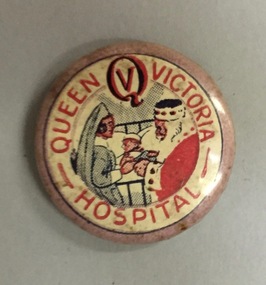
Badge - Fundraising Button, Queen Victoria Hospital, 1914-1923
... attitudes and values of the period in which they were produced. Their widespread distribution means that they are frequently significant at a local, state, national and international level. queen victoria hospital patriotic buttons badges "QV / Queen Victoria Hospital" Small circular pressed tinplate badge, produces for fundraising purposes featuring an image of Santa Claus and a nurse beside a hospital bed. ...Frances Rigg was a local business identity in Kew, at one stage managing the local branch of the English, Scottish and Australian (ES&A) Bank at 175 High Street from c. 1920 until the 1940s. After Francis Rigg’s death, the collection of buttons and medallions was inherited by his son, Ken Rigg (1922-2014). The collection was subsequently donated to the Kew Historical Society in 2015 by Francis' grandson, Adrian Rigg, at the time of the Gallipoli & Beyond Commemoration in 2015. The collection covers a period of almost 40 years. The majority of the buttons are patriotic buttons, issued and sold during and immediately after the First World World War (1914-1918) to raise funds for national and overseas causes. The collection also includes a number of locally significant sporting event buttons and sporting club medallions, issued in the 1920s and 1930s. Patriotic and other pressed tin buttons and badges were produced in large numbers in the first decades of the twentieth century. By nature, insubstantial and ephemeral, they have not always survived. The collections of badges, buttons and medallions in the Kew Historical Society collection is homogenous and yet diverse, ranging from buttons sold to raise funds for the war efforts in 1914-18 and 1939-45, to those used at festivals and sporting events. Because of the manufacturing process, many surviving buttons and badges have been affected by inadequate storage, suffering from oxidisation and physical damage. These survivors are now historically and socially significant artefacts, revealing much about the attitudes and values of the period in which they were produced. Their widespread distribution means that they are frequently significant at a local, state, national and international level. Small circular pressed tinplate badge, produces for fundraising purposes featuring an image of Santa Claus and a nurse beside a hospital bed. The words Queen Victoria Hospital surround the image. "QV / Queen Victoria Hospital" queen victoria hospital, patriotic buttons, badges -
 Returned Nurses RSL Sub-branch
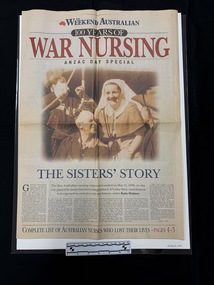
Newspaper - Newspaper lift out, The Weekend Australian et al, 100 years of War Nursing : ANZAC Day Special, 19990424
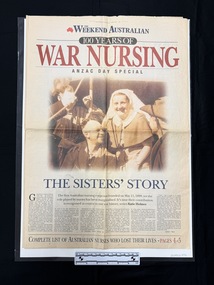
... 'Neglected heroes' by Ken Inglis - p8 - An article on war memorial recognition or lack of for nurses throughout history of memorials in Australia, how some were recognised and others not and how attitudes have changed over time...'Neglected heroes' by Ken Inglis - p8 - An article on war memorial recognition or lack of for nurses throughout history of memorials in Australia, how some were recognised and others not and how attitudes have changed over time ...The Weekend Australian lift out from ANZAC Day 1999. Contains article titles as follows: 'The Sisters' story' by Katie Holmes - p1 - Beginning of an article talking about the circumstances of nurses in warfare, duties, conditions, etc. Continued on p8 'Private battles' by Jan Bassett - p2 - Article gives a brief overview of how armed forces nursing services were formed, why and how they developed, including major players such as Nellie Gould and Grace Wilson. '100 years of service, dedication' - p2 - Timeline of armed forces nursing services. 'Wild dogs and 13 patients' by Jan Bassett - p2 - Edited extract from recollections of Julia Anderson who served as a nurse in the Boer War. 'A pioneer called Nellie' by Jan Bassett - p2 - Brief biographical article on Nellie Gould. 'Into the mess' by Jan Bassett - p3 - Article on the conditions faced by WWI nurses serving overseas including memories of various nurses. 'Tragedy made more personal' by Jan Bassett - p3 - Brief biographical article on Grace Wilson. 'The old ship is heaven after the peninsula' - p3 - Edited excerpt from WWI diary of Ella Jane Tucker. 'In Memoriam' - p4-5 - Names of nurses who have died as a result of war service from Boer war to Vietnam war. 'Hell of Banka' by Catherine Kenny - p6 - Article providing basic details on the sinking of the Vyner Brooke, massacre on Banka Island, survival of Vivian Bullwinkel and later surrender to Japanese. 'A will to remember' by Catherine Kenny - p6 - Article providing overview of stories shared by surviving Japanese POW nurses including Betty Jeffrey, Wilma Young (neé Oram), Jessie Hookway (neé Simons), Pat Darling (neé Gunther), Vivian Bullwinkel, Lorna Johnson (neé Whyte), and Mavis Cation (neé Cullen). Article also discussed artistic representations of the stories on stage and screen. 'Making do to survive' by Jessie Simons - p6 - Reprinted excerpt from book by same author 'Japanese Hands Australian Nurses as POWs'. 'Grim miracles' by Siobhan McHugh - p7 - Article on experiences of nurses in the Vietnam war including Colleen Mealy, Anne Hall, Trish Ferguson, Jan McCarthy, Del Waterman, Terrie Roach and Anne Healy. 'Anyone's blood was welcome' by Siobhan McHugh - p7 - Brief article of the working conditions of civilian nurses in Vietnam during the war, including recollections of Jenny James, Fran Sardelich and Kay Collett (radiographer not nurse). 'A long day's journey' - p7 - Brief interview article with Del Waterman an RAAF Nurse who served in Malaysia during the Vietnam war. 'Attitudes changes in the face of suffering' by Siobhan McHugh - p7 - Brief interview article with Anne Hall on her time as an army nurse during the Vietnam war. 'Neglected heroes' by Ken Inglis - p8 - An article on war memorial recognition or lack of for nurses throughout history of memorials in Australia, how some were recognised and others not and how attitudes have changed over time. '100 years of service, skill and sacrifice' by Katie Holmes - p8 - Continuation of article on p1. 'Sisters in arms' - p8 - Box insert of numbers of military nurses who served in major conflicts from Boer - Gulf wars. A large newspaper lift out with text in red, blue and black. Front cover has large headings and a large sepia toned photo featuring a woman in nurses uniform with men in dressing gowns around her. The lift out is made up of two pieces of paper folded to make 8 pages of articles. nursing in warfare, anzac day, memorial -
 Returned Nurses RSL Sub-branch
Newspaper - Newspaper lift out, The Weekend Australian et al, 100 years of War Nursing : ANZAC Day Special, 19990424
... 'Neglected heroes' by Ken Inglis - p8 - An article on war memorial recognition or lack of for nurses throughout history of memorials in Australia, how some were recognised and others not and how attitudes have changed over time...'Neglected heroes' by Ken Inglis - p8 - An article on war memorial recognition or lack of for nurses throughout history of memorials in Australia, how some were recognised and others not and how attitudes have changed over time ...The Weekend Australian lift out from ANZAC Day 1999. Contains article titles as follows: 'The Sisters' story' by Katie Holmes - p1 - Beginning of an article talking about the circumstances of nurses in warfare, duties, conditions, etc. Continued on p8 'Private battles' by Jan Bassett - p2 - Article gives a brief overview of how armed forces nursing services were formed, why and how they developed, including major players such as Nellie Gould and Grace Wilson. '100 years of service, dedication' - p2 - Timeline of armed forces nursing services. 'Wild dogs and 13 patients' by Jan Bassett - p2 - Edited extract from recollections of Julia Anderson who served as a nurse in the Boer War. 'A pioneer called Nellie' by Jan Bassett - p2 - Brief biographical article on Nellie Gould. 'Into the mess' by Jan Bassett - p3 - Article on the conditions faced by WWI nurses serving overseas including memories of various nurses. 'Tragedy made more personal' by Jan Bassett - p3 - Brief biographical article on Grace Wilson. 'The old ship is heaven after the peninsula' - p3 - Edited excerpt from WWI diary of Ella Jane Tucker. 'In Memoriam' - p4-5 - Names of nurses who have died as a result of war service from Boer war to Vietnam war. 'Hell of Banka' by Catherine Kenny - p6 - Article providing basic details on the sinking of the Vyner Brooke, massacre on Banka Island, survival of Vivian Bullwinkel and later surrender to Japanese. 'A will to remember' by Catherine Kenny - p6 - Article providing overview of stories shared by surviving Japanese POW nurses including Betty Jeffrey, Wilma Young (neé Oram), Jessie Hookway (neé Simons), Pat Darling (neé Gunther), Vivian Bullwinkel, Lorna Johnson (neé Whyte), and Mavis Cation (neé Cullen). Article also discussed artistic representations of the stories on stage and screen. 'Making do to survive' by Jessie Simons - p6 - Reprinted excerpt from book by same author 'Japanese Hands Australian Nurses as POWs'. 'Grim miracles' by Siobhan McHugh - p7 - Article on experiences of nurses in the Vietnam war including Colleen Mealy, Anne Hall, Trish Ferguson, Jan McCarthy, Del Waterman, Terrie Roach and Anne Healy. 'Anyone's blood was welcome' by Siobhan McHugh - p7 - Brief article of the working conditions of civilian nurses in Vietnam during the war, including recollections of Jenny James, Fran Sardelich and Kay Collett (radiographer not nurse). 'A long day's journey' - p7 - Brief interview article with Del Waterman an RAAF Nurse who served in Malaysia during the Vietnam war. 'Attitudes changes in the face of suffering' by Siobhan McHugh - p7 - Brief interview article with Anne Hall on her time as an army nurse during the Vietnam war. 'Neglected heroes' by Ken Inglis - p8 - An article on war memorial recognition or lack of for nurses throughout history of memorials in Australia, how some were recognised and others not and how attitudes have changed over time. '100 years of service, skill and sacrifice' by Katie Holmes - p8 - Continuation of article on p1. 'Sisters in arms' - p8 - Box insert of numbers of military nurses who served in major conflicts from Boer - Gulf wars. A large newspaper lift out with text in red, blue and black. Front cover has large headings and a large sepia toned photo featuring a woman in nurses uniform with men in dressing gowns around her. The lift out is made up of two pieces of paper folded to make 8 pages of articles. nursing in warfare, anzac day, memorial
