
Showing 5 items matching "nursing-papua new guinea"
-
 Alfred Hospital Nurses League - Nursing History Collection
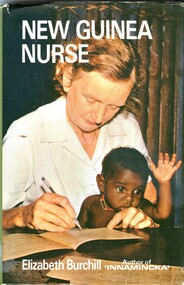
Book - Illustrated book, Elizabeth Burchill 1904-2003, New Guinea Nurse, 1967
... ...Nursing-Papua New Guinea...Of significance to the AHNL as it gives insight into nurses different working conditions Elizabeth Burchill 1904-2003 Nursing-Papua New Guinea Missions Medical-Papua New-Guinea Elizabeth Burchill offers a personal account of her experiences working as a nurse in Papua New Guinea during the 1960's. ...Elizabeth Burchill offers a personal account of her experiences working as a nurse in Papua New Guinea during the 1960's. The book provides insights into the medical challenges, cultural differences and daily life of nurses serving a population with unique health needs and beliefs, including encounters with traditional practices and the establishment of medical facilities in remote areas.Illustrated book with dust jacket. Book has a light green cover with title, author's name, publisher's name and logo embossed in gilt on the spine. Dust jacket has a photograph of a woman (Elizabeth Burchill) and baby as background to the front, with title and author's name printed in white. Spine and back of dust jacket are olive green in colour with title, author's name, publisher's name and logo printed in white on the spine.non-fictionElizabeth Burchill offers a personal account of her experiences working as a nurse in Papua New Guinea during the 1960's. The book provides insights into the medical challenges, cultural differences and daily life of nurses serving a population with unique health needs and beliefs, including encounters with traditional practices and the establishment of medical facilities in remote areas.elizabeth burchill 1904-2003, nursing-papua new guinea, missions, medical-papua new-guinea -
 Greensborough Historical Society
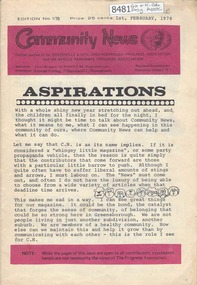
Newsletter, Greenhills and North Greensborough Progress Association, Community News: official journal of the Greenhills and Nth. Greensborough Progress Association and the Apollo Parkways Progress Association.. 1st February, 1978. Edition No. 1/78, 01/02/1978
... , Children - community responsibility, Nursing Mothers Association, Community - Papua New Guinea style. This and that, From the council Chamber...., Children - community responsibility, Nursing Mothers Association, Community - Papua New Guinea style. This and that, From the council Chamber. ...Aspirations, School news, Are you 92-97-102cm and lethargic?, Parent Australia, On powerlessness, Victoria is procrastinating!, Children - community responsibility, Nursing Mothers Association, Community - Papua New Guinea style. This and that, From the council Chamber.Newsletter, 19 p., illus. and textgreenhills and north greensborough progress association, greenhills, apollo parkways progress association, apollo parkways -
 Alfred Hospital Nurses League - Nursing History Collection
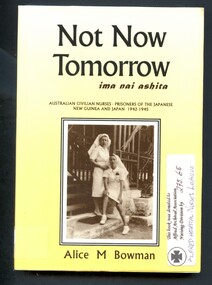
Book - Illustrated Book, Alice M. (Alice Mary) Bowman 1912-2000, Not now tomorrow=ima nai ashita, 1996
... Of significance to the AHNL as it is an important record of the conditions nurses endured ad prisoners of war World War 1939-1945 Prisoners of War-Papua New Guinea Prisoners of War-Japan nurses A true story of a civilian nurse from the Government Hospital in Rabaul, who was held prisoner in New Britain (six months) and Japan (3 years) following the Japanese attack of Rabaul in 1942 On the front of the dustjacket is a printed black and white donation sticker: black Maltese cross in circle, "This book was donated to Alfred Archival Association Nursing Division by" Alfred Hospital Nurses League (handwritten in black ink) Also previous catalogue number handwritten in black ink on this label Illustrated book with dust jacket. ...A true story of a civilian nurse from the Government Hospital in Rabaul, who was held prisoner in New Britain (six months) and Japan (3 years) following the Japanese attack of Rabaul in 1942Illustrated book with dust jacket. Book has a yellow cover with title and author's name printed in white on front and spine. Dust jacket has a pale-yellow background, title and author's name printed in brown on front and spine. The front of the dustjacket also has a black and white photograph of the author (Alice Bowman) (seated) and Joyce McGahan (standing) they are wearing Sisters uniforms; a building of the Namanalu Hospital, Rabaul is behind them (1939). On the back cover is another black and white photograph: Rabaul panorama, and a summary of the book in brown print. non-fictionA true story of a civilian nurse from the Government Hospital in Rabaul, who was held prisoner in New Britain (six months) and Japan (3 years) following the Japanese attack of Rabaul in 1942world war 1939-1945, prisoners of war-papua new guinea, prisoners of war-japan, nurses -
 Returned Nurses RSL Sub-branch
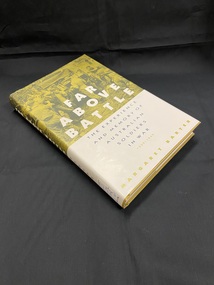
Book - Hardcover book, Allen & Unwin, Far above battle: the experience and memory of Australian soldiers in war 1939-1945, 1994
... nursing reveals little of the human suffering which faced the women in their ministrations to battlefield casualties". [page 246] 2/2 Battalion psychological impacts of war WW2 WWII World War 1939-1945 World War Two human side of warfare infantry It is the story of the men of 2/2 Infantry Battalion, Australian Imperial Forces, who fought in the Middle East, Greece, and Papua New Guinea. ...It is the story of the men of 2/2 Infantry Battalion, Australian Imperial Forces, who fought in the Middle East, Greece, and Papua New Guinea. The author describes the experience of battle and warfare itself: of fear and injury, of hunger and tiredness, of sickness, of marches through snow and jungles, of loneliness and bravery. The book provides an anatomy of war through the experience of this volunteer battalion who fought in all major theatres in World War II in which Australians took part. [from Trove]Hard-cover book with cream coloured dust jacket. There is an olive green and black toned photographic image wrapped around the top half of the cover and spine, it shows soldiers leading a man with bandaged eyes towards a jeep in the jungle, with other soldiers gathered around. The lower half of the cover is cream with blue text. There is a white label on the base of the spine with blue handwritten call number .non-fictionIt is the story of the men of 2/2 Infantry Battalion, Australian Imperial Forces, who fought in the Middle East, Greece, and Papua New Guinea. The author describes the experience of battle and warfare itself: of fear and injury, of hunger and tiredness, of sickness, of marches through snow and jungles, of loneliness and bravery. The book provides an anatomy of war through the experience of this volunteer battalion who fought in all major theatres in World War II in which Australians took part. [from Trove]2/2 battalion, psychological impacts of war, ww2, wwii, world war 1939-1945, world war two, human side of warfare, infantry -
![Medal - Court-mounted set of miniature medals: Royal Red Cross, Australian Service Medal 1945-75 with PNG clasp, Elizabeth II Silver Jubilee Medal 1977, Defence Force Service Medal, National Medal and Australian Defence Medal, [unknown]](/media/collectors/64a5077bc83bd7b7b94f4211/items/6a697004154863c24685a486/item-media/6a6971d6154863c246863334/item-fit-380x285.jpg?cb=6) Returned Nurses RSL Sub-branch
Returned Nurses RSL Sub-branchMedal - Court-mounted set of miniature medals: Royal Red Cross, Australian Service Medal 1945-75 with PNG clasp, Elizabeth II Silver Jubilee Medal 1977, Defence Force Service Medal, National Medal and Australian Defence Medal, [unknown]
... Nursing Service...Royal Australian Navy...RANNS...RAN...Papua New Guinea...Royal Red Cross Royal Australian Naval Nursing Service Royal Australian Navy RANNS RAN Papua New Guinea Medals A mounted set of six miniature medals (approximately a quarter of the size of the medals they represent) of various coloured metals with ribbons of many colours. ...These medals were awarded to Patricia Catherine Vines of the Australian Navy and Royal Australian Navy Nursing Service (RANNS). Extracts from Sea Power Centre website (listed in references): "Patricia Catherine Vines was born in Fairfield, Melbourne on 5 September 1925. Educated at the Catholic Ladies College, East Melbourne, on completion of her Intermediate Certificate, Vines undertook secretarial training before working at the Department of Aircraft Productions and then the Gun Turret Factory at Fairfield where she was still working when World War II ended in 1945. It was while she was working in the X-Ray Department at St Vincent’s Hospital that she decided to become a nurse, beginning her training in December 1948 and becoming a Registered Nurse in 1952, and a qualified midwife two years later. In 1959, in search of something different, Vines applied for a civilian nursing role at HMAS Cerberus, Flinders Naval Depot where she was employed until leaving to travel to New Zealand, Canada and the United States in 1962." "Commander Vines was presented with a Royal Red Cross in early 1972. The medal, presented by the Governor of Victoria, Sir Rohan Delacombe, was awarded for ‘exceptional competence and devotion to duty’. Also awarded were Sergeant Leslie Bending of the Naval Police (left) who received the British Empire Medal for dedicated service, and Lieutenant Commander Winston James (right) who received the Distinguished Service Cross in recognition of outstanding leadership and bravery while serving as commander of the RAN Helicopter Flight in Vietnam. During that time (1971-1980) she was also appointed an Honorary Nursing Sister to Queen Elizabeth II. In 1972 Patricia was awarded a Royal Red Cross (RRC) 2nd Class in the New Year Honours List and in January 1981 this was upgraded to a Royal Red Cross 1st class. The awards officially recognised her exceptional devotion and competency in performance of nursing duties in the RAN." "Following a 16-year career in the Navy and having reached retirement age, Patricia Vines retired from the RAN in 1980 and ran her own nursing business in Melbourne until 1995. Patricia Catherine Vines passed away in Melbourne on 15 February 2010, aged 85 years." Vines was a consistent paid member of the Returned Nurses Club (Returned Nurses Sub Branch RSL Victoria) from 1989 to her passing.A mounted set of six miniature medals (approximately a quarter of the size of the medals they represent) of various coloured metals with ribbons of many colours. The Royal Red Cross miniature medal is in the "shape of a golden cross... the obverse enamelled red, with a circular medallion, bearing an effigy of the reigning monarch [Queen Elizabeth II] at its centre. The words "Faith", "Hope" and "Charity" are inscribed on the upper limbs of the cross, with the year "1883" in the lower limb. The reverse is plain except a circular medallion bearing the royal cypher of the reigning monarch" [Wikipedia - see References], on this miniature medal the initials are ER. The ribbon is a dark blue stripe between crimson edge stripes and forms a landscape oriented bow that the medal hangs from the middle. The Australian Service Medal 1945-75 is "nickel-silver with the Australian Coat of Arms surrounded by the words The Australian Service Medal 1945-1975 on the obverse. The reverse has a Federation Star... The ribbon has central stripes of yellow and green, flanked by navy blue, khaki and light blue stripes from the Australia Service Medal 1939-45. A nickel-silver clasp with the name of the theatre or action for which the award is made is presented with the medal." [Australian Government Defence website - see References] This miniature has the PNG clasp and the navy blue stripe has faded to look more purple in colour. The Elizabeth II Silver Jubilee Medal 1977 comprises a "silver disc with, on the obverse, the words ELIZABETH II DEI GRA. REGINA FID. DEF. (Latin abbreviation for "Elizabeth II, by the Grace of God, Queen, Defender of the Faith") surrounding an effigy of Queen Elizabeth II, symbolising her role as fount of honour.[6] On the reverse is a crown atop a wreath that contains the words THE 25th YEAR OF THE REIGN OF QUEEN ELIZABETH II 6 February 1977 in six lines... The ribbon is white with cardinal red bands along the edges...and a... garter blue stripe down the centre, bisected by another... line of cardinal red" [Wikipedia - see References] The Defence Force Service Medal is a "cupro-nickel circular chamfered medal. The obverse has the Joint Service emblem. The reverse is inscribed For Efficient Service In The Permanent Forces around the circumference. The ribbon has 3 equal stripes of gold and azure-blue edged with azure-blue. The colours were the national colours of Australia at the time of introduction." [Australian Government Defence website - see References] the blue stripes have faded to look more purple in colour. The National Medal is "bronze. The obverse shows the Arms of the Commonwealth of Australia within a rim carrying the inscription The National Medal For Service. The reverse is plain. The ribbon has 15 alternating gold and blue stripes. The colours were the national colours of Australia at the time of introduction." [Australian Government Defence website - see References] Again, blue has faded to purple on the ribbon. The Australian Defence Medal is "cupronickel. The obverse has a stylised version of the Commonwealth Coat of Arms as used on the Australia Service Medal 1939-45. This is surrounded by the inscription The Australian Defence Medal above a sprig of wattle. The reverse has the inscription For Service below the Crown of St Edward surrounded by 2 sprays of wattle leaves and blossom. The ribbon is red with black edges, the colours of the Flanders poppy that represent the Anzac spirit of the Australian armed forces. The white stripes divide the ribbon into 3 to denote the three Services and represent service contributing to the peace of Australia." [Australian Government Defence website - see References] The miniature medals are court-mounted on a rigid backing with a long pin and the backing covered with a full size strip of ribbon in the Royal Red Cross medal colours.royal red cross, royal australian naval nursing service, royal australian navy, ranns, ran, papua new guinea, medals
