
Showing 33 items matching "oatmeal"
-
 Flagstaff Hill Maritime Museum and Village
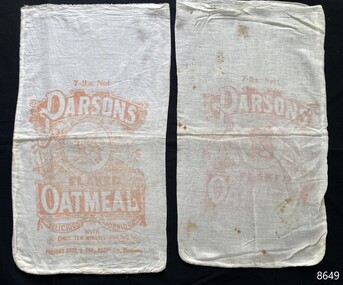
Textile - Parsons' Oatmeal Bags
... ...Oatmeal...Parsons' Brothers and Company were involved in packaging a variety of produce for the Australian market including oatmeal for porridge....A set of two Oatmeal Bags from the Parsons' company. Each bag is made from calico with ornate writing and images on the front that relate to the product and company. ...Net, PARSONS', TRADE MARK, THE ORIGINAL FLAKED OATMEAL, DELICIOUS PORRIDGE, WITH ONLY TEN MINUTES BOILING, PARSONS BROS & COY., PROPY. ...Textile Parsons' Oatmeal Bags ...Dry foods such as oats were packaged in cloth bags from the late 19th century to the mid 20th century. Parsons' Brothers and Company were involved in packaging a variety of produce for the Australian market including oatmeal for porridge.The oat bags provide a snapshot of a well-known Australian food company and how the bags were used to advertise other items available from the business.A set of two Oatmeal Bags from the Parsons' company. Each bag is made from calico with ornate writing and images on the front that relate to the product and company. The back of each bag is used to advertise a different product from the company – Saline Powder (8649.1) and Mustard (8649.2).Front (both): 7-lbs. Net, PARSONS', TRADE MARK, THE ORIGINAL FLAKED OATMEAL, DELICIOUS PORRIDGE, WITH ONLY TEN MINUTES BOILING, PARSONS BROS & COY., PROPY. LTD., MELBOURNE Back 8649.1 : TRY Parsons', PARSONS' SALINE POWDER, NET ? LB, SALINE POWDER, A COOL, REFRESHING AND HEALTHFUL DRINK Back 8649.2 : UNSURPASSED in Quality and Price, PARSONS' MUSTARD, (further writing is faded)flagstaff hill maritime museum and village, great ocean road, shipwreck coast, warrnambool, calico, domestic object, textile, food storage, parsons' bros, oatmeal, porridge -
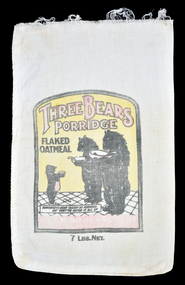
![[1] Three Bears Porridge Flaked Oatmeal Bag (Front)](/media/collectors/510b3f7f023fd725b4cd51fe/items/683baf6c69688f11138d56ba/item-media/683bf711460ecdfee7105b40/item-fit-380x285.jpg?cb=6) Arapiles Historical Society
Arapiles Historical SocietyContainer - Roy SCHMIDT Collection - Cotton Flour Bags (3)
... [1] Three Bears Porridge Flaked Oatmeal Bag: This textile bag originates from Canadian Cereal Mills Ltd., which marketed "Three Bears" flaked oatmeal. ...[1] Three Bears Porridge Flaked Oatmeal Bag: A vintage cloth oatmeal bag printed with black ink on both sides. ...[1] Three Bears Porridge Flaked Oatmeal Bag: Front side (branding side): "THREE BEARS Porridge – FLAKED OATMEAL" "7 Lbs. ...[1] Three Bears Porridge Flaked Oatmeal Bag: This textile bag originates from Canadian Cereal Mills Ltd., which marketed "Three Bears" flaked oatmeal. ...[1] Three Bears Porridge Flaked Oatmeal Bag: This textile bag originates from Canadian Cereal Mills Ltd., which marketed "Three Bears" flaked oatmeal. Popular in the early 1900s to mid-century, this product combined functional packaging with a child-friendly incentive — a cut-out cloth doll. The practice of printing toys, games, or clothing patterns on flour or oat sacks was a common marketing strategy, encouraging reuse and appealing to families during times when thrift and creativity were essential, especially during the Depression and wartime years. The Three Bears brand played off the enduring popularity of children’s nursery tales, while the doll encouraged children (and parents) to reuse packaging creatively. This object captures a unique intersection of food marketing, household resourcefulness, and early 20th-century domestic life. [2] Mammy Self-Raising Flour Bag: This item is a mid-20th-century Australian flour bag, branded “Mammy Oven Puff”, produced by A. Mammy Products Pty Ltd in West Footscray, Victoria. The use of the name "Mammy" and the caricatured illustration draws on a now widely recognised and offensive racial stereotype originating from American minstrel culture, commonly used in product branding in the early-to-mid 20th century. While the bag reflects a specific period in Australian domestic and commercial packaging history, it also exemplifies racially insensitive advertising that would be considered inappropriate and harmful by today’s standards. Such items are preserved today in museum collections to help document past social attitudes, consumer culture, and the evolution of racial representation in advertising. [3] Bandung Blue Triangle Brand Flour Bag: This bag represents a mid-20th-century Australian flour export product, particularly aimed at international markets such as Indonesia (as indicated by "Bandung"). The “Blue Triangle Brand” was likely a registered trademark used by a Melbourne-based flour mill engaged in both local and overseas trade. The use of durable cloth bags for bulk flour was common prior to the widespread adoption of paper and plastic packaging. These bags were often reused domestically for household textiles, clothing patterns, or storage. The export reference (Bandung) underscores Australia's historical agricultural trade ties with Southeast Asia, especially in wheat and flour exports. – Roy SCHMIDT resided with his siblings Mabel and Jack at ‘Parklands’ 85 Lake Avenue Natimuk home of Heinrich Friederick ‘Heiny’ & Minna Christina SUDHOLZ nee LANGE and their children Louis, Sophie, Alma, Lena (Roy's Mother), Florence 'Florrie' and Edward ‘Ted’.[1] Three Bears Porridge Flaked Oatmeal Bag: A vintage cloth oatmeal bag printed with black ink on both sides. One side is branded with "Three Bears Porridge – Flaked Oatmeal", showing an image of three bears behind a gate, referencing the well-known “Goldilocks and the Three Bears” fairytale. The opposite side features a printed cut-out doll design, showing a young girl with curly hair holding a bouquet of flowers, intended to be sewn into a stuffed toy. Instructions note that the reverse side (the doll’s back) could be obtained from a second bag. The design combines product branding with a promotional activity for children, typical of early- to mid-20th-century grocery packaging aimed at reuse. [2] Mammy Self-Raising Flour Bag: A small vintage cloth flour bag with printed branding in faded red, blue, and black inks. The front of the bag features a central image of a caricatured smiling African American woman wearing a headscarf. The text is unevenly faded but legible in parts. The bag has a rectangular shape with an open top edge and signs of previous use, including creasing and some fraying at the corners. [3] Bandung Blue Triangle Brand Flour Bag: A large, rectangular vintage cloth flour bag made of cream-coloured calico or cotton. The front of the bag is printed in bold blue ink with branding and export information. It prominently features a large triangular logo reading “Blue Triangle Brand” and numerous lines of text in block and stylised fonts. The bag is open at the top with frayed edges, suggesting it was once machine-stitched shut and later opened.[1] Three Bears Porridge Flaked Oatmeal Bag: Front side (branding side): "THREE BEARS Porridge – FLAKED OATMEAL" "7 Lbs. Net." “Packed and guaranteed by Canadian Cereal Mills Ltd., Toronto” Reverse side (doll pattern): "This is the Front for Three Bears Cut-out Doll" "In order to complete this Doll it will be necessary to obtain the Back Design from another Bag of Three Bears Rolled Oats or Oatmeal." [2] Mammy Self-Raising Flour Bag: Main product name: “MAMMY OVEN PUFF SELF-RAISING FLOUR” Additional text: “The Only Creamed Flour” “Prepared with phosphate aerator” “A. MAMMY PRODUCTS PTY. LTD., Sunshine Rd., West Footscray. Phone: FW 7321” “7 LBS. NET” (near top edge, very faded) [3] Bandung Blue Triangle Brand Flour Bag: The bag is printed with the following: “10270” “G.W.C | H.L” “BANDUNG” “BEST AUSTRALIAN” “BLUE TRIANGLE BRAND” (inside the triangle logo) “GROWER & GRINDERS” (curved around the logo) “Patent Roller” “MELBOURNE” “FLOUR” “50 LBS. GROSS WHEN PACKED” These inscriptions indicate that this flour bag was manufactured in Melbourne, Australia, and was likely exported to Bandung, Indonesia.farm equipment, flour, milling, oats, mammy, bandung blue, schmidt, sudholz, parklands -
 Southern Sherbrooke Historical Society Inc.
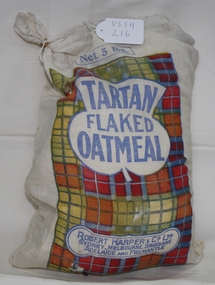
Calico bag collection
... Contains 20 bags, 4 oatmeal and 16 flour, held in a bag for Tartan Flaked Oatmeal from 'Robert Harper and Co Ltd'....Contains 20 bags, 4 oatmeal and 16 flour, held in a bag for Tartan Flaked Oatmeal from 'Robert Harper and Co Ltd'. ...Contains 20 bags, 4 oatmeal and 16 flour, held in a bag for Tartan Flaked Oatmeal from 'Robert Harper and Co Ltd'. -
 Port Melbourne Historical & Preservation Society
Photograph - Harper's 'Star' Oatmeal Manufacturer's letterhead
... Photograph of top portion of Harpers 'Star' Oatmeal Manufacturer's letterhead...industry - food robert harper & co ltd Photograph of top portion of Harpers 'Star' Oatmeal Manufacturer's letterhead Photograph Harper's 'Star' Oatmeal Manufacturer's letterhead ...Photograph of top portion of Harpers 'Star' Oatmeal Manufacturer's letterheadindustry - food, robert harper & co ltd -
 Stawell Historical Society Inc
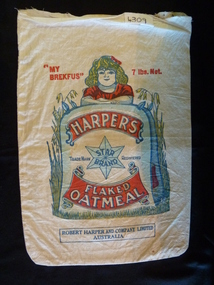
Memorabilia - Realia
... Harper’s Star Brand Oatmeal Cream Coloured Cotton Bag...Stawell Harper’s Star Brand Oatmeal Cream Coloured Cotton Bag Memorabilia Realia ...Harper’s Star Brand Oatmeal Cream Coloured Cotton Bagstawell -
 Port Melbourne Historical & Preservation Society
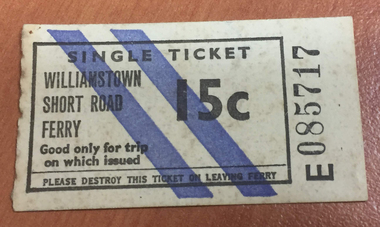
Document - Ferry Ticket, Williamstown Short Road Ferry, 1970s
... Single ticket for the Williamstown Short Road Ferry (the 'Punt') 15c - oatmeal coloured with two diagonal purple stripes. ...Kept by Les Pont, donated to Society in August 1998 transport - ferries williamstown Single ticket for the Williamstown Short Road Ferry (the 'Punt') 15c - oatmeal coloured with two diagonal purple stripes. ...Kept by Les Pont, donated to Society in August 1998Single ticket for the Williamstown Short Road Ferry (the 'Punt') 15c - oatmeal coloured with two diagonal purple stripes. (Instructions read 'Please destroy this ticket on leaving ferry')transport - ferries, williamstown -
 Hymettus Cottage & Garden Ballarat
Book - The Home at Greylock
... Ltd. was an Australian company involved with sugar refining and starch and oatmeal production. Silver Star Starch was a popular product used extensively in most households for shirt collars, household linen, tablecloths etc. ...Ltd. was an Australian company involved with sugar refining and starch and oatmeal production. Silver Star Starch was a popular product used extensively in most households for shirt collars, household linen, tablecloths etc. ...fictioncover advertising silver star starch and harper's star oatmeal. -
Port Melbourne Historical & Preservation Society
Document - Robert Harper & Co, Jenny Bell, unknown
... A three page document about Robert Harper and his company, including a 1920's black & white photograph of the packaging and 13 colour photographs of labels of products including coffee, rice, tea, oatmeal and safety matches....Industry-manufacturing Industry - Food Manufacturing Robert Harper & Co Ltd A three page document about Robert Harper and his company, including a 1920's black & white photograph of the packaging and 13 colour photographs of labels of products including coffee, rice, tea, oatmeal and safety matches. Robert Harper & Co Document Robert Harper & Co Jenny Bell ...A three page document about Robert Harper and his company, including a 1920's black & white photograph of the packaging and 13 colour photographs of labels of products including coffee, rice, tea, oatmeal and safety matches.industry-manufacturing, industry - food, manufacturing, robert harper & co ltd -
 Warrnambool and District Historical Society Inc.
Domestic object - Household, Box Silver Star Starch, Probably 1940s-1950s
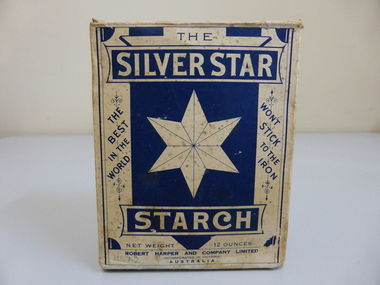
... Ltd. was an Australian company involved with sugar refining and starch and oatmeal production. Silver Star Starch was a well-known product and starch was used extensively in most households, mainly for shirt collars, aprons, nurses’ uniforms, household linen, tablecloths, doyleys etc. ...Ltd. was an Australian company involved with sugar refining and starch and oatmeal production. Silver Star Starch was a well-known product and starch was used extensively in most households, mainly for shirt collars, aprons, nurses’ uniforms, household linen, tablecloths, doyleys etc. ...Robert Harper and Co. Ltd. was an Australian company involved with sugar refining and starch and oatmeal production. Silver Star Starch was a well-known product and starch was used extensively in most households, mainly for shirt collars, aprons, nurses’ uniforms, household linen, tablecloths, doyleys etc. This item is of some interest, both for display and as a good example of housekeeping methods of the past (up to about the 1970s). However, the starching of clothing does continue today, mainly for special purposes – theatre costumes, clerical and ceremonial garb etc. The item can be specifically used by the Warrnambool and District Historical Society in any display connected to the 1896-7 Warrnambool Industrial and Art Exhibition as this exhibition had, as one of its competitions, the Silver Star Starch Ironing Competition (see pages 96-7, book, ‘The Great Warrnambool Exhibition’, by E. O’Callaghan, Collett, Bain and Gaspars, 2002)A box that contained 12 ounces of Silver Star starch for domestic use, mainly for ironing clothes. The box, a product of Robert Harper and Company Limited, Victoria, Australia, has several advertising captions – ‘Won’t Stick to the Iron’, ‘The Best in the World’. ‘Requires no Boiling’, and has directions for use. The front of the box has an illustration of two women from Victorian times using the product,warrnambool, silver star starch, robert harper & co ltd -
 Port Melbourne Historical & Preservation Society
Photograph - Robert Harper & Co picnic, 1908
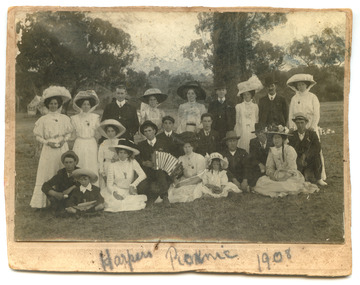
... A wide variety of goods were produced including rice, starch, spices, cocoa, flour, spices, oatmeal, jelly crystals. Most of the complex was demolished around 1980 but some buildings have been transofmed into apartment blocks....A wide variety of goods were produced including rice, starch, spices, cocoa, flour, spices, oatmeal, jelly crystals. Most of the complex was demolished around 1980 but some buildings have been transofmed into apartment blocks. ...Robert Harper & Co had an industrial complex on Beach Rd from Sandridge lagoon to Post Office Place. A wide variety of goods were produced including rice, starch, spices, cocoa, flour, spices, oatmeal, jelly crystals. Most of the complex was demolished around 1980 but some buildings have been transofmed into apartment blocks.Digital copy of Black and White photo mounted on card with the words "Harpers Picnic 1908" written below. The group of twenty two (22) includes two young children and the whole group are dressed in their finery and one man in the centre appears to be playing the piano accordion. The location of the bushland setting is unknown.social activities, industry - food, industry - manufacturing, robert harper & co ltd, picnics -
 Bendigo Historical Society Inc.
Textile - FLOUR BAG COLLECTION: ROBERT HARPER AND COMPANY, 1900-1950
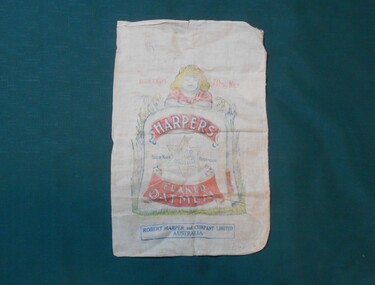
... Calico bag - ''Harpers Flaked Oatmeal'' Star brand, Trademark Registered ''My Brekfus'' 7 lbs Net. ...Calico bag - ''Harpers Flaked Oatmeal'' Star brand, Trademark Registered ''My Brekfus'' 7 lbs Net. ...Textiles. Calico bag - ''Harpers Flaked Oatmeal'' Star brand, Trademark Registered ''My Brekfus'' 7 lbs Net. Robert Harper and Company Limited Australia. Head and shoulders drawing of a blonde haired girl surrounded by wheat.On the other side of the bag is a blue and white picture of a box of ''Silver Star Starch''. Robert Harper and Co Ltd. Slogan written on box, '' The best in the world. Won't sick to the Iron''. Robert Harper and Company (1842-1919), businessman and politician, was born in Scotland. He migrated to Melbourne with his family in August 1856. He worked for J.F.McKenzie & Co., roasting and grinding millers. In 1865 he established Robert Harper & Co., trading in tea, coffee and spices from the East Indies and later in oatmeal and flour.textiles, domestic, robert harper and co calico bag -
 National Wool Museum
Textile - Three Bears Porridge Flaked Oatmeal Bag
... Front: THREE BEARS \ PORRIDGE \ FLAKED \ OATMEAL \ SOMEBODYS BEEN TASTIN' MY PORRIDGE \ AN' THEY'VE EATEN IT ALL UP \ Jas. ...Textile Three Bears Porridge Flaked Oatmeal Bag ...These domestic kitchen bags were donated to the National Wool Museum by Lila Gore. Lila donated Children’s Clothing (RGE 8324) to the museum in 2022 and at her time of donating, inquired as to whether the museum would also be interested in these bags she had been collecting. Lila said there was no reason as to why she was saving the bags, other than she liked the art works and thought they were too good to end up in landfill. She had thought perhaps she would make something out of the bags, or perhaps give the bags to a friend to make something. When Lila was donating the Children’s Clothing to the museum, she thought that the National Wool Museum would be the perfect home for the bags. Domestic kitchen bags such as these date from the late 19th century through the mid-20th century. They were used at home, usually by women, containing household items which would not spoil, such as flour, sugar, animal feed, seeds, and other commodities. In modern times a trip to the supermarket is a daily chore, in the past however, these trips happened far less often, with big sacks such as these a large reason why. In the rural US and Canada, Feed sack dresses and Flour sack dresses, were an iconic part of rural life from the 1920s through the Great Depression, World War II, and post-World War II years. Australia also reused these sacks, typically for making wagga style blankets, but re-use for clothing was not unusual.Calico oat bag with graphic image on front showing three bears holding porridge bowls with yellow background and red, white and black text. Back of bag shows red and white graphic image of a woman wearing a dress and heeled shoes holding a coffee cup, with red and white text.Front: THREE BEARS \ PORRIDGE \ FLAKED \ OATMEAL \ SOMEBODYS BEEN TASTIN' MY PORRIDGE \ AN' THEY'VE EATEN IT ALL UP \ Jas. F. McKenzie & Co. Pty. Ltd. \ AUSTRALIA \ 7 LBS. NET. Back: MCKENZIES \ EXCELSIOR \ COFFEE \ ESSENCEwagga, flour, oats, bag, calico, lila, gore, depression, war, kitchen -
![Book - Short stories, Grant, James, The Queen's cadet : and other tales, 1875 [This reprint 1890s]](/media/collectors/641920217f0478323d8a47a8/items/668b696d79518f8e24a9872d/item-media/668dc59e4d1cc58ad9c9ac41/item-fit-380x285.jpg?cb=6) Linton Mechanics Institute and Free Library Collection
Linton Mechanics Institute and Free Library CollectionBook - Short stories, Grant, James, The Queen's cadet : and other tales, 1875 [This reprint 1890s]
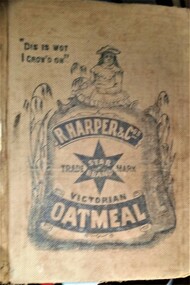
... Harper and Cos 'Victorian Oatmeal'. Rear cover advertises Robert Harper & Coy 'Silver Star' starch....Craig, Melbourne, Book is bound in calico and the covers feature advertisements for Robert Harper & Co. oatmeal and starch. Advertisements are examples of nineteenth century advertising and illustrate a method of using books for cross-promotional purposes. ...320 p. : Bound in calico which is printed with product advertisementsjames grant, fiction, t. craig [bookbinder], short stories -
 Mont De Lancey
Domestic object, Jas. F. McKenzie & Co Pty Ltd, Container of Ground Cloves, 1930's - 1960's
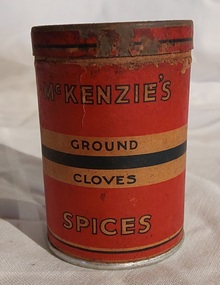
... By 1861, the range of goods had expanded to include: coffee mixed with chicory; black and white peppers; mixed spice; ground cloves, ginger, pimento and cinnamon; ground rice; maize meal; brosemeal (made from peas); and oatmeal in tins, bags or barrels. This ground cloves container was a product for cooking use in the family kitchen in the 1930's - 1960. ...By 1861, the range of goods had expanded to include: coffee mixed with chicory; black and white peppers; mixed spice; ground cloves, ginger, pimento and cinnamon; ground rice; maize meal; brosemeal (made from peas); and oatmeal in tins, bags or barrels. This ground cloves container was a product for cooking use in the family kitchen in the 1930's - 1960. ...In the 1850s, Galt and McKenzie advertised their roasted and ground coffee alongside ground pepper and pimento, supplying these commodities in bulk to grocers, merchants and store-keepers. By 1861, the range of goods had expanded to include: coffee mixed with chicory; black and white peppers; mixed spice; ground cloves, ginger, pimento and cinnamon; ground rice; maize meal; brosemeal (made from peas); and oatmeal in tins, bags or barrels. This ground cloves container was a product for cooking use in the family kitchen in the 1930's - 1960. A small vintage cardboard cylindrical container of McKenzie's Ground Cloves with a red and navy striped printed paper label with white print explaining the manfacturer details and instructions for use. 2 ozs. Net. There is an aluminium base and removable lid. It has ground cloves powder inside.'McKenzie's Ground Cloves' '2 oz. Nett.'kitchen equipment, kitchen ingredients, cooking, spices -
![Book - Novel, Galt, John, Sir Andrew Wylie of that ilk, 1854 [This reprint 1890s]](/media/collectors/641920217f0478323d8a47a8/items/64b8ec931d0277807c2cb300/item-media/65093e4f8c691b1eaeafcc92/item-fit-380x285.jpg?cb=6) Linton Mechanics Institute and Free Library Collection
Linton Mechanics Institute and Free Library CollectionBook - Novel, Galt, John, Sir Andrew Wylie of that ilk, 1854 [This reprint 1890s]
... Harper & Cos 'Star Brand' oatmeal. Rear cover advertises Robert Harper & Coy 'Silver Star' starch. ...Harper & Cos 'Star Brand' oatmeal. Rear cover advertises Robert Harper & Coy 'Silver Star' starch. ...467 p. Bound in calico which is printed with product advertisements. fictionfiction, john galt, t. craig [bookbinder] -
Linton Mechanics Institute and Free Library Collection
Book - Short stories, Craik, Dinah Maria Mulock, Romantic tales. 'By the author of 'John Halifax, Gentleman' etc. etc.' (known to be Dinah Maria Mulock Craik), First published 1870. This re-issue 1890s
... Harper & Cos 'Star Brand' oatmeal; rear cover advertises Robert Harper & Coy 'Silver Star' starch....Harper & Cos 'Star Brand' oatmeal; rear cover advertises Robert Harper & Coy 'Silver Star' starch. 406 p. ; bound in calico which is printed with product advertisements. ...406 p. ; bound in calico which is printed with product advertisements.fictionfiction, dinah maria mulock craik, short stories, t.craig [bookbinder] -
Linton Mechanics Institute and Free Library Collection
Book - Novel, Cooper, J. F. (James Fenimore Cooper), The sea lions : or the lost sealers, [n.d.] [First published 1849, Routledge 'new edition' between 1866-1878. Reprinted 1890s?]
... Harper & Cos 'Star Brand' oatmeal; Rear cover advertises 'Silver Star' starch. ...Harper & Cos 'Star Brand' oatmeal; Rear cover advertises 'Silver Star' starch. ...339 p.fictionfiction, james fenimore cooper, t. craig [bookbinder] -
 Bendigo Historical Society Inc.
Textile - FLOUR BAG COLLECTION: PARSONS BROS OATMEAL, 1900-1950
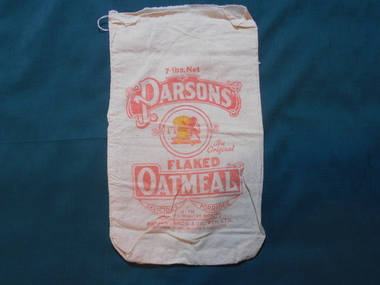
... Calico bag printed on both sides with red, white and yellow, ''PARSONS The Original FLAKED Oatmeal 7 LBS NET.Delious Porridge with only ten minutes boiling''. ...Textile FLOUR BAG COLLECTION: PARSONS BROS OATMEAL ...Textiles. Calico bag printed on both sides with red, white and yellow, ''PARSONS The Original FLAKED Oatmeal 7 LBS NET.Delious Porridge with only ten minutes boiling''. Parsons Bros & Co, Pty., Ltd., Melbourne, Sydney, Brisbane and Fremantle. Centre picture within a red circle of an upright Lion holding a yellow wheat sheaf beside a set of scales. Brothers Leonard and George Parsons left England for Australia following the discovery of gold. In 1861 the Uncle Tobys Company was born, originally under the name of Parsons Bros.textiles, domestic, parson bros calico flour bag -
 Anglesea and District Historical Society
Three Bears Porridge Bag, Jas. F. McKenzie & Co, 1936
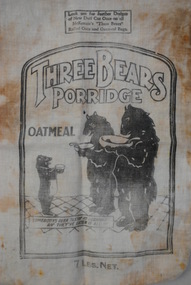
... LOOKOUT FOR FURTHER DESIGNS OF NEW DOLL CUT OUTS ON ALL MCKENZIE'S "THREE BEARS" ROLLED OATS AND OATMEAL BAGS....porridge. oatmeal mckenzies Front top: THREE BEARS PORRIDGE / OATMEAL / picture of three bears / SOMEBODY'S BEEN TASTING MY PORRIDGE AND THEY'VE EATEN IT ALL UP / 7 LBS.NET Back of bag: Cut-out pattern of Brere Rabbit. ...Calico bag originally containing porridge and sold in Australia during 1930's. Patent is dated 1936.Front top: THREE BEARS PORRIDGE / OATMEAL / picture of three bears / SOMEBODY'S BEEN TASTING MY PORRIDGE AND THEY'VE EATEN IT ALL UP / 7 LBS.NET Back of bag: Cut-out pattern of Brere Rabbit. Directions - cut around outline of design, place both patterns face to face, stitch around the outline leaving open down the side of the trousers for filling; cut notches, turn right side out, then fill with suitable filling. Sew down side of trousers when filled. Copyrights and Patents Applied for. In order to complete this doll it will be necessary to obtain the Back Design from another Bag of "Three Bears" Rolled Oats or Oat-meals. LOOKOUT FOR FURTHER DESIGNS OF NEW DOLL CUT OUTS ON ALL MCKENZIE'S "THREE BEARS" ROLLED OATS AND OATMEAL BAGS.porridge. oatmeal, mckenzies -
 Tatura Irrigation & Wartime Camps Museum
Domestic object - Rolled Oats Calico Bag, Three Bears Porridge, c. 1936
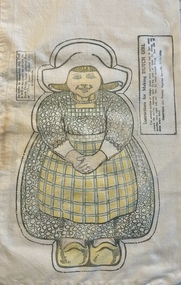
... Copyrights and Patents Applied for - No 2272/1936 In order to complete this Doll it will be necessary to obtain the Back Design from another Bag of "Three Bears" Rolled Oats or Oatmeal. ...Copyrights and Patents Applied for - No 2272/1936 In order to complete this Doll it will be necessary to obtain the Back Design from another Bag of "Three Bears" Rolled Oats or Oatmeal. Calico oat bag with graphic image on front showing three bears holding porridge bowls with yellow background and (faded red), white and black text. ...Calico oat bag with graphic image on front showing three bears holding porridge bowls with yellow background and (faded red), white and black text. Back of bag shows an image of a Dutch Girl wearing a green dress, yellow and green check apron, white Dutch Hat and yellow clogs. IFront: Look out for further Designs of New Doll Cut Outs on all McKenzie's "Three Bears" Rolled Oats and Oatmeal Bags. THREE BEARS PORRIDGE / ROLLED OATS / SOMEBODY'S BEEN TASTING MY PORRIDGE AN' THEY'VE EATEN IT ALL UP / 7 LBS.NETLOOKOUT Back of bag: Insgtructions for making DUTCH GIRL- cut around outline of design, place both patterns face to face, stitch around the outline leaving open down the side of the dress for filling; cut notches, turn right side out, then fill with suitable filling. Sew down side of dress when filled. Copyrights and Patents Applied for - No 2272/1936 In order to complete this Doll it will be necessary to obtain the Back Design from another Bag of "Three Bears" Rolled Oats or Oatmeal. mckenzie, rolled oats, porridge, three bears, calico -
Linton Mechanics Institute and Free Library Collection
Book - Novel, Lytton, Lord [Edward George Earle Lytton Bulwer-Lytton] [=Baron Lytton, Lord Lytton], Alice : or, the mysteries, [n.d.] [First published 1838. Date of this edition not known, this re-issue 1890's]
... Harper & Cos. 'Star Brand' oatmeal. Rear cover advertises Robert Harper & Coy 'Silver Star' starch. ...Harper & Cos. 'Star Brand' oatmeal. Rear cover advertises Robert Harper & Coy 'Silver Star' starch. ...Themes of love, duty and social ambition. Some supernatural elements.288 + p. (title page and final pages missing) : frontispiece illustration. Bound in calico which is printed with product advertisements.fictionThemes of love, duty and social ambition. Some supernatural elements.fiction, lord lytton, t. craig [bookbinder], english literature -
Linton Mechanics Institute and Free Library Collection
Book - Novel, Smith, Horace, Brambletyne House : or, Cavaliers and Roundheads, [n.d.] [First published 1826 by Henry Colburn. Weldon & Co. edition 1875-1876? This reprint 1890s.]
... Harper & Cos 'Star Brand' oatmeal. Rear cover advertises Robert Harper & Coy 'Silver Star' starch. ...Harper & Cos 'Star Brand' oatmeal. Rear cover advertises Robert Harper & Coy 'Silver Star' starch. ...352 p. Bound in calico which is printed with product advertisements.fictionfiction, horace smith, t. craig [bookbinder] -
 Bendigo Historical Society Inc.
Book - "Food at Sea. Eating and drinking with sailors 1500-2000.", 2001
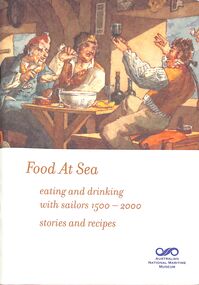
... The primary sources of nutrition included ship's biscuits, salted meats, peas, fish, oatmeal, cheese, butter, and beer. These provisions were essential for maintaining sailors' physical well-being and morale as they traversed the oceans. ...The primary sources of nutrition included ship's biscuits, salted meats, peas, fish, oatmeal, cheese, butter, and beer. These provisions were essential for maintaining sailors' physical well-being and morale as they traversed the oceans. ...Food and Drink onboard sailing historic Sailors' diets during the Age of Sail were characterized by a limited selection of food and drink due to the harsh conditions and long voyages. The primary sources of nutrition included ship's biscuits, salted meats, peas, fish, oatmeal, cheese, butter, and beer. These provisions were essential for maintaining sailors' physical well-being and morale as they traversed the oceans. The diet was often supplemented with dried fruits and pulses to prevent scurvy and ensure a balanced intake of nutrients. Despite the challenges, sailors had to rely on these limited options to sustain themselves during their long sea journeys. The history of food on ships over the period 1500-2000 reflects a marked improvement in the quality of life at sea, slow improvements over the first few hundred years and then rapid, driven by technological developments in the 19th and 20th centuries. "Food at Sea. Eating and drinking with sailors 1500-2000." Published by The Australian National Maritime Museum. Edited by Bill Richards, ANMM. This book brings together historical vignettes and notes on contemporary practices, including recipes, of the history of food on ships. Contains black and white images. 36pp. Soft cover. Stapled at spine. Front and back covers have colored image of three people seated at table eating. Title written in matt gold on front cover. ISBM 064208185.food, sailors, recipies, national maritime museum -
Linton Mechanics Institute and Free Library Collection
Book - Novel, Lytton, Lord [Edward George Earle Lytton Bulwer-Lytton] [=Baron Lytton, Lord Lytton], The last of the barons, First published 1843. Numerous later editions, including Routledge 1854. This re-issue of a Routledge edition (date not known)in 1890s.]
... Harper and Cos 'Star Brand' oatmeal; Rear cover advertises Robert Harper & Coy. ...Harper and Cos 'Star Brand' oatmeal; Rear cover advertises Robert Harper & Coy. ...The novel, comprising twelve sections or "books", is set during the Wars of the Roses, and focuses on the power struggle between King Edward IV and the Earl of Warwick, known to history as "Warwick the Kingmaker".487 p. ; bound in calico which has advertisements printed on the cover. Title page missing. Information for catalogue record derived from half-title page and publisher's advertising at end of book.fictionThe novel, comprising twelve sections or "books", is set during the Wars of the Roses, and focuses on the power struggle between King Edward IV and the Earl of Warwick, known to history as "Warwick the Kingmaker".historical fiction, edward iv king of england, warwick the kingmaker, lord lytton, t. craig [bookbinder] -
 Bendigo Historical Society Inc.
Textile - FLOUR BAG COLLECTION: ROBERT HARPER AND COMPANY, 1900-1950
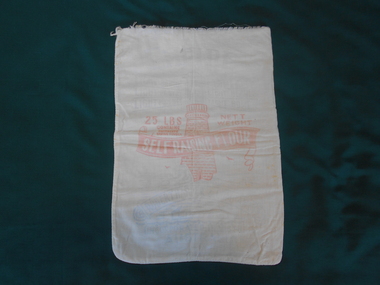
... In 1865 he established Robert Harper & Co., trading in tea, coffee and spices from the East Indies and later in oatmeal and flour....In 1865 he established Robert Harper & Co., trading in tea, coffee and spices from the East Indies and later in oatmeal and flour. Textile FLOUR BAG COLLECTION: ROBERT HARPER AND COMPANY ...Textiles. Calico flour bag printed on one side in red and blue''EMPIRE SELF RAISING FLOUR 25 lbs nett weight. Contains phosphate Baking Powder. Robert Harper & Company Incorporated Victoria, Australia''. In the background is a lighthouse with three beams of light extending from each side. Printed on the light beams- ''LIGHT BREAD, LIGHT PASTRY, LIGHT PUDDINGS, LIGHT LABOUR, LIGHT HEARTS, LIGHT HOMES''. Robert Harper (1842-1919), businessman and politician, was born in Scotland. He migrated to Melbourne with his family in August 1856. He worked for J.F.McKenzie & Co., roasting and grinding millers. In 1865 he established Robert Harper & Co., trading in tea, coffee and spices from the East Indies and later in oatmeal and flour.textiles, domestic, robert harper & co flour bag -
 National Wool Museum
Archive - Fabric Sample Booklet, Kathryn Knitwear, 1961
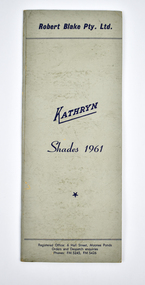
... KATHRYN Shades 1961 [Internal] KATHRYN Shades 1961 ARCTIC WHITE [Left side] WOOL Standard Shades WHITE PINK LEMON BLUE LIPSTICK EMERALD ROSE PINK AQUA ROYAL RED CELTIC TAN KASHA BROWN GREY [Right side] WOOL Fashion Shades MINT WILD RICE GERANIUM PINK LONDON BLUE TREE FERN ANCIENT GOLD ORLON WHITE PINK LEMON BLUE OATMEAL EUCALYPTUS CABER TAN YACHT BLUE RED...KATHRYN Shades 1961 [Internal] KATHRYN Shades 1961 ARCTIC WHITE [Left side] WOOL Standard Shades WHITE PINK LEMON BLUE LIPSTICK EMERALD ROSE PINK AQUA ROYAL RED CELTIC TAN KASHA BROWN GREY [Right side] WOOL Fashion Shades MINT WILD RICE GERANIUM PINK LONDON BLUE TREE FERN ANCIENT GOLD ORLON WHITE PINK LEMON BLUE OATMEAL EUCALYPTUS CABER TAN YACHT BLUE RED Kathryn Knitwear Colour swatch booklet from 1961. ...Kathryn Knitwear, founded by Robert Blake, manufactured high quality children’s knitwear in Melbourne from the 1940s – 1980s. Robert Blake began manufacturing children’s knitwear in his bedroom in Strathmore using a hand powered machine in the late 1940s. The operation moved to Ascot Vale and Essendon, before eventually establishing a factory in Moonee Ponds in the early 1950s. The business continued to expand, necessitating a move to a new factory in Broadmeadows. By 1962, the Broadmeadows factory was producing an average of 20,000 garments per month, which increased to 24,000 by 1964. Robert Blake’s Son, Brendan recalls that “The Kathryn brand was famous around Australia, anywhere children needed to keep warm and dress smartly. It also won a number of wool fashion awards”, including the 1969 Wool Awards, which was held by the Australian Wool Bureau and published in Women’s Weekly. The Kathryn range was designed for durability, comfort and care, without sacrificing style. They used patterning techniques that increase stretchiness, comfort and fit, as well as integrating decorative elements into the fabric to prevent them from being bulky, uncomfortable or tight. Making longevity of style a priority, Brendan Blake remembers that “there was one particular garment that was in the range for at least thirty years”. He also recalls “In the past, when women have found out that I was associated with Kathryn Knitwear, they would often relate to me the story of a garment they had purchased or received as a gift and, when their child had grown out of it, they would hand it on to another child. Several ladies have told me of purchasing garments for their daughters’ glory box, or saving a particular garment after their daughter had grown out of it. Brendan Blake: “At the peak of their operation they employed approximately two hundred people, mainly women and girls. A family would often seek to send their daughter to work in this company because they knew they would be looked after and safe. One lady wrote to me telling me that working at the Moonee Ponds Factory prior to getting married was the happiest time of her life.” In 1963, workers at the Kathryn factory earned £13 per week, which was 8 shillings and 8 pence higher than the minimum weekly wage for female workers in the textile manufacturing industry (£12 11s 4d). By 1970, the Kathryn Knitwear brand expanded from children’s knitwear into womenswear under the brand name ‘Lady Kathryn’, and for boys and men under ‘Robert Blake’. Continuing to diversify their distribution, they also began exporting ‘Kathryn’ garments to New Zealand, the Pacific Islands, and Japan. ‘Kathryn Knitwear’ was well-known for their early adoption of modern materials and techniques that had broad appeal to their customer base. This is shown in their early use of the acrylic fibre ‘Orlon’ in the 50s and 60s and ‘Superwash’ wool in the 1970s. Many of Kathryn Knitwear’s styles, particularly those that were long running staples of the brand, were available in both wool and Orlon to suit the consumer’s preference. Far from the humble origins of one man in his bedroom with a hand-cranked machine; at its closure in 1980, the Broadmeadows factory of ‘Kathryn’ housed more than 100 machines, including 53 sewing machines and 45 knitting machines. Robert Blake was “a passionate advocate for wool and Australian Made” throughout his whole life. A strong thread that ties through the lifespan of Robert Blake and Kathryn Knitwear is a balance between adopting new innovations without sacrificing the core values of durability, comfort, care and style that had made the brand so well known. Their legacy forms an integral part of both Australian social and manufacturing history.Kathryn Knitwear Colour swatch booklet from 1961. Booklet has navy text printed on a grey background, and opens to reveal two vertical swatch cards made of white card, one on each side of the fold line. Swatch cards have headings printed in capitals in red ink denoting the fibre and series of the below samples. Each swatch card has 15 samples of yarn wrapped around it, and each shade labelled in black ink in capital letters. There is an additional knitted swatch stapled to the top right corner labelled ‘Arctic White’.[Obverse] Robert Blake Pty. Ltd. KATHRYN Shades 1961 [Internal] KATHRYN Shades 1961 ARCTIC WHITE [Left side] WOOL Standard Shades WHITE PINK LEMON BLUE LIPSTICK EMERALD ROSE PINK AQUA ROYAL RED CELTIC TAN KASHA BROWN GREY [Right side] WOOL Fashion Shades MINT WILD RICE GERANIUM PINK LONDON BLUE TREE FERN ANCIENT GOLD ORLON WHITE PINK LEMON BLUE OATMEAL EUCALYPTUS CABER TAN YACHT BLUE REDfabric sample, textile sample, fabric swatch, textile swatch, fashion textile production, textile manufacturing -
 National Wool Museum
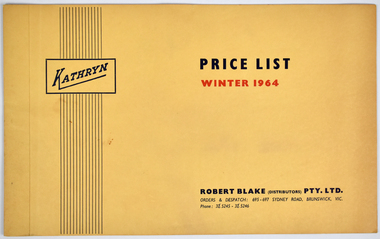
Archive - Price List, Kathryn Knitwear, 1964
... [internal] SHADES – WINTER 1964 [LEFT COLUMN] ORLON WHITE PINK LEMON BALE BLUE OATMEAL SULTRY GREEN NUTTY BROWN PINE GREEN REDCOAT BOTANY BLUE SKY BLUE VIYELLA WHITE PINK LEMON PALE BLUE [RIGHT COLUMN] WOOL. ...Business Business history Manufacturing Knitting Machine Fashion Textile Production Business Archives Manufacturing Documents [internal] SHADES – WINTER 1964 [LEFT COLUMN] ORLON WHITE PINK LEMON BALE BLUE OATMEAL SULTRY GREEN NUTTY BROWN PINE GREEN REDCOAT BOTANY BLUE SKY BLUE VIYELLA WHITE PINK LEMON PALE BLUE [RIGHT COLUMN] WOOL. ...Kathryn Knitwear, founded by Robert Blake, manufactured high quality children’s knitwear in Melbourne from the 1940s – 1980s. Robert Blake began manufacturing children’s knitwear in his bedroom in Strathmore using a hand powered machine in the late 1940s. The operation moved to Ascot Vale and Essendon, before eventually establishing a factory in Moonee Ponds in the early 1950s. The business continued to expand, necessitating a move to a new factory in Broadmeadows. By 1962, the Broadmeadows factory was producing an average of 20,000 garments per month, which increased to 24,000 by 1964. Robert Blake’s Son, Brendan recalls that “The Kathryn brand was famous around Australia, anywhere children needed to keep warm and dress smartly. It also won a number of wool fashion awards”, including the 1969 Wool Awards, which was held by the Australian Wool Bureau and published in Women’s Weekly. The Kathryn range was designed for durability, comfort and care, without sacrificing style. They used patterning techniques that increase stretchiness, comfort and fit, as well as integrating decorative elements into the fabric to prevent them from being bulky, uncomfortable or tight. Making longevity of style a priority, Brendan Blake remembers that “there was one particular garment that was in the range for at least thirty years”. He also recalls “In the past, when women have found out that I was associated with Kathryn Knitwear, they would often relate to me the story of a garment they had purchased or received as a gift and, when their child had grown out of it, they would hand it on to another child. Several ladies have told me of purchasing garments for their daughters’ glory box, or saving a particular garment after their daughter had grown out of it. Brendan Blake: “At the peak of their operation they employed approximately two hundred people, mainly women and girls. A family would often seek to send their daughter to work in this company because they knew they would be looked after and safe. One lady wrote to me telling me that working at the Moonee Ponds Factory prior to getting married was the happiest time of her life.” In 1963, workers at the Kathryn factory earned £13 per week, which was 8 shillings and 8 pence higher than the minimum weekly wage for female workers in the textile manufacturing industry (£12 11s 4d). By 1970, the Kathryn Knitwear brand expanded from children’s knitwear into womenswear under the brand name ‘Lady Kathryn’, and for boys and men under ‘Robert Blake’. Continuing to diversify their distribution, they also began exporting ‘Kathryn’ garments to New Zealand, the Pacific Islands, and Japan. ‘Kathryn Knitwear’ was well-known for their early adoption of modern materials and techniques that had broad appeal to their customer base. This is shown in their early use of the acrylic fibre ‘Orlon’ in the 50s and 60s and ‘Superwash’ wool in the 1970s. Many of Kathryn Knitwear’s styles, particularly those that were long running staples of the brand, were available in both wool and Orlon to suit the consumer’s preference. Far from the humble origins of one man in his bedroom with a hand-cranked machine; at its closure in 1980, the Broadmeadows factory of ‘Kathryn’ housed more than 100 machines, including 53 sewing machines and 45 knitting machines. Robert Blake was “a passionate advocate for wool and Australian Made” throughout his whole life. A strong thread that ties through the lifespan of Robert Blake and Kathryn Knitwear is a balance between adopting new innovations without sacrificing the core values of durability, comfort, care and style that had made the brand so well known. Their legacy forms an integral part of both Australian social and manufacturing history.Price list booklet for Winter 1964. Booklet was housed inside yellow manila envelope printed in black and red ink with the Kathryn Logo and contact details. The booklet contains tables, printed in blue ink, that outline the price for each style and size available, as well as providing the available colours. Annotations are made in red pen ink. A sheet of yellow paper has been included in the front of the booklet that includes all the shades available in Orlon, Viyella and Wool.[internal] SHADES – WINTER 1964 [LEFT COLUMN] ORLON WHITE PINK LEMON BALE BLUE OATMEAL SULTRY GREEN NUTTY BROWN PINE GREEN REDCOAT BOTANY BLUE SKY BLUE VIYELLA WHITE PINK LEMON PALE BLUE [RIGHT COLUMN] WOOL. SKY BLUE PINK LEMON PALE BLUE WILD OAT SULTRY GREEN NUTTY BROWN NED KELLY GREEN REDCOAT BOTANY BLUE CHESTNUT PARCHMENT PIONEER GREEN MAZURKAH KATHRYN AND VIYELLA/KATHRYN SHOW CARDS AVAILABLE ON REQUEST.business, business history, manufacturing, knitting machine, fashion textile production, business archives, manufacturing documents -
![Book - Novel, [Collins, Wilkie], After dark : leaves from Leah's diary, [n.d.] [1856? This re-issue 1890s]](/media/collectors/641920217f0478323d8a47a8/items/64aa5f41264f3946b6aeb7c8/item-media/64bf6cd2d2135a53624614b1/item-fit-380x285.jpg?cb=6) Linton Mechanics Institute and Free Library Collection
Linton Mechanics Institute and Free Library CollectionBook - Novel, [Collins, Wilkie], After dark : leaves from Leah's diary, [n.d.] [1856? This re-issue 1890s]
... Harper & Co. 'Star Brand' oatmeal, rear cover advertises Robert Harper & Co. ...Harper & Co. 'Star Brand' oatmeal, rear cover advertises Robert Harper & Co. ...v ; 392 p. : bound in calico which is printed with product advertisements. Title page missing. Information for catalogue record from Wikipedia and online catalogues.fictionshort stories, fiction, wilkie collins, t. craig [bookbinder], english literature -
 National Wool Museum
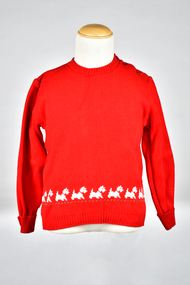
Textile - Children's Jumper, Kathryn Knitwear, c.1962-1966
... SULTRY GREEN. NUTTY BROWN. OATMEAL .3) STYLE: 44/PW – WOOL PULLOVER – ANIMAL MOTIF / SIZE: 18” 20” 22” 24”/ PRICE: 18/6 21/3 25/- 27/6 / COLOR: 18” PALE BLUE. ...SULTRY GREEN. NUTTY BROWN. OATMEAL .3) STYLE: 44/PW – WOOL PULLOVER – ANIMAL MOTIF / SIZE: 18” 20” 22” 24”/ PRICE: 18/6 21/3 25/- 27/6 / COLOR: 18” PALE BLUE. ...Kathryn Knitwear, founded by Robert Blake, manufactured high quality children’s knitwear in Melbourne from the 1940s – 1980s. Robert Blake began manufacturing children’s knitwear in his bedroom in Strathmore using a hand powered machine in the late 1940s. The operation moved to Ascot Vale and Essendon, before eventually establishing a factory in Moonee Ponds in the early 1950s. The business continued to expand, necessitating a move to a new factory in Broadmeadows. By 1962, the Broadmeadows factory was producing an average of 20,000 garments per month, which increased to 24,000 by 1964. Robert Blake’s Son, Brendan recalls that “The Kathryn brand was famous around Australia, anywhere children needed to keep warm and dress smartly. It also won a number of wool fashion awards”, including the 1969 Wool Awards, which was held by the Australian Wool Bureau and published in Women’s Weekly. The Kathryn range was designed for durability, comfort and care, without sacrificing style. They used patterning techniques that increase stretchiness, comfort and fit, as well as integrating decorative elements into the fabric to prevent them from being bulky, uncomfortable or tight. Making longevity of style a priority, Brendan Blake remembers that “there was one particular garment that was in the range for at least thirty years”. The colourwork dogs from this design are a very popular motif, and were available in both wool and Orlon in multiple styles from at least 1961-1972, including a cardigan and a pullover, selling 4346 of these in winter 1961. This example most likely dates from 1962-1966. An Illustration depicting this style is catalogued under NWM-09026. He also recalls “In the past, when women have found out that I was associated with Kathryn Knitwear, they would often relate to me the story of a garment they had purchased or received as a gift and, when their child had grown out of it, they would hand it on to another child. Several ladies have told me of purchasing garments for their daughters’ glory box, or saving a particular garment after their daughter had grown out of it. Brendan Blake: “At the peak of their operation they employed approximately two hundred people, mainly women and girls. A family would often seek to send their daughter to work in this company because they knew they would be looked after and safe. One lady wrote to me telling me that working at the Moonee Ponds Factory prior to getting married was the happiest time of her life.” In 1963, workers at the Kathryn factory earned £13 per week, which was 8 shillings and 8 pence higher than the minimum weekly wage for female workers in the textile manufacturing industry (£12 11s 4d). By 1970, the Kathryn Knitwear brand expanded from children’s knitwear into womenswear under the brand name ‘Lady Kathryn’, and for boys and men under ‘Robert Blake’. Continuing to diversify their distribution, they also began exporting ‘Kathryn’ garments to New Zealand, the Pacific Islands, and Japan. ‘Kathryn Knitwear’ was well-known for their early adoption of modern materials and techniques that had broad appeal to their customer base. This is shown in their early use of the acrylic fibre ‘Orlon’ in the 50s and 60s and ‘Superwash’ wool in the 1970s. Many of Kathryn Knitwear’s styles, particularly those that were long running staples of the brand, were available in both wool and Orlon to suit the consumer’s preference. Orlon was developed by DuPont in the 1940s and became the first commercially successful acrylic fibre in the 1950s and 1960s. The development of Orlon coincided with an increase in availability of washing machines in everyday Australian homes. The great appeal of Orlon was that while wool garments still had to be hand-washed, Orlon’s shrink-resistant nature made it machine washable and dryable. This was a very appealing prospect, especially for the seemingly unending task of cleaning active children’s clothing. Machine washable wool would not be available until the development of the ‘Superwash’ treatment by the Australian Wool Board and CSIRO in 1970. Far from the humble origins of one man in his bedroom with a hand-cranked machine; at its closure in 1980, the Broadmeadows factory of ‘Kathryn’ housed more than 100 machines, including 53 sewing machines and 45 knitting machines. Robert Blake was “a passionate advocate for wool and Australian Made” throughout his whole life. A strong thread that ties through the lifespan of Robert Blake and Kathryn Knitwear is a balance between adopting new innovations without sacrificing the core values of durability, comfort, care and style that had made the brand so well known. Their legacy forms an integral part of both Australian social and manufacturing history.Red children’s machine-knit jumper with white dog motif and green grass colourwork, closes with three red plastic buttons at left shoulder .2 and .3 are sample tags with manufacturing information, including sizes and colours available .4 is a swing tag with manufacturer care instructions.1) [label stitched at back neck] KATHRYN REGD. / 100% ORLON / 24 .2) STYLE: 44/OP – ORLON PULLOVER – ANIMAL MOTIF / SIZE: 18” 20” 22” 24”/ PRICE: 18/6 21/3 25/- 27/6 / COLOR: 18” PALE BLUE. LEMON. WHITE. / 20” – 24” SKY BLUE. LEMON. WHITE. REDCOAT. BOTANY BLUE. SULTRY GREEN. NUTTY BROWN. OATMEAL .3) STYLE: 44/PW – WOOL PULLOVER – ANIMAL MOTIF / SIZE: 18” 20” 22” 24”/ PRICE: 18/6 21/3 25/- 27/6 / COLOR: 18” PALE BLUE. LEMON. / 20” – 24” SKY BLUE. LEMON. REDCOAT. BOTANY BLUE. / SULTRY GREEN. NUTTY BROWN. NED KELLY GREEN. / .4) Obverse: [handwritten] 5/10 (unintelligible) Kathryn / ORLON KNITWEAR / Style : 44/OP / DESIGNED & MANUFACTURED BY / Robert Blake / MELBOURNE Reverse: STANDARD MEASUREMENTS / FIT EXACTLY / LAUNDER PERFECTLY / HOT WATER WILL DAMAGE / THIS GARMENT / WASHING INSTRUCTIONS / 1. Use lukewarm water and mild soap. / 2. Squeeze water out by hand – DO / NOT WRING. / 3. DO NOT ROLL. Hang on / Clothes hanger to dry. / To keep brushed garments like / new, brush frequently with / Nylon brush. / IRONING [m (handwritten)] ORLON garments require little / or no ironing if drip-dried. If / ironing is necessary, it may be done damp or dry, using / a warm iron. / DO NOT USE / STEAM IRON /knitwear, clothing, children's knitwear, children's clothing, manufacturing, fashion textile production, machine knitting, clothing set, dog motif, animal motif, colourwork -
Bendigo Historical Society Inc.
Administrative record - Commercial Egg Producers' Association of Victoria (CEPA) Central Council Correspondence, 1981
... The Association is concerned about a rumour that export controls on oatmeal may be lifted on September 16. 8504.37j To the Minister of Agriculture:Acknowledgement of Minister's ResponseThe Association thanks the Minister for his letter and the meeting held on March 17, 1981. ...The Association is concerned about a rumour that export controls on oatmeal may be lifted on September 16. 8504.37j To the Minister of Agriculture:Acknowledgement of Minister's ResponseThe Association thanks the Minister for his letter and the meeting held on March 17, 1981. ...The Commercial Egg Producers' Association of Victoria was active by the 1930s, engaging in industry management and lobbying.The Commercial Egg Producer's Association (CEPA) had branches in Bendigo, South Bendigo, Eaglehawk, Wedderburn, Murrabit and Euroa.CEPA Commercial Egg Producer's Association (Bendigo Region) correspondence, for the year 1981. This item includes the following documents: 8504.37a Legal Liabilities for Sporting Clubs and Community Groups. The document explains that clubs and groups can be held legally responsible for damages or injuries occurring during their activities.Liability may arise from negligence, breach of duty, or failure to provide a safe environment. Incorporation is recommended to limit personal liability of members and office bearers. Incorporated entities are treated as separate legal bodies.Insurance is emphasized as essential for managing risks, including public liability, personal accident, and property insurance. 8504.37b Commercial Egg Producers Co-op's submission regarding agricultural policy and support for family farmers in Victoria 8504.37c The document is a letter from the association secretary to the Victorian Egg Marketing Board, expressing concerns and suggestions after a recent meeting. 8504.37d To the Victorian Egg Board. Complaint About Reduced Purchases. The producer is concerned that Safeway Stores have significantly reduced their purchases of eggs from the Bendigo Crystal Egg Co., dropping from 80,000 dozen per week to about 40,000 dozen per week. 8504.37e Letter by the Secretary of the Commercial Egg Producers Association of Victoria to Mr Milton Whiting, M.P. The Association opposes the extension of daylight saving time in Victoria and supports abandoning it altogether. The letter states that the Association's 800 members are unanimous in their opposition to extending daylight saving, and most favour ending it. 8504.37f Confirmation of Attendance: The Secretary, K. Fitzgibbon, confirms that 12 members from their organization will attend the Victorian Egg Marketing Board meeting scheduled for 19th November, 1981. 8504.37g The document is a letter from K. Fitzgibbon to Mr. J.R.A. McMillan, Secretary of the Federal Council of Poultry Farmers Associations of Australia, dated August 20, 1981. Payment of Subscription Fee: A cheque for $250.00 is enclosed as payment for the 1979-80 subscription fee. 8504.37h The document is a formal letter from the secretary addressed to Minister Tom Austin. The group thanks Minister Austin for meeting with four of its members at the St. Arnaud Knitting Mills. 8504.37i This document is a formal letter from the Commercial Egg Producers' Association of Victoria requesting a meeting with Mr J. W. Bourchier, M.P., to discuss two main industry concerns. The Association is concerned about a rumour that export controls on oatmeal may be lifted on September 16. 8504.37j To the Minister of Agriculture:Acknowledgement of Minister's ResponseThe Association thanks the Minister for his letter and the meeting held on March 17, 1981. The Association is concerned that the price increase is only effective until the end of the year.They disagree with the stated figure of £500,000, suggesting that if this is accurate, egg pulp is being sold at too low a price. 8504.37k To the Minister of Agriculture recommends Mr. Donald Kirkwood Bain for a position on the Egg Marketing Board 8504.37l To the Committee of Enquiry into the NSW Egg Industry. The document is a letter from the Commercial Egg Producers' Association of Victoria expressing support for various items. 8504.37m This document is a nomination letter submitted to the Minister of Agriculture, proposing candidates for the vacant Producer Member position on the Victorian Egg & Marketing Board. 8504.37n Formal apology letter sent by the Secretary of the Poultry Farmers Association of Australia:Apology for Delayed Response:The Secretary apologizes for not replying promptly to a notification regarding a recent Federal Council meeting. 8504.37o This document is a formal communication addressed to the Secretary (as addressed), transmitting several important items. 8504.37p This document is a formal letter from the Secretary of CEPA addressed to the Minister of Agriculture. A large meeting was held in Bendigo with delegates from several country districts (Harcourt, Murrabit, Wedderburn, Euroa, Bendigo).The group is concerned about proposed changes to the Victorian Egg Marketing Board, believing these changes are economically disadvantageous to country producers and decentralisation. 8504.37q This summary highlights the main points from the Commercial Egg Producers' Association of Victoria Central Council half-yearly conference report from November 1981: 8504.37r Minutes from the 1981 Annual Meeting of the Commercial Egg Producers AssociationMeeting Details and AttendanceHeld at City Hall, Bendigo on June 22, 1981, with 21 members present from various districts. 8504.37s The document outlines the proceedings and resolutions from the Central Council's annual meeting regarding the egg industry. 8504.37t This document summarizes a special meeting of the Commercial Egg Producers Association of Victoria (C.E.P.A.) held on July 13, 1981, focused on industry recommendations and regulatory issues. 8504.37u Key Points from the Special Meeting of the Commercial Egg Producers Association of Victoria Central Council Meeting March 1981. 8505.37v This document is a formal response from the Victorian Egg Marketing Board addressing concerns from egg producers about packing material maintenance, reuse, and associated costs. It is to CEPA, Attention Mr M Jackman of Symons St Golden Square and addresses his two page hand written letter in Feb 1981 8505.37w Government of Victoria Department of Agriculture "Agnote" - Registration of agricultural chemicals and household insecticides March 1981 8505.37x The document from the Egg Marketing Board outlines additional charges and procedures for egg consignments handled by the Crystal Grading Floor 8505.37y The document outlines the agenda and minutes for the Commercial Egg Producers' Association of Victoria's central council and branch meetings held on November 19, 1981 8505.37z From the Crystal Egg Company informational letter regarding the new egg grading and pooling system: 8505.37aa Letter sent from the Victorian Egg Marketing Board circular. Effective April 20, 1981, the price of first quality Class B eggs is increased by 10¢ per dozen.This follows a previous reduction of 20¢ per dozen for Class B eggs after a Class A premium increase in February.Class A Premium Adjustment:The Class A premium is reduced from 30¢ to 20¢ per dozen, effective April 20, 1981.Prices for first quality Class A eggs remain unchanged.New Advance Prices (¢ per dozen). 8505.37ab From the Department of Agriculture Victoria's letter. The Department thanks C.E.P.A. members for reviewing and commenting on poultry training modules for the 1982 Farm Apprenticeship program at Bendigo Technical College.egg producer's information, correspondence, cepa, commercial egg producers' association
