
Showing 114 items matching "officer's belt"
-
 Dandenong/Cranbourne RSL Sub Branch
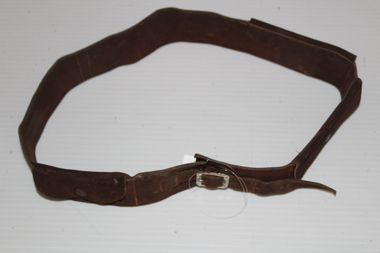
Equipment - Sam Browne Belt, Unknown
... ...Officer's Belt...WWI British Officer's Sam Browne belt....WW1 Historical significance Sam Browne Belt Officer's Belt Nil WWI British Officer's Sam Browne belt. ...WW1 Historical significanceWWI British Officer's Sam Browne belt.Nilsam browne belt, officer's belt -
 Ballarat RSL Sub-Branch Inc.
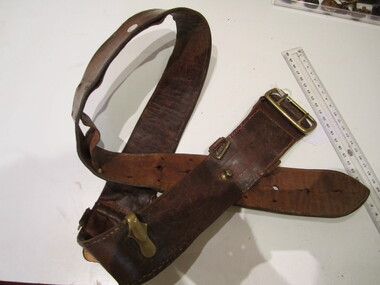
Belt - Leather Officer's
... Belt - Leather Officer's...Uniforms Ballarat RSL Ballarat Belt - Leather Officer's ...uniforms, ballarat rsl, ballarat -
 Dandenong/Cranbourne RSL Sub Branch
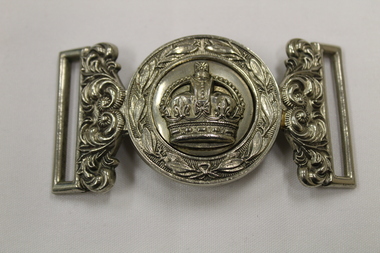
Memorabilia - Buckle, Belt, Circa late 1930s
... Claimed as Warrant Officers belt buckle from period 1939 - 1945. ...Claimed as Warrant Officers belt buckle from period 1939 - 1945. ...Claimed as Warrant Officers belt buckle from period 1939 - 1945. Belonged to James Eric Burns Sargent Major.Central crown surrounded by circle of laurel leaves. -
 Rye RSL Sub Branch
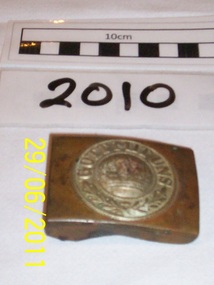
Belt Buckle German Brass Officers
... Gilt and white metal, this is thought to be an officers belt buckle. It has the imperial crown embossed in the centre surrounded bu a wreath at the bottom and the words 'GOTT MIT UNS' (God with us) above....Gilt and white metal, this is thought to be an officers belt buckle. It has the imperial crown embossed in the centre surrounded bu a wreath at the bottom and the words 'GOTT MIT UNS' (God with us) above. ...Gilt and white metal, this is thought to be an officers belt buckle. It has the imperial crown embossed in the centre surrounded bu a wreath at the bottom and the words 'GOTT MIT UNS' (God with us) above. -
 Lara RSL Sub Branch
Sword, British Naval Officer
... British Naval Officers Sword Belt complete with Clip - Sam Brown...British Naval Officers Sword Belt complete with Clip - Sam Brown British Naval Officer Sword ...British Naval Officers Sword Belt complete with Clip - Sam Brown -
 Trafalgar Holden Museum
Functional object - Officers waist belt, 1940
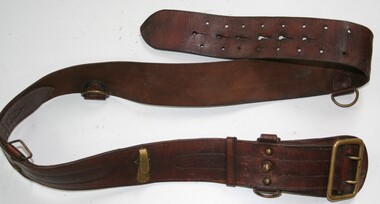
... Belt...Officer...Military officers waist belt used on full dress occasions...Military officers waist belt used on full dress occasions As manufactured and distributed by GMH ,military Belt Officer Brown leather waist belt with brass buckle and fittings Functional object Officers waist belt ...Military officers waist belt used on full dress occasionsAs manufactured and distributed by GMHBrown leather waist belt with brass buckle and fittings,military, belt, officer -
 Frankston RSL Sub Branch
Holster, Pistol, Hawker & Co
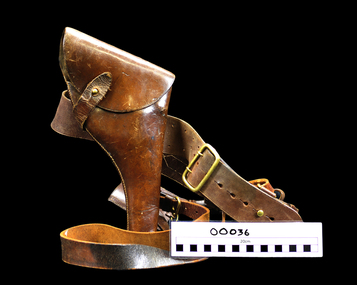
... World War 1 officers Sam Browne belt (Pistol Holster)....WW1 Officers Pistol Holder ww1 pistol belt holster sam browne McCrohan written on belt World War 1 officers Sam Browne belt (Pistol Holster). ...WW1 Officers Pistol HolderWorld War 1 officers Sam Browne belt (Pistol Holster).McCrohan written on beltww1, pistol, belt, holster, sam, browne -
 Running Rabbits Military Museum operated by the Upwey Belgrave RSL Sub Branch
Uniform Complete
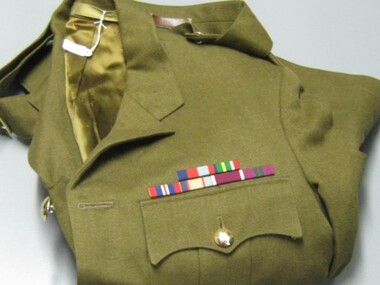
... Army Jacket service dress with trousers U226 Warrant Officer. With ribbons & belt Royal Australian Corps of Signals...Uniform 1965 Army Army Jacket service dress with trousers U226 Warrant Officer. With ribbons & belt Royal Australian Corps of Signals Uniform Complete ...Army Jacket service dress with trousers U226 Warrant Officer. With ribbons & belt Royal Australian Corps of Signalsuniform, 1965, army -
 Ringwood RSL Sub-Branch
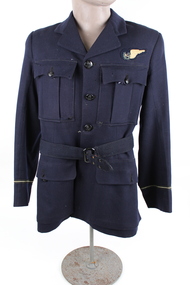
Uniform - RAAF Jacket with Air Gunner's Wings, Circa WW2
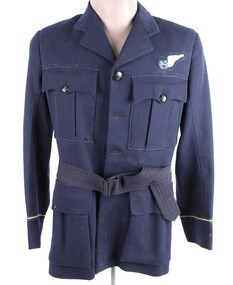
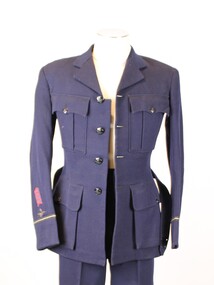
... Navy Blue WW2 Jacket with rank of Flying Officer complete with waist belt....Used by Air Gunner in RAAF during WW2, Probably in UK and Europe Navy Blue WW2 Jacket with rank of Flying Officer complete with waist belt. RAAF Jacket with Air Gunner's Wings Uniform RAAF Jacket with Air Gunner's Wings ...Used by Air Gunner in RAAF during WW2, Probably in UK and EuropeNavy Blue WW2 Jacket with rank of Flying Officer complete with waist belt. -
 Ringwood RSL Sub-Branch
Uniform - Air Force Jacket, Circa WW2
... Rank Flying Officer with waist belt....Rank Flying Officer with waist belt. Uniform Air Force Jacket ...Worn by Flying Officer Ronald Turnbull in WW2. Service No 418595Used in WW2.WW2 Dark Blue Air Force Jacket with Air Gunner’s Half Wing Badge. Rank Flying Officer with waist belt. -
4th/19th Prince of Wales's Light Horse Regiment Unit History Room
Belt Sam Browne
... belt sam browne officer...Sam Browne belts were worn by officers and RSM's. This belt is the type manufactured between 1902 and c.1945...Belt, Leather, Mid Brown, Officer, Sam Browne, Brass buckles and fittings ...Sam Browne belts were worn by officers and RSM's. This belt is the type manufactured between 1902 and c.1945 This belt is typical of belts worn by officers of the 4th, 17th and 19th Light Horse from c.1903-1943 belt sam browne officer small Belt, Leather, Mid Brown, Officer, Sam Browne, Brass buckles and fittings Belt Sam Browne ...Sam Browne belts were worn by officers and RSM's. This belt is the type manufactured between 1902 and c.1945This belt is typical of belts worn by officers of the 4th, 17th and 19th Light Horse from c.1903-1943Belt, Leather, Mid Brown, Officer, Sam Browne, Brass buckles and fittings smallbelt sam browne officer -
 Bendigo Military Museum
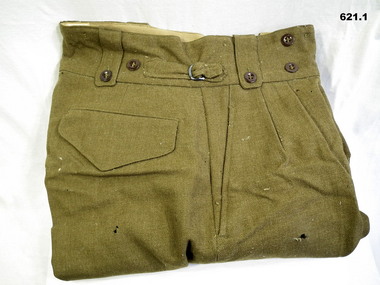
Uniform - UNIFORM ARMY, C.1939 - 45
... Has shoulder Pips and crown sewn for the rank of Lieut Colonel Shoulder flashes sewn "Royal Australian Army Medical Corps" .3) Officers Sam Brown Belt in Leather. Brown in color complete. .4) Officers peak cap with gold Badge RAAMC....Has shoulder Pips and crown sewn for the rank of Lieut Colonel Shoulder flashes sewn "Royal Australian Army Medical Corps" .3) Officers Sam Brown Belt in Leather. Brown in color complete. .4) Officers peak cap with gold Badge RAAMC. ...Belonged to Warick Rosenthal No TX6321 AAMC. Refer 622.3, 775.,1) Battledress uniform Pants, winter khaki. .2) Battledress uniform Jacket, winter khaki. Has shoulder Pips and crown sewn for the rank of Lieut Colonel Shoulder flashes sewn "Royal Australian Army Medical Corps" .3) Officers Sam Brown Belt in Leather. Brown in color complete. .4) Officers peak cap with gold Badge RAAMC.medical corp, uniform army, raamc -
 Bendigo Military Museum
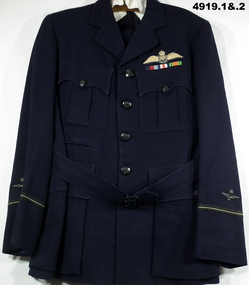
Uniform - UNIFORM, AIR FORCE, 1) .2) Carr, Son and Woor LTD, C.1944
... .1) RAAF uniform jacket dark blue colour, inner soft lining complete with buttons, belt, Pilot Officers insignia and 3 x service ribbons being 1939 - 45 star, France and Germany Star and Defence medal. ...Richard Noel Levy No 428329 RAAF enlisted on 10.10.1942 age 18 years, he flew with No 180 Sqd "B 25 Mitchell Bombers" flying 49 missions over Germany, his first operation was on 30 11.1944, discharged from the RAAF with the rank of Flying Officer on 3.1 1946 RAAF Uniforms .1) On tag in pocket, " "Oct 1944 P/O R.N.Levy RAAF". .2) Same as .1) .3) "R.N.Levy" .1) RAAF uniform jacket dark blue colour, inner soft lining complete with buttons, belt, Pilot Officers insignia and 3 x service ribbons being 1939 - 45 star, France and Germany Star and Defence medal. ...Richard Noel Levy No 428329 RAAF enlisted on 10.10.1942 age 18 years, he flew with No 180 Sqd "B 25 Mitchell Bombers" flying 49 missions over Germany, his first operation was on 30 11.1944, discharged from the RAAF with the rank of Flying Officer on 3.1 1946.1) RAAF uniform jacket dark blue colour, inner soft lining complete with buttons, belt, Pilot Officers insignia and 3 x service ribbons being 1939 - 45 star, France and Germany Star and Defence medal. Tag on inside pocket with makers and owners details, sleeves have metal crown and wings on. .2)Trousers, dark blue complete with buttons, tag sewn on with makers and owners details. .3) Hat peak RAAF blue colour with Crown and Wings on front, black hat band with black leather strap, leather liner, tag sewn on inside..1) On tag in pocket, " "Oct 1944 P/O R.N.Levy RAAF". .2) Same as .1) .3) "R.N.Levy"raaf, uniforms -
 Bendigo Military Museum
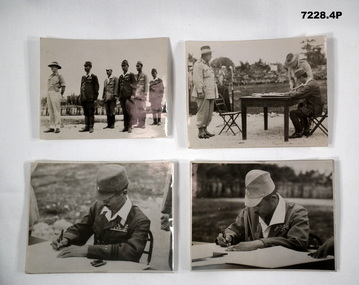
Photograph - PHOTOGRAPH, JAPANESE SURRENDER, 1945
... At their front is a Senior Australian Officer wearing a pistol belt. He has his slouch hat with slouch part down. ...At their front is a Senior Australian Officer wearing a pistol belt. He has his slouch hat with slouch part down. ...Japanese Surrender Ceremony at MOROTAI on 9 Sept 1945. Japanese Officer in the dark uniform is Lieutenant General Fusataro TESHIMA, Leader of the Japanese 2nd Army. The second man is a Japanese Naval Officer Captain Toru OYAMA. The Australian Officer at the table is Lieutenant General Frank BERRYMAN, a member of Blamey's staff. An audible recording of the ceremony is apparently on the internet including Blamey's speech.Four black and white photos. 1. This image shows at least 5 Japanese Senior officers standing to attention. At their front is a Senior Australian Officer wearing a pistol belt. He has his slouch hat with slouch part down. The Australian Officer is wearing small gaitors and boots. 2. General Blamey standing to attention on left of picture. A Japanese officer is signing some paperwork. In the background can be seen a large body of troops watching. The ground they are on has been covered in some white crushed rock. 3. A senior Japanese Officer in darkish uniform with a white shirt is signing some papers using a fountain pen. He has 4 rows of ribbons on his left chest.. On the front of his hat is star. 4. A senior Japanese Officer, lighter uniform, wearing a lanyard, is signing some papers using a fountain pen. He has 3 rows of ribbons on his left chest. On his lapels are a rectangle with 3 stars on it. On the front of his hat is a light coloured badge, possible an anchor on it. ww2, japanese surrender, morotai, blamey -
 Lara RSL Sub Branch
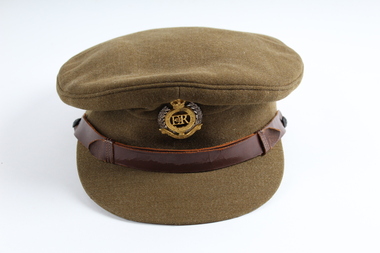
Uniform, Commonwealth Government Clothing Company, Royal Australian Engineers Officers Cap
... Officers cap , flat on top with a peak at the front and a brown belt half way around it. ...Unknown Officers cap , flat on top with a peak at the front and a brown belt half way around it. ...UnknownOfficers cap , flat on top with a peak at the front and a brown belt half way around it. Has a royal Australian engineers badge above the peak and a sweat band inside the cap. -
 Lara RSL Sub Branch
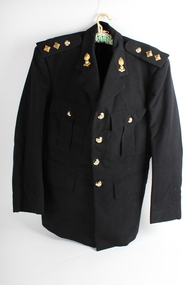
Uniform, Officer Dress Uniform Jacket
... Black Officer Dress Uniform Jacket with Belt on rear...CGCF (Commonwealth Government Clothing Factory) Brass Lapel Badge UBIQUE (Everywhere in Latin) 5 Front of Jacket Brass Badges (2.5cm) Epaulette with First Lieutenant insignia Cloth Belt rear Black Officer Dress Uniform Jacket with Belt on rear Officer Dress Uniform Jacket Uniform Uniform ...Black Officer Dress Uniform Jacket with Belt on rearCGCF (Commonwealth Government Clothing Factory) Brass Lapel Badge UBIQUE (Everywhere in Latin) 5 Front of Jacket Brass Badges (2.5cm) Epaulette with First Lieutenant insignia Cloth Belt rear -
 Lara RSL Sub Branch
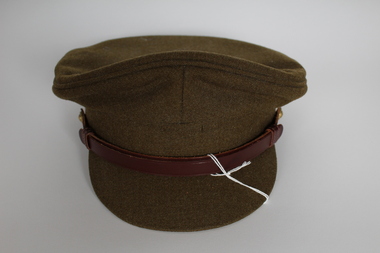
Uniform, Provest officers cap
... Officers cap , flat on top with a peak at the front and a brown belt half way around it and a sweat band inside the cap.Khaki in colour....Officers cap , flat on top with a peak at the front and a brown belt half way around it and a sweat band inside the cap.Khaki in colour. ...Officers cap , flat on top with a peak at the front and a brown belt half way around it and a sweat band inside the cap.Khaki in colour.Label inside cap saying Christies Pty.Ltd. 248 Pitt St. Sydney.hat -
 Lara RSL Sub Branch
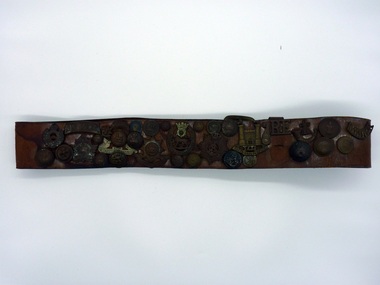
Belt, Leather Belt
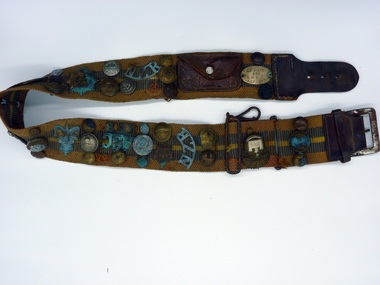
... belts was a sewn on (or in) pocket, secured by a stud or clip, within which loose change could be kept, or a pocket watch, as there were no pockets in the breeches. As you might imagine these became very popular as the pocket was useful and the extra breadth afforded by the canvas strapping made them very comfortable. Around about the turn of the 20th century it began to be popular for officers...belts was a sewn on (or in) pocket, secured by a stud or clip, within which loose change could be kept, or a pocket watch, as there were no pockets in the breeches. As you might imagine these became very popular as the pocket was useful and the extra breadth afforded by the canvas strapping made them very comfortable. Around about the turn of the 20th century it began to be popular for officers ...This belt belonged to a WW1 Australian Anzac who most probably, because of the buttons and badges, served on the Western Front. Records destroyed in 1969 bush fires at Lara means we are unable to determine who owned this in the RSL. The belts is called a 'stable belt' and the one you have acquired is an early example with a leather pocket. It became common in WW1 for both, leather belts (especially that from the 1903 bandolier equipment as worn by those in the Boer War), and stable belts to be used to hold badges collected from fellow soldiers and for that reason it was often known as a 'souvenir belt'. The evolution of the stable belt: It seems that stable belts began to become popular across the Army as a whole around the turn of the 20th century, although they probably originated with the cavalry a little earlier sometime in the 1880s/1890s. All units at that time had horses on their establishment and those soldiers told off to attend them reported for Stable Parade in Stable Dress which consisted of very high waisted and pocket less breeches, or trousers, held up by braces and collarless, woollen flannel shirts with sleeves rolled up. This was to facilitate the rigorous physical effort and flexibility of movement necessary for mucking out and grooming. Braces at that time had no elastic as rubber was expensive, they were made of cotton with no 'give' whatsoever and so soldiers commonly allowed the braces to flop down from the waist so that they could bend over freely. For trousers that fitted loosely (due to the high waist) this meant that they tended to slip down and at first soldiers cinched them in with leather belts. Later on the regimental saddlers began to make belts from the same, plain canvas or wool strapping used for the horses Surcingle and utilising the same double leather strap and buckle arrangement for security (if one strap broke the other would hold and prevent the saddle from coming unseated). One particular feature of these early stable belts was a sewn on (or in) pocket, secured by a stud or clip, within which loose change could be kept, or a pocket watch, as there were no pockets in the breeches. As you might imagine these became very popular as the pocket was useful and the extra breadth afforded by the canvas strapping made them very comfortable. Around about the turn of the 20th century it began to be popular for officers to wear neckties in regimental colours both for sport and less formal, country dress. This habit probably began with the Queens Household troops and Line Cavalry, but quickly spread throughout the Army and it appears as if this use of regimental colours spread to the canvas or wool strapping used to make stable belts. For this reason the stable belts invariably followed the same colour scheme (but not always the same pattern arrangement) of regimental neck ties. This belt is an example of what Australian troops collected when on the Western Front during WW1 and when on leave.Leather Belt with 31 Badges and Buttons from WW1 attachedSee Mediaww1, world war 1, australian army, badges, button, belt, stable belt -
 Lara RSL Sub Branch
Belt, Webbing Belt
... belts was a sewn on (or in) pocket, secured by a stud or clip, within which loose change could be kept, or a pocket watch, as there were no pockets in the breeches. As you might imagine these became very popular as the pocket was useful and the extra breadth afforded by the canvas strapping made them very comfortable. Around about the turn of the 20th century it began to be popular for officers...belts was a sewn on (or in) pocket, secured by a stud or clip, within which loose change could be kept, or a pocket watch, as there were no pockets in the breeches. As you might imagine these became very popular as the pocket was useful and the extra breadth afforded by the canvas strapping made them very comfortable. Around about the turn of the 20th century it began to be popular for officers ...This belt belonged to a WW1 Australian Anzac who most probably, because of the buttons and badges, served on the Western Front. Records destroyed in 1969 bush fires at Lara means we are unable to determine who owned this in the RSL. The belts is called a 'stable belt' and the one you have acquired is an early example with a leather pocket. It became common in WW1 for both, leather belts (especially that from the 1903 bandolier equipment as worn by those in the Boer War), and stable belts to be used to hold badges collected from fellow soldiers and for that reason it was often known as a 'souvenir belt'. The evolution of the stable belt: It seems that stable belts began to become popular across the Army as a whole around the turn of the 20th century, although they probably originated with the cavalry a little earlier sometime in the 1880s/1890s. All units at that time had horses on their establishment and those soldiers told off to attend them reported for Stable Parade in Stable Dress which consisted of very high waisted and pocket less breeches, or trousers, held up by braces and collarless, woollen flannel shirts with sleeves rolled up. This was to facilitate the rigorous physical effort and flexibility of movement necessary for mucking out and grooming. Braces at that time had no elastic as rubber was expensive, they were made of cotton with no 'give' whatsoever and so soldiers commonly allowed the braces to flop down from the waist so that they could bend over freely. For trousers that fitted loosely (due to the high waist) this meant that they tended to slip down and at first soldiers cinched them in with leather belts. Later on the regimental saddlers began to make belts from the same, plain canvas or wool strapping used for the horses Surcingle and utilising the same double leather strap and buckle arrangement for security (if one strap broke the other would hold and prevent the saddle from coming unseated). One particular feature of these early stable belts was a sewn on (or in) pocket, secured by a stud or clip, within which loose change could be kept, or a pocket watch, as there were no pockets in the breeches. As you might imagine these became very popular as the pocket was useful and the extra breadth afforded by the canvas strapping made them very comfortable. Around about the turn of the 20th century it began to be popular for officers to wear neckties in regimental colours both for sport and less formal, country dress. This habit probably began with the Queens Household troops and Line Cavalry, but quickly spread throughout the Army and it appears as if this use of regimental colours spread to the canvas or wool strapping used to make stable belts. For this reason the stable belts invariably followed the same colour scheme (but not always the same pattern arrangement) of regimental neck ties.This belt is an example of what Australian troops collected when on the Western Front during WW1 and when on leave.Webbing Belt with Badges and Buttons WW1See Mediaarmy, australian army, western front, aif, s.w.ellis, service number 640, 2 m.g.c., buttons, badges, belt, stable belt -
 Shepparton RSL Sub Branch
Uniform, Tunic, Circa 1942
... RAAF Officers Tunic, Flying Officer, Dark Blue Wool Serge, with four pockets, inside lining is of black cotton, sleeve lining is of striped sleeve lining material. Five Red Year Shevrons on lower right sleeve, with waist belt with black bakalite buckle held in place by two buttons. ...RAAF Officers Tunic, Flying Officer, Dark Blue Wool Serge, with four pockets, inside lining is of black cotton, sleeve lining is of striped sleeve lining material. Five Red Year Shevrons on lower right sleeve, with waist belt with black bakalite buckle held in place by two buttons. ...WW2 Royal Australian Air Force. Also see statement of Signifiance.Example of WW2 Officers Tunic, this example has a Kings Crown on the sleeve which denotes that the tunic could have been worn as late as 1953, after 1953 it would have been a Queens crown. Crown and eagle denotes Air-Crew. Tunic material can determine which country the tunic came from, Dark Blue- Australia, Light Blue-England, in between, South Africa, Canada and New Zealand.RAAF Officers Tunic, Flying Officer, Dark Blue Wool Serge, with four pockets, inside lining is of black cotton, sleeve lining is of striped sleeve lining material. Five Red Year Shevrons on lower right sleeve, with waist belt with black bakalite buckle held in place by two buttons. Four eyelets to end of waist belt.On lower sleves Crown and Eagle in blackened copper with blue and white rank lace. Number of buttons in correct position (8). Lable in coller MTX Size 8 overwritten in black CRA.On coller lable which says MTX Size Eight, overwritten in black CRA.raaf, officers uniform -
 Shepparton RSL Sub Branch
Uniform, Jacket, 1968
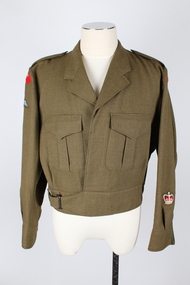
... Which is Warrant Officer Class Two. Five buttons to front of jacket, Belt and buckle does up on RHS, Makers tag with personal name of Piggott, South Australian Lable, Date 1968. ...Which is Warrant Officer Class Two. Five buttons to front of jacket, Belt and buckle does up on RHS, Makers tag with personal name of Piggott, South Australian Lable, Date 1968. ...Royal Victorian Regiment WO2 JacketPost WW2 jacket with Parachute Qualification BadgeWoolen Serge Battle Dress. Royal Victoria Regiment /White over red. Right upper sleeve- Parachute Qualification, Lower both sleeves WO2. Which is Warrant Officer Class Two. Five buttons to front of jacket, Belt and buckle does up on RHS, Makers tag with personal name of Piggott, South Australian Lable, Date 1968. Class 8505-66-025-6422. Size 41/42 PR Length 74cm. In sleeve, Length of sljacket army -
 Flagstaff Hill Maritime Museum and Village
Memorabilia - Fire Brigade Collection, Warrnambool Fire Brigade, 1863-1950s
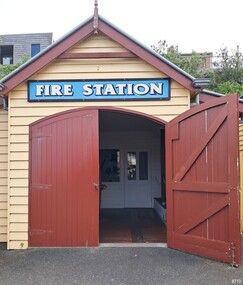
... The items include: EQUIPMENT: 2 fire reels, 3 leather buckets, 1 wooden ladder, 2 old pumps, 2 fire extinguishers, 1 foam nozzle, 2 hydrants, 1 red chest with breathing apparatus, 1 large grey chest, 1 red metal thread gauges box, 2 copper and brass extinguishers, 3 copper and brass branches, 1 canvas bucket, assorted reels of hose, assorted couplings and branches, PHOTOGRAPHS/CERTIFICATES: 3 Discipline Certificates dated 1894, 1893, 1911, Mounted photo of members of the Warrnambool Fire Brigade Football Club, Mounted photos of members of the Warrnambool Fire Brigade in uniform, framed photo of LC Marshall UNIFORMS: 1 Officer’s jacket, 1 blazer, 1 turnout jacket, 1 harness belt, 1 leather helmet, 1 pair of boots, 1 brass helmet, 1 axe belt with axe and plug spanner TROPHIES: 1 clock ...Flagstaff Hill Maritime Museum and Village Great Ocean Road Shipwreck Coast Flagstaff Hill Warrnambool Maritime Village Maritime Museum CFA Fire Brigade Warrnambool Fire Brigade fire reel leather bucket wooden ladder pump fire extinguisher foam nozzle fireman’s hydrant breathing apparatus copper and brass extinguishers copper and brass branches canvas bucket Discipline Certificates Warrnambool Fire Brigade Football Club L C Marshall Officer’s jacket blazer turnout jacket harness belt leather helmet pair of boots brass helmet axe belt with axe and plug spanner clock mantle clock Warrnambool Fire Brigade Collection: a variety of historic objects and equipment used by the firemen of the brigade since 1863. ...The original replica Fire Station at Flagstaff Hill was constructed in 2006 by members of the CVA Warrnambool Fire Brigade. It was rebuilt in 2015, ironically due to damage from fire in the adjacent building, and now includes a locked display. The fire station faithfully replicates the designs of the late 1800s fire stations found across Victoria. Every detail, including the type of nails used, adheres to period-correct specifications. The objects on display are on loan from the CFA. They provide a glimpse into the history and evolution of firefighting in Victoria, preserving the heritage and legacy of the brave men and women who have served their communities. Fire Brigade Collection highlights: . Hose reels and equipment: essential firefighting equipment used during the late 19th and early 20th centuries. . Brass helmets: symbolic headgear worn by firefighters for protection and identification. . Photographs: historical images capturing the evolution of firefighting in the region. . Certificates: awards highlighting the skill and dedication of firefighters. A BRIEF HISTORY OF THE WARRNAMBOOL FIRE BRIGADE - [Ref: Quarrell, A, 2013, The Warrnambool Fire Brigade: 1863-2013, Amazon Printing, Warrnambool]: “Since the township of Warrnambool was established in the 1840s, there were several attempts at forming a Fire Brigade. However, many issues hindered progress. Firstly, minimal fires were recorded. Secondly, the town had no money to purchase expensive equipment, including a fire engine, and thirdly and most importantly, there was no infrastructure for accessible running water from pipes, as we know today. But after the expansion and growth of the township, it was time for action. The Warrnambool Fire Brigade was formed in 1863. The Brigade has served Warrnambool on a daily basis ever since. The volunteers of the Brigade were required to fill their water carts each evening from a spring on Cannon Hill and be on standby to deliver water to fire scenes. In 1889, the Warrnambool Council built a new Fire Station at 25 Liebig Street. Today, the Civic Centre is located on this site.” The objects on loan from the Warrnambool Fire Brigade are significant to local history since its establishment in 1863. They tell the story of the Brigade’s history, which is part of Warrnambool and the district’s history.Warrnambool Fire Brigade Collection: a variety of historic objects and equipment used by the firemen of the brigade since 1863. The items are kindly on loan from the Warrnambool Fire Brigade in a building originally erected in the Village by the Fire Brigade to house their historic collection. The items include: EQUIPMENT: 2 fire reels, 3 leather buckets, 1 wooden ladder, 2 old pumps, 2 fire extinguishers, 1 foam nozzle, 2 hydrants, 1 red chest with breathing apparatus, 1 large grey chest, 1 red metal thread gauges box, 2 copper and brass extinguishers, 3 copper and brass branches, 1 canvas bucket, assorted reels of hose, assorted couplings and branches, PHOTOGRAPHS/CERTIFICATES: 3 Discipline Certificates dated 1894, 1893, 1911, Mounted photo of members of the Warrnambool Fire Brigade Football Club, Mounted photos of members of the Warrnambool Fire Brigade in uniform, framed photo of LC Marshall UNIFORMS: 1 Officer’s jacket, 1 blazer, 1 turnout jacket, 1 harness belt, 1 leather helmet, 1 pair of boots, 1 brass helmet, 1 axe belt with axe and plug spanner TROPHIES: 1 clock flagstaff hill maritime museum and village, great ocean road, shipwreck coast, flagstaff hill, warrnambool, maritime village, maritime museum, cfa, fire brigade, warrnambool fire brigade, fire reel, leather bucket, wooden ladder, pump, fire extinguisher, foam nozzle, fireman’s hydrant, breathing apparatus, copper and brass extinguishers, copper and brass branches, canvas bucket, discipline certificates, warrnambool fire brigade football club, l c marshall, officer’s jacket, blazer, turnout jacket, harness belt, leather helmet, pair of boots, brass helmet, axe belt with axe and plug spanner, clock, mantle clock -
 Flagstaff Hill Maritime Museum and Village
Clothing - Belt, late 1920's
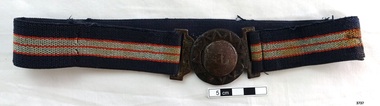
... belt was donated to Flagstaff Hill Maritime Village, along with photos of the ship LARGS BAY and of Dr Angus in his ship surgeon’s uniform, by the family of Doctor William Roy Angus, Surgeon and Oculist. ABOUT THE “W.R.ANGUS COLLECTION” Doctor William Roy Angus M.B., B.S., Adel., 1923, F.R.C.S. Edin.,1928 (also known as Dr Roy Angus) was born in Murrumbeena, Victoria in 1901 and lived until 1970. He qualified as a doctor in 1923 at University of Adelaide, was Resident Medical Officer...The belt is also representative of Australian medical students travelling overseas to complete their medical studies. The W.R. Angus Collection is significant for still being located at the site it is connected with, Doctor Angus being the last Port Medical Officer in Warrnambool. ...This late 1920’s elastic belt is decorated with an anchor, giving it a nautical theme. It was worn by Dr W.R. Angus during his service as ship’s surgeon on ships "BANESHIRE" and the Australian Commonwealth Line’s T.S.S. “LARGS BAY”, when he worked his passage to the UK and return to Australia for his overseas studies. He was awarded the FRCS (Fellow from the Royal College of Surgeons) in 1928 in Edinburgh, Scotland. The belt was donated to Flagstaff Hill Maritime Village, along with photos of the ship LARGS BAY and of Dr Angus in his ship surgeon’s uniform, by the family of Doctor William Roy Angus, Surgeon and Oculist. ABOUT THE “W.R.ANGUS COLLECTION” Doctor William Roy Angus M.B., B.S., Adel., 1923, F.R.C.S. Edin.,1928 (also known as Dr Roy Angus) was born in Murrumbeena, Victoria in 1901 and lived until 1970. He qualified as a doctor in 1923 at University of Adelaide, was Resident Medical Officer at the Royal Adelaide Hospital in 1924 and for a period was house surgeon to Sir (then Mr.) Henry Simpson Newland. Dr Angus was briefly an Assistant to Dr Riddell of Kapunda, then commenced private practice at Curramulka, Yorke Peninsula, SA, where he was physician, surgeon and chemist. In 1926, he was appointed as new Medical Assistant to Dr Thomas Francis Ryan (T.F. Ryan, or Tom), in Nhill, Victoria, where his experiences included radiology and pharmacy. In 1927 he was Acting House Surgeon in Dr Tom Ryan’s absence. Dr Angus had become engaged to Gladys Forsyth and they decided he further his studies overseas in the UK in 1927. He studied at London University College Hospital and at Edinburgh Royal Infirmary and in 1928, was awarded FRCS (Fellow from the Royal College of Surgeons), Edinburgh. He worked his passage back to Australia as a Ship’s Surgeon on the on the Australian Commonwealth Line’s T.S.S. Largs Bay. Dr Angus married Gladys in 1929, in Ballarat. (They went on to have one son (Graham 1932, born in SA) and two daughters (Helen (died 12/07/1996) and Berenice (Berry), both born at Mira, Nhill ) According to Berry, her mother Gladys made a lot of their clothes. She was very talented and did some lovely embroidery including lingerie for her trousseau and beautifully handmade baby clothes. Dr Angus was a ‘flying doctor’ for the A.I.M. (Australian Inland Ministry) Aerial Medical Service in 1928 . Its first station was in the remote town of Oodnadatta, where Dr Angus was stationed. He was locum tenens there on North-South Railway at 21 Mile Camp. He took up this ‘flying doctor’ position in response to a call from Dr John Flynn; the organisation was later known as the Flying Doctor Service, then the Royal Flying Doctor Service. A lot of his work during this time involved dental surgery also. Between 1928-1932 he was surgeon at the Curramulka Hospital, Yorke Peninsula, South Australia. In 1933 Dr Angus returned to Nhill and purchased a share of the Nelson Street practice and Mira hospital (a 2 bed ward at the Nelson Street Practice) from Dr Les Middleton one of the Middleton Brothers, the current owners of what previously once Dr Tom Ryan’s practice. Dr Tom and his brother had worked as surgeons included eye surgery. Dr Tom Ryan performed many of his operations in the Mira private hospital on his premises. He had been House Surgeon at the Nhill Hospital 1902-1926. Dr Tom Ryan had one of the only two pieces of radiology equipment in Victoria during his practicing years – The Royal Melbourne Hospital had the other one. Over the years Dr Tom Ryan had gradually set up what was effectively a training school for country general-practitioner-surgeons. Each patient was carefully examined, including using the X-ray machine, and any surgery was discussed and planned with Dr Ryan’s assistants several days in advance. Dr Angus gained experience in using the X-ray machine there during his time as assistant to Dr Ryan. When Dr Angus bought into the Nelson Street premises in Nhill he was also appointed as the Nhill Hospital’s Honorary House Surgeon 1933-1938. His practitioner’s plate from his Nhill surgery is now mounted on the doorway to the Port Medical Office at Flagstaff Hill Maritime Village, Warrnambool. When Dr Angus took up practice in the Dr Edward and Dr Tom Ryan’s old premises he obtained their extensive collection of historical medical equipment and materials spanning 1884-1926. A large part of this collection is now on display at the Port Medical Office at Flagstaff Hill Maritime Village in Warrnambool. In 1939 Dr Angus and his family moved to Warrnambool where he purchased “Birchwood,” the 1852 home and medical practice of Dr John Hunter Henderson, at 214 Koroit Street. (This property was sold in1965 to the State Government and is now the site of the Warrnambool Police Station. and an ALDI store is on the land that was once their tennis court). The Angus family was able to afford gardeners, cooks and maids; their home was a popular place for visiting dignitaries to stay whilst visiting Warrnambool. Dr Angus had his own silk worm farm at home in a Mulberry tree. His young daughter used his centrifuge for spinning the silk. Dr Angus was appointed on a part-time basis as Port Medical Officer (Health Officer) in Warrnambool and held this position until the 1940’s when the government no longer required the service of a Port Medical Officer in Warrnambool; he was thus Warrnambool’s last serving Port Medical Officer. (Masters of immigrant ships arriving in port reported incidents of diseases, illness and death and the Port Medical Officer made a decision on whether the ship required Quarantine and for how long, in this way preventing contagious illness from spreading from new immigrants to the residents already in the colony.) Dr Angus was a member of the Australian Medical Association, for 35 years and surgeon at the Warrnambool Base Hospital 1939-1942, Dr Angus served with the Australian Department of Defence as a Surgeon Captain during WWII 1942-45, in Ballarat, Victoria, and in Bonegilla, N.S.W., completing his service just before the end of the war due to suffering from a heart attack. During his convalescence he carved an intricate and ‘most artistic’ chess set from the material that dentures were made from. He then studied ophthalmology at the Royal Melbourne Eye and Ear Hospital and created cosmetically superior artificial eyes by pioneering using the intrascleral cartilage. Angus received accolades from the Ophthalmological Society of Australasia for this work. He returned to Warrnambool to commence practice as an ophthalmologist, pioneering in artificial eye improvements. He was Honorary Consultant Ophthalmologist to Warrnambool Base Hospital for 31 years. He made monthly visits to Portland as a visiting surgeon, to perform eye surgery. He represented the Victorian South-West subdivision of the Australian Medical Association as its secretary between 1949 and 1956 and as chairman from 1956 to 1958. In 1968 Dr Angus was elected member of Spain’s Barraquer Institute of Barcelona after his research work in Intrasclearal cartilage grafting, becoming one of the few Australian ophthalmologists to receive this honour, and in the following year presented his final paper on Living Intrasclearal Cartilage Implants at the Inaugural Meeting of the Australian College of Ophthalmologists in Melbourne In his personal life Dr Angus was a Presbyterian and treated Sunday as a Sabbath, a day of rest. He would visit 3 or 4 country patients on a Sunday, taking his children along ‘for the ride’ and to visit with him. Sunday evenings he would play the pianola and sing Scottish songs to his family. One of Dr Angus’ patients was Margaret MacKenzie, author of a book on local shipwrecks that she’d seen as an eye witness from the late 1880’s in Peterborough, Victoria. In the early 1950’s Dr Angus, painted a picture of a shipwreck for the cover jacket of Margaret’s book, Shipwrecks and More Shipwrecks. She was blind in later life and her daughter wrote the actual book for her. Dr Angus and his wife Gladys were very involved in Warrnambool’s society with a strong interest in civic affairs. He had an interest in people and the community They were both involved in the creation of Flagstaff Hill, including the layout of the gardens. After his death (28th March 1970) his family requested his practitioner’s plate, medical instruments and some personal belongings be displayed in the Port Medical Office surgery at Flagstaff Hill Maritime Village, and be called the “W. R. Angus Collection”. This belt is representative of the uniform worn by ship’s staff in the 1920’s. The belt is also representative of Australian medical students travelling overseas to complete their medical studies. The W.R. Angus Collection is significant for still being located at the site it is connected with, Doctor Angus being the last Port Medical Officer in Warrnambool. The collection of medical instruments and other equipment is culturally significant, being an historical example of medicine, administration, household equipment and clothing from late 19th to mid-20th century. Dr Angus assisted Dr Tom Ryan, a pioneer in the use of X-rays and in ocular surgery. Belt, part of the W.R. Angus Collection. Elastic belt, black, grey and red horizontal stripes. Round black-painted metal fastening on each end with remnants of gold zing-zag border around buckle’s wreath end an anchor impressed into the buckle’s tongue. flagstaff hill, warrnambool, shipwrecked coast, flagstaff hill maritime museum, maritime museum, shipwreck coast, flagstaff hill maritime village, great ocean road, dr w r angus, dr ryan, t.s.s. largs bay, warrnambool base hospital, nhill base hospital, mira hospital, flying doctor, ship medical staff uniform, ship medical staff belt, 1920’s elastic belt with tongue and wreath buckle, tongue and wreath belt buckle with anchor symbol, ship staff uniform, 1920’s belt -
 Flagstaff Hill Maritime Museum and Village
Money Belt, c. 1942
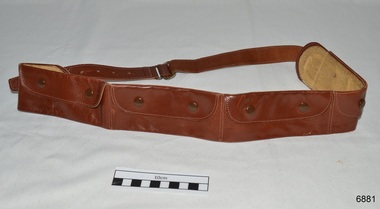
... This money belt was issued to Dr W.R. Angus when he served in the Army 1942-1945 as a medical officer at Ballarat, Victoria, and Bonegilla, N.S.W.. ...This money belt was issued to Dr W.R. Angus when he served in the Army 1942-1945 as a medical officer at Ballarat, Victoria, and Bonegilla, N.S.W.. ...This money belt was issued to Dr W.R. Angus when he served in the Army 1942-1945 as a medical officer at Ballarat, Victoria, and Bonegilla, N.S.W.. (Surgeon Captain A.A.M.C., 108 A.G.H., and 106 A.G.H., Captain A.A.M.C. retired list.) The belt was donated to Flagstaff Hill Maritime Village by the family of Doctor William Roy Angus, Surgeon and Oculist. It is part of the “W.R. Angus Collection” that includes historical medical equipment, surgical instruments and material once belonging to Dr Edward Ryan and Dr Thomas Francis Ryan, (both of Nhill, Victoria) as well as Dr Angus’ own belongings. The Collection’s history spans the medical practices of the two Doctors Ryan, from 1885-1926 plus that of Dr Angus, up until 1969. ABOUT THE “W.R.ANGUS COLLECTION” Doctor William Roy Angus M.B., B.S., Adel., 1923, F.R.C.S. Edin.,1928 (also known as Dr Roy Angus) was born in Murrumbeena, Victoria in 1901 and lived until 1970. He qualified as a doctor in 1923 at University of Adelaide, was Resident Medical Officer at the Royal Adelaide Hospital in 1924 and for a period was house surgeon to Sir (then Mr.) Henry Simpson Newland. Dr Angus was briefly an Assistant to Dr Riddell of Kapunda, then commenced private practice at Curramulka, Yorke Peninsula, SA, where he was physician, surgeon and chemist. In 1926, he was appointed as new Medical Assistant to Dr Thomas Francis Ryan (T.F. Ryan, or Tom), in Nhill, Victoria, where his experiences included radiology and pharmacy. In 1927 he was Acting House Surgeon in Dr Tom Ryan’s absence. Dr Angus had become engaged to Gladys Forsyth and they decided he further his studies overseas in the UK in 1927. He studied at London University College Hospital and at Edinburgh Royal Infirmary and in 1928, was awarded FRCS (Fellow from the Royal College of Surgeons), Edinburgh. He worked his passage back to Australia as a Ship’s Surgeon on the on the Australian Commonwealth Line’s T.S.S. Largs Bay. Dr Angus married Gladys in 1929, in Ballarat. (They went on to have one son (Graham 1932, born in SA) and two daughters (Helen (died 12/07/1996) and Berenice (Berry), both born at Mira, Nhill ) According to Berry, her mother Gladys made a lot of their clothes. She was very talented and did some lovely embroidery including lingerie for her trousseau and beautifully handmade baby clothes. Dr Angus was a ‘flying doctor’ for the A.I.M. (Australian Inland Ministry) Aerial Medical Service in 1928 . Its first station was in the remote town of Oodnadatta, where Dr Angus was stationed. He was locum tenens there on North-South Railway at 21 Mile Camp. He took up this ‘flying doctor’ position in response to a call from Dr John Flynn; the organisation was later known as the Flying Doctor Service, then the Royal Flying Doctor Service. A lot of his work during this time involved dental surgery also. Between 1928-1932 he was surgeon at the Curramulka Hospital, Yorke Peninsula, South Australia. In 1933 Dr Angus returned to Nhill and purchased a share of the Nelson Street practice and Mira hospital (a 2 bed ward at the Nelson Street Practice) from Dr Les Middleton one of the Middleton Brothers, the current owners of what previously once Dr Tom Ryan’s practice. Dr Tom and his brother had worked as surgeons included eye surgery. Dr Tom Ryan performed many of his operations in the Mira private hospital on his premises. He had been House Surgeon at the Nhill Hospital 1902-1926. Dr Tom Ryan had one of the only two pieces of radiology equipment in Victoria during his practicing years – The Royal Melbourne Hospital had the other one. Over the years Dr Tom Ryan had gradually set up what was effectively a training school for country general-practitioner-surgeons. Each patient was carefully examined, including using the X-ray machine, and any surgery was discussed and planned with Dr Ryan’s assistants several days in advance. Dr Angus gained experience in using the X-ray machine there during his time as assistant to Dr Ryan. When Dr Angus bought into the Nelson Street premises in Nhill he was also appointed as the Nhill Hospital’s Honorary House Surgeon 1933-1938. His practitioner’s plate from his Nhill surgery is now mounted on the doorway to the Port Medical Office at Flagstaff Hill Maritime Village, Warrnambool. When Dr Angus took up practice in the Dr Edward and Dr Tom Ryan’s old premises he obtained their extensive collection of historical medical equipment and materials spanning 1884-1926. A large part of this collection is now on display at the Port Medical Office at Flagstaff Hill Maritime Village in Warrnambool. In 1939 Dr Angus and his family moved to Warrnambool where he purchased “Birchwood,” the 1852 home and medical practice of Dr John Hunter Henderson, at 214 Koroit Street. (This property was sold in1965 to the State Government and is now the site of the Warrnambool Police Station. and an ALDI sore is on the land that was once their tennis court). The Angus family was able to afford gardeners, cooks and maids; their home was a popular place for visiting dignitaries to stay whilst visiting Warrnambool. Dr Angus had his own silk worm farm at home in a Mulberry tree. His young daughter used his centrifuge for spinning the silk. Dr Angus was appointed on a part-time basis as Port Medical Officer (Health Officer) in Warrnambool and held this position until the 1940’s when the government no longer required the service of a Port Medical Officer in Warrnambool; he was thus Warrnambool’s last serving Port Medical Officer. (Masters of immigrant ships arriving in port reported incidents of diseases, illness and death and the Port Medical Officer made a decision on whether the ship required Quarantine and for how long, in this way preventing contagious illness from spreading from new immigrants to the residents already in the colony.) Dr Angus was a member of the Australian Medical Association, for 35 years and surgeon at the Warrnambool Base Hospital 1939-1942, He served as a Surgeon Captain during WWII1942-45, in Ballarat, Victoria, and in Bonegilla, N.S.W., completing his service just before the end of the war due to suffering from a heart attack. During his convalescence he carved an intricate and ‘most artistic’ chess set from the material that dentures were made from. He then studied ophthalmology at the Royal Melbourne Eye and Ear Hospital and created cosmetically superior artificial eyes by pioneering using the intrascleral cartilage. Angus received accolades from the Ophthalmological Society of Australasia for this work. He returned to Warrnambool to commence practice as an ophthalmologist, pioneering in artificial eye improvements. He was Honorary Consultant Ophthalmologist to Warrnambool Base Hospital for 31 years. He made monthly visits to Portland as a visiting surgeon, to perform eye surgery. He represented the Victorian South-West subdivision of the Australian Medical Association as its secretary between 1949 and 1956 and as chairman from 1956 to 1958. In 1968 Dr Angus was elected member of Spain’s Barraquer Institute of Barcelona after his research work in Intrasclearal cartilage grafting, becoming one of the few Australian ophthalmologists to receive this honour, and in the following year presented his final paper on Living Intrasclearal Cartilage Implants at the Inaugural Meeting of the Australian College of Ophthalmologists in Melbourne In his personal life Dr Angus was a Presbyterian and treated Sunday as a Sabbath, a day of rest. He would visit 3 or 4 country patients on a Sunday, taking his children along ‘for the ride’ and to visit with him. Sunday evenings he would play the pianola and sing Scottish songs to his family. One of Dr Angus’ patients was Margaret MacKenzie, author of a book on local shipwrecks that she’d seen as an eye witness from the late 1880’s in Peterborough, Victoria. In the early 1950’s Dr Angus, painted a picture of a shipwreck for the cover jacket of Margaret’s book, Shipwrecks and More Shipwrecks. She was blind in later life and her daughter wrote the actual book for her. Dr Angus and his wife Gladys were very involved in Warrnambool’s society with a strong interest in civic affairs. He had an interest in people and the community They were both involved in the creation of Flagstaff Hill, including the layout of the gardens. After his death (28th March 1970) his family requested his practitioner’s plate, medical instruments and some personal belongings be displayed in the Port Medical Office surgery at Flagstaff Hill Maritime Village, and be called the “W. R. Angus Collection”. The W.R. Angus Collection is significant for still being located at the site it is connected with, Doctor Angus being the last Port Medical Officer in Warrnambool. The collection of medical instruments and other equipment is culturally significant, being an historical example of medicine from late 19th to mid-20th century. Dr Angus assisted Dr Tom Ryan, a pioneer in the use of X-rays and in ocular surgery. The collection of Army objects is an example of items issued to Doctors and Surgeons in the Medical Services of the Australian Army in World War 2. Brown leather money belt, genuine calf, lined, 4 pouches with stud closure flaps included. Issued to W.R. Angus in WWII and part of the W.R. Angus Collection. Gold embossed label. Hand written inscription with name and serial number. Gold embossed “GENUINE CALF” under silver coloured buckle. Hand written inside of belt “W.R. ANGUS / 61-3 9803 5228”flagstaff hill, warrnambool, shipwrecked coast, flagstaff hill maritime museum, maritime museum, shipwreck coast, flagstaff hill maritime village, great ocean road, dr w r angus, dr ryan, military money belt, surgeon captain, royal australian army, military service australian army, wwii uniform, world war 2 -
 Montmorency–Eltham RSL Sub Branch
Uniform - Sam Browne Belt, Sam Browne Belt (brown leather)
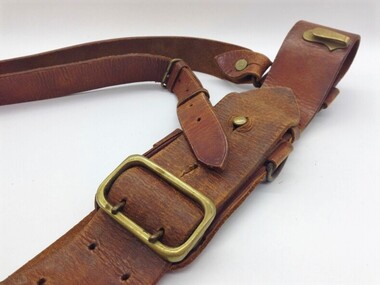
... The belt had two shoulder straps when a holster was worn. In the Australian Army, a brown leather version is worn on ceremonial occasions by officers and Warrant Officers Class One of all corps, except those who wear silver dress embellishments (Armoured, Aviation and Nursing Corps). ...The belt had two shoulder straps when a holster was worn. In the Australian Army, a brown leather version is worn on ceremonial occasions by officers and Warrant Officers Class One of all corps, except those who wear silver dress embellishments (Armoured, Aviation and Nursing Corps). ...The Samuel Browne belt is named after Sir Samuel James Browne VC. In 1858, Browne lost his left arm in battle (as a result of a sword cut) and as the dress regulations of his regiment required officers to wear their waist belts under their tunics, Browne found this ungainly and devised an external belt supported on the left-hand (sword) side by a shoulder strap. The belt had two shoulder straps when a holster was worn. In the Australian Army, a brown leather version is worn on ceremonial occasions by officers and Warrant Officers Class One of all corps, except those who wear silver dress embellishments (Armoured, Aviation and Nursing Corps). These members wear a black Sam Browne belt. Wide brown pattern stitched brown leather belt with adustable shoulder strap, brass buckle and brass loop fittings (4 at the top and 2 at the bottom) attached to the belt by stitched leather straps.Nonesam browne, belt, clothing -
 Montmorency–Eltham RSL Sub Branch
Uniform - Jacket, Khaki, Service Dress, Khaki Service Dress Jacket, Unknown, post Vietnam era
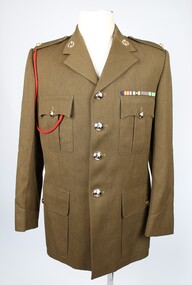
... belt. Ribbon bar - Australian Vietnam Medal, Defence Force Service Medal with Clasp, National Medal, Republic of Vietnam Star. Donor served in 3rd Battalion, Royal Australian Regiment in Vietnam uniform military officers vanzwol vanswol Label inside - Cardone Apparel Victoria with care instruction and broad arrow. ...Military uniform of an R.A.Regiment Captain, post Vietnam. The uniform is missing two ‘pips’ from both epaulettes, the date bar from the Vietnam Star, and the belt. Ribbon bar - Australian Vietnam Medal, Defence Force Service Medal with Clasp, National Medal, Republic of Vietnam Star. Donor served in 3rd Battalion, Royal Australian Regiment in VietnamOfficers Khaki Serge Jacket with brass buttons & rank insignia, and 4-medal riband barLabel inside - Cardone Apparel Victoria with care instruction and broad arrow. Hand written ‘14-4-80’ and ‘J A VANSWOL’ uniform, military, officers, vanzwol, vanswol -
 Flagstaff Hill Maritime Museum and Village
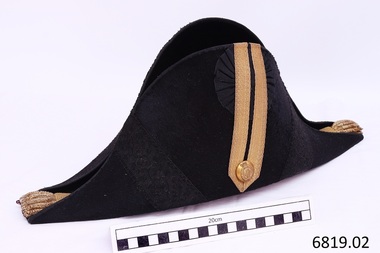
Uniform - Bicorn Hat and Hat Box, late 19th - early 20th century
... Dr Angus assisted Dr Tom Ryan, a pioneer in the use of X-rays and in ocular surgery. flagstaff hill warrnambool shipwrecked coast flagstaff hill maritime museum maritime museum shipwreck coast flagstaff hill maritime village great ocean road dr w r angus t.s.s. largs bay berry mcdade 19th century colonial military uniform artillery staff officer’s cocked had victorian volunteers victorian colonial military forces colonial militia aut pace aut bello cocked hat cockade hat bicorn hat military bullion oak leaves and acorns pattern gold bullion tassels military heraldry w.r. angus collection. Australian Navy British Navy uniform The hat has no maker’s marks although there is a darker colour in the centre where there could have been a label. Inside the hat is taped a printed label; “Mc DADE 801 1032” Button’s emblem- a cross with five stars, under a crown, all within a buckled belt ...This hat and hat box was donated to Flagstaff Hill Maritime Village by the family of Doctor William Roy Angus, Surgeon and Oculist. It is part of the “W.R. Angus Collection” which includes historical medical equipment, surgical instruments and material once belonging to Dr Edward Ryan and Dr Thomas Francis Ryan, (both of Nhill, Victoria) as well as Dr Angus’ belongings. The Collection’s history spans the medical practices of the two Doctors Ryan, from 1885-1926 plus that of Dr Angus, up until 1969. McDade is the surname of Dr Angus’ daughter Berry (Berenice) McDade nee Angus. This had belonged to her father Dr William Roy Angus, Surgeon and Oculist (1901 –1970), who wore it on the ship T.S.S. LARGS BAY when travelling from Australia to Scotland for extended studies to be a “Fellow” of the Royal College of Surgeons in Edinburgh in 1929. This bicorn, cocked hat was worn with narrow points towards the front and back. It is decorated with flat gold braid or ‘lace’ with a geometrical design. Regimental lace was worn on the uniform and headdress of regimental officers in the 19th century. Gold lace chevrons were worn on coats to signify rank. Drummers and Foot Guards also wore regimental lace to distinguish them from other military personnel. In the late 19th century the English and Welsh infantry officers’ uniforms displayed a rose-pattern lace. The gold bullion and underlying crimson ‘eyes’ have been used to signify the rank of the owner. Crimson eyes were used for military personnel, and blue eyes were used for naval personnel. Different numbers and colours of the bullion and eyes may have been used to represent different military ranks. The Regulations specify nine tassels and eleven underlying eyes but there could have been variations. We have not yet identified the rank for this particular hat but hats such as this were part of the Australian and British naval uniforms in the early 20th century. The gold button’s emblem features a cross with five stars, a crown, and the motto “AUT PACE AUT BELLO,” which translates as “either in peace or in war.” Museum Victoria has a similar button and writes that buttons with this design were used by the Victorian Volunteers in the nineteenth century. The Australian War Memorial Curator of Military Heraldry advised Museum Victoria that these buttons dated from 1880 to 1892 and were worn by regular, unranked soldiers. Tasmanian Midshipman Alan Casey, who served the British and Australian Navy from 1919 to 1933 and retired as a Lieutenant Commander, owned a similar officer's bicorn hat. His hat and epaulettes are in the Tasmanian Maritime Museum's collection. The Australian War Memorial has a hat that is very similar in design, described as an “Artillery Staff Officer’s cocked had with plume, worn by Volunteer Artillery Staff in the Victorian Colonial Military Forces”. That hat is different in that it has a plume and the braid and button are silver. Berry MdDade, the donor, has used the hat many times as a dress-up hat but doesn’t know the origin of it. The hat seems to fit the design of the Staff Officers in Victorian Volunteers in Colonial times, but the button on this hat was used for unranked volunteers. Also, military uniforms usually have very clear manufacturer’s labels, as they are made by reputable companies under contract to the Defence Department. The manufacturer’s mark is not discernible on this hat. The origin, original wearer and use of this particular hat is unclear. The military bicorn cockade hat belonged to Dr William Roy Angus and is part of the W.R. Angus Collection. It is significant for still being located at the site connected to Doctor Angus being the last Port Medical Officer in Warrnambool. The collection of medical instruments and other equipment is culturally significant, as an historical example of medicine from late 19th to mid-20th century. Dr Angus assisted Dr Tom Ryan, a pioneer in the use of X-rays and in ocular surgery. Black bicorn cocked hat and case. It appears to be part of a 19th-century Colonial full-dress naval officer's uniform. The long, narrow crescent-shaped hat is made of beaver fabric and the crown is lined with crimson silk and finished with a hand-stitched leather sweatband. On one flat side is a pleated black silk, lace cockade woven in the pattern of oak leaves and acorns. The cockade is overlaid with a double row of gold lace braiding secure with a Victorian Volunteer’s gold button. Wide diagonal bands of black lace braid trim are on each side of the gold braiding. The other side of the hat is plain. The front and back points of the hat each have seven gold bullion tassels with nine underlying twists of crimson ‘eyes’. The fitted metal carry case has a catch and a plaque on one side. The button bears a crown and cross with five stars and a motto. Inside the hat is a white name tag with clear adhesive over it, with black printed text with the name “Mc Dade”. The hat is part of the W.R. Angus Collection.The hat has no maker’s marks although there is a darker colour in the centre where there could have been a label. Inside the hat is taped a printed label; “Mc DADE 801 1032” Button’s emblem- a cross with five stars, under a crown, all within a buckled belt with the motto “AUT PACE AUT BELLO” [either in peace or in war] The plaque on the case has no legible marks.flagstaff hill, warrnambool, shipwrecked coast, flagstaff hill maritime museum, maritime museum, shipwreck coast, flagstaff hill maritime village, great ocean road, dr w r angus, t.s.s. largs bay, berry mcdade, 19th century colonial military uniform, artillery staff officer’s cocked had, victorian volunteers, victorian colonial military forces, colonial militia, aut pace aut bello, cocked hat, cockade hat, bicorn hat, military bullion, oak leaves and acorns pattern, gold bullion tassels, military heraldry, w.r. angus collection., australian navy, british navy, uniform -
 Rye RSL Sub Branch
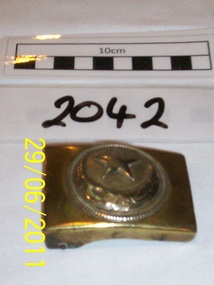
Belt Buckle Brass Turkish Officer
... Belt Buckle Brass Turkish Officer...Thought to have belonged to a Turkish Officer.It has an embossd Crescent and Star emblem. Belt Buckle Brass Turkish Officer ...Brass belt buckle similar in style to the German equivalent. Thought to have belonged to a Turkish Officer.It has an embossd Crescent and Star emblem. -
 Bendigo Military Museum
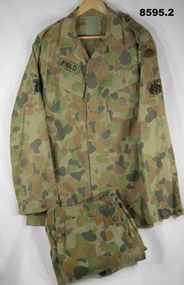
Uniform - SHIRT, TROUSERS, WORKDRESS, ARMY, Australian Defence Industries, 1990 - 1994
... officer Class One on both sleeves. Manufacturers label - green cotton fabric - below collar. 2. Trousers - new style. Two side pockets, two large patch side pockets with two button closer flaps. One back patch pocket with button. Belt...officer Class One on both sleeves. Manufacturers label - green cotton fabric - below collar. 2. Trousers - new style. Two side pockets, two large patch side pockets with two button closer flaps. One back patch pocket with button. Belt ...Original owner - 'FIELD'.Shirt and Trousers Word dress. 1. & 2. DPCU (Disruptive Pattern Camouflage Uniform) work dress. Colours light to dark green through to light to dark brown. Cotton/polyester fabric. Khaki colour plastic buttons. 1. Shirt work dress, collar, shoulder epaulettes, two front pockets with concealed button closure flaps. Front - five buttons with concealed placket, long sleeves with cuff. Name patch has been sewn on "FIELD". Australian Army Rising Sun patch, top left sleeve. Rank insignia - Australian Coat of Arms - Warrant officer Class One on both sleeves. Manufacturers label - green cotton fabric - below collar. 2. Trousers - new style. Two side pockets, two large patch side pockets with two button closer flaps. One back patch pocket with button. Belt loops with buttons. Nylon/metal zipper fly. DPCU pocket lining. Manufacturers label - on right front pocket.Manufacturers information - black ink print. 1. "VICTORIA/ 1990/ ^/ ???? 66.130.0039/ SIZE 107L/ NAME/ SERVICE NO/ MACHINE WASHABLE/ DRIP DRY ONLY/ DO NOT IRON/ DO NOT STARCH/ DO NOT BLEACH". 2. "VICTORIA/ 1994/ ^/ 8415.66.134.8920/ SIZE 95L/ CUT NO 2200/ SERVICE NO/ NAME/ 50% POLYESTER 50% COTTON/ MACHINE WASHABLE DRIP DRY ONLY/ DO NOT IRON DO NOT STARCH/ DO NOT BLEACH".uniforms, army, work dress, dpcu, passchendaele barracks trust -
 Bendigo Military Museum
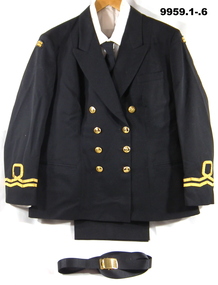
Uniform - WINTER CEREMONIAL - NAVY CADETS, Australian Defence Industries, 1992, 2002
... Belt - black with gold buckle. 7. Hat - Tricorne for female officer - black and white colour fabric. ...Belt - black with gold buckle. 7. Hat - Tricorne for female officer - black and white colour fabric. ...Uniform issued to Lieutenant ANC (Australian Navy Cadets) "Patricia Ibbotson", No. 1005777. Commanding Officer of Training Ship Bendigo. Enlisted 26/2/2004 - Admin Officer, 2IC. Acting CO June 2012 Commanding Officer 16/10/2012. Retired 26/02/2016.1. Jacket - Black winter ceremonial, wool/polyester fabric, double breasted with 8 gold plastic buttons embossed with an anchor. Two wavy gold stripes just above sleeve hems, denotes rank of Lieutenant. One stripe has a loop. There are black shoulder flashes with the words "Australian Navy Cadets" embroidered in gold. 2. Trousers - Black wool/polyester fabric with side pockets. Fob pocket, back pocket and belt loops. Nylon and metal zipper fly, Black polyester pocket lining. 3. Shirt - long sleeved with cuff, white cotton/polyester fabric, collar, front breast pockets with button down flap. Shoulder epaulettes, plastic buttons. 4. Shirt - white, short sleeved with shoulder boards. Cotton/polyester fabric, collar shoulder epaulettes, two front pockets, white plastic buttons. Shoulder boards gold ribbon on black fabric with gold plastic embossed buttons. 6. Belt - black with gold buckle. 7. Hat - Tricorne for female officer - black and white colour fabric. Black brim, white crown with black polyester lining. On front is a cloth Officers badge featuring gold laurel wreath surrounding a silver anchor. On top of that is a gold crown with padded insert of red velvet. Around the base is embroidered dots of red, blue and green representing gems. Manufacturers label - black in print - illegible. Handwritten owner's, blue ink pen "IBBOTSON". Manufacturer's label - black ink print on white cotton fabric. 1. "ADI/ 1992/ SIZE 115s/ Bust - 115cm/ Waist 90 cm/ 8410-66-134-3810/ Wool/polyester/ Service No/ Name/DRY CLEAN ONLY." 2. ADA/ 2002/ ^/ NSN 8405 66 137 9251/ Wool/Polyester/ Size: 104L/ Waist:104/ Seat: 125/ NO/ NAME/ DRY CLEAN ONLY. 5. White print on black fabric "AUSTRALIAN TIE CO/ MADE IN AUSTRALIA/ 65% POLYESTER/ 35% VISCOSE/ MADE IN AUSTRALIA/ DRY CLEAN ONLY".uniform, anc, ts bendigo, patricia ibbotson
