
Showing 5 items matching "old brick factory"
-
 Royal Australasian College of Surgeons Museum and Archives
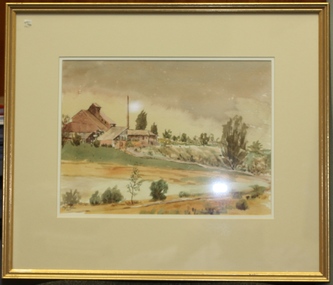
Painting - Painting, Old Brick Factory, Surrey Hills, Old Brick Factory, Surrey Hills
... Painting, Old Brick Factory, Surrey Hills...Old Brick Factory, Surrey Hills...Old Brick Factory...Painting, Old Brick Factory, Surrey Hills...Old Brick Factory Surrey Hills Painting, Old Brick Factory, Surrey Hills Old Brick Factory, Surrey Hills Painting Painting, Old Brick Factory, Surrey Hills ...Painting, Old Brick Factory, Surrey Hillsold brick factory, surrey hills -
 Flagstaff Hill Maritime Museum and Village
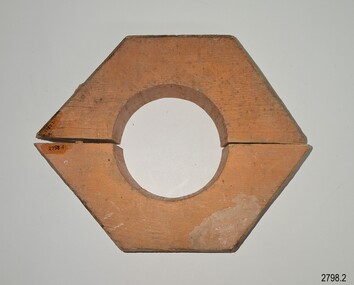
Equipment - Pattern, Briggs Brass Foundry, Early 20th century
... bricks, currently stands at approximately two-thirds of its original height, having previously been located at the Grassmere Cheese factory. The craft of sand-casting, which utilises intricately carved wooden patterns to create metal objects, stands as a testament to the enduring value of traditional skills. This age-old ...The wooden pattern forms part of a larger collection, securely stored within a durable wooden crate. This pattern was an essential tool at Briggs’ Brass Foundry, specifically designed for creating sand casts. Sand casting is a time-honoured technique, with a history exceeding 2,000 years. The handcrafted nature of this process results in the production of brass and copper alloy items, which are particularly suitable for maritime applications. Typical products include bells, boat hooks, cowls, propellers, handles, lids, rowlocks, hooks, letters, bolts, rail holders, brackets, deck plates, flanges, rudder guides, portholes and covers. The distinctive bronze mixture used at Briggs’ Foundry is copper-based, composed of local ingots of copper, tin, zinc and lead, blended in precisely measured quantities. The resulting alloy is non-ferrous, known for its exceptional durability and longevity. In the early years of Flagstaff Hill, the Briggs family generously donated the crate of patterns along with other related items such as brassware, tools and machinery. These items were prominently displayed in a simulated Brass Foundry within the Village, alongside other working crafts, trades and services typical of a maritime town. From the completion of the building in 1986 until its repurposing in 1994, visitors could view these items and gain insight into the foundering and metalwork trades that supported maritime industries, including shipwrights and boatbuilders. The castings produced at the foundry were also vital for farmers, manufacturers and other local industries. The Brass Foundry display featured a historic Cornish chimney, constructed as a working model to illustrate the process of smelting metal in furnaces and pouring it into sand moulds. The chimney, crafted from specially curved bricks, currently stands at approximately two-thirds of its original height, having previously been located at the Grassmere Cheese factory. The craft of sand-casting, which utilises intricately carved wooden patterns to create metal objects, stands as a testament to the enduring value of traditional skills. This age-old technique remains relevant today, linking past craftsmanship to ongoing industrial practices. The foundry pattern set holds particular significance due to its strong associations with brass foundries, both locally and in coastal regions across Victoria. In these areas, marine industries such as ship and boat building have long depended on high-quality metal castings for the machinery, equipment, and fittings essential to their operations. The alloys formulated by Briggs Brass Foundry, crafted from non-ferrous metals, were specifically designed to provide superior longevity and durability in maritime environments. These patterns are closely tied to the history of the Briggs Brass Foundry, a respected and long-running company that specialised in producing cast goods for the marine sector. The foundry was equipped to supply both unique, one-off items and mass-produced components, ensuring that its products found their way onto a variety of sail and steam vessels along the Victorian coast, including in Warrnambool. In addition to its broader marine applications, Briggs Brass Foundry established itself as a bell-founder specialist. The company’s expertise is notably linked to the historic Schomberg Bell at Flagstaff Hill, which they restored to its original splendour as a fine example of a bell from a luxury migrant ship of the mid-19th century. The significance of the pattern set is further heightened by its association with Briggs Brass Founders, a firm established in the early 20th century and widely recognised for its proficiency in producing, repairing, and restoring ship bells and other marine equipment. Renowned for their non-ferrous metal casting, Briggs Brass Founders consistently supplied high-quality fittings and equipment vital to maritime pursuits. Moreover, the company expanded its influence by opening a branch in Warrnambool. Through this local presence, Briggs Brass Founders supported the regional marine industry and forged strong connections with fishermen and businesses. This not only reinforced their reputation as skilled manufacturers but also highlighted their commitment to community engagement and support. Pattern; hexagonal wooden shape painted orange. The thick carved wooden shape is in halves forming a hole when locked together with the dowel pegs and opposing drilled holes. The pattern is part of a set of foundry patterns from Briggs Brass Foundry.flagstaff hill, flagstaff hill maritime museum and village, warrnambool, maritime museum, maritime village, great ocean road, shipwreck coast, briggs' bronze, trade, sand cast, cast, brass alloy, copper alloy, pattern, mould, foundry, brass foundry, metal foundry, casting, sand mould, sand casting, marine equipment, marine tools, marine fittings, copper tin zinc lead, non-ferrous, non-corrosive, brassware, metalware, foundering, metalwork, maritime, bell founders, ship chandlers, marine products, briggs family, herbert harrison briggs, h h briggs, george edward briggs, cyril falkiner mckinnon briggs, cyril briggs, briggs & son brass foundry, h h briggs & sons foundry, briggs marine, alliance casting & engineering solutions, grassmere cheese factory, cornish chimney, curved bricks, collingwood, moorabbin, collingwood foundry, moorabbin foundry, 1912, briggs, briggs brass foundry, briggs marine foundry, briggs marine products, frank lee, les lee, eva lee, briggs marine warrnambool, non-ferrous founders, bell specialists, ship bell specialists, founders, traditional send casting -
 Bendigo Historical Society Inc.
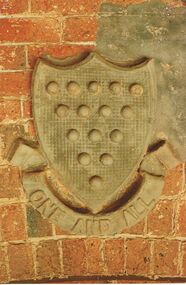
Document - CORNISH COLLECTION: DOCUMENTS RELATING TO CORNISH CREST
... Documents, relating to Cornish Crest: a. colour photograph of a crest mounted on a brick wall (located at old Fuse Factory? - Handwritten inscription on back states ''One of C Coat of Arms on its Décor''; b. ...Factory Cornish Coat of Arms. "One and All" Documents, relating to Cornish Crest: a. colour photograph of a crest mounted on a brick wall (located at old Fuse Factory? ...Documents, relating to Cornish Crest: a. colour photograph of a crest mounted on a brick wall (located at old Fuse Factory? - Handwritten inscription on back states ''One of C Coat of Arms on its Décor''; b. Note titled ''What is the Meaning of the Cornish Crest'' with diagram - historical detail; c. Copy of diagram of Coat of Arms with some historical information; d. short article extract re ''Duke of Cornwall'' and ''Duchy''.bendigo, buildings, bendigo fuse factory, cornish coat of arms. "one and all" -
 Sunshine and District Historical Society Incorporated
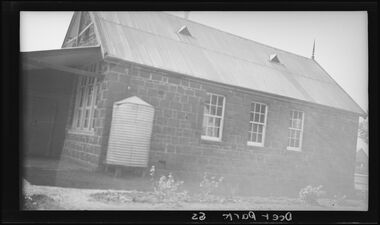
Photograph - Deer Park State School Photographs
... factory, and a fire destroyed the school in 1942. The 1940's rebuild of the school included a new red brick building with bluestone detailed used from the original building. The new building matched Percy Everett’s Education Department architectural style of the era. This school was relocated to Cairnlea in 2007 and became known as the Cairnlea Park Primary School. The old...factory, and a fire destroyed the school in 1942. The 1940's rebuild of the school included a new red brick building with bluestone detailed used from the original building. The new building matched Percy Everett’s Education Department architectural style of the era. This school was relocated to Cairnlea in 2007 and became known as the Cairnlea Park Primary School. The old ...Deer Park State School began in 1874 as State School 1434 Braybrook but soon the school became known as the Derrimut on Kororoit Creek State School. This was soon shortened to Kororoit State School The Kororoit State School and was renamed to the Deer Park State School in 1890 when the local area's name was changed from Kororoit Creek to Deer Park. The school suffered several dramatic events due to its proximity to the ICI explosives factory. These events included the windows being blown out after lightning struck the ICI factory, the ceiling collapsed after an explosion at the ICI factory, and a fire destroyed the school in 1942. The 1940's rebuild of the school included a new red brick building with bluestone detailed used from the original building. The new building matched Percy Everett’s Education Department architectural style of the era. This school was relocated to Cairnlea in 2007 and became known as the Cairnlea Park Primary School. The old 1943–44 red‑brick main building (rebuilt after the 1942 fire), the blue stone remnants and the school grounds are now protected under Brimbank’s Heritage Overlay (HO84).These photographs capture the original blue stone school building, the damaged caused by the 1942 fire and the 1943–44 replacement red‑brick main building.5343.01 - Deer Park State School Photo 01.jpg 5343.02 - Deer Park State School Photo 02.jpg 5343.03 - Deer Park State School 1942 Fire Photo 03.jpg 5343.04 - Deer Park State School 1942 Fire Photo 04.jpg 5343.05 - Deer Park State School 1942 Fire Photo 05.jpg 5343.06 - Deer Park State School 1942 Fire Photo 06.jpg 5343.07 - Deer Park State School Photo 07.jpg 5343.08 - Deer Park State School Photo 08.jpg 5343.09 - Deer Park State School Photo 09.jpg 5343.10 - Deer Park State School Photo 10.jpg 5343.11 - Deer Park State School Photo 11.jpg 5343.12 - Deer Park State School Photo 12.jpg 5343.13 - Deer Park State School Photo 13.jpg 5343.14 - Deer Park State School Photo 14.jpg 5343.15 - Deer Park State School Photo 15.jpg 5343.16 - Deer Park State School Photo 16.jpgdeer park state school, ballarat road, deer park, hume and hovell cairn -
 Ballarat Heritage Services
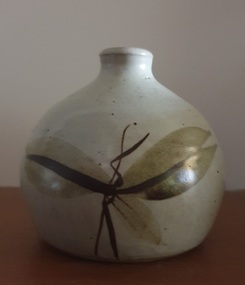
Ceramic, Small bottle by Ray Molony
... Ray Molony established the Mud Factory Pottery in Shepparton in 1977 after purchasing, renovating and extending the old Kialla Methodist church, and building a two storey mud brick pottery. ...Ray Molony established the Mud Factory Pottery in Shepparton in 1977 after purchasing, renovating and extending the old Kialla Methodist church, and building a two storey mud brick pottery. ...Ray MOLONY Born Albury, New South Wales "Notes for Raymond Walter Molony: Raymond Walter Molony grew up in the Dandenongs, and Maffra where he went to school. He attenended Sale Technical School, before studying at R.M.I.T. from where he gained a diploma of pottery and technical teaching qualifications. He taught at Shepparton Technical College leaving there in 1977 to become a full time potter. Ray Molony established the Mud Factory Pottery in Shepparton in 1977 after purchasing, renovating and extending the old Kialla Methodist church, and building a two storey mud brick pottery. Two of Ray and Deirdre Molony's sons, Kevin and Russell, were employed during the 1980s and 1990s. Kevin Molony left due in the early 1990s due to the recession at that time, and Russell Molony followed soon after. Both competent throwers, with Russell making some creative slab work while Ray continuing to decorate the works. Ray Molony continued to produce studio ceramics at the kialla studion until selling the property in 2000, and semi retiring to Miepoll. In 2005 he moved to Pottsville New South Wales." studio potterySmall ceramic bottle with leaf designs in brown glaze made at the Mud Factory Pottery by Ray Molony.ceramics, studio pottery, ray molony, mud factory pottery
