
Showing 24 items matching "open balconies"
-
 Melbourne Tram Museum
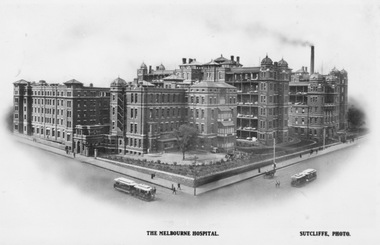
Postcard - The Melbourne Hospital, 1910s
... ...open balconies...The hospitals many open balconies are fitted with beds. As Melbourne's first major hospital, by 1900 it was overcrowded and severely run down with fundraising efforts conducted to improve facilities and patient care. ...The hospitals many open balconies are fitted with beds. As Melbourne's first major hospital, by 1900 it was overcrowded and severely run down with fundraising efforts conducted to improve facilities and patient care. ...Photograph looks north east across the Swanston and Lonsdale Streets intersection. Cable trams are shown on both streets. The hospitals many open balconies are fitted with beds. As Melbourne's first major hospital, by 1900 it was overcrowded and severely run down with fundraising efforts conducted to improve facilities and patient care. Yields information about the Melbourne Hospital. Postcard with label below photograph and postcard markings on rear. On front: 'The Melbourne Hospital Sutcliffe, Photo'; on rear: 'Postcard - A real photograph. Produced in Australia'cable tram, swanston and lonsdale streets, open balconies, overcrowded and severely run down -
 Bendigo Historical Society Inc.
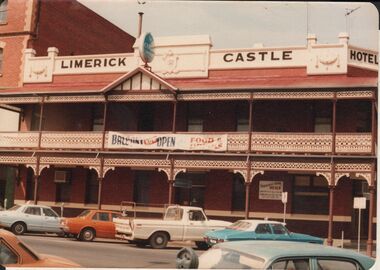
Photograph - BENDIGO HOTEL COLLECTION: LIMERICK CASTLE HOTEL, 259 WILLIAMSON STREET, BENDIGO
... Gable in centre of top level. 'Balcony now open, food and drinks' sign on verandah top. ...Gable in centre of top level. 'Balcony now open, food and drinks' sign on verandah top. ...Colour photograph: Limerick Castle, 259 Williamson Street, Bendigo, two storey brick hotel, lace verandah on both levels. Gable in centre of top level. 'Balcony now open, food and drinks' sign on verandah top. Red corrugated iron roof on verandah. 'Limerick Castle Hotel' sign on top. Appears to be early 70's ?bendigo, hotel, limerick castle hotel -
 Bendigo Historical Society Inc.
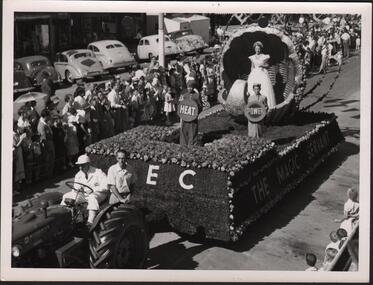
Photograph - HANRO COLLECTION: A COLLECTION OF STREET EASTER PARADE PHOTOGRAPHS
... At the right is a sign*Bendigo Olympic Pool Fun is now open* on the balcony with a crowd of people. The streets are lined with spectators with flags flying above the parade. ...At the right is a sign*Bendigo Olympic Pool Fun is now open* on the balcony with a crowd of people. The streets are lined with spectators with flags flying above the parade. ...BHS CollectionA Collection of Street Parade Photographs: Three photos all black and white. The first is of the S.E.C. float with *The Magic Servant* being pulled by a tractor with two men aboard. The float is of grass and flowers. Three children are on the float holding signs of Heat, Power, ?. A girl stands in a decorative shell. The street scene is lined with many people and cars of the day are parked at the road edge. The second is of the White Christmas Golden Square Mothers Club. A truck is decorated with a large Christmas tree with children dressed for winter. At the right is a sign*Bendigo Olympic Pool Fun is now open* on the balcony with a crowd of people. The streets are lined with spectators with flags flying above the parade. The Third is a float carrying a train with VR in flowers on the side and a floral display on the float. A crown of flowers at the front and the train on rails is featured. The train is No: B60 and is named the *Harold W. Clapp* All photos are of Bendigo's streetscape. All three photo's have two holes 7.4cm apart for housing in a folder. Box 116Aphotograph, streetscape, bendigo, bendigo. parade. golden square mothers club. -
 Eltham District Historical Society Inc
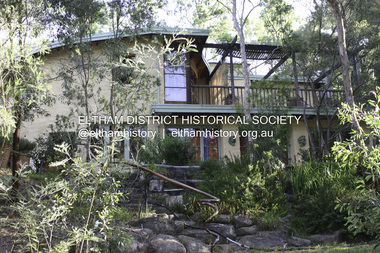
Photograph - Digital Photograph, Alan King, Busst House, cnr Silver Street and Kerrie Crescent, Eltham, 2 February 2008
... The studio/bedroom opens onto the balcony, which covers the living area. ...The studio/bedroom opens onto the balcony, which covers the living area. ...Considered the best of the early mud-brick houses built by Alistair Knox. Covered under Heritage Overlay, Nillumbik Planning Scheme. Published: Nillumbik Now and Then / Marguerite Marshall 2008; photographs Alan King with Marguerite Marshall.; p143 The Busst house hidden by trees at the corner of Silver Street and Kerrie Crescent is considered the best of the early mud-brick houses built by Eltham architect, Alistair Knox. Knox himself said, that the Busst house was the most mature mud-brick house designed at that period. ‘It related with true understanding to its steep site and expressed the flexibility of earth building ………to develop a new sense of flowing form and shape’. Built in 1948 for artist Phyl Busst, a former art student at Montsalvat, the house helped usher in Eltham Shire’s distinctive mud-brick residential character. Knox was the pivotal figure of the style developed from the 1950s to the 1970s. Scarcity of building materials after World War Two encouraged mud-brick building because earth was a cheap and plentiful building medium. But when Knox began building in mud-brick in 1947, no council in Victoria knew anything of this ancient art and he needed a permit. Fortunately the Commonwealth Experimental Building Station at Ryde in NSW, had been experimenting with earth construction to help overcome the shortages of that time. They published a pamphlet that became available in Melbourne on the same day the Eltham Council was to consider whether the earth building should be allowed. Knox caught one of the three morning trains to the city in those days and bought several copies of the pamphlet to give to each councillor. On his return he found the councillors standing on the steps of the shire offices after lunch at the local hotel. He heard that earth building had been discussed before lunch and that they were not in favor of it. Knox gave each councillor a pamphlet. They passed that plan and by doing so, opened the door for all future earth building in Victoria and by default, in Australia. Mud-brick houses attracted artists to Eltham, for their aesthetic appeal and because they were cheap. Those who built their own houses, included film maker Tim Burstall, artists Peter Glass, Clifton Pugh, Matcham Skipper, Sonia Skipper and husband Jo Hannan. For Knox, mud-brick building was more than just a cheap building medium. He saw it as harmonising with the surrounding bush and as a way of counteracting the growing materialism of the age. He wrote of its impact on ‘ 20th century man. It should counteract the confusion that the perpetual flow of high technology products have upon him ..’ Building the Busst house on a steep site was difficult because most earth-moving equipment was then in its infancy. For instance drilling for explosives was done by hand, which was a slow and painful process. Knox, assisted by his foreman Horrie Judd and Gordon Ford (who was to become a famous landscape designer), built two large main rooms - a living room/ kitchen downstairs - and upstairs, a studio/bedroom. The studio/bedroom opens onto the balcony, which covers the living area. The bath made of solid concrete by stonemason Jack Fabro, is particularly deep. Sunshine pours through the three French windows of the north-east facing kitchen/living area, which is lined with timber. The large hearth can fit a family around the fire while the timber floors and solomite (compressed straw) ceilings add to the cosy atmosphere. The garden is thick with trees, and in the late 1990s, Ford put in a pool near the original dry wall he had built as a young man.This collection of almost 130 photos about places and people within the Shire of Nillumbik, an urban and rural municipality in Melbourne's north, contributes to an understanding of the history of the Shire. Published in 2008 immediately prior to the Black Saturday bushfires of February 7, 2009, it documents sites that were impacted, and in some cases destroyed by the fires. It includes photographs taken especially for the publication, creating a unique time capsule representing the Shire in the early 21st century. It remains the most recent comprehenesive publication devoted to the Shire's history connecting local residents to the past. nillumbik now and then (marshall-king) collection, alistair knox, alistair knox design, busst house, kerrie crescent, mudbrick construction, mudbrick houses, silver street -
 Mission to Seafarers Victoria
Article, A Woman's Melbourne Letter
... They are between a series of sweeping arches which lead to the chapel, and are sheltered by the open balcony of the chaplain's quarters. Grace of contour marks the architecture on every turn. ...They are between a series of sweeping arches which lead to the chapel, and are sheltered by the open balcony of the chaplain's quarters. Grace of contour marks the architecture on every turn. ...A detailed description of the Mission and its activities written by a woman: Western Mail (Perth, WA : 1885 - 1954), Friday 13 December 1918, page 34 A WOMAN'S MELBOURNE LETTER. Melbourne, Dec. 4. There is an idea abroad, which as regards Melbourne, at any rate, is quite erroneous, that our sailors are not as well looked after as our soldiers, and that the noble men of the Mercantile Marine are much neglected ! For once, perhaps, my readers will pardon a letter dealing with only one subject, but the steady, unostentatious work done by the Ladies' Harbour Light Guild, in connection with the mission to seamen in Melbourne could not be adequately explained if dismissed in the usual short paragraph. Some of the most prominent names in Melbourne are associated with this guild and with the Mission Chaplain, and Mrs. Gurney Goldsmith, the members have made the Seamen's Institute a real home for those sailors of the Mercantile Marine, who touch our port. What we as a community owe to those men by their heroism in recent hostilities is certainly more understood by this band of enthusiastic workers than by the community generally. By using their unflagging energies, and influence on the sailor's behalf they endeavour to discharge a debt to which in some way or other we could and should all contribute. Even the most casual person can, if he thinks at all, sum up a few of the things our sailors - other than those belonging to our glorious navy - have done for us. On the spur of the moment we remember that those of the Mercantile Marine, are the men who manned our transports, who carried our wheat and wool, to oversea markets; who kept us in touch with our loved ones abroad; who kept the fires going in the furnaces of the great leviathans, bringing our wounded soldiers home again; who never flinched when self-sacrifice was demanded; who cared, with that tenderness, innate in all sailors, for the women and children, when the passenger ships were struck a dastardly blow by the wicked enemy; who, mocking death, gave up life with a heroism all the more heroic because it was always taken as a matter of course! Is it any wonder, then, that the members of the Ladies' Harbour Light Guild make it their business to provide a bright, homelike, spot in Melbourne, where the sailors are always certain of a cherry welcome ashore? The members of the guild are admirably drafted! The 360 non-workers each pay £1 1s. per annum. The workers, of whom there are between 700 and 800, donate 2s. 6d. and school members - it is confidently hoped that gradually all the schools will take an active interest in the mission - 1s. a year. The knights of the guild - as the men members are designated - are responsible for any sum they wish to name, from 5s. a year upwards. Everything is paid for out of these revenues, with the exception of a small grant from the Home Mission Fund - and such is the organisation, and management, that the entire concern is quite free from debt. The Seamen's Church and Institute, where the "Harbour Lights" gleam so brightly, is situated right in the midst of all the bustle and turmoil of the wharves, at the end of Flinders-street. The building, comprising chapel, and institute under the one red tiled roof, is grey stuccoed, with a small tower, from which flaunts the flag of 'The Flying Angel" - the badge of the guild. A visit to the institute makes one fully appreciate the boon the place must be to the voyage worn, weary, sailor. The atmosphere is eminently social in its best sense. While the architecture imparts an elegance, and quiet dignity which soothes by the very subtlety of its charm. With its comfortable furniture, its wealth of flowers, and the happy, wholesome, feminine influence which prevails everywhere, the quality which stands for the magic word "home" abounds. The Chaplain in the course of conversation said: -"We try to make this really a free club for sailors." But the habitues would probably tell you it was far more than that to them. The Institute is excellently appointed, and every little corner seems to have its particular history. It was built after the model of one of the old mission churches in California, and retains something of the old world attraction, while yet it combines all the advantages of modern, practical, conveniences. On entering the door the first thing, one notices is a huge compass, inlaid upon the floor, evidently to indicate one's proper bearings for it points due north - to the chapel! Only one other seamen's mission in the world boasts such a compass. As the sailor swings through the entrance he finds the office on his right, and there is, here, always a smiling face to welcome the shy, or timid, new comer. Quite a real post office is staffed by members of the guild, and all the letters received are listed alphabetically. Therefore, the expectant sailor has just to run his eye down the list, and he can immediately see whether there is a letter for him or not. If he is fortunate, he comes up to the member in charge, who unlocks the box, and produces the longed for missive. The boys are always encouraged to answer letters - and to write them. Often a few words about their mother, and their own home, will provoke a sleeping memory into activity. The writing room is well stocked with paper, envelopes, pens, and ink. The tables are so divided to ensure the utmost privacy, and through a calculated chain of circumstances, many an anxious mother receives a letter from her sailor lad, who, perhaps, might not have written but for these kindly inducements. The central hall - where social evenings are held every other night besides two special concerts a week - is inviting in the extreme. A handsome piano affords opportunity for those musically inclined. The tables are strewn with papers. The walls are bright with pictures, and here, and there, is a carved model, of a ship. One, of especial interest, is a model of "The Roon" carved, and presented by a French sailor. This German vessel will always be remembered in Australia. For it was across her bows that the first hostile shot was ever fired in Australian waters. In the corner is the canteen. It was fitted up entirely from the proceeds of a quotation calendar compiled by one of the members. The sailors may at any time, get a teapot of tea, or a tray of eatables, at a nominal cost. Before the canteen was in existence they had to go out for refreshments! - and sometimes they did not come back! Groups of sailors sit chatting at the tables. Half a dozen Swedes laugh and talk among themselves, for the simple reason they know no other language than their own. Several British sailors cluster about a dark-eyed Welsh lad - a perfect Celtic type - who, although only about twenty years of age, has been the victim of the Hun five times. Mines and torpedoes sank the ships he was in, either in the Channel or off the English coast, four times; and it is to his fifth experience, when the Inverness was wrecked, that everyone is eagerly listening. "We were in the boats eight days," he was saying, "I was pretty well mangled when they picked me up. The sufferings we endured were awful. At last we managed to reach Rapa, a Hawaiian island. The natives thought we were Germans, and came at us with spears. When they found we were British, they were awfully good to us. They even cried when we left, and the day before the rescue boat arrived they begged us to go into the hills and hide." At another table a Canadian lad - once a sailor - then a soldier, who trained at the Broadmeadows camp - was telling his experiences : - "The voyage which will always stick in my memory," he said, "was to a place which must be nameless. We left the United States not knowing whether we were bound, or what we were going to do. After some weeks we sighted a group of wonderfully beautiful islands, and we headed for the most remote and most lovely of them all. Then, and only then, we learned our mission from the skipper. We were taking their year's supply to a leprosy station! Oh no! I don't blame the skipper for not telling us ! Someone has to do these things, you know. A naval guard saw they didn't come near - and we all got sixty dollars extra. When the job was over we were quarantined on another island for two months, and one little chap - the baby of the crew, not eighteen - developed leprosy, and died before we left. Yes! I'll never forget that voyage, mates! Sometimes, I seem to see Leper's Island yet, with its lavish tropical vegetation and the gorgeous sunsets which stained all the water with blood. Then, too" - here the voice deepened - "there was an English girl - a leper - there. We heard she used to be an actress, and she contracted the disease somehow or other. She was always alone, and always watching us. In the distance we could see her come to the water's edge, and from there she would watch. Just watch . .. . watch . . .watch. ..." "Here come a couple of North Sea chaps," broke in an elderly man after pause. "One of them wounded, too, poor lad." It is not strange that all the sailors flock to the Institute. It is so comfortable, and essentially inviting, besides being full of human interest. The men's quarters comprise reading, writing and dressing rooms - hot and cold baths are always available - billiard room, and a special baggage room, where any sailor may leave his kit for as long as he likes. The payment of 3d. covers its complete insurance. Upstairs are the officers' quarters. These also have their own billiard room, writing and reading rooms, bath and dressing rooms. Just close are the apprentices' quarters - "The Half Deck," as popular parlance has it! The lads also have a billiard room of their own, and indulge in an easy armchair - amongst others - which was a donation from the Milverton School branch of the Guild. It is hoped by the committee to some day utilise the huge empty rooms, which run the length of the whole building. Their ultimate intention is to fit them up as cubicles, or "cabins," as they are to be called. They trust these "cabins" will be donated, either in memory, or in honour, of someone dear to the donor. Another forward movement soon to be put in hand, now that materials are available, is the establishment of "Norla Gymnasium." In a sailors' club such facility for exercise is absolutely essential. The men both need, and miss, exertion. As one boy, who had been backsliding, once said pathetically : -"If only there was something to do to get me into a good sweat, I would be all right." Soon such an one will be helped to swing from the trapese of the Norla Gymnasium into the right track! Sunday is always a fete day at the Institute, for 40 or 50 sailors generally come into tea. The up-to-date kitchen, which is fitted with every labour-saving appliance - all paid for out of working members' half crowns - is then a hive of animation, and methodical order. A formidable row of teapots await filling. Mrs. Goldsmith -, the chaplain's wife - rightly thinks it is far more homely to pour out the tea from a pot, than to serve it straight from the urns. So tea is poured out by a member, who sits at the head of a table gay with flowers, and chats to the guests. These latter are of all nationalities. But the French, the Spanish, Scandinavian, Norwegian - or any other sailor is equally welcome with the British. Two enthusiasts belonging to the Guild actually learnt Norwegian, so that men of this nation would have someone to talk to, and so be less lonely when they reached this, to them, foreign port ! The members of the Guild have their own private suite where they arrange the flow-err and do other necessary odds and ends undisturbed. No one appreciates flowers like a sailor, and the earliest and most beautiful may always be seen adorning the tables and rooms. Teas are served and lectures are held in the "Celia Little Hall," one of the most beautiful portions of the institute. It was erected by the chaplain in memory of his aunt from whom the hall takes its name. The Gothic windows open upon the cloisters, where, in the hot weather, the sailors enjoy their meals out of doors. The cloisters, indeed, form an exquisite spot. They are between a series of sweeping arches which lead to the chapel, and are sheltered by the open balcony of the chaplain's quarters. Grace of contour marks the architecture on every turn. Just around the corner is the chaplain's garden - a patch of green and colour, transformed from a desert waste, by a well-known woman horticulturist. The book room is a department especially valued by the sailors. There are two secretaries, one for home and the other for foreign literature. Books in French, English, Spanish, Scandinavian, Norwegian, and German may be found on the shelves. Each week about 36 convenient parcels of reading stuff are made up. These contain illustrated papers, books in various languages, and magazines. These parcels are eagerly accepted by the sailor with a long monotonous voyage before him. But complete as is every corner of the institute, no part is so well equipped as the memorial chapel erected by the Ladies' Harbour Light Guild, in memory of the officers and men, who have lost their lives during the war. St Peter's - for it is called after the sailor's patron saint - with its hallowed gentle dignity is a veritable sanctuary of peace, perhaps all the more so because it sprang out of war. The fittings are entirely of Australian wood. The pews, given in memory of some loved one by one of the members, are of Tasmanian hardwood. The reredos and altar chairs of carved blackwood. The rich carpet was provided by the members' magical half-crowns. Already this chapel holds memorials of peculiar historical interest. The altar lectern was given in memory of Commander Elwell, who, it will be remembered, was killed at Rabaul, in the early part of the war. The font commemorates two heroes - Nigel Hockley and Fred Hyde, who lost their lives at the hands of the Germans, although they survived the actual torpedoing of their ships, the Galgorn Castle off the coast of Ireland. The mother of one of them wrote out that her son had died as an Englishman should - fighting for the right. This noble sentiment is suitably paraphrased upon the inscription engraved upon the font. Practically every-hing enshrined in the chapel has its own sentimental value. The alms salver of beaten copper, studded with agate, is fragrant with the memory of a saintly woman.The eye of the sailor is caught and held by the pulpit, which is fashioned like a ship's hull and only a twist of rope guides the chaplain up the steps. For the last 13 years the Rev. A. Gurney Goldsmith, M.A., has acted as chaplain to the Seamen's Mission in Melbourne. Before that he and his wife worked in China. Mr Goldsmith visits all the boats and gets in touch personally with the sailor, over whom he has great influence. He is not only their chaplain and friend, but, amongst a wide range of other things, their banker besides. An exchange system exists between the various Missions, and the sailor who has "banked" his money with the chaplain, upon going away, receives a cheque which is cashed - minus exchange - by the chaplain of the next port. Mr. Goldsmith will tell you he has a soft spot in his heart for on old sailor he calls "Paddy." This ancient mariner has been wrecked ten times. It was a long time before the chaplain prevailed upon "Paddy" to partake of the spiritual and secular advantages afforded by the institute. He would not come, he said, until he could do so "with a good heart." Finally he frankly admitted that he had no "friends like those of 'the Flying Angel,' " and that he eventually proved his own "good heart" will be shown in this story. One day he came in to the chaplain and said bluffly, "Well, sir, I've been payin' off some old scores up Carlton way, an' I tells yer, plain, sir, not one of 'em would have seen a penny of their money but for the Mission." The Ladies' Harbour Light Guild has over thirty working suburban branches, and the excellent results achieved at the Institute now will no doubt be considerably augmented in the future. The practical actions of the members do more than anything else to convey the subtle meaning of the name of the Guild. To the visiting sailors the word "ladies" signifies the bread givers; "harbour" safety ; "lights" welcome; "guild" the welding of fraternity, and they one and all tell you the ideals thus embodied are unselfishly carried out by all the ladies who have banded together to care for the sailors' welfare.The article describes the Mission and the use of several spaces a year after its opening and gives details about the daily activities.Digital copy of an article published in the Western Mail on the 13th of December 1918. 717 flinders street, seamen's mission, norla dome, lhlg, reverend alfred gurney goldsmith, celia little room, garden, frederica godfrey -
Glenelg Shire Council Cultural Collection
Booklet - Cinema Program, 'Observer' Print Portland, Star Cinema Program, 1935
... The Star Theatre opened on 7th November 1925, with 991 seats located in orchestra and balcony levels. ...The Star Theatre opened on 7th November 1925, with 991 seats located in orchestra and balcony levels. ...The Star Theatre opened on 7th November 1925, with 991 seats located in orchestra and balcony levels. It was rebuilt to the plans of architect Geoffrey S. Richards, opening of 27th October 1937. In 2011, there was a small Star Cinema operating in the former balcony area. The main orchestra floor has been in use as a plumbers merchants, but is unused. The Star Cinema was closed in 2015 and is now in use as a church.Green card (folded) Cinema Program for 'Star Talkies' for weeks ending January 26 and February 2, 1935. Includes list of films, admission prices, where to buy tickets and whether the films are suitable or not suitable for a general audience.star cinema -
Glenelg Shire Council Cultural Collection
Slide - Glass Slide - advertisements for local businesses Portland, n.d
... The Star Theatre opened on 7th November 1925, with 991 seats located in orchestra and balcony levels. ...The Star Theatre opened on 7th November 1925, with 991 seats located in orchestra and balcony levels. ...The Star Theatre opened on 7th November 1925, with 991 seats located in orchestra and balcony levels. It was rebuilt to the plans of architect Geoffrey S. Richards, opening of 27th October 1937. In 2011, there was a small Star Cinema operating in the former balcony area. The main orchestra floor has been in use as a plumbers merchants, but is unused. The Star Cinema was closed in 2015 and is now in use as a church.Glass slide, possibly used at Portland Star theatre, to advertise local business. Bright and Hitchcock's Pty. Ltd - Jantzen swim suits. Image painted on one slide, then another plain glass slide fixed over imageportland star cinema -
Glenelg Shire Council Cultural Collection
Slide - Glass Slide - Advertisements for local businesses Portland, T.W. Cameron, Slide Specialist, 430 Bourke St, n.d
... The Star Theatre opened on 7th November 1925, with 991 seats located in orchestra and balcony levels. ...The Star Theatre opened on 7th November 1925, with 991 seats located in orchestra and balcony levels. ...The Star Theatre opened on 7th November 1925, with 991 seats located in orchestra and balcony levels. It was rebuilt to the plans of architect Geoffrey S. Richards, opening of 27th October 1937. In 2011, there was a small Star Cinema operating in the former balcony area. The main orchestra floor has been in use as a plumbers merchants, but is unused. The Star Cinema was closed in 2015 and is now in use as a church.Glass slide, possibly used at Portland Star theatre to advertise local business - Dawkins and Son, Top Twenty Fashions of the Year. Image on one glass slide, clear glass slide fixed over imageportland star cinema -
Glenelg Shire Council Cultural Collection
Slide - Glass slide - Local business advertisements Portland, LINTON BROS - 61 MARKET ST SYDNEY, n.d
... The Star Theatre opened on 7th November 1925, with 991 seats located in orchestra and balcony levels. ...The Star Theatre opened on 7th November 1925, with 991 seats located in orchestra and balcony levels. ...The Star Theatre opened on 7th November 1925, with 991 seats located in orchestra and balcony levels. It was rebuilt to the plans of architect Geoffrey S. Richards, opening of 27th October 1937. In 2011, there was a small Star Cinema operating in the former balcony area. The main orchestra floor has been in use as a plumbers merchants, but is unused. The Star Cinema was closed in 2015 and is now in use as a church.Glass slide, possibly used at Portland Star theatre, to advertise local business. Advertising coming movie 'The Awakening', a United Artists production directed by Samuel Goldwyn. Image painted onto one glass slide, then another plain glass slide fixed over imagestar cinema portland -
Glenelg Shire Council Cultural Collection
Slide - Glass slide, n.d
... The Star Theatre opened on 7th November 1925, with 991 seats located in orchestra and balcony levels. ...The Star Theatre opened on 7th November 1925, with 991 seats located in orchestra and balcony levels. ...The Star Theatre opened on 7th November 1925, with 991 seats located in orchestra and balcony levels. It was rebuilt to the plans of architect Geoffrey S. Richards, opening of 27th October 1937. In 2011, there was a small Star Cinema operating in the former balcony area. The main orchestra floor has been in use as a plumbers merchants, but is unused. The Star Cinema was closed in 2015 and is now in use as a church.Glass slide, advertising, shown at Star Theatre, Portland. Image painted on one glass slide, then another plain glass slide fixed over imagestar theatre, cinema, portland, photography, advertising -
Glenelg Shire Council Cultural Collection
Photograph - Photograph - Unknown double story building, c. 1970
... Image shows double storey building with pitched iron roof and fenced balcony on first floor, attached to single storey building with slate roof, 2 large multi-paned windows and partly open front door. ...Image shows double storey building with pitched iron roof and fenced balcony on first floor, attached to single storey building with slate roof, 2 large multi-paned windows and partly open front door. ...Photographic print of a rephotographed photograph. Image shows double storey building with pitched iron roof and fenced balcony on first floor, attached to single storey building with slate roof, 2 large multi-paned windows and partly open front door. Small child in open doorway, man in top hat and small boy on footpath. -
 Bendigo Historical Society Inc.
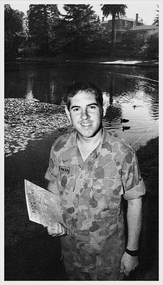
Newspaper - Fortuna Article - "Fortuna Opens its Doors", Mar 30 1996
... Fortuna Restoration Article - "Fortuna Opens its Doors" - Bendigo Advertiser Sat Mar 30 1996 - Author Nicole Ferrie This item contains the following: 11217.2a Black and White Photo of one of the tour guides - Lance Cpl Richard Arman in the Fortuna Gardens 11217.2b Black and White Photo of one of the tour guides - Lance Cpl Richard Arman on the balcony 11217.2c Part of page 2 - Fortuna Open its Doors 11217.2d Part of page 2 - Fortuna Open its Doors...Guided tours cover the complete history of Fortuna Villa and the Lansell family, lasting about three and a half hours on Sundays.Bookings are available by phone.Recent Military UpdatesThe Army will remain at the Fortuna site, though the military side will move out and soldiers will be reassigned or enter the workforce. bendigo fortuna army tropographic support establishment Fortuna Restoration Article - "Fortuna Opens its Doors" - Bendigo Advertiser Sat Mar 30 1996 - Author Nicole Ferrie This item contains the following: 11217.2a Black and White Photo of one of the tour guides - Lance Cpl Richard Arman in the Fortuna Gardens 11217.2b Black and White Photo of one of the tour guides - Lance Cpl Richard Arman on the balcony 11217.2c Part of page 2 - Fortuna Open its Doors 11217.2d Part of page 2 - Fortuna Open its Doors Newspaper Fortuna Article - "Fortuna Opens its Doors" ...Despite a report suggesting otherwise, tours of the historic Fortuna house in Bendigo will not cease when the Army Topographic Support Establishment (ATSE) takes over from the Army Survey Regiment. Both Army representatives and ATSE management confirm that public access and tours will remain unchanged. A mistaken news story led to a surge in tour attendance, with numbers tripling as people rushed to visit before the supposed closure. Recent tours have seen up to 70 visitors, including interstate travelers and descendants of the Lansell family. Fortuna is a 140-year-old house with deep ties to Bendigo's history.Originally owned by Christopher and Theodore Ballerstedt (1855–1871), it is most famously associated with the Lansell family, particularly George Lansell, a prominent gold mine owner known as the "Quartz King." The Army initiated tours 20 years ago to connect with the local community and showcase the building and the regiment's work.The tours provide an opportunity for the public to interact with soldiers and learn about their activities. After the death of George Lansell's wife, a symbolic procession with an empty coffin protested poor mine ventilation and miners' health conditions, highlighting social issues of the time.The document shares anecdotes from tours, such as Lansell's purchase of goats from local children, illustrating his character and the community's relationship with him. The homestead includes notable features like a grand entrance hall, glassroom, main staircase, Pompeii fountain, and a Roman bath.The house is known for its eclectic Victorian architecture, with many styles incorporated based on Lansell's preferences. Guided tours cover the complete history of Fortuna Villa and the Lansell family, lasting about three and a half hours on Sundays.Bookings are available by phone.Recent Military UpdatesThe Army will remain at the Fortuna site, though the military side will move out and soldiers will be reassigned or enter the workforce.Fortuna Restoration Article - "Fortuna Opens its Doors" - Bendigo Advertiser Sat Mar 30 1996 - Author Nicole Ferrie This item contains the following: 11217.2a Black and White Photo of one of the tour guides - Lance Cpl Richard Arman in the Fortuna Gardens 11217.2b Black and White Photo of one of the tour guides - Lance Cpl Richard Arman on the balcony 11217.2c Part of page 2 - Fortuna Open its Doors 11217.2d Part of page 2 - Fortuna Open its Doorsnon-fictionbendigo, fortuna, army tropographic support establishment -
 Bendigo Historical Society Inc.
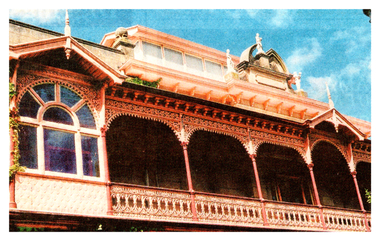
Newspaper - Fortuna Article - "Fortuna to Open Up", Nov 27 2008
... Fortuna Article - "DIGO's new home opens" - The Bendigo Miner Thursday Nov 27 2008 by Nino Bucci, picture Julian Prowd This item contains the following: 11217.21a Colour Photo of Fortuna balcony 11217.21b Part of page 8 - Article "Fortuna to Open Up"...The Villa Fortuna Action Group welcomed the announcement but expressed concern that the timing near Christmas might limit public attendance due to seasonal pressures. bendigo fortuna george lansell Villa Fortuna Action Group Fortuna Article - "DIGO's new home opens" - The Bendigo Miner Thursday Nov 27 2008 by Nino Bucci, picture Julian Prowd This item contains the following: 11217.21a Colour Photo of Fortuna balcony 11217.21b Part of page 8 - Article "Fortuna to Open Up" Newspaper Fortuna Article - "Fortuna to Open Up" ...Fortuna Villa, a prominent Bendigo landmark, will open to the public before Christmas. The Defence Department confirmed the open day will occur within the next month, though the exact date is not yet set. The opening is part of a broader community consultation process ahead of the property's eventual sale. Visitors will be able to tour the Villa and its grounds, but the level of access is still being discussed with heritage consultants. Details about the consultation process and the timeline for the property's disposal remain undecided, as site investigations are ongoing. The Villa Fortuna Action Group welcomed the announcement but expressed concern that the timing near Christmas might limit public attendance due to seasonal pressures.Fortuna Article - "DIGO's new home opens" - The Bendigo Miner Thursday Nov 27 2008 by Nino Bucci, picture Julian Prowd This item contains the following: 11217.21a Colour Photo of Fortuna balcony 11217.21b Part of page 8 - Article "Fortuna to Open Up"non-fictionbendigo, fortuna, george lansell, villa fortuna action group -
Bendigo Historical Society Inc.
Document - Fortuna Article - Handout Notes for a Tour, 1990s
... open colonnade in the 1890s. Conservatory: Built in 1876 after Lansell's European trip, showcasing high-quality etched glass and Italian design.Features rare glasswork, including Ruby Flashed Seedless French Antique glass and acid-etched panels with mining, Australian, and heraldic motifs. Reception Room: Served as the initial gathering space for guests, with a bay window added in 1875.Decorative elements like pressed metal ceilings, a cut glass skylight, and parquetry were likely added around 1895. Staircase: Made of cedar and blackwood, added in 1888 to access a new third floor, and remodeled in 1907. Features an upper balcony...open colonnade in the 1890s. Conservatory: Built in 1876 after Lansell's European trip, showcasing high-quality etched glass and Italian design.Features rare glasswork, including Ruby Flashed Seedless French Antique glass and acid-etched panels with mining, Australian, and heraldic motifs. Reception Room: Served as the initial gathering space for guests, with a bay window added in 1875.Decorative elements like pressed metal ceilings, a cut glass skylight, and parquetry were likely added around 1895. Staircase: Made of cedar and blackwood, added in 1888 to access a new third floor, and remodeled in 1907. Features an upper balcony ...Here are the key points from the document on Fortuna Villa and its grounds: Music Room: Originally the main drawing room, featuring an ornate decorative ceiling and stained glass windows with musical inscriptions. The room was expanded in 1904, with earlier renovations enclosing an open colonnade in the 1890s. Conservatory: Built in 1876 after Lansell's European trip, showcasing high-quality etched glass and Italian design.Features rare glasswork, including Ruby Flashed Seedless French Antique glass and acid-etched panels with mining, Australian, and heraldic motifs. Reception Room: Served as the initial gathering space for guests, with a bay window added in 1875.Decorative elements like pressed metal ceilings, a cut glass skylight, and parquetry were likely added around 1895. Staircase: Made of cedar and blackwood, added in 1888 to access a new third floor, and remodeled in 1907. Features an upper balcony intersecting a large stained leadlight window. Bedrooms: Main bedrooms are located off a central passage, each with its own bathroom equipped with marble baths and cedar cabinetry.Pompeii Fountain: Constructed in 1879 as a scale replica of the Great Fountain in Pompeii, inspired by Lansell's travels.Includes statues, water features, and a Roman column with a statue, considered unique in Australia and possibly worldwide. Crushing Battery: A 30-head stamper battery built in 1874 for mining, attached to the villa's northern end.The chimney and machinery were removed in the 1940s, but the structure remains largely intact, now used as a printing press. These points highlight the architectural, artistic, and historical significance of Fortuna Villa and its associated features.Fortuna Article - Handout Notes for a Tour, by the Australian Government Department of defence support group This item contains the following document: 11217.61a A glossy coloured page A3 document of Fortuna lower floor and Ground Floor, which lists tha main points of the Villa and includes plans of the two floors.non-fictionbendigo, fortuna, george lansell, george victor lansell -
 Bendigo Historical Society Inc.
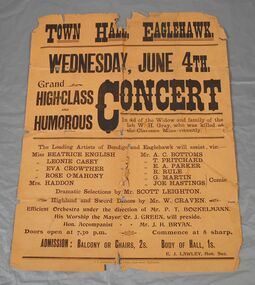
Poster - Town Hall Eaglehawk
... Doors open at 7.30 p.m. Commence at 8 sharp. Admission: Balcony or chairs 2s. ...Doors open at 7.30 p.m. Commence at 8 sharp. Admission: Balcony or chairs 2s. body of hall 1s. ...William Henry Gray was killed when a large slab of rock fell on his head at the Clarence Mine, Eaglehawk in April 1902. He was only aged 32 and left a widow and five children. The family lived at Bracewell Street, Eaglehawk.Brown poster advertising a concert at the Eaglehawk Town Hall. Wednesday, June 4th. Grand-class and humorous concert in the aid of the widow and family of the late W. H. Gray, who was killed at the Clarence mine recently. The leading artists of Bendigo and Eaglehawk will assist, viz. Miss Beatrice English, Miss Leonie Casey, Miss Eva Crowther, Miss Rose O'Mahoney, Mrs. Haddon, Mr. A.C. Bottoms, Mr. T. Pritchard, Mr. E.A. Parker, Mr. R. Rule, Mr. G. Martin, Mr. Joe Hastings. Dramatic selections by Mr. Scott Leighton. Highland and sword dances by Mr. W. Craven. Efficient orchestra under the direction of Mr. P.T. Bockelmann. His Worship the mayor Cr. J. Green will preside. Hon. accompanist Mr. J.H. Bryan. Doors open at 7.30 p.m. Commence at 8 sharp. Admission: Balcony or chairs 2s. body of hall 1s. E.J. Lawley Hon. Sec. Printed by T.J. Anderson, High Street Eaglehawk. eaglehawk, eaglehawk town hall, concert, w.h. gray, clarence mine -
 Bendigo Historical Society Inc.
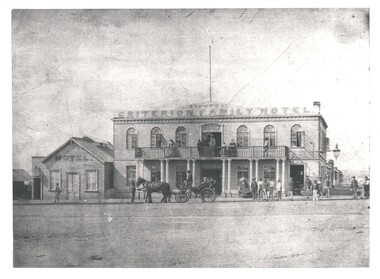
Photograph - WES HARRY COLLECTION: SYMONDS' CRITERION FAMILY HOTEL, BENDIGO
... open verandah along the first floor. The name 'Symonds Criterion Family Hotel' is painted above the first floor. There is a large lamp on a bracket on the right-hand side of the building. To the left of the main structure there is a smaller weatherboard building with the word 'Hotel' painted along the top. There are several groups of people both on the ground and on the balcony...open verandah along the first floor. The name 'Symonds Criterion Family Hotel' is painted above the first floor. There is a large lamp on a bracket on the right-hand side of the building. To the left of the main structure there is a smaller weatherboard building with the word 'Hotel' painted along the top. There are several groups of people both on the ground and on the balcony ...Photograph of a double storied stone building, it has a three quarters length open verandah along the first floor. The name 'Symonds Criterion Family Hotel' is painted above the first floor. There is a large lamp on a bracket on the right-hand side of the building. To the left of the main structure there is a smaller weatherboard building with the word 'Hotel' painted along the top. There are several groups of people both on the ground and on the balcony, also in front of the hotel is a very up market buggy/wagonette with a coachman? Driving. This hotel was on the corner of Mundy and Hargreaves Streets and is significant as centre of events as it overlooked the original Market Square. Original photo is part of the Batchelder Collection owned by the State Library of Victoria. Published in 'An American on the Goldfields' p. 38-39 with description and details. See also Mosaic No. 1232. *See Research field for further details. Symonds operated the Criterion Hotel 1858 - 1862.Batchelderbuildings, hotel, criterion family hotel, criterion family hotel. mundy street hargreaves street. market square. princess theatre. symonds, joseph s. -
 Williamstown Historical Society Inc
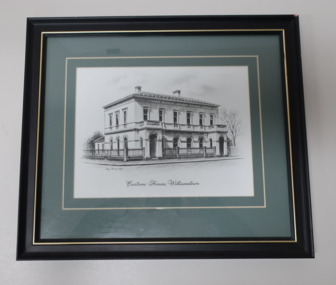
Drawing - Print, Customs House, Williamstown, Joan Storie, Customs House Williamstown, 1985
... Arches open to ground floor/upper floor double hung windows with balconies, and two chimneys. ...Arches open to ground floor/upper floor double hung windows with balconies, and two chimneys. ...The Williamstown Customs House was built in 1873 by the Public Works Department, and is now occupied by a private school. The Classical design and size of the Customs House illustrates how important the port city of Williamstown was during the 1800s, as a base for the importing and exporting of goods. Framed print of a pencil drawing of the Williamstown Customs House Building, Nelson Place, Williamstown. Arches open to ground floor/upper floor double hung windows with balconies, and two chimneys. An iron palisade fence surrounds the building."Joan Storie 1985" (artist) -
 Wodonga & District Historical Society Inc
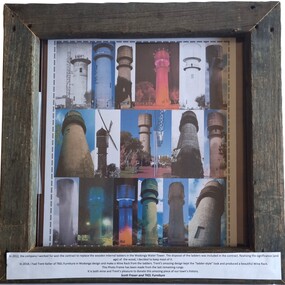
Memorabilia - Water Tower Picture Frame
... opened on 4th December 1924. It was decommissioned in 1959. It stood unused until the lower section was modified and put to use as “ The Tower’s Cobbler’s Inn” in 1962. In 1972 Wodonga City Council proposed to demolish the Tower. Their suggestion received an unfavorable response from the city’s citizens, so the Tower still stands today. The community celebrated its centenary on 4th December 2024. This picture frame was created from timber taken from the ladders that were inside the Tower, allowing access to the water tank itself and the external balconies...opened on 4th December 1924. It was decommissioned in 1959. It stood unused until the lower section was modified and put to use as “ The Tower’s Cobbler’s Inn” in 1962. In 1972 Wodonga City Council proposed to demolish the Tower. Their suggestion received an unfavorable response from the city’s citizens, so the Tower still stands today. The community celebrated its centenary on 4th December 2024. This picture frame was created from timber taken from the ladders that were inside the Tower, allowing access to the water tank itself and the external balconies ...The Water Tower is a major landmark of High Street, Wodonga. Construction of the Water Tower was completed in early 1924 and after thorough testing throughout that year, the completed new water system for Wodonga was officially opened on 4th December 1924. It was decommissioned in 1959. It stood unused until the lower section was modified and put to use as “ The Tower’s Cobbler’s Inn” in 1962. In 1972 Wodonga City Council proposed to demolish the Tower. Their suggestion received an unfavorable response from the city’s citizens, so the Tower still stands today. The community celebrated its centenary on 4th December 2024. This picture frame was created from timber taken from the ladders that were inside the Tower, allowing access to the water tank itself and the external balconies. It was donated to the Wodonga & District Historical Society at the Centenary Celebration.This item is significant because it is made from timber from the original ladders inside the Wodonga Water Tower.A timber frame made from sections of timber from the ladders once part of the Wodonga Water Tower.On sign at base on frame: In 2012, the company I worked for won the contract to replace the wooden internal ladders in the Wodonga Water Tower. The disposal of the ladders was included in the contract. Realising the significance (and age) of the wood, I decided to keep most of it. In 2018, I had Trent Keller of TKEL Furniture in Wodonga design and make a Wine Rack from the ladders. Trent's amazing design kept the "ladder-style" look and produced a beautiful Wine Rack. This Photo Frame has been made from the last remaining rungs. it is both mine and Trent's pleasure to donate this amazing piece of our town's history. Scott Fraser and TKEL Furniturewodonga water tower, landmarks wodonga -
 Old Colonists' Association of Ballarat Inc.
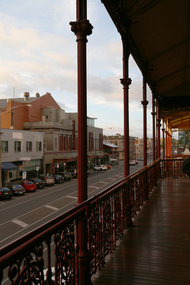
Photograph, Clare Gervasoni, View from the Balcony of the Ballarat Old Colonists' Hall, 2017, 23/03/2017
... The Old Colonists' Hall opened in 1887. ballarat old colonists' club ballarat old colonists' hall Balcony Lydiard Street View down Lydiard Street North from the verandah of the Old Colonists' Hall. ...The Old Colonists' Hall opened in 1887.View down Lydiard Street North from the verandah of the Old Colonists' Hall.ballarat old colonists' club, ballarat old colonists' hall, balcony, lydiard street -
 Northern District School of Nursing. Managed by Bendigo Historical Society Inc.
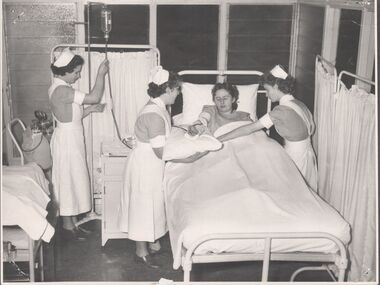
Photograph - Preliminary Training School 22
... opened in 1950 in to address the issues around nurse recruitment, training and education that had previously been hospital based. The residential school was to provide theoretical and in-house education and practical training over three years. The students would also receive practical hands-on training in the wards of associated hospitals. The Northern District School of Nursing operated from Lister House, Rowan Street, Bendigo. It was the first independent school of nursing in Victoria and continued until it closed in 1989. Prac Room student nurses IV Therapy IV Therapy in Upstairs Prac. Room Balcony ...The Northern District School of Nursing opened in 1950 in to address the issues around nurse recruitment, training and education that had previously been hospital based. The residential school was to provide theoretical and in-house education and practical training over three years. The students would also receive practical hands-on training in the wards of associated hospitals. The Northern District School of Nursing operated from Lister House, Rowan Street, Bendigo. It was the first independent school of nursing in Victoria and continued until it closed in 1989.Photo of four nurses in Prac Room at Lister House.IV Therapy in Upstairs Prac. Room Balcony 2nd year students School 22 PTS 1954prac room, student nurses, iv therapy -
 Royal District Nursing Service (now known as Bolton Clarke)
Photograph - Digital image, c.1930
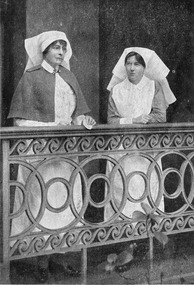
... balcony of the After Care Home at 39 Victoria Parade, Collingwood. It depicts the style of uniforms worn by trained nurses (Sisters) in that era. The Society were pioneers in recognizing the need for premises where patients too ill to be in their own home, but not ill enough to go to hospital, was needed, and the Melbourne District Nursing Society (MDNS) built, then opened, the After-Care Home in 1926, (from 1934 called After-Care Hospital), for these patients, and patients from Melbourne Hospitals who required recuperation before returning to their home. ...This image shows two of the 'Melbourne District Nursing Society After Care Home' Sisters who worked in the After Care section of the Society during the 1930s. The image was taken on the balcony of the After Care Home at 39 Victoria Parade, Collingwood. It depicts the style of uniforms worn by trained nurses (Sisters) in that era. The Society were pioneers in recognizing the need for premises where patients too ill to be in their own home, but not ill enough to go to hospital, was needed, and the Melbourne District Nursing Society (MDNS) built, then opened, the After-Care Home in 1926, (from 1934 called After-Care Hospital), for these patients, and patients from Melbourne Hospitals who required recuperation before returning to their home. Many children were nursed there, some long term during the Polio epidemic, and the Society employed two School Teachers. The Society now ran two divisions, the After-Care with its own nursing staff and the District division. The Society were the first in Melbourne, in early 1928, to recognize some patients leaving the After-Care, and many at home, needed further social care and they set up ‘Almoners’ from their committee to visit these patients and be intermediaries in getting them social assistance. It was late the following year before the first training of Almoners took place in Melbourne. In 1930 the Society employed a full time kindergarten teacher to visit poor children in their homes. That year the Society were pioneers in opening an Ante-Natal Clinic at the After-Care, setting a high standard with equipment, keeping records and providing leaflets with instructions in how to keep healthy during pregnancy, what complications to look for and what to do when labour commenced. In 1934 the Society were pioneers again when they opened the first Women’s Welfare Clinic in Melbourne giving advice on birth-control, at first attended by their own patients, but then accepting patients from public hospitals until their own clinics were opened. A trained Almoner was employed in 1934 but only stayed twelve months due to the amount of work required. Due to shortage of trained Almoners, a Social Service Officer was employed at the After-Care who successfully gained better housing from the Housing Commission for families living under unsuitable conditions. In the 1950s the Hospital and Charities Commission decided to take over the After-Care Hospital, so the Melbourne District Nursing Society and After-Care Hospital separated and the Melbourne District Nursing Service was formed, setting up Headquarters at 452 St. Kilda Road. With Royal patronage the name changed in 1966 to Royal District Nursing Service (RDNS).Digital image of two Sisters from the Melbourne District Nursing Society (MDNS) After-Care Home standing on the balcony of their building. The Sister on the left hand side is wearing a dark cape over her white uniform; she wears a white veil over her dark hair. The Sister on the right hand side is wearing a long white apron over her grey uniform which has white cuffs on the sleeves. She is wearing a white veil over her dark hair. They are leaning on the scrolled metal rail of the balcony which runs along the grey building; part of which can be seen behind them.mdns, melbourne district nursing society, after- care hospital, after-care home, rdns, royal district nursing service, nurses uniforms -
 Wodonga & District Historical Society Inc
Photograph - Gundrowing House, Wodonga
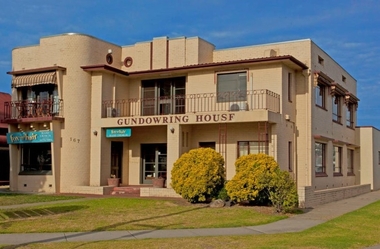
... balcony. Dr Taverney - known to many as Dr Tav - was a loyal medical practitioner in Wodonga for 40 years, retiring in 1987. He was also a member of the committee which helped to establish the Wodonga District Hospital which opened with 60 beds in 1954. ...balcony. Dr Taverney - known to many as Dr Tav - was a loyal medical practitioner in Wodonga for 40 years, retiring in 1987. He was also a member of the committee which helped to establish the Wodonga District Hospital which opened with 60 beds in 1954. ...Dr James Taverney set up practice in Wodonga on Monday 19th August 1946. His practice was initially located in rooms at the residence of Mr J. F. Turner in Beechworth Road. In the following years, Dr Taverney purchased a large part of the garden from the Turner family and built this two-storey building where he went into practice with Dr Schlink. The building contained the surgery and a residence. It has features of Art Deco architecture. The exterior consists of painted brick with a curved parapet that conceals the roof. The windows are metal framed and the door frames are timber. The verandahs feature wrought iron balustrading and posts. There is also an upper balcony. Dr Taverney - known to many as Dr Tav - was a loyal medical practitioner in Wodonga for 40 years, retiring in 1987. He was also a member of the committee which helped to establish the Wodonga District Hospital which opened with 60 beds in 1954. Other doctors who practised from this site included Dr Fitzpatrick, Dr Leberne and Dr Robinson. In about 1991 the building was purchased by a group of local businessmen led by Tom Christiansen who named it Gundowring House after his hometown. This photograph is significant because it depicts a building which was the location of two prominent doctors in Wodonga.A coloured photo of Gundowring House in Wodonga.gundowring house, dr taverney, dr schlink, wodonga district hospital -
 Lakes Entrance Historical Society
Photograph - Bellevue Apartments from Marine Parade, Lakes Entrance 1992
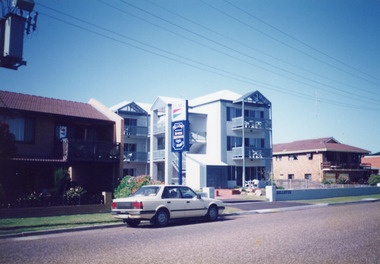
... Apartments opened for 1991-1992 season Hotels Architecture Transport Colour photograph of Bellevue Apartments, fronting Marine Parade. Three storey building, concrete slab construction, each unit having own balcony. ...Apartments opened for 1991-1992 seasonColour photograph of Bellevue Apartments, fronting Marine Parade. Three storey building, concrete slab construction, each unit having own balcony. Section of Lakeside Motel seen on left, Hybiscus Motel on right. Car on street at front. Lakes Entrance Victoriahotels, architecture, transport -
 Old Colonists' Association of Ballarat Inc.
Photograph, Old Colonists' Hall, Ballarat, 2020, 16/05/2020
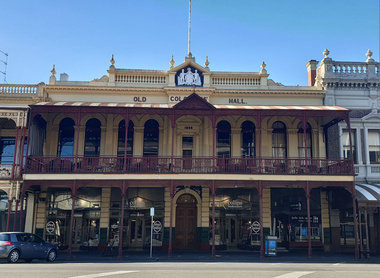
... The Old Colonists' Hall was opened in 1887. old colonists' association ballarat ballarat old colonists' club ballarat old colonists' hall shopfront lydiard street north Verandah Balcony Colour photograph of a double storey building in Lydiard Street Notth known as the Ballarat Old Colonists' Club. ...The Old Colonists' Hall was opened in 1887. Colour photograph of a double storey building in Lydiard Street Notth known as the Ballarat Old Colonists' Club. It was taken during the Covid 19 Pandemic lockdown.old colonists' association ballarat, ballarat old colonists' club, ballarat old colonists' hall, shopfront, lydiard street north, verandah, balcony
