
Showing 50 items matching "open combination"
-
 Ballarat Tramway Museum
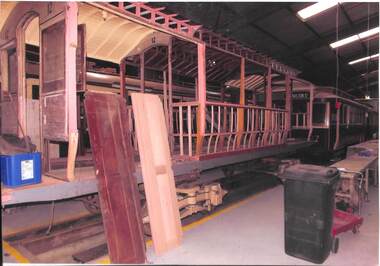
Photograph - Photograph - coloured, Tram 12: Frame of tram after being stripped back ready for restoration
... ...open combination...Tram 12 is a single truck, straight sill, open combination tram....Tram 12 is a single truck, straight sill, open combination tram. photograph tram 12 framework restoration single truck straight sill open combination Coloured photograph showing frame of tram 12. ...Coloured photograph of Tram 12 after it has been stripped back to its framework. Restoration of the tram would bring it back to its former state. Tram 12 is a single truck, straight sill, open combination tram.Coloured photograph showing frame of tram 12. Laminated.photograph, tram 12, framework, restoration, single truck, straight sill, open combination -
 Ballarat Tramway Museum
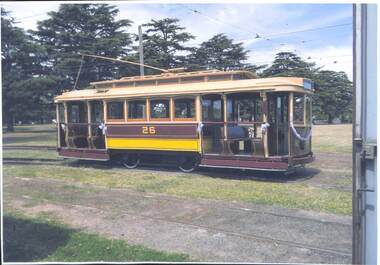
Photograph - Photograph - coloured, Tram No.26 - Single truck- drop ends, open California combination
... Tram No.26 - Single truck- drop ends, open California combination....Converted back to California combination configuration in 1978-87. tram 26 california combination single truck drop ends red and cream sec 1916 hawthorn tramways trust melbourne and metropolita tramways board ballarat green and cream Tram painted Indian Red and Gold with number 26 on sides and ends. White bows and "ribbon streamers" on each end. Large colour photograph - laminated. Tram No.26 - Single truck- drop ends, open ...Tram built in Melbourne in 1916 for the Hawthorn Tramways Trust. Taken over by the Melbourne and Metropolitan Tramways Board in 1920. Sold to Electric Supply Co. of Victoria for use in Ballarat and numbered 26. Painted the SEC colours in 1936 - dark cream and green. Back to original ESCo. colours of Indian Red and Dark Cream in 1978. Converted back to California combination configuration in 1978-87.Large colour photograph - laminated. Tram painted Indian Red and Gold with number 26 on sides and ends. White bows and "ribbon streamers" on each end.tram 26, california combination, single truck, drop ends, red and cream, sec, 1916, hawthorn tramways trust, melbourne and metropolita tramways board, ballarat green and cream -
 Ballarat Tramway Museum
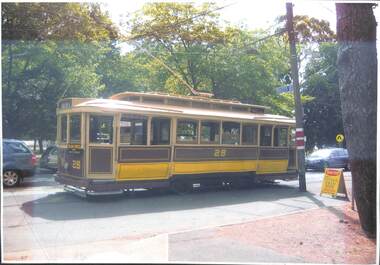
Photograph - Photograph - coloured, Tram No.28: Single Truck, drop ends, open California combination
... Tram No.28: Single Truck, drop ends, open California combination....Large colour photograph - laminated Tram No.28: Single Truck, drop ends, open California combination. Photograph Photograph - coloured ...Tram was built in 1916 and delivered to the Hawthorn Tramways Trust. it was taken over by the Melbourne & Metropolitan Tramways Board in 1920. In 1930 it was sold to the Electric Supply Company Co. of Victoria for use on the Ballarat tramway system and given the number 28. It was converted to an early form of one-man operation using barrier rails and aisles. The State Electricity Commission took over the tramway in Ballarat in 1934. In May 1934 the tram was decorated for three days to celebrate the Coronation of King George VI. In 1938 more changes were made to the appearance and it was painted dark cream and green. In 1946 it was painted Bristol Green and Ivory. In 1999-2002 it was returned to the colours of the SEC in 1930's - red and cream.Large colour photograph - laminatedIndian red and gold tram. Number 28 on sides and ends. Carlton St shown in destination window. Sign on tram indicates Tram Rides. Notice on footpath advertising Vintage Tram rides.tram 28, 1916, hawthorn tramways trust, melbourne & metropolitan tramways board, 1930, electric supply company, ballarat, one-man operation, sec, state electricity commission, 1934, coronation of king george vi, red and cream, dark cream and green, bristol green and ivory -
 Ballarat Tramway Museum
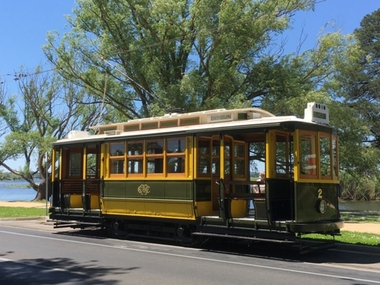
Vehicle - Tramcar, Duncan and Fraser, SECV Geelong No. 2, 1912
... A two motor four wheel tram car - Single Truck straight sill open combination with a wooden body....Trams Geelong tram 2 MESCo A two motor four wheel tram car - Single Truck straight sill open combination with a wooden body. SECV Geelong No. 2 Vehicle Tramcar Duncan and Fraser ...The tram was built by Duncan and Fraser of Adelaide in 1912 for the Melbourne Electric Supply Co (MESCo) for its Geelong operation that opened in 1912 and closed in 1956. The body was subsequently sold to Phil Shoppee, a farmer at Murradoc on the Bellarine Peninsula, purchased by the donor in 1991, who rebuilt the tram back to its MESCo configuration. The tram is fitted with a four-wheel truck from Brussels. To make the tram operable, air and electrical work was carried out by Bendigo Tramways. The tram was donated to the Museum in 2021, and the tram entered service on 6/2/2022. This tram is the only one known to exist of the seven (and four trailers) that opened the Geelong system in 1912. It is the only former MESCo Geelong tram that has been reconstructed to its as-built body configuration and made operational.A two motor four wheel tram car - Single Truck straight sill open combination with a wooden body.trams, geelong, tram 2, mesco -
 Ballarat Tramway Museum
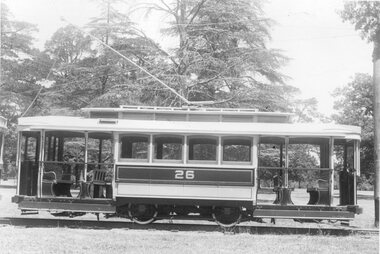
Photograph - Black & White Photograph/s, Dave Macartney, 1987 or 1988
... Black and white photograph of SEC No. 26, after completion of work to convert back to ESCo colours and California Open Combination tramcar. Photograph taken on depot fan track, late 1987, or early 1988. ...Ballarat Tramway Museum South Gardens Reserve Wendouree Parade Ballarat Ballarat goldfields Trams Tramways Ballarat BTM Depot Tram 26 Black and white photograph of SEC No. 26, after completion of work to convert back to ESCo colours and California Open Combination tramcar. Photograph taken on depot fan track, late 1987, or early 1988. ...Black and white photograph of SEC No. 26, after completion of work to convert back to ESCo colours and California Open Combination tramcar. Photograph taken on depot fan track, late 1987, or early 1988. Recommissioned Boxing Day 1987.trams, tramways, ballarat, btm depot , tram 26 -
 Ballarat Tramway Museum
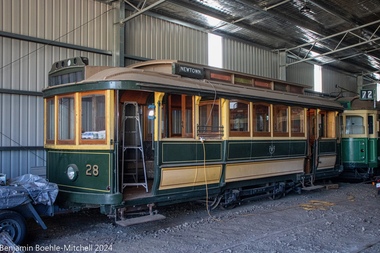
Vehicle - Tramcar, Meadowbank Manufacturing Co. Sydney, SECV Geelong No. 28, 1915
... A four wheel tram car - Single truck, drop ends, built as an open California combination...Trams Geelong MESCo SECV tram 28 A four wheel tram car - Single truck, drop ends, built as an open California combination SECV Geelong No. 28 Vehicle Tramcar Meadowbank Manufacturing Co. ...The tram was built by Meadowbank Manufacturing Co. Sydney in 1915 for the Prahran and Malvern Tramways Trust as their No. 66. Sold to the Melbourne Electric Supply Co (MESCo) Geelong in 1927 and ran as their No. 25. After two spectacular derailments in Aphrasia St during 1950 and 1951, at almost the same location, the tram was renumbered to No. 28 to reassure the public it was safe! MESCo was taken over by the SECV in 1930. It was little used between 1951 and 1956 when the system was abandoned and the body sold to a framer in Little River. In 1983 the donor purchased the body and subsequently undertook the reconstruction to its former SECV format and livery of green and cream. It has been fitted temporarily for display purposes, with an unmotored Brill 21E truck. Photo 2024 by Photo Benjamin Boehle Mitchell at the Museum's offsite store.It is one of several Meadowbank built tramcars in Museums, but the only one in the SECV Geelong livery and format. The destination indicators used by Geelong have been retained.A four wheel tram car - Single truck, drop ends, built as an open California combinationtrams, geelong, mesco, secv, tram 28 -
 Ballarat Tramway Museum
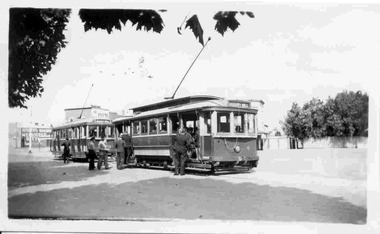
Photograph - Black & White Photograph/s, Keith Kings, Apr. 1949
... In blue ink "Bendigo / No. 22 - unaltered closed combination car / No. 4 - unaltered open combination car. / Eaglehawk terminus / Easter Monday, 4/49"...In blue ink "Bendigo / No. 22 - unaltered closed combination car / No. 4 - unaltered open combination car. / Eaglehawk terminus / Easter Monday, 4/49" Black and White photograph contained with Reg. ...Black and White photograph contained with Reg. Item 1902 - Photo Album from Keith Kings to Les Denmead 1970. Photograph of SEC Bendigo trams 22 and 4 at the Eaglehawk terminus, Easter Monday April 1949. Notes as both cars in "unaltered" condition. Keith Kings No. B(z)(1) Scanning: i - image file, p - presentation file, b - back of photograph. Has buildings at terminus in background, with Plume and Melbourne Bitter beer signs.Stamp in top left hand corner and handwritten number with "K.S. Kings No. B(z)(1) Copyright reserved". In blue ink "Bendigo / No. 22 - unaltered closed combination car / No. 4 - unaltered open combination car. / Eaglehawk terminus / Easter Monday, 4/49"trams, tramways, eaglehawk, bendigo, tram 22, tram 4 -
 Ballarat Tramway Museum
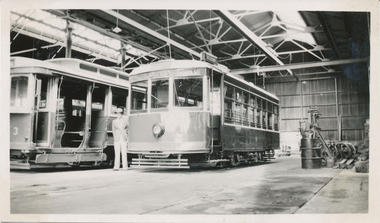
Photograph - SECV Bendigo Birney No. 11 at Bendigo depot, Keith Kings, 10/04/1950
... On the rear in blue ink "Bendigo, Birney No. 11, Open Combination No. 3, Note: Tail Lights, Depot." ...Trams tramways Bendigo Birney Depot tram 11 tram 3 On the rear in blue ink "Bendigo, Birney No. 11, Open Combination No. 3, Note: Tail Lights, Depot." ...Photo of Bendigo Birney No. 11 at Bendigo depot alongside Bendigo 3, 10-4-1950, photo by Keith Kings. Alongside the tram is a man wearing a hat. Has in the background tramcar body jacks and other equipment including wheelsets. Black and White print contained within the Wal Jack Bendigo and Geelong Album, see Reg Item 5003 for more details. IN an email from John Radcliffe 14/10/2019, the "man in a hat" is Wal Jack.Yields information about Bendigo tram 11, the tram depot and Wal Jack.Black and white print with photographer’s notes on the rear.On the rear in blue ink "Bendigo, Birney No. 11, Open Combination No. 3, Note: Tail Lights, Depot." In bottom left hand corner "10/4/50". In top right hand corner is the Keith Kings copyright stamp with number "D(2)(viii)" written in.trams, tramways, bendigo, birney, depot, tram 11, tram 3 -
 Ballarat Tramway Museum
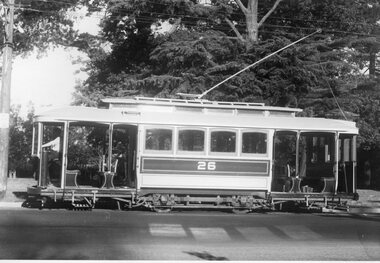
Photograph - Black & White Photograph/s, Dave Macartney, 1987
... Black and white photograph of SEC No. 26, nearing completion of work to convert back to ESCo colours and California Open Combination tramcar. Photograph taken at St Aidans Drive, prior to foot boards and barrier rails being fitted. 30 or 31 October 1987. ...Ballarat Tramway Museum South Gardens Reserve Wendouree Parade Ballarat Ballarat goldfields Trams Tramways Ballarat St Aidans Drive Tram 26 Black and white photograph of SEC No. 26, nearing completion of work to convert back to ESCo colours and California Open Combination tramcar. Photograph taken at St Aidans Drive, prior to foot boards and barrier rails being fitted. 30 or 31 October 1987. ...Black and white photograph of SEC No. 26, nearing completion of work to convert back to ESCo colours and California Open Combination tramcar. Photograph taken at St Aidans Drive, prior to foot boards and barrier rails being fitted. 30 or 31 October 1987. W.A.Doubleday in cabtrams, tramways, ballarat, st aidans drive , tram 26 -
 Bendigo Historical Society Inc.
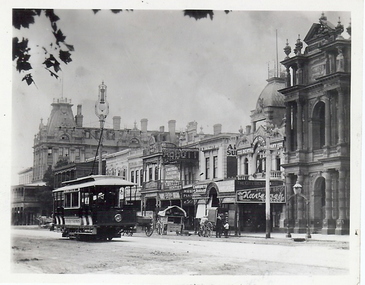
Photograph - BASIL MILLER COLLECTION: ELECTRIC TRAM IN PALL MALL
... in faded blue ink 'S.A 519 - an original open combination, tramcar in Pall Mall, early 1900's. ...BHS Collection Pall Mall Electric Tram Basil Miller in faded blue ink 'S.A 519 - an original open combination, tramcar in Pall Mall, early 1900's. ...BHS CollectionBendigo tramways - tram in Pall Mall, Bendigo. Showing streetscape from Shamrock Hotel to Colonial Bank of Australia, taken sometime after 1903.in faded blue ink 'S.A 519 - an original open combination, tramcar in Pall Mall, early 1900's. In purple stamped ink ' K.S. Kings No. S-! 519 copyright reserved. In black stamped ink '369' In black ballpoint pen 'Thurs 5/5 marks.pall mall, electric tram, basil miller -
 Whitehorse Historical Society Inc.
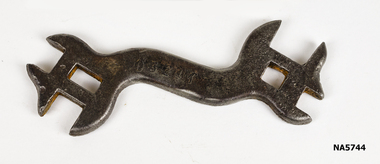
Tool - Open ended spanner
... Combination open ended spanner D 3 2 4 m...Whitehorse Historical Society Inc. 2-10 Deep Creek Road Mitcham melbourne Tool Spanner Combination open ended spanner D 3 2 4 m Tool Open ended spanner ...Combination open ended spanner D 3 2 4 mtool, spanner -
 Melbourne Tram Museum
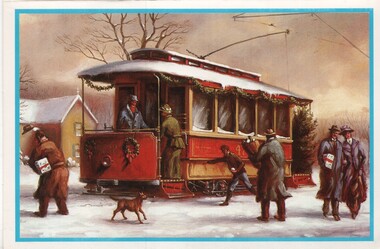
Ephemera - Christmas Card, Peter Duckett, c1990
... Items not dated. .1 - illustration of a Christmas scene featuring a small open platform saloon tram on the cover and a photo of a Bendigo open combination car with an open trailer. Detailed description. .2 - Bendigo steam tram on the cover and the inside cover - photos from Peter's collection and Wal Jack collection. .3 - featuring two scenes by Peter Duckett of trams at the Easter Fair. ...Items not dated. .1 - illustration of a Christmas scene featuring a small open platform saloon tram on the cover and a photo of a Bendigo open combination car with an open trailer. Detailed description. .2 - Bendigo steam tram on the cover and the inside cover - photos from Peter's collection and Wal Jack collection. .3 - featuring two scenes by Peter Duckett of trams at the Easter Fair. ...Set of three Christmas Cards prepared by Peter and Patti Duckett and sent to Keith Kings Printed photo on exterior with red printed ribbons, photo corners on inside with another photo and gold block print and the Duckett's address. Photographs by Peter Duckett or from his collection. Items not dated. .1 - illustration of a Christmas scene featuring a small open platform saloon tram on the cover and a photo of a Bendigo open combination car with an open trailer. Detailed description. .2 - Bendigo steam tram on the cover and the inside cover - photos from Peter's collection and Wal Jack collection. .3 - featuring two scenes by Peter Duckett of trams at the Easter Fair. Used for 1998 card."To Keith" in ink. and "(12/98)"trams, tramways, christmas cards, bendigo, steam trams, charing cross, easter fair, sec -
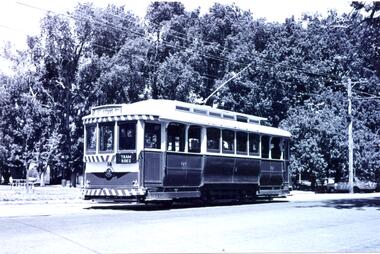 Ballarat Tramway Museum
Vehicle - Tramcar, Meadowbank Manufacturing Co Sydney, SECV Tram No. 14, 1915
... Single truck (4 wheels), drop ends, modified open California combination - to close car with 4 doors, 2 at either end, longitudinal seats, sliding doors internally, air brakes. ...Trams tram 14 Single truck (4 wheels), drop ends, modified open California combination - to close car with 4 doors, 2 at either end, longitudinal seats, sliding doors internally, air brakes. ...Single truck (4 wheels), drop ends, modified open California combination - to close car with 4 doors, 2 at either end, longitudinal seats, sliding doors internally, air brakes. For an article on the tram see issue of Fares Please Feb. 2019. Image used by Bill Scott. See Destination City, Destination Eaglehawktrams, tram 14 -
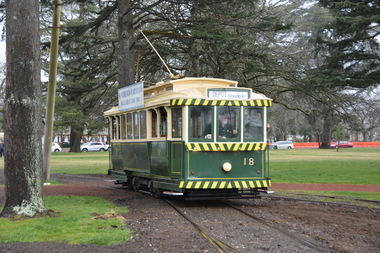 Ballarat Tramway Museum
Vehicle - Tramcar, Duncan and Fraser, SECV Tram No. 18, 1913
... Single truck, (4 wheels), drop ends, modified open California combination - to closed tram with 4 doors, 2 at either end, longitudinal seats, 2 internal sliding doors, air brakes. ...Trams tram 18 Single truck, (4 wheels), drop ends, modified open California combination - to closed tram with 4 doors, 2 at either end, longitudinal seats, 2 internal sliding doors, air brakes. ...Single truck, (4 wheels), drop ends, modified open California combination - to closed tram with 4 doors, 2 at either end, longitudinal seats, 2 internal sliding doors, air brakes. For an article on the tram and progress during 2018 see August 2019 issue of Fares Please!. Image used by Mal Rowe 21/9/2019. Destination City and Destination Eaglehawktrams, tram 18 -
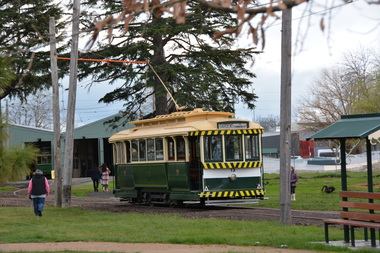 Ballarat Tramway Museum
Vehicle - Tramcar, Meadowbank Manufacturing Co. Sydney, SECV Tram No 13, 1915
... Single truck (4 wheels), drop end tram, modified open California combination- to closed car with 4 doors, 2 at either end, longitudinal seats, sliding internal doors, air brakes. ...Trams tram 11 Single truck (4 wheels), drop end tram, modified open California combination- to closed car with 4 doors, 2 at either end, longitudinal seats, sliding internal doors, air brakes. ...Single truck (4 wheels), drop end tram, modified open California combination- to closed car with 4 doors, 2 at either end, longitudinal seats, sliding internal doors, air brakes. For an article on the tram and progress during 2018 see October 2018 issue of Fares Please!. Image used by Mal Rowe 21/9/2019. See Destination Eaglehawk, Destination City.trams, tram 11 -
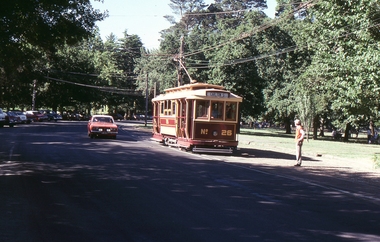 Ballarat Tramway Museum
Photograph - Digital Image of Tram 26, Peter Winspur, 26-12-1987
... Photos show Museum tram 26 in service soon after completion of the work to convert the tram back to an open Californian Combination tram and repaint into the Electric Supply Co of Victoria colour scheme. ...Ballarat Tramway Museum South Gardens Reserve Wendouree Parade Ballarat Ballarat goldfields Photos show Museum tram 26 in service soon after completion of the work to convert the tram back to an open Californian Combination tram and repaint into the Electric Supply Co of Victoria colour scheme. ...Photos show Museum tram 26 in service soon after completion of the work to convert the tram back to an open Californian Combination tram and repaint into the Electric Supply Co of Victoria colour scheme. Taken on 26-12-1987, the 100th anniversary of the commencement of public tram services in Ballarat using horse trams. Photo taken at Depot Junction.Yields information about tram 26 soon after completion of conversion back to an earlier layout showing how it arrived in Ballarat from Melbourne in 1930.Set of three digital images of tram 26 soon after completion in ESCo colours Boxing Day 1987 from Kodak slides.btps, tramways, trams, tram 26, esco, colour schemes, depot junction -
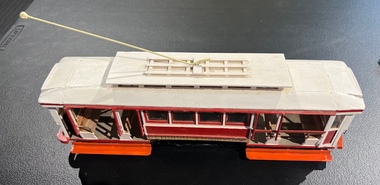 Ballarat Tramway Museum
Model - Model of Bendigo tram No. 19
... Model of Bendigo 19, Open California combination car in the Bendigo Trust colour scheme with the name of the operator "Bendigo Tramways" on the side and the front dash panel and a destination of "Gold Mine". ...Model of Bendigo 19, Open California combination car in the Bendigo Trust colour scheme with the name of the operator "Bendigo Tramways" on the side and the front dash panel and a destination of "Gold Mine". ...Model of Bendigo 19, Open California combination car in the Bendigo Trust colour scheme with the name of the operator "Bendigo Tramways" on the side and the front dash panel and a destination of "Gold Mine". The Modeller has detailed the seats the end saloons. Balsa wheels had broken off, repaired with 'O' gauge wheels along with other parts by the Museum's model builder.Demonstrates model tram building. One of a series of Ballarat and Bendigo tram models. Not known who built them.Model tram - made from Balsa wood, cardboard, paint, metal, styrene, wire.models, trams, bendigo, tram 19, bendigo trust -
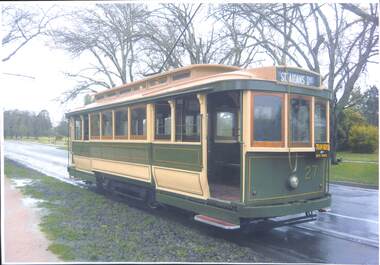 Ballarat Tramway Museum
Photograph - Photograph - coloured, Tram No.27 - Single truck - drop ends, modified California combination
... The tram is a single truck with drop ends, built as an open California combination. It is painted in the 1930 SEC colour scheme. ...The tram is a single truck with drop ends, built as an open California combination. It is painted in the 1930 SEC colour scheme. ...The tram was originally built for the Hawthorn Tramways Trust in 1916. It was sold to the Electric Supply Co. of Victoria for use on the Ballarat tramway system and converted to an early form of one-man operation in 1930. It continued in service until 1971 when the SEC operated system closed. The tram was transferred to the ownership of the Museum. The tram is a single truck with drop ends, built as an open California combination. It is painted in the 1930 SEC colour scheme. Fares are Adults $4 and Children $2.Large colour photograph, laminated.Green and cream tram with No 27 on each end. St Aidens Dve in destination window. Board indicating Tram Rides and fares.tram no 27, hawthorn tramways trust, 1916, electric supply company, esc, ballarat tramway system, one-man operation, sec, 1971, ballarat tramway museum, california combination, fares -
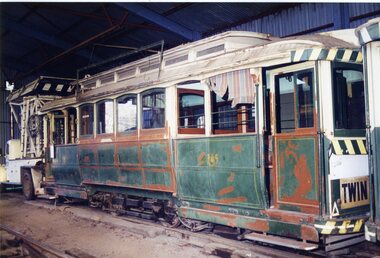 Ballarat Tramway Museum
Vehicle - Tramcar, Meadowbank Manufacturing Co. Sydney, SECV Tram No. 11, 1915
... Single truck (4 wheels), drop ends, modified open California combination to closed car, with 4 doors, 2 at either end, longitudinal seats, sliding internal doors, air brakes. - electric motors removed. ...Trams tram 11 Single truck (4 wheels), drop ends, modified open California combination to closed car, with 4 doors, 2 at either end, longitudinal seats, sliding internal doors, air brakes. - electric motors removed. ...One of a number of this type of tram still in working order in Australian tramway museums. Has no motors. Interior one of the few given a paint finish by SEC, others are varnished. Has timber panelled sides.Single truck (4 wheels), drop ends, modified open California combination to closed car, with 4 doors, 2 at either end, longitudinal seats, sliding internal doors, air brakes. - electric motors removed. Acquired from the Daylesford Historical Society. For an article on the tram see the Oct. 2018 issue of Fares Please! and the Museum Fleet page on the website. See Fares Please - Oct. 1977, Destination City, Destination Eaglehawk, BTPS Annual Reports and March 1980 Fares Please!trams, tram 11 -
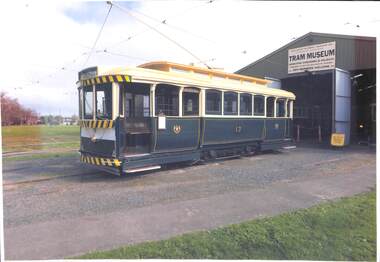 Ballarat Tramway Museum
Photograph - Photograph - coloured, Tram No.13: Tram outside shed at Tram Museum
... Tram 13 is a single truck with drop ends and an open California combination. It was built in 1915 for the Prahran and Malvern Tramways Trust. ...Tram 13 is a single truck with drop ends and an open California combination. It was built in 1915 for the Prahran and Malvern Tramways Trust. ...Green and cream tram with the SEC Logo on the side and the number 13. It is outside the shed of the Ballarat Tram Museum located near Wendouree Lake and the Gardens. Tram 13 is a single truck with drop ends and an open California combination. It was built in 1915 for the Prahran and Malvern Tramways Trust. In 1928 it was used in Geelong and then transferred to Ballarat in 1936. When the Ballarat tramways closed it was donated to the Lake Goldsmith Steam Preservation Society and returned to Ballarat on loan in 1983. Re-entered service in May 1988.Green tram number 13 outside shed.SEC Logo in gold. No 13 and stipes in gold. Depot in destination windowtram 13, sec logo, wendouree lake, gardens, ballarat tram museum, single truck, california combination, drop ends, prahran and malvern tramways trust, 1915, 1928, geelong, 1936, ballarat, lake goldsmith preservation society, 1983, 1988 -
 University of Melbourne, Burnley Campus Archives
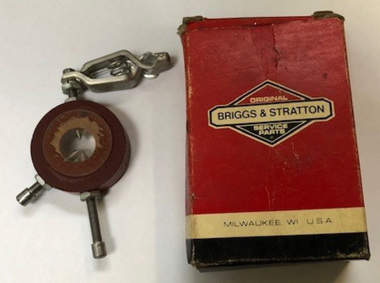
Equipment - Toolbox, Rota Industries, VCAH ENG with contents, 1983-1996
... Inside: Melco socket wrench, 0.05-0.50mm measures, 4 Stanley screwdrivers - 2 x 65-541, 65-549 and 2 Point Phillips 65-524, Sidchrome 22410 combination ring & open end spanner 7/16, Card - Check Ignition, Briggs & Stratton Spark Tester 19051 C. 1980 , Esco Nova 14 Piece Socket Set (with 2 pieces missing) in metal box....Inside: Melco socket wrench, 0.05-0.50mm measures, 4 Stanley screwdrivers - 2 x 65-541, 65-549 and 2 Point Phillips 65-524, Sidchrome 22410 combination ring & open end spanner 7/16, Card - Check Ignition, Briggs & Stratton Spark Tester 19051 C. 1980 , Esco Nova 14 Piece Socket Set (with 2 pieces missing) in metal box. ...Metal toolbox used for Engineering subject labelled VCAH ENG. Inside: Melco socket wrench, 0.05-0.50mm measures, 4 Stanley screwdrivers - 2 x 65-541, 65-549 and 2 Point Phillips 65-524, Sidchrome 22410 combination ring & open end spanner 7/16, Card - Check Ignition, Briggs & Stratton Spark Tester 19051 C. 1980 , Esco Nova 14 Piece Socket Set (with 2 pieces missing) in metal box.ROTA, VCAH ENGengineering, toolbox, teaching, tools, artifact -
 Warrnambool and District Historical Society Inc.
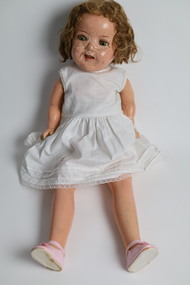
Leisure object - Child's Doll, Doll 1943 "Shirley", 25/03/2025
... Before plastic became commonplace in the 1950's dolls were typically made of this material which comprised a "combination" of sawdust and wood dust and glue which was then moulded in the required shape then painted and varnished. The head, arms and legs are made of this material. The body is stuffing covered in a cotton fabric.This doll has eyes that open...Warrnambool and District Historical Society Inc. 2 Gilles Street (south of Merri St) Warrnambool great-ocean-road Before plastic became commonplace in the 1950's dolls were typically made of this material which comprised a "combination" of sawdust and wood dust and glue which was then moulded in the required shape then painted and varnished. The head, arms and legs are made of this material. The body is stuffing covered in a cotton fabric.This doll has eyes that open ...Before plastic became commonplace in the 1950's dolls were typically made of this material which comprised a "combination" of sawdust and wood dust and glue which was then moulded in the required shape then painted and varnished. The head, arms and legs are made of this material. The body is stuffing covered in a cotton fabric.This doll has eyes that open and close and her teeth are visible and has a crying mechanism in the back. Her hair is possibly mohair and shoes are a synthetic material with metal buckles. The main enemy of composite material is water.It was a common practice for a girl to be given a doll and numerous outfits would be home made by mothers and grandmothers. This doll came to us with the name "Shirley" so possibly a Shirley Temple doll which were popular at the time.Dolls were a common child's toy and as such has strong social significance. This is a composition doll from the 1940's. It has composite arms and legs and face. Facial features are painted on and the teeth are moulded and white. Eyes are blue and open and close on moving the doll. The hair is light brown with curls and she wears pink Mary Jane style shoes. A crying mechanism is inserted in the body of the doll. The face has multiple crazed markings. composition doll, shirley doll, warrnambool, 1940's doll -
 Bendigo Military Museum
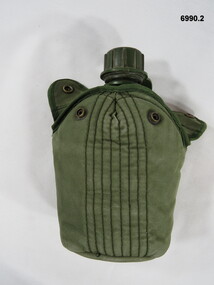
Equipment - WATER BOTTLE, CANTEEN, CARRIER, Department of Defence, 1. 1969. 2.1991
... Bendigo Military Museum 37 - 39 Pall Mall Bendigo goldfields Passchendaele Barracks Trust Combination Canteen Water bottle Cup Cover 1. On one side "FOR WATER ONLY, DO NOT APPLY CANTEEN TO OPEN FLAME OR BURNER PLATES". ...1. Water bottle, kidney shaped, plastic green colour with an attached screw top lid. 2. Cup canteen stainless steel with fold out handle with identification markings stamped on. 3. Water bottle outer carry cover, green colour, shaped to fit 1. and 2. consisting of water proof material, outer, soft inner lining. Two folding flaps with press stud closure, back has webbing section sewn on with web belt and webbing attachments.1. On one side "FOR WATER ONLY, DO NOT APPLY CANTEEN TO OPEN FLAME OR BURNER PLATES". On the base "V1969 ^ 8465-71-108-8703" 2. On underside of handle, "8465-66-058-5567 1991 ^" On underside of Outer Carry Cover "HADDEN".passchendaele barracks trust, combination canteen, water bottle, cup, cover -
 Bendigo Military Museum
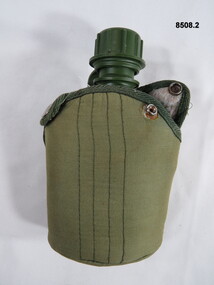
Equipment - WATER BOTTLE & CARRIER, ACMIL, 1981
... Plastic bottle, “FOR WATER ONLY DO NOT APPLY CANTEEN TO OPEN FLAME OR BURNER PLATES” “HCMIL 1981^ 8465-66-086-8349” The plastic green 1.5 litre water container is enclosed inside a fitted outer carrier. The water bottle has a secure screw lid, this combination ...The plastic green 1.5 litre water container is enclosed inside a fitted outer carrier. The water bottle has a secure screw lid, this combination is missing the universal mess canteen.1. Plastic bottle, “FOR WATER ONLY DO NOT APPLY CANTEEN TO OPEN FLAME OR BURNER PLATES” “HCMIL 1981^ 8465-66-086-8349” passchendaele barracks trust, water bottle, outer carrier -
 Bendigo Military Museum
Equipment - WATER BOTTLE & CUP, STOKES, 1986
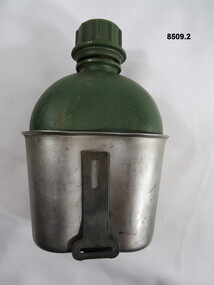
... OPEN FLAME OR BURNER PLATES" “BMW 1989^ 8465-66-086-8349. RATGMFORD?” 2. “STOKES AUSTRALASIA 8465-66-068-5567 1986^” The plastic green 1,5 litre water container is enclosed inside the stainless steel universal mess canteen. The water bottle has a secure screw lid, this combination ...The plastic green 1,5 litre water container is enclosed inside the stainless steel universal mess canteen. The water bottle has a secure screw lid, this combination is missing the outer carrier.1. "FOR WATER ONLY DO NOT APPLY CANTEEN TO OPEN FLAME OR BURNER PLATES" “BMW 1989^ 8465-66-086-8349. RATGMFORD?” 2. “STOKES AUSTRALASIA 8465-66-068-5567 1986^”passchendaele barracks trust, water bottle, canteen -
 Federation University Historical Collection
Equipment - Equipment - Scientific, VIOSH: Equipment for creating Dust Explosions which are the result of high concentrations of combustible dust particles
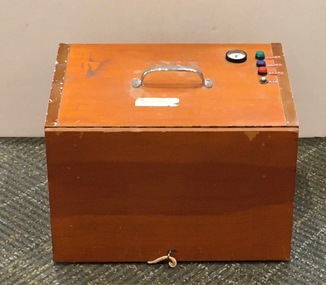
... opens to show contents. Electrical Engineering lecturer Graeme Hood remembers Paul Brass demonstrating this unit to show how dangerous a combination of dust and electricity it. ...opens to show contents. Electrical Engineering lecturer Graeme Hood remembers Paul Brass demonstrating this unit to show how dangerous a combination of dust and electricity it. ...Victorian Institute of Occupational Safety and Health (VIOSH) Australia is the Asia-Pacific centre for teaching and research in occupational health and safety (OHS) and is known as one of Australia's leaders on the field. VIOSH has a global reputation for its innovative approach within the field of OHS management. VIOSH had its first intake of students in 1979. At that time the Institution was known as the Ballarat College of Advanced Education. In 1990 it became known as Ballarat University College, then in 1994 as University of Ballarat. It was 2014 that it became Federation University. VIOSH Australia students are safety managers, senior advisors and experienced OHS professionals. They come from all over Australia and industry. Students are taught active research and enquiry; rather than textbook learning and a one-size fits all approach. VIOSH accepts people into the Graduate Diploma of Occupational Hazard Management who have no undergraduate degree - on the basis of extensive work experience and knowledge. Dust explosions are the result of high concentrations of combustible dust particles rapidly combusting inside an enclosed space. When mixed with oxygen these fine particles can ignite when in contact with a spark, metal ember, cigarette butt or other source.Wooden box with metal edges on top. Chrome handle and indicator buttons for Power, Air, Compression, Spark. Hinged front section that opens to show contents. Electrical Engineering lecturer Graeme Hood remembers Paul Brass demonstrating this unit to show how dangerous a combination of dust and electricity it. The demonstration would take about 1 minute, and would culminate with a loud bang which would make everyone jump. This item was probably last used by Paul Brass.viosh, victorian institute of occupational safety and health, dust explosion, combustible dust particles, enclosed space, spark, ember, cigarette, oxygen -
 Bendigo Military Museum
Equipment - HEXAMINE STOVE-SUGAR-OPENER, estimated Vietnam War era
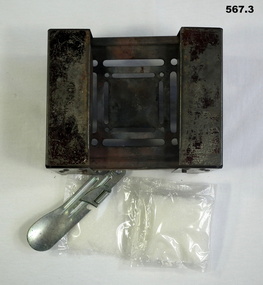
... 567.1 Stove, metal, rectangular, hexamine, folds open for use, when closed hold packet of hexamine. 567.2 Sugar, 4 serves in plastic wraps 567.3 Combination ration pack tin opener, spoon...Bendigo Military Museum 37 - 39 Pall Mall Bendigo goldfields Accessories hexamine utensil sugar “567.3 61-1983-7330-66-010-0931” 567.1 Stove, metal, rectangular, hexamine, folds open for use, when closed hold packet of hexamine. 567.2 Sugar, 4 serves in plastic wraps 567.3 Combination ration pack tin opener, spoon Equipment HEXAMINE STOVE-SUGAR-OPENER ...567.1 Stove, metal, rectangular, hexamine, folds open for use, when closed hold packet of hexamine. 567.2 Sugar, 4 serves in plastic wraps 567.3 Combination ration pack tin opener, spoon“567.3 61-1983-7330-66-010-0931”accessories, hexamine, utensil, sugar -
 Orbost & District Historical Society
book, Peisley, Allan B, Genoa School History, second half 20th century
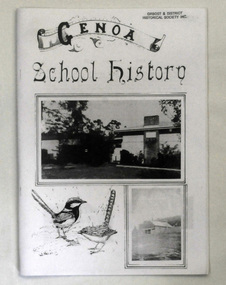
... It opened on 24th of August with an enrolment of approximately 20 pupils under the guidance of Algernon de Havilland, and served the district until 1928 when a combination of white ants and dry rot caused the building to be abandoned. ...It opened on 24th of August with an enrolment of approximately 20 pupils under the guidance of Algernon de Havilland, and served the district until 1928 when a combination of white ants and dry rot caused the building to be abandoned. ...The book was compiled by Allan B. Peisley. In 1891 a pineboard, portable school building was sent from Melbourne to Gabo by schooner, and transported to a site approximately 1½ miles SE of Genoa. When erected by Henry Bucknall, it was listed as Genoa River School. It opened on 24th of August with an enrolment of approximately 20 pupils under the guidance of Algernon de Havilland, and served the district until 1928 when a combination of white ants and dry rot caused the building to be abandoned. School was held in the Genoa hall as a 'temporary' measure until a new building was erected, and it was during this period that N. A. Wakefield, later lecturer and author of natural history articles and books, served as HT. The ‘temporary' measure proved seemingly permanent as it was not until 1953 that a new school was built on the present site, ½ mile W of Genoa. This school was opened by the late Sir Albert Lind on 15th of August 1953, the original name being amended to Genoa State School. Since then much has been done to maintain the grounds and buildings at a high standard.This item is a useful reference tool on the history of Genoa in East Gippsland.A book of 36 pp titled Genoa School History. On the front cover are black and white images of buildings and wrens. The text is black. The pages have been photocopied.education genoa -
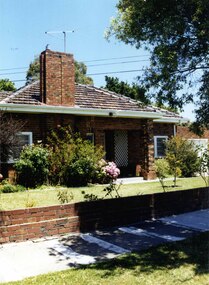 Glen Eira Historical Society
Photograph, Lindsay Avenue, 42, Murrumbeena, 2001
... The estate is distinguished by its aesthetic values, as is the earlier and comparable Hillcrest Estate, which are formed by a combination of restrained diversity in house styles, with the exception of no. 30 in the emerging International style, and by a landscaped garden environment. murrumbeena houses architectural styles 1930's inter war style a.v. jennings av jennings jennings brick houses beauville estate porches lindsay avenue sir albert victor jennings a v jennings construction co beauville estate heritage area glen eira city council architectural features jennings group limited land subdivision gardens beauville historic area brick features chimneys sash windows Garages (private) brick fences 42 Colour photograph of an unpainted variegated brown brick house. Other features include an open ...Originally labelled "Beauville Estate, Established 1936, Still Thriving 65 years on, 10th March 2001", the Beauville Estate Album contains colour photographs of houses in the Estate. They were taken around the time of the Beauville Estate’s 65th Heritage Celebration held on 10/03/2001 and donated to the Caulfield Historical Society shortly afterwards. Photographer unknown. City of Glen Eira’s Heritage Management Plan Vol 2 p79 (this is p84 of the pdf version) – HO12 Beauville Estate and environs, Murrumbeena: The Beauville Historic Area is important at the State level as the first large housing estate undertaken by the AV Jennings Construction Co, later Jennings Group Limited, Victoria’s largest home builder. It is important also as a very early estate development incorporating a range of features other than houses and including made roads, shops and recreation facilities. In this respect it was the forerunner of the comprehensively planned housing estate of the post war era. The estate is distinguished by its aesthetic values, as is the earlier and comparable Hillcrest Estate, which are formed by a combination of restrained diversity in house styles, with the exception of no. 30 in the emerging International style, and by a landscaped garden environment. Colour photograph of an unpainted variegated brown brick house. Other features include an open porch with 2 brick pillars and white trellis on one wall, tiled roof, white sash windows, feature brick wide and tall chimney and low unpainted brick fence and brick garage with white door. A public footpath and nature strip are in the foreground.42murrumbeena, houses, architectural styles, 1930's, inter war style, a.v. jennings, av jennings, jennings, brick houses, beauville estate, porches, lindsay avenue, sir albert victor jennings, a v jennings construction co, beauville estate heritage area, glen eira city council, architectural features, jennings group limited, land subdivision, gardens, beauville historic area, brick features, chimneys, sash windows, garages (private), brick fences -
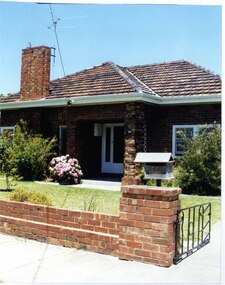 Glen Eira Historical Society
Photograph, Lindsay Avenue, 42, Murrumbeena, 2001
... The estate is distinguished by its aesthetic values, as is the earlier and comparable Hillcrest Estate, which are formed by a combination of restrained diversity in house styles, with the exception of no. 30 in the emerging International style, and by a landscaped garden environment. murrumbeena houses architectural styles 1930's inter war style a.v. jennings av jennings jennings brick houses beauville estate porches lindsay avenue sir albert victor jennings a v jennings construction co beauville estate heritage area glen eira city council architectural features jennings group limited land subdivision gardens beauville historic area brick features chimneys sash windows brick fences cast iron work 42 Colour photograph of an unpainted variegated brown brick house. Other features include an open ...Originally labelled "Beauville Estate, Established 1936, Still Thriving 65 years on, 10th March 2001", the Beauville Estate Album contains colour photographs of houses in the Estate. They were taken around the time of the Beauville Estate’s 65th Heritage Celebration held on 10/03/2001 and donated to the Caulfield Historical Society shortly afterwards. Photographer unknown. City of Glen Eira’s Heritage Management Plan Vol 2 p79 (this is p84 of the pdf version) – HO12 Beauville Estate and environs, Murrumbeena: The Beauville Historic Area is important at the State level as the first large housing estate undertaken by the AV Jennings Construction Co, later Jennings Group Limited, Victoria’s largest home builder. It is important also as a very early estate development incorporating a range of features other than houses and including made roads, shops and recreation facilities. In this respect it was the forerunner of the comprehensively planned housing estate of the post war era. The estate is distinguished by its aesthetic values, as is the earlier and comparable Hillcrest Estate, which are formed by a combination of restrained diversity in house styles, with the exception of no. 30 in the emerging International style, and by a landscaped garden environment. Colour photograph of an unpainted variegated brown brick house. Other features include an open porch with brick pillar and white trellis on one wall, tiled roof, white sash windows, feature brick wide and tall chimney and low unpainted brick fence with "42" on the wooden letterbox atop the brick pillar alongside a black metal gate in the foreground.42murrumbeena, houses, architectural styles, 1930's, inter war style, a.v. jennings, av jennings, jennings, brick houses, beauville estate, porches, lindsay avenue, sir albert victor jennings, a v jennings construction co, beauville estate heritage area, glen eira city council, architectural features, jennings group limited, land subdivision, gardens, beauville historic area, brick features, chimneys, sash windows, brick fences, cast iron work
