
Showing 4 items matching "open hearts and generosity"
-
 Marysville & District Historical Society
THE TRIANGLE NEWS-VOL 36 NO 19-MAY 29 2009
... ...open hearts and generosity...marysville victoria australia open hearts and generosity what's on when marysville cricket club agm triangle arts group meeting matdg agm marysville golf club building comissioner alexandra visitor information centre the dreamer trip cross country ski hire reopening advertisements community collection points for firewood & mulch council's landfill to ease road safety concern murrindindi shire council rspca bushfire assistance fund police news lions community bbq business tax change school crossing supervisor lions triangle tool library councillor comment remaining residents urged to come forward taskforce phoenix letter to editor alexandra vacancies marysville medical clinic assisting communities affected by bushfires state government grant arts recovery quick response fund centrelink attendance community hubs recovery mayor's chair health & wellbeing business recovery information sessions triangle distribution & fire relief centre marysville real estate planning process streamlined for rebuilding assistance with tax marysville country club footy last drinks theatre play THE TRIANGLE NEWS-VOL 36 NO 19-MAY 29 2009 ...marysville, victoria, australia, open hearts and generosity, what's on when, marysville cricket club agm, triangle arts group meeting, matdg agm, marysville golf club, building comissioner, alexandra visitor information centre, the dreamer trip, cross country ski hire reopening, advertisements, community collection points for firewood & mulch, council's landfill to ease road safety concern, murrindindi shire council, rspca bushfire assistance fund, police news, lions community bbq, business tax change, school crossing supervisor, lions triangle tool library, councillor comment, remaining residents urged to come forward, taskforce phoenix, letter to editor, alexandra vacancies, marysville medical clinic, assisting communities affected by bushfires, state government grant, arts recovery quick response fund, centrelink attendance, community hubs, recovery, mayor's chair, health & wellbeing, business recovery information sessions, triangle distribution & fire relief centre, marysville real estate, planning process streamlined for rebuilding, assistance with tax, marysville country club, footy, last drinks theatre play -
 Bendigo Historical Society Inc.
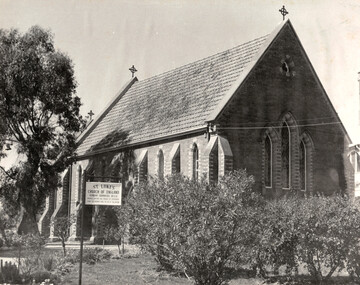
Document - National Trust Collection: Churches of Bendigo and Inglewood, Nov 7th 1965
... opened in Feb 1891. The tender price was 2,481 pounds. The church style was gothic, built by the Congregational Church to replace an earlier building built in 1858. St Johns bought the church in 1949 and made additions in 1951. THE SACRED HEART...opened in Feb 1891. The tender price was 2,481 pounds. The church style was gothic, built by the Congregational Church to replace an earlier building built in 1858. St Johns bought the church in 1949 and made additions in 1951. THE SACRED HEART ...St LUKES ANGLICAN CHURCH BENDIGO In 1852, a party of Cornish miners, refusing to give up and having dug, by hand, down nearly 70 feet ‘got their reward. Suddenly, their picks sank into soft pipe-clay, white, satin-smooth and seemingly depthless. The men began tunnelling. Presently, the roof forming above them showered gold at their feet – the secret of Bendigo’s famous White Hills lay revealed.’ In the ‘wild rush’ that followed, when ‘the White Hills yielded enormously and some pretty piles were made’, a young Anglican priest, John Herbert Gregory, held the first Anglican church service at White Hills in 1853. The Hamlet of White Hills was surveyed and mapped in 1854 and, by 1863, St Luke’s Church in White Hills was opened on ‘an elevated site’ in a generously sized ‘church reserve’. St AUGUSTINE'S CHURCH MYERS FLAT Early diggers to this area were men named Myers and Nicholls, hence the name - Myers Flat and Myers Creek. 1857 saw the discovery of gold in the area and in less than one month 1000 ounces of gold per week resulted. The number of diggers in the Myers Creek or Burnt Gully totalled 4000 to 5000. Myers Creek consisted of several shops and buildings, two hotels, a race course and a lock-up built of logs. On November 6th, 1864, the opening of the new church of St Augustine' took place. The first mass was celebrated by the Reverand Dean Hayes, of St Killian's Sandhurst. The church of gothic design was built by a local contractor, and with bricks made from local clay. The church also has a fire place and is widely known as "The church with the Chimney. For many years it was also a Catholic school. St AUGUSTINE'S CHURCH INGLEWOOD The church features an Early English design from 1864 and Decorated Gothic extensions from 1884.Notable elements include the sanctuary with the Catto Memorial window and interior cusped arcading of the wainscot. Architectural attribution is given to Vahland and Getzschmann for one or both sections. St JOHNS CHURCH (PRESBYTERIAN) BENDIGO The church's architect was W C Vahland VIA, and the builder was N Langstaff. It was built in April 1890, and opened in Feb 1891. The tender price was 2,481 pounds. The church style was gothic, built by the Congregational Church to replace an earlier building built in 1858. St Johns bought the church in 1949 and made additions in 1951. THE SACRED HEART CATHEDRAL BENDIGO Originally designed in 1895 by Reed, Smart and Tappin of Melbourne, the first stage opened in September 1901; the second stage began in January 1954 and was expected to finish in late 1976. Skilled stonemasons were brought from overseas for the completion. The Exterior built from Geelong sandstone and Harcourt granite, matching the original materials for color consistency. The cathedral is designed in the early English Gothic style. It Features a tower and spire weighing several thousand tons, with the spire rising 282 ft. from the floor and topped by a 10 ft. cross.Interior. The original stained glass window, made in Birmingham, England, is above the main entrance on the west side. Marble for the floor was imported from Vincenzo and Via Reggio, Italy; Sicilian Pearl marble is used in the four chapels. Ceilings in the chapels feature Western red cedar and yellow pine timbers.The transept includes Australian blackwood paneling and 12 carved shields representing the apostles. The internal height from floor to ceiling is 80 ft.Artistic Elements. Two large tapestries, specially designed and crafted by Mrs. Carrington, hang in the sanctuary as a symbolic link to Bendigo. ST PAULS BENDIGO The nave was built in 1868 and the tower in 1873. The nave is notable for unusual ceiling with metal and timber overlay members. The tower notable for early brick and bold Gothic influenced design. The church was opened on 12th Nov 1868 and a new chancel sanctuary and Transepts were added on 22 Oct 1927. The architect was Robert A Love. CONGREGATIONAL CHURCHES IN BENDIGO Three main Congregational church buildings existed in Bendigo: at the corner of Forest and Mackenzie Streets (the original site), on Quarry Hill (corner of Russell and Gladstone Streets), and on Calvin Street (later the Lutheran Church). The Calvin Street church was named in honor of John Calvin, a notable figure who lived in the area. In June 1858, 1.5 acres of land were purchased at the Forest and Mackenzie Streets corner for £1200.The first church was built on this site in November 1858 and later enlarged in May 1867 to seat 500 people. A prefabricated parsonage stood nearby until about 1920, serving as a caretaker's cottage for several years. In 1890, foundation stones for a new church designed by W.C. Vahland were laid, featuring a tall tower and two gable crossings (reduced from three to save costs). The new church opened on February 26, 1890, costing £2483. The contractor was N. Longstaff. Some architectural elements, such as the chancel, were added later when St. John's Presbyterian took over the building. Congregational attendance declined, leading to the purchase and alteration of a brick school complex in Olinda Street to serve as their headquarters.The timber church on Russell Street and the Calvin Street property were sold.The valuable Forest Street property was eventually sold to a London sect and later became an investment for the Methodist Church.Historical information on seven denominational churches in Bendigo and Inglewood. This item contains the following items: 3084.36a Black and white photo of St Lukes Bendigo Church of England, Napier Street, White Hills. 3084.36b St Augustine's Church Myers Flat 100 years newsletter 1965. The newsletter's purpose is for a Commemorative afternoon mass in memory of the pioneers of Myers Flat and district.Celebration of the 101st anniversary of the first mass at St. Augustine's Church; on Sunday, November 7th, 1965, at 2:00 PM.Location: St. Augustine's Church, Myers Flat. The invitation is extended to the recipient and their friends. This invitation serves both as a memorial and a community gathering to honour local history. Also included is some hand-written history notes of the church - See the notes in the Historical Section above. 3084.36c This document is a formal letter dated 9th November 1970 from the National Trust of Australia (Victoria) to Bishop Bernard Stewart. St. Augustine's Church in Bendigo has been awarded a "D" classification by the National Trust's expert committee. The church is now officially "recorded" by the National Trust. The letter is addressed to Bishop Bernard Stewart, with copies sent to Father Louis McDonnell (Eaglehawk), A. J. Watts (Town Clerk, Bendigo), and Mrs. R. R. Adams (Secretary, Central Victorian Branch). 3084.36d This document is a formal letter from the National Trust of Australia (Victoria) to Miss L. Doble, Registrar of the Bendigo Church of England Diocese, dated March 20, 1973. St. Augustine's Church of England in Inglewood has been officially placed on the National Trust's Classified List. This classification recognizes the church as essential to Australia's heritage and emphasizes its preservation. The church features an Early English design from 1864 and Decorated Gothic extensions from 1884.Notable elements include the sanctuary with the Catto Memorial window and interior cusped arcading of the wainscot. Architectural attribution is given to Vahland and Getzschmann for one or both sections. The church is about to celebrate the centenary of its consecration on May 13, with the Archbishop expected to attend. 3084.36e This document is a survey form used by the National Trust of Australia (Victoria) to collect detailed information about St Augustine's Church at Myers Flat. It records the original purpose, present use, and current name of the building.Requires a precise address or location description for site visits.It captures special features or points of interest not visible in photographs. It documents the present owner and occupant, including their addresses, the date of initial construction and supporting evidence for that date. 3084.36f Handwritten letter re history of St Johns Presbyterian Church Bendigo, 13th October 1980 - author unknown 3084.36g Typed notes - "Interesting information on the Sacred Heart Cathedral Bendigo", and hand-written notes on St Pauls Cathedral. 3084.36h Two pages of typed notes. Three main Congregational church buildings existed in Bendigo: at the corner of Forest and Mackenzie Streets (the original site), on Quarry Hill (corner of Russell and Gladstone Streets), and on Calvin Street (later the Lutheran Church). 3084.36i Hand-written notes on St Pauls Cathedral.history, church, national trust bendigo collection, sacred heart cathedral bendigo, st augustine's church myers flat, st pauls church bendigo, st johns presbyterian church bendigo, congregational church bendigo -
 Kew Historical Society Inc
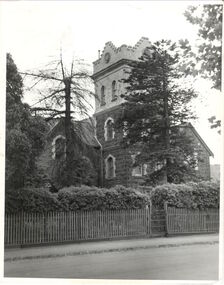
Photograph, J E & B L Rogers, 'Ivy Grange', Malmsbury Street, c. 1965
... Lawlor for their great generosity in connection with the fete, and complimented them on their successful efforts. ...Lawlor for their great generosity in connection with the fete, and complimented them on their successful efforts. ...Rate Book evidence records that by 1870 Charles Vickers, architect, was the occupier of this house, having an NA.V. at that date o f£1105, although it is apparent that the house was in fact built by 1864, from the dat; set in the brickwork above the main door. In 1873 the property was purchased by David Beath, a merchant, and it was in the following year that the house was first recorded as 'Ivy Grange'. Beath was a deeply religious man and was a foundation member of both the Congregational and the Presbyterian (the Church of Scotland) Churches of Kew . He added, probably the tower wing, to the house in 1877 when architects Crouch and Wilson called tenders in that year 'for the erection of bluestone additions to (a) villa at Kew, for Davis Beath Esq.' The house was again added to in 1885 by the leading firm Reed, Henderson and Smart. For a number of years in the 1920s 'Ivy Grange' was used as a private mental hospital and is currently a guest house. In 1921 a fete was held at Ivy Grange in aid of building a new church (Sacred Heart, Kew): "Garden Fete in Aid of New Church, Kew. A SUCCESSFUL FUNCTION. Beautiful weather favoured the opening of a garden fete at "Ivy Grange," the residence of Mr. and Mrs. J. Lawlor, Malmsbury and Princess streets, Kew, on last Saturday afternoon, in aid of the fine new Church of the Sacred Heart, Kew, which is now receiving its finishing touches. Not content to wait for the official opening, the lady stallholders did a good business on the previous evening. The ceremony was performed" by the Very Rev. Dean Hegarty, P.P., V.F. (Carlton), with whom were associated the Rev. J. Manly, P.P. (Kew), and the Rev. R. S. Benson, P.P. (South Yarra), Mr. and Mrs. J. Lawlor, and others. Fr. Manly, who was cordially received, said he desired to thank Mr. and Mrs. Lawlor for lending their charming grounds, and for the trouble, time and expense they had given to preparing for the fete. He wished to thank Dean Hegarty for coming to open the fete. The Dean had been a dear and lifelong friend of the late Fr. O'Donoghoe, the beloved pastor of the Kew parish. Next June the Dean would celebrate the golden jubilee of his priesthood, so they could see that he was not a young man. (Laughter.) He hoped that the fete would be a great success, and that when his Grace the Archbishop —: (applause) — should open the new church, he (the speaker) would be able to present a satisfactory financial statement. (Applause.) Dean Hegarty, who was very cordially received, said it was a source of great pleasure to him to come to Kew, of which he entertained many pleasant recollections. The new church would have delighted the heart of their late beloved pastor, but it had pleased God to take him to a holler temple. His mantle had fallen on worthy shoulders, in the person of Fr. Manly—(applause)—who was carrying on the work of the parish well and vigorously. (Applause.) Some wondered how these great works were successfully accomplished. The prime factor in the wonderful progress of the Church— the work of the people, priests and nuns—was their deep, abiding Catholic faith. (Applause.) Kew was not by any means a large parish, yet look at the magnificent church that Fr. Manly was building on the hill! He said to his people, "Come, follow me, and we shall win through." (Applause.) It gave him great pleasure to declare the fete open, and he wished it the highest measure of success. (Prolonged applause.) Mr. J. Lawlor, who was greeted with applause, in moving a hearty vote of thanks to Dean Hegarty for his presence and support, said he knew of the great work done by the Dean in Gippsland, where he (the speaker) lived when a young man. The Dean ministered to a parish at that time as large as was the diocese of Sale to-day. The Dean and Fr. Manly reflected credit on the pioneer priests, who had laid well and solidly the foundations, of religion in Victoria. (Applause.) He was glad that reference had been~made to the work of their late beloved pastor, Fr. O'Donoghoe. : Mr. Pierce Cody seconded the motion, which, was carried by acclamation. The Dean,* in acknowledging the compliment, paid a tribute to Mr. and Mrs. Lawlor for their great generosity in connection with the fete, and complimented them on their successful efforts. (Applause.). A cafe chantant, organised by Mr. John. Sullivan, was contributed to by Misses G. Hornal, M. O'Donnell, Ella Burke, Eileen Burke, Alice Marsh, and M. Carrucan, and Messrs. T. Hammond, J. Donovan, J. Sullivan, and Fr. Lanigan. Mrs. J. Donovan was at the piano. St. Vincent de Paul Boys' Orphanage Band (South Melbourne) rendered selections. The stalls ware as follow:—Cake and Sweets Stall: Mesdames Needham, Treacey, Lynch and Cody. Fancy Stall: Mesdames Lawlor, J. P. Martin, M. Treacey, Simpson, Giddons and A. Molton, and Miss, Shirley. Refrestiment Stall: Mesdames Shiels, Hunter, Kealy, Duane and the Misses Turner and Delahunty; Produce Stall: Mesdames O'Sullivan, Mareli, Carrucan, and Kennedy. Mr. P. J. Kennedy acted as hon. general secretary. The fete was continued in the evening, the grounds being brilliantly illuminated. (Advocate (Melbourne, Vic. : 1868 - 1954), Thursday 7 April 1921, page 13) In 1930 it was acquired by the Carmelite Fathers for use as a novitiate: "IVY GRANGE," KEW." Acquired for Carmelite Novitiate. The valuable property, "Ivy Grange," Kew. which" belonged to the McGuiness family has been acquired by the Carmelite Fathers for a novitiate." (Advocate (Melbourne, Vic. : 1868 - 1954), Thursday 18 September 1930, page 18This work forms part of the collection assembled by the historian Dorothy Rogers, that was donated to the Kew Historical Society by her son John Rogers in 2015. The manuscripts, photographs, maps, and documents were sourced by her from both family and local collections or produced as references for her print publications. Many were directly used by Rogers in writing ‘Lovely Old Homes of Kew’ (1961) and 'A History of Kew' (1973), or the numerous articles on local history that she produced for suburban newspapers. Most of the photographs in the collection include detailed annotations in her hand. The Rogers Collection provides a comprehensive insight into the working habits of a historian in the 1960s and 1970s. Together it forms the largest privately-donated collection within the archives of the Kew Historical Society.Ivy Grange, cnr Malmsbury and Princess Streets, Kew. Ivy Grange. Home of David Beath. Commenced 1864, Tower Wing added 1877. Chap 38.ivy grange, malmsbury street, dorothy rogers, david beath, charles vickers, crouch and wilson, kew houses -
 Flagstaff Hill Maritime Museum and Village
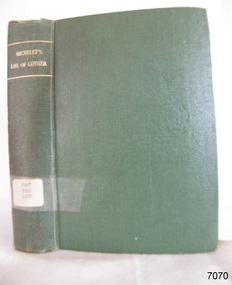
Book - Unconventional Biography, William Hazlitt Jr (Translator), The Life of Luther, 1872
... In 1835, France still largely held the image of the Reformer inherited from Bossuet "the most violent of men" and Michelet's generous selection of autobiographical texts didn't hide that violent fury, but worked equally to reveal a tender soul, sensitive to music, as open to friendship as to love. ...The Life of Luther, written by himself, is not a conventional biography but a compilation of Martin Luther's own words letters, table-talk, and passages drawn from his polemical and dogmatic writings selected, translated into French, arranged in roughly chronological order, and lightly stitched together with narrative commentary by Jules Michelet. It is a biography composed of a series of translations; except for the earliest years, which Luther could not narrate himself, the translator rarely needed to speak in his own voice. The English subject edition is Michelet's French compilation that was first published in Paris in 1835 as Mémoires de Luther, écrits par lui-même and rendered into English by William Hazlitt (1811–1893). The work traces Luther from his peasant origins and monastic life through his ordination, his journey to Rome, his "temptations" and inner spiritual crises, his break with the papacy, his marriage to the escaped nun Katharina von Bora, and his role at the centre of the Reformation, largely in his own recorded voice, framed by Michelet. Michelet composed the work almost entirely in 1828–29, publishing it in 1835. As the translator of Vico's Scienza Nuova, he felt a need at that time to move from theory to application, to study the general in the individual, history in biography, humanity in one man and Luther was his chosen vehicle: a man complete in thought and action, whose entire life, down to its smallest words and deeds, had been recorded.Hard cover book. The Life of Luther Author: M Michelet Translator: William Hazlitt Jr Publisher: Bell & Daldy & Co Date: 1872 Further Information: Green Cloth hardcover with lettering to spine in gilt. The spine has a Library label with an inscription.non-fictionThe Life of Luther, written by himself, is not a conventional biography but a compilation of Martin Luther's own words letters, table-talk, and passages drawn from his polemical and dogmatic writings selected, translated into French, arranged in roughly chronological order, and lightly stitched together with narrative commentary by Jules Michelet. It is a biography composed of a series of translations; except for the earliest years, which Luther could not narrate himself, the translator rarely needed to speak in his own voice. The English subject edition is Michelet's French compilation that was first published in Paris in 1835 as Mémoires de Luther, écrits par lui-même and rendered into English by William Hazlitt (1811–1893). The work traces Luther from his peasant origins and monastic life through his ordination, his journey to Rome, his "temptations" and inner spiritual crises, his break with the papacy, his marriage to the escaped nun Katharina von Bora, and his role at the centre of the Reformation, largely in his own recorded voice, framed by Michelet. Michelet composed the work almost entirely in 1828–29, publishing it in 1835. As the translator of Vico's Scienza Nuova, he felt a need at that time to move from theory to application, to study the general in the individual, history in biography, humanity in one man and Luther was his chosen vehicle: a man complete in thought and action, whose entire life, down to its smallest words and deeds, had been recorded.warrnambool, shipwrecked-coast, flagstaff-hill, flagstaff-hill-maritime-museum, maritime-museum, shipwreck-coast, flagstaff-hill-maritime-village, shipwrecked-artefact, book, the life of luther, m michelet
