
Showing 242 items matching "open house melbourne"
-
 Mission to Seafarers Victoria
Programme - Catalogue, Open House Melbourne, Takie Hold of the Clouds, 2022
... open house melbourne...The exhibition is conceived by Tara McDowell, Director of Curatorial Practice at Monash Art, Design and Architecture, and co-curated with Fleur Watson, Open House Melbourne’s Executive Director....Open House Melbourne...Takie Hold of the Clouds Programme Catalogue Open House Melbourne Ellikon Tom Ross Tara McDowell Fleur Watson Tricia Cortese ...Catalogue for an artistic discovery Ttail during Open House 2022.Digital copy of an artistic event catalogue 142 pages.non-fictionCatalogue for an artistic discovery Ttail during Open House 2022.open house melbourne, 2022, ying-lan dann, circular temporalities, norla dome, exhibitions, video installation, cultural events -
 Mission to Seafarers Victoria
Programme - Catalogue, Open House Melbourne 2018, July 2018
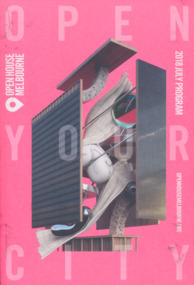
... Open House Melbourne 2018...open house melbourne...In 2009 the MtSV was encouraged to ‘open’ the building for public access and in 2010 the building was a feature in the highly successful Open House Melbourne event attracting over 2000 visits. ...The Mission is one of the sites open every year during Open House except 2023. open house melbourne cultural events 2018 Pink colour book Open House Melbourne 2018 Programme Catalogue ...In 2009 the MtSV was encouraged to ‘open’ the building for public access and in 2010 the building was a feature in the highly successful Open House Melbourne event attracting over 2000 visits. This event began a succession of public programming activities expanding the MtSV’s scope of works.The Mission is one of the sites open every year during Open House except 2023.Pink colour bookopen house melbourne, cultural events, 2018 -
 Whitehorse Historical Society Inc.
Document, Open House Melbourne 2017, 27/07/2017 12:00:00 AM
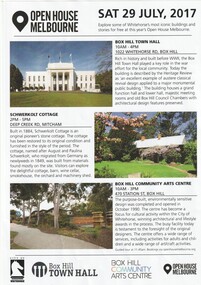
... Open House Melbourne 2017...A poster advertising Open House Melbourne which included Schwerkolt Cottage....Open House Melbourne 2017 Document Document ...A poster advertising Open House Melbourne which included Schwerkolt Cottage.schwerkolt cottage, city of whitehorse -
 Queen Victoria Women's Centre
Booklet, Open House Melbourne 2013 Self Guided Tour, c.2013
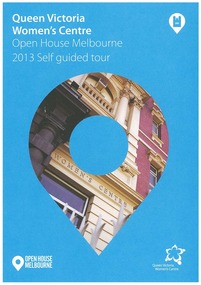
... Open House Melbourne 2013 Self Guided Tour...A4 sized cardboard halved to create a small booklet. Open House Melbourne 2013 Self Guided Tour Booklet ...A4 sized cardboard halved to create a small booklet. -
 Mission to Seafarers Victoria
Poster, Ying-Lan Dann, Circular Temporalities, July 2022
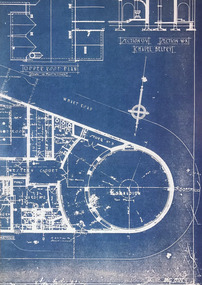
... open house melbourne...The exhibition is conceived by Tara McDowell, Director of Curatorial Practice at Monash Art, Design and Architecture, and co-curated with Fleur Watson, Open House Melbourne’s Executive Director. To create this poster, the artist used a copy of of one of Walter Butler plans for the 7171 building held in the archives as an homage to the architect. ...The Mission is one of the sites open every year during Open House. open house melbourne 2022 ying-lan dann circular temporalities norla dome blueprint plans Walter Richmond Butler (1864–1949) cultural events A3 size Blue print type plan print on glose paper. ...Take Hold of the Clouds is a curated exhibition featuring two key works by renowned international contributors – Forensic Architecture’s Cloud Studies (2021) and Cauleen Smith’s Sojourner (2018) – along with six, newly commissioned, responsive works from local and national creative practitioners. The experimental exhibition is distributed across seven of the city’s most significant buildings and urban spaces, with each temporal creative work adding a new layer to how we understand these spaces in relation to the world around us. Embedding the work within the city itself rather than a traditional gallery, the exhibition models best practices for high-impact yet sustainable and resource-sensitive exhibition-making. Created in partnership with Monash University, Take Hold of the Clouds navigates the Weekend’s theme of Built/Unbuilt through a series of thoughtful encounters in which artists reveal the invisible stories and issues in corners of the city. The exhibition is conceived by Tara McDowell, Director of Curatorial Practice at Monash Art, Design and Architecture, and co-curated with Fleur Watson, Open House Melbourne’s Executive Director. To create this poster, the artist used a copy of of one of Walter Butler plans for the 7171 building held in the archives as an homage to the architect. The sketch was then retouched to make it loo like a blueprint. The Mission is one of the sites open every year during Open House. A3 size Blue print type plan print on glose paper.open house melbourne, 2022, ying-lan dann, circular temporalities, norla dome, blueprint, plans, walter richmond butler (1864–1949), cultural events -
 Mission to Seafarers Victoria
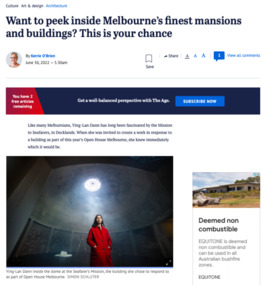
Article, Kerrie O'Brien, Want to peek inside Melbourne’s finest mansions and buildings? This is your chance, 30 June 2022
... open house melbourne...Open House 2022: "Like many Melburnians, Ying-Lan Dann has long been fascinated by the Mission to Seafarers, in Docklands. When she was invited to create a work in response to a building as part of this year’s Open House Melbourne, she knew immediately which it would be. ...Open House 2022: "Like many Melburnians, Ying-Lan Dann has long been fascinated by the Mission to Seafarers, in Docklands. When she was invited to create a work in response to a building as part of this year’s Open House Melbourne, she knew immediately which it would be. ...Open House 2022: "Like many Melburnians, Ying-Lan Dann has long been fascinated by the Mission to Seafarers, in Docklands. When she was invited to create a work in response to a building as part of this year’s Open House Melbourne, she knew immediately which it would be. Taking a peek behind the closed doors of some of Melbourne’s finest and most interesting buildings is a core premise of the weekend event, now in its 15th year. During that time, the program has grown from half a dozen buildings to a 200-plus strong list that extends to Ballarat and Bendigo. “[It’s] much more expansive and citizen-led,” says Fleur Watson, Open House Melbourne’s executive director. “As a public festival, it has always had a spirit of generosity, this gesture of opening up and allowing visitors to come and look and experience things.” Swinging open their doors at the end of the month will be some of the city’s finest mansions, including Villa Alba in Kew and Brighton’s Billilla, the Cairo flats in Fitzroy, the newly renovated Jewish Museum designed by Kerstin Thompson, the Melbourne Quakers Centre, the Albanian Mosque in Carlton North and many more. Considering how to approach the event this year, held remotely for the past two, Watson decided to explore beyond the traditional, with associate professor and director of curatorial practice at Monash University Tara McDowell. The two have co-curated an exhibition of works to run concurrently with the Open House program, called Take Hold of the Clouds. That’s where Dann’s work, Circular Temporalities, comes in, one of seven commissions around town in which local and international artists respond to chosen buildings or sites. A lecturer in interior design at RMIT as well as an artist, she is interested in time and finding different mediums to show things in flux and, having grown up on Phillip Island, she often uses water as a theme. When she started spending time at the Mission, Dann found there was an oculus at the top of the dome, known as the Norla Dome. She thought about how that small but significant opening related to where sailors spent so many months of the year, the sky being the only thing they would see much of the time, stars guiding the way in times gone by, and of the recent stories she’d heard about sailors being trapped at sea during COVID. Built in the Arts and Craft style between 1916 and 1919 and designed by architect Walter Butler, the Mission includes a chapel, clubroom, Chaplain’s house, a small cottage and the Norla Dome, which was apparently inspired by the Pantheon. The Mission was funded by the government and the Ladies Harbour Lights Guild, who Dann was also intrigued by. “One of the things those women identified is that life at sea is very dangerous [and they] wanted to give them a space of sanctuary and support,” she says, adding that for many years, the dome was used as a gymnasium. Her work inside the dome includes a 35-minute loop film, recorded from the ferry during the crossing from Queenscliff to Sorrento. The horizon takes up about a third of the shot and moves as the waves rise and fall, mirroring the journeys made by the sailors who found refuge at the mission over the years; it will be projected onto a gauze-like fabric, allowing glimpses of the building behind. Dann also plans to activate the site over the course of the weekend and will read a poem by Justin Clemens.The articles gives an insight of the création of the artwork by Ying-Lan Dann. digital copy of an article with photographs published in the Ageopen house melbourne, 2022, ying-lan dann, take hold of the clouds, norla dome, exhibition, the age, cultural events -
 City of Moorabbin Historical Society (Operating the Box Cottage Museum)
Newsletter - CMHS Moorabbin Mirror Vol 7 August 2016, Moorabbin Mirror Vol 7 August 2016, August 2016
... moorabbin, bentleigh, cheltenham, open house melbourne 2016, wattle trees, robb andrew hon. mhr., goldstein vida, mckinnon kindergarten, kingston historical societies network, southern metro historical societies network, moorabbin aviation museum,...In this Issue This is Vol. 7 of the Moorabbin Mirror, Newsletter of CMHS August 2016 moorabbin, bentleigh, cheltenham, open house melbourne 2016, wattle trees, robb andrew hon. mhr., goldstein vida, mckinnon kindergarten, kingston historical societies network, southern metro historical societies network, moorabbin aviation museum, Moorabbin / Mirror / August 2016 Vol 7 A4 x 3 paper folded to A5 x 6pp with colour photographs. ...This is Vol. 7 of the Moorabbin Mirror produced by CMHS members Fran & Holger Bader , Valma Sharp in August 2016 The Moorabbin Mirror reflects the history and heritage of the former City of Moorabbin — derived from Mooroobin, ‘a resting place’ in the Bunurrung spoken language. In 1994, the City of Moorabbin was integrated into the Cities of Bayside, Glen Eira, Kingston and Monash. In this Issue This is Vol. 7 of the Moorabbin Mirror, Newsletter of CMHS August 2016A4 x 3 paper folded to A5 x 6pp with colour photographs. Moorabbin / Mirror / August 2016 Vol 7moorabbin, bentleigh, cheltenham, open house melbourne 2016, wattle trees, robb andrew hon. mhr., goldstein vida, mckinnon kindergarten, kingston historical societies network, southern metro historical societies network, moorabbin aviation museum, -
City of Moorabbin Historical Society (Operating the Box Cottage Museum)
Newsletter - CMHS Moorabbin Mirror Issue 12 October 2017, CMHS Moorabbin Mirror Newsletter Issue 12 October 2017, 2017
... moorabbin mirror, bader fran, bader holger, patterson geoffrey, rietman august, rennick stefanie, rietman william, le page everest; open house melbourne 2017, world war 1 memorials, lone digger memorials, resin jewellery,...This is Issue 12 of the Moorabbin Mirror, Newsletter of CMHS October 2017 moorabbin mirror, bader fran, bader holger, patterson geoffrey, rietman august, rennick stefanie, rietman william, le page everest; open house melbourne 2017, world war 1 memorials, lone digger memorials, resin jewellery, Moorabbin / Mirror / Newsletter City of Moorabbin Historical Society Inc. ...This is Issue 12 of the Moorabbin Mirror produced by CMHS members Fran & Holger Bader , Geoffrey Paterson, October 2017 Topics; August Rietman Exhibition Roving Curator Program; OHM; Le Page family Travel Trunk; The Moorabbin Mirror reflects the history and heritage of the former City of Moorabbin — derived from Mooroobin, ‘a resting place’ in the Bunurrung spoken language. In 1994, the City of Moorabbin was integrated into the Cities of Bayside, Glen Eira, Kingston and Monash. This is Issue 12 of the Moorabbin Mirror, Newsletter of CMHS October 2017A4 x 2 paper folded to A5 x 4pp with B/W photographs. Moorabbin / Mirror / Newsletter City of Moorabbin Historical Society Inc. A0020547E (CMHS) / operating Box Cottage Museum (BCM) / OCTOBER 2017 ISSUE 12moorabbin mirror, bader fran, bader holger, patterson geoffrey, rietman august, rennick stefanie, rietman william, le page everest; open house melbourne 2017, world war 1 memorials, lone digger memorials, resin jewellery, -
 Mission to Seafarers Victoria
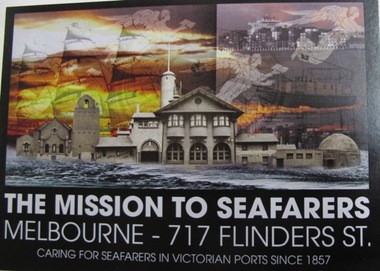
Postcard - Postcard, Colour, Mission to Seafarers Victoria, The Mission To Seafarers Melbourne 717 Flinders St: Caring for Seafarers in Victorian Ports since 1857, 2011
... During the Open House Melbourne 2011 artist nicknamed "586" participated in one of the Norla Dome Project Space events sponsored by Bendigo Wealth. ...During the Open House Melbourne 2011 artist nicknamed "586" participated in one of the Norla Dome Project Space events sponsored by Bendigo Wealth. ...During the Open House Melbourne 2011 artist nicknamed "586" participated in one of the Norla Dome Project Space events sponsored by Bendigo Wealth. The original large print was on display and smaller prints were also sold to raised funds for the Mission. The postcard was printed as a marketing to raise awareness of the work of the Mission.The postcard llustrates the typical early 21st services such as money exchange, modems, sim cards et al and facilities such as a free bus service and collection available through the Mission. Also documents the continuity of services offered to Seafarers over 100 years in the current building at 717 Flinders St (1917-2017).Full colour promotional and information postcard featuring artwork collage print ( MTSV 0650) on one side and black on white information about the Flying Angel Club on the reverse.flying angel club, flinders street, mission to seafarers, seamen's mission, artist 586, open house, fundraising, marketing -
City of Moorabbin Historical Society (Operating the Box Cottage Museum)
Newsletter, CMHS Moorabbin Mirror Issue 11 July 2017, CMHS Moorabbin Mirror Newsletter Issue 11 July 2017, 2017
... Topic; Notices for AGM July 23rd and Open House Melbourne 2017 July 29th a& 30th ; RHSV History week in October, Elster Creek; Clee Hill;Leonard.A. ...Topic; Notices for AGM July 23rd and Open House Melbourne 2017 July 29th a& 30th ; RHSV History week in October, Elster Creek; Clee Hill;Leonard.A. ...Topic; Notices for AGM July 23rd and Open House Melbourne 2017 July 29th a& 30th ; RHSV History week in October, Elster Creek; Clee Hill;Leonard.A. LePage; Cheltenham Church of Christ 160th; Pennydale Post Office; Cheltenham; Ross St & Smith St Bentleigh; This is Issue 11 of the Moorabbin Mirror produced by CMHS members Fran & Holger Bader , Geoffrey Paterson, in July 2017 The Moorabbin Mirror reflects the history and heritage of the former City of Moorabbin — derived from Mooroobin, ‘a resting place’ in the Bunurrung spoken language. In 1994, the City of Moorabbin was integrated into the Cities of Bayside, Glen Eira, Kingston and Monash This is Issue 11 of the Moorabbin Mirror, Newsletter of CMHS in July 2017A4 x 2 paper folded to A5 x 4pp printed on both sidesMoorabbin / Mirror / Newsletter City of Moorabbin Historical Society (CMHS) Inc . / operating Box Cottage Museum / July 2017 Issue 11moorabbin mirror, bader fran, bader holger, patterson geoffrey, cheltenham chhurch of christ, lepage a.l.; clee hill estate; elster creek, sir ross smith, aviators, moorabbin, bentleigh, cheltenham, brighton, market gardeners, early settlers -
 Mission to Seafarers Victoria
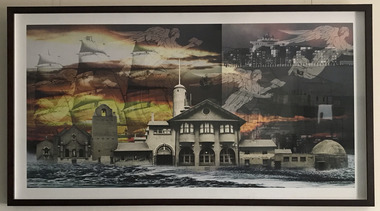
Print - Digital collage, 586, Captured, 2011
... melbourne...windvane...dome...flying angel...sea...norla dome...bendigo wealth...artist 586...2011...artwork-paintings...open house...During the Open House Melbourne 30-31 July 2011, the artist nicknamed "586" participated in one of the Norla Dome Project Space events sponsored by Bendigo Wealth. ...During the Open House Melbourne 30-31 July 2011, the artist nicknamed "586" participated in one of the Norla Dome Project Space events sponsored by Bendigo Wealth. ..."Art is the vehicule for communications far Beyond the confines of a space, while design is the aesthetic cradle in which messages are nurtured and processed." "A 586 rework of the iconic building that has withstood the redevelopment of the Melbourne Docklands and defied the odds. On display a large format print 700mm x 1400mm print. Also a limited run of smaller prints on archival paper also available to support Melbourne's first non-profit charitible organisation that is still self funded, ie. not government funded." During the Open House Melbourne 30-31 July 2011, the artist nicknamed "586" participated in one of the Norla Dome Project Space events sponsored by Bendigo Wealth. Made in Melbourne, 586 is an urban digital experimentalist who blends social narrative with found image creating messages that inspire social consciousness and free thought. Cast in a local foundry back in 1991, 586 was a number, amid hundreds of men working between the ladie and the furnace in a clock on - clock off automated industrious landscape. Legend tells of a time when correspondance to workers was addressed to their number, not their name. Disapproval spread rapidly and a revoit soon followed, eventually the power of the masses won out, but the demoralizing treatment of the worker would go on to shape 586's perception and became the catalyst for a personal protest against social imbalance. This print was on display and smaller prints were also sold to raised funds for the Mission.DigitalLarge digital print of a design that overlays various symbols ( 4 flying angels ), the sails of a sailing ship and contemporary cityscapes and seascapes. centrally features a full photograph of the Mission to seafarers building at 717 Flinders St. Melbourne. Mounted in a large black frame and glazed with perspex .mission to seafarers, flinders street, melbourne, windvane, dome, flying angel, sea, norla dome, bendigo wealth, artist 586, 2011, artwork-paintings, open house, norla dome project space -
 Melbourne Tram Museum
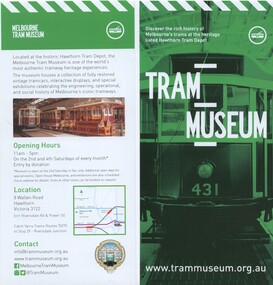
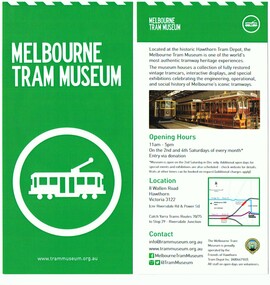
Pamphlet, FOHTD, Adam Chandler, "Melbourne Tram Museum", Jul. 2016
... Prepared by Adam Chandler July 2016 - first used at the Melbourne Open House Day 2016.....Prepared by Adam Chandler July 2016 - first used at the Melbourne Open House Day 2016.. "Melbourne Tram Museum" Pamphlet FOHTD, Adam Chandler ...Pamphlet titled "Melbourne Tram Museum", advertising the Hawthorn Tram depot, giving opening hours, location and contact details. Prepared by Adam Chandler July 2016 - first used at the Melbourne Open House Day 2016..trams, tramways, hawthorn, melbourne tramway museum, pamphlets, fohtd -
Port Melbourne Historical & Preservation Society
FIlm - DVD, Princes Pier reconstruction, 2007 - 2011
... This film was shown at the opening of the pier and at the Piers Festivals 2012 and 2013, and at the Melbourne Open House Weekend July 2012 at which PMHPS took part. ...This film was shown at the opening of the pier and at the Piers Festivals 2012 and 2013, and at the Melbourne Open House Weekend July 2012 at which PMHPS took part. ...This film was shown at the opening of the pier and at the Piers Festivals 2012 and 2013, and at the Melbourne Open House Weekend July 2012 at which PMHPS took part. We requested a copy.DVD of Princes Pier construction montage compiled by Major Projects Victoria over the years during which the abandoned pier was renovated to produce both public space and a monument to its own history. A stop-action film of the construction process, donated to PMHPS by MPV in 2012 by the Project Manager Andrew McKinleypiers and wharves - princes pier, major projects victoria, andrew mckinley -
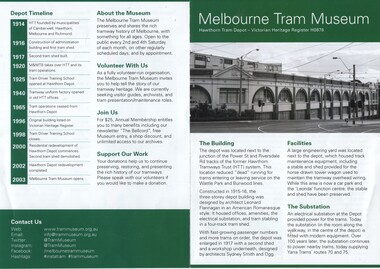 Melbourne Tram Museum
Pamphlet, Melbourne Tram Museum, "Melbourne Tram Museum", Jul. 2017
... Used for the 2017 Melbourne Open House depot. Prepared by Adam Chandler July 2017....Used for the 2017 Melbourne Open House depot. Prepared by Adam Chandler July 2017. ...Colour photocopy - folded to A5 on titled "Melbourne Tram Museum", providing details of the Hawthorn Tram depot. Includes photo of depot on front cover, history of the Building, Operations, Location , Expansion, Decline and Redevelopment. Includes a depot map and a list of the tramcars On the rear is a timeline, details of the Museum. Used for the 2017 Melbourne Open House depot. Prepared by Adam Chandler July 2017.trams, tramways, hawthorn, melbourne tram museum, mtm, depots, pamphlets -
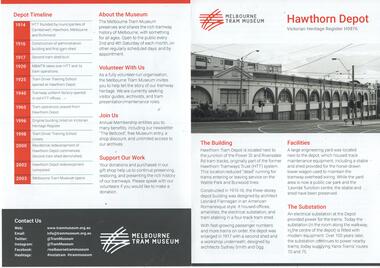 Melbourne Tram Museum
Pamphlet, Adam Chandler, "Melbourne Tram Museum", Jul. 2018
... Used for the 2018 Melbourne Open House depot. Prepared by Adam Chandler July 2018....Used for the 2018 Melbourne Open House depot. Prepared by Adam Chandler July 2018. ...Colour photocopy - folded to A5 on titled "Melbourne Tram Museum", providing details of the Hawthorn Tram depot. Includes photo of depot on front cover, history of the Building, Operations, Location , Expansion, Decline and Redevelopment. Includes a depot map and a list of the tramcars On the rear is a timeline, details of the Museum. First version with the new logo. Used for the 2018 Melbourne Open House depot. Prepared by Adam Chandler July 2018.trams, tramways, hawthorn, melbourne tram museum, mtm, depots, pamphlets -
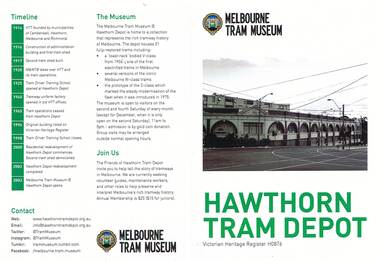 Melbourne Tram Museum
Pamphlet, Adam Chandler, Russell Jones, "Hawthorn Tram Depot", Jun. 2014
... Used for the 2014 Melbourne Open House depot. Prepared by Adam Chandler June 2014 from previous sheets. 525.1 - A4 - the 2015 Melbourne Open House version. ...Used for the 2014 Melbourne Open House depot. Prepared by Adam Chandler June 2014 from previous sheets. 525.1 - A4 - the 2015 Melbourne Open House version. ...525 Colour photocopy - folded to A5 on heavy paper, titled "Hawthorn Tram Depot", providing details of the Hawthorn Tram depot, with the FOHTD logo and "Melbourne Tram Museum" in the top left hand corner. Includes photo of depot on front cover, history of the Building, Operations, Location , Expansion, Decline and Redevelopment. On the rear is a timeline, details of the Museum and the Friends Group. Used for the 2014 Melbourne Open House depot. Prepared by Adam Chandler June 2014 from previous sheets. 525.1 - A4 - the 2015 Melbourne Open House version. Printed on heavy paper. 525.2 - an earlier version - two A4 pages stapled in the top left hand corner. Prepared by Warren Doubleday and Mike Ryan. Uses a Keith Kings Oct. 1946 of the front of the depot. .1 and .2 added 13/1/15. 525.3 - A4 - 2016 Open House version, added 4-11-2016trams, tramways, hawthorn, fohtd, depots -
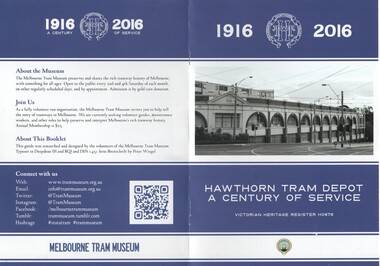 Melbourne Tram Museum
Book, Adam Chandler, "Hawthorn Tram Depot a Century of Service", Jul. 2016
... Printed for sale at the 2016 Melbourne Open House depot....Printed for sale at the 2016 Melbourne Open House depot. "Hawthorn Tram Depot a Century of Service" Book Adam Chandler ...Colour printed book - 8 pages, A5 size, centre stapled, printed on heavy paper, titled "Hawthorn Tram Depot a Century of Service", providing details of the Hawthorn Tram depot, the Hawthorn Tramway Trust, HTT, it services, substation, opening, amalgamation, uniforms and redevelopment. Has the details of the Museum on the rear cover. Prepared by Adam Chandler July 2016. Printed for sale at the 2016 Melbourne Open House depot.trams, tramways, hawthorn, fohtd, depots, pamphlets, htt, substation, uniforms, construction -
 Melbourne Tram Museum
Pamphlet, Adam Chandler, Melbourne Tram Museum, 2015
... ... Melbourne Open House Day...Set of three pamphlets produced by the Melbourne Tram Museum @ Hawthorn Depot - 2015. .1 - DL size flyer - full colour advertising the Melbourne Tram Museum - giving details of the Museum, location, map etc. .2 - A4 sheet, full colour, "Become a Member", Membership application form. .3 - A4 folded sheet produced for the 2015 Melbourne Open House day - "Fancy a coffee or a bit?"...Trams tramways FOHTD Melbourne Tram Museum Melbourne Open House Day Membership Publicity advertisements Set of three pamphlets produced by the Melbourne Tram Museum @ Hawthorn Depot - 2015. .1 - DL size flyer - full colour advertising the Melbourne Tram Museum - giving details of the Museum, location, map etc. .2 - A4 sheet, full colour, "Become a Member", Membership application form. .3 - A4 folded sheet produced for the 2015 Melbourne Open House day - "Fancy a coffee or a bit?" ...Set of three pamphlets produced by the Melbourne Tram Museum @ Hawthorn Depot - 2015. .1 - DL size flyer - full colour advertising the Melbourne Tram Museum - giving details of the Museum, location, map etc. .2 - A4 sheet, full colour, "Become a Member", Membership application form. .3 - A4 folded sheet produced for the 2015 Melbourne Open House day - "Fancy a coffee or a bit?", giving details of the food vans at the Museum. Two copies of each held. Produced by Adam Chandler.trams, tramways, fohtd, melbourne tram museum, melbourne open house day, membership, publicity, advertisements -
 Melbourne Tram Museum
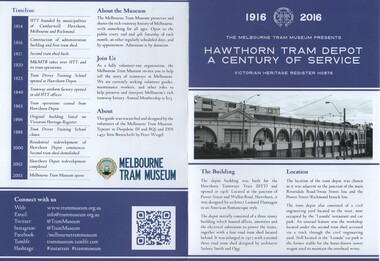
Pamphlet, Adam Chandler, "Hawthorn Tram Depot a Century of Service", Jul. 2016
... Used for the 2016 Melbourne Open House depot. Prepared by Adam Chandler July 2016. ...Used for the 2016 Melbourne Open House depot. Prepared by Adam Chandler July 2016. ...Colour photocopy - folded to A5 on heavy paper, titled "Hawthorn Tram Depot a Century of Service", providing details of the Hawthorn Tram depot, with the FOHTD logo and "Melbourne Tram Museum" in the top left hand corner. Includes photo of depot on front cover, history of the Building, Operations, Location , Expansion, Decline and Redevelopment. Includes a depot map and a list of the tramcars On the rear is a timeline, details of the Museum. Used for the 2016 Melbourne Open House depot. Prepared by Adam Chandler July 2016. Two copies held.trams, tramways, hawthorn, fohtd, depots, pamphlets -
 Melbourne Tram Museum
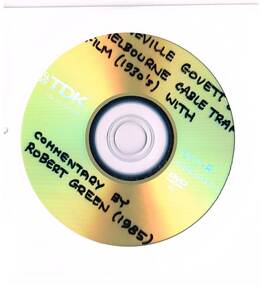
Film - Compact Diskette with video, Robert Green, 1985
... CD is a copy of an original held by Robert, provided by Robert on 26/7/2014 in time for the Melbourne Open House Day. DVD files converted to an AVI file 11/12/14 for showing at depot on PC - see htd553movie.avi in image files....CD is a copy of an original held by Robert, provided by Robert on 26/7/2014 in time for the Melbourne Open House Day. DVD files converted to an AVI file 11/12/14 for showing at depot on PC - see htd553movie.avi in image files. ...Compact Diskette in a paper envelope with a video made from film taken by Neville Govett with voice over by Robert Green. With the CD are a photocopy of notes provided by Neville at the time of production on the sources, how made, when and that a copy had gone to the TMSV c1980. Has explanations on how the cable system worked, shunting of tramcars, views of the cars operating in Bourke and other streets, the Gertrude and Nicholson St powerhouse and other features. The last sheet (i6) - copy of an article written by Lorna Hanna, niece to Neville, wrote for the March 2013 issue of the North and West Melbourne News, with particular notes on the North Melbourne route and its operation. CD is a copy of an original held by Robert, provided by Robert on 26/7/2014 in time for the Melbourne Open House Day. DVD files converted to an AVI file 11/12/14 for showing at depot on PC - see htd553movie.avi in image files.trams, tramways, cable trams, north melbourne, abbotsford st., melbourne, cable grip, cables -
 City of Melbourne Libraries
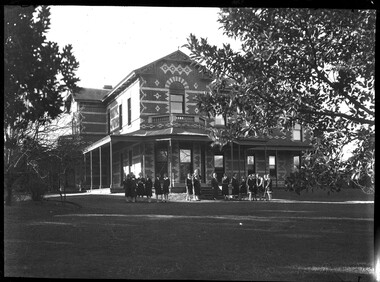
Photograph, Bull, Hugh Jones, 1897-1993, Ruyton Girls School 1933
... Located at 82 Selbourne Road, Kew, it is described by Melbourne’s Open House organisation as “… a two-storey, polychrome brick mansion built for them by prominent Melbourne architect Albert Purchas. ...Located at 82 Selbourne Road, Kew, it is described by Melbourne’s Open House organisation as “… a two-storey, polychrome brick mansion built for them by prominent Melbourne architect Albert Purchas. ...Published: Age (Melbourne, Vic.: 1854- ), 4 August 1933, page 3 Published title: GIRLS’ SCHOOLS – MODEL YACHTING - FOOTBALL Published caption: The headmistress, Miss H. Daniell, and girls at Ruyton, Selbourne Road, Kew, snapped after school hours. Trove article identifier: http://nla.gov.au/nla.news-article204381763 Research by Project Volunteer, Louise McKenzie: Rather than the people, this charming building takes the eye! Originally named “Tarring”, it was built in 1872 by Mr Henry Henty and his wife Mrs Marion Anne Henty (nee McKellar) for their family. Located at 82 Selbourne Road, Kew, it is described by Melbourne’s Open House organisation as “… a two-storey, polychrome brick mansion built for them by prominent Melbourne architect Albert Purchas. The house and nearly four acres of grounds served as their family home until the death of Marian Henty in 1919. “ (See below for further information on Albert Purchas.) In 1920 it was sold to Ruyton Girls School. Ruyton was established in 1878 by its first principal, Charlotte Anderson (1838-1906), who named it in honour of the parish in Shropshire, England, Ruyton-XI-Towns, where her great-great-grandfather David Evans had been vicar. Its motto is Recte et Fideliter, meaning "Upright and Faithful", which is also the name of the school song. The original school, one of Victoria’s oldest independent schools for girls, was located at the home of Mrs Anderson at 63 High Street South, Kew. In 1882 she moved the school to Edgecombe in Studley Park Road. Mrs Anderson retired due to ill health and sold the school to her friend Miss Eliza Bromby. One of Ruyton's four Houses, Anderson, is named for Charlotte Anderson. When Ruyton Girls School was moved to the site in 1920 it established the building as a Boarding House, and renamed the building “Henty House” in honour of its original owners. Today the school remains an all girls’ school, and pays tribute to its founder and the historic significance of Henty House and its magnificent Moreton Bay Fig tree, which still stands today. The building retains many original, Victorian-era features, while also showing the layers of change, made over the decades in order to meet the evolving needs of one of Melbourne’s leading schools. The headmistress mentioned in the caption for MCK016 is Miss Hilda Daniell, shown standing in front of Henty House in the midst of a group of Ruyton girls in their school uniforms, some holding hockey sticks. Miss Daniell was the longest serving Principal of Ruyton 1913-1952. She was originally a student in 1893, then joined the teaching staff in 1898. It was under her leadership that the School purchased and moved to “Tarring”. The boarding house included a flat for Hilda to live onsite. An article in the Ruyton Heritage Collection – Bedford Series, dated 21 May 2021 cites that Miss Daniell “was affectionately known as “Dream” by Ruytonians of her era” apparently due to a tendency to quiet reflection. The article continues, “After her retirement in 1952 Miss Daniell was awarded an Order of the British Empire for her many services to education, an award she received from the hands of the Queen during the 1954 Royal Tour. Also in 1952, the Kew Council honoured her by renaming Brougham Place as ‘Daniell Place’.” Arthur Purchas, architect: The architect responsible for the design of “Tarring”. Arthur Purchas, was extremely active and highly regarded at this time. Born in Wales in 1825, he emigrated to Melbourne in 1851 and soon established a private practice as a surveyor and architect, with offices variously in Little Collins, Queen Street, Chancery Lane, and finally 462 Little Collins Street. Wikipedia notes in an early reference to Purchas that “An early story is that one of his first jobs, when he would have been about 25 years old, was a position under Surveyor-General Robert Hoddle, and disagreeing with him over the line for St Kilda Road, appealed to Governor La Trobe, and successfully got the road diverted around the hill which eventually became the site of the Shrine of Remembrance. There may not be much truth to this, since by 1851 St Kilda Road was already a well worn track running around the hill, the top of which La Trobe had reserved for a Government House in 1840.” The timing of Purchas’s arrival in Melbourne was perfect. The Victorian gold rush of the 1850’s generated enormous wealth in Melbourne, and a building boom followed. The Wikipedia entry continues … that alone, or with his brother in law Charles R Swyer, “Purchas is said to have designed over 140 houses, offices, churches, banks and cemetery buildings in Victoria in his long career. Berkely Hall, St Kilda dating from 1854 is one of his first buildings, and still exists, though the original house is obscured by an early C20th verandah. Another notable early design was the head office of the Melbourne Savings Bank, built on the corner Flinders Lane and Market Street in 1857-58, in an elaborately detailed Renaissance Revival style. His churches were mostly Gothic Revival, built for the Anglican Church, along with some parsonages, while most of the bank buildings were Renaissance Revival designs for the Bank of Australasia. He also designed city buildings in the 1860s and 70s, such as the Mutual Insurance Co, Northern Insurance Co, and the first premises for George & George, destroyed by fire in 1889. One of his most outstanding designs is St George's Presbyterian Church in Chapel Street, St Kilda (1877–80), in a striking polychrome brick Gothic Revival style, unusually carried on through to the interior. Purchas produced one of the few published maps and compilations of the early pastoral settlers runs in Victoria in 1853. In the same year he designed the layout of the Melbourne General Cemetery, the first 'garden' cemetery in Victoria, a curvilinear layout with extensive plantings, as well as the gate lodge and gates (the gates lodge were demolished and the gates relocated to their present position in the 1930s). He was a long time member of the Cemetery Trust, serving as secretary from 1876-1886. He was also Chairman of the Boroondara General Cemetery Board of Trustees 1867 to 1909, and designed many aspects of the cemetery, including the landscape, the cast iron entrance gates (1889), the rotunda (1890) and the surrounding brick wall (1895–6). Purchas was a keen inventor having applied for a patent for an invention for lighting a railway carriage with gas in 1861, and won a competition for a model farm complex, in 1862. This unusual design had the dairy either underground or half underground, to keep it cool, with a 'dry lining' around the outside of the sunken portions. In 1883, with fellow architect Alfred Smith, he took out a patent for fire-proof floors, arches, staircases and other parts of buildings.” Purchas died in his home in Kew in 1909 and, not surprisingly, was buried at Boroondara Cemetery. Henty family history in Australia: Henry Henty (b.1833-d.1912) was a successful businessman, and briefly a MLA for the seat of Grenville, Victoria in 1866. He was one of three sons of James Henty, and nephew of Edward Henty who is considered to be the first permanent European colonist to take up residence in Victoria. The Australian Dictionary of Biography provides a riveting overview of the complex and enthusiastic activities of the Henty family, and its entanglement in the development of mercantile life in WA, Tasmania, SA and Victoria from 1828 onwards. The family had a focussed commitment to creating thriving businesses in Australia, despite being regularly thwarted by legislative pushbacks and law changes, instigated in Britain as the Australian colony developed. Areas of greatest influence were merino sheep, beef and horse breeding, whaling, farm establishment, membership of the legal and political fraternities, sporting prowess, and board directorships in banking and railways. The Dictionary of Biography summarises: “As settlers the Henty men were notable not merely for being the first to settle in Victoria but also for their number and quality: a father and seven educated sons experienced in farming and trading, occupations of prime importance to a new colony, and importers of unusually substantial capital in money, skilled workers and thoroughbred stock.” As well as Tarring, the Henty family Melbourne residences included Findon (in Kew, overlooking Studley Park), Offington (St Kilda Road overlooking Albert Park) and Field Place (Henty Court, Kew), and descriptions of the houses in Wikipedia –Melbourne Architecture 1870s - reflect the development of Melbourne society. References RUYTON (1934, December 15). The Argus (Melbourne, Vic. : 1848 - 1957), p. 18. Retrieved March 12, 2025, from http://nla.gov.au/nla.news-article11001092 https://en.wikipedia.org/wiki/Ruyton_Girls%27_School#:~:text=Ruyton%20Girls'%20School%2C%20commonly%20referred,of%20Melbourne%2C%20Victoria%2C%20Australia. https://www.ruyton.vic.edu.au/our-school#:~:text=With%20an%20international%20reputation%20as,opportunity%20and%20challenge%20for%20girls. https://victoriancollections.net.au/items/5bea06b121ea690bf4eb08ed https://www.ruyton.vic.edu.au/our-school/campus-and-facilities Biography of Edward Henty and family: https://adb.anu.edu.au/biography/henty-edward-2247 Article on Offington House: http://nla.gov.au/nla.news-article196554993 Article on Field Place House : https://vhd.heritagecouncil.vic.gov.au/places/64881 Article on Findon: https://www.facebook.com/KewHistoryGroup/posts/in-the-book-jubilee-history-of-kew-1803-1910-by-fga-barnard-there-is-a-photo-of-/4389837914376555/ Charlotte Anderson/Ruyton: https://victoriancollections.net.au/items/5be4b8c821ea6a039c7a13e3 https://victoriancollections.net.au/items/6179e90da912eb195970bdf8 https://victoriancollections.net.au/items/5bea06b121ea690bf4eb08ed https://victoriancollections.net.au/items/65d3e05c5b5e5c61346420a2 Photo of Charlotte Anderson: https://viewer.slv.vic.gov.au/?entity=IE1515776&mode=browse Photo of Charlotte Anderson: https://victoriancollections.net.au/items/6179e90da912eb195970bdf8 https://victoriancollections.net.au/items/5be4b8c821ea6a039c7a13e3 Wikipedia: Architecture of Melbourne: https://en.wikipedia.org/wiki/Architecture_of_Melbourne Open House Melbourne: Henty House: https://www.universe.com/events/henty-house-ruyton-girls-school-tickets-Z45LYH Albert Purchas: https://en.wikipedia.org/wiki/Albert_Purchas Leader (Melbourne, Vic. : 1862 - 1918, 1935), Saturday 3 June 1876, page 9 – Article on Offington http://www.ohta.org.au/organs/organs/BoxHillUC.html Melb Architecture 1870s - Wikipedia Victorian Collections: Letters of Hilda Daniell https://victoriancollections.net.au/items/65d3e05c5b5e5c61346420a2 Photographer notations on slide: "Ruyton Girls School 1933".schools, 1930-1939, architecture, victorian architecture, trees, architects -
 Flagstaff Hill Maritime Museum and Village
Photograph - Historical, religious, mid-20th century
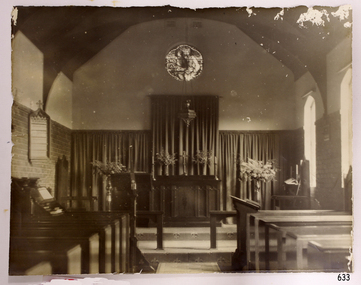
... House in Nelson Place. Around this time, in 1906, the Ladies Harbour Lights Guild was formed in Australia to support and raise funds for the Mission to Seamen organisation in Melbourne. Two of the most significant ladies of the Guild were founding members Ethel Godfrey and Alice Sibthorpe. During the Mission's time at Siddeley Street, Melbourne, the activities of the Guild raised funds for the Mission to Seamen's Chapel at their new, and still current, premises in Flinders Street, Melbourne, opened in 1917. ...House in Nelson Place. Around this time, in 1906, the Ladies Harbour Lights Guild was formed in Australia to support and raise funds for the Mission to Seamen organisation in Melbourne. Two of the most significant ladies of the Guild were founding members Ethel Godfrey and Alice Sibthorpe. During the Mission's time at Siddeley Street, Melbourne, the activities of the Guild raised funds for the Mission to Seamen's Chapel at their new, and still current, premises in Flinders Street, Melbourne, opened in 1917. ...This photograph records the interior of St Nicholas Seamen's Church at 139 Nelson Place, Williamstown, Victoria, which was purchased and furnished around 1943. The furniture and furnishings are now part of the St. Nicholas Seamen's Church collection. HISTORY of the Missions to Seamen: - DETAILED HISTORY of the Missions to Seamen: - The Missions to Seamen is an Anglican (Church of England) charity that has served the world’s seafarers since 1856. It was inspired by the work of Rev. John Ashley, who, 20 years earlier, had pioneered a ministry to seafarers in the Bristol Channel in Great Britain. When Ashley retired, others continued the work, founding the Missions to Seamen. It adopted a Flying Angel as its symbol, inspired by a verse from the Bible in Revelation 14. Today, over 200 world ports have Missions to Seamen centres and chaplains. A Missions to Seamen’s Club warmly welcomes sailors of all colours, creeds and races and provides a wide range of facilities. The Missions to Seamen organisation changed its name to the Mission to Seafarers in 2000, continuing to include Missions to Seamen clubs in Victoria’s cities of Melbourne, Portland, Geelong and Hastings. Flagstaff Hill’s St Nicholas’ Seamen’s Church is named after its namesake from Williamstown, Victoria, which began in 1857. Bishop Perry opened the first Sailors’ Church there, known as ‘Bethel’, on an old hulk floating in Hobson’s Bay, Port of Melbourne. In 1860, a Sailors’ Rest started operating from rented premises in Williamstown. In 1878, the Sailors’ Church moved into an old Wesleyan chapel in Ann Street. By the end of that year, they managed to purchase the building, which they had already refurbished. In 1883, they affiliated with the Victorian Seamen’s Mission. A few years later, in 1906, the building had to be demolished because it was no longer safe. While they raised funds for a new building, the Sailors’ Rest temporarily moved to premises in front of Customs House in Nelson Place. Around this time, in 1906, the Ladies Harbour Lights Guild was formed in Australia to support and raise funds for the Mission to Seamen organisation in Melbourne. Two of the most significant ladies of the Guild were founding members Ethel Godfrey and Alice Sibthorpe. During the Mission's time at Siddeley Street, Melbourne, the activities of the Guild raised funds for the Mission to Seamen's Chapel at their new, and still current, premises in Flinders Street, Melbourne, opened in 1917. The Guild continued its important work until the 1960s. In 1908, the Williamstown Mission had enough money to purchase the former Mascotte skating rink on Thompson Street, Williamstown. In August of that year, they were inaugurated into the Victorian Missions to Seamen. They continued at that venue for a few decades. In 1943, the former ES&A Bank building at 139 Nelson Place, Williamstown, was purchased to become the new Mission to Seamen’s Club. On May 6th, 1944, it was officially opened, described as a ‘distinctive little building’. Funds had previously been raised for the building and furnishing of the chapel at the rear. The chapel was named St Nicholas’ Seamen’s Church, after St Nicholas, fourth-century bishop and patron saint of sailors. Services were held on Wednesdays and Sundays. The church was supported by the Williamstown Lightkeepers’ Auxiliary, newly founded by Mrs Ethel Margaret Musther in 1943, as well as the Harbour Lights Guild and the League of Soldiers’ and Sailors’ Friends. The Williamstown Mission to Seamen’s Church operated until 1966, when large international ships no longer used the Port of Williamstown. The Commonwealth Government then leased the premises. In the formative years of Flagstaff Hill Maritime Village, the Advisory Board decided to include a Missions to Seamen Chapel and Recreation Room in its village. The Missions organisation was a significant feature of ports during the late 1800s and early 1900s, the period that the Village represents. They often erected Missions to house social and worshipful activities for seamen. Flagstaff Hill’s curator, Mr Ken Marshman, approached the Melbourne Board of Management of Missions to Seamen regarding the Williamstown branch. Consequently, the Board permitted the furnishings of the Williamstown chapel to be transferred to Flagstaff Hill Maritime Village. A provision of the transfer was that the Victoria Missions to Seamen be recognised, that the items would remain as a collection, and that the chapel would be called St Nicholas Seamen’s Church and conduct Divine services. The donation was approved on 21st May 1979. Flagstaff Hill's St. Nicholas Seamen's Church: - The idea behind Flagstaff Hill’s Missions to Seamen’s Church was partly driven by the offer of Stained Glass Memorial Windows that originated from the Warrnambool and District Base Hospital, which was undergoing multi-storey expansion in the late 1960s and early 1970s. The hospital’s Manager/Secretary was eager to see the historic window installed in a suitable place. The church, or chapel, was designed by a local architectural draftsman in collaboration with the Flagstaff Hill Planning Board and was constructed by Mr Leon Habel. The designers hoped that the church would be used for formal worship such as weddings, funerals, and multi-denominational special services like war commemorations. The design is inspired by the ‘Missions to Seamen’ buildings in Portland and the Port of Melbourne. The furniture and furnishings were placed as accurately as possible according to photographs of the Williamstown St Nicholas Seamen’s Church and with assistance from local clergy. The Recreation Room was furnished and arranged on advice from experienced members of the Missions to Seamen organisation. A framed document in the building recognises the donor of the furnishings, Victoria Missions to Seamen, and includes the names of some original donors and their donated item/s. The building’s design incorporates local features such as Warrnambool sandstone, which was no longer commercially available but was procured from demolished buildings and uniformly cut to use as a veneer over the stronger Mt. Gambier stone. Also, traditional green American roofing slate was used, sourced from the 1908 local shipwreck “Falls of Halladale” by Flagstaff Hill volunteer divers. The bell tower includes a bell believed to be from a local shipwreck. Additional furnishings were acquired locally, along with several items donated by Warrnambool residents. Light fittings in both rooms were assembled to simulate 19th-century gas light fittings. The stained-glass window at the back of the church is a memorial to Dr Connell, a well-respected member of the Warrnambool community. It was originally installed in 1928 in the main building of Warrnambool Hospital. The St Nicholas’ Seamen’s Church at Flagstaff Hill was officially opened by His Worship the Mayor, Cr. John Lindsay, on Sunday, 11th October 1981. The event included a service of thanksgiving conducted by the Warrnambool Ministers Fraternal. Since then, the Chapel has been the historic venue for many weddings. This photograph is significant through its association with the St Nicholas' Mission to Seamen Church in Williamstown, Melbourne, established in 1857. The building in the photograph is the former English, Scottish and Australian Bank (ES&A bank), also known as the Mission to Seamen. It is listed on the Victorian Heritage Database for having local historic and aesthetic interest. Photograph of St Nicholas Seamen's Church, Williamstown. Sepia photograph. The photograph shows the inside of the Chapel of Mission to Seamen, including organ, pews and other furniture and furnishings. There is a circular stained glass window high on the back wall depicting a sailor at the helm of a ship and a man standing behind him and pointing the way - "Christ Showing The Helmsman The Way". A Sanctuary Light is suspended from the ceiling. The Sanctuary chars are visible. This shows the St Nicholas Seamen's Church in Williamstown, the furnishings and furniture of which is now part of the St Nicholas Seamen's Church Collection’.flagstaff hill, warrnambool, shipwrecked-coast, flagstaff-hill, flagstaff-hill-maritime-museum, maritime-museum, shipwreck-coast, flagstaff-hill-maritime-village, st nicholas mission to seamen's church williamstown, mission to seamen williamstown, mission to seamen victoria, st nicholas mission to seamen, chapel window, christ showing the helmsman the way, stained glass window, st nicholas seamen's church, religion, religious service, sailor's rest, ladies harbour light guild -
 Flagstaff Hill Maritime Museum and Village
Equipment - Block, Tangyes engineering, Early 20th century
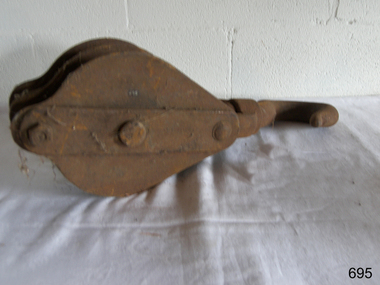
... In 1884, a branch with showrooms, offices, and a warehouse was opened in Melbourne at Cornwall House, Collins Street West. ...In 1884, a branch with showrooms, offices, and a warehouse was opened in Melbourne at Cornwall House, Collins Street West. ...This metal block may have been used as part of a boat or ship's rigging or winch. The becket is the loop or ring where a shackle could be attached to use as a pulley. The two-sheaved block has a mechanical advantage over a single-sheave block, using less power to lift a load. The block was made by Tangyes, established in Birmingham, UK, in 1857, and renowned for producing high-quality, reliable machines, equipment, and tools in the late 19th and early 20th centuries. Richard Tangye (1833–1906) and four of his brothers—James, Joseph, Edward, and George—were the sons of Joseph Tangye, a Quaker Cornish miner. In 1857, they founded the engineering firm Richard Tangye & Brothers in Birmingham, UK. In 1860, the firm became Tangye Brothers and moved to Cornwall Works in Birmingham. The business encouraged inventors to join the company and develop their patents there, as happened with Weston’s differential pulley block, invented by the Englishman Thomas Aldridge Weston in 1854. Tangye bought the patent in 1858, giving the firm the sole right to manufacture it. The design received a medal for “original application, practical utility and success” at the 1862 International Exhibition in London. Also in 1858, the Tangye firm was commissioned by Brunel’s shipping company to manufacture hydraulic lifting jacks, or rams, to launch the steamship SS Great Eastern. The success of this project brought favourable attention to the firm, and it became involved in other notable projects, including the erection of Cleopatra’s Needle in London in 1878 and work on the Forth Road Bridge in Scotland. The firm underwent several name changes over the years, including James Tangye and Brothers (1857), Tangye Brothers and Price (1859), Tangye Brothers (1860), Tangye Brothers & Holman (1876), Tangye Brothers (by 1878), Tangye Ltd. (1881), and then simply Tangye. Its machinery and equipment were exported worldwide. In 1884, a branch with showrooms, offices, and a warehouse was opened in Melbourne at Cornwall House, Collins Street West. The firm was well known for producing high-quality machinery for agriculture and industry. Even today, new Tangye machinery is available for a subsidiary of Allspeeds. An extensive account of the firm’s history, names, inventions, and further references is available in Grace’s Guide, which also includes references to and diagrams of the Tangye horizontal steam engine. The block is significant for its connection to the renowned and innovative Tangye machine makers, respected for their high quality and standards. The block's maker,, Tangyes, also manufactured an 1880s steam engine, sold by a Melbourne merchant, and locally significant for its use in a late-19th century cheese factory. The block also represents the many blocks used in many industries, including the marine concerns, for rigging and lifting. Flagstaff Hill has a wide variety of these simple but very important pieces of equipment.Becket block: a metal block with two sheaves, a hook, a becket attachment point, and straps. Inscription embossed. Made by Tangyes."TANGYES"warrnambool, flagstaff hill maritime museum and village, maritime museum, maritime village, great ocean road, shipwreck coast, block, metal block, two sheave block, marine technology, rigging, tangye, ship rigging, block with hook and becket, becket block, sailing block, cargo block, tangyes block, vintage, nautical pulley, rigging equipment, pulley system, functional machine, machine, lifting equipment, marine equipment, richard tangye & brothers, james tangye and brothers, tangye brothers and price, tangye brothers, tangye brothers & holman, tangyes ltd., cornwall works -
 Flagstaff Hill Maritime Museum and Village
Functional object - Standard Measure, James McEwan & Co, 1860s-1900s
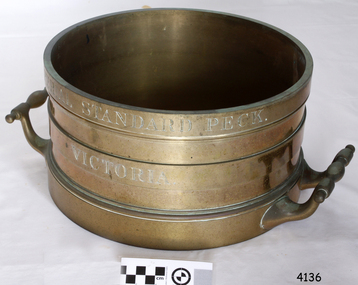
... house and private offices. Wholesale warehouses adjoined these premises at 4, 6 and 10 Little Collins Street, West. This company provided and sold a large and varied amount of imported goods into the colony; agricultural equipment, building materials, mining items, steam engines, tools of all types and marble fireplaces. The company grew to employ over 150 people in Melbourne and opened...house and private offices. Wholesale warehouses adjoined these premises at 4, 6 and 10 Little Collins Street, West. This company provided and sold a large and varied amount of imported goods into the colony; agricultural equipment, building materials, mining items, steam engines, tools of all types and marble fireplaces. The company grew to employ over 150 people in Melbourne and opened ...This container is a pre-Decimal, Imperial Standard Peck, part of a three-piece set of Standard measures used in Victoria from around 1900 to 1940. The measures were made in Melbourne by J. McEwan & Co. These three measures were likely used by the local Melbourne authority that monitored weights and measures in the mid to late 19th century. . An Imperial Bushel was equal to 8 gallons, or 36.36872 litres . An Imperial Peck equals a quarter of a Bushel, or 9.09 litres Standards for weights and measures began in Victoria when the Melbourne Observatory received primary sets of Imperial Standard Weights and Measures from Britain. These were tested against the then British Imperial Standards to measure length, weight and currency. Administrative bodies in the Colony of Australia could then compare their weights and measures against these British Primary Standards and adjust their Measures accordingly, to maintain the Standards. The Weights and Measures Act of 1862 was passed in Victoria, and local inspectors were established throughout the colony. By the 1870s, local councils and shires in Victoria held a set of Standards used to test scales, weights, and measures used by manufacturers, wholesalers, and retailers. Every ten years, the councils’ Standards needed to be rechecked against the Victorian Standards. In the 19th Century, the Victorian Customs Department inspected and maintained the Standards. In 1901, the Customs Department was transferred to the Federal Government, but the Weights and Measures authority remained with the Victorian Government and relocated to the Melbourne Observatory. In 1904, the Standard weights and measures, and testing equipment, were installed in the room of a new building erected at the south end of the Great Melbourne Telescope House. The room became known as the Whirling Room, due to its large whirling apparatus that tested air meters. When the Melbourne Observatory closed in 1944, the Weights and Measures Branch was formed to continue maintaining the Standards. On February 14th, 1966, Australia began its conversion to metric measures and currency, and a new set of Standard Measures was introduced; the conversion took place in stages. The Weights and Measures Branch remained at the Observatory site until 1995. James McEwan & Co.: - The maker of this set of Standard Measures was James McEwan. His Melbourne business was established in 1852 and sold retail furniture and wholesale ironmongery. The firm’s warehouses were situated at the intersection of 81-83 Elizabeth and Little Collins Streets. Shortly afterwards, the firm partnered with William Kerr Thomson and Samuel Renwick. When McEwan died in 1868, his partners carried on and expanded the business under his name, J McEwan. The business was expanded to provide a retail shop, counting-house and private offices. Wholesale warehouses adjoined these premises at 4, 6 and 10 Little Collins Street, West. This company provided and sold a large and varied amount of imported goods into the colony; agricultural equipment, building materials, mining items, steam engines, tools of all types and marble fireplaces. The company grew to employ over 150 people in Melbourne and opened offices at 27 Lombard St, London, as well as in New Zealand and Fiji. It also serviced the Mauritius islands and the Pacific area with its steamship, the Suva, and a brig, the Shannon. The set of Imperial Standard Measures is an example of a bronze measure container made specifically for J. McEwan & Co. Today, it helps us to understand how imperial weights and measures were used, and how a standard of measurement for merchants was developed in the Australian colonies based on the Imperial British measurement system. The container has social significance as an item retailed by J McEwan, and used by Victoria’s authorities legally responsible for ensuring that dry goods sold in Victoria by wholesalers and retailers are correct. Imperial Standard Measure: a container to measure the volume of a Peck. It is part of a set of three precision measures - a Peck, a Half Bushel and a Bushel – used by government authorities in Victoria. The cast brass cylinder has straight sides and a flat base, and two handles are attached near the base by two posts on each handle. The wall inside is straight, and outside has grooves and horizontal bands. Inscriptions are engraved on the outside. The Measures were made for the retailer, J. McEwan & Co., London and Melbourne. Engraved on side: "IMPERIAL STANDARD PECK. / VICTORIA."flagstaff hill, flagstaff hill maritime museum and village, warrnambool, maritime museum, maritime village, great ocean road, shipwreck coast, weights and measurements, science, james mcewan & co., precision instrument, technology, melbourne observatory, british imperial standards, standard weights & measures, volume measure, dry measure, customs, commerce, victorian standard measure, pre-decimal measure, imperial standard, imperial bushel, imperial half bushel, imperial peck, peck measure, bronze container, brass container, cast container -
 Flagstaff Hill Maritime Museum and Village
Functional object - Standard Measure, James McEwan & Co, 1860s-1900s
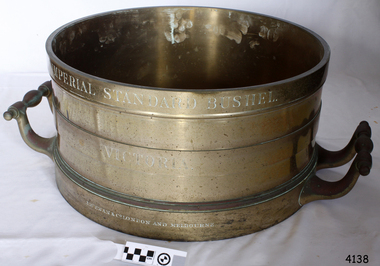
... house and private offices. Wholesale warehouses adjoined these premises at 4, 6 and 10 Little Collins Street, West. This company provided and sold a large and varied amount of imported goods into the colony; agricultural equipment, building materials, mining items, steam engines, tools of all types and marble fireplaces. The company grew to employ over 150 people in Melbourne and opened...house and private offices. Wholesale warehouses adjoined these premises at 4, 6 and 10 Little Collins Street, West. This company provided and sold a large and varied amount of imported goods into the colony; agricultural equipment, building materials, mining items, steam engines, tools of all types and marble fireplaces. The company grew to employ over 150 people in Melbourne and opened ...This container is a pre-Decimal, Imperial Standard Bushel, part of a three-piece set of Standard measures used in Victoria from around 1900 to 1940. The measures were made in Melbourne by J. McEwan & Co. These three measures were likely used by the local Melbourne authority that monitored weights and measures in the mid to late 19th century. . An Imperial Bushel was equal to 8 gallons, or 36.36872 litres . An Imperial Peck equals a quarter of a Bushel, or 9.09 litres Standards for weights and measures began in Victoria when the Melbourne Observatory received primary sets of Imperial Standard Weights and Measures from Britain. These were tested against the then British Imperial Standards to measure length, weight and currency. Administrative bodies in the Colony of Australia could then compare their weights and measures against these British Primary Standards and adjust their Measures accordingly, to maintain the Standards. The Weights and Measures Act of 1862 was passed in Victoria, and local inspectors were established throughout the colony. By the 1870s, local councils and shires in Victoria held a set of Standards used to test scales, weights, and measures used by manufacturers, wholesalers, and retailers. Every ten years, the councils’ Standards needed to be rechecked against the Victorian Standards. In the 19th Century, the Victorian Customs Department inspected and maintained the Standards. In 1901, the Customs Department was transferred to the Federal Government, but the Weights and Measures authority remained with the Victorian Government and relocated to the Melbourne Observatory. In 1904, the Standard weights and measures, and testing equipment, were installed in the room of a new building erected at the south end of the Great Melbourne Telescope House. The room became known as the Whirling Room, due to its large whirling apparatus that tested air meters. When the Melbourne Observatory closed in 1944, the Weights and Measures Branch was formed to continue maintaining the Standards. On February 14th, 1966, Australia began its conversion to metric measures and currency, and a new set of Standard Measures was introduced; the conversion took place in stages. The Weights and Measures Branch remained at the Observatory site until 1995. James McEwan & Co.: - The maker of this set of Standard Measures was James McEwan. His Melbourne business was established in 1852 and sold retail furniture and wholesale ironmongery. The firm’s warehouses were situated at the intersection of 81-83 Elizabeth and Little Collins Streets. Shortly afterwards, the firm partnered with William Kerr Thomson and Samuel Renwick. When McEwan died in 1868, his partners carried on and expanded the business under his name, J McEwan. The business was expanded to provide a retail shop, counting-house and private offices. Wholesale warehouses adjoined these premises at 4, 6 and 10 Little Collins Street, West. This company provided and sold a large and varied amount of imported goods into the colony; agricultural equipment, building materials, mining items, steam engines, tools of all types and marble fireplaces. The company grew to employ over 150 people in Melbourne and opened offices at 27 Lombard St, London, as well as in New Zealand and Fiji. It also serviced the Mauritius islands and the Pacific area with its steamship, the Suva, and a brig, the ShannonThe set of Imperial Standard Measures is an example of a bronze measure container made specifically for J. McEwan & Co. Today, it helps us to understand how imperial weights and measures were used, and how a standard of measurement for merchants was developed in the Australian colonies based on the Imperial British measurement system. The container has social significance as an item retailed by J McEwan, and used by Victoria’s authorities legally responsible for ensuring that dry goods sold in Victoria by wholesalers and retailers are correct.Imperial Standard Measure: a container to measure the volume of a Busel. It is part of a set of three precision measures - a Peck, a Half Bushel and a Bushel – used by government authorities in Victoria. The cast brass cylinder has straight sides and a flat base, and two handles are attached near the base by two posts on each handle. The wall inside is straight, and outside has grooves and horizontal bands. Inscriptions are engraved on the outside. The Measures were made for the retailer, J. McEwan & Co., London and Melbourne.Engraved on side: "IMPERIAL STANDARD BUSHEL. / VICTORIA ./ J. MCEWAN & CO. LONDON AND MELBOURNE."flagstaff hill, flagstaff hill maritime museum and village, warrnambool, maritime museum, maritime village, great ocean road, shipwreck coast, weights and measurements, science, james mcewan & co., precision instrument, technology, melbourne observatory, british imperial standards, standard weights & measures, volume measure, dry measure, customs, commerce, victorian standard measure, pre-decimal measure, imperial standard, imperial bushel, peck measure, bronze container, brass container, cast container -
 Flagstaff Hill Maritime Museum and Village
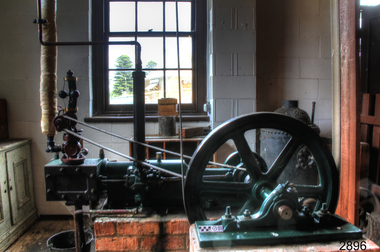
Machine - Steam Engine, Tangyes engineering, Mid-1880s
... In 1884, a branch with showrooms, offices, and a warehouse was opened in Melbourne at Cornwall House, Collins Street West. ...In 1884, a branch with showrooms, offices, and a warehouse was opened in Melbourne at Cornwall House, Collins Street West. ...This Tangye B-size, single-cylinder, horizontal steam engine was likely manufactured in England around the mid-1880s. It was distributed by Melbourne machinery merchants Cameron & Sutherland, which also operated in Bendigo and Ballarat. A local cheese maker once used the engine to drive factory equipment. It was later donated to the Warrnambool Technical School, which then donated it to Flagstaff Hill to add to its historical steam engine collection. Between its manufacture and its donation to Flagstaff Hill, the governor had been replaced by the current Pickering governor. This engine design was very popular in the late 19th and early 20th centuries. When connected and powered up, the engine could drive an overhead line shaft via a flat belt off its flywheel. The line shaft would then drive the machinery via flat belts. It could drive virtually any type of machinery, such as water and sewerage pumps, mine elevators, winches, cranes, metal forges, air blowers, and marine machinery. This engine features a mechanical governor, which controls the speed of the engine regardless of whether it is under load. It also has a water pump built into the valve rod, which is used to supply the boiler with water. Steam enters the cylinder via a slide valve and applies pressure to the piston; it is like a modern internal combustion engine, but in the case of the steam engine, the pressure is exerted in turn on either side of the piston. In other words, the connecting rod is pushed by steam via the piston and piston rod and then pulled back again by steam pushing on the opposite side of the piston. Thus, power is exerted almost continuously, except at the end of each piston stroke, when it reverses direction. In the 1880s, many local butter and cheese manufacturers installed Tangye steam engines to power their machinery. A comprehensive article in the Gippsland Mercury in September 1889 extolled the magnificence of the Farnham Butter Factory in Dennington, Warrnambool, and described how one Tangye engine was used to drive several machines in the cheese- and butter-making processes. A report in the Warragul Guardian in December 1890 notes that the newly opened Warrnambool Butter Factory used a Tangye steam engine to pump water from a 60-foot well. Tangye: Richard Tangye (1833–1906) and four of his brothers—James, Joseph, Edward, and George—were the sons of Joseph Tangye, a Quaker Cornish miner. In 1857, they founded the engineering firm Richard Tangye & Brothers in Birmingham, UK. In 1860, the firm became Tangye Brothers and moved to Cornwall Works in Birmingham. The business encouraged inventors to join the company and develop their patents there, as happened with Weston’s differential pulley block, invented by the Englishman Thomas Aldridge Weston in 1854. Tangye bought the patent in 1858, giving the firm the sole right to manufacture it. The design received a medal for “original application, practical utility and success” at the 1862 International Exhibition in London. Also in 1858, the Tangye firm was commissioned by Brunel’s shipping company to manufacture hydraulic lifting jacks, or rams, to launch the steamship SS Great Eastern. The success of this project brought favourable attention to the firm, and it became involved in other notable projects, including the erection of Cleopatra’s Needle in London in 1878 and work on the Forth Road Bridge in Scotland. The firm underwent several name changes over the years, including James Tangye and Brothers (1857), Tangye Brothers and Price (1859), Tangye Brothers (1860), Tangye Brothers & Holman (1876), Tangye Brothers (by 1878), Tangye Ltd. (1881), and then simply Tangye. Its machinery and equipment were exported worldwide. In 1884, a branch with showrooms, offices, and a warehouse was opened in Melbourne at Cornwall House, Collins Street West. The firm was well known for producing high-quality machinery for agriculture and industry. Even today, new Tangye machinery is available for a subsidiary of Allspeeds. An extensive account of the firm’s history, names, inventions, and further references is available in Grace’s Guide, which also includes references to and diagrams of the Tangye horizontal steam engine. The horizontal steam engine was made by the well-known engineering firm Tangye, known for its high quality of manufacture. It was an important development in machinery because it helped improve productivity. Engines of this type are still used in some parts of the world today. This engine is a good example of a late 19th-century steam engine used in industry and agriculture and adapted for many different purposes. It is also important locally because it was connected to a local cheese making business and part of the thriving western district dairy industry. It may have been one of the Tangyes engines used at the Farnham butter factory or the Warrnambool Butter Factory, which was reported to be one of the most important in the Colony. It is also connected to the Warrnambool Technical School, established in 1968. Steam engine: stationary Tangye Size B, single-cylinder, horizontal Mill type steam engine. It has a 4-inch diameter cylinder with an 8-inch stroke. The body is painted green, and the Pickering governor is red. It was manufactured in Birmingham, England, in accordance with Tangye's Patent 238930, and distributed by Cameron and Sunderland, Melbourne, in the mid-1880s. TANGEYS PATENT BIRMINGHAM B SIZE 238930 CAMERON & SUTHERLAND MELBOURNE THE PICKERING PORTLAND . GOVERNOR . CONN. U.S.A.flagstaff hill, warrnambool, maritime village, maritime museum, flagstaff hill maritime museum and village, shipwreck coast, great ocean road, machine, invention, engine, steam, steam engine, horizontal steam engine, tangyes horizontal steam engine, stationary steam engine, single cylinder steam engine, manufacturing, farming, pumps, lifting equipment, engines, machine tools, hydraulic rams, hydraulic pumps, steam pumps, differential pulleys, mill type steam engine, 4 inch cylinder, weston’s differential pulley, thomas aldridge weston, 1862 international exhibition in london, brunel, ss great eastern, cleopatra’s needle, forth road bridge, cornwall house, collins street melbourne, agricultural machinery, industrial machinery, allspeeds, dairy, pump, richard tangye & brothers, james tangye and brothers, tangye brothers and price, tangye brothers, tangye brothers & holman, tangyes ltd., tangye, richard tangye, james tangye, joseph tangye, edward tangye, george tangye, cornwall works, birmingham, pickering governor, pickering portland connecticut usa, 19th century, dairy plant, steam power, tangye's patent 238930, tangye b size engine, cameron & sutherland, machine merchants, 1880s, mid-1880s, cheese manufacturer, butter manufacturer, diary industry, warrnambool technical school, belt driven machinery, agriculture, mechanical governor, farnham butter factory, warrnambool butter factory -
 Federation University Historical Collection
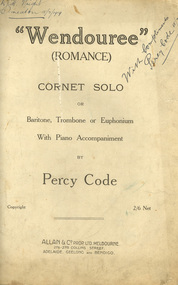
Booklet - Sheet Music, Allan & Company Pty Ltd, "Wendouree", Romance by Percy Code, 1919
... Open Cornet Championship using this music, and won the gold medal for the highest mark in the British Colonies. Percy Code was born in Melbourne on 03 July 1888. He started learning the violin and piano at the age of eight. Three years later his father, Edward, started tutoring him on the cornet. His first competition was in October 1902 in Ballarat's South Street Competitions. Percy Code was Musical Director of Ballarat City Brass Band from 1913 until 1921. He was Frank Wright's teacher. Code apparently lived in a large house...Open Cornet Championship using this music, and won the gold medal for the highest mark in the British Colonies. Percy Code was born in Melbourne on 03 July 1888. He started learning the violin and piano at the age of eight. Three years later his father, Edward, started tutoring him on the cornet. His first competition was in October 1902 in Ballarat's South Street Competitions. Percy Code was Musical Director of Ballarat City Brass Band from 1913 until 1921. He was Frank Wright's teacher. Code apparently lived in a large house ...This music was used by Frank Wright who had been tutored by Percy Code. Frank Wright won the Australian Open Cornet Championship using this music, and won the gold medal for the highest mark in the British Colonies. Percy Code was born in Melbourne on 03 July 1888. He started learning the violin and piano at the age of eight. Three years later his father, Edward, started tutoring him on the cornet. His first competition was in October 1902 in Ballarat's South Street Competitions. Percy Code was Musical Director of Ballarat City Brass Band from 1913 until 1921. He was Frank Wright's teacher. Code apparently lived in a large house just west of where St Peter's church (Ballarat) now stands. Percy Code toured the world as principal cornet with the 'Besses o' th' Barn Band.' He returned to Australia in 1912. Frank Wright at one stage rode his pushbike from Smeaton to Ballarat for lessons. Leaving Australia for America in March 1921 Percy Code obtained an appointment as trumpet soloist for the 70 piece San Francisco Symphony Orchestra. He returned home two years later and became bandmaster to the Prahran City Band in 1925. From 1938, as part of Australia's Sesqui Centenary celebrations, Percy Code conducted the Sydney Symphony Orchestra for the ABC orchestral concerts in Sydney Town Hall. His career with the ABC came to an end in late 1951 due to poor health. Percy Code died on 17 October 1953. From 'Legend in Brass' with additions from Bob Pattie of the Ballarat Brass Band.11071.1 Four cream pages containing handwritten title page in front, two sheet music pages inside and blank back cover. 11071.2 Eight cream pages containing front page typed title with handwritten text at top, Six pages of sheet music cream pages, with parts for piano and cornet, with black printed notes. A photograph of the composer Mr Percy Code is glued into the first page at the top left hand corner. The back cover page has advertisements for four music albums from Allan & Co. Prop. Ltd..1) Front page handwritten in blue pen and pencil. Hand written notations in pencil for cornet throughout sheet music pages. Frank Wright Smeaton 15 July 1919 in top right hand corner; Champion Bb cornet solo South Street 1919 in top left hand corner. Under title on front page: Handwritten notes in pencil giving results of competition and judge's comments. 2) Frank H. Wright Smeaton 15/7/1919 handwritten in top left hand corner. "With Compliments Percy Code 15/7/1919 written diagonally in blue pen in at right hand top.cornet, frank wright, allan & co., allans music, ballarat, south street, percy code, code, wright, sheet music, "wendouree", (romance), wendouree, romance, wendouree -
 Mission to Seafarers Victoria
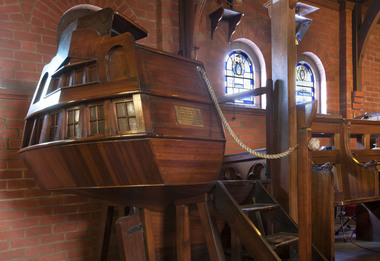
Furniture - Pulpit, Rodney Howard Alsop, 1909
... Melbourne, Siddeley St. It is located in the Chapel of Saint Peter of the Mission to Seafarers 717 Flinders St. complex since 1917 (State Heritage listed (H1496). This complex was designed by Walter Richmond Butler in 1916, and officially opened on 11 September 1917, a day '...of unusually kind weather', by the Governor of Victoria, the Honourable Sir Arthur Stanley. According to a later article published in 1950: The pulpit is a model, built to scale, of the stern of an old ship of the line in Lord Nelson's day. This pulpit is significant as it is housed ...In 1909, assistant Chaplain Rev. Haire presented the Mission with an 'uncommonly artistic pulpit' in memory of his mother. A plaque in memory of Jane King Haire can be found on the side next to the steps. The dedication was performed by the Archbishop of Melbourne on the 26th January (date engraves on the plaque) This pulpit was designed by Melbourne architect Rodney Howard Alsop (1881-1932) and manufactured by William John Dalziel (furniture manufacturer). It was initially used in the first Mission in Central Melbourne, Siddeley St. It is located in the Chapel of Saint Peter of the Mission to Seafarers 717 Flinders St. complex since 1917 (State Heritage listed (H1496). This complex was designed by Walter Richmond Butler in 1916, and officially opened on 11 September 1917, a day '...of unusually kind weather', by the Governor of Victoria, the Honourable Sir Arthur Stanley. According to a later article published in 1950: The pulpit is a model, built to scale, of the stern of an old ship of the line in Lord Nelson's day. This pulpit is significant as it is housed in The Memorial Chapel of Saint Peter forming part of the State Heritage listed Mission to Seafarers Victoria complex. It was built in Melbourne of Australian timbers, and is one of only two known maritime inspired pulpits, both associated with Missions to Seamen of the early 20th C. the other is held in the ANMM Collection see link. Their statement of significance is worth quoting in part as it applies equally to this pulpit "...an extremely rare and unique example of such pulpits. It is highly significant as a wonderfully preserved example of a time when religion was preached to sailors for their spiritual guidance and temperance..." Rodney Howard Alsop was an important Melbourne architect of the Arts and Crafts movement. John William Dalziel had sailed from Liverpool to Melbourne in 1862. Seventeen years later Penman and Dalziel founded the business in Lonsdale Street West, and won recognition at the Indian and Colonial Exhibition in London in 1886. Penman and Dalziel were identified in 1937 as one of Melbourne’s early ‘skilled craftsmen’ and ‘leading names’ in the manufacture of fine furniture. He died in February 1918 in a railway accident.Timber pulpit built in the form of a ship's stern including a timber step ladder for access, a timber keel and rudder, a rope fixed from the pulpit to a post mounted to the floor, and a dedication plaque on the side of the pulpit. The pulpit sits on timber legs. It's likely to be the original rope: traditionally made coir rope with twisted fibres, covered with canvas supported by a thread. At lower end the rope is secured by a monkey fist know and at the top by a turk head knot.Inside the pulpit (right) is the cardboard label with the maker details: " On an attached plaque see 0678 To the greater glory of God and in ever loving memory of Jane King Haire. This pulpit is erected by her son. Blessed are the pure in heart. For they shall see God. St. Matt. V.8. 26.1.09mission, seafarers, melbourne, victoria, chapel, saint peter, pulpit, australian timber, stern, walter richmond butler, australian maritime history, reverend w.f. haire, rodney howard alsop (1881-1932), wright's lane, william john dalziel, gifts-1917, heritage listed -
 Ballarat and Queen's Anglican Grammar School
Badge - Physical Culture Badge, J. King
... Melbourne. the company was based in Castlereagh St, Sydney from 1923-1982. Zone competitions were introduced and State finals held at the Grace Bros Auditorium. The Senior Finals were held at the Sydney Opera House from 1974 when it opened...Melbourne. the company was based in Castlereagh St, Sydney from 1923-1982. Zone competitions were introduced and State finals held at the Grace Bros Auditorium. The Senior Finals were held at the Sydney Opera House from 1974 when it opened ...The company began in 1892 as a medical gymnasium in Hobart started by Hans Christian Bjelke-Petersen. Sir Joh Bjelke Petersen was a nephew but had no connection with the company. The success of the gymnasium developed and physical culture was taught in Sydney and Melbourne. the company was based in Castlereagh St, Sydney from 1923-1982. Zone competitions were introduced and State finals held at the Grace Bros Auditorium. The Senior Finals were held at the Sydney Opera House from 1974 when it opened. See Bjelke-Petersen School of Physical Culture www.physicalculture.com.au Silver stamped badge enamelled with blue on the outside and white within with a figure at the centre. rings on centre top. Motto printed on badgeAdhesive label originally with badge handwritten "MY PHYSICAL CULTURE BADGE FROM BJELKE PETERSON [sic]" Bjelke Petersen Bros School Physical Culture Mens sana in corpore sanaphysical-culture, badge, ballarat-grammar, bqags -
Marysville & District Historical Society
THE TRIANGLE NEWS-VOL 41 NO 22-JUNE 13 2014
... open mic...marysville & triangle community men's shed...advertisements...disappointment at mountain of dumped waste...residential & rural real estate...marysville triangle real estate...alexandra library...buxton primary school trivia night success...marysville midweek netball...el kanah eat in eat out menu...marysville preschool centre...long day care & kindergarten...black spur inn kitchen assistant...2014 racv great race victoria bike ride...2014 melbourne international comedy festival in marysville...open house...marysville victoria australia hillary challenge state championship marysville camp marysville what's on when in june 2014 seasonal influenza vaccine available the committee of management of the gallipoli park precinct marysville community market e creative triangle buxton progress assocn comedy festival after party at crossways church notices marysville golf report new marysville golf & bowls clubhouse blumes fashions christ church marysville mayor's chair by cr margaret rae councillor comment by cr john walsh koriella ward black spur inn open mic marysville & triangle community men's shed advertisements disappointment at mountain of dumped waste residential & rural real estate marysville triangle real estate alexandra library buxton primary school trivia night success marysville midweek netball el kanah eat in eat out menu marysville preschool centre long day care & kindergarten black spur inn kitchen assistant 2014 racv great race victoria bike ride 2014 melbourne international comedy festival in marysville open house day high wood health retreat THE TRIANGLE NEWS-VOL 41 NO 22-JUNE 13 2014 ...marysville, victoria, australia, hillary challenge state championship, marysville camp marysville, what's on when in june, 2014 seasonal influenza vaccine available, the committee of management of the gallipoli park precinct, marysville community market, e, creative triangle, buxton progress assocn, comedy festival after party at crossways, church notices, marysville golf report, new marysville golf & bowls clubhouse, blumes fashions, christ church marysville, mayor's chair by cr margaret rae, councillor comment by cr john walsh koriella ward, black spur inn open mic, marysville & triangle community men's shed, advertisements, disappointment at mountain of dumped waste, residential & rural real estate, marysville triangle real estate, alexandra library, buxton primary school trivia night success, marysville midweek netball, el kanah eat in eat out menu, marysville preschool centre, long day care & kindergarten, black spur inn kitchen assistant, 2014 racv great race victoria bike ride, 2014 melbourne international comedy festival in marysville, open house day high wood health retreat
