
Showing 9 items matching "operating theatre techniques"
-
![First page of 'Responsiblities of circulating (scout) nurse' Alfred Hospital [ca.1960's]](/media/collectors/50187a8f023fd7201471f198/items/6a2384ecfc7af4b751bf343b/item-media/6a238598fc7af4b751bf47b7/item-fit-380x285.jpg?cb=6) Alfred Hospital Nurses League - Nursing History Collection
Alfred Hospital Nurses League - Nursing History CollectionDocument - Resposibility document, Alfred Hospital, Responsiblities of circulating (scout) nurse, [ca.1960's]
... ...operating theatre techniques...Notes given to student nurses at the Alfred Hospial when they worked in the operating theatres, providing expectations of the scout nurse, and also the anaesthetic nurse, as sometimes the roles were combined Insight into operating theatre practices in the early 1960's Operating room nursing-History operating theatres operating theatre techniques nursing Holes where a staple has been removed at top left. ...Notes given to student nurses at the Alfred Hospial when they worked in the operating theatres, providing expectations of the scout nurse, and also the anaesthetic nurse, as sometimes the roles were combinedInsight into operating theatre practices in the early 1960'sBlack print on off white paper. Pages printed on one side only. Staple has been removedHoles where a staple has been removed at top left. 'NR McKinnon' handwritten [blue ink] at top right of first pageoperating room nursing-history, operating theatres, operating theatre techniques, nursing -
 Alfred Hospital Nurses League - Nursing History Collection
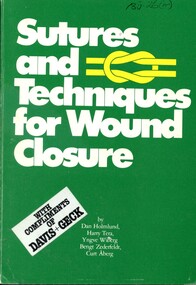
Book - Illustrated textbook, Dan Holmund et al, Sutures and techniques for wound closure, 1978
... ...operating theatre techniques...Authors of book are Swedish, first published in Swedish in 1976 Insight into available suture materials in the 1970's Sutures Suture material suture needles surgical wounds operating theatre techniques This book provides comprehensive guidence on suture materials, knot tying and various suturing techniques for surgical wound closure On the front cover there is a rectangular white sticker on which is printed 'WITH/ COMPLIMENTS/ OF/ DAVIS+GLICK'. ...This book provides comprehensive guidence on suture materials, knot tying and various suturing techniques for surgical wound closureIllustrated book with green cover. On front cover white print details title and authors. There is also an illustration of a reef knot [yellow ink] This book provides comprehensive guidence on suture materials, knot tying and various suturing techniques for surgical wound closuresutures, suture material, suture needles, surgical wounds, operating theatre techniques -
 Australian Commando Association - Victoria
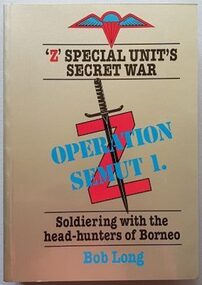
Book, Z Special Units' Secret War- Operations SEMUT 1, 1989
... operating on Borneo and the islands of the former Netherlands East Indies. The unit carried out a total of 81 covert operations in the South West Pacific theatre, with parties inserted by parachute or submarine to provide intelligence and conduct guerrilla warfare. The best known of these missions were Operation Jaywick and Operation RIMAU, both of which involved raids on Japanese shipping in Singapore Harbour; the latter of which resulted in the deaths of twenty-three commandos either in action or by execution after capture. Although the unit was disbanded after the war, many of the training techniques...operating on Borneo and the islands of the former Netherlands East Indies. The unit carried out a total of 81 covert operations in the South West Pacific theatre, with parties inserted by parachute or submarine to provide intelligence and conduct guerrilla warfare. The best known of these missions were Operation Jaywick and Operation RIMAU, both of which involved raids on Japanese shipping in Singapore Harbour; the latter of which resulted in the deaths of twenty-three commandos either in action or by execution after capture. Although the unit was disbanded after the war, many of the training techniques ...An account of the operations of The Allied Intelligence Bureau (AIB) better known as ‘Z’ Special Unit. Now a scarce and highly sought after title. The author’s personal experiences with Australian Special Forces (Services Reconnaissance Department) which involved guerrilla soldiering with the head-hunters of Japanese held Borneo during World War 2. Z Special Unit an administrative support unit of (also known as Special Operations Australia (SOA) or the Services Reconnaissance Department (SRD)) was a joint Allied special forces unit formed during the Second World War to operate behind Japanese lines in South East Asia. Predominantly Australian, SRD was a specialist reconnaissance and sabotage unit that included British, Dutch, New Zealand, Timorese and Indonesian members, predominantly operating on Borneo and the islands of the former Netherlands East Indies. The unit carried out a total of 81 covert operations in the South West Pacific theatre, with parties inserted by parachute or submarine to provide intelligence and conduct guerrilla warfare. The best known of these missions were Operation Jaywick and Operation RIMAU, both of which involved raids on Japanese shipping in Singapore Harbour; the latter of which resulted in the deaths of twenty-three commandos either in action or by execution after capture. Although the unit was disbanded after the war, many of the training techniques and operational procedures employed were later used during the formation of other Australian Army special forces units and they remain a model for guerrilla operations to this day.Hard Cover with Dust Jacket – 608 pagesInscribed by author-Bob Long AK223 SEMUT 1 Borneo 1945 -
 Australian Commando Association - Victoria
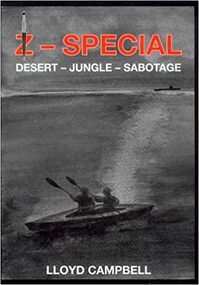
Book, Z Special- Desert-Jungle- Sabotage
... operating on Borneo and the islands of the former Netherlands East Indies. The unit carried out a total of 81 covert operations in the South West Pacific theatre, with parties inserted by parachute or submarine to provide intelligence and conduct guerrilla warfare. The best known of these missions were Operation Jaywick and Operation Rimau, both of which involved raids on Japanese shipping in Singapore Harbour; the latter of which resulted in the deaths of 23 commandos either in action or by execution after capture. Although the unit was disbanded after the war, many of the training techniques...operating on Borneo and the islands of the former Netherlands East Indies. The unit carried out a total of 81 covert operations in the South West Pacific theatre, with parties inserted by parachute or submarine to provide intelligence and conduct guerrilla warfare. The best known of these missions were Operation Jaywick and Operation Rimau, both of which involved raids on Japanese shipping in Singapore Harbour; the latter of which resulted in the deaths of 23 commandos either in action or by execution after capture. Although the unit was disbanded after the war, many of the training techniques ...When Lloyd Campbell joined the AIF, he was underage and went to the Middle East with 2/17 Battalion. Later in New Guinea he made a major career change and volunteered for an unknown unit and special operations. What he had joined was the SRD – known as Z-Special Unit. Z Special Unit—also known as Special Operations Executive (SOE), Special Operations Australia (SOA) or the Services Reconnaissance Department (SRD)—was a joint Allied special forces unit formed during the Second World War to operate behind Japanese lines in South East Asia. Predominantly Australian, Z Special Unit was a specialist reconnaissance and sabotage unit that included British, Dutch, New Zealand, Timorese and Indonesian members, predominantly operating on Borneo and the islands of the former Netherlands East Indies. The unit carried out a total of 81 covert operations in the South West Pacific theatre, with parties inserted by parachute or submarine to provide intelligence and conduct guerrilla warfare. The best known of these missions were Operation Jaywick and Operation Rimau, both of which involved raids on Japanese shipping in Singapore Harbour; the latter of which resulted in the deaths of 23 commandos either in action or by execution after capture. Although the unit was disbanded after the war, many of the training techniques and operational procedures employed were later used during the formation of other Australian Army special forces units and they remain a model for guerrilla operations to this day. pp. 274, illusts, maps ww2, the australian special operations, special forces, z special unit -
 Royal Australian and New Zealand College of Obstetricians & Gynaecologists (RANZCOG)
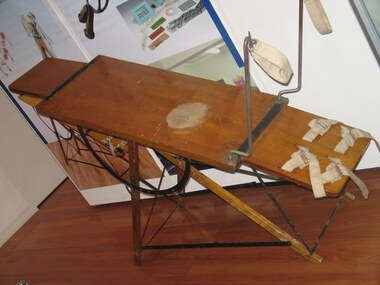
Portable operating table used by Sir Victor Bonney, Allen & Hanburys, England, c. 1900
... technique emulated by so many of his pupils. To theatre sisters, labour-ward sisters and young house-surgeons he will always be remembered as the discoverer of 'Bonney's Blue' [antiseptic solution].'" Bonney's utilitarian, portable operating...technique emulated by so many of his pupils. To theatre sisters, labour-ward sisters and young house-surgeons he will always be remembered as the discoverer of 'Bonney's Blue' [antiseptic solution].'" Bonney's utilitarian, portable operating ...This operating table belonged to the famous gynaecological surgeon Dr Victor Bonney and was given to Dr Frank Forster in 1953 by his widow Mrs Annie Bonnie, a distant relative of Forster's. Dr Victor Bonney (1872 - 1953) followed his father into medicine and trained at St Bartholomew's and the Middlesex Hospitals. Writing his obituary in 1953, FW Roques said of Bonney that he "'made three great gifts to surgery. First, he was the pioneer of myomectomy; second, with Berkeley, he extended and perfected Wertheim's operation for carcinoma of the cervix; and third, he devised a fine surgical technique emulated by so many of his pupils. To theatre sisters, labour-ward sisters and young house-surgeons he will always be remembered as the discoverer of 'Bonney's Blue' [antiseptic solution].'" Bonney's utilitarian, portable operating table has a round, worn scrubbed patch showing traces of his famous blue solution.This portable operating table was owned and used by pioneering gynaecological surgeon Sir Victor Bonney in London, U.K. c 1900. Dr Bonney employed two theatre sisters and had two sets of instruments and portable operating tables. This made it possible for Dr Bonney to 'complete three or more operations a day by rotating staff and equipment with a chauffeur driven Lanchester or Rolls Royce', delivering them from one house to the next. The donor of the operating table, the late Dr Frank Forster, was a distant relative of Sir Victor Bonney's widow, Annie Appleyard, formerly of Tasmania. When he visited her in the UK after Bonney's death, she offered the operating table to Dr Forster for the RANZCOG Museum. It was still in a canvas bag in the boot of one of Bonney's cars. Sir Victor Bonney was the pioneer of myomectomy, the surgical procedure for removing uterine fibroids. In collaboration with Berkeley, he extended and perfected Wertheim's operation for carcinoma of the cervix. Bonney was an influential teacher, developing and promoting conservatism of surgical technique (minimal intervention) that has had a lasting influence in modern surgical practice. To theatre-sisters, labour-ward sisters and young house-surgeons he will always be remembered as the discoverer of Bonney's Blue an antiseptic that was characteristically blue.Portable, laminated operating table. Plywood rectangular table with two laminated plywood extensions, a head board, and a foot board. At the foot board are insets of canvas straps to support a patient's ankles. Two detachable stirrup poles, each with a canvas strap attached, fit into two holes at the lower end of the table. The table is supported by two timber trellis cross braces with metal bars, and supported at the centre by a metal rod that allows the table to pivot up and down. Two metal arcs with a locking mechanism fix the table at the desired elevation, allowing a Trendelenburg tilt ( a 45 degree tilt, with the patient's head downwards.) The operating table is demountable for transportation and re-assembly.obstetric delivery -
![First page of 'Aseptic Technique' Alfred Hospital [ca.1960's]](/media/collectors/50187a8f023fd7201471f198/items/6a23c7bafc7af4b751c307a5/item-media/6a23c90afc7af4b751c3332d/item-fit-380x285.jpg?cb=6) Alfred Hospital Nurses League - Nursing History Collection
Alfred Hospital Nurses League - Nursing History CollectionDocument - Instruction document, Alfred Hospital, Aseptic Technique, [ca.1960's]
... operating theatre stressing the importance of developing a strict aeseptic conscience. Details the correct produres for "scrubbing up", donning and doffing of gowns and gloves, and maintaining sterilitity in the operating theatre Importance of aseptic technique in the operating theatre Operating room nursing-History operating theatre nursing Aseptic technique 'NR McKinnon' handwritten [blue ink] at top right. ...Document provided to student nurses in the operating theatre stressing the importance of developing a strict aeseptic conscience. Details the correct produres for "scrubbing up", donning and doffing of gowns and gloves, and maintaining sterilitity in the operating theatreImportance of aseptic technique in the operating theatreBlack print on off-white background. Pages printed on one side only'NR McKinnon' handwritten [blue ink] at top right. Holes where a staple has been removed at top left'NR McKinnon' handwritten [blue ink] at top right. Holes where a staple has been removed at top leftoperating room nursing-history, operating theatre nursing, aseptic technique -
 Alfred Hospital Nurses League - Nursing History Collection
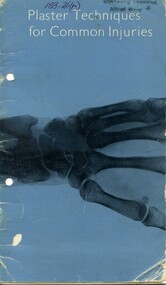
Booklet - Illustrated booklet, Windsor Accident Service, Plaster techniques for common injuries, [ca.1960]
... Before the advent of fibreglass casts in the 1970's plaster of paris was used to immobilize fractures, this boooklet provides illustrated guidence of techniques for application and removal of plaster for common injuries Nurses assisted with the applicaton and removal of plaster Plaster of paris fracture treatment Above title the previous catalogue number is handwritten [black ink] along with a black stamp reading 'Operating Theatres/Alfred Hospital' .This stamp also appears on the title page and page three. ...Before the advent of fibreglass casts in the 1970's plaster of paris was used to immobilize fractures, this boooklet provides illustrated guidence of techniques for application and removal of plaster for common injuriesNurses assisted with the applicaton and removal of plasterIllustrated stapled booklet with blue cover. On the front cover there is an Xray of a human hand and wrist with title in white print above. Two holes have been punched at leftAbove title the previous catalogue number is handwritten [black ink] along with a black stamp reading 'Operating Theatres/Alfred Hospital' .This stamp also appears on the title page and page three. On the title page 2/5 Theatre Alfred Hospital, has been handwritten [blue ink] at top rightplaster of paris, fracture treatment -
 Alfred Hospital Nurses League - Nursing History Collection
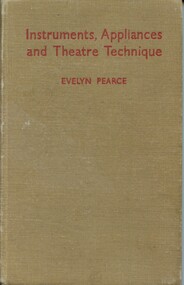
Book - Illustrated textbook, Evelyn C Pearce, Instruments, appliances and theatre technique, 1945
... First published in 1941 Insight into surgical equipment, appliances and opeting theatre techniques of the 1940's nursing study and teaching Operating theatre surgical instruments hospital appliances Vintage textbook covers surgical instruments, hospital appliances and operating theatre techniques, primarily for nurses and medical staff Top right of front endpage: 10/6. ...Vintage textbook covers surgical instruments, hospital appliances and operating theatre techniques, primarily for nurses and medical staffIllustraed book with beige cloth binding. Title and author stamped in red on front cover and spine. Publisher also stamped in red at base of spinenon-fictionVintage textbook covers surgical instruments, hospital appliances and operating theatre techniques, primarily for nurses and medical staffnursing study and teaching, operating theatre, surgical instruments, hospital appliances -
 Alfred Hospital Nurses League - Nursing History Collection
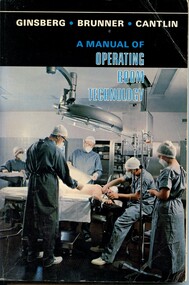
Book - Illustrated textbook, Frances Ginsberg et al, A manual of operating room technology, 1966
... Insight into the practices and technologies used in surgical education in the 1960's Operating Theatre Surgical nursing Postoperative care Vintage (1966) textbook designed as a practical concise guide to instruct surgical technicians and nursing students on the foundational principles, sterile techniques and workflows required within an operating the are environment Illustrated textbook, front cover has a coloured photograph of an operating theatre scene with black banner above on which authors' surnames are overprinted in white ink and title in blue ink. ...Vintage (1966) textbook designed as a practical concise guide to instruct surgical technicians and nursing students on the foundational principles, sterile techniques and workflows required within an operating the are environmentIllustrated textbook, front cover has a coloured photograph of an operating theatre scene with black banner above on which authors' surnames are overprinted in white ink and title in blue ink. Title, authors' surnames and publisher also printed on spinenon-fictionVintage (1966) textbook designed as a practical concise guide to instruct surgical technicians and nursing students on the foundational principles, sterile techniques and workflows required within an operating the are environmentoperating theatre, surgical nursing, postoperative care
