
Showing 37 items matching "operational control"
-
 Moorabbin Air Museum
Book - AIR TRAFFIC CONTROL, Take Off To Touchdown The Story of Air Traffic Control
... ...Operational control...Air traffic control The coming of radio War years Post war boom Navigation & control aids Area control Control tower Operational control Control of a flight Search & rescue Men of ATC Phonetic alphabet Air traffic control terms Technical & general overview of air traffic control in Australia, circa 1967 Take Off To Touchdown The Story of Air Traffic Control Book AIR TRAFFIC CONTROL ...Technical & general overview of air traffic control in Australia, circa 1967non-fictionTechnical & general overview of air traffic control in Australia, circa 1967the coming of radio, war years, post war boom, navigation & control aids, area control, control tower, operational control, control of a flight, search & rescue, men of atc, phonetic alphabet, air traffic control terms -
 Federation University Historical Collection
Photograph - Photographs - colour, VIOSH: Postgraduate Student, Geoffrey Dell's PhD, 1996, c1996
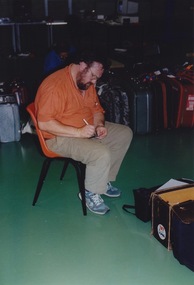
... operational systems used by baggage handlers in a range of airlines, worldwide. Where possible the investigation will include an epidemiological study of baggage handler back injury occurrence in those airlines. The information gathered will provide an understanding of back injury causation modes, and will focus attention on the specific tasks for which engineering solutions should be sought. Engineering solutions identified will be subject to controlled...operational systems used by baggage handlers in a range of airlines, worldwide. Where possible the investigation will include an epidemiological study of baggage handler back injury occurrence in those airlines. The information gathered will provide an understanding of back injury causation modes, and will focus attention on the specific tasks for which engineering solutions should be sought. Engineering solutions identified will be subject to controlled ...Victorian Institute of Occupational Safety and Health (VIOSH) Australia is the Asia-Pacific centre for teaching and research in occupational health and safety (OHS) and is known as one of Australia's leaders on the field. VIOSH has a global reputation for its innovative approach within the field of OHS management. VIOSH Australia enrolled its first PhD candidate in 1995 and during 1996 focused on attracting increasing numbers of students. In 1996, three candidates were enrolled through VIOSH Australia.They were John Culvenor, Geoffrey Dell and Thomas Mitchell. All had Prof Dennis Else as their supervisor. Previously, Geoffrey Dell was in Intake 7, 1985, Occupational Hazard Management. Geoffrey Dell's topic was "Airline Baggage Handler Back Injuries - Causes and Prevention." "The aim of this study is to investigate the work practises and operational systems used by baggage handlers in a range of airlines, worldwide. Where possible the investigation will include an epidemiological study of baggage handler back injury occurrence in those airlines. The information gathered will provide an understanding of back injury causation modes, and will focus attention on the specific tasks for which engineering solutions should be sought. Engineering solutions identified will be subject to controlled trial, to confirm their validity." This led to the construction of a full scale plywood baggage compartment model and a partnership with Ballarat University's School of Human Movement and Sports Science. Three different loading systems were tested. Qantas baggage handlers travelled to Ballarat University to fill the human frame of the investigation. The photographs show this aspect of the research. In 1997, Geoffrey Dell was awarded the Eric Wigglesworth Prize. The prize acknowledges publication of an article which constitutes a significant contribution to the body of occupational health and safety knowledge in an approved OH&S journal.32 co;our photographs showing procedure of baggage handlers.viosh, victorian institute of occupational safety and health, geoffrey dell, john culvenor, thomas mitchell, phd, airline baggage handler back injuries, work practises, operational systems, engineering solutions, causes of injury, qantas baggage handlers, prof dennis else, eric wiggles worth prize, oh&s journal, ballarate university, school of human movement and sports science, plywood compartment model, loading systems -
 Ringwood and District Historical Society
Administrative record - Borough Of Ringwood 14th August 1950, Constitution of the East Ringwood Reserve Management Committee
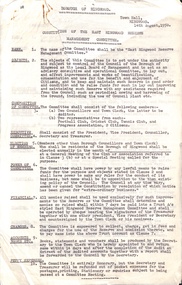
... The objects of the committee is to act under the authority and subject to control of the Council of the Borough of Ringwood as the Local Board of Management and to act as an advisory consultive and operational Committee, to lay out, and effect improvements and works of beautification, ornamentation and use for the benefit and enjoyment of citizens and to keep and maintain such Reserve in good order and condition and raise funds for improving and mataining such Reserve. ...The objects of the committee is to act under the authority and subject to control of the Council of the Borough of Ringwood as the Local Board of Management and to act as an advisory consultive and operational Committee, to lay out, and effect improvements and works of beautification, ornamentation and use for the benefit and enjoyment of citizens and to keep and maintain such Reserve in good order and condition and raise funds for improving and mataining such Reserve. ...The objects of the committee is to act under the authority and subject to control of the Council of the Borough of Ringwood as the Local Board of Management and to act as an advisory consultive and operational Committee, to lay out, and effect improvements and works of beautification, ornamentation and use for the benefit and enjoyment of citizens and to keep and maintain such Reserve in good order and condition and raise funds for improving and mataining such Reserve. The Committee shall consist of two Councillors and Town Clerk and two representatives from each: Football Club, Cricket Club, Tennis Club and Progress Association and 2 Citizens. -
 Kiewa Valley Historical Society
Telephone Handset Field, early 1900s
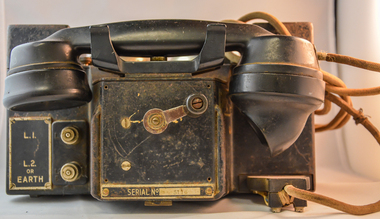
... On the front of the control box is a winder handle(to ring off) and in a field situation to activate/deactivate the magneto. To the left of the winder but on the the main body are two wind up connection buttons for the connection of operational wires (power)...On the front of the control box is a winder handle(to ring off) and in a field situation to activate/deactivate the magneto. To the left of the winder but on the the main body are two wind up connection buttons for the connection of operational wires (power) Telephone Handset Field Australian Post Office ...This field telephone was developed primary for military purposes (World War I) and other wars/military interventions there after. It was the first "mobile" telephone which had a prime objective of providing isolated or "hard" to connect with locations instant communication links. Like a lot of "new" technologies it evolved from a war environment. This handset was used to connect offices and workshops, which due to their functions could not be co-located with their prime office(external workshops).The evolution from the early 1900s to the mid 1980s when mobile communication technology progressed in leaps and bounds from hard wire telephone communication to mobile digital receivers. This handset was manufactured by a subcontracted Australian company under the Australian Post Office mandate.This handset is significant in that it was donated by the Mount Beauty Timber yards and formed an integrated part of its communication system with its out lying work yards and buildings, before the mobile handset evolution. This handset was located in an environment which required a rugged and reliable day to day communications linkage as a vital part of its logistical (business) survival. As progress demands it, the faster that customers are satisfied with the service they obtain from suppliers the longer those services will be asked for and the longer and more profitable the supplier will be. This edict is as true for rural companies as it is for small or large city businesses. The customer is "always" right.This sturdy field telephone has a shell housing made in black bakelite material with a "U" form housing the major components (wiring, magneto and batteries). The main housing has two metal bells, with a central ringer between both, on the top part (to notify incoming calls). In front of the main structure is a box with the telephone hand piece (ear and mouth receptacles) nestled on two cradles. An on/off switch is activated when handset is removed from its cradle. On the front of the control box is a winder handle(to ring off) and in a field situation to activate/deactivate the magneto. To the left of the winder but on the the main body are two wind up connection buttons for the connection of operational wires (power)On the main right hand front body and next to two chrome switches is a plate with "L (next to the top switch) and below this "L2" and underneath this are "or" "EARTH". There is a plate fastened to the front of the handset and behind the winder with "REPLACE HANDSET WHEN FINISHED" and below the winder 'SERIAL NUMBER 5116"field telephone, world war ii field telephone f mk i -
 Kiewa Valley Historical Society
Lamp Small Kerosene, circa early 1900s
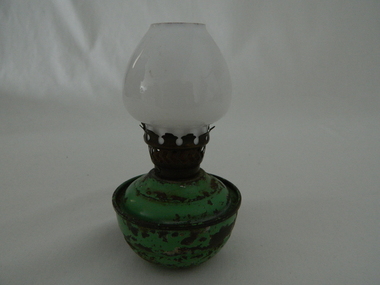
... operational. The supply was relative to how close the homestead was to the major electricity substation. This kerosene lamp was in use during the period when it was the only reliable source of domestic night time lighting. The strength of refractive light produced by this lantern/lamp hinged upon the size of the lamp(wick and glass bowl). The small size of this lamp suggests that it was for use in a small room(children's bedroom) or as providing a light for a safe walk to the outside ablutions (toilet) area. kerosene reading lamp domestic lighting bedside light On the wick control ...The period when kerosene was extensively used for indoor lighting was before electrical reticulation was installed in rural areas. In remote areas this was up to the mid 1900's. The kerosene lantern however was still in use, for camping and outdoor activities, well beyond this period and was eventually replaced by LPG and battery powered lighting. The transition phase to "modern" outdoor and domestic lighting lingered on the rural areas where the electrical reticulation suffered from reliable constant supply.In the Kiewa Valley, being a rural region, had reliable electrical domestic and farm supply only after the Kiewa Hydro Electricity Scheme had been fully operational. The supply was relative to how close the homestead was to the major electricity substation. This kerosene lamp was in use during the period when it was the only reliable source of domestic night time lighting. The strength of refractive light produced by this lantern/lamp hinged upon the size of the lamp(wick and glass bowl). The small size of this lamp suggests that it was for use in a small room(children's bedroom) or as providing a light for a safe walk to the outside ablutions (toilet) area. This small kerosene lamp has an enclosed "cup" body which would have contained the kerosene fuel. The top wick holder, made from brass, has an extended enclosed spout which raises the wick approximately 20mm from the bottom of the holder. The wick holder screws into the the top of the kerosene reservoir bowl and has a wick adjustment screw (light control) at one side. The small white glass light reflector bulb nestles securely onto the wick holder and is kept snug by snap designed extending "fingers". The section between the bottom of the refractive glass "light" bowl and the top of the kerosene bowl has perforations to allow air passage to feed directly to the wick.The light refracting bulb is open at the top to allow heat and smoke from the burning wick to escape upwards.On the wick control screw "CWB BRITISH MADE"kerosene reading lamp, domestic lighting, bedside light -
 Kiewa Valley Historical Society
Resistor 2000 Amperes, circa mid to late 1900's
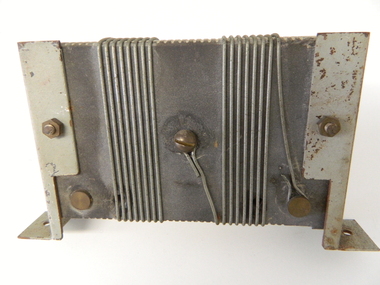
... control monitor. This resistor is highly significant to the Kiewa Valley because it represents a major construction and ongoing operational industry dealing with the supply of hydro electricity to Victoria. ...This resistor was part of the Hydro generator control metering system which displays what electricity is produced at the underground generators. The control centre can be hundreds of meters above the generators and this resistor reduces the large current to a small voltage entering a calibrated control monitor. This resistor is highly significant to the Kiewa Valley because it represents a major construction and ongoing operational industry dealing with the supply of hydro electricity to Victoria. Although it is relatively small in size it is part of the controlling mechanism for the supply of a non polluting energy source for home and industrial use.This mainly metal and wire resistor has been built of copper and brass and designed to carry a current of 2000 Amperes. Wires are wound around a non conductive cement block which has grooves on the top and bottom ledges to hold the wires snuggle into place. At the rear there are three connection rods which have long 5mm thick screws (to fasten cable ends)On one side it is scribed "0.2 OHMS" and underneath this "10 AMPS"kiewa hydro electricity scheme, victorian state electricity commission, transformers -
 Kiewa Valley Historical Society
Console Telephone 10 shutter, circa early 1900s
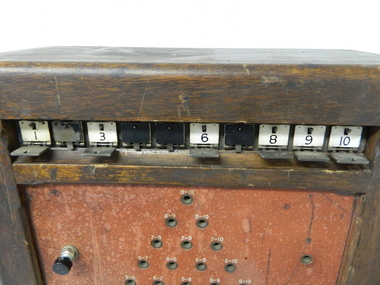
... This telephone exchange console is highly significant to both the Kiewa Valley and Mount Beauty region because it was so important in the communications field relating to operational safety and work related controls. The success of any large undertaken relies heavily upon good communications. ...This manual telephone exchange console is an important piece of equipment which provided the most efficient method of long distance communications in the 1950's to the 1980's. Communications were critical, not only for the regional Hospital, but also for large construction sites i.e. the Kiewa Hydro Scheme, especially if they are in dense rugged mountainous regions. The degree of Occupation Health and Welfare on industrial sites were at a bare minimum compared to the work scene after the 1980's.This telephone exchange console is highly significant to both the Kiewa Valley and Mount Beauty region because it was so important in the communications field relating to operational safety and work related controls. The success of any large undertaken relies heavily upon good communications. In the hospital this method of communications is still used i.e. patient to ward station. This flag system link a patient's room to the controlling nursing station. Identification of the patient needing help is crucial for swift action from the available medical staff. Similarly in large construction sites such as the Kiewa Hydro Scheme, successful instant communications was also essential. This switchboard required a 50 volt supply to successfully operate and was in use when both telecommunications and postal were under the one Federal Government carrier i.e. The Post Master General. A benefit with a line communication system (such as the one that fed this console was that interference from atmospheric conditions did not impede the connection.This console telephone switchboard (manual) unit has a shutter operation (precursor to the light indicator) to identify the caller to the telephone switchboard operator. This switchboard has a ten point indication shutter system allowing the operator to clearly identify where the caller is located. The console has a 44 connection point holes with their configurations in a triangular shape. The shutters are held closed by a small lever at the top which is opened by a small electrical charge from the incoming call. The operator uses a wind up handle to power a magneto connector(handle on the console's right side). The telephone hand set is located on the left side of the console. sec vic kiewa hydro scheme, alternate energy supplies, alpine population growth and communications -
4th/19th Prince of Wales's Light Horse Regiment Unit History Room
Training Pamphlet, The Armoured Personnel Carrier Regiment, 25/10/1984
... The pamphlet covers the following: a. the role, tasks, characteristics, organisation and responsibilities of key personnel of the armoured personnel carrier regiment, b. command and control within the regiment,and c. the operational employment of the regiment and the techniques it will use at regimental and squadron level. ...The pamphlet covers the following: a. the role, tasks, characteristics, organisation and responsibilities of key personnel of the armoured personnel carrier regiment, b. command and control within the regiment,and c. the operational employment of the regiment and the techniques it will use at regimental and squadron level. ...The aim of this pamphlet is to provide the doctrine for the employment of the Armoured Personnel Carrier Regiment in war. The pamphlet covers the following: a. the role, tasks, characteristics, organisation and responsibilities of key personnel of the armoured personnel carrier regiment, b. command and control within the regiment,and c. the operational employment of the regiment and the techniques it will use at regimental and squadron level. Manual of Land Warfare Part Two- Armour Training Volume 1 - Armour in Battle Pamphlet No 3 7610-66-120-3847 -
 4th/19th Prince of Wales's Light Horse Regiment Unit History Room
Book, Australian Defence Heritage, 1988 (exact)
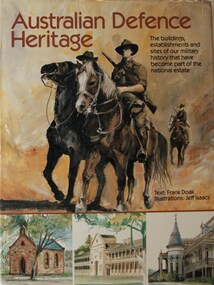
... The Department of Defence controls more than two million hectares of land used either as training areas or for operational and logistic bases. ...heritage books defence estate national estate national trust aboriginal sites australian heritage commission defence properties frank doak jeff isaacs fairfax library heritage books defence estate national estate national trust aboriginal sites australian heritage commission defence properties frank doak jeff isaacs fairfax library ISBN 949 054 968 The Department of Defence controls more than two million hectares of land used either as training areas or for operational and logistic bases. ...The Department of Defence controls more than two million hectares of land used either as training areas or for operational and logistic bases. Approximately 200 Defence-occupied buildings have been classified by the Australian Heritage Commission and placed on the Register of the National Estate, and a further 100 buildings have been registered by the National Trust. Twenty properties also have been listed by the Australian Heritage Commission for significant environmental aspects and for the protection of Aboriginal sites. This book, produced as a contribution to Australia's bicentennial, is the first publication devoted entirely to Australia's priceless defence heritage. Text: Frank Doak Illustrations: Jeff IsaacsISBN 949 054 968heritage, books, defence estate, national estate, national trust, aboriginal sites, australian heritage commission, defence properties, frank doak, jeff isaacs, fairfax library, heritage, books, defence estate, national estate, national trust, aboriginal sites, australian heritage commission, defence properties, frank doak, jeff isaacs, fairfax library -
 Kiewa Valley Historical Society
Electric Current Shunt
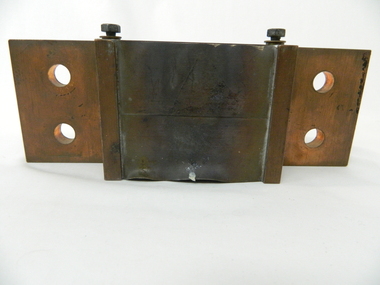
... control metering system. It reduces the large current to a small voltage. Historical: This equipment represents a major construction and ongoing operational industry dealing with the supply of hydro electricity to Victoria. kiewa hydro electric scheme. secv. hydro generator. victorian electricity grid power station. electricity. resistor Screwed in metal plaque: Deriv. 1662691 / OHM 0.0000833 / AMP 1200 on the side of the cube above a shelf and on the opposite shelf: ALTO ----> (also a metal plaque screwed on). ...This shunt is a type of resistor built of copper and designed to carry a current. It was part of the Hydro generator control metering system. It reduces the large current to a small voltage.Historical: This equipment represents a major construction and ongoing operational industry dealing with the supply of hydro electricity to Victoria.Made of copper the shunt has a middle cube with 12 sheets of copper, 5mm apart formed like shelves. On either side of the cube are two shelves coming out from the middle. Both have 2 hollow circles 17.5mm in diameter 25 mm apart in the middle. At the Join of the 'shelves' and cube is a screw on each side.Screwed in metal plaque: Deriv. 1662691 / OHM 0.0000833 / AMP 1200 on the side of the cube above a shelf and on the opposite shelf: ALTO ----> (also a metal plaque screwed on). kiewa hydro electric scheme. secv. hydro generator. victorian electricity grid, power station. electricity., resistor -
 Bendigo Historical Society Inc.
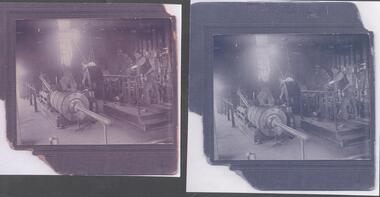
Photograph - Monument Hill Gold Mine Engine Room, 1930's, exact date unknown
... Albert is at the controls of the engine, lowering and raising the mining cage; he is leaning on the support railing around the elevated platform he is standing on. Letter accompanying images describes the donor's family connection to John Perry Dunstan and Albert Ernest Dunstan, he writes that ' the mine was fully operational in the 1940's and I was often able to see my Grandfather at work and watched as men stepped into cages to be lowered to their awful occupation. ...operational in the 1940's and I was often able to see my Grandfather at work and watched as men stepped into cages to be lowered to their awful occupation'. Donor's great, great grandfather was John Perry Dunstan, a well respected mine manager on the Bendigo goldfield. Monument Hill Gold Mine Albert Dunstan Old Violet Street Olive Street engine room mining cage Two black and white copies of original photograph. Image shows Albert Ernest Dunstan working in the engine room of the Monument Hill Gold Mine, Bendigo. Albert is at the controls ...The Monument Hill Gold Mine was at the corner of Old Violet Street and Olive Street. It operated until 1947. The shaft was capped, the poppet legs and mullock removed. A house now occupies the site. The Monument Hill Gold mine depth was over 1200 ft. The donor of the photograph is the grandson of Albert Dunstan, and he recalls that 'the mine was fully operational in the 1940's and I was often able to see my Grandfather at work and watched as men stepped into cages to be lowered to their awful occupation'. Donor's great, great grandfather was John Perry Dunstan, a well respected mine manager on the Bendigo goldfield.Two black and white copies of original photograph. Image shows Albert Ernest Dunstan working in the engine room of the Monument Hill Gold Mine, Bendigo. Albert is at the controls of the engine, lowering and raising the mining cage; he is leaning on the support railing around the elevated platform he is standing on. Letter accompanying images describes the donor's family connection to John Perry Dunstan and Albert Ernest Dunstan, he writes that ' the mine was fully operational in the 1940's and I was often able to see my Grandfather at work and watched as men stepped into cages to be lowered to their awful occupation. I was very surprised that today there is a home sitting above what was once a very deep mine'.monument hill gold mine, albert dunstan, old violet street, olive street, engine room, mining cage -
 Bendigo Historical Society Inc.
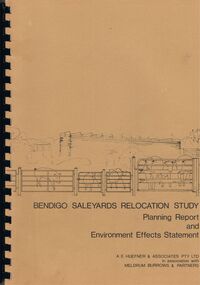
Book - BENDIGO SALEYARDS COLLECTION: BENDIGO SALEYARDS RELOCATION STUDY - PLANNING REPORT AND ENVIRONMENT
... Invironmental Effects which include Visual Impact Dust, Odours, Effluent, Effluent Treatment System, Traffic, Artificial Lighting, Noise, Operational Failures and Nature Conservation Effects. Statutory Planning Considerations which includes Zoning Controls and Suggested Procedure for Initiating I.D.O. ...Invironmental Effects which include Visual Impact Dust, Odours, Effluent, Effluent Treatment System, Traffic, Artificial Lighting, Noise, Operational Failures and Nature Conservation Effects. Statutory Planning Considerations which includes Zoning Controls and Suggested Procedure for Initiating I.D.O. ...Bendigo Saleyards Relocation Study - Planning Report and Environment Effects Statement for the City of Bendigo by A E Huefner & Associates Pty Ltd in association with Meldrum Burrows & Partners. Book has a light brown cover with black plastic binder spine. Green and yellow pages separate some sections. The front cover has a sketch of a stock transport with a pig, sheep and cattle behind gates. Contents include: Introduction, Summary, Recapitulation on the Feasibility Report which includes The Need for Action, the Site and Existing Uses Adjacent to the Site, The Proposal which includes Concept, Project Description, Components, Siting of Facilities, Land Clearing, Earthworks, Darainage, Buildings and Structures, Roads and Pavements, Services, Landscaping, Soil Profile and Construction Programme. Invironmental Effects which include Visual Impact Dust, Odours, Effluent, Effluent Treatment System, Traffic, Artificial Lighting, Noise, Operational Failures and Nature Conservation Effects. Statutory Planning Considerations which includes Zoning Controls and Suggested Procedure for Initiating I.D.O. Amendment. Appendices are: A.- Copy of Tit;e, B - Soil Investigation, C - Acoustic Assessment and D - Suggested Draft Amendment to Shire of Marong I.D.O. Contains a photo of the area - View of the Site, looking South and a number of drawings. Copies of various Council Reports referring to the Saleyards Relocation Project. It has a bright yellow cover and a hard plastic type spine. Mentioned in the reports is the cost to bring the old saleyards up to standard and list of improvements. Reports are as at 16th July, 1984. Mustard coloured book with plastic spine titled Bendigo Saleyards Relocation Study Feasibility Report by Meldrum Burrows & Partners in association with A E Huefner & Associates Pty Ltd and Acil Australia Pty Ltd dated September, 1983. Items mentioned are: Introduction, Summary, Background, Role in Livestock Marketing for the Bendigo Saleyards (Acil Australia Pty. Ltd., Saleyard Relocation: Strategic Considerations, Financial Implications and Conclusion. Appendix 1: Estimation of Livestock Population in Catchment Area. Drawings in Fig 1 Existing Bendigo Saleyards and Surrounding Land Uses, Fig 2 Catchment Area for Bendigo Saleyards 1983, Fig 4.1 Estimated Sheep Populatiuon in Catchment Area 1976 - 77 to 1981 - 82, Fig 4.2 Estimated Cattle Population in Catchment area 1976 -77 to 1981 -82, Fig 3 Possible Saleyard Relocation Areas, Fig 4, Directions from which access to possible Saleyard Locations would be obtained - Estimated percentage of sheep to cattle stock, Fig 5 Possible Saleyard Locations - Northern Area, Fig 6 Possible Locations of Saleyards - Inner West, Fig 7 Possible Locations of Saleyards - Outer West. Considerations were made as to renovate the existing saleyards or to move them elsewhere. Effluent, transport and stock movement, and condition of the yards were a problem.bendigo, council, cattle markets, bendigo saleyards collection - bendigo saleyards relocation study - planning report and environment effects statement, a e huefner & associates pty ltd, meldrum burrows & partners, city of bendigo, state electricity commission, mal styles, bendigo college of advanced education, n j fieldew, pryce goodale & duncan pty ltd, p b swift, shire of marong -
 National Vietnam Veterans Museum (NVVM)
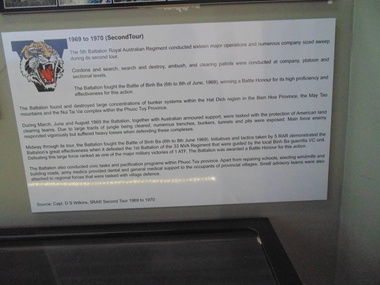
Poster - Information Board, 5 RAR 1969 - 1970 (2nd Tour)
... control over the central region of Phuoc Tuy Province - an area that communists had freely operated in since 1945. See media for more information Commencing of the 24th May 1966, the Battalion conducted its first operation codenamed "Hardihood". Their objective was to sweep and clear areas of the north and east of Nui Dat to a distance of 5000 meters, then create a defensive position to enable 1 ATF to establish an operational base....control over the central region of Phuoc Tuy Province - an area that communists had freely operated in since 1945. See media for more information Commencing of the 24th May 1966, the Battalion conducted its first operation codenamed "Hardihood". Their objective was to sweep and clear areas of the north and east of Nui Dat to a distance of 5000 meters, then create a defensive position to enable 1 ATF to establish an operational base. 5 RAR 1969 - 1970 (2nd Tour) Poster Information Board ...An Poster, Information Board of The 5th Battalion Royal Australian Regiment ("Battalion") were the leading element of the First Australian Task Force (1 ATF) and stationed in Vietnam from 1966 - 1967. The Battalion's task was to break Viet Cong control over the central region of Phuoc Tuy Province - an area that communists had freely operated in since 1945. See media for more information Commencing of the 24th May 1966, the Battalion conducted its first operation codenamed "Hardihood". Their objective was to sweep and clear areas of the north and east of Nui Dat to a distance of 5000 meters, then create a defensive position to enable 1 ATF to establish an operational base.5 rar, 1 atf, viet cong, phuoc tuy province, nui dat, nui thai vai mountains, 274 vc regiments, 275 vc regiments, military awards, operation canberra, operation queanbeyan, operation hardihood, poster, information board, battle of binh ba, 1st australian task force, hat dich, bien hoa province, may tao mountains, 33 nva regiment, capt david symon wilkins, 235241, royal australian infantry corps, the royal australian regiment -
 National Vietnam Veterans Museum (NVVM)
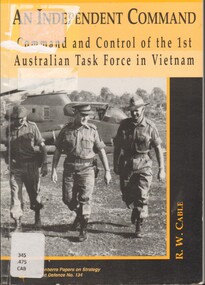
Book, Cable. R.W, An Independent Command: Command & Control of the 1st Australian Task Force in Vietnam
... operational command in Australia's largest military commitment of the Cold War period. Although the Vietnam War has been written on at length, the brigade level of command, held in Vietnam by the commander of 1 ATF, has received comparatively little attention. This is the more remarkable given the Australian Army's recently renewed interest in a "task force' structure and the modern trend away from large scale conventional warfare. An Independent Command: Command & Control ...The commander f the 1st Australian Task Force in Vietnam held the key operational command in Australia's largest military commitment of the Cold War period. Although the Vietnam War has been written on at length, the brigade level of command, held in Vietnam by the commander of 1 ATF, has received comparatively little attention. This is the more remarkable given the Australian Army's recently renewed interest in a "task force' structure and the modern trend away from large scale conventional warfare.The commander f the 1st Australian Task Force in Vietnam held the key operational command in Australia's largest military commitment of the Cold War period. Although the Vietnam War has been written on at length, the brigade level of command, held in Vietnam by the commander of 1 ATF, has received comparatively little attention. This is the more remarkable given the Australian Army's recently renewed interest in a "task force' structure and the modern trend away from large scale conventional warfare. australia. army. australian task force (vietnam), command of troops, 1 atf, cold war -
Moorabbin Air Museum
Document (item) - Roland Jahne Collection - See Description for details
... Parameter for Crusiing Control Single page Nov-38 Bristol Perseus X111C Single page Nov-38 Napier Dagger V111 Stapled pages Dec-38 Recent Progress in Aviation Superchargers Stapled pages No date Treasure in the Dust Bin of History Stapled pages Sep-46 Gloster Meteor Single page Sep-67 Preserve Aircraft in Australia Stapled pages No date AFDAS Aircraft Fatigue Data Analysis System Stapled pages No date Comair Root Length Scanner Single page No date Computer Aided Graphics Facility. Commonwealth Aircraft Corporation Limited Stapled pages No date Commonwealth Aircraft Corporation Limited. CAC Enters space age Booklet No date Garrett's TPE331 Turboprop Pilots Brief & Operational...Parameter for Crusiing Control Single page Nov-38 Bristol Perseus X111C Single page Nov-38 Napier Dagger V111 Stapled pages Dec-38 Recent Progress in Aviation Superchargers Stapled pages No date Treasure in the Dust Bin of History Stapled pages Sep-46 Gloster Meteor Single page Sep-67 Preserve Aircraft in Australia Stapled pages No date AFDAS Aircraft Fatigue Data Analysis System Stapled pages No date Comair Root Length Scanner Single page No date Computer Aided Graphics Facility. Commonwealth Aircraft Corporation Limited Stapled pages No date Commonwealth Aircraft Corporation Limited. CAC Enters space age Booklet No date Garrett's TPE331 Turboprop Pilots Brief & Operational ... -
Moorabbin Air Museum
Album (item) - CAC Folder containing a range of documents - See Description for details
... Control Systems. CAC Fishermans Bend Sector Sales Analysis Fixed 1986 Dollars CAC Active Ship Location By Major Type And Ocean Areas as April 30,1985 CAC Fishermans Bend Sales Revenue And Profit (After Tax) 1978-1986. CAC Fishermans Bend Workload Distribution 1984/5. CAC Fishermans Bend Sales Revenue Distribution 1984/85. CAC Effect Of Local Procurement On Initial Purchase Cost And Life Of Type Cost - Atar Engine. CAC Photo Composite Maintenance Trainer. CAC Product & Services Applicable to RAN New Submarine Programme. CAC Maintenance And Operational...Control Systems. CAC Fishermans Bend Sector Sales Analysis Fixed 1986 Dollars CAC Active Ship Location By Major Type And Ocean Areas as April 30,1985 CAC Fishermans Bend Sales Revenue And Profit (After Tax) 1978-1986. CAC Fishermans Bend Workload Distribution 1984/5. CAC Fishermans Bend Sales Revenue Distribution 1984/85. CAC Effect Of Local Procurement On Initial Purchase Cost And Life Of Type Cost - Atar Engine. CAC Photo Composite Maintenance Trainer. CAC Product & Services Applicable to RAN New Submarine Programme. CAC Maintenance And Operational ...CAC Green Folder containing following articles, CAC Workforce 1936-1980. CAC Facility Locations. CAC Hawker De Havilland International Manufacturing Contracts. Some CAC Future Products & Contracts. CAC Typical Customer List. CAC Man Hours Lost 1978-1979 & 1980. CAC Prime Marketing Objectives. CAC Automatic Flight Control Systems. CAC Fishermans Bend Sector Sales Analysis Fixed 1986 Dollars CAC Active Ship Location By Major Type And Ocean Areas as April 30,1985 CAC Fishermans Bend Sales Revenue And Profit (After Tax) 1978-1986. CAC Fishermans Bend Workload Distribution 1984/5. CAC Fishermans Bend Sales Revenue Distribution 1984/85. CAC Effect Of Local Procurement On Initial Purchase Cost And Life Of Type Cost - Atar Engine. CAC Photo Composite Maintenance Trainer. CAC Product & Services Applicable to RAN New Submarine Programme. CAC Maintenance And Operational Training Task/Study Definition-Development-Fabrication/Manufacture Implementation/Management Infrastructure Ikara MH53E Maintenance Trainers F18A MDSLMP. CAC Torpedo Handling And Stowage System Mine Launch Handling Stowage System. CAC Airconditioning System (Environmental Control) -
 Australian Gliding Museum
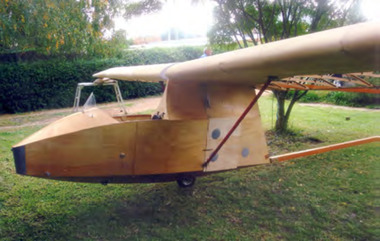
Machine - Glider – Sailplane, 2015
... In addition to the finishing work (including painting) and rigging of the main components, the linkages for Ray’s control rod modification may need further engineering to make them operational. ...In addition to the finishing work (including painting) and rigging of the main components, the linkages for Ray’s control rod modification may need further engineering to make them operational. ...The Salamandra is a Polish glider designed by Waclaw Czerwinski at the Military Glider Workshops in Krakow in 1936. This glider, designated “W.W.S.1”, was produced in substantial numbers prior to the second world war and used in Poland and some other eastern European countries for training pilots. Only one example survived the war, hidden away in the village of Goleszow in Silesia. In addition, no technical drawings could be found, so when the glider was discovered, the Gliding Institute being keen to re-establish gliding in Poland, used the glider to draw up new plans for construction. Five were built for the Institute in 1947 before production was resumed of the “Salamandra 48” at the SZD Jezow Workshops. Improvement were made by adding airbrakes and structural changes for the “Salamandra 49” and a windscreen and larger tailplane were changes adopted for the “Salamandra 53”. An export version designated “53A” was sold to and built under licence in China. Production of the Salamandra ceased in the early 1960s. Total production may have been in excess of 500. The glider was well regarded as a light weight trainer capable of soaring performance. The Museum’s replica was built by Ray Ash and may be may be classified as a “Salamandra 53”. However, he has added something of his own to the design by replacing the cable runs in the wings with control rods. The glider is substantially complete. The wings and tail / rudder surfaces have been covered with poly-fibre fabric. The fuselage woodwork is sealed with varnish. In addition to the finishing work (including painting) and rigging of the main components, the linkages for Ray’s control rod modification may need further engineering to make them operational. The Ray Ash Salamandra is the first of the type to appear in Australia. The Salamandra did not play any role in the development of gliding in Australia in the early years. However, it is an important exhibit in that it shows in tangible form a nacelle fuselage training glider in configuration and construction detail. As such it revisits the pioneering era of the 1930s and 1940s in Australia when wood, wire and fabric were the rule and the nacelle primary glider was generally the first step up for pilots who had mastered the basics in an open primary.Nacelled solo training glider of traditional wood and fabric construction. Construction incomplete.Noneaustralian gliding, sailplane, glider, salamandra, czerwinshi, poland, ash -
 Australian Gliding Museum
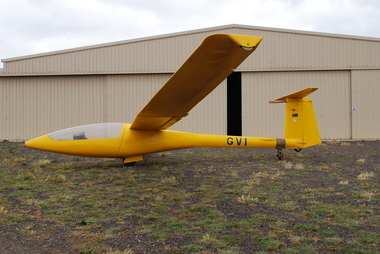
Machine - Glider - Sailplane
... operational life was brought to an end due to expansion of the foam in the wings causing distortion of the wing surface. The MOBA2 is a notable home built 1970s sailplane design that featured a number of innovative elements including composite construction without the need for expensive jigs, nose cone canopy and asymmetrical placement of control column. australian gliding glider sailplane moba2b moba2c sunderland moba2d victorian motorless flight group vmfg Registration "GVI" on fuselage; Kangaroo, Australian Flag and VMFG decals on vertical stabiliser Composite single seat glider / sailplane finished in bright yellow Machine Glider - Sailplane Gary Sunderland ...MOBA2 is a 15 metre sailplane designed by Gary Sunderland, who was an aeronautical engineer working for the Department of Civil Aviation (Australia) and a member of the Victorian Motorless Flight Group (VMFG). The design gave effect to ideas that he developed circa 1970 for an aircraft that he could build himself. He entered a 13 metre wingspan version of his MOBA design (MOBA2B) in an Australian Gliding sailplane design competition that was announced in 1970. The competition called for sailplane designs with a maximum wingspan of 13 metres that could be built by amateurs in a small workshop with limited tools and facilities. In 1973, Gary’s MOBA was judged by the competition panel as equal best with the other outstanding submission, which were chosen from a field of 19 entrants. However, after gathering further information and deliberation by the competition panel neither of the two outstanding designs were chosen as the winner. Notwithstanding the outcome, in 1974 Gary proceeded built his glider to the original 15 metre design. The wing was equipped with camber changing flaps that were permitted under special standard class rules for the 1974 world championships. Changes were made along the way in the light of construction experience and the completed glider was given the designation MOBA2C. The glider first flew on 12 December 1979. It was never flown in standard class competition as by the time the glider was built the special 1974 rules were revoked and wing flaps were no longer permitted in that class. However, Gary flew MOBA2C in the Australian national gliding competitions held at Benalla in the summer of 1979 / 1980 competing in the open class. After adjustment to the aileron gearing during initial trials MOBA2C was found to fly well and in competition produced performances believed to be better than contemporary standard class sailplanes but not as good as the open class machines. The glider was later modified in a number of respects including amongst other things the installation of spoilers located just forward of the wing flaps and by increasing the chord marginally at the wing root. With these changes the glider type was given the designation MOBA2D. The last recorded flights occurred in February 1996 at which time MOBA2 had flown an aggregate of 401 hours and 59 minutes during its 297 launches. Its operational life was brought to an end due to expansion of the foam in the wings causing distortion of the wing surface.The MOBA2 is a notable home built 1970s sailplane design that featured a number of innovative elements including composite construction without the need for expensive jigs, nose cone canopy and asymmetrical placement of control column.Composite single seat glider / sailplane finished in bright yellowRegistration "GVI" on fuselage; Kangaroo, Australian Flag and VMFG decals on vertical stabiliseraustralian gliding, glider, sailplane, moba2b, moba2c, sunderland, moba2d, victorian motorless flight group, vmfg -
 Wangaratta RSL Sub Branch
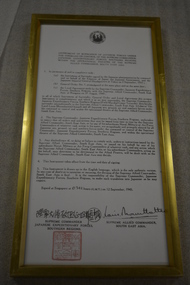
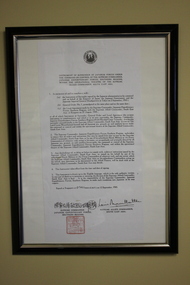
Document - Framed document, Japanese Surrender
... Instrument of Surrender of Japanese Fores under the Command or Control of the Supreme Commander Japanese Expeditionary Forces Southern Regions within the Operational Theatre of the Supreme Allied Commander, South East Asia. ...Instrument of Surrender of Japanese Fores under the Command or Control of the Supreme Commander Japanese Expeditionary Forces Southern Regions within the Operational Theatre of the Supreme Allied Commander, South East Asia...Instrument of Surrender of Japanese Fores under the Command or Control of the Supreme Commander Japanese Expeditionary Forces Southern Regions within the Operational Theatre of the Supreme Allied Commander, South East Asia. ...Instrument of Surrender of Japanese Fores under the Command or Control of the Supreme Commander Japanese Expeditionary Forces Southern Regions within the Operational Theatre of the Supreme Allied Commander, South East Asia. Signed at Singapore on 12/9/1945 by Louis Mountbatten Supreme Allied Commander South East Asia.Gold coloured metal frame containing document with logo at top and signatures and red stamp belowInstrument of Surrender of Japanese Fores under the Command or Control of the Supreme Commander Japanese Expeditionary Forces Southern Regions within the Operational Theatre of the Supreme Allied Commander, South East Asiajapanese surrender, ww2, singapore, 12/9/1945 -
 Ballarat Tramway Museum
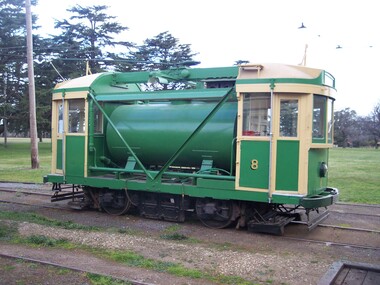
Vehicle - Tramcar, Melbourne and Metropolitan Tramways Board (MMTB), Scrubber Tram No. 8, 1934
... operational tram 2001. Trams Scrubber Tram tram 8 tram 8W MMTB Single truck (4 wheels), special purpose tram fitted with two cabs, control equipment, air brakes, track scrubber or cleaning equipment, pump, water and air lines to clean track. ...The tram carries approx. 4 cubic metres of water. Built by the Melbourne and Metropolitan Tramways Board in 1934 using the cabs from a C class tram (No. 32). It was transported to the isolated Footscray system a number of times to clean the rails there. In 1961 it received additional body bracing and repainted in the diagonal black and string (light cream) stripes. The tram became 8W during 1975 as the then new Z class trams came into service. By the early 1990's the need for the tram and the other similar cars used to "scrub" the surface of the rails was no longer. The tram was stored at Malvern depot for many years before being donated to the Ballarat Tramway Museum by the Public Transport Commission in September 1999. It has been scrubbing the rails in Ballarat since March 2001. For a detailed article see April 2008 issue of Fares Please. Photo Warren Doubleday 20/9/2008 after painting completed. See Destination City for further details.One of a few service vehicles built from almost new by the MMTB rather than being a converted vehicle. Donated to the BTM in 1999 and has been an operational tram 2001.Single truck (4 wheels), special purpose tram fitted with two cabs, control equipment, air brakes, track scrubber or cleaning equipment, pump, water and air lines to clean track. MMTBtrams, scrubber tram, tram 8, tram 8w -
 Wangaratta RSL Sub Branch
Document - Framed photocopy of Instrument of Surrender of Japanese Forces Singapore
... Instrument of surrender of Japanese Forces under the command or control of the Supreme Commander, Japanese Expeditionary forces, southern regions within the operational theatre of the Supreme Allied Commander, South East Asia. ...The surrender of Imperial Japan was announced on August 15 and formally signed on September 2, 1945, bringing the hostilities of World War II to a close.Following the war, Mountbatten was known to have largely shunned the Japanese for the rest of his life out of respect for his men killed during the war, and as per his will, Japan was not invited to send diplomatic representatives to his funeral in 1979, wwii world war 2 imperial japanese forces surrender singapore japanese army Instrument of surrender of Japanese Forces under the command or control of the Supreme Commander, Japanese Expeditionary forces, southern regions within the operational theatre of the Supreme Allied Commander, South East Asia. ...The Instrument of Surrender signed at Singapore by Admiral Lord Louis Mountbatten for the Allies and General Itagaki for the Japanese. During his time as Supreme Allied Commander of the Southeast Asia Theatre, Lord Mountbatten's command oversaw the recapture of Burma. A personal high point was the receipt of the Japanese surrender in Singapore when British troops returned to the island to receive the formal surrender of Japanese forces in the region led by General Itagaki on 12 September 1945, codenamed Operation Tiderace. General Itagaki was convicted of war crimes and executed inn 1948.The surrender of Imperial Japan was announced on August 15 and formally signed on September 2, 1945, bringing the hostilities of World War II to a close.Following the war, Mountbatten was known to have largely shunned the Japanese for the rest of his life out of respect for his men killed during the war, and as per his will, Japan was not invited to send diplomatic representatives to his funeral in 1979,Black frame with silver insert with glass of a photocopy of the Instrument of Surrender of the Japanese Forces. Script is in black on white paper with a red square seal at the bottom left, mounted on cream board.Instrument of surrender of Japanese Forces under the command or control of the Supreme Commander, Japanese Expeditionary forces, southern regions within the operational theatre of the Supreme Allied Commander, South East Asia. Signed at Singapore at 0341 hours (G.M.T.) on 12 September, 1945.wwii, world war 2, imperial japanese forces, surrender, singapore, japanese army -
Moorabbin Air Museum
Manual - Pilots Notes Avro Anson, Pilots Notes for Anson I Two Cheetah IX Engines
... Avro Anson Overiew of aircraft/engine controls, operational equipment, operating data, emercency proecdures for Anson I aircraft Manual in small booklet form Pilots Notes for Anson I Two Cheetah IX Engines Manual Pilots Notes Avro Anson ...Overiew of aircraft/engine controls, operational equipment, operating data, emercency proecdures for Anson I aircraftManual in small booklet formnon-fictionOveriew of aircraft/engine controls, operational equipment, operating data, emercency proecdures for Anson I aircraft -
Moorabbin Air Museum
Manual - Pillot's notes - Bristol Beaufighter, Pilot's Notes Beaufighter II Aeroplane Two Merlin XX Engnes
... Bristol Beaufighter Overview of aircraft/engine controls, cockpit/operational/radio/signaling/de-icing equipment, lights & emergency equipment Manual in booklet form Pilot's Notes Beaufighter II Aeroplane Two Merlin XX Engnes Manual Pillot's notes - Bristol Beaufighter ...Overview of aircraft/engine controls, cockpit/operational/radio/signaling/de-icing equipment, lights & emergency equipmentManual in booklet form non-fictionOverview of aircraft/engine controls, cockpit/operational/radio/signaling/de-icing equipment, lights & emergency equipment -
Moorabbin Air Museum
Manual - Pilot's Notes - Bristol Blenheim, Pilot's Notes Blenheim V Aeroplane Two Mercury XV or 25 Engines
... Bristol Blenheim technical overview for pilots Overview of aircraft /engne controls, de-icing/operational/emergency equipment & controls Manual in booklet form Pilot's Notes Blenheim V Aeroplane Two Mercury XV or 25 Engines Manual Pilot's Notes - Bristol Blenheim ...Overview of aircraft /engne controls, de-icing/operational/emergency equipment & controlsManual in booklet form non-fictionOverview of aircraft /engne controls, de-icing/operational/emergency equipment & controls -
Moorabbin Air Museum
Manual - Pilot's Notes - Bristol Beaufighter, Pilot's Notes for Beaufighter TFX Two Hercules XVII or XVIII Engines
... Bristol Beaufighter General technical overview of operational aircraft for pilots Technical overview of controls & equipment for Beaufighter pilots Manual in booklet form Pilot's Notes for Beaufighter TFX Two Hercules XVII or XVIII Engines Manual Pilot's Notes - Bristol Beaufighter ...Technical overview of controls & equipment for Beaufighter pilotsManual in booklet form non-fictionTechnical overview of controls & equipment for Beaufighter pilotsgeneral technical overview of operational aircraft for pilots -
Moorabbin Air Museum
Manual - Pilot's Notes - Douglas Dakota, Pilot's Notes for Dakota IV Two Twin Wasp R1830 - 90C Engines
... Douglas Dakota General technical overview of operational aircraft for pilots Technical overview of controls & equipment for Dakota pilots Manual in booklet format Pilot's Notes for Dakota IV Two Twin Wasp R1830 - 90C Engines Manual Pilot's Notes - Douglas Dakota ...Technical overview of controls & equipment for Dakota pilotsManual in booklet formatnon-fictionTechnical overview of controls & equipment for Dakota pilots general technical overview of operational aircraft for pilots -
Moorabbin Air Museum
Book - AGARD reports, Guidance and Control Design Considerations for Low Altitude and Terminal -Area Flight
... Operational problems and considerations Terrain following Terminal area and landing considerations Weapon delivery System integration Overview of technology for operational safety in helicopters & VTOL aircraft, circa 1977 Guidance and Control Design Considerations for Low Altitude and Terminal -Area Flight Book AGARD reports ...Overview of technology for operational safety in helicopters & VTOL aircraft, circa 1977non-fictionOverview of technology for operational safety in helicopters & VTOL aircraft, circa 1977operational problems and considerations, terrain following, terminal area and landing considerations, weapon delivery, system integration -
Moorabbin Air Museum
Book - AGARD reports, Advances in Guidance and Control Systems Using Digital Techniques
... AGARD reports Functional design concepts/trends & requirements Advances in analytical & design techniques Advances in digital system design Data processing & computation techniques Software design validation techniques Operational & system development Overview of use of digital techniques in guidance & control system advances , circa 1979 Advances in Guidance and Control Systems Using Digital Techniques Book AGARD reports ...Overview of use of digital techniques in guidance & control system advances , circa 1979non-fictionOverview of use of digital techniques in guidance & control system advances , circa 1979functional design concepts/trends & requirements, advances in analytical & design techniques, advances in digital system design, data processing & computation techniques, software design validation techniques, operational & system development -
 Melbourne Tram Museum
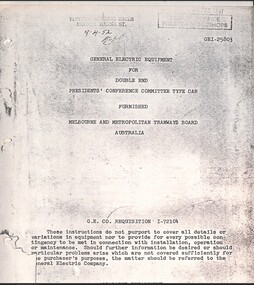
Manual, General Electric, "General electric equipment for double end PCC car", 4/1952
... Gives maintenance and operational details on the tram itself - including operation, inspection, lubrication, GE-1220-E1 Traction motor, GMG-153-B1 motor generator set, control, brake control, trouble shooting and connection diagrams. ...Gives maintenance and operational details on the tram itself - including operation, inspection, lubrication, GE-1220-E1 Traction motor, GMG-153-B1 motor generator set, control, brake control, trouble shooting and connection diagrams. ...Manual provided to the MMTB for the operation of PCC tram No 980 / 1041, dated April 1952. Gives maintenance and operational details on the tram itself - including operation, inspection, lubrication, GE-1220-E1 Traction motor, GMG-153-B1 motor generator set, control, brake control, trouble shooting and connection diagrams. The full document is (25/3/2026) available on the COTMA technical library at https://www.cotma.org.au/library/PCC/pcc-maintenace.htmlYields information about maintenance of the PCC Class tram.Manual, four spring clip or binders in a green plastic card cover - approx 250 pages.trams, tramways, manual, pcc, pcc class, maintenance, tram 980, tram 1041 -
 Tramways/East Melbourne RSL Sub Branch - RSL Victoria Listing id: 27511
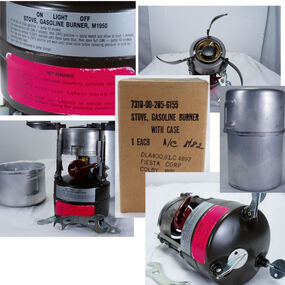
Stove Cooking Gasoline, M-1950 Burner, 2/66
... control valve handle, that swings left to right through 180 degrees. Purpose built service spanner secured between burner support legs. Operating Instruction have worn off. Significant damage to Safety warning label. Still fully operational...control valve handle, that swings left to right through 180 degrees. Purpose built service spanner secured between burner support legs. Operating Instruction have worn off. Significant damage to Safety warning label. Still fully operational ...US Army Rogers M-1950 Stove Portable Gasoline Burner Vietnam Era Removable Hand pump set into base to pressurise fuel Maroon plastic flame control valve handle, that swings left to right through 180 degrees. Purpose built service spanner secured between burner support legs. Operating Instruction have worn off. Significant damage to Safety warning label. Still fully operational1 Gold adhesive label with Operating Instructions 1 Red adhesive label with Safety Warning under instructions
