
Showing 8 items matching "operational technique"
-
 Moorabbin Air Museum
Manual - Aerial agriculture, Agricultural Pilots Manual
... ...Operational technique...Aerial agriculture Agricultural airstrip requirements Pilot technique Aircraft performance Operational planning Operational technique The helicopter in agriculture The turbine engine in agriculture Night aerial spraying operations Study guide for those seeking agricultural pilot licences, circa 1985 4 ring folder Agricultural Pilots Manual Manual Aerial agriculture ...Study guide for those seeking agricultural pilot licences, circa 19854 ring foldernon-fictionStudy guide for those seeking agricultural pilot licences, circa 1985agricultural airstrip requirements, pilot technique, aircraft performance, operational planning, operational technique, the helicopter in agriculture, the turbine engine in agriculture, night aerial spraying operations -
 Australian Commando Association - Victoria
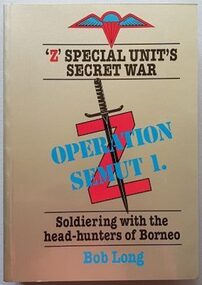
Book, Z Special Units' Secret War- Operations SEMUT 1, 1989
... Although the unit was disbanded after the war, many of the training techniques and operational procedures employed were later used during the formation of other Australian Army special forces units and they remain a model for guerrilla operations to this day....Although the unit was disbanded after the war, many of the training techniques and operational procedures employed were later used during the formation of other Australian Army special forces units and they remain a model for guerrilla operations to this day. ...An account of the operations of The Allied Intelligence Bureau (AIB) better known as ‘Z’ Special Unit. Now a scarce and highly sought after title. The author’s personal experiences with Australian Special Forces (Services Reconnaissance Department) which involved guerrilla soldiering with the head-hunters of Japanese held Borneo during World War 2. Z Special Unit an administrative support unit of (also known as Special Operations Australia (SOA) or the Services Reconnaissance Department (SRD)) was a joint Allied special forces unit formed during the Second World War to operate behind Japanese lines in South East Asia. Predominantly Australian, SRD was a specialist reconnaissance and sabotage unit that included British, Dutch, New Zealand, Timorese and Indonesian members, predominantly operating on Borneo and the islands of the former Netherlands East Indies. The unit carried out a total of 81 covert operations in the South West Pacific theatre, with parties inserted by parachute or submarine to provide intelligence and conduct guerrilla warfare. The best known of these missions were Operation Jaywick and Operation RIMAU, both of which involved raids on Japanese shipping in Singapore Harbour; the latter of which resulted in the deaths of twenty-three commandos either in action or by execution after capture. Although the unit was disbanded after the war, many of the training techniques and operational procedures employed were later used during the formation of other Australian Army special forces units and they remain a model for guerrilla operations to this day.Hard Cover with Dust Jacket – 608 pagesInscribed by author-Bob Long AK223 SEMUT 1 Borneo 1945 -
 Australian Commando Association - Victoria
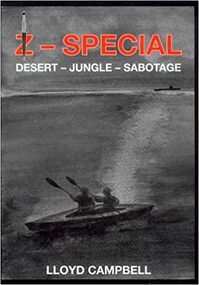
Book, Z Special- Desert-Jungle- Sabotage
... Although the unit was disbanded after the war, many of the training techniques and operational procedures employed were later used during the formation of other Australian Army special forces units and they remain a model for guerrilla operations to this day. ...Although the unit was disbanded after the war, many of the training techniques and operational procedures employed were later used during the formation of other Australian Army special forces units and they remain a model for guerrilla operations to this day. ...When Lloyd Campbell joined the AIF, he was underage and went to the Middle East with 2/17 Battalion. Later in New Guinea he made a major career change and volunteered for an unknown unit and special operations. What he had joined was the SRD – known as Z-Special Unit. Z Special Unit—also known as Special Operations Executive (SOE), Special Operations Australia (SOA) or the Services Reconnaissance Department (SRD)—was a joint Allied special forces unit formed during the Second World War to operate behind Japanese lines in South East Asia. Predominantly Australian, Z Special Unit was a specialist reconnaissance and sabotage unit that included British, Dutch, New Zealand, Timorese and Indonesian members, predominantly operating on Borneo and the islands of the former Netherlands East Indies. The unit carried out a total of 81 covert operations in the South West Pacific theatre, with parties inserted by parachute or submarine to provide intelligence and conduct guerrilla warfare. The best known of these missions were Operation Jaywick and Operation Rimau, both of which involved raids on Japanese shipping in Singapore Harbour; the latter of which resulted in the deaths of 23 commandos either in action or by execution after capture. Although the unit was disbanded after the war, many of the training techniques and operational procedures employed were later used during the formation of other Australian Army special forces units and they remain a model for guerrilla operations to this day. pp. 274, illusts, maps ww2, the australian special operations, special forces, z special unit -
4th/19th Prince of Wales's Light Horse Regiment Unit History Room
Publication, Major Edwin L. Kennedy Jr, The Australian Light Horse: A Study of the Evolution of Tactical and Operational Maneuver
... techniques were successful by adapting to the circumstances of the situation. The Australian Light Horse demonstrated the traits of initiative and flexibility during the campaign in Egypt and Palestine by changing their modus operandii from mounted infantry to cavalry. a seemingly minor shift semantically, a major shift doctrinally. Their adaptability to the situations in the desert was largely responsible for their tactical successes and played a major part in the success of the operational...techniques were successful by adapting to the circumstances of the situation. The Australian Light Horse demonstrated the traits of initiative and flexibility during the campaign in Egypt and Palestine by changing their modus operandii from mounted infantry to cavalry. a seemingly minor shift semantically, a major shift doctrinally. Their adaptability to the situations in the desert was largely responsible for their tactical successes and played a major part in the success of the operational ...This study analyses the actions of the Australian Light Horse in the Middle East campaign during World War 1. It shows the basis for their approach to war and how these techniques were successful by adapting to the circumstances of the situation. The Australian Light Horse demonstrated the traits of initiative and flexibility during the campaign in Egypt and Palestine by changing their modus operandii from mounted infantry to cavalry. a seemingly minor shift semantically, a major shift doctrinally. Their adaptability to the situations in the desert was largely responsible for their tactical successes and played a major part in the success of the operational manoeuver of the mounted forces under General Allenby during the last year of the war.Photocopy , filed in 4 ring A4 loose leaf binder, 181 pages -
4th/19th Prince of Wales's Light Horse Regiment Unit History Room
Training Pamphlet, The Armoured Personnel Carrier Regiment, 25/10/1984
... The pamphlet covers the following: a. the role, tasks, characteristics, organisation and responsibilities of key personnel of the armoured personnel carrier regiment, b. command and control within the regiment,and c. the operational employment of the regiment and the techniques it will use at regimental and squadron level. ...The pamphlet covers the following: a. the role, tasks, characteristics, organisation and responsibilities of key personnel of the armoured personnel carrier regiment, b. command and control within the regiment,and c. the operational employment of the regiment and the techniques it will use at regimental and squadron level. ...The aim of this pamphlet is to provide the doctrine for the employment of the Armoured Personnel Carrier Regiment in war. The pamphlet covers the following: a. the role, tasks, characteristics, organisation and responsibilities of key personnel of the armoured personnel carrier regiment, b. command and control within the regiment,and c. the operational employment of the regiment and the techniques it will use at regimental and squadron level. Manual of Land Warfare Part Two- Armour Training Volume 1 - Armour in Battle Pamphlet No 3 7610-66-120-3847 -
Moorabbin Air Museum
Manual (Item) - Cloud-Seeding Techniques
... Operational Supplement for Technical Manual & Illustrated Parts Level of Importance: World. Manual Cloud-Seeding Techniques ...Description: SUPPLEMENTS TO-1C-130E-4, PUBLISHED 1/2/1966. SUPERSEDES TO-1C-130E-4S-22, PUBLISHED 1/5/1977. 300 pages. Published by USAF. Published 5/10/1977. TO-1C-130E-4S-28. Operational Supplement for Technical Manual & Illustrated Parts Level of Importance: World. -
Moorabbin Air Museum
Book - AGARD reports, Advances in Guidance and Control Systems Using Digital Techniques
... AGARD reports Functional design concepts/trends & requirements Advances in analytical & design techniques Advances in digital system design Data processing & computation techniques Software design validation techniques Operational & system development Overview of use of digital techniques in guidance & control system advances , circa 1979 Advances in Guidance and Control Systems Using Digital Techniques Book AGARD reports ...Overview of use of digital techniques in guidance & control system advances , circa 1979non-fictionOverview of use of digital techniques in guidance & control system advances , circa 1979functional design concepts/trends & requirements, advances in analytical & design techniques, advances in digital system design, data processing & computation techniques, software design validation techniques, operational & system development -
 The Beechworth Burke Museum
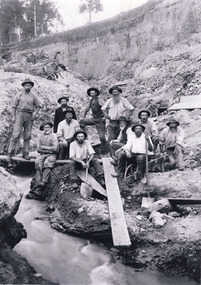
Photograph - Photograph - Reproduction, W. D. Gibbon, Early 1900s
... operational until 1950. The eleven miners in this photograph are: Back row: Led Guthrie, P. Pund, F. Beel, [Unknown] Miller Front row: Paddy McNamara, J. King, W. Beel, [Unknown] Garland, J. Clarke, J. Ryan, H. Bartsh In the background of the photograph is a huge dirt wall that appears to suffer damage caused by hydraulic sluicing. Hydraulic sluicing is a specialised mining technique...operational until 1950. The eleven miners in this photograph are: Back row: Led Guthrie, P. Pund, F. Beel, [Unknown] Miller Front row: Paddy McNamara, J. King, W. Beel, [Unknown] Garland, J. Clarke, J. Ryan, H. Bartsh In the background of the photograph is a huge dirt wall that appears to suffer damage caused by hydraulic sluicing. Hydraulic sluicing is a specialised mining technique ...This photograph was taken in 1911 at Three Mile Creek, about five kilometers south of Beechworth town. Significant digging took place at this location from late 1855, which led to a flood of workers and stores to follow, though daily earnings were slim compared to the nearby Woolshed site. This remained the case even after workers at Three Mile Creek attempted to protest around Beechworth during an election in November 1855. Three Mile Creek was one of seven significant divisions of the Beechworth Mining District formalised by the Governor-in-Council in 1858, though by the time this photograph was taken, the boundaries of the original seven districts had shifted to create seventeen divisions. The Three Mile Goldfields was a site of rich alluvial gold deposits located about 5km south of Beechworth in Victoria. Today, the location of this gold deposit is called Baarmutha. It was a popular area for gold mining in the 1850s but became largely abandoned by the following decade. In 1865, a man named John Pund (a man second from the left in the back row of this photograph shares this surname) recognized that the area could be potentially rich if a better water supply could be obtained. He secured a 15 year license with three other miners. Within the next five years, these men had constructed 19 km of water race going from Upper Nine Mile Creek to Three Mile Creek. By 1881, these four men had delivered 950,000 gallons to the Three Mile Sluicing area which is depicted in this photograph. Pund would later go into partnership with John Alston Wallace who would become owner of the Star Hotel in Beechworth. The Three Mile sluicing location continued to be operational until 1950. The eleven miners in this photograph are: Back row: Led Guthrie, P. Pund, F. Beel, [Unknown] Miller Front row: Paddy McNamara, J. King, W. Beel, [Unknown] Garland, J. Clarke, J. Ryan, H. Bartsh In the background of the photograph is a huge dirt wall that appears to suffer damage caused by hydraulic sluicing. Hydraulic sluicing is a specialised mining technique that involves directing high pressure water flows at dirt to uncover gold. The technique played a significant role in shaping Beechworth's landscape during the gold rush to create the topography seen today.The search for gold is ingrained into the history of Victoria and therefore, images like this one which portray an open cut sluicing site can reveal important information for society and technology for the date when the photograph was taken. This image is of important historical significance for its ability to convey information about sluicing and the methods used to find gold in the late 1800s and early 1900s. It also shows a location where sluicing was undertook which provides insight into the impact of sluicing on the environment at a time when it was done. Images, like this one, of Australian gold rush history can reveal important information about the social and environmental impact of this period. This image depicts diggers standing in a mining location and therefore, this image has the capacity to reveal or support significant information for researchers studying the fashion and social status of diggers in Australia in approximately 1911. It can also provide information on the landscape of Australia in this period and the impact of mining for gold on both society and the Australian landscape. The Burke Museum is home to a substantial collection of Australian mining photographs which can be used to gain a deeper understanding into life on the gold fields, technology used in mining, the miners themselves and the impact of the gold digging on the environment.Black and white / sepia rectangular reproduced photograph printed on glossy photographic paper mounted on board.beechworth, beechworth museum, mining, mining team, three mile creek, sluicing, hydraulic sluicing, photography, gold sluicing, gold mining, pund mining
