
Showing 272 items matching "operations officer"
-
 Melbourne Tram Museum
Document - Instruction, Metropolitan Transit Authority (MTA), "Public Transport Corporation - Tram and Bus Division - Operations Officer - Office Procedure", Nov. 1984
... "Public Transport Corporation - Tram and Bus Division - Operations Officer - Office Procedure"...Provides information for the training of inspectors or Operations Officers, titled "Public Transport Corporation - Tram and Bus Division - Operations Officer - Office Procedure". ...Provides information for the training of inspectors or Operations Officers, titled "Public Transport Corporation - Tram and Bus Division - Operations Officer - Office Procedure". ...Instruction or Manual, brown comb binder, green covers with Metropolitan Transit logo on front cover and The Met name on rear cover, 54 single sided pages. Provides information for the training of inspectors or Operations Officers, titled "Public Transport Corporation - Tram and Bus Division - Operations Officer - Office Procedure". Has forms, procedures, traffic operations, change overs, staff issues, specials, transport cars, services, accidents, defective cars, closing of depots and general operations.trams, tramways, the met, inspectors, metropolitan transit authority, traffic officers, training, instructions, depot, staff, tram bus services -
 National Vietnam Veterans Museum (NVVM)
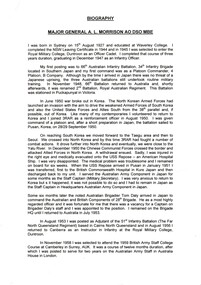
Document, A Copy of the Biography of Major General A.L. Morrison AO DSO MBE
... ...Operations Officer...Morrison AO DSO MBE Biography - Alan Lindsay Morrison Col Alan Lindsay Morrison 2508 Royal Australian Infantry Corps 9th Battalion The Royal Australian Regiment Companion of the Distinguished Service Order Royal Military College Officer Cadet 2nd Battalion Royal Australian Regiment 3RAR Korea Operations Officer 1RAR Lt Col A.L. Morrison Australian Army Staff College 1st Australian Task Force DSO Military Assistant Chief of the General Staff Sir Thomas Daly Brig Alan Lindsay Morrison Maj Gen Alan Lindsay Morrison Officer of the Order of Australia AO A Copy of the Biography of Major General A.L. ...A Copy of the Biography of Major General A.L. Morrison AO DSO MBE. See media files for more infomation.major general a.l. morrison ao dso mbe, biography - alan lindsay morrison, col alan lindsay morrison, 2508, royal australian infantry corps, 9th battalion, the royal australian regiment, companion of the distinguished service order, royal military college, officer cadet, 2nd battalion royal australian regiment, 3rar, korea, operations officer, 1rar, lt col a.l. morrison, australian army staff college, 1st australian task force, dso, military assistant, chief of the general staff sir thomas daly, brig alan lindsay morrison, maj gen alan lindsay morrison, officer of the order of australia, ao -
 National Vietnam Veterans Museum (NVVM)
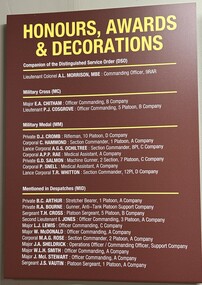
Honour Board - Honours, Awards & Decorations
... ...Operations Officer...Vautin 9 RAR Honour Board Companion of the Distinguished Service Order DSO Member of the Order of the British Empire (MBE) Lt Col Alan Lindsay Morrison 2508 Royal Australian Infantry Corps 9th Battalion The Royal Australian Regiment Military Cross MC Maj Edward Albert Chitham 235140 Officer Commanding B Company Lt Peter John Cosgrove 235341 1 Australian Reinforcement Unit Headquarters 1st Australian Task Force Military Medal MM Pte Douglas John Cromb L/Cpl Douglas John Cromb 3792885 Australian National Serviceman 10 Platoon D Company Cpl Colin Hammond 214044 1 Platoon A Company L/Cpl Andrew Gordon Stuart Ochiltree 39324 Section Commander 8 Platoon C Company Cpl Allen Patrick Paul Rae 216899 Royal Australian Army Medical Corps RAAMC Medical Assistant Pte Gregory Donald Salmon 2788882 Machine Gunner 2 Section 7 Platoon Cpl Peter Snell 39397 L/Cpl Trevor Robert Whitton 217749 12 Platoon Mention in Dispatches MID Pte Barry Charles Arthur 39601 Stretcher Bearers Pte Raymond Arthur Bourne 1733972 Gunner Anti-Tank Platoon Sgt Thomas Henry Cross 54454 Platoon Sergeant 2Lt Ian Jones 1201040 3 Platoon Maj Lawrence John Lewis 26351 Maj (Temp) William McDonald 335122 Medal For Gallantry Cpl (Temp) Mark Ardroy Greffield Rose 39532 Maj John Arthur Sheldrick 335088 Operations Officer Support Company Maj (Temp) Warwick Louis Hunt Smith 53024 Maj John Melville Stewart 4899 Sgt John Stafford Vautin 214185 Honours, awards, decorations:-/ Companion of the Distinguished Service Order (DSO),Lt Col. ...Honours, awards, decorations:-/ Mention in Dispatches (MID) Pte B.C. Arthur, Pte R.A. Bourne, Sgt T.H, Cross, 2Lt I. Jones, Maj L.J. Lewis, Maj W. MAudio, C Donald, Cpl M.A.G. rose, Maj J.A. Sheldrick, Maj J Mcl. Stewart, Sgt J.S. VautinMaroon board with yellow and white print. There are four awards/medals mentioned, each of which is underlined with a yellow line. Recipients of awards are listed with Rank, Name and position/company.Honours, awards, decorations:-/ Companion of the Distinguished Service Order (DSO),Lt Col. A. L. Morrison, MBE/Military Cross (MC), Maj E.A. Chitham, Lt P.J. Cosgrove,/ Military Medal (MM), Pte D.J, Cromb, Cpl C. Hammond, L/Cpl A.G.S. Ochiltree, Cpl A.P.P. Rae, Pte G.D. Salmon, Cpl P Snell, L/Cpl T.R. Whitton,/ Mention in Dispatches (MID) Pte B.C. Arthur, Pte R.A. Bourne, Sgt T.H, Cross, 2Lt I. Jones, Maj L.J. Lewis, Maj W. MAudio, C Donald, Cpl M.A.G. rose, Maj J.A. Sheldrick, Maj J Mcl. Stewart, Sgt J.S. Vautin9 rar, honour board, companion of the distinguished service order, dso, member of the order of the british empire (mbe), lt col alan lindsay morrison, 2508, royal australian infantry corps, 9th battalion, the royal australian regiment, military cross, mc, maj edward albert chitham, 235140, officer commanding, b company, lt peter john cosgrove, 235341, 1 australian reinforcement unit, headquarters, 1st australian task force, military medal, mm, pte douglas john cromb, l/cpl douglas john cromb, 3792885, australian national serviceman, 10 platoon, d company, cpl colin hammond, 214044, 1 platoon, a company, l/cpl andrew gordon stuart ochiltree, 39324, section commander, 8 platoon, c company, cpl allen patrick paul rae, 216899, royal australian army medical corps, raamc medical assistant, pte gregory donald salmon, 2788882, machine gunner, 2 section, 7 platoon, cpl peter snell, 39397, l/cpl trevor robert whitton, 217749, 12 platoon, mention in dispatches, mid, pte barry charles arthur, 39601, stretcher bearers, pte raymond arthur bourne, 1733972, gunner, anti-tank platoon, sgt thomas henry cross, 54454, platoon sergeant, 2lt ian jones, 1201040, 3 platoon, maj lawrence john lewis, 26351, maj (temp) william mcdonald, 335122, medal for gallantry, cpl (temp) mark ardroy greffield rose, 39532, maj john arthur sheldrick, 335088, operations officer, support company, maj (temp) warwick louis hunt smith, 53024, maj john melville stewart, 4899, sgt john stafford vautin, 214185 -
 Bendigo Military Museum
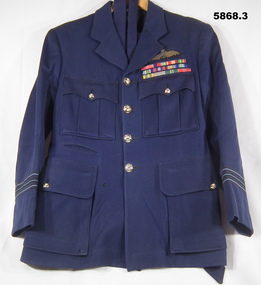
Uniform - UNIFORM, RAAF, 3) Trent Nathan
... 'Joe' Lyons, Operations Officer for No. 77 Squadron. Part of the Ian A. ...'Joe' Lyons, Operations Officer for No. 77 Squadron. Part of the Ian A. ...RAAF uniform worn by Squadron Leader Ian A. 'Joe' Lyons, Operations Officer for No. 77 Squadron. Part of the Ian A. 'Joe' Lyons MBE Collection. See Catalogue No. 5374P for details of his service record..1) RAAF uniform jacket, dark blue in colour. Black fabric inner lining. Gold coloured buttons. Coat has two button down breast pockets and two button-down side pockets. Dark blue fabric belt with metal buckle is threaded through two belt loops. Three rows of service ribbons including an MBE ribbon and pilot officer's wings on left hand breast. Rank insignia on the bottom of each sleeve. .2) Dark blue fabric trousers with two side pockets, belt loops and button fly. Buttons for braces on the inner waist band. .3) Dark blue fabric tie. Manufacturer's label on keeper loop..1) On label sewn into neck: 'M TX'. .2) On label sewn onto inside waist band: ' M TX'. .3) On keeper: Trent Nathan'.uniform, raaf, ian a. 'joe' lyons -
 Uniting Church Archives - Synod of Victoria
Photograph, 1944
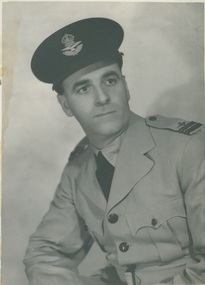
... "Seasons Greetings I Menear F/LT Control Officer Operations Room Pearce W.A."...Ira Menear, methodist, minister, Adelaide University, Brighton Training College, Methodist Inland Mission, Cloncurry, RAAF, Commonwealth Rehabilitation Centre "Seasons Greetings I Menear F/LT Control Officer Operations Room Pearce W.A." B & W waist length studio portrait of Rev. ...Rev Ira Menear (1901 - 1977). Born at Kapunda. Worked at the Kimba and Pt Neill mission stations on the west coast of South Australia before studying at the Brighton Training College and Adelaide University. Graduated B.A. Adelaide University 1928. After completing his theological training he was appointed to the Norwood Circuit before being appointed to take charge of the Methodist Inland Mission at Cloncurry. Minister at Crow's Nest, Gympie & Rockhampton 1936 - 1940. In 1940 he was accepted as a pilot officer in the RAAF, having been given leave of absence by the Methodist Conference. Menear enlisted RAAF air crew but was later transferred to the administrative staff. He rose from A.C.1 to the rank of Acting Wing Commander. He served in many parts of Australia, including the Darwin area. After the war Rev Menear took charge of the Commonwealth Rehabilitation Centre at Mount Osmond and later Mount Breckan, Victoria Harbour Rehabilitation Centre. B & W waist length studio portrait of Rev. Ira Menear dressed in his RAAF Flt. Lt. uniform."Seasons Greetings I Menear F/LT Control Officer Operations Room Pearce W.A."ira menear, methodist, minister, adelaide university, brighton training college, methodist inland mission, cloncurry, raaf, commonwealth rehabilitation centre -
 Melbourne Tram Museum
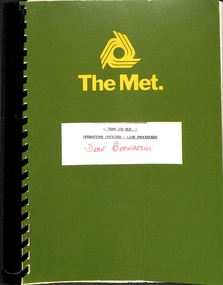
Document, The Met, "Tram and Bus Operations Officers - Line Procedures", 11/1984
... Gives detailed information on training of Operations Officers in bus and tram operations. has a contents sheet. ...Gives detailed information on training of Operations Officers in bus and tram operations. has a contents sheet. ...Gives detailed information on training of Operations Officers in bus and tram operations. has a contents sheet. Explains leadership, timetables, headway sheets, procedures for accidents, reports, communications, adjusting traffic, late running, fault finding, service run ins and industrial disputes.Yields information about the training of line officers and what they had to know.Document - approx 120 A4 sheets, green comb binder, with printed green The Met covers.tramways, the met, depot manager, management, operations, line officers, training -
 Melbourne Tram Museum
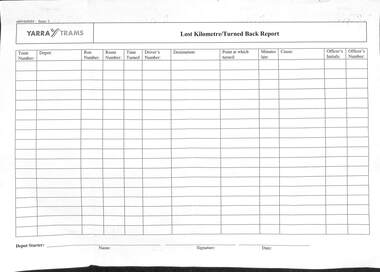
Document - Form/s, Yarra Trams, "Operations Officer's Report of car turned back and kilometres lost for..", "Lost Kilometre/Turned Back Report", c2005?
... Set of two forms - A4 photocopies - Yarra Trams .1 - "Operations Officer's Report of car turned back and kilometres lost for.." .2 - "Lost Kilometre/Turned Back Report" To provide details of tram services that were turned back or "short shunted" and details - recording the tram, depot, run number, route, time, driver's details, destination, point of turn back, minutes late, cause, and Officer's details. ...This information became important for the performance reports to Government. "Operations Officer's Report of car turned back and kilometres lost for..", "Lost Kilometre/Turned Back Report" Document Form/s Yarra Trams ...Set of two forms - A4 photocopies - Yarra Trams .1 - "Operations Officer's Report of car turned back and kilometres lost for.." .2 - "Lost Kilometre/Turned Back Report" To provide details of tram services that were turned back or "short shunted" and details - recording the tram, depot, run number, route, time, driver's details, destination, point of turn back, minutes late, cause, and Officer's details. This information became important for the performance reports to Government.trams, tramways, tramcars, operations, forms, depots, yarra trams -
 Melbourne Tram Museum
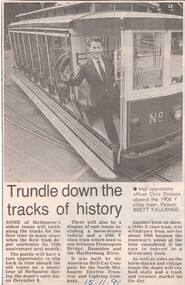
Newspaper, Brett Faulkner, "Trundle down the tracks of history", 15-11-1991
... The accompanying photo by Brett Faulkner has Met Operations Officer Chris Drossos leaning out of V 214....The accompanying photo by Brett Faulkner has Met Operations Officer Chris Drossos leaning out of V 214. ...Newspaper clipping titled "Trundle down the tracks of history"" about the 75th anniversary of Kew Depot next month. Notes the proposed display of trams, including V 214. The accompanying photo by Brett Faulkner has Met Operations Officer Chris Drossos leaning out of V 214.Yields information about the celebrations of Kew Depot's 75th anniversary.Newspaper clipping from The Sun, dated 15-11-1991kew depot, 75th anniversary, v class, tram 214, the met -
 University of Melbourne, Burnley Campus Archives
Document, Andrew Smith, Andrew Smith Miscellaneous Documents, 1986-2022
... Documents from Andrew Sith (Gardens and Operations Officer), personal file. Includes: Guest list for Andrew Smith Farewell 25.03.2022. ...andrew smith staff student farewell james hitchmough 30th celebration burnley backchat friends of burnley gardens Documents from Andrew Sith (Gardens and Operations Officer), personal file. Includes: Guest list for Andrew Smith Farewell 25.03.2022. ...andrew smith, staff, student, farewell, james hitchmough, 30th celebration, burnley backchat, friends of burnley gardens -
 Melbourne Tram Museum
Document - Set of 9 MMTB or The Met badges, Stokes & Sons, 1960s to 1990s
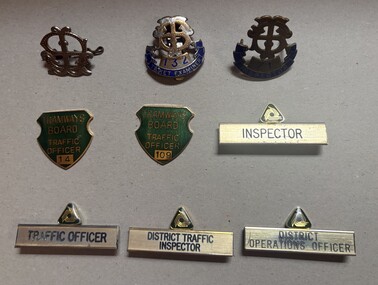
... Set of nine badges collected or worn by Dean Bernardini during his career with the MMTB or The Met - see item 9579 for his positions. 1 - MMTB cap badge 2 - Ticket Examiner No. 137 with clip on the rear 3 - Inspector No. 71 cap badge with clips on the rear. 4 - MMTB Traffic Officer badges 14 & 109 5 - The Met - Inspector 6 - The Met - Traffic Officer 7 - The Met - District Traffic Inspector 8 - The Met - District Operations Officer Items 5 to 8 have a pin clip on the rear. ...Set of nine badges collected or worn by Dean Bernardini during his career with the MMTB or The Met - see item 9579 for his positions. 1 - MMTB cap badge 2 - Ticket Examiner No. 137 with clip on the rear 3 - Inspector No. 71 cap badge with clips on the rear. 4 - MMTB Traffic Officer badges 14 & 109 5 - The Met - Inspector 6 - The Met - Traffic Officer 7 - The Met - District Traffic Inspector 8 - The Met - District Operations Officer Items 5 to 8 have a pin clip on the rear. ...Set of nine badges collected or worn by Dean Bernardini during his career with the MMTB or The Met - see item 9579 for his positions. 1 - MMTB cap badge 2 - Ticket Examiner No. 137 with clip on the rear 3 - Inspector No. 71 cap badge with clips on the rear. 4 - MMTB Traffic Officer badges 14 & 109 5 - The Met - Inspector 6 - The Met - Traffic Officer 7 - The Met - District Traffic Inspector 8 - The Met - District Operations Officer Items 5 to 8 have a pin clip on the rear. MMTB badges made by Stokes & Sons, no manufacturer marked for The Met badges.Yields information about the the type and style of badges issued to MMTB and The Met Traffic Offices for identification purposes.Set of nine badges - metal with pins or clips.tramways, the met, management, operations, badges -
 Bendigo Military Museum
Photograph - PHOTOGRAPH, FRAMED, Vincent Kelly
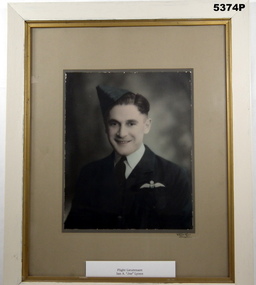
... He was awarded an MBE as Operations Officer with 77Sqd for 'Outstanding enthusiasm and energy at 3 Korean bases'. ...He was awarded an MBE as Operations Officer with 77Sqd for 'Outstanding enthusiasm and energy at 3 Korean bases'. ...IAN ALFRED (Joe) LYONS MBE Born 16.2.1915 in Bendigo enlisted in the RAAF aged 25 years on 27.5.1940, No 400095. Starting in the ranks as an LAC, he rose to Flt/Sgt pre-embarkation. He embarked for the Middle East on 2.11.1941before dis-embarking to serve with No 3 Sqd RAAF. During heavy action on 8.1.1942, his plane was forced down due to engine damage. It landed in an enemy minefield and when it came to a halt, its wheels were straddling a mine. After being rescued by a British officer, dozens of mines were located and dug up. On return, some 15 miles from base, the vehicle Lyons was travelling in hit a mine (on 9.1.1942), resulting in 5 KIA or WIA. Lyons spent 2 weeks in hospital with severe concussion and deafness. Lyons the embarked for Australia on 11.3.1942 before disembarking on 18.4.1942. He was posted to Townsville with 82nd Sqd on 27.6.1944. Subsequently he was posted to Noemfoor Island on 21.9.1944 as Operational with 82nd Sqd and promoted to Flt/Lt (Temp.) on 3.1.1945. On 6.1.1945 he was posted to 77Sqd as Operational on Morotai. This deployment ended on 9.7.1945. Records show that he flew 26 Strike/Attack missions and 13 others with both squadrons. Post WW2, Lyons remained with the RAAF with a new service number (033072). On 2.2.1948 he was posted to Japan before returning to Australia on 28.8.1948, apparently for medical reasons. He was appointed Flt/Lt on 23.9.1948 before returning to Japan and Korea on 22.8.1950. He was awarded an MBE as Operations Officer with 77Sqd for 'Outstanding enthusiasm and energy at 3 Korean bases'. A US Bronze Star was awarded to Lyons for 'Distinguished and meritorious service as Operations Officer in Korea during the period 14.10.1950 to 17.2.1951'. After Korea, Lyons received a number of posting from Victoria to Western Australia. He was awarded the Air Efficiency Medal in 1964. At his own request, Flt/Lt Ian Alfred 'Joe' Lyons MBE, retired from the RAAF HQ OP COM on 15.12.1967. The photograph is part of the Ian A. 'Joe' Lyons MBE Collection.Framed hand tinted colour head and shoulders photograph of a man in an RAAF uniform. The photograph is bordered with a light brown matt. THe wooden frome is painted white and gold. A white printed label bearing the name of the man is located below the photograph. Clear perspex covers the photograph. The photographer's name also appears below the photograph. The rear of the frame is covered in brown paper secured with masking tape. Two eyes and white cord are attached for hanging purposes.Handwritten in black below the photograph: 'VINCENT KELLY, Bendigo'.raaf uniform, photograph, flight lieutenant ian a. lyons -
 Wangaratta RSL Sub Branch
Photograph - Framed Photograph
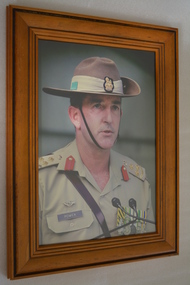
... He further served in 4th Field Regiment as a Gun Position Officer, Assistant Adjutant, Adjutant, Operations Officer (BatteryCommander Headquarters Battery) and Commanding Officer.Ash has commanded the 1st Brigade, 1st Division and Training Command – Army. ...He further served in 4th Field Regiment as a Gun Position Officer, Assistant Adjutant, Adjutant, Operations Officer (BatteryCommander Headquarters Battery) and Commanding Officer.Ash has commanded the 1st Brigade, 1st Division and Training Command – Army. ...Colour photograph of Lt General Brian Ashley "Ash" Power AO, CSC . Ash Power was born on the 20th of January 1957 in Wangaratta, Victoria. After completing his secondary education at Wangaratta High School, he entered the Royal Military College in 1975, graduating in 1978 into the Royal Regiment of Australian Artillery. His initial appointment was as a Section Commander in 4th Field Regiment. He further served in 4th Field Regiment as a Gun Position Officer, Assistant Adjutant, Adjutant, Operations Officer (BatteryCommander Headquarters Battery) and Commanding Officer.Ash has commanded the 1st Brigade, 1st Division and Training Command – Army. He has served on exchange at the Royal Military Academy Sandhurst, Camberley, United Kingdom and has had other training appointments at the School of Artillery, and the Royal Military College Duntroon. He also served as the Defence Attaché in Thailand. On operations Ash deployed to Bougainville on Operation BELISI as Chief of Staff in 1998 and in 1999, after a short period as Chief of Staff Deployable Joint Force Headquarters, was deployed as the Colonel Operations for INTERFET in East Timor. From June 2004 to July 2005 he was appointed as Director, Combined Planning Group, US Central Command, Tampa. He deployed as the Deputy Chief of Staff, Strategic Partnering Headquarters International Security Assistance Force, Kabul, Afghanistan in 2010-11. Lieutenant General Power retired from the Army on 19 July 2014, his final posting being the Chief of Joint OperationsBrown timber frame containing photograph of uniformed Army Officer ash power, australian army -
 Northern District School of Nursing. Managed by Bendigo Historical Society Inc.
Administrative record - Northern District School of Nursing Graduates Association - Letter from the Health Department Victoria, 07 July 1987
... This document is a formal acceptance letter from a Senior Operations Officer at the S Health Department Victoria. ...This document is a formal acceptance letter from a Senior Operations Officer at the S Health Department Victoria. ...The Northern District School of Nursing in Victoria, Australia Graduates Association: History of the School Managed by a committee including hospital administrators, medical professionals, and nursing leaders from several regional hospitals. Associated with major hospitals in the Northern District, including Bendigo Base, Mildura Base, Castlemaine, Echuca, Swan Hill, St. Arnaud, and Kyneton District Hospitals. Provide high-quality theoretical and practical nursing training. Raise the standard of nursing education in the region. Maintain the highest principles of nursing practice. Applicants must be at least 17 years old and hold a Proficiency Certificate or higher educational qualification. Application involves submitting forms, certificates, an interview, an aptitude test, and a medical examination. A three-month probationary period follows initial acceptance. Preliminary Training School: Four-week introductory course covering basic nursing, anatomy, hygiene, and practical skills. Practical experience in various hospital departments, guided by senior staff. Study Block Plan: Includes several blocks of theoretical and practical instruction throughout the three-year program. Regular school exams and two state exams (First Professional and Final State) are required for progression and graduation. Nurses work a 40-hour week with at least one or two days off per week and three weeks of annual leave. Accommodation is provided in comfortable hostels with good facilities. Uniforms are supplied free; nurses provide their own shoes and stockings. Salaries and allowances are regulated, with deductions for board and free medical care. Additional Information Post-Graduate Opportunities. Senior positions require further experience and additional certificates (e.g., Midwifery, Infant Welfare).Diploma courses available in administration, teaching, and specialized nursing fields. Bursaries are available for advanced study.Career Prospects: Graduates can pursue roles in administration, teaching, ward and departmental leadership, district and visiting nursing, industrial and school nursing, and more. Opportunities existed both within hospitals and in community or specialized settings.FAQs and Practical Details. Minimal training costs (mainly exam fees and personal items).Living out allowances and travel expenses are covered. Four training intakes per year; waiting periods are short if qualifications are met.Northern District School of Nursing Graduates Association - Letter from the Health Department Victoria 07 July 1987 to Mrs M Worme, Secretary This item contains the following documents: 3793.12a Letter from the Health Department Victoria 07 July 1987 to Mrs M Worme, Secretary. This document is a formal acceptance letter from a Senior Operations Officer at the S Health Department Victoria. The officer accepts an invitation to attend the Northern District School of Nursing Past Graduates group meeting at Lister House on Monday, 27 July 1987, at 10:30 a.m. This document reviews the history, current status, and proposed changes for the Northern District Nursing Graduates Association (NDSNGA): The NDSN was a major development in nursing education, though initially met with resistance and seen by some as radical. Advocacy by figures like Miss Long was crucial in advancing nursing education standards. There is concern that without updates, the Association may become irrelevant or cease to exist as new generations of graduates emerge. Minor changes could help the Association better serve practicing, non-practicing, and retired nurses, fostering community and professional discussion. Membership Eligibility:Open to graduates of NDSN and CAE nursing courses in the region.Include students who did not complete the course. Allow nurses who graduated elsewhere but worked in the region for at least five years. Name Change Options include minor modifications (e.g., Northern District Nursing Graduates Association) or broader regional names (e.g., Loddon Campaspe Region). The Association maintains connections among graduates, with opportunities for tours and social contact. Some school facilities have been repurposed (e.g., library, recreation room, hostel). Progress on creating an archival repository and potential museum is slow due to limited resources and the scale of groundwork required. Members are encouraged to contribute historical materials. Written communication is less frequent among nurses, but efforts are being made to gather feedback via newsletters and questionnaires. Member input is sought on proposed changes, especially regarding membership and the Association's name. These points highlight the Association's ongoing efforts to adapt, preserve its heritage, and remain relevant to both current and future nursing professionals.nurse training, lister house, m worme -
 Ballarat Tramway Museum
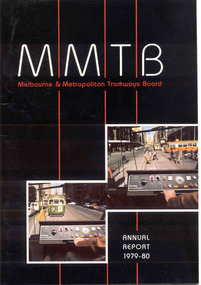
Document - Report, Melbourne and Metropolitan Tramways Board (MMTB), MMTB Reports 1979 to 1981, 1980 to 1982
... Three copies of the Annual report of the MMTB for the years end 1980, 1981 and 1982 3953.1 - "Annual Report 1979-80" - white gloss paper with colour card covers with 36 pages, gloss, on inside giving details of the MMTB Board, Officers, Operations report, schedule of debenture, investments, Auditors reports, record of Annual traffic receipts, passengers, miles etc, tram and bus routes operated, statistical information, graphs and photographs. ...Operations Trackwork 3951.1 - has Graeme Breydon's address stamp on front cover., 3951.2 - ditto, 3951.3 - ditto and on inside of front cover., 3951.6 - "G. Breydon" in pencil on front cover and pencil comments on balance sheet., 3951.7 - ditto Three copies of the Annual report of the MMTB for the years end 1980, 1981 and 1982 3953.1 - "Annual Report 1979-80" - white gloss paper with colour card covers with 36 pages, gloss, on inside giving details of the MMTB Board, Officers, Operations report, schedule of debenture, investments, Auditors reports, record of Annual traffic receipts, passengers, miles etc, tram and bus routes operated, statistical information, graphs and photographs. ...Three copies of the Annual report of the MMTB for the years end 1980, 1981 and 1982 3953.1 - "Annual Report 1979-80" - white gloss paper with colour card covers with 36 pages, gloss, on inside giving details of the MMTB Board, Officers, Operations report, schedule of debenture, investments, Auditors reports, record of Annual traffic receipts, passengers, miles etc, tram and bus routes operated, statistical information, graphs and photographs. Photos include; Z 117 in Bourke St, Z 31 Burwood terminus, new safety tower wagon, Z118 in Bourke St, W2 528 High St Kew, reconstruction of High St Kew, Z3 120, cable and electric trams at Flemington Bridge, Z3 117, fitting trams to bogies at Preston workshops, Queens Bridge roundabout, MAN bus, Burwood substation, Z111 in Bourke St and Z's enter Elizabeth St service and Z3 129 on rear cover at night. 3953.2 - "Annual Report 1980-81" - white gloss paper with colour card covers with 36 pages, on inside giving details of the MMTB Board, Officers, Operations report, schedule of debenture, investments, Auditors reports, record of Annual traffic receipts, passengers, miles etc, tram and bus routes operated, statistical information, graphs and photographs. Photos include; image of Park St, Domain Road Jtn before changes, Museum station entrance, Flinders and Swanston St, CDB City Ring bus service, Swanston St, Westgate bus route, Park St, new substation, Swanston and Flinders St, Flinders land, and give way to buses pulling out of stops. 3953.2 - "Annual Report 1981-82" - white gloss paper with colour card covers with 36 pages, on inside giving details of the MMTB Board, Officers, Operations report, schedule of debenture, investments, Auditors reports, record of Annual traffic receipts, passengers, miles etc, tram and bus routes operated, statistical information, graphs and photographs. Photos include images of a z class crossing the Maribyrnong bridge, Footscray bus workshops, track renewals, a wedding at Wattle Park, a W2 arriving at Museum Station, Clifton Hill interchange, buses, Z class in Elizabeth St (Nos 158 and 43), Z89 in Mt Alexander Road North Essendon and a W2 loaded on a truck for New Zealand.3951.1 - has Graeme Breydon's address stamp on front cover., 3951.2 - ditto, 3951.3 - ditto and on inside of front cover., 3951.6 - "G. Breydon" in pencil on front cover and pencil comments on balance sheet., 3951.7 - dittotrams, tramways, mmtb, melbourne, annual reports, operations, trackwork -
 Ballarat Tramway Museum
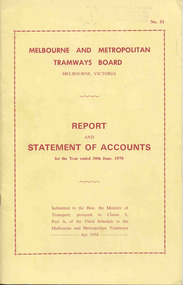
Document - Report, Melbourne and Metropolitan Tramways Board (MMTB), MMTB Reports 1970 to 1976, 1970 to 1976
... No printer name given. 3951.4 - "Annual Report 1973" - light grey gloss heavy paper cover with 40 pages, gloss, on inside giving details of the MMTB Board, Officers, Operations report, schedule of debenture, investments, Auditors reports, record of Annual traffic receipts, passengers, miles etc, tram and bus routes operated, statistical information, graphs and photographs. ...No printer name given. 3951.4 - "Annual Report 1973" - light grey gloss heavy paper cover with 40 pages, gloss, on inside giving details of the MMTB Board, Officers, Operations report, schedule of debenture, investments, Auditors reports, record of Annual traffic receipts, passengers, miles etc, tram and bus routes operated, statistical information, graphs and photographs. ...Seven copies of the Annual report of the MMTB for the years end 1970 to 1976. 3951.1 - "Report and Statement of Accounts for year ended 30 June 1970", No. 51, gloss fawn heavy paper cover with 44 pages, gloss, on inside giving details of the MMTB Board, Officers, Balance Sheet, Statement of operations, schedule of debenture, investments, Auditors reports, record of Annual traffic receipts, passengers, miles etc, tram and bus routes operated, statistical information, graphs and photographs. Photos include Doncaster depot, track reconstruction - concrete spreading equipment, Wattle Park and tram wheel grinding equipment. No printer name given. 3951.2 - "Report and Statement of Accounts for year ended 30 June 1971", No. 52, white embossed heavy paper cover with 44 pages, gloss, on inside giving details of the MMTB Board, Officers, Balance Sheet, Statement of operations, schedule of debenture, investments, Auditors reports, record of Annual traffic receipts, passengers, miles etc, tram and bus routes operated, statistical information, graphs and photographs. Photos include; prototype tram in St Kilda Rd, the New computer installation, decorated tram - Christmas 1970, Tram Advertising 1971 (briquettes), No printer name given. 3951.3 - "Annual Report 1972" - white gloss heavy paper cover with 44 pages, gloss, on inside giving details of the MMTB Board, Officers, Operations report, schedule of debenture, investments, Auditors reports, record of Annual traffic receipts, passengers, miles etc, tram and bus routes operated, statistical information, graphs and photographs. Photos include; school children boarding bus, passengers boarding bus at Shoppingtown, Concreting tracks in Keilor Road, Rail Inspection Unit and Wattle Park. No printer name given. 3951.4 - "Annual Report 1973" - light grey gloss heavy paper cover with 40 pages, gloss, on inside giving details of the MMTB Board, Officers, Operations report, schedule of debenture, investments, Auditors reports, record of Annual traffic receipts, passengers, miles etc, tram and bus routes operated, statistical information, graphs and photographs. Photos include; tram 1041, interior and driving cabin of 1041 and fire fighting demonstration at Preston Workshops. No printer name given. 3951.5 - "Annual Report 1974" - light blue gloss heavy paper cover with 40 pages, gloss, on inside giving details of the MMTB Board, Officers, Operations report, schedule of debenture, investments, Auditors reports, record of Annual traffic receipts, passengers, miles etc, tram and bus routes operated, statistical information, graphs and photographs. Photos include; Pedestrian Mall, Bourke St, New truck assembly area at Preston Workshops, electronic control equipment for new trams, English language lessons for migrant employees and 1041 turning from Bourke into Spring St. Printed by Sands & McDougall. 3951.6 - "Annual Report 1975" - fawn coloured gloss heavy paper cover with 44 pages, gloss, on inside giving details of the MMTB Board, Officers, Operations report, schedule of debenture, investments, Auditors reports, record of Annual traffic receipts, passengers, miles etc, tram and bus routes operated, statistical information, graphs and photographs. Photos include; Z class tram in Nicholson St, National Bus in Doncaster, New passenger shelter in St Kilda Road, new trams at Preston, drivers position of Z class tram, Interior of National Bus, Drivers position in National bus and first cable car in Melbourne after restoration. Printed by Magnum Press. 3951.7 - "Annual Report 1976" - light blue coloured gloss heavy paper cover with 44 pages, gloss, on inside giving details of the MMTB Board, Officers, Operations report, schedule of debenture, investments, Auditors reports, record of Annual traffic receipts, passengers, miles etc, tram and bus routes operated, statistical information, graphs and photographs. Photos include; Z2 in Bourke St, Z24 Victoria Parade, Z17 Nicholson St, overhead trucks, W2 in Mount Alexander Road Nth Essendon, Z28 Nicholson St, W2 226 loading passengers St Georges Rd and Wattle Park. Printed by Magnum Press.3951.1 - has Graeme Breydon's address stamp on front cover., 3951.2 - ditto, 3951.3 - ditto and on inside of front cover., 3951.6 - "G. Breydon" in pencil on front cover and pencil comments on balance sheet., 3951.7 - dittotrams, tramways, mmtb, melbourne, annual reports, operations, trackwork -
 Flagstaff Hill Maritime Museum and Village
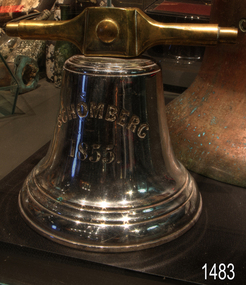
Functional object - Bell, Schomberg 1855, Before 1855
... Officer spotted the SS Queen and signalled for help. The master of the Queen brought his vessel alongside, and all passengers and crew disembarked safely. The Black Ball Line’s Melbourne agent sent another steamer to collect the passengers’ baggage, and other steamers assisted with cargo salvage until worsening weather forced operations to cease. ...Officer spotted the SS Queen and signalled for help. The master of the Queen brought his vessel alongside, and all passengers and crew disembarked safely. The Black Ball Line’s Melbourne agent sent another steamer to collect the passengers’ baggage, and other steamers assisted with cargo salvage until worsening weather forced operations to cease. ...The Rescue and Journey of the Schomberg Bells: This bell was the smaller of two rescued by the crew of the Schomberg following the ship’s wreck in 1855. While the specific purpose of the smaller bell is unknown, it may have served to assemble the crew or signal mealtimes on board. After surviving the shipwreck, the crew carried both bells as they made their way along the coastline. Their journey eventually led them to the home of settler John Manning, located at Hopkins Point near Warrnambool. Manning took possession of the bells and subsequently presented them to two churches in Warrnambool. The smaller bell went to St Joseph’s Catholic Church, while the larger bell went to St John’s Presbyterian Church. After around a year, the small bell at St Joseph’s developed a crack and became unusable. Thomas Manifold imported a replacement bell for the church, and the damaged bell was stored at his farm. Years later, when the property was sold to John Logan, the discarded bell was donated to the old Warrnambool Museum upon its opening in 1886. The Curator, Joseph Archibald, placed the bell on display in the entry. In 1975, it was transferred from the Warrnambool Art Gallery to Flagstaff Hill. The ’Mystery’ of the small bell solved: Despite numerous attempts by the staff at Flagstaff Hill to restore the bell’s lustre, the bell remained dull and tarnished. In October 1986, Director Peter Ronald decided to send the bell for professional advice. The bell was entrusted to Briggs Marine Products, a renowned brass founder established in 1912. Upon examination, the specialists at Briggs discovered the reason behind the bell’s persistent lack of shine: it had originally been silver-plated, but most of the plating had worn away over time. The experts at Briggs then undertook the task of restoring the bell, successfully returning it to a gleaming silver surface. The Sailing Ship Schomberg: Launched in 1855, the Schomberg was regarded as the “Noblest” ship afloat at the time. Owned by the Black Ball Line, it was built for their passenger fleet by Alexander Hall of Aberdeen at a cost of £43,103. The construction featured three skins: one planked fore and aft and two diagonally planked, all fastened with screw-threaded trunnels (wooden rails). The ship’s First Class accommodation was luxurious, boasting velvet pile carpets, large mirrors, rosewood, birds-eye maple and mahogany timbers, satin damask soft furnishings, and an oak-lined library with a piano. Schomberg had a capacity for 1,000 passengers. The ship’s master, Captain James Nicol Forbes—also known as ‘Bully’ Forbes—was only 34 years old at the launch. He had a reputation for setting and breaking speed records on the Black Ball Line’s Marco Polo and Lightning. In 1852, Forbes completed the London to Melbourne journey on the Marco Polo in 68 days, a record at the time, though 53 passengers died during the voyage. In 1854, he sailed the Lightning to Melbourne in 76 days and returned in only 63 days—a record that stood among sailing ships. Forbes was known for driving his ship and crew to their limits, often prioritising speed over passenger comfort. Determined to set new records, he promised to reach Melbourne in sixty days, declaring he would do so “with or without the help of God.” The Maiden Voyage and the Wreck: Schomberg departed Liverpool on 6th October 1855, flying a banner that read “Sixty Days to Melbourne”. The vessel carried 430 passengers and 3,000 tons of cargo, including materials to build the Melbourne to Geelong Railway and a bridge over the Yarra River. Among the cargo were a cow for fresh milk, pens for fowls and pigs, and 90,000 gallons of water for drinking and washing. Additionally, it transported 17,000 letters and 31,800 newspapers. The ship and cargo were insured for $300,000, a considerable sum for the era. Poor winds while crossing the equator delayed Schomberg’s progress. Land was first sighted on Christmas Day at Cape Bridgewater near Portland. Captain Forbes followed the coastline towards Melbourne, but was reportedly playing cards when the third mate, Henry Keen, reported land only three miles away. The ship ran aground on a sand spit near Curdie’s Inlet (approximately 56 km west of Cape Otway) on 26th December 1855, after 78 days at sea. The sand spit and nearby currents were not marked on Forbes’s map. During the night, the crew launched a lifeboat to search for a safe landing spot for the passengers. The scouting party advised Forbes to wait until morning, as rough seas posed a danger to the lifeboats. At dawn, the ship’s Chief Officer spotted the SS Queen and signalled for help. The master of the Queen brought his vessel alongside, and all passengers and crew disembarked safely. The Black Ball Line’s Melbourne agent sent another steamer to collect the passengers’ baggage, and other steamers assisted with cargo salvage until worsening weather forced operations to cease. Notably, a plunderer later recovered a case of Wellington boots, but all were for the left foot. The wreck and its cargo were sold to local merchants Manifold & Bostock, who did not attempt further salvage. They later sold their interest to a Melbourne businessman and two seafarers. In 1864, after two men drowned in their attempt to reach the Schomberg, salvage efforts were abandoned. By 1870, parts of the ship had washed ashore on New Zealand’s South Island. Today, the wreck is about nine metres below the surface. Although most woodwork has disintegrated, the vessel’s shape remains discernible due to the railway irons, girders, and framework. Various goods and materials from the ship are scattered nearby. The bell is particularly significant in that along with other items from the wreck helped in part to having the legislation changed to protect shipwrecks, with far tighter controls being employed to oversee the salvaging of wreck sites. This bell forms part of the Schomberg collection at Flagstaff Hill maritime museum. The collection as a whole is of historical and archaeological significance at a State level. Flagstaff Hill’s collection of artefacts from the Schomberg is also significant for its association with the Victorian Heritage Registered Schomberg shipwreck (VHR S 612). The collection is of additional significance because of the relationship between the objects salvaged, as together they help us to interpret the story of the Schomberg. The collection as a whole is historically significant for representing aspects of Victoria's maritime history and its potential to interpret social and historical themes from society at the time of the wreck. A small ship’s bell. The silver-plated metal bell bears the ship’s name and year of construction on one side and the name and address of the ship’s builders on the other. These details are deeply engraved into the metal and formed in bold, upper-case lettering. The bell has two bell stands: the left and the right. Both stands have an Iron pipe bent into an inverted ‘Y’ shape, with a hole along its length and feet attached to a rectangular metal plate at the other two ends. Feet are bolted to a timber base that has a hole drilled through the centre for mounting. Bell's front; “SCHOMBERG” with “1855” below. Bell's back “HALL & SONS (crack splits letter “N”) / BUILDERS (in italics) / ABERDEEN” (crack splits letter “B”).flagstaff hill, flagstaff hill maritime museum and village, warrnambool, maritime museum, maritime village, great ocean road, shipwreck coast, schomberg, silver plated bell, mess bell, bell stands, captain ‘bully’ forbes, alexander hall and son, james baines and company, liverpool’s black ball line, bell, schomberg bell, ship's bell, small bell, st joseph's church, briggs marine, john manning, john logan, warrnambool museum, briggs foundry, silver bell -
 The Beechworth Burke Museum
Audio - Oral History, Jennifer Williams, Barry Pope, 26/6/2000
... He worked firstly in logging operations at the mill in Stanley, had some bartending jobs at Beechworth hotels, then got a job as a kitchen-hand at the Mayday Hill Hospital. Taking up new opportunities to advance his career and earning potential, he trained as a prison officer, working for several months at Pentridge Prison and Fairlea Women's Prison in Melbourne. ...He worked firstly in logging operations at the mill in Stanley, had some bartending jobs at Beechworth hotels, then got a job as a kitchen-hand at the Mayday Hill Hospital. Taking up new opportunities to advance his career and earning potential, he trained as a prison officer, working for several months at Pentridge Prison and Fairlea Women's Prison in Melbourne. ...Barry Pope left Melbourne at the intentions of travelling around Australia, met a local girl in Beechworth and decided to stay. He worked firstly in logging operations at the mill in Stanley, had some bartending jobs at Beechworth hotels, then got a job as a kitchen-hand at the Mayday Hill Hospital. Taking up new opportunities to advance his career and earning potential, he trained as a prison officer, working for several months at Pentridge Prison and Fairlea Women's Prison in Melbourne. He then returned to Beechworth to work in the prison system. In his story Mr Pope discusses many aspects of prison life for both prisoners and prison officers, from the food and daily routine, attitudes to discipline and rehabilitation, industries and opportunities available to prisoners and how prisoners were viewed in society after their period in prison was finished. This oral history recording was part of a project conducted by Jennifer Williams in the year 2000 to capture the everyday life and struggles in Beechworth during the twentieth century. This project involved recording seventy oral histories on cassette tapes of local Beechworth residents which were then published in a book titled: Listen to what they say: voices of twentieth century Beechworth. These cassette tapes were digitised in July 2021 with funds made available by the Friends of the Burke.Barry Pope's account of his career is historically and socially significant as it details practices within the prison industry in the Twentieth Century as well as the operations of regional hospitals. This oral history account is socially and historically significant as it is a part of a broader collection of interviews conducted by Jennifer Williams which were published in the book 'Listen to what they say: voices of twentieth-century Beechworth.' While the township of Beechworth is known for its history as a gold rush town, these accounts provide a unique insight into the day-to-day life of the town's residents during the 20th century, many of which will have now been lost if they had not been preserved.This is a digital copy of a recording that was originally captured on a cassette tape. The cassette tape is black with a horizontal white strip and is currently stored in a clear flat plastic rectangular container. It holds up 40 minutes of recordings on each side.Barry Pope /beechworth, 1960s, 1970s, 1980s, stanley mill, logging, hotel wentworth, oral history, hospital garden, mayday hill hospital, met hospital, social welfare department, loyola, lyolla, pentridge prison, fairlea women's prison, prison officer training, drug crimes, prison daily life, prison farm, prison wood workshop, prison industry, prison escapes, beechworth prison, prison suicides, prison violence, prisoner attitudes to crime, mental health, isolation cells, walking dog scheme, guide dogs, prison concerts, prison plays, george smee, prison food, prison officer accommodation -
 Mission to Seafarers Victoria
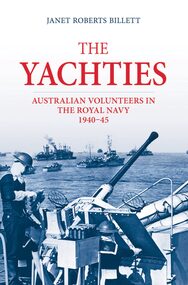
Book, Janet Billett, The Yachties - Australian Volunteers in the Royal Navy 1940-45, 2023
... officers with the Royal Navy. Recruited under the Dominion Yachtsmen Scheme, their war service in the Northern Hemisphere was as diverse as it was dangerous. Most sailed in convoy duties in the Battle of the Atlantic and some in the Arctic run to Murmansk in Russia. A small group distinguished themselves in Rendering Mines Safe. The majority served in Combined Operations...officers with the Royal Navy. Recruited under the Dominion Yachtsmen Scheme, their war service in the Northern Hemisphere was as diverse as it was dangerous. Most sailed in convoy duties in the Battle of the Atlantic and some in the Arctic run to Murmansk in Russia. A small group distinguished themselves in Rendering Mines Safe. The majority served in Combined Operations ...201 pages with black and white illustrations; notes, bibliography, index.non-fictionyachties, dominion yachtsmen scheme, royal navy, ww2 -
 Mission to Seafarers Victoria
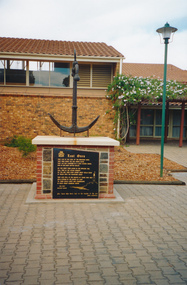
Photograph - Photograph, colour, c. 2001
... Mr Noel Smith, a resident of Port Pirie, former Merchant Navy seaman and Port Pirie tugboat officer designed the memorial, found the anchor located on the top of the memorial during a dredging operation in a creek near the Nystar plant and wrote the poem inscribed on the main plaque. ...Mr Noel Smith, a resident of Port Pirie, former Merchant Navy seaman and Port Pirie tugboat officer designed the memorial, found the anchor located on the top of the memorial during a dredging operation in a creek near the Nystar plant and wrote the poem inscribed on the main plaque. ...Opened by His Excellency Sir Eric Neal AC CVO on 30 September 2001, the Memorial is located in City Park, Port Pirie, South Australia. The monument commemorates those who were lost at sea while serving with the Merchant Navy. Mr Noel Smith, a resident of Port Pirie, former Merchant Navy seaman and Port Pirie tugboat officer designed the memorial, found the anchor located on the top of the memorial during a dredging operation in a creek near the Nystar plant and wrote the poem inscribed on the main plaque. Front Inscription Lost Ones They live in the curl of the breaking wave, They sing when the sea winds blow, They lay not confined in a land locked grave, Nor in dim dark depths below. Do you hear them laugh in the rippling tide, Call free in the ocean breeze ? Do you see them soar where great gulls glide At peace with the fearsome seas ? They live still in the hearts of those who wait Held strong in the bonds of love 'Til their souls unite and congregate In God`s great harbour above. Noel Smith Merchant Seaman For those who were lost to the depths of the sea Emma Hindmarsh Left Side Inscription Memorial unveiled by His Excellency Sir Eric Neal AC CVO Governor of South Australia and His Worship the Mayor Ken Madigan Port Pirie Regional Council Memorial blessed and consecrated by Right Reverend Garry Weatherill Bishop of Willochra 30 September 2001Colour photograph of the memorial made of an anchor on a bricks and stones base with a black marble plaque titled The Lost Ones. The logo of the Merchant Navy, MN, on the top left corner of the plaque.merchant navy, mn, port pirie, memorial -
 Federation University Historical Collection
Document - Document - Report, VIOSH: Fire Protection; Identify exposures to Property Loss and Business Interruption, 1980, 1980
... Aust. in consultation with Alan Webb, Buildings Officer at Ballarat College of Advanced Education, Gear Avenue, Mount Helen. The College operations include Engineering, Science, Education, Physical Education and School of Arts Facilities. ...Aust. in consultation with Alan Webb, Buildings Officer at Ballarat College of Advanced Education, Gear Avenue, Mount Helen. The College operations include Engineering, Science, Education, Physical Education and School of Arts Facilities. ...Victorian Institute of Occupational Safety and Health (VIOSH) Australia is the Asia-Pacific centre for teaching and research in occupational health and safety (OHS) and is known as one of Australia's leaders on the field. VIOSH has a global reputation for its innovative approach within the field of OHS management. VIOSH had its first intake of students in 1979. At that time the Institution was known as the Ballarat College of Advanced Education. In 1990 it became known as Ballarat University College, then in 1994 as University of Ballarat. It was 2014 that it became Federation University. VIOSH Australia students are safety managers, senior advisors and experienced OHS professionals. They come from all over Australia and industry. Students are taught active research and enquiry; rather than textbook learning and a one-size fits all approach. VIOSH accepts people into the Graduate Diploma of Occupational Hazard Management who have no undergraduate degree - on the basis of extensive work experience and knowledge. This report is prepared by Bruce S Webber, M.I.E. Aust. in consultation with Alan Webb, Buildings Officer at Ballarat College of Advanced Education, Gear Avenue, Mount Helen. The College operations include Engineering, Science, Education, Physical Education and School of Arts Facilities. It was opened in 1969 with the completion of the Engineering, Metallurgy and Geology Buildings. This report was made upon observations of the conditions and information provided at the time the College was inspected.Thirty-five A4 sheets, spiral bound. Contents in two sections. Typed.Cover has Logo for Reed Stenhouse at bottomviosh, victorian institute of occupational safety and health, ballarat college of advanced education, fire protection, property loss exposures, engineering, science, physical education, school of arts, metallurgy, geology, reed stenhouse report, alan webb, buildings officer, bruce webber -
Federation University Historical Collection
Document - Document - Letter, Ballarat Junior Technical School: Character reference for Grahame L Reeve, 1956
... operation from students. Participated and assisted in school cricket and tennis teams. Welcome him as an officer of the School Air Training Corps. ...operation from students. Participated and assisted in school cricket and tennis teams. Welcome him as an officer of the School Air Training Corps. ballarat junior technical school headmaster l garner character reference grahame l reeve woodwork teacher trade instructor temporary teacher geelong junior technical school school air training corps Cream paper, typed Ballarat Junior Technical School: Character reference for Grahame L Reeve, 1956. ...Reference for Grahame Reeve, teacher at Ballarat Junior Technical School since the beginning of the year. Trained for two years to obtain his certificate as a trade instructor. Temporary teacher at Geelong Junior Technical School. Competent instructor who gained interest and co-operation from students. Participated and assisted in school cricket and tennis teams. Welcome him as an officer of the School Air Training Corps. Cream paper, typed ballarat junior technical school, headmaster, l garner, character reference, grahame l reeve, woodwork teacher, trade instructor, temporary teacher, geelong junior technical school, school air training corps -
 Federation University Historical Collection
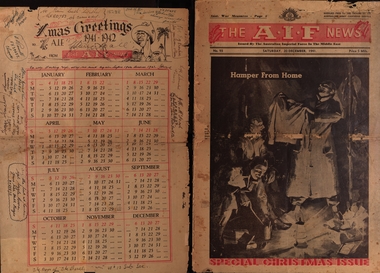
Newspaper - Twenty page issue December 1941 No. 93, Societe Orientale de Publicite, The A.I.F. News Special Christmas Issue 1941, December 1941
... Officers and a cartoon by George Aria titled 'Jonah '. Pages 10&11 "Christmas 1941" - messages from prominent people: Mr Winston Churchill; The Govenor General (Lord Gorrie); The Prime Minister (Mr Curtin); Mininster for the Army (Mr Forde). Also photos of army operations...Officers and a cartoon by George Aria titled 'Jonah '. Pages 10&11 "Christmas 1941" - messages from prominent people: Mr Winston Churchill; The Govenor General (Lord Gorrie); The Prime Minister (Mr Curtin); Mininster for the Army (Mr Forde). Also photos of army operations ...The A.I.F.= The Australian Imperial Force and this newspaper was supplied free to the troops of the Australian Army Canteens Service. This issue is dated Saturday 22nd December 1941. It includes advertisments for businesses in Cairo and Alexandria; Egypt, Palestine and Syria. Page 2 includes a poem titled "This Holy Night" by Pte C.M. Walker; two sonnets by Rupert Brooke; a poem, "Waiting Dreams" by Pilot Officer J.A. Henderson RAAF and a poem by Lieut. David McNicoll AIF Abroad Air Mail - Palestine. Page 3 includes a message from General Sir Thomas Blamey, an article on the part women would increasingly play as a consequence of the emergency war policy; an advertisment for tobacco specially packed for overseas forces. Page 4 includes an article on Australian coastal cities being ready for raids. Page 5 includes an article about the Commonwealth of the Philippines and their defense which until 1946 lay with America. General D Macarthur was the Commander In Chief in the Philippines. Germany's "secret Weapon" legend. Page 6 includes "Dancing Dan's Christmas"; "Bluey and Curley" comic strip. Page 7 includes article "Rommel's Armoured Might Lies Strewn Over Libyan Sands" Page 8 includes an article: "All In Fun" - a revue - has begun a tour of Australian camps in Palestine and Syria. Page 9 includes articles "War Will Revolutionise Air Services In Australia"; a list - Greek Awards To AIF Officers and a cartoon by George Aria titled 'Jonah '. Pages 10&11 "Christmas 1941" - messages from prominent people: Mr Winston Churchill; The Govenor General (Lord Gorrie); The Prime Minister (Mr Curtin); Mininster for the Army (Mr Forde). Also photos of army operations and traditional family Christmas time. Page 12 &13 Articles regarding sport under the heading 'Australian Sporting Digest'. Page 14 A story - "The Gift of the Magi" - an O Henry Christmas Story. Also a greeting from Myer's of Melbourne and Adelaide to all Myer Men in the AIF Page 15 An article where General Blamey reassures Australia about its capability of defence. Page 16 A description of a battle by Australian sloop "Parramatta" with HMAS "Auckland" against enemy planes whilst they were escorting a merchant ship with a cargo of petrol during the Battle of Tobruk Page 17 & 18 Pages under the title 'ACK-I-FOOFS' (Articles submitted by soldiers: The real Rat of Tobruk - a rat trained by L/Cpl Jack Kneeshaw which he named "Goebbels"; poems and cartoons. Page 19 "Women of War" - photos of women at work filling in for men who have gone to war. Page 20 Xmas Greetings 1942-1942 - a 1942 Calendar signed by 14 members of the AIF, some with messages and including their Army Number. Twenty pages of news supplied free to the troops by the Australian Army Canteens Service.The last page is a calendar for 1942 with personal inscriptions and greetings of servicemen. Some inscriptions have I.D. Numbers ( VX35435 W. Johnston; QX20753 of Carmody ; VX40449 ; VX39637 N. Powell; VX32054 Blue Ernistson?; N?X23234 W.Cummins; VXthe a.i.f. news christmas edition 1941, australian imperial force, world war 2, australian army canteens service, general blamey, world war 2 - pacific war, world war 2 - phillipine islands, general d macarthur, emergency plans ww2 australia, secret weapons ww2, western desert ww2, australian imperial force - western desert ww2, civil aviation post ww2, air services australia, lord gowrie, governor general lord gowrie, prime minister john curtain, minister for the army - mr forde, cartoons 1941, women-in ww2, xmas greetings calendar 1941-1942, cairo 1941, palestine 1941, western desert 1941, advertisements 1941, middle east 1941 -
 Ballarat Clarendon College
Book, The watches of the trails
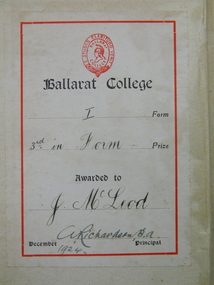
... He was an officer in the Geelong College cadet corps and joined the Army as a private and rose to the permanent rank of Major after meritorious performance in the intelligence area of operations. ...He was an officer in the Geelong College cadet corps and joined the Army as a private and rose to the permanent rank of Major after meritorious performance in the intelligence area of operations. ...John Anning MacLeod John was born in Ballarat as the second generation of Ballarat MacLeod’s, with his grandfather arriving in Geelong on the Hornet in 1857 as an 11 year old child with his 60 year old father John and mother Mary aged 37 years and 5 brothers and one sister. He grew up on the corner of Drummond Street and Mair Streets, opposite what became St John of God hospital, at his parents house of Dunvegan. John entered Ballarat College as a junior student in 1923. He received 3rd in Form prizes in both 1924 and 1925. His sister Margaret, attended Clarendon Ladies College. The household employed a chauffeur, a cook, a gardener and a ladies maid to care for them. In the 1930’s his father lost his fortune in the collapse of the jute future’s market so the staff were dismissed and he left Ballarat to go to Geelong College as a boarder. He was an officer in the Geelong College cadet corps and joined the Army as a private and rose to the permanent rank of Major after meritorious performance in the intelligence area of operations. He served in North Africa, in Palestine, Egypt, Moratai, the Philippines, Java and New Guinea. He was awarded his Military MBE by King George VI for exceptional devotion to duty and for brilliant coordination work amongst the allied intelligence team. During the war he met Mary Monica Carrol Bateman, a lietenant in the 2/4th Army General Hospital at a dinner party in Brisbane. The couple had four children, Hamish John Torquil born in 1945, Rory Hugh Alexander born in 1947 and twins Ian Donald and Katriona Margaret born in 1948. After the Second World War he worked for Lumley’s Insurance Brokers in London for a couple of years to follow up his accountancy training and then returned to Ballarat due to his father’s failing health and took over the management of John MacLeod and Co, Wholesale grocers and Merchants in Lydiard Street, Ballarat. The business had been started by his great grandfather and they produced the famous Sirdar brand of products and a special tea blend called Afternoon Cup. There was a spice mill in nearby Market Street and there they roasted peanuts, coffee and ground spices for packaging and distribution to the small corner shops who were the mainstay of commercial grocery. In the 1950’s John MacLeod and Co merged with James McKay and Sons to form McKay MacLeod Pty Ltd., wholesale tobacco, wine and spirits and grocery merchants who also manufactured the Sunny South brand of sweet mustard pickles, brewed vinegar and tomato sauce. He introduced the semi-automated system for extensions and financial records on the Bradma plates that saved staff the problems of sorting out the calculations for sales tax, miscellaneous charges etc. that greatly sped up the transactions at the checkout points. A new warehouse and office complex was built in Mair Street east up near Humffray Street, with the manufacturing factory on the opposite side of the street. They had a shop in St Arnaud and one in Geelong which was the local wholesaler for supplying to the corner shops of the greater Geelong area. With the development of supermarkets the demise of the corner store began and so the sales profiles began to diminish. He unsuccessfully stood for Liberal Party pre-selection for the seat of Ballarat in 1948 and served on the Liberal state finance and executive team for many years before resigning over the issue of conscripts being sent to Vietnam. He was instrumental in leading a group of Ballarat academics in opposition to the Vietnam war and publicly resigned from the Liberal Party over their foreign policy. John MacLeod saw the writing on the wall of the business in the early 1970’s and suggested that the firm restructured with focusing on tobacco, wine and spirits. His partners did not agree and so he sold out and retired to Barwon Heads. After a few years of golfing and surfing he became frustrated and joined SCORE, the Service Corp of Retired Executives. In this role he worked for ten years in the Geelong area solving accounting problems for Geelong small businesses and so helped Beaumont’s bakery back onto its feet. He worked gentlemen’s hours of 10 am to 3 pm which allowed him to have time for a round of 9 holes on the golf course at the end of the day and to have a surf before breakfast. He fully retired at the age of 65 and had ten years of voluminous reading of local library books before dying of burns at the age of 75. His war record has been documented in other archives at the College. He was a member of the Naval and Military Club and of the Barwon Heads Golf Club. He had good crafting skills and built a series of steam driven boats for his four children that used to be sailed at home on Lake Wendouree, Lake Learmonth and on the sheltered waters of the Barwon River. The boats are now being restored to operational order to be sailed by his great grandson Grayson Girardi. Red cloth bound book with title printed in gold lettering on spine, embossed publisher's mark centre of front cover and school crest in gold relief on front cover; book plate inside front cover. Book plate inside front cover: School crest / Ballarat College / I form / 3rd in form Prize / Awarded to / J MacLeod / December 1924 A Richardson B A Principaljohn-macleod, ballarat-college, book-prize, 1924 -
 Ballarat Clarendon College
Book, The school across the road
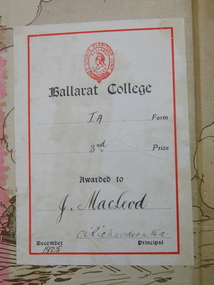
... He was an officer in the Geelong College cadet corps and joined the Army as a private and rose to the permanent rank of Major after meritorious performance in the intelligence area of operations. ...He was an officer in the Geelong College cadet corps and joined the Army as a private and rose to the permanent rank of Major after meritorious performance in the intelligence area of operations. ...John Anning MacLeod John was born in Ballarat as the second generation of Ballarat MacLeod’s, with his grandfather arriving in Geelong on the Hornet in 1857 as an 11 year old child with his 60 year old father John and mother Mary aged 37 years and 5 brothers and one sister. He grew up on the corner of Drummond Street and Mair Streets, opposite what became St John of God hospital, at his parents house of Dunvegan. John entered Ballarat College as a junior student in 1923. He received 3rd in Form prizes in both 1924 and 1925. His sister Margaret, attended Clarendon Ladies College. The household employed a chauffeur, a cook, a gardener and a ladies maid to care for them. In the 1930’s his father lost his fortune in the collapse of the jute future’s market so the staff were dismissed and he left Ballarat to go to Geelong College as a boarder. He was an officer in the Geelong College cadet corps and joined the Army as a private and rose to the permanent rank of Major after meritorious performance in the intelligence area of operations. He served in North Africa, in Palestine, Egypt, Moratai, the Philippines, Java and New Guinea. He was awarded his Military MBE by King George VI for exceptional devotion to duty and for brilliant coordination work amongst the allied intelligence team. During the war he met Mary Monica Carrol Bateman, a lietenant in the 2/4th Army General Hospital at a dinner party in Brisbane. The couple had four children, Hamish John Torquil born in 1945, Rory Hugh Alexander born in 1947 and twins Ian Donald and Katriona Margaret born in 1948. After the Second World War he worked for Lumley’s Insurance Brokers in London for a couple of years to follow up his accountancy training and then returned to Ballarat due to his father’s failing health and took over the management of John MacLeod and Co, Wholesale grocers and Merchants in Lydiard Street, Ballarat. The business had been started by his great grandfather and they produced the famous Sirdar brand of products and a special tea blend called Afternoon Cup. There was a spice mill in nearby Market Street and there they roasted peanuts, coffee and ground spices for packaging and distribution to the small corner shops who were the mainstay of commercial grocery. In the 1950’s John MacLeod and Co merged with James McKay and Sons to form McKay MacLeod Pty Ltd., wholesale tobacco, wine and spirits and grocery merchants who also manufactured the Sunny South brand of sweet mustard pickles, brewed vinegar and tomato sauce. He introduced the semi-automated system for extensions and financial records on the Bradma plates that saved staff the problems of sorting out the calculations for sales tax, miscellaneous charges etc. that greatly sped up the transactions at the checkout points. A new warehouse and office complex was built in Mair Street east up near Humffray Street, with the manufacturing factory on the opposite side of the street. They had a shop in St Arnaud and one in Geelong which was the local wholesaler for supplying to the corner shops of the greater Geelong area. With the development of supermarkets the demise of the corner store began and so the sales profiles began to diminish. He unsuccessfully stood for Liberal Party pre-selection for the seat of Ballarat in 1948 and served on the Liberal state finance and executive team for many years before resigning over the issue of conscripts being sent to Vietnam. He was instrumental in leading a group of Ballarat academics in opposition to the Vietnam war and publicly resigned from the Liberal Party over their foreign policy. John MacLeod saw the writing on the wall of the business in the early 1970’s and suggested that the firm restructured with focusing on tobacco, wine and spirits. His partners did not agree and so he sold out and retired to Barwon Heads. After a few years of golfing and surfing he became frustrated and joined SCORE, the Service Corp of Retired Executives. In this role he worked for ten years in the Geelong area solving accounting problems for Geelong small businesses and so helped Beaumont’s bakery back onto its feet. He worked gentlemen’s hours of 10 am to 3 pm which allowed him to have time for a round of 9 holes on the golf course at the end of the day and to have a surf before breakfast. He fully retired at the age of 65 and had ten years of voluminous reading of local library books before dying of burns at the age of 75. His war record has been documented in other archives at the College. He was a member of the Naval and Military Club and of the Barwon Heads Golf Club. He had good crafting skills and built a series of steam driven boats for his four children that used to be sailed at home on Lake Wendouree, Lake Learmonth and on the sheltered waters of the Barwon River. The boats are now being restored to operational order to be sailed by his great grandson Grayson Girardi. john-macleod, ballarat-college, 1925, book-prize -
 Shepparton RSL Sub Branch
Uniform, Jacket, E.W. PTY/LTD, 1968
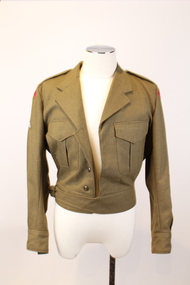
... operations. The jacket was manufactured in 1968 and was worn by an unknown RAAOC serviceman. The patches on his sleeves denote that he had earned qualifications as a parachuter and a marksman and that he was a Warrant Officer 1. ...operations. The jacket was manufactured in 1968 and was worn by an unknown RAAOC serviceman. The patches on his sleeves denote that he had earned qualifications as a parachuter and a marksman and that he was a Warrant Officer 1. ...This jacket is part of a Royal Australian Army Ordnance Corps uniform. The Royal Australian Army Ordnance Corps (RAAOC) is responsible for various logistics and organisational operations, such as maintenance of parachutes, fuel distribution, personnel administration, exlosive disposal and laundy operations. The jacket was manufactured in 1968 and was worn by an unknown RAAOC serviceman. The patches on his sleeves denote that he had earned qualifications as a parachuter and a marksman and that he was a Warrant Officer 1. Due to the period of manufacture it can be presumed that the serviceman whom this uniform belonged to served Vietnam War.As an historic military uniform dating to 1968, it is presumed that this item would have been used in service during the Vietnam War. The wearer of the uniform is unknown, however the patches and flashes attached signify that the serviceman worked for the Royal Australian Army Ordnance Corps, earned qualifications as a parachuter and marksman and ranked highly as a Warrant Officer 1. The item is representative of a type of uniform worn by high ranking RAAOC servicemen during the 1960’s. It is also in very good condition for its age.A khaki coloured waist length jacket which is composed of a heavy fabric. The jacket fastens with five buttons down the front and a buckle. The buttons are composed of brown plastic and the buckle is a dark grey metal. The buckle is attached to a waistband on the right-hand side which loops around to a strip of fabric on the left-hand side which passes through the buckle. There are two breast pockets, one on each side of the chest. The right breast pocket is fastened with a brown plastic button and the left breast pocket is missing its button. Each pocket has a flap of fabric which covers the button area. The jacket has a collar and an epaulette on each shoulder which are each fastened with one brown plastic button. There is a ribbon of fabric on the interior of the collar with no inscriptions. There are identical crescent shaped red patches on each shoulder, each showing the words in navy blue stitching "Royal Australian Army Ordinance Corps". The upper right sleeve has a khaki coloured parachuting qualification patch, which depicts an air balloon in white stitching, with wings on either side in light blue stitching. The lower section of each sleeve has a Warrant Officer First Class khaki coloured patch. This depicts a shield in red, black, white, blue and gold stitching in the centre which sits beneath a gold and blue striped line and a gold star. There is a gold kangaroo to the left of these motifs and a gold emu to the right. Beneath these motifs there is a ribbon in white, blue and gold stitching with the word "Australia". In addition there are curvilinear green decorative elements with yellow flowers on their ends. The left-hand sleeve also has a brown marksmen qualification patch. This depicts two crossed rifles in white and brown stitching. There is a white label with printed inscriptions on the interior of the left breast pocket. There is also a band of fabric on the interior back waist band which has three button holes.Printed in black inscriptions on the white label: E.W. PTY/LTD. SOUTH AUSTRALIA 1968 (a broad arrow) Class 8405-66-025-641 Batch A.W... Mill (the ‘A.W...’ is in stamped purple ink and there are some other purple inscriptions that are difficult to decipher) SIZE OF CHEST 39/49PR MATCHING TROUSERS 37 PR DRY CLEAN ONLY CREASE UPPER HALF OF LAPELS ONLY NAME..... ARMY No..... (the number 40 is also wrtten in faded black ink in the top right corner of the label)military, jacket, army, raaoc, royal australian army ordnance corps, parachuting, marksman, warrant officer, uniform -
 Shepparton RSL Sub Branch
Uniform, trousers, Conway Bros. PTY. LTD, 1969
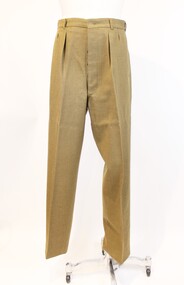
... operations. The trousers were manufactured in 1969 and were worn by an unknown RAAOC serviceman. The patches on the sleeves of the corresponding jacket denote that he had earned qualifications as a parachuter and a marksman and that he was a Warrant Officer 1. ...operations. The trousers were manufactured in 1969 and were worn by an unknown RAAOC serviceman. The patches on the sleeves of the corresponding jacket denote that he had earned qualifications as a parachuter and a marksman and that he was a Warrant Officer 1. ...These trousers are part of a Royal Australian Army Ordnance Corps uniform. The Royal Australian Army Ordnance Corps (RAAOC) is responsible for various logistics and organisational operations, such as maintenance of parachutes, fuel distribution, personnel administration, exlosive disposal and laundy operations. The trousers were manufactured in 1969 and were worn by an unknown RAAOC serviceman. The patches on the sleeves of the corresponding jacket denote that he had earned qualifications as a parachuter and a marksman and that he was a Warrant Officer 1. Due to the period of manufacture it can be presumed that the serviceman whom this uniform belonged to served in the Vietnam War.As historic military uniform trousers dating to 1968, it is presumed that this item would have been used in service during the Vietnam War. The wearer of the uniform is unknown, however the patches and flashes attached signify that the serviceman worked for the Royal Australian Army Ordnance Corps, earned qualifications as a parachuter and marksman and ranked highly as a Warrant Officer 1. The item is representative of a type of uniform worn by high ranking RAAOC servicemen during the 1960’s. It is also in very good condition for its age.khaki coloured trousers which are composed of a heavy fabric. The trousers button up at the front with 6 plastic buttons. There is an additional strip of fabric attached to the right-hand fly which can be fastened with an extra button on the interior of the left-hand fly. There are an additional 6 buttons along the interior waistband. There are also three buttons on the exterior waistband down the front and a buckle. The buttons are composed of brown plastic. There are two open hip pockets, one on either side, and another button-up pocket on the right-hand side of the back. There is a white label with inscriptions attached to the interior of the back pocket with an extra piece of fabric attached for mending patches.Printed in black inscriptions on the white label: CONWAY BROS. PTY. LTD ADELAIDE 1969 (a broad arrow) Class 8405-66-025-6183 A W M 7 (these characters are stamped in faded black ink) SIZE & WAIST 33R MATCHING JACKET 37-38R in a box are the words: DRY CLEAN ONLY. Re-press on original seams. Creases set by Si-ro-set. Mending patch attached. (end of box containing words) NAME.....DOCKSEY (‘Docksey is in hand-written black ink) ARMY No.....216308 (numbers also hand-written in black ink) (the number 40 is also wrtten in faded black ink in the top right corner of the label)military, army, raaoc, marksman, royal australian army ordnance corps, parachuting, warrant officer, uniform, trousers -
 Shepparton RSL Sub Branch
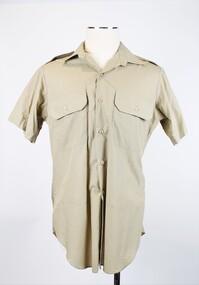
Uniform, Shirt, Australian Defence Industries, 1989
... The Royal Australian Army Ordnance Corps (RAAOC) is responsible for various logistics and organisational operations, such as maintenance of parachutes, fuel distribution, personnel administration, explosive disposal and laundy operations. military army raaoc royal australian army ordnance corps uniform parachuting marksman warrant officer Printed in black inscriptions on the white label: “ADI P/L/VIC 1989/[broad arrow]/SIZE. 40/8405-66-093-8319/SERVICE NO/NAME/DO NOT BOIL OR WRING/MACHINE WASHABLE/DRIP DRY, IRON LIGHTLY/WITH WARM IRON”. ...This shirt is part of a Royal Australian Army Ordnance Corps uniform. The Royal Australian Army Ordnance Corps (RAAOC) is responsible for various logistics and organisational operations, such as maintenance of parachutes, fuel distribution, personnel administration, explosive disposal and laundy operations.Short sleeved khaki shirt in light polyester material. Fastened by seven plastic buttons along centre. Two chest pockets fastene with externa flap and button. Fabric shoulder epaulettes on left and right side held in place with a plastic button. Label on interior back of neck and stamp on collar.Printed in black inscriptions on the white label: “ADI P/L/VIC 1989/[broad arrow]/SIZE. 40/8405-66-093-8319/SERVICE NO/NAME/DO NOT BOIL OR WRING/MACHINE WASHABLE/DRIP DRY, IRON LIGHTLY/WITH WARM IRON”. “SIZE 40” is stamped in black into on interior collar. Inscription handwritten on interior lower back panel “4800045/MARTINS.”military, army, raaoc, royal australian army ordnance corps, uniform, parachuting, marksman, warrant officer -
 Federation University Historical Collection
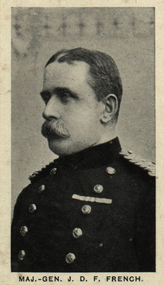
Photograph (black & White), Major-General John Denton Pinkstone French, 1st Earl of Ypres - South Africa
... officer. He distinguished himself on the Gordon Relief Expedition and was rapidly promoted. French became a national hero during the Second Boer War. He won the Battle of Elandslaagte near Ladysmith, escaping on the last train as the siege began. He commanded the Cavalry Division, winning the Battle of Klip Drift during the march to relieve Kimberley. In Cape Colony he conducted Counter-insurgency operations...officer. He distinguished himself on the Gordon Relief Expedition and was rapidly promoted. French became a national hero during the Second Boer War. He won the Battle of Elandslaagte near Ladysmith, escaping on the last train as the siege began. He commanded the Cavalry Division, winning the Battle of Klip Drift during the march to relieve Kimberley. In Cape Colony he conducted Counter-insurgency operations ...French was born in Kent in 1852. He had a brief service in the Royal Navy before becoming a cavalry officer. He distinguished himself on the Gordon Relief Expedition and was rapidly promoted. French became a national hero during the Second Boer War. He won the Battle of Elandslaagte near Ladysmith, escaping on the last train as the siege began. He commanded the Cavalry Division, winning the Battle of Klip Drift during the march to relieve Kimberley. In Cape Colony he conducted Counter-insurgency operations. Attained the rank of Field Marshall. Awards he received: Knight of the Order of St Patrick, Knight Grand Cross of the Order of the Bath, Member of the Order of Merit, Knight Grand Cross of the Royal Victorian Order, Knight Commander of the Order of St Michael and St George. French died in Kent in !925, aged 72. Individual image from photographed poster of tobacco and cigarette cards.1st earl of ypres, john french, second boer war, gordon relief expedition, cavalry, battle of klip drift, battle of elandslaagte, cape colony, counter insurgency operations, field marshall, knight of the order of st patrick, knight grand cross of the order of the bath, order of merit, knight grand cross of the royal victorian order, knight commander of the order of st michael and st george -
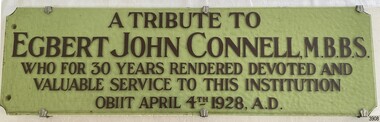 Flagstaff Hill Maritime Museum and Village
Plaque - Commemorative, circa 1928
... operation of the hospital between the years 1900 to 1939. One of these doctors was Dr. Connell, who passed away in 1928. A paragraph in the book ‘A History of the Warrnambool Base Hospital’ by Forth and Yule describes the role of the Honorary Doctors - “At the start of the period the senior-part time medical officer was replaced by the junior resident medical officer and control of beds and the right to operate were given to the honorary medical officers...and these men dominated the Warrnambool medical world in the years before the Second World War.” ...operation of the hospital between the years 1900 to 1939. One of these doctors was Dr. Connell, who passed away in 1928. A paragraph in the book ‘A History of the Warrnambool Base Hospital’ by Forth and Yule describes the role of the Honorary Doctors - “At the start of the period the senior-part time medical officer was replaced by the junior resident medical officer and control of beds and the right to operate were given to the honorary medical officers...and these men dominated the Warrnambool medical world in the years before the Second World War.” ...This commemorative plaque refers to the religiously themed window situated in the western (weather) wall of the St. Nicholas Mission to Seamen’s Church building in the Flagstaff Hill Maritime Village. It was crafted circa 1928. ABOUT THE WINDOW The window, to which this plaque belongs was once known as the Dr Connell Memorial Window, which was a feature of an external wall adjacent to the Women’s Children’s Wards of Warrnambool Hospital. Honorary Doctors had played a significant role in the operation of the hospital between the years 1900 to 1939. One of these doctors was Dr. Connell, who passed away in 1928. A paragraph in the book ‘A History of the Warrnambool Base Hospital’ by Forth and Yule describes the role of the Honorary Doctors - “At the start of the period the senior-part time medical officer was replaced by the junior resident medical officer and control of beds and the right to operate were given to the honorary medical officers...and these men dominated the Warrnambool medical world in the years before the Second World War.” Dr. Connell leased ‘Ambleside’, 192 Koroit Street, in the early 20th century, following Dr Teed who had previously run his medical practice there. In 1914 Dr Connell purchased the property and continued his private practice there until his death in 1928. He also took a prominent part in hospital work, both as physician and surgeon, and often acted as spokesmen for the Honorary Doctors. According to colleague Dr. Horace Holmes’ subsequent notes, it was after the close of the First World War, and the following years of the world-wide pneumonic influenza epidemic, that Dr. Connell himself contracted pneumonia and died. His family and friends then recognised his work by gifting the memorial window in his honour to the Hospital. By the mid-1970s the old wards at the hospital had been replaced and there was no obvious place for the window. Discussions between the previous and past Hospital managers, the Anglican Diocese, and Flagstaff Hill Planning Board, led to its installation in its present position in St Nicholas Seamen’s Church. It was installed without the bottom section of stained glass, which was inscribed as a memorial to Dr. Connell. St NICHOLAS SEAMEN’S CHURCH, Anglican Church Flagstaff Hill’s Mission to Seamen was opened in 1981. Its conception was partly motivated by the offer of Stained Glass Memorial Windows from the local Warrnambool and District Base Hospital, which was undergoing multi-storey development in the late 1960’s and early 1970’s. The Manager/Secretary at the time was keen to see the historical windows installed in an appropriate location. The chapel was designed by a local architectural draftsman in conjunction with members of the Planning Board of Flagstaff Hill, and built by Mr Leon Habel. The vision of the designers included the hope that the church be used for formal worship such as weddings and funeral, and for multi-denominational special services such as War commemorations. The design is based on the ‘Mission to Seamen’ buildings in both Portland and Port Melbourne. These types of buildings were often erected to house social and worshipful activities for seamen. The materials used in the building include sandstone recycled from nineteenth-century buildings demolished in Warrnambool and American slate tiles retrieved from the 1908 wreck of the FALLS OF HALLADALE. Most of the chapel furnishings came from the Williamstown Missions to Seamen, which was consecrated in 1946 but later decommissioned. These artefacts range from the altar cloth to the hymn board and include a visually stunning round stained glass widow called ‘Christ Guiding the Helmsman’. However the provenance of this particular artefact, large western window, is local.This plaque is significant because of its association with stained glass memorial window is of local, historical and social significance, linking local history and heritage with one of Warrnambool's doctors, Dr. Egbert John Connell (d. 1928), who gave 30 years of dedicated, medical service to the local citizens.Plaque, opaque, pale green glass rectangle mounted on white timber board and held in place with six decorative silver coloured clasps. Five rows of printed, capitalised text are fixed on the top surface. The plaque is companion to the commemorative, stained glass window installed in the St. Nicholas Mission to Seamen's Church at Flagstaff Hill. (The window was previously known locally as the Dr. Connell Memorial Window.)"A TRIBUTE TO / EGBERT JOHN CONNELL, M.B.B.S. / WHO FOR 30 YEARS RENDERED DEVOTED AND / VALUABLE SERVICE TO THIS INSTITUTION / OBIIT APRIL 4th 1928, A.D."flagstaff hill, warrnambool, shipwrecked coast, flagstaff hill maritime museum, maritime museum, shipwreck coast, flagstaff hill maritime village, great ocean road, chapel window, stained glass window, warrnambool and district base hospital, st nicholas mission to seamen’s church, williamstown mission to seamen, dr egbert connell, ambleside warrnambool, leon habel builder, falls of halladale slate, memorial window, commemorative window, dr connell, commemorative plaque, plaque, edgar mcconnell -
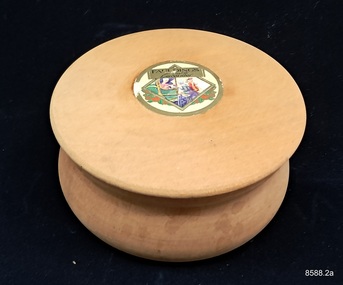 Flagstaff Hill Maritime Museum and Village
Container - Wooden Box, 1930s
... operation today. ABOUT THE “W.R.ANGUS COLLECTION” Doctor William Roy Angus M.B., B.S., Adel., 1923, F.R.C.S. Edin.,1928 (also known as Dr Roy Angus) was born in Murrumbeena, Victoria in 1901 and lived until 1970. He qualified as a doctor in 1923 at University of Adelaide, was Resident Medical Officer...operation today. ABOUT THE “W.R.ANGUS COLLECTION” Doctor William Roy Angus M.B., B.S., Adel., 1923, F.R.C.S. Edin.,1928 (also known as Dr Roy Angus) was born in Murrumbeena, Victoria in 1901 and lived until 1970. He qualified as a doctor in 1923 at University of Adelaide, was Resident Medical Officer ...One pharmaceutical enterprise which put greater emphasis on the manufacturing side of its business and whose successors strengthened this emphasis was Faulding's. A pharmacist, Francis H. Faulding, started his shop in Adelaide in 1841 and formed a partnership with an English physician, L. Scammel, in 1861. From its beginnings the firm showed a flare for innovation. After Simpson's discovery of the anaesthetic properties of chloroform in 1847, Francis Faulding was the first to import chloroform; in 1858 he distributed cocaine preparations; in 1864 he produced the first olive oil from South Australian olives and, after J. Lister's reports in Lancet on the reduction of mortality after surgery with the use of phenol, Faulding began production of antiseptics ('Solyptol') in 1867. Faulding was also the first to utilize the medicinal and antiseptic properties of eucalyptus oil which was obtained from distilleries on Kangaroo Island The Second World War in Europe disrupted the supply of cod liver oil, an important source of Vitamin A. Faulding chemists found an alternative source in white schnapper shark, which sustained supplies in Australia as well as generated exports to the UK . When supplies of I.G. Farben's newly discovered sulpha drugs ran out, Faulding became involved in the national program organised by the Medical Equipment Control Committee (MECC) and, jointly with universities, synthesised sulphanilamide. Following the transfer of American knowhow. Faulding's was also the first private enterprise to produce yet another life saving drug of military importance, penicillin. After the war basic synthesis of antibiotics became difficult to sustain by private enterprise because of the gigantic scale advantages of competing US producers, and competition in the synthesis of new drugs demanded huge investment in R & D; Fauldings maintained their business by a combination of marketing, wholesaling and producing consumer and medical products. In the 1970s, however, Fauldings set a remarkable precedent in research strategy and achievement in the Australian pharmaceutical business. They decided to concentrate their research on drugs which had proven efficacy, but which also suffered from certain shortcomings restricting their clinical usefulness, and to seek advances overcoming these shortcomings. This was an imaginative new strategy, a way of grafting Australian knowhow on to major products, in keeping with local resources and yet offering opportunities for sophisticated skill. At the same time it promised to open internatiSurgeon and onal markets, since the major producers of the basic drugs could hardly ignore significant advances. https://www.samhs.org.au/Virtual%20Museum/Medicine/drugs_nonsurg/Fauldings_drug/Fauldings_drugs.html This decorative gift box once containing Faulding’s Old English Lavender soap or powder belonged to Dr. Angus' wife, Gladys. It was donated to Flagstaff Hill Maritime Village by his daughter, Bernice McDade. It is part of the “W.R. Angus Collection” that includes historical medical equipment, surgical instruments and material once belonging to Dr Edward Ryan and Dr Thomas Francis Ryan, (both of Nhill, Victoria) as well as Dr Angus’ own belongings. The Collection’s history spans the medical practices of the two Doctors Ryan, from 1885-1926 plus that of Dr Angus, up until 1969. Powder or soap in boxes such as this was perfumed and used as part of a women’s personal grooming in the early to mid 20th century. Faulding’s Company began in Adelaide, Australia, in 1845 and made a wide range of cosmetic and perfume products as well as pharmaceuticals. The company is still in operation today. ABOUT THE “W.R.ANGUS COLLECTION” Doctor William Roy Angus M.B., B.S., Adel., 1923, F.R.C.S. Edin.,1928 (also known as Dr Roy Angus) was born in Murrumbeena, Victoria in 1901 and lived until 1970. He qualified as a doctor in 1923 at University of Adelaide, was Resident Medical Officer at the Royal Adelaide Hospital in 1924 and for a period was house surgeon to Sir (then Mr.) Henry Simpson Newland. Dr Angus was briefly an Assistant to Dr Riddell of Kapunda, then commenced private practice at Curramulka, Yorke Peninsula, SA, where he was physician, surgeon and chemist. In 1926, he was appointed as new Medical Assistant to Dr Thomas Francis Ryan (T.F. Ryan, or Tom), in Nhill, Victoria, where his experiences included radiology and pharmacy. In 1927 he was Acting House Surgeon in Dr Tom Ryan’s absence. Dr Angus had become engaged to Gladys Forsyth and they decided he further his studies overseas in the UK in 1927. He studied at London University College Hospital and at Edinburgh Royal Infirmary and in 1928, was awarded FRCS (Fellow from the Royal College of Surgeons), Edinburgh. He worked his passage back to Australia as a Ship’s Surgeon on the on the Australian Commonwealth Line’s T.S.S. Largs Bay. Dr Angus married Gladys in 1929, in Ballarat. (They went on to have one son (Graham 1932, born in SA) and two daughters (Helen (died 12/07/1996) and Berenice (Berry), both born at Mira, Nhill ) According to Berry, her mother Gladys made a lot of their clothes. She was very talented and did some lovely embroidery including lingerie for her trousseau and beautifully handmade baby clothes. Dr Angus was a ‘flying doctor’ for the A.I.M. (Australian Inland Ministry) Aerial Medical Service in 1928 . Its first station was in the remote town of Oodnadatta, where Dr Angus was stationed. He was locum tenens there on North-South Railway at 21 Mile Camp. He took up this ‘flying doctor’ position in response to a call from Dr John Flynn; the organisation was later known as the Flying Doctor Service, then the Royal Flying Doctor Service. A lot of his work during this time involved dental surgery also. Between 1928-1932 he was surgeon at the Curramulka Hospital, Yorke Peninsula, South Australia. In 1933 Dr Angus returned to Nhill and purchased a share of the Nelson Street practice and Mira hospital (a 2 bed ward at the Nelson Street Practice) from Dr Les Middleton one of the Middleton Brothers, the current owners of what previously once Dr Tom Ryan’s practice. Dr Tom and his brother had worked as surgeons included eye surgery. Dr Tom Ryan performed many of his operations in the Mira private hospital on his premises. He had been House Surgeon at the Nhill Hospital 1902-1926. Dr Tom Ryan had one of the only two pieces of radiology equipment in Victoria during his practicing years – The Royal Melbourne Hospital had the other one. Over the years Dr Tom Ryan had gradually set up what was effectively a training school for country general-practitioner-surgeons. Each patient was carefully examined, including using the X-ray machine, and any surgery was discussed and planned with Dr Ryan’s assistants several days in advance. Dr Angus gained experience in using the X-ray machine there during his time as assistant to Dr Ryan. When Dr Angus bought into the Nelson Street premises in Nhill he was also appointed as the Nhill Hospital’s Honorary House Surgeon 1933-1938. His practitioner’s plate from his Nhill surgery is now mounted on the doorway to the Port Medical Office at Flagstaff Hill Maritime Village, Warrnambool. When Dr Angus took up practice in the Dr Edward and Dr Tom Ryan’s old premises he obtained their extensive collection of historical medical equipment and materials spanning 1884-1926. A large part of this collection is now on display at the Port Medical Office at Flagstaff Hill Maritime Village in Warrnambool. In 1939 Dr Angus and his family moved to Warrnambool where he purchased “Birchwood,” the 1852 home and medical practice of Dr John Hunter Henderson, at 214 Koroit Street. (This property was sold in1965 to the State Government and is now the site of the Warrnambool Police Station. and an ALDI sore is on the land that was once their tennis court). The Angus family was able to afford gardeners, cooks and maids; their home was a popular place for visiting dignitaries to stay whilst visiting Warrnambool. Dr Angus had his own silk worm farm at home in a Mulberry tree. His young daughter used his centrifuge for spinning the silk. Dr Angus was appointed on a part-time basis as Port Medical Officer (Health Officer) in Warrnambool and held this position until the 1940’s when the government no longer required the service of a Port Medical Officer in Warrnambool; he was thus Warrnambool’s last serving Port Medical Officer. (Masters of immigrant ships arriving in port reported incidents of diseases, illness and death and the Port Medical Officer made a decision on whether the ship required Quarantine and for how long, in this way preventing contagious illness from spreading from new immigrants to the residents already in the colony.) Dr Angus was a member of the Australian Medical Association, for 35 years and surgeon at the Warrnambool Base Hospital 1939-1942, He served as a Surgeon Captain during WWII1942-45, in Ballarat, Victoria, and in Bonegilla, N.S.W., completing his service just before the end of the war due to suffering from a heart attack. During his convalescence he carved an intricate and ‘most artistic’ chess set from the material that dentures were made from. He then studied ophthalmology at the Royal Melbourne Eye and Ear Hospital and created cosmetically superior artificial eyes by pioneering using the intrascleral cartilage. Angus received accolades from the Ophthalmological Society of Australasia for this work. He returned to Warrnambool to commence practice as an ophthalmologist, pioneering in artificial eye improvements. He was Honorary Consultant Ophthalmologist to Warrnambool Base Hospital for 31 years. He made monthly visits to Portland as a visiting surgeon, to perform eye surgery. He represented the Victorian South-West subdivision of the Australian Medical Association as its secretary between 1949 and 1956 and as chairman from 1956 to 1958. In 1968 Dr Angus was elected member of Spain’s Barraquer Institute of Barcelona after his research work in Intrasclearal cartilage grafting, becoming one of the few Australian ophthalmologists to receive this honour, and in the following year presented his final paper on Living Intrasclearal Cartilage Implants at the Inaugural Meeting of the Australian College of Ophthalmologists in Melbourne In his personal life Dr Angus was a Presbyterian and treated Sunday as a Sabbath, a day of rest. He would visit 3 or 4 country patients on a Sunday, taking his children along ‘for the ride’ and to visit with him. Sunday evenings he would play the pianola and sing Scottish songs to his family. One of Dr Angus’ patients was Margaret MacKenzie, author of a book on local shipwrecks that she’d seen as an eye witness from the late 1880’s in Peterborough, Victoria. In the early 1950’s Dr Angus, painted a picture of a shipwreck for the cover jacket of Margaret’s book, Shipwrecks and More Shipwrecks. She was blind in later life and her daughter wrote the actual book for her. Dr Angus and his wife Gladys were very involved in Warrnambool’s society with a strong interest in civic affairs. He had an interest in people and the community They were both involved in the creation of Flagstaff Hill, including the layout of the gardens. After his death (28th March 1970) his family requested his practitioner’s plate, medical instruments and some personal belongings be displayed in the Port Medical Office surgery at Flagstaff Hill Maritime Village, and be called the “W. R. Angus Collection”.Fauldings Company is a very historical Australian company, still in operating today. The powder box is an example of fashion and grooming in the 1930's in Australia. The W.R. Angus Collection is significant for still being located at the site it is connected with, Doctor Angus being the last Port Medical Officer in Warrnambool. The collection of medical instruments and other equipment is culturally significant, being an historical example of medicine from late 19th to mid-20th century. Dr Angus assisted Dr Tom Ryan, a pioneer in the use of X-rays and in ocular surgery.Container, wooden powder box with separate lid. Round box is made from light coloured timber and was sold containing Faulding’s Old English Lavender cosmetic powder. The wooden bowl is light in colour and the lid has a decal with text and images of two ladies facing each other, a gentleman looking over his shoulder at them, and red roses. From the W.R. Angus Collection.Faulding's Old English Lavender, and picture of old English men and women in period costume.flagstaff hill maritime museum and village, great ocean road, shipwreck coast, warrnambool, shipwtreck coast, dr w r angus, faulding's, lavender, powder, cosmetic
