
Showing 149 items matching "operator manual"
-
 Moorabbin Air Museum
Manual (item) - Nomad N22S Sensor Operator Manual - ASTA
... Nomad N22S Sensor Operator Manual - ASTA...Nomad N22S Sensor Operator Manual - ASTA...Nomad N22S Sensor Operator Manual - ASTA Manual Nomad N22S Sensor Operator Manual - ASTA ... -
Moorabbin Air Museum
Manual (item) - Nomad N22S Sensor Operator Manual - ASTA, Nomad N22S Sensor Operator Manual - ASTA - 2 copies
... Nomad N22S Sensor Operator Manual - ASTA...Nomad N22S Sensor Operator Manual - ASTA - 2 copies...Nomad N22S Sensor Operator Manual - ASTA - 2 copies Manual Nomad N22S Sensor Operator Manual - ASTA ... -
Moorabbin Air Museum
Manual (item) - CAC Owner/Operator Manual CMM500-1 McCauley C500 Series Full Feathering Constant Speed Propeller
... CAC Owner/Operator Manual CMM500-1 McCauley C500 Series Full Feathering Constant Speed Propeller...Manual CAC Owner/Operator Manual CMM500-1 McCauley C500 Series Full Feathering Constant Speed Propeller ... -
 Sunshine and District Historical Society Incorporated
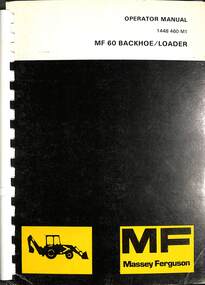
Manual - Massey Ferguson - Operator Manual MF60 Backhoe Loader
... Massey Ferguson - Operator Manual MF60 Backhoe Loader...Massey Ferguson Sunshine Harvester Works Farm Machinery Ring Bounded Operating Manual Manual Massey Ferguson - Operator Manual MF60 Backhoe Loader ...massey ferguson, sunshine harvester works, farm machinery -
Moorabbin Air Museum
Manual (Item) - ASTA Pub 12.35-1 Nomad N22S Searchmaster Marine Surveillance and Tracking System Sensor Operator Manual
... ASTA Pub 12.35-1 Nomad N22S Searchmaster Marine Surveillance and Tracking System Sensor Operator Manual...Manual ASTA Pub 12.35-1 Nomad N22S Searchmaster Marine Surveillance and Tracking System Sensor Operator Manual ... -
Moorabbin Air Museum
Manual (Item) - ASTA Pub 12.72-1 Nomad N22S Searchmaster Marine Surveillance and Tracking System Sensor Operator Manual
... ASTA Pub 12.72-1 Nomad N22S Searchmaster Marine Surveillance and Tracking System Sensor Operator Manual...Manual ASTA Pub 12.72-1 Nomad N22S Searchmaster Marine Surveillance and Tracking System Sensor Operator Manual ... -
 Running Rabbits Military Museum operated by the Upwey Belgrave RSL Sub Branch
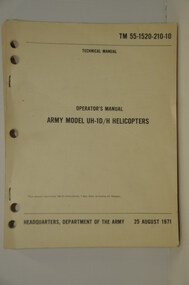
Book
... Operators Manual Helicopter UH-1D...Documents Vietnam Army Operators Manual Helicopter UH-1D Book ...Operators Manual Helicopter UH-1Ddocuments, vietnam, army -
4th/19th Prince of Wales's Light Horse Regiment Unit History Room
Book, Change 1 to Operator & Organizational Maintenance Manual for TM 11-5820-498-12, 1968
... Change 1 to Operator & Organizational Maintenance Manual for TM 11-5820-498-12...Training manual for Regimental equipment radio training manuals TM 11-5820-498-12 C1 Uncovered book of changes to manual TM 11 5820 - 498 - 12 Change 1 to Operator & Organizational Maintenance Manual for TM 11-5820-498-12 Book ...Training manual for Regimental equipmentUncovered book of changes to manual TM 11 5820 - 498 - 12TM 11-5820-498-12 C1radio, training manuals -
4th/19th Prince of Wales's Light Horse Regiment Unit History Room
Book, Operator's Manual Radio Sets AN/VRC 12,43,44,45,46,47,48 & 49, 1961
... ...operator manual...Radio operator manual TM 11-5820-A01-10 Soft covered book. ...Soft covered book. Detailing general information, operating instructions & operator's maintenance for the radio sets AN/VRC-12 and AN/VRC - 43,44,45,46,47,48,& 49. Including amdts 1, 2 & 3TM 11-5820-A01-10radio, operator manual -
Nhill Aviation Heritage Centre
Verbal Time Announcer
... Rack mounted, Gives verbal time at set intervals, Includes operators manual...Not certain if this equipment was used at Nhill Time Announcer, Aeradio Plessey Verbal Time Announcer Rola Company Australia Product of VT13 Rack mounted, Gives verbal time at set intervals, Includes operators manual Verbal Time Announcer ...Not certain if this equipment was used at NhillRack mounted, Gives verbal time at set intervals, Includes operators manualPlessey Verbal Time Announcer Rola Company Australia Product of VT13time announcer, aeradio -
Moorabbin Air Museum
Archive (Item) - Box WP4 Prowse Collection see details under Description section
... P-3C NATOPS Crew Operators Manual - Flight Technician P-3C NATOPS Crew Operators Manual - (Sensors 1 & 2) P-3C NATOPS Crew Operators Manual -(Sensor 3) P-3C NATOPS Crew Operators Manual -(NAV/COMM) ELATS - Expanded Litton Automatic Test Set RAAF - Fitters IIA - Carpenter Riggers & Flight Riggers Course Notes GAF Project Notes N2/58 Nomad Air Cooler Installation GAF Regulations for Fitting Out Military Aircraft ...P-3C NATOPS Crew Operators Manual - Flight Technician P-3C NATOPS Crew Operators Manual - (Sensors 1 & 2) P-3C NATOPS Crew Operators Manual -(Sensor 3) P-3C NATOPS Crew Operators Manual -(NAV/COMM) ELATS - Expanded Litton Automatic Test Set RAAF - Fitters IIA - Carpenter Riggers & Flight Riggers Course Notes GAF Project Notes N2/58 Nomad Air Cooler Installation GAF Regulations for Fitting Out Military Aircraft Archive Box WP4 Prowse Collection see details under Description section ... -
4th/19th Prince of Wales's Light Horse Regiment Unit History Room
Book, US Government Printing Office, Operator and Organizational Maintenance Manual, Radio Set Control Group AN/GRA-39, Oct 1962
... Operator and Organizational Maintenance Manual, Radio Set Control Group AN/GRA-39 ...Operator and Organizational Maintenance Manual, Radio Set Control Group AN/GRA-39 Book US Government Printing Office ...Handbook for equipment previously used by the RegimentSoft covered book detailing introduction, installation, operating procedures and operator's maintenance for the Radio Set Control Group AN/GRA-39.TM 11-5820-477-12book, radio training -
Moorabbin Air Museum
Manual (Item) - Notes On Operating The Gazelle Mark 161
... Lycoming Model 10-720 Series Aircraft Engines Operator's Manual Level of Importance: World. ...Lycoming Model 10-720 Series Aircraft Engines Operator's Manual Level of Importance: World. Issued by Rolls-Royce Service Dept.( Military) Notes On Operating The Gazelle Mark 161 Manual Notes On Operating The Gazelle Mark 161 ...Description: 75 pages. Published by Avco Corporation - Lycoming Division. Published 30/6/1964. Part No. 60299-20. Lycoming Model 10-720 Series Aircraft Engines Operator's Manual Level of Importance: World. Issued by Rolls-Royce Service Dept.( Military) -
Moorabbin Air Museum
Manual (Item) - Nomad Manuals - see Description
... Box BDA 7 - 2 off - ASTA NOMAD N22S PILOT’S OPERATING HANDBOOK 1 off - NOMAD TECHNICAL LIBRARY FILE REGISTER 3 off - N22C NOMAD PERFORMANCE SUMMARY 2 off - N22B NOMAD PERFORMANCE SUMMARY FOR AIR TAXI 1 off - NOMAD N22S SEARCHMASTER ‘L’VARIANT OPERATIONS MANUAL 1 each - NOMAD PRICE LISTS - 1977, 1978, 1979, 1984 4 off - NOMAD PRICE LIST - 1982 1 off - CERTIFICATE OF AIRCRAFT BUILD STANDARD - N22B - SERIAL No 160 1 off - PERMIT TO FLY - N22B - SERIAL No 160 5 off - NOMAD SEARCHMASTER N22S - SENSOR OPERATOR MANUAL - ASTA Numerous INSPECTION HISTORY CARDS - OLEO - NOMAD 5 off - NOMAD SEARCHMASTER N22S FLIGHT SERVICING CHECKLIST 1 off - NOMAD SEARCHMASTER N22S SENSOR OPERATOR CHECKLIST...Box BDA 7 - 2 off - ASTA NOMAD N22S PILOT’S OPERATING HANDBOOK 1 off - NOMAD TECHNICAL LIBRARY FILE REGISTER 3 off - N22C NOMAD PERFORMANCE SUMMARY 2 off - N22B NOMAD PERFORMANCE SUMMARY FOR AIR TAXI 1 off - NOMAD N22S SEARCHMASTER ‘L’VARIANT OPERATIONS MANUAL 1 each - NOMAD PRICE LISTS - 1977, 1978, 1979, 1984 4 off - NOMAD PRICE LIST - 1982 1 off - CERTIFICATE OF AIRCRAFT BUILD STANDARD - N22B - SERIAL No 160 1 off - PERMIT TO FLY - N22B - SERIAL No 160 5 off - NOMAD SEARCHMASTER N22S - SENSOR OPERATOR MANUAL - ASTA Numerous INSPECTION HISTORY CARDS - OLEO - NOMAD 5 off - NOMAD SEARCHMASTER N22S FLIGHT SERVICING CHECKLIST 1 off - NOMAD SEARCHMASTER N22S SENSOR OPERATOR CHECKLIST Manual Nomad Manuals - see Description ... -
Moorabbin Air Museum
Document (item) - John Porter Collection
... Flight Radio Operator's Manual x 2. Department of Civil Aviation. ...Flight Radio Operator's Manual x 2. Department of Civil Aviation. ... -
 Vision Australia
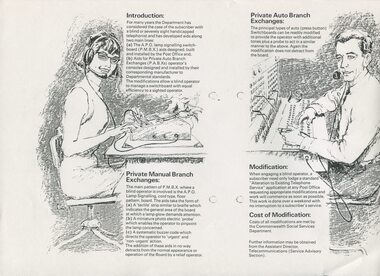
Document - Text, Branch Exchanges and blind switchboard operators, 1969?
... Copy of page from pamphlet about the modifications required for a blind switchboard operator for Private Manual Branch Exchanges (PBX) and Private Auto Branch Exchanges (PABX). ...Copy of page from pamphlet about the modifications required for a blind switchboard operator for Private Manual Branch Exchanges (PBX) and Private Auto Branch Exchanges (PABX). ...Copy of page from pamphlet about the modifications required for a blind switchboard operator for Private Manual Branch Exchanges (PBX) and Private Auto Branch Exchanges (PABX). Collected by C.H. Nipper during his writing of 'The Past and the Present 1866-1971' (a history of the RVIB). 1 foolscap photocopied page from pamphletroyal victorian institute for the blind, employment -
 Wodonga & District Historical Society Inc
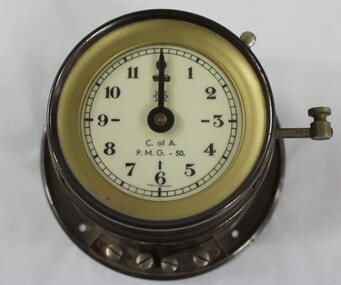
Functional object - Post Master General Exchange Clock, Junghans Watchmakers
... Telephone calls were transferred through exchanges by manual operators who staffed switchboards throughout the country. ...Telephone calls were transferred through exchanges by manual operators who staffed switchboards throughout the country. ...The Postmaster-General's Department (PMG) was a department of the Australian federal government, established at Federation in 1901, whose responsibilities included the provision of postal and telegraphic services throughout Australia. It was abolished in December 1975 and replaced by the Postal and Telecommunications Department. Telephone calls were transferred through exchanges by manual operators who staffed switchboards throughout the country. The clock was used to time calls in order to levy appropriate charge for telephone usage.The use of manual telephone exchanges played an important role in Australian telecommunications history, not just for day -to-day business and commercial use, but for social connections and communication during emergency. This timer has local significance as it was used at the Wodonga Telephone Exchange.A small clock used by switchboard operators to time calls at the Wodonga Telephone Exchange. Lever on the side operates timier.In centre of clock 'C. of A./P.M.G -50" Insignia of the Junghans Clock Manufacturers At the bottom edge of the time "Made in Germany",telecommunication, wodonga telephone exchange, p.m.g., timer, wodonga -
Moorabbin Air Museum
Manual (item) - Duplicates - see Description
... Flight Radio Operator's Manual. D.C.A. Publication No. 46 Booklet No date Commonwealth of Australia. ...Flight Radio Operator's Manual. D.C.A. Publication No. 46 Booklet No date Commonwealth of Australia. ... -
 Sunshine and District Historical Society Incorporated
Archive - Industries
... Flyer Industries of Sunshine and District 1860s to 1950s 10 April to 9 May 2015 Phoenix Fireworks Co Pty Ltd|Typed list of Industrial deaths in Sunshine District 1920s to 1940s|Newspaper article Sunshine Advocate 28 February 1925 Albion News Spalding|Newspaper article The Western Times 8 November 1989 Industries of the West|Newspaper article 16 August 1890 Supplement to the Footscray Advertisement|Brochure Ferrous the big name in Forgings|Letter 11 October 1982 from Environment Protection Authority of Victoria to SCI Meat and Paper Pty Ltd|Railway Compartment Corridor A and B|Advertisements 1891|Letter 11 September 1978 from Sunshine and District Historical Society to Australian Railway Historical Society|Australasian Statutue 17 December 1884 Messrs Wright and Edwards Engineering Works Little Bourke Street West|Handwritten notes Nettlefords Screw makers|Handwritten notes Sunshine Porcelain Potteries|Handwritten notes Crittalls Manufacturing Co|Handwritten notes Pearson Soap Co|Newspaper article Herald Sun 29 March 1992 Aussie built crane gives vital lift to export earnings|Report The practical payoff for Christian style management|Newspaper article The Advocate 4 December 1991 Profit sharing is a bonus|Newspaper article The Advocate 2 October 1991 Half century of progress|Newspaper article Herald Sun 17 October 1992 Forges Ahead|Newspaper article Herald Sun 17 October 1992 Good Deed Firm W L Allen|Newspaper article The Sunday Herald 22 April 1990 Memory Echoes in the Pipeline|Operators Manual John Deere 210 Corn Attachment|Newspaper article The Land 18 June 1964 Choose from the Long Green Line of John Deere Tractors and Combines...Industries Flyer Industries of Sunshine and District 1860s to 1950s 10 April to 9 May 2015 Phoenix Fireworks Co Pty Ltd|Typed list of Industrial deaths in Sunshine District 1920s to 1940s|Newspaper article Sunshine Advocate 28 February 1925 Albion News Spalding|Newspaper article The Western Times 8 November 1989 Industries of the West|Newspaper article 16 August 1890 Supplement to the Footscray Advertisement|Brochure Ferrous the big name in Forgings|Letter 11 October 1982 from Environment Protection Authority of Victoria to SCI Meat and Paper Pty Ltd|Railway Compartment Corridor A and B|Advertisements 1891|Letter 11 September 1978 from Sunshine and District Historical Society to Australian Railway Historical Society|Australasian Statutue 17 December 1884 Messrs Wright and Edwards Engineering Works Little Bourke Street West|Handwritten notes Nettlefords Screw makers|Handwritten notes Sunshine Porcelain Potteries|Handwritten notes Crittalls Manufacturing Co|Handwritten notes Pearson Soap Co|Newspaper article Herald Sun 29 March 1992 Aussie built crane gives vital lift to export earnings|Report The practical payoff for Christian style management|Newspaper article The Advocate 4 December 1991 Profit sharing is a bonus|Newspaper article The Advocate 2 October 1991 Half century of progress|Newspaper article Herald Sun 17 October 1992 Forges Ahead|Newspaper article Herald Sun 17 October 1992 Good Deed Firm W L Allen|Newspaper article The Sunday Herald 22 April 1990 Memory Echoes in the Pipeline|Operators Manual John Deere 210 Corn Attachment|Newspaper article The Land 18 June 1964 Choose from the Long Green Line of John Deere Tractors and Combines Collection of documents relating to|Industries of Sunshine and District 1860s - 1950s|Industrial deaths in Sunshine District 1920s to 1940s|Albion new Spaldings 1925|John Deere 210 Corn Attachment Archive Industries ...Flyer Industries of Sunshine and District 1860s to 1950s 10 April to 9 May 2015 Phoenix Fireworks Co Pty Ltd|Typed list of Industrial deaths in Sunshine District 1920s to 1940s|Newspaper article Sunshine Advocate 28 February 1925 Albion News Spalding|Newspaper article The Western Times 8 November 1989 Industries of the West|Newspaper article 16 August 1890 Supplement to the Footscray Advertisement|Brochure Ferrous the big name in Forgings|Letter 11 October 1982 from Environment Protection Authority of Victoria to SCI Meat and Paper Pty Ltd|Railway Compartment Corridor A and B|Advertisements 1891|Letter 11 September 1978 from Sunshine and District Historical Society to Australian Railway Historical Society|Australasian Statutue 17 December 1884 Messrs Wright and Edwards Engineering Works Little Bourke Street West|Handwritten notes Nettlefords Screw makers|Handwritten notes Sunshine Porcelain Potteries|Handwritten notes Crittalls Manufacturing Co|Handwritten notes Pearson Soap Co|Newspaper article Herald Sun 29 March 1992 Aussie built crane gives vital lift to export earnings|Report The practical payoff for Christian style management|Newspaper article The Advocate 4 December 1991 Profit sharing is a bonus|Newspaper article The Advocate 2 October 1991 Half century of progress|Newspaper article Herald Sun 17 October 1992 Forges Ahead|Newspaper article Herald Sun 17 October 1992 Good Deed Firm W L Allen|Newspaper article The Sunday Herald 22 April 1990 Memory Echoes in the Pipeline|Operators Manual John Deere 210 Corn Attachment|Newspaper article The Land 18 June 1964 Choose from the Long Green Line of John Deere Tractors and Combinesindustries -
 Federation University Historical Collection
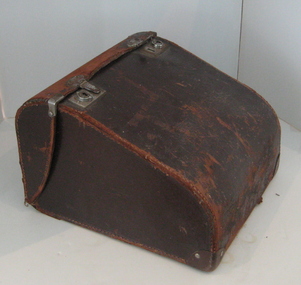
Calculator, Burroughs, Calculator (Adding Machine), c1935
... manual adding machine. The key-driven type machine did not print, and was exceedingly fast and experienced operators could easily outrun an operator on a full keyboard or 10-key adding machine. ...manual adding machine. The key-driven type machine did not print, and was exceedingly fast and experienced operators could easily outrun an operator on a full keyboard or 10-key adding machine. ...The "Burroughs Calculator" was a non-printing key-driven machine introduced in 1912 in response to the success of the Felt & Tarrant "Comptometer". The first Burroughs key-driven machine was very similar to the Comptometer in its external appearance, but was quite different in its internal mechanism, with the register and carry mechanism based on a complex system of planetary gears. It was only about two-thirds of the weight of the Felt & Tarrant machine, and had none of the safety features. In particular, there was no protection against incomplete keystrokes in either direction. The register would simply advance in proportion to the depth of stroke, with no indication of error. However, the price was also about two-thirds of the Comptometer, which made it quite a popular (if dangerous) machine. (http://home.vicnet.net.au/~wolff/calculators/Burroughs/Burroughs.htm) The Burroughs Portable Adding Machine introduced in 1925 became the basic design for the adding machine for many years, until the ten key adder was introduced and started to replace it gradually. The key-driven type machine did not print, and while it was often used as an adding machine, it developed into a special purpose machine in later years. The machine was very fast . The efficient operation of these machines required an experienced operator who often received a high salary. The machine was produced over a very long period because of its unique capabilities and was often used to verify product delivery lists from delivery routes. Later models of the machine, called a duplex design, could hold a running total in a second set of dial wheels while the primary wheels continued to add and subtotal amounts that could be transferred at any time to the running total. A side note, Burroughs copied the Felt design for its first models and was sued for patent infringement by Felt and Tarrant who prevailed in the suit. As a result, Burroughs totally redesigned their machine and went on to compete with the Felt machine for decades. Info from (http://www.burroughsinfo.com/group_d.htm) Black metal low keyboard manual adding machine. The key-driven type machine did not print, and was exceedingly fast and experienced operators could easily outrun an operator on a full keyboard or 10-key adding machine. The adding machine has a brown leather carry case.calculator -
 Federation University Historical Collection
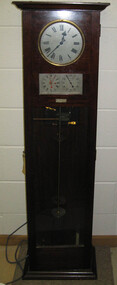
Object, Synchronome Co. Ltd, Synchronome Frequency Checking Master Clock No. 2191, c1930
... A maximum deviation between the two dials was set in the operating instructions (eg 5 seconds) and the operator would correct this when necessary by remote manual alteration of the turbine governor set point. ...A maximum deviation between the two dials was set in the operating instructions (eg 5 seconds) and the operator would correct this when necessary by remote manual alteration of the turbine governor set point. ...Information from Norman F. Dalton: Ballarat had a reticulated DC supply in the early part of last century and in 1905 had sufficient generating capacity to enable the trams to be changed from horse drawn to DC electricity. The use of electricity increased with the main power station located on Wendouree Parade, near Webster Street, under the ownership of The Electric Supply Company of Victoria. AC generating plant was installed in 1925 and conversion to AC proceeded. In 1934 the company was taken over by the State Electricity Commission Victoria (SECV) and more AC generation was installed and the changeover of customers was accelerated. This is around the time that the Synchronome Frequency Checking Mast Clock was installed at the Wendouree Parade Power Station. The SECV Annual Report of 1921 states: ::Section 11 of the act directed the COmmission to enquire into the question of securing the adoption of such standards of plant and equipment of a system, frequency and pressure for the generation and distribution of electricity as will admit of the efficient interconnection of undertakings throughout the State. In 1934 when the SECV took over the Ballarat operations the question of linking with the State grid had been a planned operation for some years but due to financial considerations had hindered it and in fact would continue to do so for a further 10 years. So while the need for close frequency control for interconnection was hardly an issue, the need to keep electric clocks correct was important, particularly as this item was a frequent sales point to cover the inconvenience and sometimes expense of converting from DC to AC. The clock is a very accurate pendulum clock with provision for varying effective length during operation for precise time regulation. There are two normal time dials and one is controlled by the pendulum and the other is operated by the system frequency. When the clock was in use it was installed by the MEter and Tests Laboratory and the time was checked daily by radio time signals. The two dials were repeated in the operators control panel in the Power Station. A maximum deviation between the two dials was set in the operating instructions (eg 5 seconds) and the operator would correct this when necessary by remote manual alteration of the turbine governor set point. The clock was used to drive and regulate a system of "slave" clocks which were used to display the time in various locations around the power station. A slave clock is a simple clock which is driven by a small electric motor, its accuracy is regulated by the master clock every 30 seconds to ensure that it and all the other slave clocks in the station are on exactly the right time; slave clocks were placed in various locations, from common rooms to workshops. A master clock could potentially run thousands of slave clocks at one plant. The clock also contains a rectifier. A rectifier is a device that is used to convert AC power to more stable DC current.Two clocks in a timber case. Both are electric, one is powered by the main pendulum mechanism, the other is a self contained electric clock. The main mechanism is of the gravity arm and roller type, which sends an impulse to the slave clocks every 30 seconds. The This Synchronome Frequency Checking Master Clock was used at the Ballarat Power Station. Below the main section of the case is a smaller cabinet containing a rectifier to provide consistent DC power for the clock. The rectifier was made by the Victorian company Hilco, which was located in Burwood. There is a high chance this is not the original rectifier from this clock as there appears to be brackets to hold a larger device in the space the rectifier occupies.Front below main clock face on front of case: "Patented Sychronome Brisbane" Lower left-hand clock face: "Frequency time" Lower right-hand clock face: "Standard Seconds" Synchronous electric clock mechanism on door (Frequency time clock): >200/250 V. 50~ >"Synchronomains" Made in England >Direction indicator for clock starting switch >"To start move lever in direction of arrow and release" >"Patent applied for" Mechanism for "standard seconds" clock: >"English Made" >"Patented" >Serial number "321" >0 above right-hand pillar on front-plate Mechanism for "standard seconds" clock: >"English Made" >"Patented" >Serial number "321" >0 above right-hand pillar on front-plate Mechanism for main clock face: >"English Made" >"Patented" >Serial number "8751" >0 above right-hand pillar on front-plate Inside case, back panel, top enamel plate: >Seconds Battery + Pos. > Battery Common or - Neg. >1/2 min dials Inside case, back panel, bottom enamel plate: external seconds dial Inside case, right hand side, electrical knobs: two switches, both "A.C. mains" Pendulum rod, below suspension spring: Serial number (?) 0000005 Rectifier in bottom cabinet: >"Hilco Rectifier" >"A.C. Volts 230/240" >"Model 1060/S" >"A.C. Amperes" >"Serial No. 1060/S >"Phases 1" >"D.C. Volts 6" >"C.P.S. 50" >"D.C. Amperes 1" >"Made in Australia by Hilco Transformers McIntyre St., Burwood, Victoria." Bakelite electrical plug: makers mark Lower cabinet, RH side panel, pressed tin plate: "AC" (upside down) Brass speed adjustment, outer right RH side: "S" and "F" Ivory and wood pendulum beat ruler: >Ruler, with 0 in centre and numbers 1-5 in ascending order from centre on left and right. > "Synchronome Patent." Steel plate, back panel, inside case, right hand side: >N R A" (descending) >"2191" serial number/part number Face of main clock: "Synchronome Electric" synchronome frequency checking master clock, electricity, state electricity commission, wendouree parade power station, secv, clock, time, pendulum, electric supply company of victoria, norman f. dalton, ballarat power station, rectifier, slave clock -
 Orbost & District Historical Society
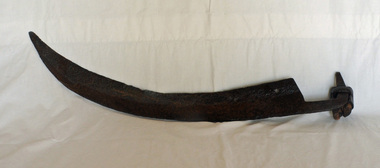
scythe blade, late 19th - early 20th century
... manually mow wheat or grass. Scythes were used with a long sweeping movement which made them much less tiring for labourers to use than reaping hooks or sickles though they still involved great physical labour and considerable skill to perfect. Both hands were in use and the operator...manually mow wheat or grass. Scythes were used with a long sweeping movement which made them much less tiring for labourers to use than reaping hooks or sickles though they still involved great physical labour and considerable skill to perfect. Both hands were in use and the operator ...Scythes were used to manually mow wheat or grass. Scythes were used with a long sweeping movement which made them much less tiring for labourers to use than reaping hooks or sickles though they still involved great physical labour and considerable skill to perfect. Both hands were in use and the operator did not have to bend his back to reach down to the crop. On farms scythes were sharpened on a sandstone wheel mounted on an axle with a crank handle on one side. This was hand powered and used with water. Scythes were not used as often on farms after the mechanisation of harvesting. They were still used for cutting awkward shaped small plots and for opening a path for the tractors. This item is an example of a tool used by the early settlers of the Orbost district. An iron scythe blade, curved and tapered. There is no handle and the blade is rusted and pitted."ROSE"scythe tool agriculture rural -
 Flagstaff Hill Maritime Museum and Village
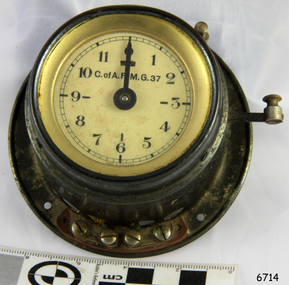
Timer, 1940s
... operators had to be employed and so labour costs increased. It was a tedious and slow way of making a long-distance call, and it was sometimes hard to hear, particularly when several exchanges were linked With technical advances, trunk switching moved from manual operation through a partly automatic phase. ...operators had to be employed and so labour costs increased. It was a tedious and slow way of making a long-distance call, and it was sometimes hard to hear, particularly when several exchanges were linked With technical advances, trunk switching moved from manual operation through a partly automatic phase. ...Australia's first telephone exchange was opened in Melbourne in August 1880. It was operated by the Melbourne Telephone Exchange Company. Owned by W. H. Masters and T. T. Draper, the Manager of the Company was H. Byron Moore. This was only two years after the world's first exchange in the United States, and just four years after Bell first spoke on a telephone. The exchange was located in the old Stock Exchange building at 367 Collins Street, a site now occupied by the Commonwealth Bank. In 1884, the operations of the Company, by then known as the Victorian Telephone Exchange Company, had grown considerably and were transferred to Wills Street, Melbourne. Private ownership of this company continued until 1887 when it was bought out by the Victorian Colonial Government. Other colonial governments followed this example. By 1910, the growth in telephone services made additional accommodation necessary. This could not be provided in the existing building in Wills Street and arrangements were made for a new exchange in Lonsdale Street. Alexander Graham Bell visited Australia in 1910 to advise the Federal Government's Postal Commission. Telephone exchanges were established in Adelaide with (48 subscribers), Hobart (10 subscribers) and Launceston (35 subscribers). The first exchange in Western Australia was established in 1887 and located in a small three-room cottage in Wellington Street, Perth with 17 subscribers. The year 1888 marked the opening of the Fremantle exchange in a small room at the rear of the Town Hall. There were nine subscribers. Australia's first automatic exchange was installed in the GPO in Sydney, in 1911, for internal use. But the first automatic exchange for public use was opened at Geelong in Victoria in the next year July 1912 with 800 subscribers. Melbourne's first automatic exchange was opened in the suburb of Brighton in 1914; the first public automatic exchange in NSW began operating at Newtown, Sydney in 1915; and Queensland's first was installed at South Brisbane in 1925. 1929 saw the opening of Tasmania's first automatic exchange in Hobart. an automatic telephone service. In June 1977, the manual telephone exchange at Swansea was replaced with an automatic service and made Tasmania the first State in Australia to have a fully automatic net work. The half-century following Federation saw the growth of the automatic operation; a great extension of trunk line services; The automatic telephone contributed greatly to the early popularity of telephones in Australia. It was a quicker and more convenient way of communicating with another person on the same exchange — instead of having to go through tedious processes with the operator. From its introduction, the number of automatic telephones in operation grew to a remarkable extent. In 1886, the first trunk link of 16 km was connected to the exchanges of Adelaide and Port Adelaide in South Australia. Then, in 1907, the first inter-capital telephone trunk line was opened between Sydney and Melbourne. It was followed by a line between Melbourne and Adelaide in 1914. Sydney and Brisbane were linked in 1923, and Perth and Adelaide in 1930. In 1930, the first overseas calls from Australia came possible with the introduction of a radio telephone service to England, and through there to Europe and America. A similar service opened to New Zealand in the same year. Initially, trunk channels linked different manual trunk exchanges. It was necessary for a succession of trunk operators to connect the appropriate channels, one after the other until the connection was made. As trunk traffic grew. the system became increasingly unsuitable. More trunk operators had to be employed and so labour costs increased. It was a tedious and slow way of making a long-distance call, and it was sometimes hard to hear, particularly when several exchanges were linked With technical advances, trunk switching moved from manual operation through a partly automatic phase. Automatic transit switching equipment was used and only a single operator was required to connect a trunk call to a wanted automatic subscriber. Until well beyond the middle of this century, the majority of trunk traffic went through this single telephonist control. In 1953, the number of telephones in use in Australia passed the one million mark. By then, the need for improvement in the automatic exchanges was be coming well recognised. The need was for a telephone switching system which would do a better job more economically than the conventional step-by-step ex-change. This led to the adoption of the Crossbar system as the standard in automatic telephone exchanges in 1960. The introduction of Crossbar switching was a big step forward in the automation of trunk calls. It substituted automatic switching and charging equipment for the originating trunk operator, and improved the quality of the system radically. Before the introduction of the Crossbar system there were often very long delays in obtaining a booked trunk call, and the quality of sound was often very poor. With Crossbar, Subscriber Trunk Dialing (STD) became a reality. A trunk call by STD was as easy to make and almost as fast to connect as a local call.The item was made around the 1940s and used up until the 1970s in manual cord telephone exchanges as a way to time and charge users for trunk calls made over the telecom system of the time. Post Master General dept. - Trunk Call Timer.Inscribed PMG, C. of A, 37. Bell chimes at 3 min increments.flagstaff hill, warrnambool, shipwrecked-coast, flagstaff-hill, flagstaff-hill-maritime-museum, maritime-museum, shipwreck-coast, flagstaff-hill-maritime-village, timer, trunk call, telephone, cord exchange -
 Bendigo Military Museum
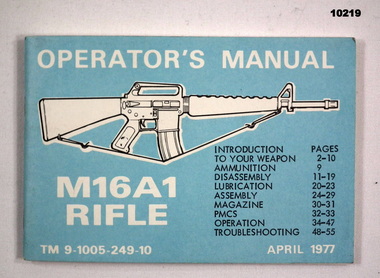
Manual - OPERATORS MANUAL, US Govt Printing Office, c.1984
... Manual is dated April 1977. Manual OPERATORS MANUAL US Govt Printing Office. ...Manual issued to US soldiers to understand and maintain their weapon. Part of the collection of "Bill Thomason". Refer No. 4136P.Small blue covered booklet with 56 pages inside covering the use and maintenance of the USA M16 Rifle issued by the US Dept of Defence. Includes descriptions, drawings and specifications for the weapon. Manual is dated April 1977.collection of william (bill) thomason, operators manual, m16 rifle -
 Bendigo Military Museum
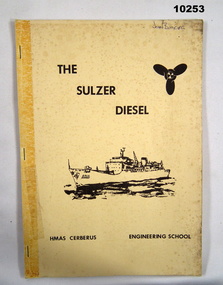
Manual - OPERATORS MANUAL, RAN HMAS CERBERUS, "THE SULZER DIESEL"
... "THE SULZER DIESEL" Manual OPERATORS MANUAL RAN HMAS CERBERUS ...Locally made book. Rear cover is hard cardboard. Front cover is of light cardboard. The front cover shows a 3 bladed propeller. The title is an image of a supply ship labelled A215. At bottom is name HMAS CERBERUS, Engineering School. Inside are 48 pages of engine drawings and explanatory texts. Routine maintenance is shown at the rear. The whole book is fastened with 3 staples. Written in ink on front cover is:- "John BUTTIGIEG"book, manual, marine diesel engines -
 Bendigo Military Museum
Manual - STANDING ORDERS VEHICLE OPERATORS, 1961
... Manual STANDING ORDERS VEHICLE OPERATORS ...Book is a training manual for the Standing Orders for Vehicle Operation & Servicing 1961 used by the RAASC School for Training Purposes.Metal bound book, brown in colour with dark blue edging on front and back covers. 93 pages inside covering Procedures and Processes for Vehicle Operations and Servicing.On top front, SGT A.K. Teale (or Seale) ? and No. 20 in pencil. Inside says "RAASC School - This copy belongs to school Headquarters Library". Cover says "Restricted", "Australian Military Forces" & "Standing Orders for Vehicle Operation and Servicing 1961".training manual, raasc, passchendaele barracks trust -
 Bendigo Military Museum
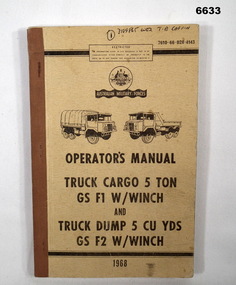
Manual - VEHICLE OPERATORS, Commonwealth Dept of Supply, Maribyrnong 3032, 1968
... It has photos drawings and specifications. Manual VEHICLE OPERATORS Commonwealth Dept of Supply, Maribyrnong 3032 ...This is a cardboard covered book. The front cover is khaki. It shows drawings of the cargo F1 Truck and Dump truck F2. It is an operations Manual. At top and bottom of front cover is a black bar, The book is army part NR 7610-66-028-4143. The book has 49 pages. It has photos drawings and specifications.Front cover has written in ink (1) 3-12-9865 WO2 T.B. Caffin, inside has the same soldier.passchendaele barracks trust, truck manual, army -
 Queenscliffe Maritime Museum
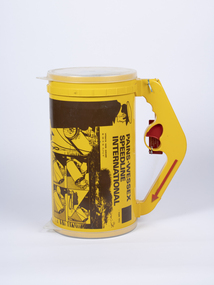
Equipment - Rescue Equipment
... manually launched lines that had shorter ranges and were not very accurate. They faced problems on wind-powered boats and ships since they were dependent on wind speed, wind direction, and the operator accuracy....manually launched lines that had shorter ranges and were not very accurate. They faced problems on wind-powered boats and ships since they were dependent on wind speed, wind direction, and the operator accuracy. ...The line throwing apparatus has been in use for several centuries, in a wide variety of forms. It initially started off as manually launched lines that had shorter ranges and were not very accurate. They faced problems on wind-powered boats and ships since they were dependent on wind speed, wind direction, and the operator accuracy.Modern-day line throwing apparatus are powered using rockets, pneumatic systems, or slingshot mechanisms. They fall under two main categories of propulsion- pyrotechnic, and pneumatic. Pyrotechnic systems make use of an ignition that is used to launch the line, whereas pneumatic systems make use of built-up pressure. Pyrotechnic systems are volatile and can be extremely dangerous due to accidental ignition. In response to growing concerns about the safety of pyrotechnic systems, pneumatic based launchers were invented and widely implemented in the late 20th century.Yellow line throwing device consisting of a canaster containing rolled rope and a firing mechanismPains-Wessex Speedline International. Pt No 5151-01/02speed line, line throwing, marine rescue, pyrotechnics -
 Kiewa Valley Historical Society
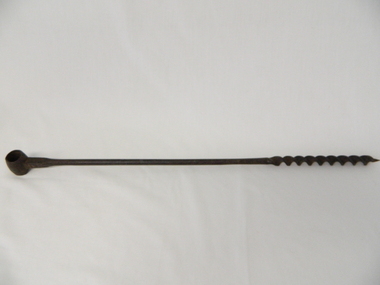
Drill Auger, Circa early 1900s
... Fitness of the operator was at a high standard but protective gloves were not highly thought of as it was before occupational, health and safety regulations became mandatory over all manual handling activities, be they on rural properties or town/city factories. ...Fitness of the operator was at a high standard but protective gloves were not highly thought of as it was before occupational, health and safety regulations became mandatory over all manual handling activities, be they on rural properties or town/city factories. ...This item wasused before diesel, electric and battery drilling apparatus were used by farmers, and other trades requiring a portable yet reliable method of drilling holes. As this item is a 3/4 inch hole drill it would be suitable for fencing and providing holes for structural studs. As with all outdoor farm equipment, man power was required (be it the farmer or farm hands). Fitness of the operator was at a high standard but protective gloves were not highly thought of as it was before occupational, health and safety regulations became mandatory over all manual handling activities, be they on rural properties or town/city factories. This period was one where the male ego was at its pinnacle i.e. the harder the tasks the more of a man was required. Hard manual work was not only the "way to go" but also a necessity. Evolution of cheap portable electric/battery powered tools opened up a more efficient method available, especially to those with less muscle strength. This item personifies the rugged environment of the rural workplace. The Kiewa Valley with its main emphasis on farming and grazing provided ample opportunity to use this construction implement. The manufacturer being a Scottish tool company is very significant in the era when this hole maker was in high demand. British steel products were of high grade and had a good record of reliability. The reliability of any tool was a solid factor for farmers and tradesmen in this semi-isolated region (Circa early 1900s) within the Kiewa Valley and its regional area. This factor,although not as crucial, post 1960s, when Asian manufacturers entered the market place and produced cheaper tools and transportation and supplies was more frequent and reliable, the need for the more expensive British made tools diminished considerably. After the influx of tradesmen from war torn Europe (post 1945) and the increased availability of tradesmen in the Kiewa Valley and its region the price of tools was and still is not as crucial and the cost of all required tools has become a minimal part of the equation. It is only with the emerging younger trades person, farmer and grazier, who have more, "one eye on production costs" and no "old ties to the motherland" inert mind set that quality tools such as this auger and other hand tools "must be made to last a life time" is no longer part of the modern work environment.This cast iron, hand operated Auger has a short barrel shaped cylinder at one end (known as the "Eye") and at the other end a Helical screw blade (screws the cutting edge into wooden material, thereby creating a hole 3/4 inch diameter in the wood) . The barrel section at the top permits a metal or wooden leverage plank to be inserted. The main rod has a 180mm long cutting/screw blade running from the bottom up towards the "eye" end. From the end of the screw blade to the handle is 380mm and cylindrical, but this changes at 550mm from the "eye" end to a 14mm x 10mm rectangular shape shaft.This shaft end is welded to the "Eye".On the shaft below the "eye" is stamped " MATHESON GLASGOW" on the front side and a spade (cards) symbol on the back.auger, hand drill, fencing, tool, rural trades, brace & bit -
 Kiewa Valley Historical Society
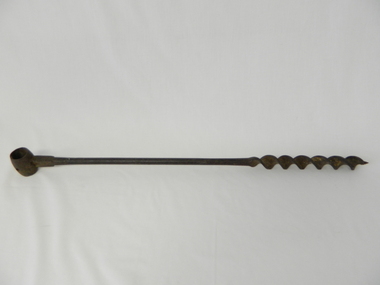
Drill Auger, Circa early 1900's
... Fitness of the operator was at a high standard but protective gloves were not highly thought of as it was before occupational, health and safety regulations became mandatory over all manual handling activities, be they on rural properties or town/city factories. ...Fitness of the operator was at a high standard but protective gloves were not highly thought of as it was before occupational, health and safety regulations became mandatory over all manual handling activities, be they on rural properties or town/city factories. ...This item was before diesel, electric and battery drilling apparatus were used by farmers, and other trades requiring a portable yet reliable method of drilling holes. As this item is a 3/4 inch hole drill it would be suitable for fencing and providing holes for structural studs. As with all outdoor farm equipment, man power was required (be it the farmer or farm hands). Fitness of the operator was at a high standard but protective gloves were not highly thought of as it was before occupational, health and safety regulations became mandatory over all manual handling activities, be they on rural properties or town/city factories. This period was one where the male ego was at its pinnacle i.e. the harder the tasks the more of a man was required. Hard manual work was not only the "way to go" but also a necessity. Evolution of cheap portable electric/battery powered tools opened up a more efficient method available, especially to those with less muscle strength.This item personifies the rugged environment of the rural workplace. The Kiewa Valley with its main emphasis on farming and grazing provided ample opportunity to use this construction implement. The manufacturer being a Scottish tool company is very significant in the era when this hole maker was in high demand. British steel products were of high grade and had a good record of reliability. The reliability of any tool was a solid factor for farmers and tradesmen in this semi-isolated region (Circa early 1900s) of the Kiewa Valley and its regional area. This factor,although not as crucial, post 1960s, when Asian manufacturers entered the market place and produced cheaper tools and transportation and supplies was more frequent and reliable, the need for the more expensive British made tools diminished considerably. After the influx of tradesmen from war torn Europe (post 1945) and the increased availability of tradesmen in the Kiewa Valley and its region the price of tools is not as crucial and the cost of all required tools has become a minimal part of the equation. It is only with the emerging younger trades person, farmer and grazier, who have more, "one eye on production costs" and no "old ties to the motherland" inert mind set that quality tools such as this auger and other hand tools "must be made to last a life time" is no longer part of the modern work environment.This cast iron hand operated drill, has a short barrel-shaped cylinder, known as "the eye" welded across the main rod and is 30mm in circumference. It also has a hole drilled to allow a screw to be fastened onto the hand stock ( not available).The main rod is solid for 400mm and then has been flattened and coiled (Helical screw blade) for another 200mm. At the end of the larger screw blade there is a smaller gauged starter blade with a pointer thread 15mm long. This Auger produces a 1/8th inch hole (metric measurement not used at time of manufacture) See KVHS 0469 for 3/4 inch hole and KVHS 0471 for another 1/8th inch hole.A number 5 stamped on the flat sideauger, hand drill, fencing, tool, rural trades, brace & bit
