
Showing 17 items matching "oral health"
-
 Alfred Hospital Nurses League - Nursing History Collection
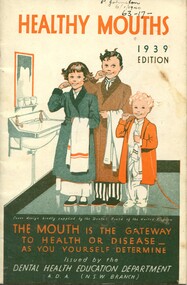
Booklet - Reference booklet, Dental Health Education Depatment, A.D.A (NSW branch), Healthy mouths, 1939 edition, 1939
... ...oral health...Focuses on dental hygeine and emphasizes that oral health affects overall physical well being, also contains related advertisenents...Focuses on dental hygeine and emphasizes that oral health affects overall physical well being, also contains related advertisenents Importance of public health education dental hygeine oral health public health education At top of front cover 'P.Johnston//6/1/40' and previous catalogue number, all handwritten [black ink] Stapled booklet. on the front cover is an Illustration of three children brushing their teeth at a handbasin. ...Focuses on dental hygeine and emphasizes that oral health affects overall physical well being, also contains related advertisenentsImportance of public health educationStapled booklet. on the front cover is an Illustration of three children brushing their teeth at a handbasin. Title [orange print] edition [black print] slogan - 'THE MOUTH IS THE GATEWAY TO HEALTH OR DISEASE-AS YOU YOURSELF DETERMINE' [orange print] illustration acknowledgement and publisher detals white print]. At top of front cover 'P.Johnston//6/1/40' and previous catalogue number, all handwritten [black ink]dental hygeine, oral health, public health education -
 Melbourne Tram Museum
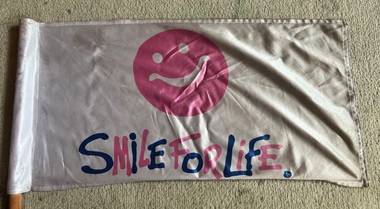
Flag, "Smile for Life", 1990s
... Flag promoting the VicHealth Oral Health Program...Flag advertising the Vic Health oral health program pink and blue print on white background, mounted on wooden dowel for use on Melbourne tramcars. ...Flag promoting the VicHealth Oral Health Program Demonstrates a flag produced to promote Oral Health using Melbourne trams. ...Flag promoting the VicHealth Oral Health ProgramDemonstrates a flag produced to promote Oral Health using Melbourne trams.Flag advertising the Vic Health oral health program pink and blue print on white background, mounted on wooden dowel for use on Melbourne tramcars. Flag made from nylon or a similar synthetic, sewn into a white nylon circular section and then slipped over the dowel and stapled into position. trams, vichealth, flags -
 Kew Historical Society Inc
Audio - Interview with Dolly Stainer, 12/08/1987
... ...mental health...oral...This is a rare record of a resident of Kew Cottages, recorded in 1987, captured in an oral history interview. kew cottages (kew, vic.) mental health oral history cliff judge collection dolly Stainer Oral History record. ...At four years of age Dolly Stainer was admitted to Kew Cottages, an institution for the intellectually disabled situated in suburban Melbourne. The Cottages were Dolly's home for the next seventy-five years. Dolly was unable to read or write but she like to talk. In her old age she co-operated in the making of a series of tape recordings about her life. Kew Cottages: The World of Dolly Stainer is based on these recordings and places them in the context of the wider Cottages' history.This is a rare record of a resident of Kew Cottages, recorded in 1987, captured in an oral history interview.Oral History record. Interview on cassette, later digitised of an interview with Ms Dolly Stainer, a long term resident of Kew Cottages. The early parts of the tape are difficult to hear clearly but the interviewer and interviewee are clearer as the audio file progresses. kew cottages (kew, vic.), mental health, oral history, cliff judge collection, dolly stainer -
 Flagstaff Hill Maritime Museum and Village
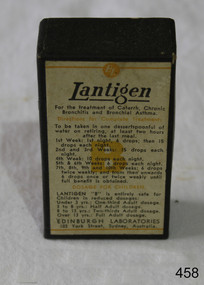
Container - Bottle & Box, Edinburgh Laboratories, Early - Mid 20th Century
... oral product based on bacterial lysates of six different inactivated strains commonly involved in respiratory tract infections. ……….This study demonstrates Lantigen B's effectiveness in the prevention of bacterial complications and suggests that it can be used in patients who are particularly at risk of infection (children, the elderly, diabetics, and immunocompromised patients) or those in whom an infection might aggravate a clinical picture that is already inherently complicated (diabetics again, but also patients with heart, kidney, or liver disease). https://www.researchgate.net/publication/8349012_Efficacy_of_Lantigen_B_in_the_prevention_of_bacterial_respiratory_infections The control of respiratory conditions is essential to public health ...Respiratory tract infections are among the most common diseases both in adults and children. ………….Lantigen B is an oral product based on bacterial lysates of six different inactivated strains commonly involved in respiratory tract infections. ……….This study demonstrates Lantigen B's effectiveness in the prevention of bacterial complications and suggests that it can be used in patients who are particularly at risk of infection (children, the elderly, diabetics, and immunocompromised patients) or those in whom an infection might aggravate a clinical picture that is already inherently complicated (diabetics again, but also patients with heart, kidney, or liver disease). https://www.researchgate.net/publication/8349012_Efficacy_of_Lantigen_B_in_the_prevention_of_bacterial_respiratory_infectionsThe control of respiratory conditions is essential to public health.Cardboard box containing a glass bottle of Lantigen colloidal mixture.Lantigen. For the treatment of catarrah, chronic bronchitis and bronchial asthma. Edinburgh Laboratories, 103 York Street, Sydney, Australia. Bacterial Vaccine. flagstaff hill, warrnambool, shipwrecked-coast, flagstaff-hill, flagstaff-hill-maritime-museum, maritime-museum, shipwreck-coast, flagstaff-hill-maritime-village, lantigen, medical, respiratory conditions -
 The Beechworth Burke Museum
Audio - Oral History, Jennifer Williams, Mr Alfred Spencer, 17th February 2000
... oral history...burke museum...spencer...alfred spencer...migration...post-war migration...goldfields...health...He also discusses the experience of health care in a rural area during his childhood. This oral history recording was part of a project conducted by Jennifer Williams in the year 2000 to capture the everyday life and struggles in Beechworth during the twentieth century. ...He also discusses the experience of health care in a rural area during his childhood. This oral history recording was part of a project conducted by Jennifer Williams in the year 2000 to capture the everyday life and struggles in Beechworth during the twentieth century. ...Alfred 'Alf' Spencer grew up on a dairy farm run by his mother, west south west of Beechworth 'down Robertson Road', and was very well connected to the wider Beechworth area. In this oral history, he recalls his time driving the milk cart around Beechworth as well as the time he spent buying lollies and seeing the pictures. He talks extensively about working as a butcher at his brother's store, including how the butchers interacted with the rest of the town and the staff, as well as his time constructing roads and the pipe network of Beechworth. He discusses the dynamics of other workplaces around Beechworth, describing issues with how the local tannery treated its workers as well as how post-war migrants integrated across the town. He briefly discusses racial tensions between Chinese migrants and other miners on the goldfields. He also discusses the experience of health care in a rural area during his childhood. This oral history recording was part of a project conducted by Jennifer Williams in the year 2000 to capture the everyday life and struggles in Beechworth during the twentieth century. This project involved recording seventy oral histories on cassette tapes of local Beechworth residents which were then published in a book titled: Listen to what they say: voices of twentieth century Beechworth. These cassette tapes were digitised in July 2021 with funds made available by the Friends of the Burke.Alfred Spencer's oral history of his life around Beechworth during the 20th century is historically and socially significant to the cultural history of the region and Victoria. There is a lot of detail about workplaces, their staff, and how the resources of the town interacted. He explores themes that are important to Victorian history, such as migration. This oral history account is socially and historically significant as it is a part of a broader collection of interviews conducted by Jennifer Williams which were published in the book 'Listen to what they say: voices of twentieth-century Beechworth.' While the township of Beechworth is known for its history as a gold rush town, these accounts provide a unique insight into the day-to-day life of the town's residents during the 20th century, many of which will have now been lost if they had not been preserved.This is a digital copy of a recording that was originally captured on a cassette tape. The cassette tape is black with a horizontal white strip and is currently stored in a clear flat plastic rectangular container. It holds up to 40 minutes of recordings on each side.Mr Alfred Spencer /listen to what they say, beechworth, oral history, burke museum, spencer, alfred spencer, migration, post-war migration, goldfields, health care, farm, farming, dairy farm, black springs, butchers, meat processing, butcher, road, road network, labour relations -
The Beechworth Burke Museum
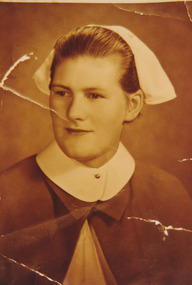
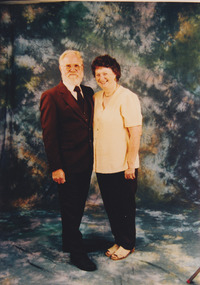
Audio - Oral History, Jennifer Williams, Gwen and Jack Scott, 24th February 2000
... oral histories on cassette tapes of local Beechworth residents which were then published in a book titled: Listen to what they say: voices of twentieth century Beechworth. These cassette tapes were digitised in July 2021 with funds made available by the Friends of the Burke. Gwen and Jack Scott’s account of their lives in Beechworth is historically and socially significant to the cultural heritage of the region. Gwen and Jack in reflecting on their everyday experiences of operating a family business, availability of work, leisure opportunities, interaction with migrants, and access to maternal health ...Jack Scott was born in Beechworth on the 24th January 1919 into a third generation Beechworth family who had migrated from Scotland, Cornwall and Ireland during the 1860s. Also present during the oral history recording is Jack’s wife, Gwen Scott. In 1878 Jack’s grandfather established the carrier business - R. Scott Carriers. Jack’s grandfather secured a contract with the Zwar Brothers' Beechworth Tannery to transport all goods between the tannery and train station via horse and cart. Jack’s father and uncle carried on the family business, before Jack and his brother eventually joined after the Second World War. The company expanded from a single horse and cart short route to multiple trucks operating interstate routes. Prior to joining the family carrier business, Jack on leaving school started work at the tannery and served in the air force during the Second World War. When asked about the working conditions at the tannery, Jack recalls while they did have union representatives, it was not particularly effectual. The union representatives were often placated by sharing multiple whiskies with the Zwar brothers when in their offices to discuss workers’ issues. Gwen’s father also worked for the tannery for a period of time, and she enjoyed the annual picnics the tannery provided for employee families. Both Jack and Gwen’s connections to the tannery reinforces the tannery’s role as a major employer and presence in the Beechworth community. Prior to marrying Jack, Gwen worked in a range of roles including at the Ovens and Murray Hospital for the Aged, managing the family home when her parents both worked during the Second World War, and apprenticed with her sister as a hairdresser. Jack and Gwen provide some insight into maternal health issues in brief discussions of hospital birthing trends and awareness of contraception and family planning. Both Jack and Gwen recalled attending the open-air cinema at ‘The Rock’ in their childhoods. Gwen remembers that the ‘elites’ would sit on chairs at the front, and Gwen’s family sat on a rug at the back, while Jack would jump the fence and get in for nothing. Jack and Gwen discuss attitudes towards both Chinese Australians and Italian migrants in Beechworth. They did not notice any racism and from their perspective felt they were accepted in the town. Jack did note that Italian employees lost their jobs at the tannery during the Second World War, but believed they all stayed within the area and found stonemason and concrete work in the interim. Jack socialised with members of the Italian community and joyfully recalled attending their homes for music nights with lots of drinking and instruments being played. This oral history recording was part of a project conducted by Jennifer Williams in the year 2000 to capture the everyday life and struggles in Beechworth during the twentieth century. This project involved recording seventy oral histories on cassette tapes of local Beechworth residents which were then published in a book titled: Listen to what they say: voices of twentieth century Beechworth. These cassette tapes were digitised in July 2021 with funds made available by the Friends of the Burke. Gwen and Jack Scott’s account of their lives in Beechworth is historically and socially significant to the cultural heritage of the region. Gwen and Jack in reflecting on their everyday experiences of operating a family business, availability of work, leisure opportunities, interaction with migrants, and access to maternal health care provide essential economic, social, and healthcare insights. Gwen and Jack Scott’s oral history recording is part of a larger collection of oral histories recorded by Jennifer Williams in 2000, collectively they provide invaluable insights into Beechworth during the 20th century, much of the information in these oral histories would be lost if not documented and missed in the interpretation of tangible objects. This is a digital copy of a recording that was originally captured on a cassette tape. The cassette tape is black with a horizontal white strip and is currently stored in a clear flat plastic rectangular container. It holds up 40 minutes of recordings on each side.Mrs Gwen and Mr Jack Scott jack scott, gwen scott, r. scott carriers, scott brothers, zwar brother's beechworth tannery, zwar tannery, beechworth tannery, ovens and murray hospital for the aged, benevolent asylum, open-air cinema, the rock cinema, italians beechworth, hospital births 1920s, wang tech, wangaratta tech, nell scott, jennifer williams, oral history, listen to what they say: voices of twentieth century beechworth, tannery union -
 The Beechworth Burke Museum
Audio - Oral History, Jennifer Williams, Mavis Jensen, 11 May 2000
... oral history...burke museum...jensen...mavis jensen...psychiatric hospitals...mid-twentieth century psychiatry...regional hospitals...regional mental health...While the township of Beechworth is known for its history as a gold rush town, these accounts provide a unique insight into the day-to-day life of the town's residents during the 20th century, many of which will have now been lost if they had not been preserved. listen to what they say beechworth oral history burke museum jensen mavis jensen psychiatric hospitals mid-twentieth century psychiatry regional hospitals regional mental health care mid-twentieth century women's working conditions Mayday Hills Hospital. ...Mavis Jensen (nee Knight) was born in Broadford in 1920 and came to Beechworth with her family a year later, so her father could assist his father at Knight's Blacksmith at 1A Camp Street, where the Hotel Nicholas is now located. Mavis Jensen left school at the age of 13 and worked as a kitchen maid at Ovens Benevolent Asylum. She was employed as a ward assistant at Mayday Hills Hospital from 1939 to 1980, except for 1958-59 when she gave birth to her son, Noel. This oral history recording was part of a project conducted by Jennifer Williams in the year 2000 to capture the everyday life and struggles in Beechworth during the twentieth century. This project involved recording seventy oral histories on cassette tapes of local Beechworth residents which were then published in a book titled: Listen to what they say: voices of twentieth century Beechworth. These cassette tapes were digitised in July 2021 with funds made available by the Friends of the Burke.Mavis Jensen's account of her life in Beechworth and the local area during the 20th century is historically and socially significant to the cultural heritage of the region. She details important historical events and hardships in the region's history that had a lasting local, regional and national impact, including Australia during war time, economic struggles, and women's societal roles in a rural area. Her oral history is particularly significant for its insights into developments in psychiatric patient treatment and care in regional Victoria, as well as women's work conditions in the mid-twentieth century. This oral history account is socially and historically significant as it is a part of a broader collection of interviews conducted by Jennifer Williams which were published in the book 'Listen to what they say: voices of twentieth-century Beechworth.' While the township of Beechworth is known for its history as a gold rush town, these accounts provide a unique insight into the day-to-day life of the town's residents during the 20th century, many of which will have now been lost if they had not been preserved.This is a digital copy of a recording that was originally captured on a cassette tape. The cassette tape is black with a horizontal white strip and is currently stored in a clear flat plastic rectangular container. It holds up 40 minutes of recordings on each side.Mavis Jensen /listen to what they say, beechworth, oral history, burke museum, jensen, mavis jensen, psychiatric hospitals, mid-twentieth century psychiatry, regional hospitals, regional mental health care, mid-twentieth century women's working conditions, mayday hills hospital., ovens benevolent asylum, beechworth hospital history -
 The Beechworth Burke Museum
Audio - Oral History, Jennifer Williams, Barry Pope, 26/6/2000
... Oral history...Hospital garden...Mayday Hill Hospital...Met Hospital...Social Welfare Department...Loyola...Lyolla...Pentridge Prison...Fairlea Women's Prison...Prison officer training...Drug crimes...Prison daily life...Prison farm...Prison wood workshop...Prison industry...Prison escapes...Beechworth Prison...Prison suicides...Prison violence...Prisoner attitudes to crime...Mental health...Beechworth 1960s 1970s 1980s Stanley Mill Logging Hotel Wentworth Oral history Hospital garden Mayday Hill Hospital Met Hospital Social Welfare Department Loyola Lyolla Pentridge Prison Fairlea Women's Prison Prison officer training Drug crimes Prison daily life Prison farm Prison wood workshop Prison industry Prison escapes Beechworth Prison Prison suicides Prison violence Prisoner attitudes to crime Mental health Isolation cells Walking Dog Scheme Guide Dogs Prison concerts Prison plays George Smee Prison food Prison officer accommodation Barry Pope / This is a digital copy of a recording that was originally captured on a cassette tape. ...Barry Pope left Melbourne at the intentions of travelling around Australia, met a local girl in Beechworth and decided to stay. He worked firstly in logging operations at the mill in Stanley, had some bartending jobs at Beechworth hotels, then got a job as a kitchen-hand at the Mayday Hill Hospital. Taking up new opportunities to advance his career and earning potential, he trained as a prison officer, working for several months at Pentridge Prison and Fairlea Women's Prison in Melbourne. He then returned to Beechworth to work in the prison system. In his story Mr Pope discusses many aspects of prison life for both prisoners and prison officers, from the food and daily routine, attitudes to discipline and rehabilitation, industries and opportunities available to prisoners and how prisoners were viewed in society after their period in prison was finished. This oral history recording was part of a project conducted by Jennifer Williams in the year 2000 to capture the everyday life and struggles in Beechworth during the twentieth century. This project involved recording seventy oral histories on cassette tapes of local Beechworth residents which were then published in a book titled: Listen to what they say: voices of twentieth century Beechworth. These cassette tapes were digitised in July 2021 with funds made available by the Friends of the Burke.Barry Pope's account of his career is historically and socially significant as it details practices within the prison industry in the Twentieth Century as well as the operations of regional hospitals. This oral history account is socially and historically significant as it is a part of a broader collection of interviews conducted by Jennifer Williams which were published in the book 'Listen to what they say: voices of twentieth-century Beechworth.' While the township of Beechworth is known for its history as a gold rush town, these accounts provide a unique insight into the day-to-day life of the town's residents during the 20th century, many of which will have now been lost if they had not been preserved.This is a digital copy of a recording that was originally captured on a cassette tape. The cassette tape is black with a horizontal white strip and is currently stored in a clear flat plastic rectangular container. It holds up 40 minutes of recordings on each side.Barry Pope /beechworth, 1960s, 1970s, 1980s, stanley mill, logging, hotel wentworth, oral history, hospital garden, mayday hill hospital, met hospital, social welfare department, loyola, lyolla, pentridge prison, fairlea women's prison, prison officer training, drug crimes, prison daily life, prison farm, prison wood workshop, prison industry, prison escapes, beechworth prison, prison suicides, prison violence, prisoner attitudes to crime, mental health, isolation cells, walking dog scheme, guide dogs, prison concerts, prison plays, george smee, prison food, prison officer accommodation -
Federation University Historical Collection
Notebook, Work Programme 1967, 1967
... oral expression...written expression...spelling...speech...poetry...social studies...health...They are "Infant Syllabus Grades 1 & 2" with the sections "Reading", "Word Study", "Number", "Spoken Expression", "Written Expression", "Writing", "Social Studies", "Nature Study", "Health", "Physical Education", "Literature", "Creative Activities", "Music", and "Character Training". The "Primary Syllabus Grades 4, 5 & 6" features the section "Mathematics", "Grammar", "Reading", "Oral Expression", "Written Expression", "Spelling", "Speech", "Poetry", "Social Studies", "Health", "Physical Education", "Music", "Creative Activities", and "Nature Study". ...They are "Infant Syllabus Grades 1 & 2" with the sections "Reading", "Word Study", "Number", "Spoken Expression", "Written Expression", "Writing", "Social Studies", "Nature Study", "Health", "Physical Education", "Literature", "Creative Activities", "Music", and "Character Training". The "Primary Syllabus Grades 4, 5 & 6" features the section "Mathematics", "Grammar", "Reading", "Oral Expression", "Written Expression", "Spelling", "Speech", "Poetry", "Social Studies", "Health", "Physical Education", "Music", "Creative Activities", and "Nature Study". ...This is a syllabus programme prepared for the education of students by a teacher for the year 1967, along with his comments regarding the itinerary for each week's classes. The first section is divided into the schedule for each term of the school year. They are "Term 1", "Term 2", "Term 3" and "Term 4". These terms are further divided into columns with the headings "Grade 1'", "Grade 2", "Grade 4", "Grade 5", and "Grade 6".The Rows are titled "Speech", "Reading", "English", "Poetry", "Spelling & Dictation", "Writing", "Maths", "Social Studies", "Nature", "Creative Activities", "Music", and "Health & Phys. Ed". along with comments regarding the events of the week's classes. What follows is the class plan for each grade level with an index detailing each aspect of that grades education for the 1967 school year. They are "Infant Syllabus Grades 1 & 2" with the sections "Reading", "Word Study", "Number", "Spoken Expression", "Written Expression", "Writing", "Social Studies", "Nature Study", "Health", "Physical Education", "Literature", "Creative Activities", "Music", and "Character Training". The "Primary Syllabus Grades 4, 5 & 6" features the section "Mathematics", "Grammar", "Reading", "Oral Expression", "Written Expression", "Spelling", "Speech", "Poetry", "Social Studies", "Health", "Physical Education", "Music", "Creative Activities", and "Nature Study". A inset has been included within the notebook titled "Psychological Research Group:Grade VI. Grouped Spelling List." which was kept in a homemade paper pocket.Included throughout the notebook are various images taken from various sources, cut out and stuck to the front page of each section. The registration no. "11932" is included on the front page in pencil.alex ball, 1967, work programme, syllabus, grade 1, grade 2, grade 4, grade 5, grade 6, mathematics, grammar, reading, oral expression, written expression, spelling, speech, poetry, social studies, health, physical education, music, creative activities, nature study, notebook, english, spelling & dictation, writing, nature, health & phys. ed -
 J. Ward Museum Complex
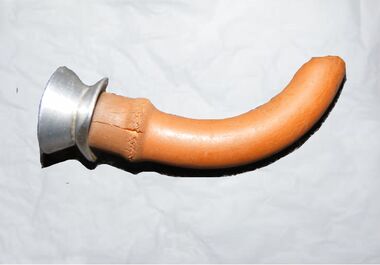
Functional object - Hewitt's Airway, Unknown
... oral opening to the hypopharynx. The Hewitt Airway was the foundation for many subsequent oropharyngeal airway designs. The oropharyngeal airway is significant because of its lesser acknowledged advances in anaesthesia. medical health anaesthesia Round metal tube with a brown rubber tubing sleeve around the outside. ...Hewitt’s airway was the first known oral airway and laid the foundations for the numerous other airways that were later developed. The development of the oropharyngeal airway is one of the lesser-acknowledged advances in anaesthesia. Oral airways made anaesthesia safer and significantly reduced the trauma associated with earlier attempts at managing the obstructed airway. The Hewitt Airway – the first known artificial oral ‘air-way’. In 1890, Frederic Hewitt noted the frequency and danger of upper airway obstruction. In 1908, dissatisfied with the use of tongue forceps and that Esmarch’s maneuver sometimes failed, he described the first oropharyngeal airway, the Hewitt Airway. The tube was less than 8 cm long, ideally connecting the oral opening to the hypopharynx. The Hewitt Airway was the foundation for many subsequent oropharyngeal airway designs.The oropharyngeal airway is significant because of its lesser acknowledged advances in anaesthesia.Round metal tube with a brown rubber tubing sleeve around the outside.medical health, anaesthesia -
Bendigo Historical Society Inc.
Document - HARRY BIGGS COLLECTION: SABIN ORAL POLIOMYELITIS VACCINE FORM
... health...Harry Biggs Collection... Sabin Oral...ORGANIZATION Government health Harry Biggs Collection Sabin Oral Poliomyelitis Vaccine Form Department of Health Victoria Document. ...Document. Harry Biggs Collection. 1 side of this document is the Poliomyelitis Vaccination Form which contains information required to be recorded & filed. Is produced by the Department of Health Victoria. On the back of the card are what appear to be random jottings including phone numbers of various people.Department of Health Victoriaorganization, government, health, harry biggs collection, sabin oral poliomyelitis vaccine form -
Glen Eira Historical Society
Newspaper - Maisel, Phillip
... Oral History project that records audio and video recordings of Holocaust survivors and includes 1300 video recordings made by Mr. Maisel and for which he received a Victorian Seniors of the Year Award. The press cuttings are as follows a. Press cutting from the Caulfield / Port Philip Leader dated October 11th 2011 has a photo of Mr Maisel before a TV screen with his image b. The press cutting from the Melbourne Weekly Bayside, ‘Your Community Voice’, for October 12th 2011 with a photo of Mr Maisel showing his award plaque with the Victorian Member for Health...Oral History project that records audio and video recordings of Holocaust survivors and includes 1300 video recordings made by Mr. Maisel and for which he received a Victorian Seniors of the Year Award. The press cuttings are as follows a. Press cutting from the Caulfield / Port Philip Leader dated October 11th 2011 has a photo of Mr Maisel before a TV screen with his image b. The press cutting from the Melbourne Weekly Bayside, ‘Your Community Voice’, for October 12th 2011 with a photo of Mr Maisel showing his award plaque with the Victorian Member for Health ...This filecontains two press cuttings with photographs of Philip Maisel aged 89, describing Mr.Maisel’s community work for the Melbourne Oral History project that records audio and video recordings of Holocaust survivors and includes 1300 video recordings made by Mr. Maisel and for which he received a Victorian Seniors of the Year Award. The press cuttings are as follows a. Press cutting from the Caulfield / Port Philip Leader dated October 11th 2011 has a photo of Mr Maisel before a TV screen with his image b. The press cutting from the Melbourne Weekly Bayside, ‘Your Community Voice’, for October 12th 2011 with a photo of Mr Maisel showing his award plaque with the Victorian Member for Health and Ageing, the Hon. David Davies.jewish community, voluntary workers, phillip maisel, jewish holocaust and research center, senior citizens, history, awards, oral history, citizens of the year, video recording equipment, victorian citizens of the year -
 South West Healthcare
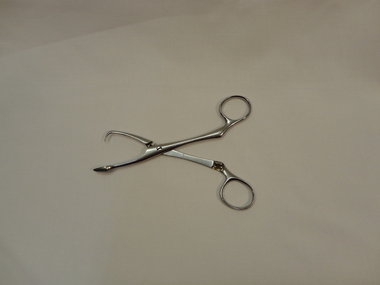
Carmalt's tongue holding forceps, Medical Equipment, ca 1920
... Oral & tonsil instrument...Mental Health...health hospital in Victoria circa 1920. Positions the tongue of an unconscious patient forward; possibly used during tonsillectomies. May also have been used for patients with epilepsy. http://museumvictoria.com.au/collections/items/259059/carmalt-s-tongue-holding-forceps-medicon-metal-circa-1920 Oral & tonsil instrument Mental Health Epilepsy "STAINLESS STEEL", "F.G & D" "C.TURTIN & SONS. ...Used for surgery in a mental health hospital in Victoria circa 1920. Positions the tongue of an unconscious patient forward; possibly used during tonsillectomies. May also have been used for patients with epilepsy. http://museumvictoria.com.au/collections/items/259059/carmalt-s-tongue-holding-forceps-medicon-metal-circa-1920Stainless steel forcep with punch arm and base with matching hole"STAINLESS STEEL", "F.G & D" "C.TURTIN & SONS. SHEFIELD"oral & tonsil instrument, mental health, epilepsy -
Unions Ballarat
I, the Aboriginal, Lockwood, Douglas, 1962
... oral histories...biography...department of health...An oral history of Waipuldanya (AKA Phillip Roberts), a full-blood Aboriginal who became a medical assistant for Department of Health at Darwin Hospital....An oral history of Waipuldanya (AKA Phillip Roberts), a full-blood Aboriginal who became a medical assistant for Department of Health at Darwin Hospital. ...An oral history of Waipuldanya (AKA Phillip Roberts), a full-blood Aboriginal who became a medical assistant for Department of Health at Darwin Hospital.Oral history. Aboriginal biography.Paper; book. Front cover: colour head image of an Aboriginal man; white lettering.Front cover: title and compiler's name.btlc, ballarat trades and labour council, ballarat trades hall, aboriginal persons, oral histories, biography, department of health - northern territory, darwin hospital, waipuldanya, indigenous australians, aboriginal australians, ethnography, northern territory, alawa people, aboriginal - customs -
Unions Ballarat
Framework of flesh : Builders' Labourers battle for health and safety, McQueen, Humphrey, 2009
... health...building workers...unions...history...oral...oral history. "McQueen uses labourers' own words to retell their battles around scaffolding and shithouses, for the safe removal of asbestos, prompt and adequate compensation, and a decent burial. The stories start in convict times and cover the six states and the ACT. The labourers' struggle for health...Relevant to the history of health and safety in the building industry and the building unions. btlc ballarat trades hall ballarat trades and labour council oh&s occupational health and safety workers health building workers unions history oral history Front cover: author's name and title. ...An oral history. "McQueen uses labourers' own words to retell their battles around scaffolding and shithouses, for the safe removal of asbestos, prompt and adequate compensation, and a decent burial. The stories start in convict times and cover the six states and the ACT. The labourers' struggle for health and safety is followed into their dismantling of the framework of fear erected by the Building and Construction Commission. By tracking on-the-job experiences of demolishers, dog-men, hod-carriers and navvies, McQueen confirms the conviction of an early official of the BLF, Ben Mulvogue: "A union constitutes a school for the working class, wherein they learn self-reliance, learn their rights, privileges, opportunities, as well as their possibilities. Every new demand for better physical protection of the workers ensures a great ideal development for a future generation.'"--Publisher's website. Relevant to the history of health and safety in the building industry and the building unions.Paper; book.Front cover: author's name and title.btlc, ballarat trades hall, ballarat trades and labour council, oh&s, occupational health and safety, workers health, building workers, unions, history, oral history -
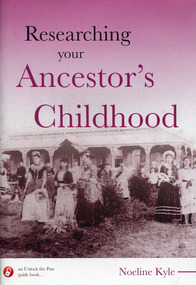 Surrey Hills Historical Society Collection
Booklet - Researching your ancestor's childhood
... Adoption -- Australia -- History Children -- Australia -- History Children -- Institutional care -- Australia Children -- New Zealand -- History Education -- Australia -- History Immigrant children -- Australia -- History Orphans -- Australia Genealogy -- Australia Australia -- Genealogy N This book draws on a range of research on the history of childhood and the family; histories of and sources for institutionalised care, educational records, toys and games, childhood museums, oral traditions, photographs, law and work for children, health and children's hospitals, the history of women's ancestry and much more from Noeline Kyle's research into the history of childhood, to map out useful strategies for researching the history of your ancestors' childhood An A5 sized booklet, 56p, index Researching your ancestor's childhood Booklet Researching your ancestor's childhood ...This book draws on a range of research on the history of childhood and the family; histories of and sources for institutionalised care, educational records, toys and games, childhood museums, oral traditions, photographs, law and work for children, health and children's hospitals, the history of women's ancestry and much more from Noeline Kyle's research into the history of childhood, to map out useful strategies for researching the history of your ancestors' childhoodAn A5 sized booklet, 56p, indexnon-fictionThis book draws on a range of research on the history of childhood and the family; histories of and sources for institutionalised care, educational records, toys and games, childhood museums, oral traditions, photographs, law and work for children, health and children's hospitals, the history of women's ancestry and much more from Noeline Kyle's research into the history of childhood, to map out useful strategies for researching the history of your ancestors' childhoodadoption -- australia -- history, children -- australia -- history, children -- institutional care -- australia, children -- new zealand -- history, education -- australia -- history, immigrant children -- australia -- history, orphans -- australia, genealogy -- australia, australia -- genealogy, n -
Bendigo Historical Society Inc.
Audio - The 1930s Depression Tapes - Nancy Betteridge, Michele Matthews, Depression Tapes, 2005
... The questions covered sixteen relevant subjects: • Introduction and housing • Social activities, swimming, cinemas, school and games played with friends • Organizations such as the RSL, Relief Committees etc. and any effect they had on family life • The life of the single woman • Unemployment and Employment • Government Assistance • Charities Aid • Self-help • People Power, e.g. boycotts or protests • Politics • Trouble or crime • Family Health, Medical and Diet • Education • General memories of, and hardships encountered, during the Depression history Bendigo Michele Matthews Collection The 1930s Depression Tapes Nancy Lenton Nancy Betteridge Oral History Interview Audio tape interview with Nancy Betteridge (Nee Lenton). ...In 2005 Michele Matthews interviewed current and former residents of Bendigo for her thesis on the 1930s Depression as part of her PhD Research, with the University of Melbourne Faculty of Arts, History Department. Michele interviewed fifteen members of prominent Bendigonian families. The thesis was titled: "How Depressing?: The impact of the Great Depression on Bendigo and District 1925-1935". The Michele Matthews Collection contains fourteen audio cassette tape recordings and one written transcript. The tapes are each approximately 1 hour and 45 minutes duration. The questions presented to the interviewees explore everyday experiences they would have lived through at the time of the Depression. The questions covered sixteen relevant subjects: • Introduction and housing • Social activities, swimming, cinemas, school and games played with friends • Organizations such as the RSL, Relief Committees etc. and any effect they had on family life • The life of the single woman • Unemployment and Employment • Government Assistance • Charities Aid • Self-help • People Power, e.g. boycotts or protests • Politics • Trouble or crime • Family Health, Medical and Diet • Education • General memories of, and hardships encountered, during the DepressionAudio tape interview with Nancy Betteridge (Nee Lenton). Nancy lived in fifteen different addresses in Bendigo throughout her lifetime. She married John Alexander Betteridge in 1951. Her father did odd jobs and sustenance work before getting a permanent job at the Bendigo Preserving Company. She went to St Joseph's Catholic School (1930-31) and St Kilian's (1931-38). The tape has been converted to a sound file. The 90 minute interview can be listened to, and the notes viewed, at the Bendigo Historical Society. By appointment only.history, bendigo, michele matthews collection, the 1930s depression tapes, nancy lenton, nancy betteridge, oral history, interview
