
Showing 16 items matching "organ seat"
-
 Emerald Museum & Nobelius Heritage Park
Instrument - Organ and seat, Cornish Piano & Organ Company, 1900s
... Organ and seat......Organ seat...It is a Cornish Reed Organ. Instrument Organ and seat Cornish Piano & Organ Company ...Rose Charman's parents, David and Lilly Charman managed Brookdale Guest House 1901-1914. Guest Houses in the Dandenongs had become popular weekend destinations for visitors from Melbourne at that time. This organ would have been used for concerts, singalongs etc. Rose Charman's parents, David and Lilly Charman managed Brookdale Guest House 1901-1914. Guest Houses in the Dandenongs had become popular weekend destinations for visitors from Melbourne at that time.This organ is a reminder of the time when guesthouses flourished in the Dandenongs following the completion of the narrow gauge train line,This reed or pump organ is a keyboard instrument that operates via bellows that blow wind past free-floating reeds. It is a Cornish Reed Organ.Inscribed on organ pedals: 'Cornish & Co.' and 'Washington N.J.'organ, organ seat, rose charman, brookdale guest house, cornish piano & organ company -
Uniting Church Archives - Synod of Victoria
BW photo, c. early 1980s
... Alison McAllister Pownall and daughter Amanda are shown seated an organ keyboard....p11 Alison McAllister Pownall and daughter Amanda are shown seated an organ keyboard. BW photo ...No further informationAlison McAllister Pownall and daughter Amanda are shown seated an organ keyboard.Alison McAllister Pownall and daughter Amanda. Church and Nation 26 October 1982? p11alison allister pownall; amanda pownall -
 Flagstaff Hill Maritime Museum and Village
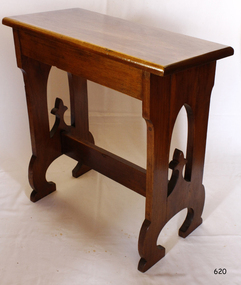
Furniture - Stool, circa 1880
... Stool; mahogany organ stool, angled seat with two legs reinforced by horizontal wooden bar. ...Flagstaff Hill Warrnambool Maritime Museum Maritime Village Shipwreck coast Great Ocean Road Church furniture Religious furniture Religious worship Missions to Seamen Victoria St Nicholas Seamen’s Church Williamstown St Nicholas Seamen’s Church Flagstaff Hill church music stool organ stool piano stool Stool; mahogany organ stool, angled seat with two legs reinforced by horizontal wooden bar. ...This organ stool was part of the original furnishings of the St Nicholas' Mission to Seamen's Church at 139 Nelson Place, Williamstown, Victoria. The Church was operated by the Mission to Seamen organisation. The stool was possibly donated together with the Mason & Hamilton reed organ, which was generously donated by the Joy Club for Fighters, a charity organisation in Williamstown. THE MISSIONS TO SEAMEN (Brief History: for more, see our Reg. No. 611, Set of Pews) The Missions to Seamen, an Anglican charity, has served seafarers of the world since 1856 in Great Britain. It symbol is a Flying Angel, inspired by a Bible verse. Today there are centr4es in over 200 ports world-wide where seamen of all backgrounds are offered a warm welcome and provided with a wide range of facilities. In Victoria the orgainsation began in Williamstown in 1857. It was as a Sailors’ Church, also known as ‘Bethel’ or the ‘Floating Church’. Its location was an old hulk floating in Hobson’s Bay, Port of Melbourne. It soon became part of the Missions to Seamen, Victoria. In the year 2000 the organisation, now named Mission to Seafarers, still operated locally in Melbourne, Portland, Geelong and Hastings. The Ladies’ Harbour Lights Guild was formed in 1906 to support the Missions to Seamen in Melbourne and other centres such as Williamstown. Two of the most significant ladies of the Guild were founder Ethel Augusta Godfrey and foundation member Alice Sibthorpe Tracy (who established a branch of the Guild in Warrnambool in 1920). The Guild continued its work until the 1960s. In 1943 a former Williamstown bank was purchased for the Missions to Seaman Club. The chapel was named St Nicholas’ Seamen’s Church and was supported by the Ladies’ Harbour Lights Guild, the Williamstown Lightkeepers’ Auxiliary and the League of Soldiers’ and Sailors’ Friends. It ceased operation in 1966. A Missions to Seamen Chapel and Recreation Room was a significant feature of ports during the late 1800s and into the 1900s. It seemed appropriate for Flagstaff Hill to include such a representation within the new Maritime Village, so the Melbourne Board of Management of Missions to Seamen Victoria gave its permission on 21st May 1979 for the entire furnishings of the Williamstown chapel to be transferred to Flagstaff Hill. The St Nicholas Seamen’s Church was officially opened on October 11, 1981 and closely resembles the Williamstown chapel. This organ stool is significant historically for its origin in the St Nicholas Mission to Seamen's Church in Williamstown, established in 1857 to cater for the physical, social, and spiritual needs of seafarers. It originated in Bristol, England when a Seamen's Mission was formed in 1837. The stool is historically significant for its connection to the 1880s Mason & Hamilton reed organ that was also in the St Nicholas Seamen's Church in Williamstown. The connection of this stool to the Mission to Seamen and to the Ladies Lightkeepers’ Auxiliary, and possibly to the Joy Club for Fighters, highlights the strong community awareness of the life of people at sea, their dangers and hardships, and their need for physical, financial, spiritual and moral support. Stool; mahogany organ stool, angled seat with two legs reinforced by horizontal wooden bar. Legs have a decorative cut away design. This stool is in our St Nicholas Seamen's Church Collection.flagstaff hill, warrnambool, maritime museum, maritime village, shipwreck coast, great ocean road, church furniture, religious furniture, religious worship, missions to seamen victoria, st nicholas seamen’s church williamstown, st nicholas seamen’s church flagstaff hill, church music, stool, organ stool, piano stool -
 Bendigo Historical Society Inc.
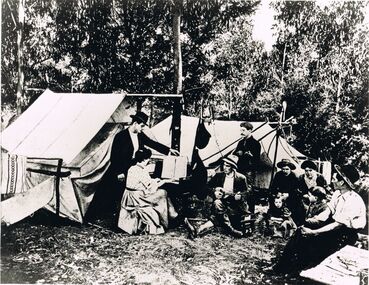
Photograph - PETER ELLIS COLLECTION: GROUP OF PEOPLE
... seated and standing outside tents. Some are playing instruments and some are listening. A lady is playing an old pedal organ with a man standing there turning the music pages for her. ...seated and standing outside tents. Some are playing instruments and some are listening. A lady is playing an old pedal organ with a man standing there turning the music pages for her. ...Black and white photo of men, women and children seated and standing outside tents. Some are playing instruments and some are listening. A lady is playing an old pedal organ with a man standing there turning the music pages for her. A man is playing a mandolin and a man behind him is possibly playing something small. The photo was taken in the bush. A yellow sticky note on the back reads: 'Somewhere in Vic. Old pedal organ. Mandolins. Gold rush poss with tents. Spoon why?'photo, group, mixed group, peter ellis collection, musical group -
 Bendigo Historical Society Inc.
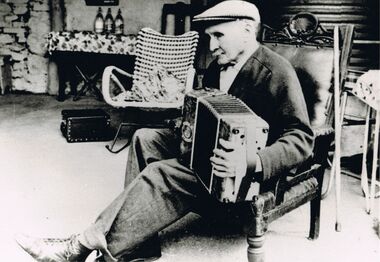
Photograph - PETER ELLIS COLLECTION: MAN PLAYING ACCORDION
... seated in an armchair with an upholstered back with a carved top playing an accordion? He is wearing shirt, cardigan, trousers, lace up boots and a cap. His walking stick is hanging on the back of the chair. (2) A middle aged man sitting in front of a brick fireplace playing an accordion. The instrument has a plate near the keys with 'The Grand Organ...seated in an armchair with an upholstered back with a carved top playing an accordion? He is wearing shirt, cardigan, trousers, lace up boots and a cap. His walking stick is hanging on the back of the chair. (2) A middle aged man sitting in front of a brick fireplace playing an accordion. The instrument has a plate near the keys with 'The Grand Organ ...(1) An older man seated in an armchair with an upholstered back with a carved top playing an accordion? He is wearing shirt, cardigan, trousers, lace up boots and a cap. His walking stick is hanging on the back of the chair. (2) A middle aged man sitting in front of a brick fireplace playing an accordion. The instrument has a plate near the keys with 'The Grand Organ' printed on it. It has decorative scroll work on the corner near the keys.photo, individual, male, peter ellis collection, accordion/concertina players -
Bendigo Historical Society Inc.
Document - GOLDEN SQUARE METHODIST GRAND CONCERT AND ORGAN RECITAL, 1908
... Organ Recital by Mr Mansley Greer, (of Melbourne). Wednesday August 18th, 1909. Participants; Church Choir, Mr Mansley Greer, Mr Percy Hampton, Miss Winnie Bradbury, Miss Jennings, and Mr E H Collett. Concert will start punctually at 8 o'clock. Admission 1/- Seats...Organ Recital by Mr Mansley Greer. Aug 18th 1909. Participants; Church Choir Mr Mansley Greer Mr Percy Hampton Miss Winnie Bradbury Miss Jennings and Mr E H Collett. Concert 8pm. Admission 1/- Seats ...Golden Square Methodist Grand Concert and Organ Recital by Mr Mansley Greer, (of Melbourne). Wednesday August 18th, 1909. Participants; Church Choir, Mr Mansley Greer, Mr Percy Hampton, Miss Winnie Bradbury, Miss Jennings, and Mr E H Collett. Concert will start punctually at 8 o'clock. Admission 1/- Seats may be reserved in any part of the church for 6d. Extra. Plan of seats by flights. Arrangements will be made for special Tram Service to and from the church on the evening of the Concert. Proceed in aid of Church Funds. A W Andrew Hon Conductor, Alex Hampton Hon. Organist, R Martin Hon. Secretary.program, music, methodist church grand concert, golden suare methodist grand concert organ recital by mr mansley greer. aug 18th, 1909. participants; church choir, mr mansley greer, mr percy hampton, miss winnie bradbury, miss jennings, and mr e h collett. concert 8pm. admission 1/- seats may be reserved for 6d. arrangements for special tram service on the evening of the concert. proceed in aid of church funds. a w andrew hon conductor, alex hampton hon. organist, r martin hon. secretary. -
 Uniting Church Archives - Synod of Victoria
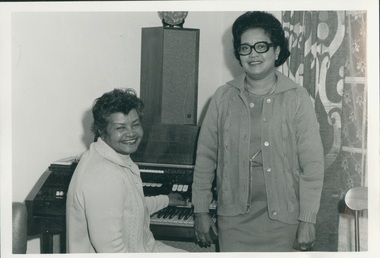
Photograph - Mercy Isaacs
... Mercy Isaacs seated at her organ with Mabel Dodampe standing standing with an unidentified person seated...Mercy Isaacs, New Spectator 2 August 1972 p2 Mercy Isaacs seated at her organ with Mabel Dodampe standing standing with an unidentified person seated Photograph Mercy Isaacs ...Mercy Isaacs seated at her organ with Mabel Dodampe standing standing with an unidentified person seatedMercy Isaacs, New Spectator 2 August 1972 p2 -
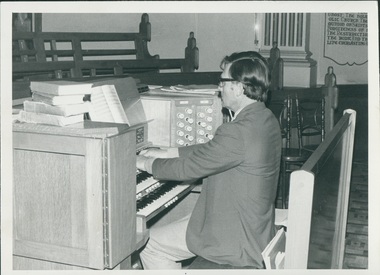 Uniting Church Archives - Synod of Victoria
BW glossy photo, 1978
... BW photo of William (Bill) Martin seated at and playing an organ. (likely Auburn Uniting)...William (Bill) Martin William (Bill) Martin c1978 Photo by J Mack 836 1781 BW photo of William (Bill) Martin seated at and playing an organ. (likely Auburn Uniting) BW glossy photo ...BW photo of William (Bill) Martin seated at and playing an organ. (likely Auburn Uniting)William (Bill) Martin c1978 Photo by J Mack 836 1781william (bill) martin -
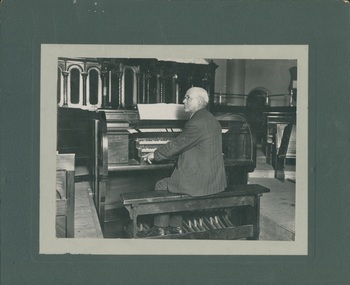 Uniting Church Archives - Synod of Victoria
Photograph, 1926
... B & W photograph, mounted on green card, of William Bousted seated at the organ in St. Andrew's Presbyterian Church Ballarat after its reconstruction. ...organ, organist. B & W photograph, mounted on green card, of William Bousted seated at the organ in St. ...William Bousted was organist and choir master of the St. Andtrew's Presbyterian Church Ballarat 1887 - 1938.B & W photograph, mounted on green card, of William Bousted seated at the organ in St. Andrew's Presbyterian Church Ballarat after its reconstruction. william boustead, st. andrew's presbyterian church ballarat, organ, organist. -
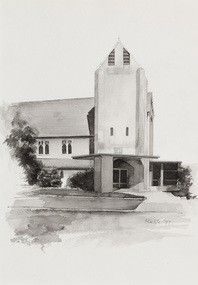 Bayside Gallery - Bayside City Council Art & Heritage Collection
Work on paper - ink and watercolour, Annette Meikle, Church of England, 1977
... The foundation stone laid on 7 September 1919 and was consecrated in December 1921, the church seats 350 and contains an organ loft, a marble chancel floor, and Australian hardwood pulpit and pews....The foundation stone laid on 7 September 1919 and was consecrated in December 1921, the church seats 350 and contains an organ loft, a marble chancel floor, and Australian hardwood pulpit and pews. annette meikle sandringham sketchbook elizabeth waters all souls memorial church church building architecture bay road sandringham church of england Church of England Work on paper ink and watercolour Annette Meikle ...In 1977, artist Annette Meikle undertook a commission to illustrate a book recording stories of places and people in the Bayside area. It was published in 1978 as Sandringham Sketchbook, with text by Elizabeth Waters. The sketches were intended to record remaining examples of Bayside’s early architecture and environment, as well as reflect newer architectural changes. Meikle went on to donate 22 of these sketches to Bayside City Council in 2003. All Souls Memorial Church, located at 48 Bay Road, Sandringham, is believed to be the first reinforced concrete church in Australia. The foundation stone laid on 7 September 1919 and was consecrated in December 1921, the church seats 350 and contains an organ loft, a marble chancel floor, and Australian hardwood pulpit and pews.Annette Meikle, Church of England 1977, ink and watercolour, 35.6 x 25 cm. Bayside City Council Art and Heritage Collection. Donated by the artist, 2003annette meikle, sandringham sketchbook, elizabeth waters, all souls memorial church, church, building, architecture, bay road, sandringham, church of england -
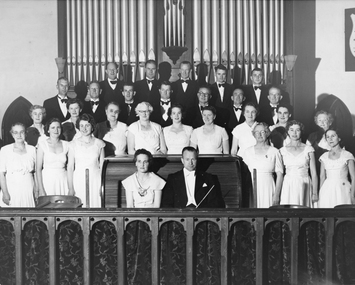 Stawell Historical Society Inc
Photograph, Choral Society in St Matthews Church c1953-1954
... Black And White photograph of a Large group of People most Standing apart from One Man and Woman seated in front of a Pipe Organ and the group. Men Standing in suits with Black Bow Ties, Man seated has White Bow Tie. ...St Mattews Choral Black And White photograph of a Large group of People most Standing apart from One Man and Woman seated in front of a Pipe Organ and the group. Men Standing in suits with Black Bow Ties, Man seated has White Bow Tie. ...This Photograph was loaned by Mrs Gwen Reeve to be copied. Black And White photograph of a Large group of People most Standing apart from One Man and Woman seated in front of a Pipe Organ and the group. Men Standing in suits with Black Bow Ties, Man seated has White Bow Tie. Women in White Dresses.st mattews, choral -
 Sunshine and District Historical Society Incorporated
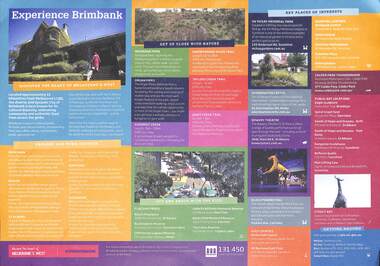
Poster - Experience Brimbank Poster
... Organ Pipes, Taylors Creek Trail, Kororoit Creek & Jones Creek Trail|Out and about with the kids - Alice's Playspace, Buckingham Reserve, Cliff Harvey Lagoon Reserve, Isabella Williams Memorial Reserve, Kevin Flint Memorial Reserve & The Lakes Reserve|Key places of interest - H.V. McKay Memorial Park, Overnewton Castle, Bowery Theatre, Black Powder Mill, Keilor Golf Course, Mt. Derrimut Golf Club, Brimbank Cente Shopping Centre, Keilor Central Shopping Centre, Sunshine Marketplace Shopping Centre, Sunshine Plaza Shopping Centre, Watergardens Shopping Centre, Clader Park Thunderdome|Public Art locations - Eagle sculpture Federation Trail Brooklyn, Spiral Graph Seat...Organ Pipes, Taylors Creek Trail, Kororoit Creek & Jones Creek Trail|Out and about with the kids - Alice's Playspace, Buckingham Reserve, Cliff Harvey Lagoon Reserve, Isabella Williams Memorial Reserve, Kevin Flint Memorial Reserve & The Lakes Reserve|Key places of interest - H.V. McKay Memorial Park, Overnewton Castle, Bowery Theatre, Black Powder Mill, Keilor Golf Course, Mt. Derrimut Golf Club, Brimbank Cente Shopping Centre, Keilor Central Shopping Centre, Sunshine Marketplace Shopping Centre, Sunshine Plaza Shopping Centre, Watergardens Shopping Centre, Clader Park Thunderdome|Public Art locations - Eagle sculpture Federation Trail Brooklyn, Spiral Graph Seat ...Poster produced by the City of BrimbankExperience Brimbank|Explore town centres of Deer Park, Keilor, St. Albans, Sunshine & Sydenham|Get up close with nature - Brimbank Park, Maribyrnong River Trail, Organ Pipes, Taylors Creek Trail, Kororoit Creek & Jones Creek Trail|Out and about with the kids - Alice's Playspace, Buckingham Reserve, Cliff Harvey Lagoon Reserve, Isabella Williams Memorial Reserve, Kevin Flint Memorial Reserve & The Lakes Reserve|Key places of interest - H.V. McKay Memorial Park, Overnewton Castle, Bowery Theatre, Black Powder Mill, Keilor Golf Course, Mt. Derrimut Golf Club, Brimbank Cente Shopping Centre, Keilor Central Shopping Centre, Sunshine Marketplace Shopping Centre, Sunshine Plaza Shopping Centre, Watergardens Shopping Centre, Clader Park Thunderdome|Public Art locations - Eagle sculpture Federation Trail Brooklyn, Spiral Graph Seat Lennon Parkway Derrimut, Seeds of Hope and Dreams Drift Alfredia St, Seeds of Hope and Dreams Yam Daisy St. Albans Square, Kangaroo Sculpture Matthews Hill, Reflexio Qualis sculptures Sunshine Bus Interchange and City Place, Man Lifting Cow Hampshire Rdbrimbank -
 Linton and District Historical Society Inc
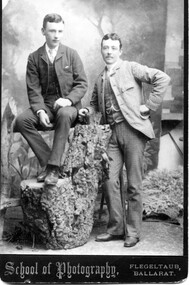
Photograph, School of Photography Flegeltaub, Ballarat, Richard and Thomas Kennedy
... Proceeds were in aid of a church organ which I believe is still there. HB Mrs Barry" Sepia photograph of two young men wearing suits, one seated on tall object with left arm resting in knee, right arm resting on left, the other with fob chain, standing, leaning right arm on object, left arm crooked onto waist. ...Sepia photograph of two young men wearing suits, one seated on tall object with left arm resting in knee, right arm resting on left, the other with fob chain, standing, leaning right arm on object, left arm crooked onto waist."Richard (born c1864, married Catherine Honora O'Beirne on 7.4.1890) and Thomas Kennedy, taken while they lived at Fingal Park and managed it with the help of 2 sisters. The Family were still in Portland. Richard (Dick) was secretary with our Mother and organiser of the very first concert at Linton. Proceeds were in aid of a church organ which I believe is still there. HB Mrs Barry"richard kennedy, thomas kennedy, fingal park, catherine o'beirne -
 Musculoskeletal Health Australia (now held by the Glen Eira Historical Society)
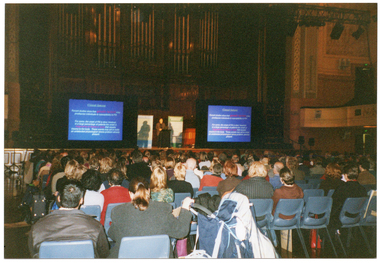
Photograph - Group photo, 28/05/2005
... In the foreground, there is seated audience who have been Photographed from behind. In the background, there are several sections of wood panelling and several organ pipes separated into five groups....In the foreground, there is seated audience who have been Photographed from behind. In the background, there are several sections of wood panelling and several organ pipes separated into five groups. ...On Saturday the 28th of May 2005, the Arthritis Foundation of Victoria (AFV), incorporating Osteoporosis Victoria (OV), held a Fibromyalgia Seminar and Expo at the Melbourne Town Hall. The event was attended by more than 350 people. Presenters included Rheumatologist, Dr Daniel Lewis, and Dr Craig Hassed from Monash University, who specialises in mind-body and integrative medicine. This photo is a wide shot of Dr Lewis making his presention on the stage. Also available on the day were 30 minute break-out sessions covering topics such as Feldenkrais, Food for Life (nutrition), Pain Management, Psychosocial Aspects, Relaxation, and Yoga.COL photo of a man standing at a lecturn, behind which are two free-standing vertical banners. On either side of him are two large screens displaying projected slides containing textual information. In the foreground, there is seated audience who have been Photographed from behind. In the background, there are several sections of wood panelling and several organ pipes separated into five groups.[On a white label, printed in black ink] Fibromyalgia Seminar May 28 2005 Dr Daniel Lewisarthritis foundation of victoria, afv, osteoporosis victoria, ov, fibromyalgia syndrome, fms, seminar, expo, information, education, pain management, feldenkrais, food for life, nutrition, healthy food, healthy diet, psychosocial, relaxation, yoga, dr daniel lewis, rheumatologist, mind and body model, integrative medicine, melbourne town hall, 2005 -
 Musculoskeletal Health Australia (now held by the Glen Eira Historical Society)
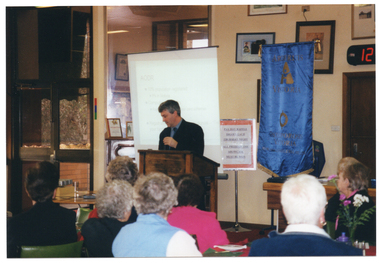
Photograph - Group photo, XX/05/2003
... Dr Pollock is an ophthalmologist and eye surgeon who established the Lions Eye Donation Service in 1991. arthritis victoria av northern metro shg seminar self help groups dr graeme pollock ophthalmologist eye surgeon aodr australian organ donor registry lions eye donation service leds 2003 [On a green sticky note, handwritten in blue/black ink] Dr Graeme Pollock. presenting @ the Northern Metro SHG Seminar Colour photo of a man, standing at a lectern, addressing a roomful of people, who are seated. ...In May 2003, Arthritis Victoria (AV) held a seminar for its self help groups in the northern metropolitan region. This photo depicts Dr Graeme Pollock making his presentation at the Northern Metro Self Help Group Seminar. The slide being projected is titled, "AODR", which is an ancronym for the Australian Organ Donor Registry. Dr Pollock is an ophthalmologist and eye surgeon who established the Lions Eye Donation Service in 1991.Colour photo of a man, standing at a lectern, addressing a roomful of people, who are seated. Behind him, there is a slide being projected onto a freestanding screen and a tall, freestanding blue and gold banner. The slide on the screen is titled, "AODR".[On a green sticky note, handwritten in blue/black ink] Dr Graeme Pollock. presenting @ the Northern Metro SHG Seminararthritis victoria, av, northern metro shg seminar, self help groups, dr graeme pollock, ophthalmologist, eye surgeon, aodr, australian organ donor registry, lions eye donation service, leds, 2003 -
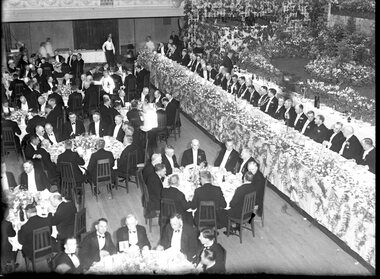 City of Melbourne Libraries
Photograph, Bull, Hugh Jones, 1897-1993, Lord Mayor's Dinner, Melbourne Town Hall
... Rosy flowers were issued up every pillar, and great golden lamps, hanging from the door, were seated in greenery and trails of sweet peas. The organ gallery was converted into a terrace garden with stone steps leading to banks of pink azaleas, pink pelargoniums, masses of calceolarias, and the lovely deep mauve and blue of cinerarias. ...Rosy flowers were issued up every pillar, and great golden lamps, hanging from the door, were seated in greenery and trails of sweet peas. The organ gallery was converted into a terrace garden with stone steps leading to banks of pink azaleas, pink pelargoniums, masses of calceolarias, and the lovely deep mauve and blue of cinerarias. ...Photographer notations on slide: "General View Of Lord Mayor's Dinner At Town Hall Nov 1936 B112" Published: The Age, Tuesday 10 November 1936, page 13 Published title: LORD MAYOR'S BANQUET Published caption: The brilliant scene inside the Melbourne Town Hall last night during the Lord Mayor’s banquet. Trove article identifier: http://nla.gov.au/nla.news-article205939431 Description: 700 guests (all men) are seated around numerous tables in the Melbourne Town Hall for the Lord Mayor's dinner in November 1936. Before the stage is a top table of 35 men, all dressed smartly in black dinner suits, with either a black or white bow tie. Many are wearing their medals. The Lord Mayor has on his Mayoral chains, and to his right is the Governor of Victoria, Lord Huntingfield. The stage is heavily decorated with fresh flowers. Research by project volunteer, Louise McKenzie: This image takes up one quarter of the photographic space on page 13 of The Age on 10 November 1936, reflecting the importance of the event and also the sheer dramatics of the image: 700 guests (all men), a top table of 35, and all dressed smartly in black dinner suits, with either a black or white bow tie. Many are wearing their medals. The Lord Mayor has on his Mayoral chains, and to his right is the Governor of Victoria, Lord Huntingfield. Further to his right is a man with an impressive sash across his chest. It is a very animated, and rather informal, moment. Banks of fresh flowers smother the stage, which is decorated in the manner of a terrace at an English stately home. Tables are laden with food, drink and decorations, and the wait staff (men and women) are also formally dressed, in the manner of Downton Abbey. It is spectacular, dramatic, and luxurious, and perpetuates the proud descriptor of “Marvellous Melbourne” as conferred by London Journalist George Augustus Sala when he visited the city in 1885. During its 1880s boom, Melbourne was the second-largest city in the British Empire, after London, and reputedly the richest city in the world. At times the expression was used with some irony, but "...in Victoria’s centenary year, 1934, with the city mired in another depression, a publisher bravely entitled a book of souvenir photographs Marvellous Melbourne, claiming that the subject ‘still finds apt expression in the happy one-time sobriquet’.” This photo seems to reflect an ongoing pride in Melbourne and a desire for it to live up to its descriptor and celebrate its post-centenary era in style. So it is no surprise to find that on page 11 of The Age on the same day, a second photo is to be found – a cropped view of one table – along with a very detailed description of the night, its purpose, and a surprise announcement. But, who was the Lord Mayor in whose honour the dinner was held? In 1934, the Lord Mayor of Melbourne was Cr. Alexander George Wales, (born Richmond, 11 October 1885, died Elsterwick, 31 May 1962). His father was a contractor and quarry-owner, but was blinded in an industrial accident in 1899. Consequently Alexander, then aged 14, left Brunswick State School to become a railway labourer working at a quarry, and in 1903 joined the Commonwealth public service as a clerk and began studying at night school, determined to improve himself. In 1907 he was appointed secretary of the Albion Quarrying Co. (in which the family had an interest), then its managing director and chairman. As the Australian Dictionary of Biography notes, he was instrumental in expanding the company’s interests, "...becoming director of the Hardware Co. of Australia Pty Ltd, the Twentieth Century Building and Investment Society, the Albion Sand Co. and the Geelong Brick Co.”. His public career began in 1914 when he was elected to the Brunswick council. He was mayor 1917-18, and in 1925 progressed to the Melbourne City Council where he remained for 29 years, being a member of most council committees. He served three successive terms as lord mayor (1934-37), was Chairman of the council’s decorations committee for Melbourne’s centenary, president of the Metropolitan Fire Brigades Board (1936), and Chairman of the Public Works Committee (1937-39). In 1936 he was elected to the Legislative Council with United Australia Party support, but later resigned over possible State government contract tender irregularities. Wales received "the customary reward” of a knighthood and was invested at Buckingham Palace by King George VI whose coronation he attended in 1937. He was an early director of what is now Ampol, and helped the development of the petroleum industry in Australia after visiting the USA in 1943 and 1946. He was impressed by that country’s wartime shipbuilding efforts and supported closer ties with the USA. “While president (1947-48) of the Melbourne Chamber of Commerce, Wales was a vocal critic of the Federal Labor Government, ...a staunch anti-socialist ... and a focus for conservative opposition to the Curtin and Chifley governments...” He is described as “a natural leader in business and civic politics,... a powerful force in the Melbourne City Council... opposing democratic reforms such as the creation of a Greater Melbourne Council and the abolition of plural voting, but advocat[ing] the redevelopment of city-owned property like the Eastern and Western markets...” So, this Lord Mayor’s dinner marks the third successive term in office for Governor Cr. A G Wales. The room is filled with powerful and influential men, and provided a platform for the Premier of Victoria, Albert Dunstan (1882-1950, United Country party) to announce that if the City Council would bear half the cost the State Government would build a bridge at Punt Road “at once”. He announced that the Government proposed to have the bridge built by the Country Roads Board, and allow the City Council to pay its share on convenient terms, and further, it would investigate the shared provision of more Yarra bridges. The proposal for the Punt Road Bridge was met with applause as the Yarra River constituted a serious traffic barrier. On 12 November 1936, two days after the Lord Mayor’s dinner, The Age published an article, “Building without a Plan”. It questions the appropriateness of the next Yarra bridge being the one at Punt Road, and encourages a “proper procedure” to look at the provision of additional Yarra bridges as a whole. But in fact this topic had been canvassed back in August when Melbourne City Council’s public works committee had recommended the replacement of the footbridge at Punt Road with a bridge, and if the Country Roads Board would declare this portion of Punt Road, including the river crossing, a State Highway, this could give the Board authority to construct the bridge and allocate the cost. Hence the reference at the dinner to a shared expense. Still an integral part of traffic management today, the Hoddle Bridge carries Punt Road over the Yarra River between Richmond and South Yarra in Melbourne. It is a five-lane road bridge with narrow footpaths on either side. It is of continuous reinforced concrete T-beam construction with five segmental arched spans, supported on transverse piers, and linked by concrete cross-beams. “The piers terminate in a series of tapered concrete pillars with Art Deco-styled steamlined decoration. Each pillar supports a Victorian-style lamp. The infill railings are geometric-patterned painted metal. Construction began in late 1937, and it was opened by Premier Albert Dunstan on 22 December 1938. It replaced an earlier footbridge, which in turn had replaced a punt service. The bridge (originally referred to as Punt Road Bridge) was named after Robert Hoddle, who planned central Melbourne’s Hoddle Grid, the grid of streets which form Melbourne’s central business district. Hoddle arrived in Australia from the UK in 1823 and went on to carry out surveys in NSW and Queensland before arriving in Melbourne in 1837. He designed layouts for both Melbourne and Williamstown, and later Geelong and other Victorian country areas. He was keen that major streets be at least 30 metres wide. ”With remarkable foresight he provided for wide boulevards from the city to the suburbs, but the subdivisions of early speculators in inner suburbs created the bottle-necks of today. After the separation of the colony in 1851, he became Victoria’s first surveyor-general... and advocated the provision of three-chain (60 m) roads and the widening of all existing main roads from one (20 m) to three chains." However, he was met with constant opposition and in 1853, was eased out of office. As a small and interesting aside: Hoddle was appointed auctioneer for the first sale of crown land in Melbourne on 1 June 1837. His commission was 57 pounds 12s 7d. and he bought two allotments for himself at a cost of 54 pounds. After he died his second wife married Richard Buckhurst Buxton, a member of the family which in 1860s Melbourne established the Australian property dynasty of Buxton Real Estate, Becton, MAB Corporation etc. Returning to the dinner and The Age article of 10 November 1836: Another topic of the after-dinner speeches was a reference to the upcoming Armistice Day. “The Minister of Customs (Mr White) said the proximity of Armistice day reminded us that eighteen years ago we had high hopes of prolonged peace.” The term “Armistice Day” was coined after WWI: “At 11 am on 11 November 1918, the guns on the Western Front fell silent after more than four years of continuous warfare. The Germans called for an armistice (suspension of fighting) in order to secure a peace settlement. They accepted the allied terms on unconditional surrender. Therefore on the 11th hour of the 11th day of the 11th month, a minute’s silence is observed and dedicated to those soldiers who died fighting to protect the nation. Originally known as Armistice Day, it was renamed Remembrance Day after World War Two to commemorate those who were killed in both World Wars. Today it refers to the loss of Australian lives from all wars and conflicts, accompanied by the words, "We will remember them, Lest we forget"." There was comment at the dinner about the need to remain firm in supporting the “democratic government in the British Empire to avoid a “plunge into savagery”. There was a grave responsibility on the British people to keep democracy alive, and that could not be done without adequate defence forces... Many weak governments in non-British countries had been swept aside by strong-fisted dictators, who now were the real threat to peace”. With the benefit of hindsight these were very pertinent comments and tragically prophetic. The Melbourne Shrine of Remembrance had only been dedicated two years earlier, at a ceremony attended by the Duke of Gloucester, son of King George V. Over 300,000 citizens attended: one third of the population of Melbourne. It became the location for the Anzac Day Dawn Service. Originally the march travelled from the Shrine into the city, however, in 1936, this was reversed, and the Shrine became the termination point for Anzac Day Marches. Also significant in 1936, was the installation of a statue in the west forecourt of the Shrine: “The Man with the Donkey” (aka 'Private John Simpson and his Little Donkey'). The work is said to represent the “valour and compassion of the Australian soldier”. Its full citation, according to the City of Melbourne City Collection is: West Side of Base: "The / Man with his Donkey / Gallipoli, April 25 to May 19 / in Commemoration / of the valour and compassion / of the Australian Soldier" AFTER LANDING AT GALLIPOLI, SIMPSON, WITH HIS LITTLE DONKEY, WORKED ALONE, DAY AND NIGHT TAKING WATER TO THE FRONT LINE AND CARRYING THE WOUNDED BACK TO THE DRESSING STATIONS. HE AND HIS DONKEY WERE KILLED BY A SHRAPNEL SHELL ON THE 19TH MAY, 1915. SIMPSON WAS MENTIONED IN DISPATCHES BY SIR IAN HAMILTON, COMMANDER-IN-CHIEF OF THE MEDITERRANEAN EXPEDITIONARY FORCE. / Erected by Public Subscription under auspices of the / Red Cross Society. East Side of Base: Private John Simpson." Their summary in background states: "A bronze figure of Simpson and his donkey with a wounded man on the donkey's back on a granite pedestal. Private John Simpson Kirkpatrick’s intrepid and short-lived exploits during the Gallipoli campaign have made him a popular figure of World War One. He has been mythologised to represent the lauded values of the digger, and he symbolises all those who went into battle unarmed. Born in England in 1892, he came to Australia in 1910. He enlisted to make his way back to England, but as a member of the 3rd Field Ambulance AIA was sent to Gallipoli. After just three weeks of bearing wounded soldiers across Shrapnel Gully on the back of his donkey, Simpson was killed by shrapnel fire. Simpson’s story became a powerful propaganda tool for enlistment in Australia, but following the war he was quickly forgotten. With the Shrine of Remembrance nearing completion in 1933, the memory of Simpson was rekindled to commemorate all who gave their lives to help others during the war. One plaque reads: ‘The / Man with his donkey / Gallipoli … / In commemoration / of the valour and compassion / of the Australian soldier’. In 1935, Wallace Anderson’s design for the memorial was selected though a competition organised by the Australian Red Cross. Anderson had served during the war and worked at the Australian War Memorial after his return. His Man with the Donkey was cast in Italy, and after some debate was sited near the shrine. Unveiled 20th June, 1936." The sculptor, Victorian-born William Wallace Anderson (1888-1975), served in France during WWI and afterwards produced a number of bronze war memorials and memorial portraits, predominantly in Victoria. “His most famous work is that of Simpson and his Donkey (1935), which he completed after winning a competition conducted by the Victorian Division of the Australian Red Cross. Anderson’s fee was 350 pounds; the cast, made by the Chiurazzi Foundry, Naples, Italy, cost 40 pounds. The work... has become well known as a symbol of the Anzac tradition.” A debate as to the siting of the statue arose from a strong view expressed by General Sir John Monash that no representation of individual members of the Australian Defence Force be located on the Shrine itself. Hence its location off to the northwest of the forecourt, in a garden of rosemary. And finally we return to the photo of the grand Lord Mayor’s dinner! An article in The Argus of 4 November 1936 refers to “Brilliant Scene at Lord Mayor’s Ball – Hall Becomes a Garden”. So now it becomes clear why the Town Hall, location of the Lord Mayor’s Dinner on 10 November 1934, only 6 days later, is so lavishly decorated. The floral decorations from the Ball are still in place - an early example of “recycling”, which is gratifying to note at a time of Depression. The reporter has captured the scene with enthusiasm: “Hundreds of tiny rose lights, hidden among pink roses, transformed the Melbourne Town Hall into a magical garden last night, when the Lord Mayor and Lady Mayoress (Councillor A. C. Wales, M.L.C., and Mrs. Wales) entertained about 3,500 guests at a ball. His Excellency the Governor (Lord Huntingfield) and Lady Huntingfield were present, while Rear-Admiral and Mrs. Lane Poole and officers from the visiting squadron were among the special guests. The balconies all round the hall were hidden by a white trellis, covered with pink blossoms and greenery. Rosy flowers were issued up every pillar, and great golden lamps, hanging from the door, were seated in greenery and trails of sweet peas. The organ gallery was converted into a terrace garden with stone steps leading to banks of pink azaleas, pink pelargoniums, masses of calceolarias, and the lovely deep mauve and blue of cinerarias. Slender Japanese maples and poplar trees grew from the higher slopes amid thickets of hostas, while a fascinating illusion was created by the lofty conservatory windows, which formed the background, and which were tinted cerulean blue to simulate the sky seen through glass. Large fern baskets hung from the conservatory roof, and the whole scene was enclosed in trellises of blossom. In the entrance palm green shrubs stood like sentinels round the passed floor, and flowers bloomed in misty golds. The long corridor upstairs leading to the council chamber was lined with an avenue of poplar trees in tubs. In the Lower Town Hall great banks of calceolarias and azaleas decked the upper dais, and each supper table was adorned with a different coloured flower with sprays of roses and Japanese maple laid on the snowy cloths. The adjoining supper-rooms were fragrant with the scent of huge bowls of stock in mauve, purple, and pink, while the white walls were covered with palm leaves and flowers. The roof garden below the clock tower was enclosed as a buffet with rose wreathed walls, and flowers were arranged attractively in the Lady Mayoress's rooms." References: LORD MAYOR'S BANQUET. CENTURY MAKERS AT THE M.C.G. BEFORE THE CHANGE. (1936, November 10). The Age (Melbourne, Vic. : 1854 - 1954), p. 13. Retrieved September 4, 2024, from http://nla.gov.au/nla.news-article205939431 'Portrait of Sir George Wales (Lord Mayor 1934-1937)', City Collection, City of Melbourne, https://citycollection.melbourne.vic.gov.au/portrait-of-sir-george-wales-lord-mayor-1934-37/ Graeme Davison, 'Marvellous Melbourne', eMelbourne, https://www.emelbourne.net.au/biogs/EM00906b.htm THE LORD MAYOR'S BANQUET. (1936, November 10). The Age (Melbourne, Vic. : 1854 - 1954), p. 11. Retrieved September 26, 2024, from http://nla.gov.au/nla.news-article205939643 BRILLIANT SCENE AT LORD MAYOR'S BALL Hall Becomes a Garden (1936, November 4). The Argus (Melbourne, Vic. : 1848 - 1957), p. 14. Retrieved September 26, 2024, from http://nla.gov.au/nla.news-article11932746 'Hoddle Bridge', Wikipedia, https://en.wikipedia.org/wiki/Hoddle_Bridge 'Hoddle Bridge', Victorian Heritage Database Report, Victorian Heritage Council, https://vhd.heritagecouncil.vic.gov.au/places/195689/download-report David Dunstan, 'Wales, Sir Alexander George (1885–1962)', Australian Dictionary of Biography, National Centre of Biography, Australian National University, https://adb.anu.edu.au/biography/wales-sir-alexander-george-8951/text15737, published first in hardcopy 1990, accessed online 26 September 2024. Marjorie J. Tipping, 'Hoddle, Robert (1794–1881)', Australian Dictionary of Biography, National Centre of Biography, Australian National University, https://adb.anu.edu.au/biography/hoddle-robert-2190/text2823, published first in hardcopy 1966, accessed online 26 September 2024. BUILDING WITHOUT A PLAN. (1936, November 12). The Age (Melbourne, Vic. : 1854 - 1954), p. 8. Retrieved September 26, 2024, from http://nla.gov.au/nla.news-article205949762 NEW BRIDGE AT PUNT ROAD (1936, August 12). The Argus (Melbourne, Vic. : 1848 - 1957), p. 10. Retrieved September 26, 2024, from http://nla.gov.au/nla.news-article11902131 'The Shrine of Remembrance', Beaconsfield’s Soldiers: https://beaconsfield.org.au/digitalmemorial/shrine-introduction/ 'Shrine of Remembrance', Wikipedia, https://en.wikipedia.org/wiki/Shrine_of_Remembrance Ken Scarlett, 'Anderson, William Wallace (1888–1975)', Australian Dictionary of Biography, National Centre of Biography, Australian National University, https://adb.anu.edu.au/biography/anderson-william-wallace-9362/text16441, published first in hardcopy 1993, accessed online 26 September 2024. 'Man with the Donkey', City Collection, City of Melbourne, https://citycollection.melbourne.vic.gov.au/man-with-the-donkey-aka-private-john-simpson-and-his-little-donkey/ 'Remembrance Day', Australian Army, https://www.army.gov.au/about-us/history-and-research/traditions/remembrance-day Photographer notations on slide: "General View Of Lord Mayor's Dinner At Town Hall Nov 1936 B112".melbourne town hall, mayors, lord mayors, centenaries, bridges, dinners, clothing and dress, festive decorations, dances and balls, eating and drinking, shrine of remembrance, governors, monuments and memorials, 1930-1939, plants
