
Showing 5 items matching "organ vase"
-
 Flagstaff Hill Maritime Museum and Village
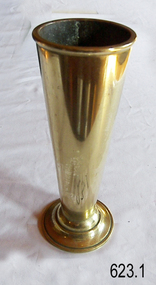
Functional object - Vase, circa 1944
... ...organ vase...This vase, one of a part of a pair of organ vases, was part of the original furnishings of the St Nicholas' Mission to Seamen's Church at 139 Nelson Place, Williamstown, Victoria. ...Vase, one of a pair, of organ vases, polished brass church vases with truncated conical shapes. ...This vase, one of a part of a pair of organ vases, was part of the original furnishings of the St Nicholas' Mission to Seamen's Church at 139 Nelson Place, Williamstown, Victoria. ...This vase, one of a part of a pair of organ vases, was part of the original furnishings of the St Nicholas' Mission to Seamen's Church at 139 Nelson Place, Williamstown, Victoria. THE MISSIONS TO SEAMEN (Brief History: for more, see our Reg. No. 611, Set of Pews) The Missions to Seamen, an Anglican charity, has served seafarers of the world since 1856 in Great Britain. It symbol is a Flying Angel, inspired by a Bible verse. Today there are centr4es in over 200 ports world-wide where seamen of all backgrounds are offered a warm welcome and provided with a wide range of facilities. In Victoria the orgainsation began in Williamstown in 1857. It was as a Sailors’ Church, also known as ‘Bethel’ or the ‘Floating Church’. Its location was an old hulk floating in Hobson’s Bay, Port of Melbourne. It soon became part of the Missions to Seamen, Victoria. In the year 2000 the organisation, now named Mission to Seafarers, still operated locally in Melbourne, Portland, Geelong and Hastings. The Ladies’ Harbour Lights Guild was formed in 1906 to support the Missions to Seamen in Melbourne and other centres such as Williamstown. Two of the most significant ladies of the Guild were founder Ethel Augusta Godfrey and foundation member Alice Sibthorpe Tracy (who established a branch of the Guild in Warrnambool in 1920). The Guild continued its work until the 1960s. In 1943 a former Williamstown bank was purchased for the Missions to Seaman Club. The chapel was named St Nicholas’ Seamen’s Church and was supported by the Ladies’ Harbour Lights Guild, the Williamstown Lightkeepers’ Auxiliary and the League of Soldiers’ and Sailors’ Friends. It ceased operation in 1966. A Missions to Seamen Chapel and Recreation Room was a significant feature of ports during the late 1800s and into the 1900s. It seemed appropriate for Flagstaff Hill to include such a representation within the new Maritime Village, so the Melbourne Board of Management of Missions to Seamen Victoria gave its permission on 21st May 1979 for the entire furnishings of the Williamstown chapel to be transferred to Flagstaff Hill. The St Nicholas Seamen’s Church was officially opened on October 11, 1981 and closely resembles the Williamstown chapel. This vase, and its pair, is significant through its association with the St Nicholas' Mission to Seamen Church in Williamstown, Melbourne, established in 1857. The items in our collection from the Missions to Seamen in Williamstown, Victoria, have historical and social significance. They show that people of the 1800s and 1900s cared about the seafarers’ religious, moral, and social welfare, no matter what the religion, social status or nationality. It had its origins in Bristol, England when a Seamen's Mission was formed in 1837. The first Australian branch was started in 1856 by the Rev. Kerr Johnston, a Church of England clergyman, and operated from a hulk moored in Hobson’s Bay; later the Mission occupied buildings in Williamstown and Port Melbourne. Vase, one of a pair, of organ vases, polished brass church vases with truncated conical shapes. White sticker under vase with hand written number "136" This is one of the original items in our ‘St Nicholas Seamen's Church Williamstown Collection’.White sticker under vase with hand written number "136" flagstaff hill, warrnambool, shipwrecked-coast, flagstaff-hill, flagstaff-hill-maritime-museum, maritime-museum, shipwreck-coast, flagstaff-hill-maritime-village, vase, church vase, brass vase, conical vase, religion, religious service, sailors rest, bethel sailors’ church, bethel floating church, ladies harbour light guild, missions to seamen victoria, mission to seafarers, st nicholas seaman’s church williamstown, st nicholas mission to seamen church williamstown, mission to seamen williamstown, st nicholas seamen’s church flagstaff hill, 139 nelson place williamstown, flying angel club, organ vase -
 Flagstaff Hill Maritime Museum and Village
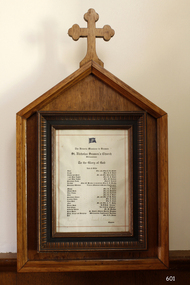
Document - Commemorative, The Victorian Missions to Seamen, St Nicholas Seamen's Church Williamstown, circa 1944
... Vases - Mrs. R. Kaybould Bible - Mrs. R.J. Ewart Sanctuary Chairs - Mr. and Mrs. F.H. Twist Credence Table - Mrs. F. Clark Altar Dish – Mrs L. Clark Font - Mr. and Mrs. C.V. Dyble Prayer Desk - H.M.H.S. "Centaur" Reed Organ...Vases - Mrs. R. Kaybould Bible - Mrs. R.J. Ewart Sanctuary Chairs - Mr. and Mrs. F.H. Twist Credence Table - Mrs. F. Clark Altar Dish – Mrs L. Clark Font - Mr. and Mrs. C.V. Dyble Prayer Desk - H.M.H.S. "Centaur" Reed Organ ...This framed document titled "The Victorian Missions to Seamen, St Nicholas Seamen's Church Williamstown" shows a list of donors of significant items to the St Nicholas Missions to Seamen's Church in Williamstown when the new building opened in 1944. The organisation ceased in 1966, and the furnishings were later donated to Flagstaff Hill Maritime Village in Warrnambool by the Missions to Seamen Victoria. The transcription of the document is as follows: The Victoria Missions to Seamen, St Nicholas Seamen's Church, Williamstown To the Glory of God List of Gifts Altar - Mrs. and Miss J.R. Schutt Cross - Mrs. R.J. Ewart Chalice and Paten - Mr. and Mrs. Percy Taylor 1 Pair Altar Lights - Mrs. R.J. Ewart 1 Pair Altar Lights - Mrs. M. Jackson Sanctuary Lamp - Miss C. Roberts Rerebos - Miss. M. Breaks, in memoriam Miss. L.A. Breaks Sanctuary Window - Victoria Missions to Seamen Lightkeepers' Auxiliary Missal - Mrs. R.J. Ewart Missal Desk - Mrs. R. Hodgkiss Altar Vases - Mrs. R. Kaybould Bible - Mrs. R.J. Ewart Sanctuary Chairs - Mr. and Mrs. F.H. Twist Credence Table - Mrs. F. Clark Altar Dish – Mrs L. Clark Font - Mr. and Mrs. C.V. Dyble Prayer Desk - H.M.H.S. "Centaur" Reed Organ - "Joy Club for Fighters" Collection Plates - Mr. D. MacKae Hymn Board - St. David's Musical Society, Brighton Pews, Carpet and Hangings - Williamstown Lightkeepers' Auxiliary Bell - Mrs. A.L. Feenes THE MISSIONS TO SEAMEN (Brief History: for more, see our Reg. No. 611, Set of Pews) The Missions to Seamen, an Anglican charity, has served seafarers of the world since 1856 in Great Britain. It symbol is a Flying Angel, inspired by a Bible verse. Today there are centr4es in over 200 ports world-wide where seamen of all backgrounds are offered a warm welcome and provided with a wide range of facilities. In Victoria the orgainsation began in Williamstown in 1857. It was as a Sailors’ Church, also known as ‘Bethel’ or the ‘Floating Church’. Its location was an old hulk floating in Hobson’s Bay, Port of Melbourne. It soon became part of the Missions to Seamen, Victoria. In the year 2000 the organisation, now named Mission to Seafarers, still operated locally in Melbourne, Portland, Geelong and Hastings. The Ladies’ Harbour Lights Guild was formed in 1906 to support the Missions to Seamen in Melbourne and other centres such as Williamstown. Two of the most significant ladies of the Guild were founder Ethel Augusta Godfrey and foundation member Alice Sibthorpe Tracy (who established a branch of the Guild in Warrnambool in 1920). The Guild continued its work until the 1960s. In 1943 a former Williamstown bank was purchased for the Missions to Seaman Club. The chapel was named St Nicholas’ Seamen’s Church and was supported by the Ladies’ Harbour Lights Guild, the Williamstown Lightkeepers’ Auxiliary and the League of Soldiers’ and Sailors’ Friends. It ceased operation in 1966. A Missions to Seamen Chapel and Recreation Room was a significant feature of ports during the late 1800s and into the 1900s. It seemed appropriate for Flagstaff Hill to include such a representation within the new Maritime Village, so the Melbourne Board of Management of Missions to Seamen Victoria gave its permission on 21st May 1979 for the entire furnishings of the Williamstown chapel to be transferred to Flagstaff Hill. The St Nicholas Seamen’s Church was officially opened on October 11, 1981 and closely resembles the Williamstown chapel. This document is significant through its association with the St Nicholas' Mission to Seamen Church in Williamstown, Melbourne, established in 1857. The document is socially significant as it connects the community of Williamstown with the St Nicholas' Missions to Seamen and represents the importance of the church to the community. The items in our collection from the Missions to Seamen in Williamstown, Victoria, have historical and social significance. They show that people of the 1800s and 1900s cared about the seafarers’ religious, moral, and social welfare, no matter what the religion, social status or nationality. It had its origins in Bristol, England when a Seamen's Mission was formed in 1837. The first Australian branch was started in 1856 by the Rev. Kerr Johnston, a Church of England clergyman, and operated from a hulk moored in Hobson's Bay; later the Mission occupied buildings in Williamstown and Port Melbourne. Document titled "The Victorian Missions to Seamen, St Nicholas Seamen's Church Williamstown". The document is a list of gifts originally given to the St Nicholas Seaman's Church in Williamstown, Victoria. The document is mounted in a decorative wooden frame with glass cover. This is one of the original items in our ‘St Nicholas Seamen's Church Williamstown Collection’.flagstaff hill, warrnambool, shipwrecked-coast, flagstaff-hill, flagstaff-hill-maritime-museum, maritime-museum, shipwreck-coast, flagstaff-hill-maritime-village, framed document, donations to st nicholas seamen's church williamstown, 139 nelson place williamstown, religion, religious service, sailors rest, bethel sailors’ church, bethel floating church, ladies harbour light guild, mission to seafarers, st nicholas seaman’s church williamstown, mission to seamen williamstown, st nicholas seamen’s church flagstaff hill, flying angel club, mrs. and miss j.r. schutt, mrs. r.j. ewart, mr. and mrs. percy taylor, mrs. m. jackson, miss c. roberts, miss. l.a. breaks, miss. m. breaks, victoria missions to seamen lightkeepers' auxiliary, mrs. r. hodgkiss, mrs. r. kaybould, mr. and mrs. f.h. twist, mrs. f. clark, mrs l. clark, mr. and mrs. c.v. dyble, h.m.h.s. "centaur", "joy club for fighters", mr. d. mackae, williamstown lightkeepers' auxiliary, mrs. a.l. feenes, st. david's musical society brighton -
 Mission to Seafarers Victoria
Ceremonial object - Vases, pair, Early 20th Century
... vases may belong originally in one of the MIssion Chapels. Possibly either the demolished 1937 Building at Port Melbourne or the original Chapel from the early 20th C at the previous Mission Building in Port Melbourne. Possibly donated in the name of Olive Cramer along with an organ...vases may belong originally in one of the MIssion Chapels. Possibly either the demolished 1937 Building at Port Melbourne or the original Chapel from the early 20th C at the previous Mission Building in Port Melbourne. Possibly donated in the name of Olive Cramer along with an organ ...The quatrefoil design similar to other chapel decorative arts, suggests these vases may belong originally in one of the MIssion Chapels. Possibly either the demolished 1937 Building at Port Melbourne or the original Chapel from the early 20th C at the previous Mission Building in Port Melbourne. Possibly donated in the name of Olive Cramer along with an organ lamp and memorial plaque mounted in the Chapel of St Peter.Many people see the quatrefoil as representing good luck. Christians, on the other hand, see the quatrefoil as representing the four Gospel writers: Matthew, Mark, Luke, and John. Some Christians also regard it as being symbolic of the cross.Pair of small fluted heavy brass vases with quatrefoil opening and small footprint. Highly polished outer surface and unpolished inner; each of the undersides seem to be of lead or coarse alloy lined finish.quatrefoil, clover, shamrock -
 Mission to Seafarers Victoria
Plaque - Memorial Plaque, Olive Cramer, 1967
... Olive Cramer who passed away in August 1966, this plaque along with an Organ Lamp were dedicated to her on the 2nd of April 1967. Two vases were later added as well....Olive Cramer who passed away in August 1966, this plaque along with an Organ Lamp were dedicated to her on the 2nd of April 1967. Two vases were later added as well. ...Olive Cramer who passed away in August 1966, this plaque along with an Organ Lamp were dedicated to her on the 2nd of April 1967. Two vases were later added as well.(see record 0670 this database)small rectangular plaque mounted on a wooden board.In loving memory of Olive Cramer who gave over 40 years of devoted service as organist of this church. 2nd April 1967plaque, memorial, organist, olive cramer, olive kramer, organ, music, chapel, seamen's mission, mission to seafarers, mission to seamen, lhlg -
 Embroiderers Guild, Victoria
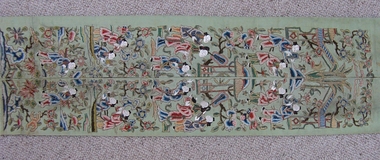
Accessory - Pair of Chinese Sleeve Bands, Late 19th century
... organ implies the wish for a son. Pomegranate- symbolizes many sons (or possibly children). Boat - may be travelling from or to. Fan (shan)- longevity, and also a pun for goodness (shan). Boy pointing upwards (?to the sun) - may you rise in rank (zhri goosheng). The act of pointing at the sun is a pun for 'soon' (zhri). Fungus - resembles the head of a wish granting wand (ruyi) and has the same meaning of 'as you wish'. Lotus flower - (he) is a pun for harmony. Vase...organ implies the wish for a son. Pomegranate- symbolizes many sons (or possibly children). Boat - may be travelling from or to. Fan (shan)- longevity, and also a pun for goodness (shan). Boy pointing upwards (?to the sun) - may you rise in rank (zhri goosheng). The act of pointing at the sun is a pun for 'soon' (zhri). Fungus - resembles the head of a wish granting wand (ruyi) and has the same meaning of 'as you wish'. Lotus flower - (he) is a pun for harmony. Vase ...Chinese sleeve embroidery bands, or wanxiu became popular in the late 19th century during the Qing Dynasty, evolving from the traditional Han cuff embroidery and Manchu styles. These detachable, decorated bands were added to women's informal jackets and robes, often featuring symbolic motifs like landscapes, flowers, and auspicious symbols. They served both a decorative function, displaying artistic skill and personal wishes, and a practical one by covering the sleeves when hands were folded at the waist. History and evolution: Origins: The practice of embroidering cuffs on robes existed during the previous Ming Dynasty for Han women, and this was adopted by the Manchu rulers who founded the Qing Dynasty. Qing Dynasty (1644-1911): The practice was popularized and elaborated upon during this era, with detachable bands becoming a fashionable element for informal wear. Symbolism: The embroidery included a complex visual vocabulary of wishes for a long life, many offspring, and a happy marriage, derived from nature, mythology, and classical literature. Functionality: Women would fold their arms, often with their hands inside the sleeves, so the embroidered bands, which were sewn to hang down the back of the jacket, would be displayed prominently down the front. 19th century peak: The late 19th century was the peak of their popularity, with intricate designs becoming fashionable and even influenced by court tastes, such as those favoured by the Empress Dowager Cixi. Later developments: The late 19th century saw the introduction of chemical 'aniline' dyes from Europe, leading to brighter, bolder colours in embroidery. Motifs and their Meanings: Auspicious symbols: Designs often included symbols for good fortune, wealth, and longevity. Natural imagery: Birds, flowers, and landscapes were common motifs that could represent natural beauty or convey specific symbolic meanings. Figurative scenes: Bands could also feature narrative scenes from classical stories or legends. The choice of motifs allowed women to express personal desires, cultural values, and aesthetic preferences, reflecting a more personal and informal style than official court attire. Looking at the cuffs from bottom to top: there is a rock formation, a zig zag fence and flowers (chrysanthemums and a branch with Buddha's hand citron). Next is a male figure carrying a halberd over his shoulder and surrounded by flowers, foliage and hillocks. Above are two more males in a boat. One is standing, the other kneeling. The one kneeling holds a bamboo pipe, while the one standing holds a branch with pomegranates. The men are surrounded by more flowers, foliage, rocks and bats . Three more figures come next. A male holding a fan, a woman holding a dish and another male. The woman on the left cuff holds a dish which appears to hold fruit, whereas the woman on the right cuff holds a dish containing a ? hat. Further up is a pagoda with a pomegranate tree and two more male figures. One holds the sacred fungus, the other a vase with a lotus flower. Finally there are two pagodas, leaves, flowers and clouds. Symbolism: Buddha's (foshou) hand citron. This plant derives it's name from the shape of the fruit, which is said to resemble Buddha's hand. 'Foshou' is used as a pun from blessings (fu) and longevity (shou). Chrysanthemum - longevity. Halberd - a spear like object symbolizing rank and military achievement. Halberd (ji) is a pun for rank (ji) and represents rapid promotion and doing well in officialdom or politics. Bamboo pipe or mouth organ (skeng) is a pun for giving birth (skeng). The image of a boy with a mouth organ implies the wish for a son. Pomegranate- symbolizes many sons (or possibly children). Boat - may be travelling from or to. Fan (shan)- longevity, and also a pun for goodness (shan). Boy pointing upwards (?to the sun) - may you rise in rank (zhri goosheng). The act of pointing at the sun is a pun for 'soon' (zhri). Fungus - resembles the head of a wish granting wand (ruyi) and has the same meaning of 'as you wish'. Lotus flower - (he) is a pun for harmony. Vase - (ping) a pun for peace (ping'an) therefore a vase with lotus - peace and harmony. These sleeve bands are more generic but they do convey a wish for many sons who will become officials and bring fortune. Dr Rachel Silberstein, visiting Associate Professor at Rhode Island School of Design.Pair of Chinese Sleeve bands using Pekin knots, satin stitch. Depicts an outdoor scene with pagodas, people, zig zag fences, boats and plants embroidered on a pale green silk ground. Both cuffs have been joined at the bottom.embroidery, garments, silk embroidery, china, sleeve bands, late 19th century, garden, figures
