
Showing 15 items matching "organisational factors"
-
 Moorabbin Air Museum
Book - Air crashes, Analysis of the Accident to Singapore Airlines flight SQ006, Boeing 747-412 ,9V-SPK at Chiang Kai-shek Airport , Taipei,Taiwan on 31 October 2000
... ...Organisational factors...Aircraft crashes Crew actions Task & environmental factors Defences Organisational factors Survival factors Findings Safety recommendations & actions Analysis of aircraft crash at Taipei airport 31/10/2000 Analysis of the Accident to Singapore Airlines flight SQ006, Boeing 747-412 ,9V-SPK at Chiang Kai-shek Airport , Taipei,Taiwan on 31 October 2000 Book Air crashes ...Analysis of aircraft crash at Taipei airport 31/10/2000non-fictionAnalysis of aircraft crash at Taipei airport 31/10/2000crew actions, task & environmental factors, defences, organisational factors, survival factors, findings, safety recommendations & actions -
 Greensborough Historical Society
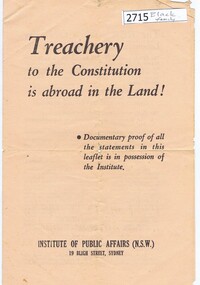
Leaflet, Institute of Public Affairs (N.S.W), Treachery to the constitution is abroad in the land!, 1949_
... The Australian Labor Party's bank nationalisation policy was strenuously opposed by conservative parties and organisations, and probably was a significant factor in its loss of the 1949 federal election. institute of public affairs (n.s.w) australian labor party bank nationalisation politics Leaflet 4 p. printed in black on white paper Treachery to the constitution is abroad in the land! ...Brochure issued by the Institute of Public Affairs prior to the 1949 Australian federal election criticising the Labor government policy of bank nationalisation.The Australian Labor Party's bank nationalisation policy was strenuously opposed by conservative parties and organisations, and probably was a significant factor in its loss of the 1949 federal election.Leaflet 4 p. printed in black on white paperinstitute of public affairs (n.s.w), australian labor party, bank nationalisation, politics -
 Warrnambool and District Historical Society Inc.
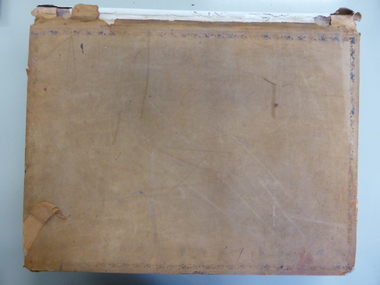
Financial record - Ledger: Warrnambool Water works Trust, Circa 1900
... The supply and storage of fresh water and drainage of the area was an important factor in the development and sustainability of the town. This ledger provides an insight into the daily operations of this organisation. warrnambool water works warrnambool water supply 1900 warrnambool water works ledger 1900 warrnambool waterworks trust Warrnambool Waterworks Trust stamp on sheet inside front cover. ...This ledger contains entries which relate to waterworks and associated expenses: construction, pumping schemes, water from stand pipes, meter rent arrears, interest payments, pumping scheme. Early residents in Warrnambool relied on tanks and wells for their water supply and in 1880 the first water supply scheme was implemented from a well on Cannon Hill. Using a windmill the water was pumped up and stored in a small reservoir nearby then piped to the corner of Timor and Liebig Streets where a stand pipe allowed the filling of water carts. Similar supplies were also installed at Albert Park, the Botanic Gardens and the Cattle markets and from 1893 to 1939 water was drawn from the Merri River. Drainage works commenced with the building of the Japan Street tunnel in 1856. The Warrnambool Waterworks Trust was the body responsible for administering these works.The supply and storage of fresh water and drainage of the area was an important factor in the development and sustainability of the town. This ledger provides an insight into the daily operations of this organisation. Large suede covered journal. Tan in colour with pink, green and white on edge of pages. Faded black stylised border around front cover. Inside front covers are patterned in green and tan. Printed sheet with Warrnambool waterworks Trust is pasted inside front cover. Warrnambool Waterworks Trust stamp on sheet inside front cover.warrnambool water works, warrnambool water supply 1900, warrnambool water works ledger 1900, warrnambool waterworks trust -
 Victorian Aboriginal Corporation for Languages
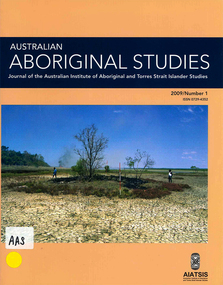
Periodical, Australian Institute of Aboriginal and Torres Strait Islander Studies, Australian Aboriginal studies : journal of the Australian Institute of Aboriginal and Torres Strait Islander Studies, 2009
... Based on a search for material about a 30-year-old Aboriginal health organisation, this paper aims to (1) identify factors that influenced the distribution of written material authored by the organisation; (2) consider the implications for Aboriginal people who wish to have their viewpoints widely available to researchers; and (3) assess the implications for research practice. ...Based on a search for material about a 30-year-old Aboriginal health organisation, this paper aims to (1) identify factors that influenced the distribution of written material authored by the organisation; (2) consider the implications for Aboriginal people who wish to have their viewpoints widely available to researchers; and (3) assess the implications for research practice. ...Social Engineering and Indigenous Settlement: Policy and demography in remote Australia John Taylor In recent years neo-liberals have argued that government support for remote Aboriginal communities contributes to social pathology and that unhindered market engagement involving labour mobility provides the only solution. This has raised questions about the viability of remote Aboriginal settlements. While the extreme view is to withdraw services altogether, at the very least selective migration should be encouraged. Since the analytical tools are available, one test of the integrity of such ideas is to consider their likely demographic consequences. Accordingly, this paper provides empirically based speculation about the possible implications for Aboriginal population distribution and demographic composition in remote areas had the advice of neo-liberal commentators and initial labour market reforms of the Northern Territory Emergency Response been fully implemented. The scenarios presented are heuristic only but they reveal a potential for substantial demographic and social upheaval. Aspects of the semantics of intellectual subjectivity in Dalabon (south-western Arnhem Land) Ma�a Ponsonnet This paper explores the semantics of subjectivity (views, intentions, the self as a social construct etc.) in Dalabon, a severely endangered language of northern Australia, and in Kriol, the local creole. Considering the status of Dalabon and the importance of Kriol in the region, Dalabon cannot be observed in its original context, as the traditional methods of linguistic anthropology tend to recommend. This paper seeks to rely on this very parameter, reclaiming linguistic work and research as a legitimate conversational context. Analyses are thus based on metalinguistic statements - among which are translations in Kriol. Far from seeking to separate Dalabon from Kriol, I use interactions between them as an analytical tool. The paper concentrates on three Dalabon words: men-no (intentions, views, thoughts), kodj-no (head) and kodj-kulu-no (brain). None of these words strictly matches the concept expressed by the English word mind. On the one hand, men-no is akin to consciousness but is not treated as a container nor as a processor; on the other, kodj-no and kodj-kulu-no are treated respectively as container and processor, but they are clearly physical body parts, while what English speakers usually call the mind is essentially distinct from the body. Interestingly, the body part kodj-no (head) also represents the individual as a social construct - while the Western self does not match physical attributes. Besides, men-no can also translate as idea, but it can never be abstracted from subjectivity - while in English, potential objectivity is a crucial feature of ideas. Hence the semantics of subjectivity in Dalabon does not reproduce classic Western conceptual articulations. I show that these specificities persist in the local creole. Health, death and Indigenous Australians in the coronial system Belinda Carpenter and Gordon Tait This paper details research conducted in Queensland during the first year of operation of the new Coroners Act 2003. Information was gathered from all completed investigations between December 2003 and December 2004 across five categories of death: accidental, suicide, natural, medical and homicide. It was found that 25 percent of the total number of Indigenous deaths recorded in 2004 were reported to, and investigated by, the Coroner, in comparison to 9.4 percent of non-Indigenous deaths. Moreover, Indigenous people were found to be over-represented in each category of death, except in death in a medical setting, where they were absent. This paper discusses these findings in detail, following the insights gained from the work of Tatz (1999, 2001, 2005) and Morrissey (2003). It also discusses a further outcome of this situation - the over-representation of Indigenous people in figures for full internal autopsy. Finding your voice: Placing and sourcing an Aboriginal health organisation?s published and grey literature Clive Rosewarne It is widely recognised that Aboriginal perspectives need to be represented in historical narratives. Sourcing this material may be difficult if Aboriginal people and their organisations do not publish in formats that are widely distributed and readily accessible to library collections and research studies. Based on a search for material about a 30-year-old Aboriginal health organisation, this paper aims to (1) identify factors that influenced the distribution of written material authored by the organisation; (2) consider the implications for Aboriginal people who wish to have their viewpoints widely available to researchers; and (3) assess the implications for research practice. As part of researching an organisational history for the Central Australian Aboriginal Congress, seven national and regional collections were searched for Congress?s published and unpublished written material. It was found that, in common with other Aboriginal organisations, most written material was produced as grey literature. The study indicates that for Aboriginal people and their organisations? voices to be heard, and their views to be accessible in library collections, they need to have an active program to distribute their written material. It also highlights the need for researchers to be exhaustive in their searches, and to be aware of the limitations within collections when sourcing Aboriginal perspectives. Radiocarbon dates from the Top End: A cultural chronology for the Northern Territory coastal plains Sally Brockwell , Patrick Faulkner, Patricia Bourke, Anne Clarke, Christine Crassweller, Daryl Guse, Betty Meehan, and Robin Sim The coastal plains of northern Australia are relatively recent formations that have undergone dynamic evolution through the mid to late Holocene. The development and use of these landscapes across the Northern Territory have been widely investigated by both archaeologists and geomorphologists. Over the past 15 years, a number of research and consultancy projects have focused on the archaeology of these coastal plains, from the Reynolds River in the west to the southern coast of the Gulf of Carpentaria in the east. More than 300 radiocarbon dates are now available and these have enabled us to provide a more detailed interpretation of the pattern of human settlement. In addition to this growing body of evidence, new palaeoclimatic data that is relevant to these northern Australian contexts is becoming available. This paper provides a synthesis of the archaeological evidence, integrates it within the available palaeo-environmental frameworks and characterises the cultural chronology of human settlement of the Northern Territory coastal plains over the past 10 000 years. Ladjiladji language area: A reconstruction Ian Clark and Edward Ryan In this reconsideration of the Ladjiladji language area in northwest Victoria, we contend that while Tindale?s classical reconstruction of this language identified a fundamental error in Smyth?s earlier cartographic representation, he incorrectly corrected that error. We review what is known about Ladjiladji and through a careful analysis demonstrate not only the errors in both Smyth and Tindale but also proffer a fundamental reconstruction grounded in the primary sources.ladjiladji, social engineering, dalabon, indigenous health, coronial system, radiocarbon dating -
 National Wool Museum
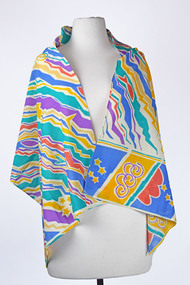
Clothing - 1988 Seoul Olympics women's scarf, c. 1988
... factors in a short space of time. The Americans made their Games a huge financial success, whereas other countries, e.g. Canada, was left with a huge debt. The key to this was SPONSORSHIP which soon replaced the old Australian way of fundraising with pub raffles. It also began to change the atmosphere where the AWC had previously been valued for their generous donation. There was a move by commercial specialist uniform marketing organisations...factors in a short space of time. The Americans made their Games a huge financial success, whereas other countries, e.g. Canada, was left with a huge debt. The key to this was SPONSORSHIP which soon replaced the old Australian way of fundraising with pub raffles. It also began to change the atmosphere where the AWC had previously been valued for their generous donation. There was a move by commercial specialist uniform marketing organisations ...The conduct of the LA games changed many factors in a short space of time. The Americans made their Games a huge financial success, whereas other countries, e.g. Canada, was left with a huge debt. The key to this was SPONSORSHIP which soon replaced the old Australian way of fundraising with pub raffles. It also began to change the atmosphere where the AWC had previously been valued for their generous donation. There was a move by commercial specialist uniform marketing organisations paying sponsorship money to publicise the fact that they were clothing high profile athletes. Old loyalties remained but became tested more and more as time progressed. For example, each uniform was expected to include an Akubra hat, why? Because it always had. For the same reason the uniforms also had Driza-Bone Coats. The day before the Seoul Opening Ceremony it rained in Seoul, so at the Opening Ceremony the Australian Team emerged in their Driza-Bones, made from cotton, not a wool fibre in sight, and the wool growers were footing the bill for over a million dollars. Thoroughly embarrassed, I resolved to avoid this situation next time by having all uniform fabrics pre-treated with Scotchguard prior to garment making.The scarf is brightly coloured in blue, green, yellow, purple and red on a plain cream base fabric. The lines of colour run on an angle across the fabric as jagged, irregular lines with small motifs of Australia, the Southern Cross stars, fish, triangles and a wave pattern, placed throughout. The centre of the scarf is dominated by a depiction of Australia presented in yellow. Within Australia are eucalyptus leaf shapes as well as mountainous shapes and the wave shape that is featured elsewhere on the scarf. The left hand short hem of the scarf has a differing pattern with larger lines running on the opposite angle to the rest of the scarf. Within the larger lines the same motifs are again printed. -
 Sunshine and District Historical Society Incorporated
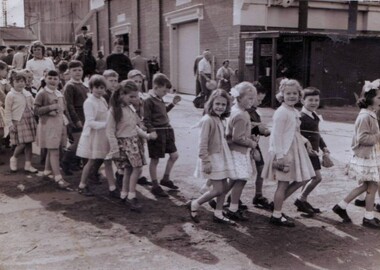
Photograph - Braybrook State School Excursion To The Melbourne Show C1958 Photograph
... Schools attended because the Show offered: - Agricultural demonstrations - Livestock judging - Wool, dairy, and grain displays - Machinery and industry exhibits - Food production and rural‑skills education - Displays by government departments and civic organisations For many urban students, it was their only direct exposure to rural industries. From the late 1990s onward, several factors reduced school excursions to the Show: - Rising transport and supervision costs - Curriculum tightening - Increased risk‑management requirements - Shift toward museum, science, and cultural excursions - The end of the Show Day public holiday Some schools still attend, but it’s no longer the near‑universal tradition it once was....Schools attended because the Show offered: - Agricultural demonstrations - Livestock judging - Wool, dairy, and grain displays - Machinery and industry exhibits - Food production and rural‑skills education - Displays by government departments and civic organisations For many urban students, it was their only direct exposure to rural industries. From the late 1990s onward, several factors reduced school excursions to the Show: - Rising transport and supervision costs - Curriculum tightening - Increased risk‑management requirements - Shift toward museum, science, and cultural excursions - The end of the Show Day public holiday Some schools still attend, but it’s no longer the near‑universal tradition it once was. ...For decades, Victorian state schools organised annual excursions to the Royal Melbourne Show, especially from the 1950s through the 1990s. These trips were so common that many former students remember them as a defining part of the school year. The Royal Melbourne Show wasn’t just rides and showbags, it was originally promoted as an educational agricultural exhibition. Schools attended because the Show offered: - Agricultural demonstrations - Livestock judging - Wool, dairy, and grain displays - Machinery and industry exhibits - Food production and rural‑skills education - Displays by government departments and civic organisations For many urban students, it was their only direct exposure to rural industries. From the late 1990s onward, several factors reduced school excursions to the Show: - Rising transport and supervision costs - Curriculum tightening - Increased risk‑management requirements - Shift toward museum, science, and cultural excursions - The end of the Show Day public holiday Some schools still attend, but it’s no longer the near‑universal tradition it once was.Many students who attended the Melbourne Show excursions will remember holding onto a rope as shown in this photograph.5372 - Braybrook State School Excursion To The Melbourne Show C1958 Photograph.jpgbraybrook state school, ballarat road, braybrook -
 Ballarat Tramway Museum
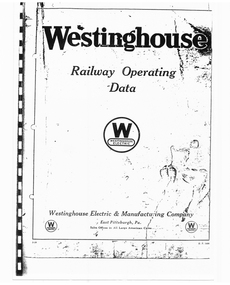
Document - Instruction Book, Westinghouse Brake Company of Australasia Limited and The Westinghouse Brake & Saxby Signal Co. Ltd. of 82 York Road and Kings Cross London, "Westinghouse Railway Operating Data", 2000
... Care and repair of commutators 1 Undercutting commutators 2 Railway Motor carbon brushes 3 Brush holders 4 Flashing of railway motors 5 Soldering railway armatures 6 Armature Winding 7 Banding armatures 8 Railway Motor Bearings 9 Lubrication of railway motor bearings 10 How to babbitt motor bearings 11 Oil, grease and waster for motors and gears 12 Saturation of motor bearing waste 13 Testing Polarity of Field Coils 14 Charging of storage batteries on Interurban & street rail cars 15 Precautions to be taken with blower installations on motor cars 16 Putting on Railway Motor Pinions 17 How to take armatures out of box frame motors 18 Dipping and Baking of Railway Motors 19 War time dipping and baking outfits 20 Dipping and baking railway motors will decrease troubles 21 Protection of Motor Bearings from Dust 25 Winter Operation of Railway Motor equipments 26 Installation of Air piping to prevent freezing 27 Maintenance of Traction Brake Equipment 28 Maintenance of controller fingers and contacts 29 Hand operated circuit breakers 30 Railway Motor Testing I 31 Railway Motor Testing II 33 Railway Motor Testing III 35 Railway Motor Testing IV 36 Railway Motor Testing V 37 Removing and replacing railway motor armature shaft 39 Mounting and Maintenance of car resistors 40 Lubrication of control apparatus 41 Maintenance of fuse boxes for railway service 42 Does it pay to dip and bake armatures 43 Dipping and Baking as a financial asset 44 Shop Organisation 45 Tinning Malleable Iron Bearing shells 46 Life of armature bearings or railway motors 47 The assembly of complete sets of commutator segments 48 Electric welding as a factor in reclamation 50 Metal to Metal press, shrink and clamping fit allowances 52 Life of railway motor carbon brushes 54 General information of grid resistance design for the operating man 56 Stopping a car by braking with the motors 57 Railway Motor shafts and their maintenance 58 Axle collars 59 Gear cases 60 Ventilated railway motors 62 Revamping Loose armature bearings 64 Life of axle bearings of railway motors 65 Heat-treated bolts for railway service 66 Document imaged over 7 parts 7-9-2016 - see hi res files. ...Care and repair of commutators 1 Undercutting commutators 2 Railway Motor carbon brushes 3 Brush holders 4 Flashing of railway motors 5 Soldering railway armatures 6 Armature Winding 7 Banding armatures 8 Railway Motor Bearings 9 Lubrication of railway motor bearings 10 How to babbitt motor bearings 11 Oil, grease and waster for motors and gears 12 Saturation of motor bearing waste 13 Testing Polarity of Field Coils 14 Charging of storage batteries on Interurban & street rail cars 15 Precautions to be taken with blower installations on motor cars 16 Putting on Railway Motor Pinions 17 How to take armatures out of box frame motors 18 Dipping and Baking of Railway Motors 19 War time dipping and baking outfits 20 Dipping and baking railway motors will decrease troubles 21 Protection of Motor Bearings from Dust 25 Winter Operation of Railway Motor equipments 26 Installation of Air piping to prevent freezing 27 Maintenance of Traction Brake Equipment 28 Maintenance of controller fingers and contacts 29 Hand operated circuit breakers 30 Railway Motor Testing I 31 Railway Motor Testing II 33 Railway Motor Testing III 35 Railway Motor Testing IV 36 Railway Motor Testing V 37 Removing and replacing railway motor armature shaft 39 Mounting and Maintenance of car resistors 40 Lubrication of control apparatus 41 Maintenance of fuse boxes for railway service 42 Does it pay to dip and bake armatures 43 Dipping and Baking as a financial asset 44 Shop Organisation 45 Tinning Malleable Iron Bearing shells 46 Life of armature bearings or railway motors 47 The assembly of complete sets of commutator segments 48 Electric welding as a factor in reclamation 50 Metal to Metal press, shrink and clamping fit allowances 52 Life of railway motor carbon brushes 54 General information of grid resistance design for the operating man 56 Stopping a car by braking with the motors 57 Railway Motor shafts and their maintenance 58 Axle collars 59 Gear cases 60 Ventilated railway motors 62 Revamping Loose armature bearings 64 Life of axle bearings of railway motors 65 Heat-treated bolts for railway service 66 Document imaged over 7 parts 7-9-2016 - see hi res files. ...Photocopy of 54 data sheets published by Westinghouse Electric & Manufacturing Company of East Pittsburgh Pa, USA c1920. Consists of plastic cover, header page with Westinghouse logo, contents sheets (2 pages), forward, 67 pages (single side photocopy) and heavy rear card cover bound with a green comb binder. Original material lent by Craig Tooke of the Melbourne Tramcar Preservation Association at Haddon. Photocopied by Warren Doubleday March 2000. List of contents produced 30/6/2000 and then bound. Contains data sheets regarding motors, commutators, brushes, armatures, bearings, field coils, pinions, lubrication, air piping, axle collars, resistance grids, gear cases and other technical information. Westinghouse Railway Operating Data 30/6/2000 List of Contents Page No. Care and repair of commutators 1 Undercutting commutators 2 Railway Motor carbon brushes 3 Brush holders 4 Flashing of railway motors 5 Soldering railway armatures 6 Armature Winding 7 Banding armatures 8 Railway Motor Bearings 9 Lubrication of railway motor bearings 10 How to babbitt motor bearings 11 Oil, grease and waster for motors and gears 12 Saturation of motor bearing waste 13 Testing Polarity of Field Coils 14 Charging of storage batteries on Interurban & street rail cars 15 Precautions to be taken with blower installations on motor cars 16 Putting on Railway Motor Pinions 17 How to take armatures out of box frame motors 18 Dipping and Baking of Railway Motors 19 War time dipping and baking outfits 20 Dipping and baking railway motors will decrease troubles 21 Protection of Motor Bearings from Dust 25 Winter Operation of Railway Motor equipments 26 Installation of Air piping to prevent freezing 27 Maintenance of Traction Brake Equipment 28 Maintenance of controller fingers and contacts 29 Hand operated circuit breakers 30 Railway Motor Testing I 31 Railway Motor Testing II 33 Railway Motor Testing III 35 Railway Motor Testing IV 36 Railway Motor Testing V 37 Removing and replacing railway motor armature shaft 39 Mounting and Maintenance of car resistors 40 Lubrication of control apparatus 41 Maintenance of fuse boxes for railway service 42 Does it pay to dip and bake armatures 43 Dipping and Baking as a financial asset 44 Shop Organisation 45 Tinning Malleable Iron Bearing shells 46 Life of armature bearings or railway motors 47 The assembly of complete sets of commutator segments 48 Electric welding as a factor in reclamation 50 Metal to Metal press, shrink and clamping fit allowances 52 Life of railway motor carbon brushes 54 General information of grid resistance design for the operating man 56 Stopping a car by braking with the motors 57 Railway Motor shafts and their maintenance 58 Axle collars 59 Gear cases 60 Ventilated railway motors 62 Revamping Loose armature bearings 64 Life of axle bearings of railway motors 65 Heat-treated bolts for railway service 66 Document imaged over 7 parts 7-9-2016 - see hi res files. trams, tramways, westinghouse, motors, data sheets, technical information -
 Melbourne Legacy
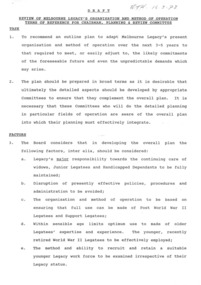
Document - Report, Review of Melbourne Legacy's Organisation and Method of Operation Terms of Reference for Chairman, Planning & Review Committee, 1993
... factors under consideration, 3a-3l. At this point of time Legacy members were recruited from ex WW1 & WW11 service personnel. This draft raises the idea of recruiting other community members, as members of legacy (3e). planning review committee Penciled initials A.T.H., penciled date 16/3/93. Final paragraph has 'R C Allison' handwritten next to it. White paper with black type of a report from the review committee. Review of Melbourne Legacy's Organisation ...A draft report from the Planning and Review Committee about Legacy's operation in the short term. This item is a draft copy of the original and was subject for discussion and or alteration as need be, for the future direction/focus of Melbourne Legacy, over the next 3-5 years. There were twelve factors under consideration, 3a-3l.At this point of time Legacy members were recruited from ex WW1 & WW11 service personnel. This draft raises the idea of recruiting other community members, as members of legacy (3e).White paper with black type of a report from the review committee. Penciled initials A.T.H., penciled date 16/3/93. Final paragraph has 'R C Allison' handwritten next to it.planning, review committee -
Kew Historical Society Inc
Archive (series) - Subject File, Victoria Park : Concept Management Plan, Research Papers, 2004, 2004
... factor was to be followed by further master plans of the Park. While final heritage reports or master plans are frequently made available by the authorities, institutions or organisations that commission them, these reports, developed by heritage consultants, include information based on extensive research that may or may not be footnoted in the research. ...Graeme Butler & AssociatesProject FilesProvenance OrderRed cardboard wallet containing historical research by Graeme Butler, heritage architect, into the history of Victoria Park, Kew. The file also includes a draft Victoria Park Concept Master Plan, 2004. The research includes memoranda, maps, photocopies of plans, forms, notes, aerial photos, and sundry references.graeme butler - heritage architect, victoria park - kew (vic), heritage studies - kew (vic.)graeme butler - heritage architect, victoria park - kew (vic), heritage studies - kew (vic.) -
 Returned Nurses RSL Sub-branch
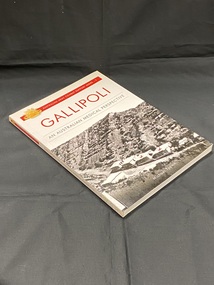
Book - Paperback book, Michael Tyquin, Gallipoli: an Australian medical perspective, 2012
... factor in warfare. In many respects the Gallipoli campaign was a doomed undertaking. The seeds of ultimate defeat in December 1915 were the risks that attended a hugely ambitious, complex, and large-scale amphibious operation - the landings on well-defended shores on the Gallipoli peninsula, under cover of darkness. Communications at the time were primitive, while general staff officers had little understanding of their own army's medical assets or the needs of a large medical organisation ...To be successful, a modern army needs logistical support to survive - to arm, feed, transport, and care for its soldiers. As history shows us the maintenance of health in any army , is a key factor in warfare. In many respects the Gallipoli campaign was a doomed undertaking. The seeds of ultimate defeat in December 1915 were the risks that attended a hugely ambitious, complex, and large-scale amphibious operation - the landings on well-defended shores on the Gallipoli peninsula, under cover of darkness. Communications at the time were primitive, while general staff officers had little understanding of their own army's medical assets or the needs of a large medical organisation. The Australian Army Medical Corps (AAMC) received aid from, and gave support to, all five forces at various times during 1915. Underlying the execution of the Dardanelles campaign were factors wholly outside the control of the Australian AMS. - from TroveWhite paperback book with a large black and white image of a field hospital at the base of a hill, two of the white tents have red crosses on the roofs'. Above the image, the title is printed in red with the sub-title in black beneath it. At the top of the cover is a red banner with the series title and at the far left of the banner is the gold Australian Army pin. The text on the spine matches the cover and there is a spine label taped to the base.non-fictionTo be successful, a modern army needs logistical support to survive - to arm, feed, transport, and care for its soldiers. As history shows us the maintenance of health in any army , is a key factor in warfare. In many respects the Gallipoli campaign was a doomed undertaking. The seeds of ultimate defeat in December 1915 were the risks that attended a hugely ambitious, complex, and large-scale amphibious operation - the landings on well-defended shores on the Gallipoli peninsula, under cover of darkness. Communications at the time were primitive, while general staff officers had little understanding of their own army's medical assets or the needs of a large medical organisation. The Australian Army Medical Corps (AAMC) received aid from, and gave support to, all five forces at various times during 1915. Underlying the execution of the Dardanelles campaign were factors wholly outside the control of the Australian AMS. - from Trovegallipoli, australian army medical corps, aamc, medical aspects of war, wwi, ww1, world war 1914-1918 -
Emerald Museum & Nobelius Heritage Park
Photograph - Nobelius Packing Shed, Unknown photographer, 2000s
... Trees were sold to more than forty councils and Government organisations in the 1890s, including the Department of Agriculture, Lands Department and Victorian Railways. The need to transport nursery products by train via Ferntree Gully rather than by bullock dray to Narre Warren was a factor in the successful petition to develop what is now known as the Puffing Billy Railway. ...Trees were sold to more than forty councils and Government organisations in the 1890s, including the Department of Agriculture, Lands Department and Victorian Railways. The need to transport nursery products by train via Ferntree Gully rather than by bullock dray to Narre Warren was a factor in the successful petition to develop what is now known as the Puffing Billy Railway. ...The Gembrook Nurseries, informally known as the Nobelius Nurseries after the founder Carl Axel Nobelius, began with the purchase of sixty-three acres in 1886 and boomed in the 1890s due to opportunities provided by employment-promoting schemes to develop public parks and gardens and street shade by local and State Governments around Australia. Trees were sold to more than forty councils and Government organisations in the 1890s, including the Department of Agriculture, Lands Department and Victorian Railways. The need to transport nursery products by train via Ferntree Gully rather than by bullock dray to Narre Warren was a factor in the successful petition to develop what is now known as the Puffing Billy Railway. Railway developments in 1900 included the creation of a siding and Packing Shed, known as Nobelius Station, which is featured in this photograph. The Packing Shed was able to handle 250,000 cases of fruit each year at the height of the nurseries' activities. The image shows the Packing Shed with boarded-up windows, suggesting it was taken prior to the purchase of the facility for use in the Puffing Billy Railway service. Gembrook Nurseries had an indirect influence on the development of other farms and industries in the region. As a wholesale nursery with high sales volumes it was an important employer of local people. Peak season for employees was during the cooler months, during most farmers' off-season. This provided local farmers with a source of income while their own farms were becoming established.The photograph is significant because it depicts infrastructure associated with the Gembrook or Nobelius Nurseries, a business which was instrumental to the development of Emerald as a settlement in the 19th and 20th Centuries and also influenced the development of public and private gardens and the farming of several species in Australia and internationally. The Nobelius Nursery is listed on the Victorian Heritage Register.A coloured rectangular photograph of the Nobelius Nurseries Packing Shed. The photograph was taken in the grounds looking up towards the packing shed. There are various trees and vegetation throughout the grounds and surrounding the packing shed. The Nobelius Nurseries Packing Shed was used to sort and pack trees to be sent overseas during the 1900s-1940s.No inscriptions/marksnobelius nursery, packing shed, 2000s, puffing billy railway, nobelius heritage park -
Emerald Museum & Nobelius Heritage Park
Domestic object - Writing equipment, 1900s
... Trees were sold to more than forty councils and Government organisations in the 1890s, including the Department of Agriculture, Lands Department and Victorian Railways. The need to transport nursery products by train via Ferntree Gully rather than by bullock dray to Narre Warren was a factor in the successful petition to develop what is now known as the Puffing Billy Railway. ...Trees were sold to more than forty councils and Government organisations in the 1890s, including the Department of Agriculture, Lands Department and Victorian Railways. The need to transport nursery products by train via Ferntree Gully rather than by bullock dray to Narre Warren was a factor in the successful petition to develop what is now known as the Puffing Billy Railway. ...The item is a glass writing desk set used at Carramar, the family home of Carl Axel Nobelius, who founded the Gembrook Nurseries. Gembrook Nurseries were a major employer in the area, shipping fruit and decorative tree species around Australia and internationally. Carramar was the largest private residence in the area with sixteen rooms in addition to staff accommodations. The Nobelus family entertained several famous or important guests there, including Dame Nellie Melba and the Governor of Victoria, Sir Reginald Talbot. The desk set is thought to have been a gift to Carl Axel Nobelius and his wife Emily on the anniversary of their wedding. The Gembrook Nurseries, informally known as the Nobelius Nurseries after the founder Carl Axel Nobelius, began with the purchase of sixty-three acres in 1886 and boomed in the 1890s due to opportunities provided by employment-promoting schemes to develop public parks and gardens and street shade by local and State Governments around Australia. Trees were sold to more than forty councils and Government organisations in the 1890s, including the Department of Agriculture, Lands Department and Victorian Railways. The need to transport nursery products by train via Ferntree Gully rather than by bullock dray to Narre Warren was a factor in the successful petition to develop what is now known as the Puffing Billy Railway. Gembrook Nurseries had an indirect influence on the development of other farms and industries in the region. As a wholesale nursery with high sales volumes it was an important employer of local people. Peak season for employees was during the cooler months, during most farmers' off-season. This provided local farmers with a source of income while their own farms were becoming established. The desk set appears to be in Art Deco style, which suggests that it was in use at Carramar later in Carl Axel Nobelius' life, prior to his death in 1921, as the style became most popular in the years after the First World War. Carramar was the largest private residence in the area with sixteen rooms in addition to staff accommodations. A real estate listing from the sale of Carramar in 1941 indicates that it had five bedrooms, three reception areas, a large billiards room, two bathrooms, rooms for staff use and a separate six-room gardener's cottage as the home sat within extensive gardens. The Nobelus family entertained several famous or important guests there, including Dame Nellie Melba and the Governor of Victoria, Sir Reginald Talbot.The item is significant due to its association with the estate of Carl Axel Nobelius, a horticulturist whose business activities at the Gembrook Nurseries contributed to both the social and infrastructure development of Emerald and surrounds and the distribution of several plant species internationally.The item is a glass plate on small metal legs. Arranged across the surface of the glass plate are a metal rack suitable for holding letters, a square glass bottle with a metal lid sitting in a square metal receptacle which may have been used for ink and two metal brackets suitable for holding a pen. The metal used is silver-toned.carramar, carl axel nobelius, carl axel nobelius, gembrook nurseries, nobelius nursery, writing equipment, desk set, art deco -
Emerald Museum & Nobelius Heritage Park
Photograph - Packing Shed, Gembrook Nurseries, Unknown maker, 1900-1920
... Trees were sold to more than forty councils and Government organisations in the 1890s, including the Department of Agriculture, Lands Department and Victorian Railways. The need to transport nursery products by train via Ferntree Gully rather than by bullock dray to Narre Warren was a factor in the successful petition to develop what is now known as the Puffing Billy Railway. ...Trees were sold to more than forty councils and Government organisations in the 1890s, including the Department of Agriculture, Lands Department and Victorian Railways. The need to transport nursery products by train via Ferntree Gully rather than by bullock dray to Narre Warren was a factor in the successful petition to develop what is now known as the Puffing Billy Railway. ...The Gembrook Nurseries, informally known as the Nobelius Nurseries after the founder Carl Axel Nobelius, began with the purchase of sixty-three acres in 1886 and boomed in the 1890s due to opportunities provided by employment-promoting schemes to develop public parks and gardens and street shade by local and State Governments around Australia. Trees were sold to more than forty councils and Government organisations in the 1890s, including the Department of Agriculture, Lands Department and Victorian Railways. The need to transport nursery products by train via Ferntree Gully rather than by bullock dray to Narre Warren was a factor in the successful petition to develop what is now known as the Puffing Billy Railway. Railway developments in 1900 included the creation of a siding and Packing Shed, known as Nobelius Station, which is featured in this photograph. The Packing Shed was able to handle 250,000 cases of fruit each year. Gembrook Nurseries had an indirect influence on the development of other farms and industries in the region. As a wholesale nursery with high sales volumes it was an important employer of local people. Peak season for employees was during the cooler months, during most farmers' off-season. This provided local farmers with a source of income while their own farms were becoming established.The photograph is significant because it depicts personnel and infrastructure associated with the Gembrook or Nobelius Nurseries, a business which was instrumental to the development of Emerald as a settlement in the 19th and 20th Centuries and also influenced the development of public and private gardens and the farming of several species in Australia and internationally. The Nobelius Nursery is listed on the Victorian Heritage Register.Black and white rectangular photograph printed on print media paper. The image is captioned 'Lunch Hour at the Packing Shed, Gembrook Nurseries.' It depicts thirty-one men (including one adolescent) and one woman posing for a group photograph behind approximately five large product bales resting in a rectangular metal rail cargo carriage. One of the men has a bandage across one eye. The people depicted are wearing clothing indicating the image may have been taken in the early 20th century. The Packing Shed building (built in 1900) and several stacked wooden storage crates are visible behind the group.Obverse: 59 NOR (?) 10 (?) + / LUNCH HOUR AT THE PACKING SHED, GEMBROOK NURSERIES. /1900s, gembrook nurseries, nobelius nurseries, carl axel nobelius, packing shed, railway, puffing billy railway, nursery employees, farming, agriculture, government initiatives -
Emerald Museum & Nobelius Heritage Park
Photograph - Nobelius Nursery Packing Shed, Unknown photographer, 1970s
... Trees were sold to more than forty councils and Government organisations in the 1890s, including the Department of Agriculture, Lands Department and Victorian Railways. The need to transport nursery products by train via Ferntree Gully rather than by bullock dray to Narre Warren was a factor in the successful petition to develop what is now known as the Puffing Billy Railway. ...Trees were sold to more than forty councils and Government organisations in the 1890s, including the Department of Agriculture, Lands Department and Victorian Railways. The need to transport nursery products by train via Ferntree Gully rather than by bullock dray to Narre Warren was a factor in the successful petition to develop what is now known as the Puffing Billy Railway. ...The Gembrook Nurseries, informally known as the Nobelius Nurseries after the founder Carl Axel Nobelius, began with the purchase of sixty-three acres in 1886 and boomed in the 1890s due to opportunities provided by employment-promoting schemes to develop public parks and gardens and street shade by local and State Governments around Australia. Trees were sold to more than forty councils and Government organisations in the 1890s, including the Department of Agriculture, Lands Department and Victorian Railways. The need to transport nursery products by train via Ferntree Gully rather than by bullock dray to Narre Warren was a factor in the successful petition to develop what is now known as the Puffing Billy Railway. Railway developments in 1900 included the creation of a siding and Packing Shed, known as Nobelius Station, which is featured in this photograph. The Packing Shed was able to handle 250,000 cases of fruit each year at the height of the nurseries' activities. The image shows the Packing Shed with boarded-up windows, suggesting it was taken prior to the purchase of the facility for use in the Puffing Billy Railway service. Gembrook Nurseries had an indirect influence on the development of other farms and industries in the region. As a wholesale nursery with high sales volumes it was an important employer of local people. Peak season for employees was during the cooler months, during most farmers' off-season. This provided local farmers with a source of income while their own farms were becoming established.The photograph is significant because it depicts infrastructure associated with the Gembrook or Nobelius Nurseries, a business which was instrumental to the development of Emerald as a settlement in the 19th and 20th Centuries and also influenced the development of public and private gardens and the farming of several species in Australia and internationally. The Nobelius Nursery is listed on the Victorian Heritage Register. The image appears to show the Packing Shed building prior to its restoration as a tourist facility.Black and white rectangular photograph printed on print media paper. The image depicts the Gembrook Nurseries Packing Shed building with boarded up windows.Obverse: NOBELIUS NURSERIES / . WEEKEND TRADING . /1970s, gembrook nurseries, puffing billy railway, carl axel nobelius, packing shed, railway stations, farming, agriculture -
Emerald Museum & Nobelius Heritage Park
Photograph - Nobelius Packing Shed, Unknown photographer
... Trees were sold to more than forty councils and Government organisations in the 1890s, including the Department of Agriculture, Lands Department and Victorian Railways. The need to transport nursery products by train via Ferntree Gully rather than by bullock dray to Narre Warren was a factor in the successful petition to develop what is now known as the Puffing Billy Railway. ...Trees were sold to more than forty councils and Government organisations in the 1890s, including the Department of Agriculture, Lands Department and Victorian Railways. The need to transport nursery products by train via Ferntree Gully rather than by bullock dray to Narre Warren was a factor in the successful petition to develop what is now known as the Puffing Billy Railway. ...The Gembrook Nurseries, informally known as the Nobelius Nurseries after the founder Carl Axel Nobelius, began with the purchase of sixty-three acres in 1886 and boomed in the 1890s due to opportunities provided by employment-promoting schemes to develop public parks and gardens and street shade by local and State Governments around Australia. Trees were sold to more than forty councils and Government organisations in the 1890s, including the Department of Agriculture, Lands Department and Victorian Railways. The need to transport nursery products by train via Ferntree Gully rather than by bullock dray to Narre Warren was a factor in the successful petition to develop what is now known as the Puffing Billy Railway. Railway developments in 1900 included the creation of a siding and Packing Shed, known as Nobelius Station, which is featured in this photograph. The Packing Shed was able to handle 250,000 cases of fruit each year at the height of the nurseries' activities. The image shows the Packing Shed prior to the purchase of the facility for use in the Puffing Billy Railway service. Gembrook Nurseries had an indirect influence on the development of other farms and industries in the region. As a wholesale nursery with high sales volumes it was an important employer of local people. Peak season for employees was during the cooler months, during most farmers' off-season. This provided local farmers with a source of income while their own farms were becoming established.The photograph is significant because it depicts infrastructure associated with the Gembrook or Nobelius Nurseries, a business which was instrumental to the development of Emerald as a settlement in the 19th and 20th Centuries and also influenced the development of public and private gardens and the farming of several species in Australia and internationally. The Nobelius Nursery is listed on the Victorian Heritage Register. The image appears to show the Packing Shed building prior to its restoration as a tourist facility.Black and white rectangular photograph printed on print media paper. The image depicts the Gembrook Nurseries Packing Shed building. The building is made from weatherboard and features a brick chimney. There is also a tall tree standing next to the chimney.Obverse: IUS NURSERIES / TRADING ... /gembrook nurseries, puffing billy railway, carl axel nobelius, packing shed, railway stations, farming, agriculture
