
Showing 14 items matching "origins of oil"
-
 Bendigo Historical Society Inc.
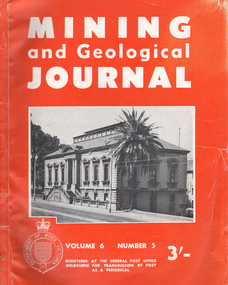
Book - Kairn Collection: Mining and Geological Journal, Department of Mines, Victoria, 1959 - 1960
... ...origins of oil...Geology mining gold mining Bendigo Department of Mines water divining origins of oil bentonite alluvial gold nickle serpentinite Hit of Miss Mine Wedderburn geological museum Orange cover, white text, printed on front cover: 'Mining and Geological Journal', Volume 6, Number 5, 1965. ...The Mining & Geological Journal was produced by the Department of Mines, Victoria twice a year, during the period 1937 to 1972. It was an official publication of the Victorian Government, Department of Mines, devoted to issues and events surrounding mining and metallurgical engineering in Victoria along with education, research and innovations in mining. The journal also included advertisements and references to business interests. Editorial (page 3) discusses the imminent demolition of the Geological Museum, situated alongside the Old Treasury Building in Melbourne. The genesis of the Geological Museum was 'the Exhibition of 1861 when the potential value of scientific search to the community as a whole was recognised'. In 1887 the Secretary for Mines in Melbourne was strongly of the opinion that a School of Mines should be established...it was decided that a building should be erected to house a thorough staff of professsors to impart instruction.' Orange cover, white text, printed on front cover: 'Mining and Geological Journal', Volume 6, Number 5, 1965. In centre of cover, black and white photo of the Geological Museum Melbourne. Colour photograph on back cover shows Mindrill type 13 model F 62B diamond drilling machine in PNG. geology, mining, gold mining, bendigo, department of mines, water divining, origins of oil, bentonite, alluvial gold, nickle, serpentinite, hit of miss mine wedderburn, geological museum -
 Lakes Entrance Historical Society
Book, Doty Roy, Where are you going with that oil by Roy Doty, 1976
... A children's book explaining the origins of oil and gas, extraction refinement and applications, and brief discussion on alternative fuel sources...Industrial Education A children's book explaining the origins of oil and gas, extraction refinement and applications, and brief discussion on alternative fuel sources Where are you going with that oil by Roy Doty Book Doty Roy ...A children's book explaining the origins of oil and gas, extraction refinement and applications, and brief discussion on alternative fuel sourcesindustrial, education -
 Whitehorse Historical Society Inc.
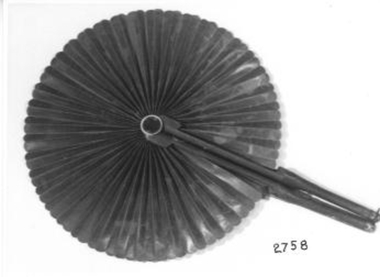
Functional object - Fan
... Hand held parasol fan of Flemish origin, red oil cloth, folds up in between two wooden guards & handles that have been coated to look like leather. ...Owned and used by Mrs Garnett O'Neill costume accessories female Hand held parasol fan of Flemish origin, red oil cloth, folds up in between two wooden guards & handles that have been coated to look like leather. ...Owned and used by Mrs Garnett O'NeillHand held parasol fan of Flemish origin, red oil cloth, folds up in between two wooden guards & handles that have been coated to look like leather. The ends have metal tops with two round rings. with red centres holding the fan together.|Sometimes known as Dagger Fans.costume accessories, female -
 Lara RSL Sub Branch
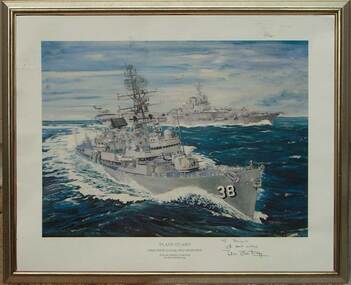
Plane Guard Print, Plane Guard - HMAS Perth escorting HMAS Melbourne
... Front : "Plane Guard" - HMAS Perth escorting HMAS Melbourne, from an originial oil painting by Peter Blenkinsopp. Rear : small sign from Geelong Pictture framers and Ryrie ST Art Gallery...Artist Peter Blenkinsopp, 1936 to 2010, Limited edition print of HMAS Perth Escorting HMAS Melourne Australian Navy color print of HMAS Perth and HMAS Melbourne hmas perth, hmas melbourne artist peter blenkinsopp Front : "Plane Guard" - HMAS Perth escorting HMAS Melbourne, from an originial oil painting by Peter Blenkinsopp. Rear : small sign from Geelong Pictture framers and Ryrie ST Art Gallery Color print of HMAS Perth escorting HMAS Melbourne at sea - framed print. ...Artist Peter Blenkinsopp, 1936 to 2010, Limited edition print of HMAS Perth Escorting HMAS MelourneAustralian Navy color print of HMAS Perth and HMAS MelbourneColor print of HMAS Perth escorting HMAS Melbourne at sea - framed print.Front : "Plane Guard" - HMAS Perth escorting HMAS Melbourne, from an originial oil painting by Peter Blenkinsopp. Rear : small sign from Geelong Pictture framers and Ryrie ST Art Galleryhmas perth, hmas melbourne, artist peter blenkinsopp -
 Flagstaff Hill Maritime Museum and Village
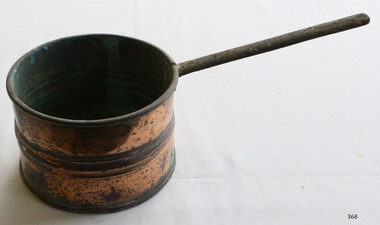
Domestic object - Saucepan
... Origins It is hard to pin down an exact date when copper cookware was first introduced. Pieces discovered in regions of the middle east were dated as far back as 9000BC, suggesting cooking with copper began during the Neolithic period (≈10000-2000BC). As civilisations became increasingly capable in metallurgical techniques, metals such as copper became more widely used. It would have been around this time that copper replaced stone as the material used for making tools and cooking vessels. The use of copper is also well documented in Ancient Egypt. Not only was it used to produce water and oil...Origins It is hard to pin down an exact date when copper cookware was first introduced. Pieces discovered in regions of the middle east were dated as far back as 9000BC, suggesting cooking with copper began during the Neolithic period (≈10000-2000BC). As civilisations became increasingly capable in metallurgical techniques, metals such as copper became more widely used. It would have been around this time that copper replaced stone as the material used for making tools and cooking vessels. The use of copper is also well documented in Ancient Egypt. Not only was it used to produce water and oil ...It is no secret that copper is currently experiencing a huge upsurge in popularity. This is mainly thanks to its beautiful colour featuring heavily in the ranges of countless homeware retailers. There is, however, far more to this lustrous metal than just its appearance. For example, it has a greater level of thermal conductivity than any other metal (except silver); roughly 60% higher than aluminium and 3000% higher than stainless steel. This means copper is capable of heating up very quickly when compared to other metals. Perhaps a less commonly known property of copper is it being inherently antimicrobial. A wide range of harmful microbes are unable to survive for more than a couple of hours when in contact with a surface made of copper or one of its alloys (brass and bronze). This has led to it often being used for frequently touched surfaces such as door knobs, push plates and taps. A seemingly perfect material for cooking, it is therefore no surprise that it has been used in kitchens for millennia. But exactly when did we learn to utilise copper and its valuable assets? Origins It is hard to pin down an exact date when copper cookware was first introduced. Pieces discovered in regions of the middle east were dated as far back as 9000BC, suggesting cooking with copper began during the Neolithic period (≈10000-2000BC). As civilisations became increasingly capable in metallurgical techniques, metals such as copper became more widely used. It would have been around this time that copper replaced stone as the material used for making tools and cooking vessels. The use of copper is also well documented in Ancient Egypt. Not only was it used to produce water and oil containers, but it was also used to in medical practices. The antimicrobial nature of copper was exploited long before the concept of microorganisms was fully understood. The Smith Papyrus, a medical text written between 2600 and 2200BC records the use of copper in sterilising wounds and drinking water. Tin Lining Although copper is essential to many processes within the human body, it can become toxic if consumed in excess. It was this knowledge that gave rise to lining cookware with tin, a technique used for hundreds of years to prevent copper leaching in to food. These tin linings would eventually wear out and during the 18th and 19th century, it was common for people to send pans away to be re-tinned. This practice is becoming increasingly rare, as are the craftsmen who perform it. Despite this, there are still manufactures producing tin-lined copper cookware who also offer a re-lining service. Perhaps the best known of these is Mauviel, a French manufacturer who have been making this type of cookware since 1830. Tin has now largely been replaced by stainless steel as an interior cooking surface. Not only is it more cost effective, but the high grade of stainless steel used in premium cookware (typically 18/10) is highly resistant to corrosion and more durable than tin.Copper saucepans are still used in many kitchens.Small copper saucepan with long handle and three ridges around the circumference. Extensive corrosion.None.flagstaff hill, warrnambool, shipwrecked-coast, flagstaff-hill, flagstaff-hill-maritime-museum, maritime-museum, shipwreck-coast, flagstaff-hill-maritime-village, copper, saucepans, kitchen equipment -
 Frankston RSL Sub Branch
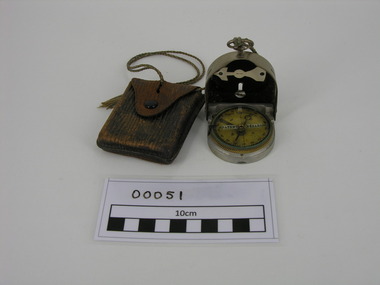
Compass
... Handheld oil filled compass possibly of German military origin. Labelled 'Bezard Kompass'. ...compass prismatic Bezard Kompass Handheld oil filled compass possibly of German military origin. Labelled 'Bezard Kompass'. ...Handheld oil filled compass possibly of German military origin. Labelled 'Bezard Kompass'. Complete with leather pouch.Bezard Kompasscompass, prismatic -
Glenelg Shire Council Cultural Collection
Functional object - Demijohn, n.d
... A demijohn is a large, narrow necked bottle for containing liquids such as wine or olive oil. The word is French in origin....A demijohn is a large, narrow necked bottle for containing liquids such as wine or olive oil. The word is French in origin. container liquid wine Stoneware demijohn with woven cane covering, handle each side Functional object Demijohn ...A demijohn is a large, narrow necked bottle for containing liquids such as wine or olive oil. The word is French in origin.Stoneware demijohn with woven cane covering, handle each sidecontainer, liquid, wine -
 City of Moorabbin Historical Society (Operating the Box Cottage Museum)
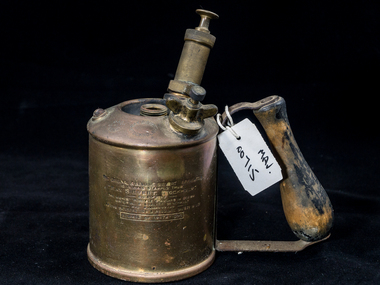
Tools, Blowtorch 'Sievert', 20thC
... The blowlamp is of ancient origin and was used as a tool by gold and silversmiths. They began literally as a "blown lamp", a wick oil lamp with a mouth-blown tube alongside the flame. ...The blowlamp is of ancient origin and was used as a tool by gold and silversmiths. They began literally as a "blown lamp", a wick oil lamp with a mouth-blown tube alongside the flame. ...A blowtorch or blowlamp is a fuel-burning tool used for applying flame and heat to various applications, usually metalworking. Early blowlamps used liquid fuel, carried in a refillable reservoir attached to the lamp. Modern blowtorches are mostly gas-fuelled. The blowlamp is of ancient origin and was used as a tool by gold and silversmiths. They began literally as a "blown lamp", a wick oil lamp with a mouth-blown tube alongside the flame. This type of lamp, with spirit fuel, continued to be in use for such small tasks into the late 20th century. In 1882, a new vaporizing technique was developed by Carl Richard Nyberg in Sweden, and the year after, the production of the Nyberg blow lamp started. It was quickly copied or licensed by many other manufacturers. Carl Richard Nyberg (May 28, 1858, – 1939) was the founder of Max Sievert’s Lödlampfabrik, then one of the largest industries in Sundbyberg, Sweden. After school he started working for a jeweller and later he moved to Stockholm and worked with various metalworks. 1882 and set up a workshop at Luntmakargatan in Stockholm making blowtorches. However the business didn't work well because it took too long to both manufacture and sell them. In 1886 he met Max Sievert (1849 - 1913) at a country fair and Sievert became interested in Nyberg's blowtorch and started selling it. In 1922 the company was sold to Max Sievert who continued to own it until 1964 when it was bought by Esso. The blowtorch is commonly used where a diffuse high temperature naked flame heat is required but not so hot as to cause combustion or welding: soldering, brazing, softening paint for removal, melting roof tar, or pre-heating large castings before welding such as for repairing. It is also common for use in weed control by controlled burn methods, melting snow and ice from pavements and driveways in cold climate areas, road repair crews may use a blowtorch to heat asphalt or bitumen for repairing cracks in preventive maintenance. It is also used in cooking; one common use is for the creation of the layer of hard caramelised sugar in a crème brûlée. A brass blowtorch, 'Sievert' with a wooden handleSIEVERTtools, blow torches, blow lamps, welding, brazing, jewellery, cookery, soldering, nyberg carl, sievert max, stockholm, sweden, spirit fuel, kerosene, gas fuel, moorabbin, bentleigh, cheltenham, market gardeners, pioneers, early settlers, plumbing, carpenters, -
 Warrnambool and District Historical Society Inc.
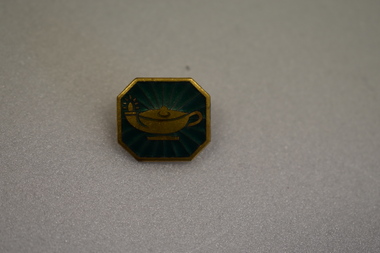
Badges, TOC-H Badges x 3
... origins in the Ypres salient.The lamp is a symbol of an ongoing commitment of TOC H to spread light wherever it may be required. These badges are maintained as mementos of the Warrnambool branch of TOC H which operated from a sandstone building in Koroit Street Warrnambool. It was active during the middle decades of the 20th Century TOC H Tubby Clayton Lord Forster .1Indecipherable .2 Stokes and Sons Melbourne .3 2849 .1 Octagonal metal and enamel badge featuring a gold coloured oil lamp and cross on a green luminous background with rays emanating from the lamp. ...TOC H was founded as a Christian organisation during the First World War in Belgium in 1915. Talbot House was a venue for respite from the war for soldiers and civilians. During the 1920s TOC H spread around the world especially to Commonwealth countries. In 1923 the Governor General of Australia wrote to The Reverend "Tubby" Clayton indicating that he and Lady Forster wished to endow a TOC H lamp, the symbol of TOC H in memory of their two sons who were killed in the war. The lamp symbol is a replica of the lamp used to provide light to early Christians who sought refuge in the catacombs of Rome. The cross of Lorraine is an indicator of its origins in the Ypres salient.The lamp is a symbol of an ongoing commitment of TOC H to spread light wherever it may be required. These badges are maintained as mementos of the Warrnambool branch of TOC H which operated from a sandstone building in Koroit Street Warrnambool. It was active during the middle decades of the 20th Century .1 Octagonal metal and enamel badge featuring a gold coloured oil lamp and cross on a green luminous background with rays emanating from the lamp. The badge has a gold edging. The reverse has a pin clip and text .2 and .3 Octagonal metal and enamel lapel badge featuring a gold coloured oil lamp and cross on a royal blue background. The badge has a gold edging. The reverse has a horseshoe shaped device to allow the badge to be secured in the buttonhole of a jacket. .1Indecipherable .2 Stokes and Sons Melbourne .3 2849toc h, tubby clayton, lord forster -
 Ballarat Tramway Museum
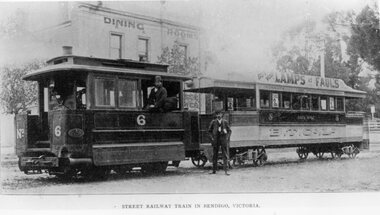
Photograph - Black & White Photograph/s, Peter Duckett, late 1890's?
... oil? or electric? Taken from a postcard or a magazine - has the caption "Street Railway Train in Bendigo, Victoria", possibly North American origin given the language. ...oil? or electric? Taken from a postcard or a magazine - has the caption "Street Railway Train in Bendigo, Victoria", possibly North American origin given the language. ...Yields information about the appearance of Bendigo Birney trams during the 1950's, possibly during enthusiast tour.Black and White Photograph of Bendigo steam tram motor No. 2 and bogie trailer No. 5, 1890's?, photographed with a building marked "Dining Rooms" in the background. Has the driver in the steam tram motor and the conductor standing alongside. Trailer marked "B.T.Co. Ltd", possibly around the turn of the century. Earlier photos have the full company name. Trailer has roof advertisement "Buy your Lamps at Faull's" - oil? or electric? Taken from a postcard or a magazine - has the caption "Street Railway Train in Bendigo, Victoria", possibly North American origin given the language. Peter Duckett Collection.On the front, top left hand corner of the print "26" in ink within a circle. On rear, stamped in black ink "Photo supplied from P.W. Duckett Collection, All Rights Reserved, 69 Howitt Rd. Nth Caulfield 3161." On rear in ink "Motor 6 and Trailer 5" and a "William F Scott" address label.trams, tramways, bendigo, steam tram motors, trailers, tram 6, tram 5 -
 Sunshine and District Historical Society Incorporated
Container - Joseph "Joe" Wlodarczyk Collection - Vintage Oil Can
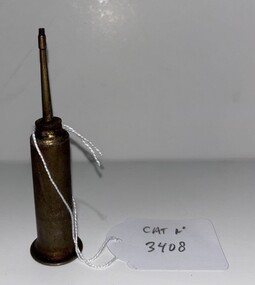
... They were typical used for multiple functions including drilling metal, oiling small bearings, etc. The origin of the can came from the estate of Joseph Wlodarczyk whom worked at Massey Ferguson, therefore it may have come from Massey Ferguson...They were typical used for multiple functions including drilling metal, oiling small bearings, etc. The origin of the can came from the estate of Joseph Wlodarczyk whom worked at Massey Ferguson, therefore it may have come from Massey Ferguson Small brass cylinder oil can with needle style sprout and push button bottom Container Joseph "Joe" Wlodarczyk Collection - Vintage Oil Can ...This is a typical small oil can found in many factory or home workshops. They were typical used for multiple functions including drilling metal, oiling small bearings, etc. The origin of the can came from the estate of Joseph Wlodarczyk whom worked at Massey Ferguson, therefore it may have come from Massey FergusonSmall brass cylinder oil can with needle style sprout and push button bottom -
 Kew Historical Society Inc
Painting, Farmyard Scene, 1900-1920
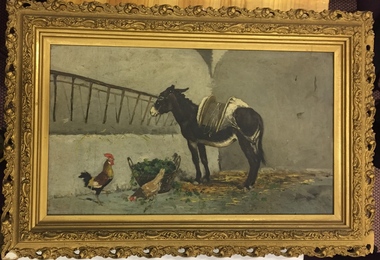
... origin. The framer, William Lewis Hamilton, trading as A.L. Hambleton is listed in a Commonwealth of Australia Gazette of 1917. (No.113) in an application for copyright. The donor's ancestors, who included a number of amateur artists, lived in Coorparoo, Queensland. vaughan-smith collection farmyard scenes oil paintings See note on label above Oil on canvas mounted in an elaborate gilt wooden frame. ...The painter of the work is unidentified. While the frame was made in Brisbane, the artwork is likely to be European in origin. The framer, William Lewis Hamilton, trading as A.L. Hambleton is listed in a Commonwealth of Australia Gazette of 1917. (No.113) in an application for copyright. The donor's ancestors, who included a number of amateur artists, lived in Coorparoo, Queensland.Oil on canvas mounted in an elaborate gilt wooden frame. The painting depicts a donkey and chickens in a barn. Donated by Rosemary Vaughan-Smith. A label on the frame is partly readable. It indicates that the frame was supplied by A.L. Hambleton, Kents Building, cnr Adelaide and Albert Streets, Brisbane.See note on label abovevaughan-smith collection, farmyard scenes, oil paintings -
 Mrs Aeneas Gunn Memorial Library
Book, A. C. Black, Constantinople, 1906
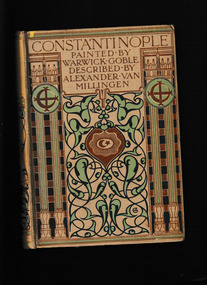
... origins of the city's prominence is included as a prelude to the physical qualities of the city itself. The influence of important rulers on the city's layout, the walls, the Golden Horn and inland walls, the churches of the city, and contemporary impressions of Constantinople are included. Has a chapter on Turkish women, and discussion of Islam in Constantinople. Includes reproductions of Goble's watercolor and oil ...An art history of the city of Constantinople. The origins of the city's prominence is included as a prelude to the physical qualities of the city itself. The influence of important rulers on the city's layout, the walls, the Golden Horn and inland walls, the churches of the city, and contemporary impressions of Constantinople are included. Has a chapter on Turkish women, and discussion of Islam in Constantinople. Includes reproductions of Goble's watercolor and oil paintings.Index, ill, map, p.282non-fictionAn art history of the city of Constantinople. The origins of the city's prominence is included as a prelude to the physical qualities of the city itself. The influence of important rulers on the city's layout, the walls, the Golden Horn and inland walls, the churches of the city, and contemporary impressions of Constantinople are included. Has a chapter on Turkish women, and discussion of Islam in Constantinople. Includes reproductions of Goble's watercolor and oil paintings.constantinople - description, constantinople - travel -
 Flagstaff Hill Maritime Museum and Village
Equipment - Navigation Lamp, Port, George Bocock & Co. Ltd, Trading As Seahorse Lamps, 1930s
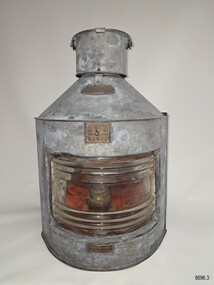
... He asked about the lamp, but nobody there knew anything about its origin, and he was told that he could have it. This is a complete ship navigation lamp with its original oil burner. ...He asked about the lamp, but nobody there knew anything about its origin, and he was told that he could have it. This is a complete ship navigation lamp with its original oil burner. ...The donor recovered this navigation lamp before the 1980s from an old storage area in a South Melbourne factory where he worked. He asked about the lamp, but nobody there knew anything about its origin, and he was told that he could have it. This is a complete ship navigation lamp with its original oil burner. The internal red colour and shape indicate that the lamp was used for the port side of a vessel. The burner assembly is fixed to a removable tray, and the burner disconnects from the tank to allow fuel to be added. Light showing from the lamp is magnified by the polished brass reflector behind it, and the painted internal surfaces give the light its red colour. The lid on the chimney unclips for inspection purposes. The wedge shape of the lamp is intentional. It allows the light to be visible horizontally from up to a 112.5-degree angle, and to be invisible past that angle. The light's colour and position are part of the code of signals that inform viewers of the vessel’s position, direction of travel and status. The red lights indicate the port side of a vessel, green lights indicate the starboard side, and white lights are used on the masthead. From 1972, lights and signals on marine vessels are required to be fitted according to the International Regulations for Preventing Collisions at Sea. SEAHORSE lamp, made in Britain: The firm Bocock & Wilkinson was established in Birmingham in 1890 as an electroplate manufacturer. In 1900, Kelly’s Directory lists the firm as a ship lamp manufacturer. In 1910, the firm was listed Trading As “Seahorse” at 17 & 18 Mott Street, Birmingham. The firm later became Bocock & Son, and in 1932 was listed as George Bocock & Co. Ltd, and in 1973, it was still at that address. Ship’s navigation lamp: an original, galvanised metal, Port bow-side lamp. The wedge-shaped case has an arc front and two flat side panels that meet at the back, with a metal chimney and a swinging ‘C’ shaped handle on top. The curved, clear glass Fresnel has moulded ribs, top and bottom. The chimney has a hinged cap with a clip closure. One flat panel has a firmly attached, hollow rectangular channel for mounting onto a post or bracket. The other flat panel has a ‘D’ shaped, swinging handle, and slides upwards to access the burner assembly with its original brass burner. Concentric rings of ventilation holes are in the base. A removable tray, with ventilation holes on two edges, holds the round fuel tank and burner and the short post with the curved brass reflector. All internal metal surfaces, apart from the brass burner and reflector, were painted red sometime after the lamp’s manufacture. Inscriptions are embossed on the three brass plaques on the front; one has a rope design border and a seahorse emblem. Branded Seahorse, made in Great Britain, Ca. 1930s. Plaque on top, crescent shape: “PORT” Plaque in centre, square logo: “[rope design border] [Seahorse logo] “SEAHORSE / G B / TRADE / MARK / P55933” Plaque on base, rectangular: “PATENT NO. 546575 / AND OTHERS PENDING” flagstaff hill maritime museum and village, great ocean road, shipwreck coast, ship lamp, navigation lamp, masthead light, masthead lamp, port lamp, port light, bow side lamp, lighting device, navigation, marine light, marine lamp, marine equipment, marine technology, marine safety, running light, position light, code of lights, international regulations for preventing collisions at sea, antique, galvanised, seahorse, great britain, gb, patent 546575, seahorse logo, trade mark p55933, oil burner, bocock & wilkinson, bocock & sons, george bocock & co. ltd
