
Showing 102 items matching "owl"
-
 Montsalvat
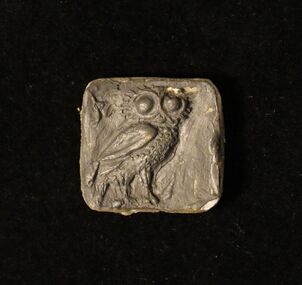
Plaster Relief, Matcham Skipper (1921-2011), Owl
... Owl......owl...Square plaster relief depicting an owl....matcham skipper relief jewellery owl None Square plaster relief depicting an owl. ...Square plaster relief depicting an owl.Nonematcham skipper, relief, jewellery, owl -
 Montsalvat
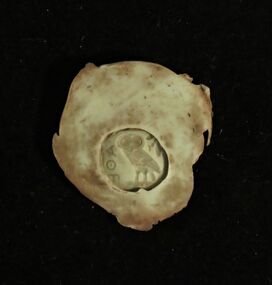
Silicon Mould, Untitled (Owl)
... Untitled (Owl)......owl...Silicon mould of a circular design depicting an owl with the text AOE....matcham skipper mould silicon owl None Silicon mould of a circular design depicting an owl with the text AOE. ...Silicon mould of a circular design depicting an owl with the text AOE.Nonematcham skipper, mould, silicon, owl -
 The Dunmoochin Foundation
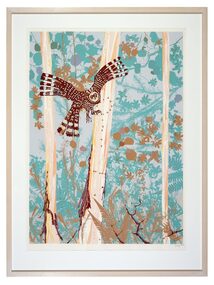
Screenprint, Owl in the Night, 1986
... Owl in the Night......Owl...Screenprint depicting a landscape with three trees and turquoise foliage and owl in flight. ...Clifton Pugh Screenprint Landscape Owl Signed (L.l) 'Clifton' Screenprint depicting a landscape with three trees and turquoise foliage and owl in flight. ...Screenprint depicting a landscape with three trees and turquoise foliage and owl in flight. Signed (L.l) 'Clifton'clifton pugh, screenprint, landscape, owl -
 The Dunmoochin Foundation
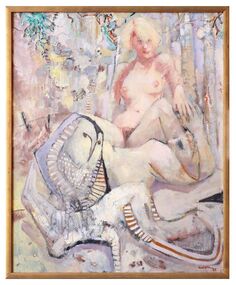
Oil Painting, Nude and Owl, 1985
... Nude and Owl......Owl...Seated female nude with blonde hair in landscape with male nude and owl. ...Clifton Pugh Painting Female Nude Dunmoochin Owl Male Nude Signed (L.r) 'Clifton '85' Seated female nude with blonde hair in landscape with male nude and owl. ...Seated female nude with blonde hair in landscape with male nude and owl. Signed (L.r) 'Clifton '85'clifton pugh, painting, female nude, dunmoochin, owl, male nude -
 Embroiderers Guild, Victoria
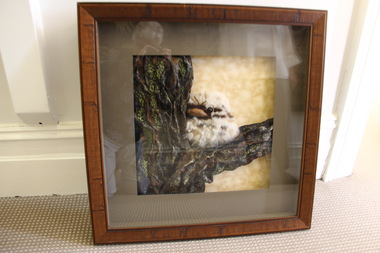
Artwork, other - Picture, Linda Worthington, Baby Tawny Frogmouth Owl, 2010
... Baby Tawny Frogmouth Owl......Owl...Baby owl, couched brushed wool, some emu feathers. ...Embroidery Picture Owl Wool Emu fathers Exhibition 2010 Baby owl, couched brushed wool, some emu feathers. ...Designed and made by Linda Worthington for the Guild's Wool Exhibition 2010, and sold to the donor Joan Lefroy.Baby owl, couched brushed wool, some emu feathers. Glass eye. Owl is on tree, of constructed fabric. Threads of wool fibres, black sheer, free machine stitched and hand stitched. Recessed frame. embroidery, picture, owl, wool, emu fathers, exhibition 2010 -
 The Beechworth Burke Museum
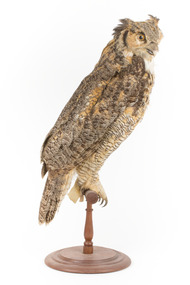
Animal specimen - Long-Eared Owl, Trustees of the Australian Museum, 1860- 1880
... ...owl...The Long-eared owl is one of the most widely distributed and most numerous owl species in the world. ...This Long-Eared Owl is a rather slim, long-winged bird with prominent erectile ear tufts. ...Swing tag: 33 / Virginian / Bee-boo Owl / Catalogue, page 52 / Other tag: No 19 / STRIX Virginian / N. ...The Long-eared owl is one of the most widely distributed and most numerous owl species in the world. ...The Long-eared owl is one of the most widely distributed and most numerous owl species in the world. It is a rather slim and long-winged bird with usually prominent erectile ear tufts, which are positioned closer to the center of the head than in many other types of owl. Long-eared owls prefer open landscapes with groups of trees, hedges or small woods, as well as pastureland with rows of trees and bushes, any type of forest with clearings, forest edges, semi-open taiga forest, swampy areas and bogs, orchards with old fruit trees, parks, even gardens and timbered areas in villages, towns or cities. In many parts of the world, Long-eared owls have even adapted to deserts, though more commonly semi-desert, and may nest and roost in available oases and hunt prey over the open desert ground. This particular specimen has been mounted in a correctly stylised fashion. This specimen is part of a collection of almost 200 animal specimens that were originally acquired as skins from various institutions across Australia, including the Australian Museum in Sydney and the National Museum of Victoria (known as Museums Victoria since 1983), as well as individuals such as amateur anthropologist Reynell Eveleigh Johns between 1860-1880. These skins were then mounted by members of the Burke Museum Committee and put-on display in the formal space of the Museum’s original exhibition hall where they continue to be on display. This display of taxidermy mounts initially served to instruct visitors to the Burke Museum of the natural world around them, today it serves as an insight into the collecting habits of the 19th century.This specimen is part of a significant and rare taxidermy mount collection in the Burke Museum. This collection is scientifically and culturally important for reminding us of how science continues to shape our understanding of the modern world. They demonstrate a capacity to hold evidence of how Australia’s fauna history existed in the past and are potentially important for future environmental research. This collection continues to be on display in the Museum and has become a key part to interpreting the collecting habits of the 19th century.This Long-Eared Owl is a rather slim, long-winged bird with prominent erectile ear tufts. The coloration of this Long-eared Owl is a hue of ochraceous-tawny with a brownish wash. The wings, back and chest are patterned and the facial disc is visibly well developed and light brown in colour. The ear tufts are dusky in front and darter tawny on the back. This Long-eared owl possesses a light-coloured bill and its eyes are yellowish-orange. The specimen stands upon a wooden platform. Swing tag: 33 / Virginian / Bee-boo Owl / Catalogue, page 52 / Other tag: No 19 / STRIX Virginian / N. America / taxidermy mount, taxidermy, animalia, burke museum, beechworth, australian museum, skin, reynell eveleigh johns, bird, owl, long-eared owl -
 The Beechworth Burke Museum
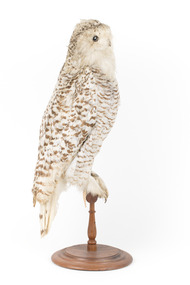
Animal specimen - Snowy Owl, Trustees of the Australian Museum, 1860- 1880
... ...owl...The Snowy owl is a large and powerful bird. It is one of the largest species of owl, and in North America, it is on average the heaviest owl species. ...This Snowy Owl adult male is virtually pure white with brown spot markings and a pale brownish wash. ...Swing tag: [torn] snowy owl / See catalogue, page 54 / Metal tag: 4054 /...The Snowy owl is a large and powerful bird. It is one of the largest species of owl, and in North America, it is on average the heaviest owl species. ...The Snowy owl is a large and powerful bird. It is one of the largest species of owl, and in North America, it is on average the heaviest owl species. The adult male is virtually pure white, but females and young birds have some dark spots; the young are heavily barred, and dark spotting may even predominate. Thick plumage, heavily feathered taloned feet, and coloration render the Snowy owl well-adapted for life north of the Arctic Circle. This Snowy Owl example is slightly discoloured and in real life the Snowy Owl displays much more brilliant white feathers. This specimen is part of a collection of almost 200 animal specimens that were originally acquired as skins from various institutions across Australia, including the Australian Museum in Sydney and the National Museum of Victoria (known as Museums Victoria since 1983), as well as individuals such as amateur anthropologist Reynell Eveleigh Johns between 1860-1880. These skins were then mounted by members of the Burke Museum Committee and put-on display in the formal space of the Museum’s original exhibition hall where they continue to be on display. This display of taxidermy mounts initially served to instruct visitors to the Burke Museum of the natural world around them, today it serves as an insight into the collecting habits of the 19th century.This specimen is part of a significant and rare taxidermy mount collection in the Burke Museum. This collection is scientifically and culturally important for reminding us of how science continues to shape our understanding of the modern world. They demonstrate a capacity to hold evidence of how Australia’s fauna history existed in the past and are potentially important for future environmental research. This collection continues to be on display in the Museum and has become a key part to interpreting the collecting habits of the 19th century.This Snowy Owl adult male is virtually pure white with brown spot markings and a pale brownish wash. It has thick plumage and heavily feathered taloned feet. This specimen stands upon a wooden platform and has an identification tag tied around its leg.Swing tag: [torn] snowy owl / See catalogue, page 54 / Metal tag: 4054 /taxidermy mount, taxidermy, animalia, burke museum, beechworth, australian museum, skin, reynell eveleigh johns, bird, owl, snowy owl, arctic circle -
 Latrobe Regional Gallery
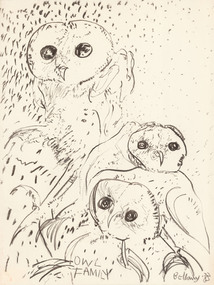
Drawing, BELLANY, John b. 1942, Port Seton d. 2013, Owl Family, 1983
... Owl Family...Titled 'OWL FAMILY' centre bottom of drawing. Signed and dated 'Bellany '83' in bottom right corner of drawing....Titled 'OWL FAMILY' centre bottom of drawing. Signed and dated 'Bellany '83' in bottom right corner of drawing. ...Charcoal on paperTitled 'OWL FAMILY' centre bottom of drawing. Signed and dated 'Bellany '83' in bottom right corner of drawing. -
 The Beechworth Burke Museum
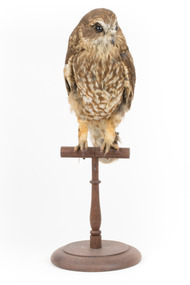
Animal specimen - Southern Boobook, Trustees of the Australian Museum, 1860-1880
... ...owl...Known for its distinctive ‘boo-book’ sound which gives it its name, the Southern Boobook owl inhabits a variety of environments, including woodland, rural, open desert and dense forest. ...One of the most commonly found Australian species of owl, the Southern Boobook is also Australia’s smallest owl. ...Swing-tag appears to read: '39. Boobook Owl / Catalogue page 53.' The 2 digit number at the beginning of the label could also be '3a'. ...One of the most commonly found Australian species of owl, the Southern Boobook is also Australia’s smallest owl. ...Known for its distinctive ‘boo-book’ sound which gives it its name, the Southern Boobook owl inhabits a variety of environments, including woodland, rural, open desert and dense forest. It is found on mainland Australia as well as Tasmania and other costal islands. Some similar species can be located in New Zealand, New Guinea and Indonesia. Young Boobooks’ plumage is mostly off white, and there are slight variations in subspecies based on location - the Cape York rainforest owls are a larger, darker brown bird while the Tasmanian Boobooks are smaller and often have more white flecks on their plumage. Southern Boobooks hunt and eat nocturnally and, like most owls, their diet consists of smaller animals including smaller mammals and insects. While elements of this particular specimen are representative of the actual bird, the form and structuring of this specimen’s neck area appears to be somewhat out of shape in comparison to images of the actual bird, which present a distinct head structure. The eyes on this specimen are also problematic, as they are solely black - not aligning with accurate representations of this species that have a distinct golden yellow outer ring in their eyes around a large black pupil. This specimen is part of a collection of almost 200 animal specimens that were originally acquired as skins from various institutions across Australia, including the Australian Museum in Sydney and the National Museum of Victoria (known as Museums Victoria since 1983), as well as individuals such as amateur anthropologist Reynell Eveleigh Johns between 1860-1880. These skins were then mounted by members of the Burke Museum Committee and put-on display in the formal space of the Museum’s original exhibition hall where they continue to be on display. This display of taxidermy mounts initially served to instruct visitors to the Burke Museum of the natural world around them, today it serves as an insight into the collecting habits of the 19th century.This specimen is part of a significant and rare taxidermy mount collection in the Burke Museum. This collection is scientifically and culturally important for reminding us of how science continues to shape our understanding of the modern world. They demonstrate a capacity to hold evidence of how Australia’s fauna history existed in the past and are potentially important for future environmental research. This collection continues to be on display in the Museum and has become a key part to interpreting the collecting habits of the 19th century.One of the most commonly found Australian species of owl, the Southern Boobook is also Australia’s smallest owl. With a coating of dark chocolate brown coloured plumage on its wings, dorsal area, continuing onto the top of the head and around its eyes, the owl’s breast plumage is flecked with hazelnut brown and white feathers. Its chin and nose areas are a soft creamy white, and the owl’s beak is a darker grey. Traditionally, the eyes are yellow as are the legs and taloned feet. This particular specimen stands upon a wooden perch and an identifying tag hangs from its right leg.Swing-tag appears to read: '39. Boobook Owl / Catalogue page 53.' The 2 digit number at the beginning of the label could also be '3a'. taxidermy mount, taxidermy, animalia, burke museum, beechworth, australian museum, skin, reynell eveleigh johns, bird, southern boobook, mopoke, australia, boobook, nocturnal, ninox novaeseelandiae, owl -
 Embroiderers Guild, Victoria
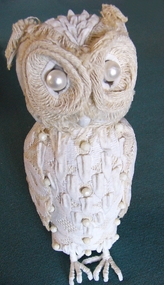
Textile - Owl, Miss Leslie Uren, 1960-80
... Owl...Embroidered felt owl. The front is covered with a collage of cream and white fabrics, representing wings and feathers, with beads on front and large pearl beads for eyes....Textile Owl Miss Leslie Uren ...Designed and made by Miss Leslie Uren.Embroidered felt owl. The front is covered with a collage of cream and white fabrics, representing wings and feathers, with beads on front and large pearl beads for eyes.embroidery, creative, soft sculpture, 1960-80, australia -
 The Beechworth Burke Museum
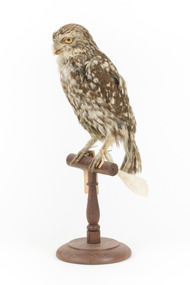
Animal specimen - Diurnal Owl / Ural Owl
... ...owl...Little owls (also known as the owl of Athena or owl of Minerva) usually prefer the warmer parts of Europe, North Africa and Asia, enjoying open country and agricultural land with high trees to swoop down upon their prey from. ...This Athene Nuctua (The Little Owl) is dark to medium brown with white specks all over the feathers. .... / Allied to / Diurnal Owl / Catalogue page 53 / Other tag: 31 / Strix Noctua / Holland Metal tag: 4061 /...Little owls (also known as the owl of Athena or owl of Minerva) usually prefer the warmer parts of Europe, North Africa and Asia, enjoying open country and agricultural land with high trees to swoop down upon their prey from. ...Little owls (also known as the owl of Athena or owl of Minerva) usually prefer the warmer parts of Europe, North Africa and Asia, enjoying open country and agricultural land with high trees to swoop down upon their prey from. Their diet includes amphibians, small mammals, reptiles and insects that they also hunt from small holes in the ground. Little owls are monogamous and while they're usually solitary creatures, pairs who breed together will often stay together past breeding season. An Athene Noctua would usually be slightly smaller than this specimen. The colouring of browns and whites speckling the feathers is an accurate representation however the posture of a typical little owl would be more crouched, not so thin and tall. This specimen is part of a collection of almost 200 animal specimens that were originally acquired as skins from various institutions across Australia, including the Australian Museum in Sydney and the National Museum of Victoria (known as Museums Victoria since 1983), as well as individuals such as amateur anthropologist Reynell Eveleigh Johns between 1860-1880. These skins were then mounted by members of the Burke Museum Committee and put-on display in the formal space of the Museum’s original exhibition hall where they continue to be on display. This display of taxidermy mounts initially served to instruct visitors to the Burke Museum of the natural world around them, today it serves as an insight into the collecting habits of the 19th century.This specimen is part of a significant and rare taxidermy mount collection in the Burke Museum. This collection is scientifically and culturally important for reminding us of how science continues to shape our understanding of the modern world. They demonstrate a capacity to hold evidence of how Australia’s fauna history existed in the past and are potentially important for future environmental research. This collection continues to be on display in the Museum and has become a key part to interpreting the collecting habits of the 19th century.This Athene Nuctua (The Little Owl) is dark to medium brown with white specks all over the feathers. Large white spots are located on their wings/back. This specimen has some inconsistencies with how it has been styalised by the taxidermist. The tail curls in under itself where it should be straight and flat. There are several feathers which appear disheveled on the chest, shoulder and wing. The specimen is mounted on a wooden stand with paper and metal tags attached to the legs. Swing tag: 41. / Allied to / Diurnal Owl / Catalogue page 53 / Other tag: 31 / Strix Noctua / Holland Metal tag: 4061 /taxidermy mount, taxidermy, animalia, burke museum, beechworth, australian museum, skin, bird, owl, little owl, athene noctua -
 The Beechworth Burke Museum
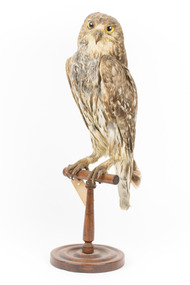
Animal specimen - Barking Owl (Male), Trustees of the Australian Museum, 1860-1880
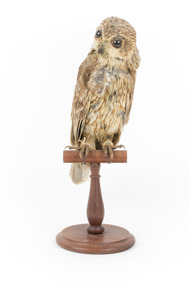
... The Barking Owl is a nocturnal, medium sized (390-440 mm) bird of prey native to Australia, parts of Papua New Guinea, and the Moluccas. ...This male Barking Owl is average sized with brown, grey and white spots and vertical chest streaks. ...17. / Bookook Owl / See catalogue page, 4 /...The Barking Owl is a nocturnal, medium sized (390-440 mm) bird of prey native to Australia, parts of Papua New Guinea, and the Moluccas. ...The Barking Owl is a nocturnal, medium sized (390-440 mm) bird of prey native to Australia, parts of Papua New Guinea, and the Moluccas. Males are generally slightly larger by weight than females and they are only one of small number of owl species that do not exhibit marked sexual dimorphism. Barking Owls have characteristic vocalisations, ranging from 'a 'woof woof' barking dog sounds to shrill, human-like scream sounds, which reportedly alarmed early European settlers. The Barking Owl's shrill and explosive vocalisation is sometimes associated with Bunyip mythology or referred to as 'the screaming woman call'. The male call is slightly lower in pitch than the female, and males and females often duet, contrasting low and high pitches. The owls are brown-grey in colour with white spots on the wings and vertically streaked chest. Their eyes are large and yellow. Barking Owls may be vulnerable in some parts of Australia due to woodland habitat loss. This specimen is part of a collection of almost 200 animal specimens that were originally acquired as skins from various institutions across Australia, including the Australian Museum in Sydney and the National Museum of Victoria (known as Museums Victoria since 1983), as well as individuals such as amateur anthropologist Reynell Eveleigh Johns between 1860-1880. These skins were then mounted by members of the Burke Museum Committee and put-on display in the formal space of the Museum’s original exhibition hall where they continue to be on display. This display of taxidermy mounts initially served to instruct visitors to the Burke Museum of the natural world around them, today it serves as an insight into the collecting habits of the 19th century. This specimen is part of a significant and rare taxidermy mount collection in the Burke Museum. This collection is scientifically and culturally important for reminding us of how science continues to shape our understanding of the modern world. They demonstrate a capacity to hold evidence of how Australia’s fauna history existed in the past and are potentially important for future environmental research. This collection continues to be on display in the Museum and has become a key part to interpreting the collecting habits of the 19th century. This male Barking Owl is average sized with brown, grey and white spots and vertical chest streaks. The face and breast are lighter in colour than the wings and dorsal plumage. The eyes are large and dark and the legs and feet are yellowish. The eyes are large and yellow irises and the legs and feet are yellowish. The specimen stands on a wooden perch pedestal with identification tags attached to its leg. 17. / Bookook Owl / See catalogue page, 4 /taxidermy mount, taxidermy, animalia, burke museum, beechworth, australian museum, skin, owls, barking owls, screaming woman call, yowing, woodland birds, birds of prey, australian owls, endangered, loss of habitat, woodland habitat, bunyip, australian early settler mythology -
 The Beechworth Burke Museum
Animal specimen - Barking Owl (Female), Trustees of the Australian Museum, 1860-1880
... Barking Owls are a nocturnal, medium sized bird of prey native to Australia, parts of Papua New Guinea, and the Moluccas. ...This female Barking Owl is of an average size. It has brown, grey and white spots and vertical streaks. ...[torn] / 16. / Winking Owl / See catalogue Page, 4 /...Barking Owls are a nocturnal, medium sized bird of prey native to Australia, parts of Papua New Guinea, and the Moluccas. ...Barking Owls are a nocturnal, medium sized bird of prey native to Australia, parts of Papua New Guinea, and the Moluccas. Average size ranges between 390-440mm in length. Females are generally slightly smaller than males and they are only one of a small number of owl species that do not exhibit marked sexual dimorphism. Barking Owls have characteristic vocalisations, ranging from a 'woof woof' barking dog sound, to shrill, human-like screams, which reportedly alarmed early European settlers to Australia. The Barking Owl's shrill and explosive vocalisation is sometimes associated with Bunyip mythology or referred to as 'the screaming woman call'. The female call is slightly higher in pitch than the male, and males and females often duet, contrasting low and high pitches. Barking Owls may be vulnerable in some parts of Australia due to woodland habitat loss. This specimen is part of a collection of almost 200 animal specimens that were originally acquired as skins from various institutions across Australia, including the Australian Museum in Sydney and the National Museum of Victoria (known as Museums Victoria since 1983), as well as individuals such as amateur anthropologist Reynell Eveleigh Johns between 1860-1880. These skins were then mounted by members of the Burke Museum Committee and put-on display in the formal space of the Museum’s original exhibition hall where they continue to be on display. This display of taxidermy mounts initially served to instruct visitors to the Burke Museum of the natural world around them, today it serves as an insight into the collecting habits of the 19th century.This specimen is part of a significant and rare taxidermy mount collection in the Burke Museum. This collection is scientifically and culturally important for reminding us of how science continues to shape our understanding of the modern world. They demonstrate a capacity to hold evidence of how Australia’s fauna history existed in the past and are potentially important for future environmental research. This collection continues to be on display in the Museum and has become a key part to interpreting the collecting habits of the 19th century.This female Barking Owl is of an average size. It has brown, grey and white spots and vertical streaks. The face and breast are lighter in colour than the wings and the dorsal plumage. The glass eyes are large and dark in colour while the tarsi and toes are yellowish. This specimen stands on a wooden perch with identification tags attached to its leg. [torn] / 16. / Winking Owl / See catalogue Page, 4 /taxidermy mount, taxidermy, animalia, burke museum, beechworth, australian museum, skin, owls, barking owls, screaming woman call, yowing, woodland birds, birds of prey, australian owls, endangered, loss of habitat, woodland habitat, bunyip, australian early settler mythology -
 The Beechworth Burke Museum
Animal specimen - Australian masked owl, Trustees of the Australian Museum, 1860-1880
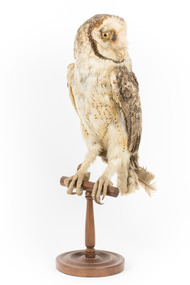
... Australian masked owls are an Australian barn owl species ranging across most of mainland Australia and Tasmania, generally within 300 km of coastline. ...This Masked Owl specimen is medium sized with a large head and distinctive heart-shaped facial markings. ...12. / Delicate Owl / See Catalogue, page, 3 /...Australian masked owls are an Australian barn owl species ranging across most of mainland Australia and Tasmania, generally within 300 km of coastline. ...Australian masked owls are an Australian barn owl species ranging across most of mainland Australia and Tasmania, generally within 300 km of coastline. Masked Owls are a medium sized bird averaging 390-500mm in length with wing spans up to 1250mm. There are several subspecies across Australia and the Tasmanian Masked Owl is the largest. Female Masked Owls are markedly larger than males. Masked Owls prefer forested, woodland, or timbered waterway habitats to open country, and nest in tall trees with suitable hollows and adjacent areas for foraging. They are territorial and hunt small mammals, rodents, rabbits, reptiles and small marsupials. Population numbers are in decline on the mainland and in Victoria the species is considered threatened. This specimen is part of a collection of almost 200 animal specimens that were originally acquired as skins from various institutions across Australia, including the Australian Museum in Sydney and the National Museum of Victoria (known as Museums Victoria since 1983), as well as individuals such as amateur anthropologist Reynell Eveleigh Johns between 1860-1880. These skins were then mounted by members of the Burke Museum Committee and put-on display in the formal space of the Museum’s original exhibition hall where they continue to be on display. This display of taxidermy mounts initially served to instruct visitors to the Burke Museum of the natural world around them, today it serves as an insight into the collecting habits of the 19th century.This specimen is part of a significant and rare taxidermy mount collection in the Burke Museum. This collection is scientifically and culturally important for reminding us of how science continues to shape our understanding of the modern world. They demonstrate a capacity to hold evidence of how Australia’s fauna history existed in the past and are potentially important for future environmental research. This collection continues to be on display in the Museum and has become a key part to interpreting the collecting habits of the 19th century. This Masked Owl specimen is medium sized with a large head and distinctive heart-shaped facial markings. The plumage is mostly brown, patterned with flecks and patches of white, chestnut and light grey. The tail is short and largely concealed by long wing feathers. The face, feathered tarsi and underparts are much paler in contrast to the dorsal plumage, and the facial mask is edged by a distinct dark brown line. The eyes are large and yellow. This specimen stands on a wooden perch pedestal with identification tags attached to its leg. 12. / Delicate Owl / See Catalogue, page, 3 /taxidermy, taxidermy mount, masked owl, burke museum, australian museum, owls, birds of prey, heart-shaped faced owl, nocturnal birds, predator birds, barn owl, carnivore, tyto novaehollandiae, australian masked owl, tytonidae, tyto, territorial owl, threatened species, animalia, australian owls, tasmanian masked owl -
 Mrs Aeneas Gunn Memorial Library
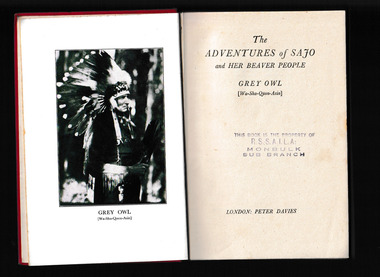
Book, Peter Davies, The adventures of Sajo and her beaver people, 1935
... ...Grey Owl...The adventures of Sajo and her beaver people Book Peter Davies Grey Owl ...The adventures of two young beavers after they are rescued by an Indian hunter and taken to his village.Ill, p.208.non-fictionThe adventures of two young beavers after they are rescued by an Indian hunter and taken to his village.animals - fiction, american fiction -
 The Beechworth Burke Museum
Animal specimen - Northern Hawk Owl, Trustees of the Australian Museum, 1860-1880
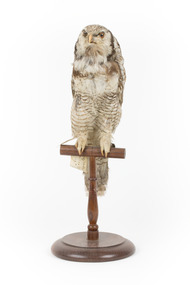
... ...owl...The Northern Hawk-owl is a nomadic and generally solitary bird, although they can occasionally be seen in pairs. ...The Northern hawk-owl's face features white and brown soft feathery plumage and a dark brown border around its face/chin area, with a dark cream curving beak soft yellowy brown coloured eyes. ...Swing-tag: 38 / Rayed Swin Owl –/ See Catalogue, Page 53. Tag with faded script: No 33 Strix[?] ...The Northern Hawk-owl is a nomadic and generally solitary bird, although they can occasionally be seen in pairs. ...The Northern Hawk-owl is a nomadic and generally solitary bird, although they can occasionally be seen in pairs. While these birds resemble owls, their behaviour is more similar to that of a hawk, hence their name. Normally active during the day (similar to the hunting habits of a hawk), they prefer to reside in boreal forest, grasslands, shrublands and temperate, cold and polar zones. Located in North America, Europe and Asia, these owls can also occasionally be found during migration, in the northern United States. There are three subspecies in North America, Central Asia and Siberia. At the present time (2021), its numbers are stable and so it is therefore considered of ‘least concern’ on the IUCN Red List, indicating it is not yet endangered. This particular specimen has been correctly mounted and presented as a relatively accurate representation of the actual bird. This specimen is part of a collection of almost 200 animal specimens that were originally acquired as skins from various institutions across Australia, including the Australian Museum in Sydney and the National Museum of Victoria (known as Museums Victoria since 1983), as well as individuals such as amateur anthropologist Reynell Eveleigh Johns between 1860-1880. These skins were then mounted by members of the Burke Museum Committee and put-on display in the formal space of the Museum’s original exhibition hall where they continue to be on display. This display of taxidermy mounts initially served to instruct visitors to the Burke Museum of the natural world around them, today it serves as an insight into the collecting habits of the 19th century.This specimen is part of a significant and rare taxidermy mount collection in the Burke Museum. This collection is scientifically and culturally important for reminding us of how science continues to shape our understanding of the modern world. They demonstrate a capacity to hold evidence of how Australia’s fauna history existed in the past and are potentially important for future environmental research. This collection continues to be on display in the Museum and has become a key part to interpreting the collecting habits of the 19th century.The Northern hawk-owl's face features white and brown soft feathery plumage and a dark brown border around its face/chin area, with a dark cream curving beak soft yellowy brown coloured eyes. Its front breast feathers are generally off white in colour with some flecks of brown. It has a long brown tail with off white banding, with creamy white claws. The owl has speckled brown and white plumage over the back of its body and wings and some areas of more solid brown are present around the back of its neck and top of wings. This specimen stands upon a wooden platform and two identifying tags hang from its right leg, while a metal numbered tag hangs from its left.Swing-tag: 38 / Rayed Swin Owl –/ See Catalogue, Page 53. Tag with faded script: No 33 Strix[?] / misarea[?] / Sweden[?] Metal tag - digits on metal tag appear to read, either ‘5028’ or ‘6028’taxidermy mount, taxidermy, animalia, burke museum, beechworth, australian museum, skin, reynell eveleigh johns, bird, surnia ulula, strigidae, northern hawk-owl, hawk-owl, canadian owl, hudsonian hawk-owl, owl, canada, asia, europe, north america -
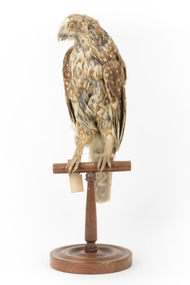 The Beechworth Burke Museum
Animal specimen - Morepork, Trustees of the Australian Museum, 1860-1880
... The Morepork is a small brown and white spotted owl found in New Zealand, Tasmania and Norfolk Island. ...This Morepork (also known as a Masked Owl) is covered in brown and white plumage on its head and body. ...11 / Masked Owl / See Catalogue, page 3 /...The Morepork is a small brown and white spotted owl found in New Zealand, Tasmania and Norfolk Island. ...The Morepork is a small brown and white spotted owl found in New Zealand, Tasmania and Norfolk Island. It is known by around twenty different names which are all onomatopoeic which emulate the birds distinctive two-pitched call. They are mostly nocturnal and carnivorous (eating insects and small vertebrates). They reside in habitats with trees, they sleep in roosts and hunt mainly in the evenings and early morning. Females are slightly bigger than males. This species attains full plumage in its third or fourth year. They can turn their heads 270 degrees." In Māori tradition the morepork was seen as a watchful guardian. It belonged to the spirit world as it is a bird of the night. Although the more-pork or ruru call was thought to be a good sign, the high pitched, piercing, ‘yelp’ call was thought to be an ominous forewarning of bad news or events." (NZ Department of Conservation). This specimen is part of a collection of almost 200 animal specimens that were originally acquired as skins from various institutions across Australia, including the Australian Museum in Sydney and the National Museum of Victoria (known as Museums Victoria since 1983), as well as individuals such as amateur anthropologist Reynell Eveleigh Johns between 1860-1880. These skins were then mounted by members of the Burke Museum Committee and put-on display in the formal space of the Museum’s original exhibition hall where they continue to be on display. This display of taxidermy mounts initially served to instruct visitors to the Burke Museum of the natural world around them, today it serves as an insight into the collecting habits of the 19th century.This specimen is part of a significant and rare taxidermy mount collection in the Burke Museum. This collection is scientifically and culturally important for reminding us of how science continues to shape our understanding of the modern world. They demonstrate a capacity to hold evidence of how Australia’s fauna history existed in the past and are potentially important for future environmental research. This collection continues to be on display in the Museum and has become a key part to interpreting the collecting habits of the 19th century.This Morepork (also known as a Masked Owl) is covered in brown and white plumage on its head and body. The white feathers delineate its round yellow eyes. Its belly and back are brown and white with the white feathering appearing spotted. He sits on a wooden perch with his head turned to the left. A swing tag is attached to its leg.11 / Masked Owl / See Catalogue, page 3 /taxidermy mount, taxidermy, animalia, burke museum, beechworth, australian museum, skin, reynell eveleigh johns, bird, ruru, spotted owl, tasmanian spotted owl, morepork, mopoke, new zealand owls, new zealand birds, tasmanian owls, tasmanian birds, norfolk island owls, norfolk island birds -
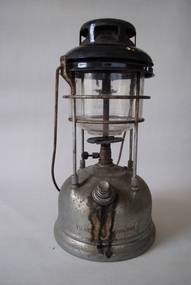 Anglesea and District Historical Society
Tilley Lamp, W. H. Tilley, Estimated 1954-57
... Tilley Owl England Kerosene Pressure Lantern. A camping pressure lamp with dark blue enamel top. ...TILLEY - ENGLAND (on tank) GLASS - TILLEY - DAVISIL 171 HEAT RESISTING / MADE IN ENGLAND Owl motif on base...tilley kerosene lamp TILLEY - ENGLAND (on tank) GLASS - TILLEY - DAVISIL 171 HEAT RESISTING / MADE IN ENGLAND Owl motif on base Tilley Owl England Kerosene Pressure Lantern. ...Tilley Owl England Kerosene Pressure Lantern. A camping pressure lamp with dark blue enamel top. Pump action handle pressurizes the fuel tank to approx 2 atmospheres. Owl motif on base (very unclear).TILLEY - ENGLAND (on tank) GLASS - TILLEY - DAVISIL 171 HEAT RESISTING / MADE IN ENGLAND Owl motif on basetilley, kerosene, lamp -
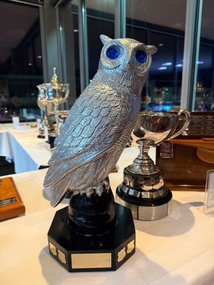 Royal Brighton Yacht Club
Award - Paul Wise Owl Dragon Trophy, Dragon Long Race Trophy
... James is the creative genius behind Wise Owl's restoration. ...Paul Wise Owl Dragon Trophy...James is the creative genius behind Wise Owl's restoration. Paul Wise Owl Dragon Trophy Dragon Long Race Trophy Award Paul Wise Owl Dragon Trophy ...This trophy first appeared at the 150th anniversary presentation night in July 2025. It is awarded for the Dragon Long race and included retrospective winners of the trophy. The trophy is aptly named after Paul Wise, a frequent Dragon Sailor and the one who approved the rescue of the owl from the hardstand bin. The trophy was then given a base with plaques and is a testament to RBYC’s cleaner sailing commitments. The winner this season was Lyla 194, skippered by Maia Hester and crewed by Ruby Wise (Paul’s granddaughter) and James Harland. It was Ruby’s inaugural Dragon Race. James is the creative genius behind Wise Owl's restoration. Paul Wise Owl Dragon Trophy -
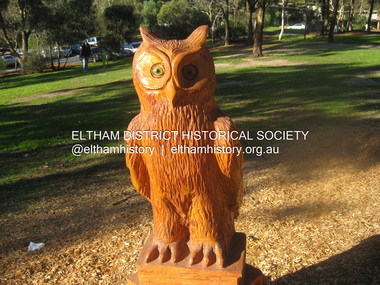 Eltham District Historical Society Inc
Photograph, Fay Bridge, Owl, chainsaw sculpture by Leigh Conkie, 21 July 2013
... Owl, chainsaw sculpture by Leigh Conkie...Location unknown Fay Bridge Collection Chainsaw sculpture Leigh Conkie 2013-07-21 sculpture 1 image - born digital Owl, chainsaw sculpture by Leigh Conkie Photograph Photograph Fay Bridge ...Leigh Conkie is a well known Eltham artist who creates a wide variety of subjects in wood modelled by chainsaw at his home in Main Road. Location unknownfay bridge collection, chainsaw sculpture, leigh conkie, 2013-07-21, sculpture -
 Round the Bend Conservation Co-operative
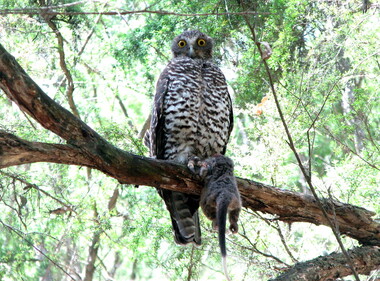
Powerful Owl, The Co-op provides habitat for rare and endangered species such as the Powerful Owl. Sightings of local fauna and birds are recorded regularly
... The Co-op provides habitat for rare and endangered species such as the Powerful Owl. Sightings of local fauna and birds are recorded regularly....Powerful Owl ...Photo taken on Round the Bend Conservation Co-operativeColour photo -
 Darebin Art Collection
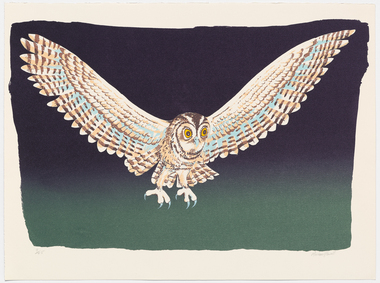
Print, Michael Powell, 'Owl', 2006
... 'Owl'...'Owl' Print Michael Powell ... -
 Mrs Aeneas Gunn Memorial Library
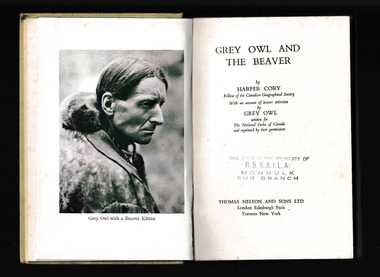
Book, Nelson, Grey Owl and the beaver, 1935
... Grey Owl and the beaver ...Beavers Conservationists - Canada - Biography A book of beavers and their conservation Ill, p.137. Grey Owl and the beaver Book Nelson Harper Cory ...A book of beavers and their conservationIll, p.137.non-fictionA book of beavers and their conservation beavers, conservationists - canada - biography -
 Croydon Conservation Society Inc.
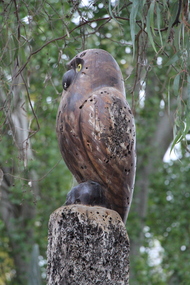
Sculpture, Owl wooden sculpture at Ringwood Lake Croydon 2023
... Owl wooden sculpture at Ringwood Lake Croydon 2023...Digital photograph Owl wooden sculpture at Ringwood Lake Croydon 2023 Sculpture ...Digital photograph -
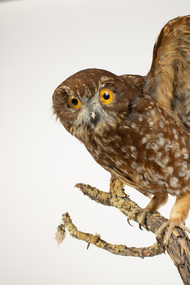 Barwon Coast Discovery Centre
Animal specimen - Southern Boobook Owl, Southern Boobook Owl on Branch
... Southern Boobook Owl on Branch...Southern Boobook Owl on Branch Animal specimen Southern Boobook Owl ... -
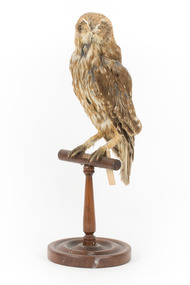 The Beechworth Burke Museum
Animal specimen - Morepork, Trustees of the Australian Museum, 1860-1880
... The Morepork is a small brown and white spotted owl found in New Zealand, Tasmania and Norfolk Island. ...This Morepork (also known as the Masked Owl) is covered in brown and white plumage on its head and body. ...Swing tag: 10 / Masked Owl / See Catalogue, page 3 /...The Morepork is a small brown and white spotted owl found in New Zealand, Tasmania and Norfolk Island. ...The Morepork is a small brown and white spotted owl found in New Zealand, Tasmania and Norfolk Island. It is known by around twenty different names which are all onomatopoeic which emulate the birds distinctive two-pitched call. They are mostly nocturnal and carnivorous (eating insects and small vertebrates). They reside in habitats with trees, they sleep in roosts and hunt mainly in the evenings and early morning. Females are slightly bigger than males. This species attains full plumage in its third or fourth year. They can turn their heads 270 degrees." In Māori tradition the morepork was seen as a watchful guardian. It belonged to the spirit world as it is a bird of the night. Although the more-pork or ruru call was thought to be a good sign, the high pitched, piercing, ‘yelp’ call was thought to be an ominous forewarning of bad news or events." (NZ Department of Conservation). This specimen is part of a collection of almost 200 animal specimens that were originally acquired as skins from various institutions across Australia, including the Australian Museum in Sydney and the National Museum of Victoria (known as Museums Victoria since 1983), as well as individuals such as amateur anthropologist Reynell Eveleigh Johns between 1860-1880. These skins were then mounted by members of the Burke Museum Committee and put-on display in the formal space of the Museum’s original exhibition hall where they continue to be on display. This display of taxidermy mounts initially served to instruct visitors to the Burke Museum of the natural world around them, today it serves as an insight into the collecting habits of the 19th century.This specimen is part of a significant and rare taxidermy mount collection in the Burke Museum. This collection is scientifically and culturally important for reminding us of how science continues to shape our understanding of the modern world. They demonstrate a capacity to hold evidence of how Australia’s fauna history existed in the past and are potentially important for future environmental research. This collection continues to be on display in the Museum and has become a key part to interpreting the collecting habits of the 19th century.This Morepork (also known as the Masked Owl) is covered in brown and white plumage on its head and body. The white feathers delineate its round yellow eyes. Its belly and back are brown and white with the white feathering appearing spotted. This Morepork specimen sits on a wooden perch with his head turned to the left. A swing tag is attached to its left leg.Swing tag: 10 / Masked Owl / See Catalogue, page 3 /taxidermy mount, taxidermy, animalia, burke museum, beechworth, australian museum, skin, reynell eveleigh johns, bird, ruru, spotted owl, tasmanian spotted owl, morepork, mopoke, new zealand owls, new zealand birds, tasmanian owls, tasmanian birds, norfolk island owls, norfolk island birds -
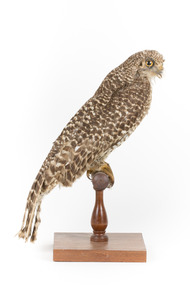 The Beechworth Burke Museum
Animal specimen - Powerful Owl, Trustees of the Australian Museum, 1860- 1880
... ...owl...The Powerful owl is native to south-eastern and eastern Australia and is the largest owl on the continent. ...This Powerful Owl has medium brown to dark grey-brown above, with white barring, and off-white front. ...The Powerful owl is native to south-eastern and eastern Australia and is the largest owl on the continent. ...The Powerful owl is native to south-eastern and eastern Australia and is the largest owl on the continent. It is found in coastal areas and in the Great Dividing Range rarely more than 200 km (120 mi) inland. An apex predator in its narrow distribution, the Powerful owl is often an opportunist like most predators, but generally hunts arboreal mammals, in particular small to medium-sized marsupials. It is a typically territorial raptorial bird that maintains a large home range and has long intervals between egg-laying and hatching of clutches. Unlike most raptorial birds, male Powerful owls are larger and stronger than females and so the male takes the dominant position in the mating pair, which extends to food distribution. This example of a Powerful Owl show lighter brown coloured feathers and slight discolouration. The Powerful Owl has darker colourings and whiter feathers in real life. This example also show discolouration in the feet and they are brighter yellow in colour in real life. This specimen is part of a collection of almost 200 animal specimens that were originally acquired as skins from various institutions across Australia, including the Australian Museum in Sydney and the National Museum of Victoria (known as Museums Victoria since 1983), as well as individuals such as amateur anthropologist Reynell Eveleigh Johns between 1860-1880. These skins were then mounted by members of the Burke Museum Committee and put-on display in the formal space of the Museum’s original exhibition hall where they continue to be on display. This display of taxidermy mounts initially served to instruct visitors to the Burke Museum of the natural world around them, today it serves as an insight into the collecting habits of the 19th century.This specimen is part of a significant and rare taxidermy mount collection in the Burke Museum. This collection is scientifically and culturally important for reminding us of how science continues to shape our understanding of the modern world. They demonstrate a capacity to hold evidence of how Australia’s fauna history existed in the past and are potentially important for future environmental research. This collection continues to be on display in the Museum and has become a key part to interpreting the collecting habits of the 19th centuryThis Powerful Owl has medium brown to dark grey-brown above, with white barring, and off-white front. The glass eyes are yellow, set in a dark grey/brown facial mask. The legs are feathered with yellow feet and talons. The specimen stands upon a wooden platform and has no identification tags attached. Swing-tag: n/a Metal tag: n/a Mount: no markings taxidermy mount, taxidermy, animalia, burke museum, beechworth, australian museum, skin, reynell eveleigh johns, bird, owl, powerful owl -
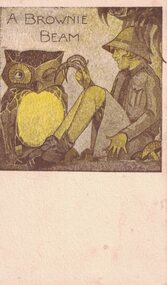 Linton and District Historical Society Inc
Card, A Brownie Beam, Marie Grigg, 1930
... Small Christmas card given to members of Linton Brownie Pack in 1930 by 'Brown Owl' L? Nicol. Card depicts a girl in Brownie uniform, sitting next to a very large owl which is winking at her....Inside the card, on line for name, handwritten: "Brownie Maree" Printed message: "With all Good Wishes for Christmas and the New Year / from" On line for name, handwritten: "L? Nicol / Brown Owl / Xmas 1930"....Nicol / Brown Owl / Xmas 1930". Small Christmas card given to members of Linton Brownie Pack in 1930 by 'Brown Owl' L? ...Card is part of collection of items donated by the Grigg family to LDHS after the death of Marie Grigg.Small Christmas card given to members of Linton Brownie Pack in 1930 by 'Brown Owl' L? Nicol. Card depicts a girl in Brownie uniform, sitting next to a very large owl which is winking at her.Inside the card, on line for name, handwritten: "Brownie Maree" Printed message: "With all Good Wishes for Christmas and the New Year / from" On line for name, handwritten: "L? Nicol / Brown Owl / Xmas 1930".christmas cards, brownies, girl guide movement, marie grigg legacy, christmas cards, l? nicol [brown owl] -
 The Beechworth Burke Museum
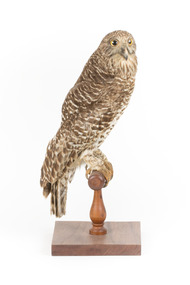
Animal specimen - Powerful Owl, Trustees of the Australian Museum, 1086- 1880
... ...owl...The Powerful owl is native to south-eastern and eastern Australia and is the largest owl on the continent. ...This Powerful Owl has medium brown to dark grey-brown on its wings and back, lighter patterning on its chest lightening with white barring, and off-white front. ...The Powerful owl is native to south-eastern and eastern Australia and is the largest owl on the continent. ...The Powerful owl is native to south-eastern and eastern Australia and is the largest owl on the continent. It is found in coastal areas and in the Great Dividing Range rarely more than 200 km (120 mi) inland. An apex predator in its narrow distribution, the Powerful owl is often an opportunist like most predators, but generally hunts arboreal mammals, in particular small to medium-sized marsupials. It is a typically territorial raptorial bird that maintains a large home range and has long intervals between egg-laying and hatching of clutches. Unlike most raptorial birds, male Powerful owls are larger and stronger than females and so the male takes the dominant position in the mating pair, which extends to food distribution. This example of a Powerful Owl show lighter brown coloured feathers and slight discolouration. The Powerful Owl has darker colourings and whiter feathers in real life. This example also show discolouration in the feet and they are brighter yellow in colour in real life. This specimen is part of a collection of almost 200 animal specimens that were originally acquired as skins from various institutions across Australia, including the Australian Museum in Sydney and the National Museum of Victoria (known as Museums Victoria since 1983), as well as individuals such as amateur anthropologist Reynell Eveleigh Johns between 1860-1880. These skins were then mounted by members of the Burke Museum Committee and put-on display in the formal space of the Museum’s original exhibition hall where they continue to be on display. This display of taxidermy mounts initially served to instruct visitors to the Burke Museum of the natural world around them, today it serves as an insight into the collecting habits of the 19th century.This specimen is part of a significant and rare taxidermy mount collection in the Burke Museum. This collection is scientifically and culturally important for reminding us of how science continues to shape our understanding of the modern world. They demonstrate a capacity to hold evidence of how Australia’s fauna history existed in the past and are potentially important for future environmental research. This collection continues to be on display in the Museum and has become a key part to interpreting the collecting habits of the 19th century.This Powerful Owl has medium brown to dark grey-brown on its wings and back, lighter patterning on its chest lightening with white barring, and off-white front. The eyes are yellow, set in a dark grey/brown facial mask. The legs are feathered with yellow/browning feet and talons. The specimen stands upon a wooden platform and has no identification tags attached. Swing-tag: n/a Metal tag: n/a Mount: wooden with no markings.taxidermy mount, taxidermy, animalia, burke museum, beechworth, australian museum, skin, reynell eveleigh johns, bird, owl, powerful owl -
 The Dunmoochin Foundation
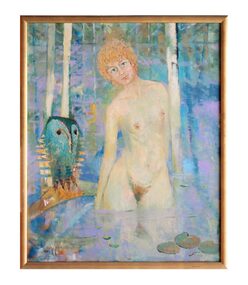
Oil Painting, Prue, 1988
... ...Owl...Painting depicting a female nude with blonde curly hair standing in a dam with lily pads and owl. ...Clifton Pugh Painting Portrait Prue Acton Dunmoochin Owl None Painting depicting a female nude with blonde curly hair standing in a dam with lily pads and owl. ...Painting depicting a female nude with blonde curly hair standing in a dam with lily pads and owl. Noneclifton pugh, painting, portrait, prue acton, dunmoochin, owl
