
Showing 4 items matching "pace counter"
-
 The 5th/6th Battalion Royal Victoria Regiment Historical Collection
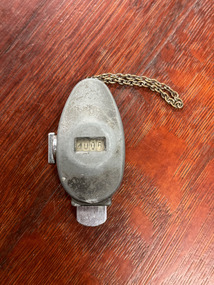
Equipment - pace counter
... pace counter...pace counter...old pace counter, mostly worn off...old pace counter, mostly worn off pace counter Equipment pace counter ...old pace counter, mostly worn off -
 National Vietnam Veterans Museum (NVVM)
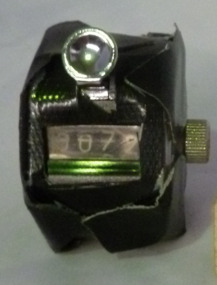
Equipment - Equipment, Army Pace Counter
... Equipment, Army Pace Counter...Pace counter...Equipment Equipment, Army Pace Counter ...A handheld tally counter which is a mechanical device used for counting. It is a steel flat cylindrical shaped counter with 4 digit face, silver winder on side, silver clip on top, bound in black tape. pace counter, sas, tally counter -
 Musculoskeletal Health Australia (now held by the Glen Eira Historical Society)
Photograph - Object, 1987
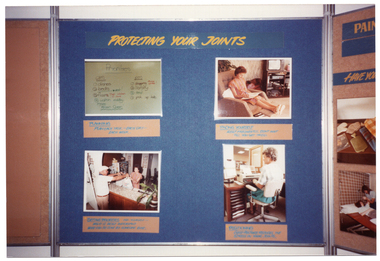
... PACING YOURSELF [underlined] REST FREQUENTLY. DON'T WAIT TILL YOU GET TIRED". A photo of a man handing two full plastic bags over a kitchen counter to a woman is followed by an information panel titled, "SETTING PRIORITIES [underlined] ASK YOURSELF - WHAT IS MOST IMPORTANT WHAT CAN BE DONE BY SOMEONE ELSE.". ...PACING YOURSELF [underlined] REST FREQUENTLY. DON'T WAIT TILL YOU GET TIRED". A photo of a man handing two full plastic bags over a kitchen counter to a woman is followed by an information panel titled, "SETTING PRIORITIES [underlined] ASK YOURSELF - WHAT IS MOST IMPORTANT WHAT CAN BE DONE BY SOMEONE ELSE.". ...This photo depicts the top centre-right panel of an Arthritis Foundation of Victoria multi-panel display board from 1987. The Foundation utilised freestanding display boards such as this to provide information about its programs and services at events. COL photo of one panel from a large freestanding display board. The main heading is, "PROTECTING YOUR JOINTS". Below that, there are four enlarged photos, each with an information panel with various sub-headings beneath it. A photo of a whiteboard with a list of "Priorities" is followed by an information panel titled, "PLANNING" [underlined] PLAN EACH TASK - EACH DAY - EACH WEEK.". A photo of a woman sitting on an armchair with a built-in leg rest is followed by an information panel titled, "PACING YOURSELF [underlined] REST FREQUENTLY. DON'T WAIT TILL YOU GET TIRED". A photo of a man handing two full plastic bags over a kitchen counter to a woman is followed by an information panel titled, "SETTING PRIORITIES [underlined] ASK YOURSELF - WHAT IS MOST IMPORTANT WHAT CAN BE DONE BY SOMEONE ELSE.". A photo of a woman sitting at an office desk, typing on an electric typewriter is followed by an information panel titled, "POSITIONING [underlined] GOOD POSTURE REDUCES THE STRESS ON YOUR JOINTS." [On a white label, handwritten in blue ink] Self-help Display. '87 Centre Left - upper. arthritis foundation of victoria, afv, display board, information, resources, education, self help, pain management, pain relief, stress management, joint health, healthy food, healthy diet, exercise, recreation, rest, arthritis help book, 1987 -
 Kew Historical Society Inc
Coat dress, Kenneth Pirrie, 1967-8
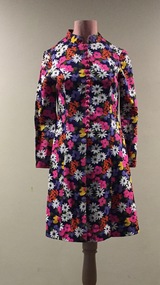
... paced, modern lifestyles of younger working women. The high collar and structured button-front design seen here explicitly capture the brief design transition where military tailoring elements met bright, counter-culture psychedelia....paced, modern lifestyles of younger working women. The high collar and structured button-front design seen here explicitly capture the brief design transition where military tailoring elements met bright, counter-culture psychedelia. ...This garment reflects the apex of the Australian "Youthquake" movement between 1967 and 1968. During this tight window, international mod influences from London's Carnaby Street fused heavily with local Australian manufacturing. Melbourne emerged as the absolute epicenter of the nation's revolutionary ready-to-wear "rag trade," led by visionary young designers who rebelled against traditional haute couture. Kenneth Pirrie, starting his label in 1959, became a crucial vanguard of this shift. By 1967, Pirrie was heavily commissioning his own exclusive textile prints—capitalizing on newly popularized, easy-to-launder synthetic crepes, crimplenes, and lightweight blends that mirrored the fast-paced, modern lifestyles of younger working women. The high collar and structured button-front design seen here explicitly capture the brief design transition where military tailoring elements met bright, counter-culture psychedelia. This coat dress stands as a stellar, physically intact index of mid-century Australian fashion innovation. It documents a pivotal socio-cultural era when locally manufactured ready-to-wear labels successfully captured and redirected global youth subcultures specifically for the domestic market. The piece demonstrates the high-caliber printmaking and structured garment construction that earned Kenneth Pirrie national acclaim. It provides an excellent material baseline of the late-1960s shift away from structural, monochromatic mod toward organic, vivid flower-power palettes. The dress, owned by Melbourne architect, Dione McIntyre, possesses exceptional local provenance. It highlights the local domestic and commercial history of Kew and greater Melbourne, recording what the fashion-conscious public actually bought, wore, and preserved during a period of massive industry transformation An A-line, knee-length woman’s garment designed to function as a standalone dress or light structured coat. The piece is constructed from a dark base fabric featuring a densely populated, screen-printed psychedelic floral motif. The pattern exhibits stylized white, pink, magenta, and purple blossoms with golden-yellow centers, typifying the iconic "flower power" aesthetic of the late sixties. The garment features a structured, high Nehru collar closing directly down a central front-button placket. It has tailored, long inset sleeves terminating in clean cuffs, a fitted torso that gently flares outward from the hips into a minimalist A-line skirt, and an overall sharp, geometric silhouette. Label: Kenneth Pirrie kenneth pirrie, women's clothing, australian fashion - 1970s, mcintyre collection, day wear, coat dresses
