
Showing 12 items matching "pace stick"
-
 Bendigo Military Museum
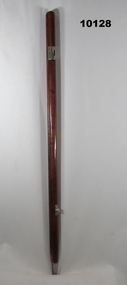
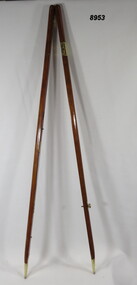
Uniform - PACE STICK, ARMY, Australian Defence Industries, Unknown
... PACE STICK, ARMY......Pace stick...Pace stick issued to G. WESTHEAD, No. 317595/8233929. ...Pace stick, two pieces of timber with brown stain and gloss varnish, brass metal hinge at the top. ...Pace stick issued to G. WESTHEAD, No. 317595/8233929. ...Pace stick - a training instrument used to gauge the length of pace and measure distance and interval for military parades and military situations. Pace stick issued to G. WESTHEAD, No. 317595/8233929. Refer Cat No. 1496.7 for Service Records.Pace stick, two pieces of timber with brown stain and gloss varnish, brass metal hinge at the top. Two silver colour metal tips at bottom. Silver colour metal fittings along length of timber sticks are used to set a particular distance.uniform, army, pace stick, military police, g. westhead -
 Melbourne Legacy
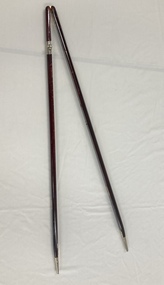
Ceremonial object, Military Pace Stick
... Military Pace Stick......pace stick...It is kept in the Comradeship Lounge as a link to the legatees' military background. A pace stick is a training instrument used to gauge the length of pace and measure distance and interval for military parades. ...Wooden stick that is hinged, has metal tips and is used as a pace tool....Military Pace Stick Ceremonial object ...A hinged wooden stick that is used in military situations. It is kept in the Comradeship Lounge as a link to the legatees' military background. A pace stick is a training instrument used to gauge the length of pace and measure distance and interval for military parades. Legacy has a strong link to the military, most early legatees would be familiar with the pace stick and its use.Wooden stick that is hinged, has metal tips and is used as a pace tool.comradeship, pace stick -
 Bendigo Military Museum
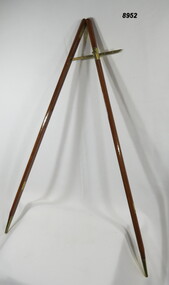
Equipment - PACE STICK, ARMY, Unknown
... PACE STICK, ARMY......Pace Stick...A pace stick is a hinged, two piece wooden staff used to measure, maintain and check the marching pace to ensure step cadence, and align drill ranks. ...Equipment PACE STICK, ARMY ...Symbolises high standards of army drill, discipline and auuthority for Regimental Sergeant Majors.A pace stick is a hinged, two piece wooden staff used to measure, maintain and check the marching pace to ensure step cadence, and align drill ranks. it is also used to lay out parade ground markers.passchendaele barracks trust, pbt248, pace stick, equipment -
 Dandenong/Cranbourne RSL Sub Branch
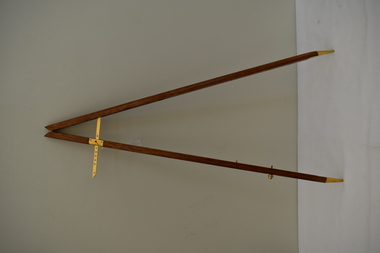
Instrument - Pace Stick
... Pace Stick...The Pace Stick is used to measure the correct length of pace. ...The Pace Stick is used to measure the correct length of pace. ...The Pace Stick is used to measure the correct length of pace. Rhythm and uniformity in marching is achieved by using the Pace Stick as well as the drum and metronome. Correct pace length is necessary not only for ceremonial purposes, but also to reduce fatigue on long marches and set the standard of accuracy required of soldiers. The Pace Stick is actually two pieces of timber, hinged at the top and able to be set to a particular distance, something like the compass set you used at school. -
 Bendigo Military Museum
Equipment - SWAGGER STICK, C & S LTD, 1965
... ...Pace stick...A pace stick is a hinged, two piece wooden staff used to measure, maintain and check the marching pace to ensure step cadence, and align drill ranks. ...Passchendaele Barracks Trust PBT249 Pace stick Marching Equipment “WO1 BERTRAM (BLUEY) ADDINGTON, 41843. - B.E.M. ...Symbolises high standards of military drill, discipline and authority for Regimental Sergeant Major. Bluey Addington, refer Cat No 6853.3 for his service details.A pace stick is a hinged, two piece wooden staff used to measure, maintain and check the marching pace to ensure step cadence, and align drill ranks. it is also used to lay out parade ground markers.“WO1 BERTRAM (BLUEY) ADDINGTON, 41843. - B.E.M. E.M. A.A.T.T.V. - C & S - LTD 1965 - 6910^-99-120-6375”passchendaele barracks trust, pbt249, pace stick, marching, equipment -
 The 5th/6th Battalion Royal Victoria Regiment Historical Collection
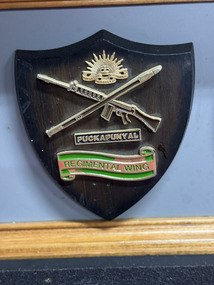
Plaque - Presentation Plaque, Puckapunyal Regimental wing plaque
... Located centrally is a pace stick and a SLR in gold. ...Located centrally is a pace stick and a SLR in gold. Puckapunyal Regimental wing plaque Plaque Presentation Plaque ...Shield shaped plaque made from dark varnished wood. Located centrally is a pace stick and a SLR in gold. puckapunyal, regimental wing -
 Bendigo Military Museum
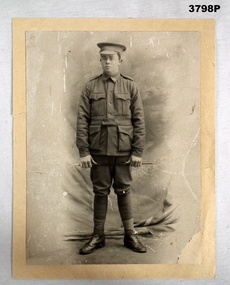
Photograph - PHOTOGRAPH WW1, C.WW1
... Photo B & W of a soldier in peak hat standing holding a pace stick. Photo is pasted to a light fawn coloured piece of cardboard....Photographs 22nd Photo B & W of a soldier in peak hat standing holding a pace stick. Photo is pasted to a light fawn coloured piece of cardboard. ...The photo is John Thomas O’Bree MM, No 6865, 22nd Batt AIF. Refer Cat No 1334 for his service history and award of the Military Medal.Photo B & W of a soldier in peak hat standing holding a pace stick. Photo is pasted to a light fawn coloured piece of cardboard.photographs, 22nd -
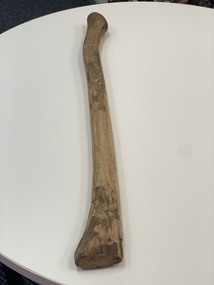 Mentone Grammar School... This he proudly marched out of camp with, under arm, in the manner of one bearing a pace stick. This idea seemed to catch on with the then CO, LTCOL Tony Drinan who decided that each CSM would be issued with one of these as a “perpetual trophy” marking his promotion to the rank of WO2 and appointment as a CSM. ...This he proudly marched out of camp with, under arm, in the manner of one bearing a pace stick. This idea seemed to catch on with the then CO, LTCOL Tony Drinan who decided that each CSM would be issued with one of these as a “perpetual trophy” marking his promotion to the rank of WO2 and appointment as a CSM. ...The “Axe Handle” awards originated in 1988, when WO2 Zachary Reark (CSM B Coy and son of famed Old Mentonian, Jim Reark) found an old axe handle in the bush at the end of the 1988 annual Cadet camp. This he proudly marched out of camp with, under arm, in the manner of one bearing a pace stick. This idea seemed to catch on with the then CO, LTCOL Tony Drinan who decided that each CSM would be issued with one of these as a “perpetual trophy” marking his promotion to the rank of WO2 and appointment as a CSM. The name of the recipient was duly engraved on a plate affixed to the handle. The Archive Centre holds about 12 such axes as well as this original.
 -
 Bendigo Military Museum
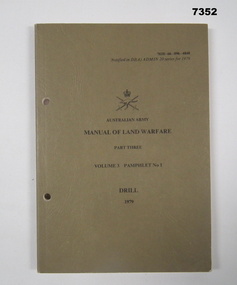
Manual - LAND WARFARE, DRILL, ARMY, HEADQUARTERS TRAINING COMMAND, 3 May 1979
... Drill with the pace stick. 12. Unit drill - platoon drill. 14. ...Drill with the pace stick. 12. Unit drill - platoon drill. 14. ...Manual consists of fiteen chapters related to drill movements. 1. Information for the Instructor. 2. Squad drill without arms - at the halt. 3. Marching. 4. Marching in line and changing direction and formation. 5. Rifle exercises at the halt and on the march. 6. Rifle drill for funerals. 7. Pistol drill - 9mm Browning. 8. Sentry Drill. 9. Quarter guards and sentries. 10. Sword Drill. 11. Drill with the cane. 12. Drill with the pace stick. 12. Unit drill - platoon drill. 14. Unit Drill - Company drill. 15. Unit drill - non-ceremonial. Plus list of illustrations, figures and tables. Part of the collection of KEVIN JOHN HERDMAN, No. 397661. See Cat. No. 5942P for details of his service record.Khaki coloured, textured soft covered manual with two punched holes for attaching to a ring binder. Title on front, cover in black type. Army logo in black. Pages are white in colour with black type. Black and white photographs and diagrams. Fifteen chapters. Pages glued to spine.drill movements, australian army, training manual, kevin john herdman -
 Bendigo Military Museum
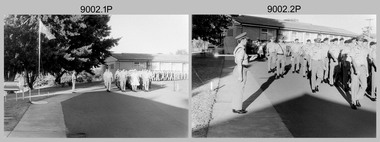
Photograph - RSM’s Handover Parade at the Army Survey Regiment, Fortuna Villa, Bendigo, 1986
... Outgoing RSM WO1 Bob Mason hands over the pace stick to new RSM WO1 Jeff Lynch. CO LTCOL Don Swiney MBE at far right. ...Outgoing RSM WO1 Bob Mason hands over the pace stick to new RSM WO1 Jeff Lynch. CO LTCOL Don Swiney MBE at far right. ...This is a set of 17 photographs of a RSM Handover Parade held at the Army Survey Regiment, Bendigo on the 3rd of February 1986. WO1 Robert ‘Bob’ Mason served in the Australian Regular Army (ARA) from April 1962 to March 1986 and was the RSM of the Army Survey Regiment from 1982 to 1986. WO1 Jeffery Lynch succeeded WO1 Bob Mason as RSM. He served in the ARA from August 1964 to August 1989. He was the RSM of the Army Survey Regiment from 1986 to 1988.This is a set of 17 photographs of a RSM Handover Parade held at the Army Survey Regiment, Bendigo on the 3rd of February 1986. The black & white photographs are on 35mm negative film and are part of the Army Survey Regiment’s Collection. The photographs were scanned at 96 dpi. .1) - Photo, Black & white, 1986. The Army Survey Regiment’s squadrons march on to the parade ground. RSM WO1 Bob Mason at far left. .2) - Photo, Black & white, 1986. Lithographic Squadron marches on to the parade ground. RSM WO1 Bob Mason at far left. Supernumeraries L to R: WO2 Ralph Chant, WO1 Jeff Lynch, WO2 Dave Miles, WO2 Trevor Osborne. .3) & .4) - Photo, Black & white, 1986. RSM WO1 Bob Mason issues orders. .5) - Photo, Black & white, 1986. RSM WO1 Bob Mason in foreground. Cartographic Squadron performs right dress drill. L to R: WO2 Neville Stone, SSGT Brett ‘Dutchy’ Van Leeuwen, SGT Gill Park, CPL Peter Johnson, CPL Jamie McRae, SPR Eric Nicolson, CPL Col McInnes, remainder unidentified. .6) & .7) - Photo, Black & white, 1986. RSM WO1 Bob Mason in foreground hands over to 2IC MAJ Terry Edwards. Cartographic Squadron in background. .8) - Photo, Black & white, 1986. Headquarters Squadron inspection. In foreground L to R: RSM WO1 Bob Mason, LT Greg Oaten CSC, Centre rank L to R: unidentified, SSGT Greg Gilbert, SGT Roger Rees. Front rank L to R: SSGT Don Williams, unidentified, SSGT Tony Harder – UK Exchange. .9) - Photo, Black & white, 1986. Headquarters Squadron inspection. In foreground L to R: MAJ Rene van den Tol, RSM WO1 Bob Mason, CO LTCOL Don Swiney MBE. Centre rank: all unidentified. Rear rank L to R: SGT Kevin Boehm, SGT Bob Garritty. .10) - Photo, Black & white, 1986. Air Survey Squadron inspection. In background L to R: CO LTCOL Don Swiney MBE, RSM WO1 Bob Mason, In foreground at right L to R: SSGT Adrian ‘Charlie’ Creedy, SGT Graham Johnston, CPL Kevin ‘Chuck’ Berry, unidentified, SPR Bron Jones, remainder unidentified. .11) to .13) - Photo, Black & white, 1986. Formal RSM Handover. L to R: outgoing RSM WO1 Bob Mason, new RSM WO1 Jeff Lynch, CO LTCOL Don Swiney MBE. Cartographic Squadron in background. Officers L to R: LT Victoria Thompson, CAPT Roger Rix, OC MAJ Bob McHenry, CAPT Peter ‘Blue’ Blaskett. .14) & .15) - Photo, Black & white, 1986. Formal RSM Handover. Outgoing RSM WO1 Bob Mason hands over the pace stick to new RSM WO1 Jeff Lynch. CO LTCOL Don Swiney MBE at far right. Cartographic Squadron in background. Officer at left: LT Victoria Thompson .16) & .17) - Photo, Black & white, 1986. Outgoing RSM WO1 Bob Mason with his family after the parade. L to R: CO LTCOL Don Swiney MBE, Gary (Sue Mason’s husband), Sue Mason, Pam Mason, Fred Murphy, WO1 Bob Mason..1P to .17P – ‘Slides are from Bob Mason’s last Parade 3 Feb 86’ annotated on the cover sheet. royal australian survey corps, rasvy, army survey regiment, army svy regt, fortuna -
 Australian Army Museum of Western Australia
Poem
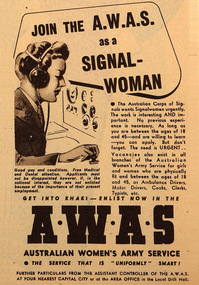
... We made the pace a hard one, sometimes there were tears, But you lasses learned as much in months, as we men absorbed in years. You’re in the ARMY now; you all wear the Rising Sun, Sometimes you’ll be unhappy, but stick till the job is done. ...We made the pace a hard one, sometimes there were tears, But you lasses learned as much in months, as we men absorbed in years. You’re in the ARMY now; you all wear the Rising Sun, Sometimes you’ll be unhappy, but stick till the job is done. ...SIGNALWOMEN An appreciation by an instructor (Sgt J.F. Larkins). Presented to Signalwoman Ruth Franklin after training in Melbourne 1942. After training, Ruth served on Rottnest Island as a communicator in the Plotting Room, Oliver Hill “Join the Corps of Signals”, the clarion call went forth, “Volunteer for the A.W.A.S. and let another man go north.” So you came into the Signals, in Australia’s hour of need, And let a thousand men go up the line, to meet the yellow breed. Where the lazy Yarra flows, through the green Victorian glade, They formed a school of Signals, to teach you in our trade, And the Old Ones, they were cynical, their tones were full of Jeers, “Women in the Signals! What rot!” But their moans have turned to cheers. You were tossed into the melting pot, that is an Australian Army camp. There weren’t many comforts, there were no electric lamps, There weren’t many blankets, it was cold in those tin huts, But the A.W.A.S. came up smiling; you had good Australian GUTS. The hours were long and wearisome, you were given lots of work, But we didn’t find a loafer, we knew not one to shirk. We made the pace a hard one, sometimes there were tears, But you lasses learned as much in months, as we men absorbed in years. You’re in the ARMY now; you all wear the Rising Sun, Sometimes you’ll be unhappy, but stick till the job is done. Time there will be, when the nerves are frayed, and all you do is bungle, Just feel the badge on your tunic, and remember your mates in the jungle. We wish you luck, and God-speed you on your way, And wherever war may scatter us, we’ll look forward to the day, When the final battle’s over and you’ve sent your last G.B., And the DIGGERS and the A.W.A.S. march in the parade of VICTORY. GB (Golf Bravo) is the sign off God Bless [G] DAH DAH DIT [B] DAH DI DI DIT Transcription of poem by Signals instructor Sgt JF Larkins presented to Signal Woman Ruth Franklin during Training in 1943. Read during 75th anniversary commemoration of proofing of Oliver Hill Battery, Rottnest Island. Computer printed on A4 bond paper. -
 Musculoskeletal Health Australia (now held by the Glen Eira Historical Society)
Document - Letter, 25/04/2000
... pace and join together for morning tea (B.Y.O.) and a Fun Quiz. Ten of our group were joined by our friends. It was most enjoyable. [New paragraph] Our support group would prefer you stick to Arthritis Victoria as a name - succint, self-explanatory and easily recognised by members of the community. ...pace and join together for morning tea (B.Y.O.) and a Fun Quiz. Ten of our group were joined by our friends. It was most enjoyable. [New paragraph] Our support group would prefer you stick to Arthritis Victoria as a name - succint, self-explanatory and easily recognised by members of the community. ...On the 25th of April, 2000, Barbara Wolfe, a member of the Rochester Arthritis Support Group sent two photos of their National Arthritis Week activities to Arthritis Victoria, along with a letter.COL digital scan of a letter from Barbara Wolfe, Rochester Arthritis Support Group.[Handwritten in blue ink] 84 McKenzie Street, [Next line] Rochester 3561. [Next line] 25.4.00 [Next line] Gillian van der Drift, [Next line] C'sy Devt Coordinator, [Next line] Dear Gillian, [Next line] Enclosed, 2 photos you may be interested in. Our group had a display - took videos, aids, windcheaters etc - in an empty shop window in our main shopping street. It was there for 12 days. [New paragraph] On the 11th April we had a walk along the Campaspe River, leaving 9:30am, returning 10:30am. This enabled people to go as far as they wished at their own pace and join together for morning tea (B.Y.O.) and a Fun Quiz. Ten of our group were joined by our friends. It was most enjoyable. [New paragraph] Our support group would prefer you stick to Arthritis Victoria as a name - succint, self-explanatory and easily recognised by members of the community. We see no need for change. [Next line] Yours sincerely, [Next line] Barbara Wolfe. [Next line] Contact Person. [Next line] Rochester Arthritis Support Group.arthritis victoria, av, national arthritis week, naw, rochester arthritis support group, barbara wolfe, shop window display, health promotion, joint walk, campapse river, 2000
