
Showing 58 items matching "padded seats"
-
 Flagstaff Hill Maritime Museum and Village
Textile - Seat Squabs, mid-20th century
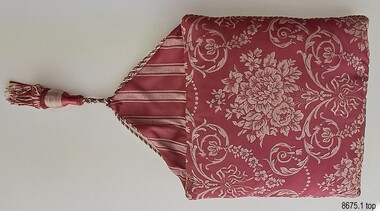
... ...padded seats...The term 'seat squabs' is no longer commonly used, but is sometimes referred to in the upholstery and motor vehicle industries. Squabs are padded...Squabs or padded seat cushions, a pair of two. These 18th to 19th-century design squabs have crimson and cream satin fabric on top and underneath, and weighted tassels are attached to their rear corners. ...The term 'seat squabs' is no longer commonly used, but is sometimes referred to in the upholstery and motor vehicle industries. Squabs are padded ...The term 'seat squabs' is no longer commonly used, but is sometimes referred to in the upholstery and motor vehicle industries. Squabs are padded cushions frequently added to wooden chairs or benches to add comfort to their hard forms. They have been made to an 18th-to-19th-century pattern using beautiful, richly coloured satin fabric and fancy cord tassels. The weighted flap at the rear of the squabs helps to keep them in place on the chair, and could be used on the top of the backrest instead of on the seat. These days, squabs are attached with fabric ties or hook-and-loop tabs. These seat squabs were once used in the St Nicholas Seamen's Church at 139 Nelson Place, Williamstown, Victoria, which was purchased and furnished around 1943. The furniture and furnishings are now part of the St. Nicholas Seamen's Church collection. DETAILED HISTORY of the Missions to Seamen: - The Missions to Seamen is an Anglican (Church of England) charity that has served the world’s seafarers since 1856. It was inspired by the work of Rev. John Ashley, who, 20 years earlier, had pioneered a ministry to seafarers in the Bristol Channel in Great Britain. When Ashley retired, others continued the work, founding the Missions to Seamen. It adopted a Flying Angel as its symbol, inspired by a verse from the Bible in Revelation 14. Today, over 200 world ports have Missions to Seamen centres and chaplains. A Missions to Seamen’s club warmly welcomes sailors of all colours, creeds and races and provides a wide range of facilities. The Missions to Seamen organisation changed its name to the Mission to Seafarers in 2000, continuing to include Missions to Seamen clubs in Victoria’s cities of Melbourne, Portland, Geelong and Hastings. Flagstaff Hill’s St Nicholas’ Seamen’s Church is named after its namesake from Williamstown, Victoria, which began in 1857. Bishop Perry opened the first Sailors’ Church, which was known as ‘Bethel’, on an old hulk floating in Hobson’s Bay, Port of Melbourne. In 1860, a Sailors’ Rest started operating from rented premises in Williamstown. In 1878, the Sailors’ Church moved into an old Wesleyan chapel in Ann Street. By the end of that year, they managed to purchase the building, which they had already refurbished. In 1883, they affiliated with the Victorian Seamen’s Mission. A few years later, in 1906, the building had to be demolished because it was no longer safe. While they raised funds for a new building, the Sailors’ Rest temporarily moved to premises in front of Customs House in Nelson Place. Around this time, in 1906, the Ladies Harbour Lights Guild was formed in Australia to support and raise funds for the Mission to Seamen organisation in Melbourne. Two of the most significant ladies of the Guild were founding members Ethel Godfrey and Alice Sibthorpe. During the Mission's time at Siddeley Street, Melbourne, the activities of the Guild raised funds for the Mission to Seamen's Chapel at their new, and still current, premises in Flinders Street, Melbourne, opened in 1917. The Guild continued its important work until the 1960s. In 1908, the Williamstown Mission had enough money to purchase the former Mascotte skating rink on Thompson Street, Williamstown. In August of that year, they were inaugurated into the Victorian Missions to Seamen. They continued at that venue for a few decades. In 1943, the former ES&A Bank building at 139 Nelson Place, Williamstown, was purchased for the new Mission to Seaman’s Club. The official opening was on May 6th, 1944. It was described as a ‘distinctive little building’. Funds had previously been raised for the building and furnishing of the chapel at the rear. The chapel was named St Nicholas’ Seamen’s Church, after St Nicholas, fourth-century bishop and patron saint of sailors. Services were held on Wednesdays and Sundays. The church was supported by the Williamstown Lightkeepers’ Auxiliary, newly founded by Mrs Ethel Margaret Musther in 1943, as well as the Harbour Lights Guild and the League of Soldiers’ and Sailors’ Friends. The Williamstown Mission to Seamen’s Church operated until 1966, when large international ships no longer used the Port of Williamstown. The Commonwealth Government then leased the premises. In the formative years of Flagstaff Hill Maritime Village, the Advisory Board decided to include a Missions to Seamen Chapel and Recreation Room in its village. The Missions organisation was a significant feature of ports during the late 1800s and early 1900s, the period that the Village represents. They often erected Missions to house social and worshipful activities for seamen. Flagstaff Hill’s curator, Mr Ken Marshman, approached the Melbourne Board of Management of Missions to Seamen regarding the Williamstown branch. Consequently, the Board permitted the furnishings of the Williamstown chapel to be transferred to Flagstaff Hill Maritime Village. A provision of the transfer was that the Victoria Missions to Seamen be recognised, that the items would remain as a collection, and that the chapel would be called St Nicholas Seamen’s Church and conduct Divine services. The donation was approved on 21st May 1979. Flagstaff Hill's St. Nicholas Seamen's Church: - The idea behind Flagstaff Hill’s Missions to Seamen’s Church was partly driven by the offer of Stained Glass Memorial Windows that originated from the Warrnambool and District Base Hospital, which was undergoing multi-storey expansion in the late 1960s and early 1970s. The hospital’s Manager/Secretary was eager to see the historic window installed in a suitable place. The church, or chapel, was designed by a local architectural draftsman in collaboration with the Flagstaff Hill Planning Board and was constructed by Mr Leon Habel. The designers hoped the church would be used for formal worship, such as weddings, funerals, and multi-denominational special services like war commemorations. Its design was inspired by the ‘Missions to Seamen’ buildings in Portland and the Port of Melbourne. The furniture and furnishings were placed as accurately as possible according to photographs of the Williamstown St Nicholas Seamen’s Church and with assistance from local clergy. The Recreation Room was furnished and arranged on advice from experienced members of the Missions to Seamen organisation. A framed document in the building recognises the donor of the furnishings, Victoria Missions to Seamen, and includes the names of some original donors and their donated item/s. The building’s design incorporates local features such as Warrnambool sandstone, which was no longer commercially available but was procured from demolished buildings and uniformly cut to use as a veneer over the stronger Mt. Gambier stone. Also, traditional green American roofing slate was used, sourced from the 1908 local shipwreck “Falls of Halladale” by Flagstaff Hill volunteer divers. The bell tower includes a bell believed to be from a local shipwreck. Additional furnishings were acquired locally, and several items were donated by Warrnambool residents. Light fittings in both rooms were assembled to simulate 19th-century gas light fittings. The stained-glass window at the back of the church is a memorial to Dr Connell, a well-respected member of the Warrnambool community. It was originally installed in 1928 in the main building of Warrnambool Hospital. The St Nicholas’ Seamen’s Church at Flagstaff Hill was officially opened by His Worship the Mayor, Cr. John Lindsay, on Sunday, 11th October 1981. The event included a service of thanksgiving conducted by the Warrnambool Ministers Fraternal. Since then, the Chapel has been the historic venue for many weddings. This pair of seat squabs is historically significant for its origin in the St Nicholas Mission to Seamen's Church in Williamstown, established in 1857 to cater for seafarers’ physical, social, and spiritual needs. The organisation originated in Bristol, England, when a Seamen's Mission was formed in 1837. The squabs are also significant for their use in the St Nicholas Missions to Seamen's chapel, Williamstown, as the original building is now listed on the Victorian Heritage Register. Squabs or padded seat cushions, a pair of two. These 18th to 19th-century design squabs have crimson and cream satin fabric on top and underneath, and weighted tassels are attached to their rear corners. They can be used for comfort on hard seats and benches. The squabs were furnishings from the Missions to Seamen chapel in Williamstown, and they are now part of the St Nicholas Seamen's Church Collection.flagstaff hill, warrnambool, shipwrecked-coast, flagstaff-hill, flagstaff-hill-maritime-museum, maritime-museum, shipwreck-coast, flagstaff-hill-maritime-village, st nicholas mission to seamen's church williamstown, mission to seamen williamstown, mission to seamen victoria, st nicholas mission to seamen, st nicholas seamen's church, religion, religious service, sailor's rest, ladies harbour light guild, squab, seat covers, cushions, squabs, religious furnishing, padded seats, seating, accessory -
 Orbost & District Historical Society
chair
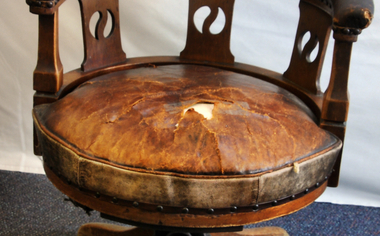
... Wooden leg supports. Padded seat - probably horsehair. Spring suspension....Wooden leg supports. Padded seat - probably horsehair. Spring suspension. chair ...Editor's chair. Used by Mr Billy Ross, proprietor of "Snowy River Mail". Donated by Mr George Hollins, later proprietor of "Snowy River Mail". William Ross (1868-1957) was editor of S.R.M. for many years. He was also a talented musician, Presbyterian church organist. Married Jessie Gray. Brought up Jean,Les, Dave, Keith Gray.Since 1890 the Snowy River Mail has been the local newspaper of the Orbost district.This local paper has been the means by which readers in Orbost were able to learn about newsworthy events and issues in their local community for over a centuryLarge round carved wood and leather arm chair on metal swivel. Wooden leg supports. Padded seat - probably horsehair. Spring suspension.On back of head rest - cut out 3.chair chair-wooden billy-ross snowy-river-mail -
 Ballarat Clarendon College
Furniture, Chair
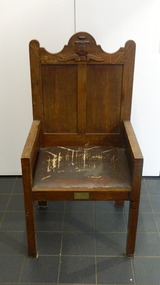
... Carved CPLC crest attached to neck rest. Padded seat. Bronze plaque at front of seat. ...Carved CPLC crest attached to neck rest. Padded seat. Bronze plaque at front of seat. Chair Furniture ...This librarian's chair was given to the school by the family of Joy Chapman who had died during 1948. The chair was part of a number of furnishings supplied by donation for the new library which was opened in 1949. These included blackwood shelves, tables and chairs and a new set of Encycopedia Britannica supplied by the Parents and Friend's Association, a grooved periodical table given by Old Collegians Younger Set, a librarian's desk supplied by the E M Bell estate and more than 200 books supplied by the Old Collegians. (see 'A lamp burns brightly' p. 61). This item is a significant example of the degree to which the school relied on donations from the community to develop the school during the post-war years. Solid wood chair with high solid back and solid arm rests. Carved CPLC crest attached to neck rest. Padded seat. Bronze plaque at front of seat. Plaque: In memory of / JOY CHAPMAN / 1947 - 1948 - The Gift of Her / Father, Mother & Ruthc-p-l-c, younger-set, parents-and-friends-association, clarendon-presbyterian-ladies-college, library, joy-chapman -
 Flagstaff Hill Maritime Museum and Village
Domestic object - Commode Chair, 1930's
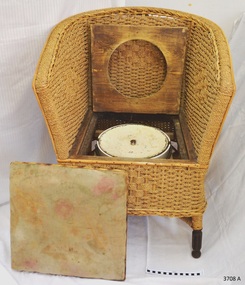
... Commode chair, cane chair, padded seat lifts up to reveal toilet seat with enamel bucket and metal lid beneath. ...THOMASTOWN VIC" Commode chair, cane chair, padded seat lifts up to reveal toilet seat with enamel bucket and metal lid beneath. ...Early Australian homes were built with outdoor bathrooms and toilets. A commode chair was a convenient and discreet design to save trips outside in the dark, creating an early form of indoor toilet. The commode chair was designed to look like any other household chair and fitted in with other bedroom furniture. The toilet bucket or chamber pot was hiding beneath a false seat and a lid was provided to cover the pot to help prevent odour and spillage. The bucket would be emptied each morning and washed out. This commode chair belonged to the great great grandmother of the donor and has been kept in very good condition. It was originally one of a pair of two chairs. The Robert Fowler Ltd Pottery was established in 1837 by Irish immigrant Enoch Fowler (1807-1879) in Marrickville, Sydney; his son Robert managed the business from 1873. Initially, the company mainly supplied the building and industrial trades but after the First World War, demand for domestic clayware grew. The company opened a second factory in Thomastown, VIC, in 1927. They are still operating today as one of Australia's leading bathroom products companies. This commode chair is an example of early 20th century bedroom furniture made by the first company to make pottery in Australia.Commode chair, cane chair, padded seat lifts up to reveal toilet seat with enamel bucket and metal lid beneath. Bucket is made by R. Fowler Ltd. of Victoria, Australia. Early 20th century.Bucket Maker's Mark "R. FOWLER LTD. THOMASTOWN VIC"flagstaff hill,, warrnambool, shipwrecked coast, flagstaff hill maritime museum, maritime museum, shipwreck coast, flagstaff hill maritime village, great ocean road, commode chair, cane commode chair, robert fowler porcelain ware, bedroom furniture, potty chair, wicker toilet chair, ceramic chamber pot -
 Numurkah & District Historical Society
Furniture - Office Chair
... Metal adjustable armless chair for office work. Has padded rectangular seat and masonite back support...Metal adjustable armless chair for office work. Has padded rectangular seat and masonite back support Furniture Office Chair ...Metal adjustable armless chair for office work. Has padded rectangular seat and masonite back support -
 Sunshine and District Historical Society Incorporated
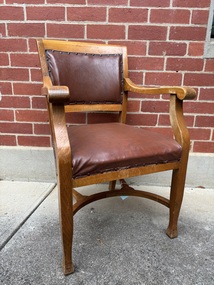
Functional object - H.V. McKay Offices Boardroom Chair 2 Devonshire Rd Sunshine, Mid 1920's
... A wooden chair with arms and red padded leather back & seat...Kays A wooden chair with arms and red padded leather back & seat Functional object H.V. McKay Offices Boardroom Chair 2 Devonshire Rd Sunshine ...The chair came from H.V. McKay Offices Broadroom 2 Devonshire Rd Sunshine. A photograph of the set of these chairs in the boardroom can be seen in the photograph Cat No 126. The photograph was taken in 1927 after the death of George McKay. Repairs have been made to the webbing, coconut fibre & wadding, new hession and sew were sowed in (20.8.2024)A wooden chair with arms and red padded leather back & seath.v. kays -
 Sunshine and District Historical Society Incorporated
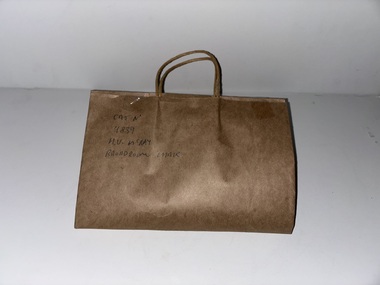
Furniture - H.V. McKay Offices Boardroom Chair 2 Devonshire Rd Sunshine Old Webbing, Mid 1920's
... A wooden chair with arms and red padded leather back & seat...McKay Offices Boardroom Chair 2 Devonshire Rd Sunshine|Description of repairs made to chair by Megan Treanor 20/8/2024 A wooden chair with arms and red padded leather back & seat Furniture H.V. McKay Offices Boardroom Chair 2 Devonshire Rd Sunshine Old Webbing ...The chair came from H.V. McKay Offices Broadroom 2 Devonshire Rd Sunshine. A photograph of the set of these chairs in the boardroom can be seen in the photograph Cat No 126. The photograph was taken in 1927 after the death of George McKay. Repairs have been made to the webbing, coconut fibre & wadding, new hession and sew were sowed in (20.8.2024)A wooden chair with arms and red padded leather back & seatMuseum of Australia - H.V. McKay Offices Boardroom Chair 2 Devonshire Rd Sunshine|Description of repairs made to chair by Megan Treanor 20/8/2024h.v. mckays, sunshine harvester works, devonshire road, sunshine -
 Flagstaff Hill Maritime Museum and Village
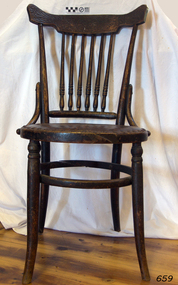
Chair, late 19th - early 20th C
... Chair, bentwood, wooden, dark stain, curved backrest with carved leaf pattern, 6 turned spindles. Fabric padded seat attached with studs, upholstery webbing is visible underneath. ...flagstaff hill warrnambool shipwrecked-coast flagstaff-hill flagstaff-hill-maritime-museum maritime-museum shipwreck-coast flagstaff-hill-maritime-village bentwood chair dining chair cafe or bistro chair Mark pressed into wood "15" Chair, bentwood, wooden, dark stain, curved backrest with carved leaf pattern, 6 turned spindles. Fabric padded seat attached with studs, upholstery webbing is visible underneath. ...Chair, bentwood, wooden, dark stain, curved backrest with carved leaf pattern, 6 turned spindles. Fabric padded seat attached with studs, upholstery webbing is visible underneath. Bentwood legs have bracing ring, front legs have truned rings on top. Mark; pressed into wood under seat.Mark pressed into wood "15"flagstaff hill, warrnambool, shipwrecked-coast, flagstaff-hill, flagstaff-hill-maritime-museum, maritime-museum, shipwreck-coast, flagstaff-hill-maritime-village, bentwood chair, dining chair, cafe or bistro chair -
 Kiewa Valley Historical Society
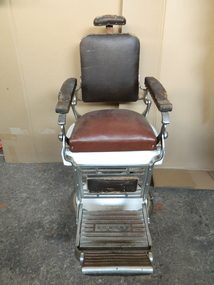
Barber's Chair
... Brown leather padded seat, back rest, headrest and armrest. ...Ref. online: "The Mt Beauty & Murray connection" Barber's chair hair dressing Mt Beauty shops Shaving Embossed on foot rest: "Raynor" Brown leather padded seat, back rest, headrest and armrest. ...The first factory manufactured chairs date to c1850. With a foot rest in 1878 and with a mechanically raised and lowered chair. Chairs have an adjustable height with foot operated jack or hand operated lever on the side. The chair can also rotate, or lean backwards (for hair washing and shaving) and has a head rest .Old Barber's chairs are made from metal and leather and are heavy. Mt Beauty township had a Barber's business during the construction of the Kiewa Hydro Electric Scheme and beyond. ""Sam The Barber" was an original Kiewa character. Probably for 45 years cut the hair of thousands of Kiewa workers with his scissors, hand clippers and cut throat razor." Ref. online: "The Mt Beauty & Murray connection"Brown leather padded seat, back rest, headrest and armrest. At the front of the arm rest is a wooden section (maybe for a cuppa?). The chair has a steel frame and foot rest. There is a large white enamel disc under the seat and a white enamel stand with a steel perimeter. A metal lever joins from the back of the footrest to the base enabling the chair to be tilted back.Embossed on foot rest: "Raynor"barber's chair, hair dressing, mt beauty shops, shaving -
 Puffing Billy Railway
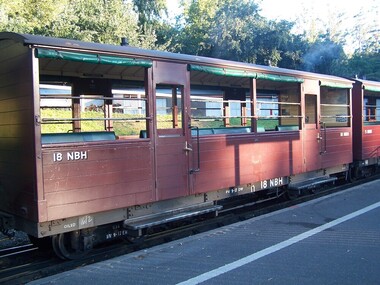
18 NBH - Passenger Carriage - Excursion Car, Between 1979 and 1988
... These had steel frames, padded seats, and a wide "window sill". At first glance they look the same as the previous NBHs. ...These had steel frames, padded seats, and a wide "window sill". At first glance they look the same as the previous NBHs. ...18NBH - Excursion Car (28) Puffing Billy Service History or Notes Between 1979 and 1988 the Puffing Billy railway built six more NBHs, numbered 18-23. These had steel frames, padded seats, and a wide "window sill". At first glance they look the same as the previous NBHs. There are other minor construction differences due to the use of steel framing. 18NBH entered traffic on 19/4/1997; Currently these six steel framed NBHs (numbers 18-23) are being modified to provide double doors and space for wheel chairs at one end. The photo on the right shows the exterior of one such NBH. These have a seating capacity of 24 passengers.Historic - Puffing Billy Railway Narrow Gauge - Passenger Rolling Stock: Excursion Car18 NBH Passenger Carriage - Excursion Car18NBHpuffing billy railway, pbr, rolling stock , 18 nbh, narrow gauge - passenger rolling stock, passenger carriage - excursion car -
 Puffing Billy Railway
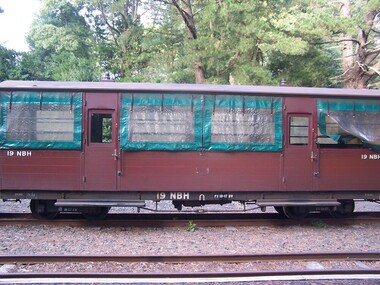
19 NBH - Passenger Carriage - Excursion Car, Between 1997 and 1998
... These had steel frames, padded seats, and a wide "window sill". At first glance they look the same as the previous NBHs. ...These had steel frames, padded seats, and a wide "window sill". At first glance they look the same as the previous NBHs. ...19NBH - Excursion Car Puffing Billy Service History or Notes Between 1997 and 1998 the Puffing Billy railway built six more NBHs, numbered 18-23. These had steel frames, padded seats, and a wide "window sill". At first glance they look the same as the previous NBHs. There are other minor construction differences due to the use of steel framing. 19NBH entered traffic on 5/12/1997 Currently these six steel framed NBHs (numbers 18-23) are being modified to provide double doors and space for wheel chairs at one end. The photo on the right shows the exterior of one such NBH. These have a seating capacity of 24 passengers.Historic - Puffing Billy Railway Narrow Gauge - Passenger Rolling Stock: Excursion Car19 NBH - Passenger Carriage - Excursion Car made of wrought iron and timber19NBHpuffing billy, pbr, rolling stock, 19 nbh, narrow gauge - passenger rolling stock, passenger carriage - excursion car -
 Puffing Billy Railway
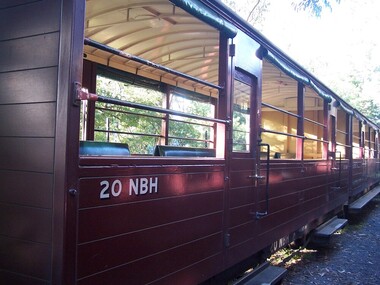
20 NBH - Passenger Carriage - Excursion Car, Between 1998 and 1989
... These had steel frames, padded seats, and a wide "window sill". At first glance they look the same as the previous NBHs. ...These had steel frames, padded seats, and a wide "window sill". At first glance they look the same as the previous NBHs. ...20NBH - Excursion Car Puffing Billy Service History or Notes Between 1979 and 1988 the Puffing Billy railway built six more NBHs, numbered 18-23. These had steel frames, padded seats, and a wide "window sill". At first glance they look the same as the previous NBHs. There are other minor construction differences due to the use of steel framing. 20NBH entered traffic on 19/12/1997 Currently these six steel framed NBHs (numbers 18-23) are being modified to provide double doors and space for wheel chairs at one end. The photo on the right shows the exterior of one such NBH. These have a seating capacity of 24 passengers.Historic - Puffing Billy Railway Narrow Gauge - Passenger Rolling Stock: Excursion Car20 NBH - Passenger Carriage - Excursion Car Steel Iron and timber20NBHnbh, puffing billy, narrow gauge -
 Puffing Billy Railway
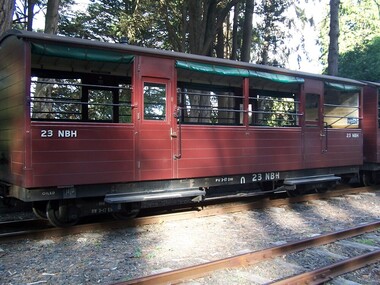
23 NBH - Passenger Carriage - Excursion Car, Between 1998 and 1989
... These had steel frames, padded seats, and a wide "window sill". At first glance they look the same as the previous NBHs. ...These had steel frames, padded seats, and a wide "window sill". At first glance they look the same as the previous NBHs. ...23NBH - Excursion Car Puffing Billy Service History or Notes Between 1979 and 1988 the Puffing Billy railway built six more NBHs, numbered 18-23. These had steel frames, padded seats, and a wide "window sill". At first glance they look the same as the previous NBHs. There are other minor construction differences due to the use of steel framing. 23NBH entered traffic in 1998. Currently these six steel framed NBHs (numbers 18-23) are being modified to provide double doors and space for wheel chairs at one end. The photo on the right shows the exterior of one such NBH. These have a seating capacity of 24 passengers.Historic - Puffing Billy Railway Narrow Gauge - Passenger Rolling Stock: Excursion Car23 NBH - Passenger Carriage - Excursion Car 23NBHpuffing billy, pbr, rolling stock , 23 nbh, narrow gauge - passenger rolling stock, passenger carriage - excursion car -
 Puffing Billy Railway
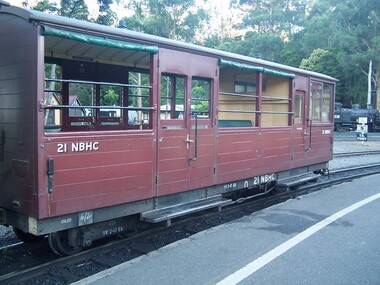
21 NBHC - Passenger Carriage - Excursion Car for wheelchairs and Guard's Van, Between 1979 and 1988
... These had steel frames, padded seats, and a wide "window sill". At first glance they look the same as the previous NBHs. ...These had steel frames, padded seats, and a wide "window sill". At first glance they look the same as the previous NBHs. ...21 NBHC built as 21 NBH. It was converted by the addition of a Guard's Van compartment and modified for Wheelchairs access by Puffing Billy Railway and re classed & numbered 21NBHC Puffing Billy Service History or Notes Between 1997 and 1998 the Puffing Billy railway built six more NBHs, numbered 18-23. These had steel frames, padded seats, and a wide "window sill". At first glance they look the same as the previous NBHs. There are other minor construction differences due to the use of steel framing. 21NBH entered traffic in 1998. The photo on the right shows the exterior of one such NBH. These have a seating capacity of 24 passengers. April 2016 - In for a lift, roller bearings replaced with standard bearings Historic - Puffing Billy Railway Narrow Gauge - Passenger Rolling Stock: Excursion Car 21 NBH which has been converted by the addition of a Guard's Van compartment and modified for Wheelchairs access by Puffing Billy Railway and re classed & numbered 21NBHC21 NBHC Passenger Carriage - Excursion Car - specially modified for Wheelchair access allowing it to carry wheelchairs and to have a Guard's Van compartment. made of wrought iron and timber21NBHCpuffing billy, pbr, rolling stock, 21 nbhc -
 National Vietnam Veterans Museum (NVVM)
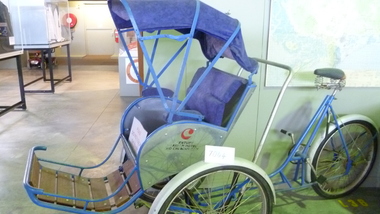
Vehicle - Rickshaw
... Predominantly blue in colour material covering the soft-top hood & padded passenger seat is timber with a slatted foot rest. ...Predominantly blue in colour material covering the soft-top hood & padded passenger seat is timber with a slatted foot rest. ...Vietnamese rickshaw. Predominantly blue in colour material covering the soft-top hood & padded passenger seat is timber with a slatted foot rest. It is powered by a bicycle at the rear of the rickshaw. All metal frames.C Century Saigon Hotel, Ho Chi Minh City.rickshaw -
Melbourne Tram Museum
Newspaper, The Sun, “Tramming it in comfort”, 24/03/1973 12:00:00 AM
... Wide gangways give tram a spacious look, brown padded seats for 48 people. Even heated. Will take another 5 years at present rate of production for 99 others. ...Wide gangways give tram a spacious look, brown padded seats for 48 people. Even heated. Will take another 5 years at present rate of production for 99 others. ...Newspaper clipping titled: “Tramming it in comfort” The Sun, 24/3/73 Photo and text of Melbourne’s newest tram Equipped with stop lights and indicators. Melbourne’s newest tram made first appearance at Preston workshops. Orange undercoat. Wide gangways give tram a spacious look, brown padded seats for 48 people. Even heated. Will take another 5 years at present rate of production for 99 others. Transport minister, Wilcox, said can travel at 45 mph. Number of people travelling on trams has increased in the past six months.trams, tramways, prototype tramcar, bourke st, preston workshops, tram 1041 -
 Puffing Billy Railway
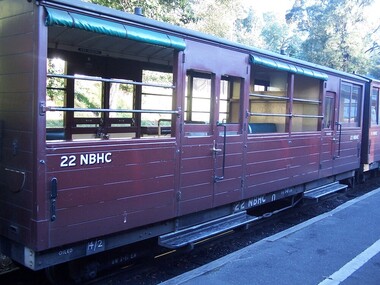
22 NBHC - Passenger Carriage - Excursion Car for wheelchairs and Guard's Van, Between 1997 and 1998
... These had steel frames, padded seats, and a wide "window sill". At first glance they look the same as the previous NBHs. ...These had steel frames, padded seats, and a wide "window sill". At first glance they look the same as the previous NBHs. ...22 NBHC - Passenger Carriage - Excursion Car - specially modified for Wheelchair access allowing it to carry for wheelchairs and Guard's Van Puffing Billy Service History or Notes Between 1979 and 1988 the Puffing Billy railway built six more NBHs, numbered 18-23. These had steel frames, padded seats, and a wide "window sill". At first glance they look the same as the previous NBHs. There are other minor construction differences due to the use of steel framing. 22NBH entered traffic in 1998. Currently these six steel framed NBHs (numbers 18-23) are being modified to provide double doors and space for wheel chairs at one end. The photo on the right shows the exterior of one such NBH. These have a seating capacity of 24 passengers. Oct 2009 - Rebuild continues. Aug 2016 - 22NBC Wheel flats removed Sept 2016 - 22NBC Wheel flats removedHistoric - Puffing Billy Railway Narrow Gauge - Passenger Rolling Stock: Excursion Car 22 NBH which has been converted by the addition of a Guard's Van compartment and modified for Wheelchairs access by Puffing Billy Railway and re classed & numbered 22NBHC22 NBHC - Passenger Carriage - Excursion Car - specially modified for Wheelchair access allowing it to carry wheelchairs and to have a Guard's Van compartment. made of wrought iron and timber22NBHCpuffing billy, pbr, rolling stock , 22 nbhc -
 Puffing Billy Railway
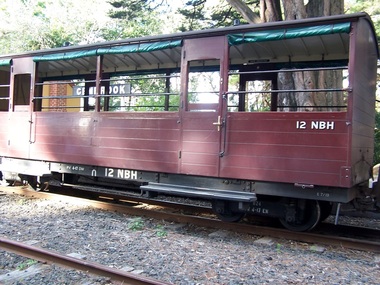
12 NBH, Passenger Carriage - Excursion Car, 1976
... These had steel frames, padded seats, and a wide "window sill". At first glance they look the same as the previous NBHs. ...These had steel frames, padded seats, and a wide "window sill". At first glance they look the same as the previous NBHs. ...12NBH - Excursion Car Replica body built by Puffing Billy Preservation Society, Emerald - 1976. Puffing Billy Service History or Notes May 2016 - Lifted NBH SECOND-CLASS EXCURSION CAR. The H was recognising their use for "Holiday" traffic. 15 of these cars were built in 1919 and numbered 1-15. Two more were built in 1981, and numbered 16 & 17. Two extended versions for wheelchair passengers were built in 1981 & 1983. These were numbered 51 & 52 - a separate number series due to the different type of vehicle. Six, numbered 18-23, were built in 1997-98. These had steel frames, padded seats, and a wide "window sill". At first glance they look the same as the previous NBHs. There are other minor construction differences due to the use of steel framing. 18NBH entered traffic 19/4/1997; 19NBH on 5/12/1997; 20NBH on 19/12/1997, the others added in 1998.Historic - Puffing Billy Railways Narrow Gauge - Passenger Rolling Stock: Excursion CarMade of timber and steel12NBHpuffing billy railway -
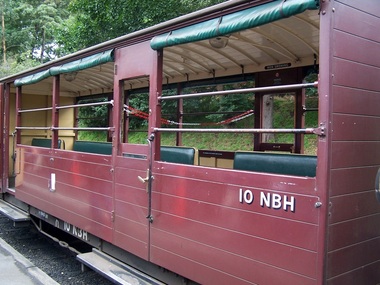 Puffing Billy Railway
10 NBH - Passenger Carriage - Excursion Car, 8/12/1919
... These had steel frames, padded seats, and a wide "window sill". At first glance they look the same as the previous NBHs. ...These had steel frames, padded seats, and a wide "window sill". At first glance they look the same as the previous NBHs. ...10NBH Carriage - Excursion Car In Active Service - Belgrave Station Yard NBH SECOND-CLASS EXCURSION CAR. The H was recognising their use for "Holiday" traffic. 15 of these cars were built in 1919 and numbered 1-15. Two more were built in 1981, and numbered 16 & 17. Two extended versions for wheelchair passengers were built in 1981 & 1983. These were numbered 51 & 52 - a separate number series due to the different type of vehicle. Six, numbered 18-23, were built in 1997-98. These had steel frames, padded seats, and a wide "window sill". At first glance they look the same as the previous NBHs. There are other minor construction differences due to the use of steel framing. 18NBH entered traffic 19/4/1997; 19NBH on 5/12/1997; 20NBH on 19/12/1997, the others added in 1998. VR Service History : *NBH 10.VA - 8/12/1919 NWS Built new - /12/1928 - Modified AC Malco BO circa 1955 - Condemned -Historic - Victorian Railways Narrow Gauge - Passenger Rolling Stock: Excursion Car Victorian Heritage Register (VHR) Number H2187 Puffing Billy Locomotives and Rolling Stock Collection10 NBH Passenger Carriage - Excursion Car made of steel and timber10NBHpuffing billy, 10nbh, nbh - excursion car, victorian railways, victorian railways narrow gauge - passenger rolling stock -
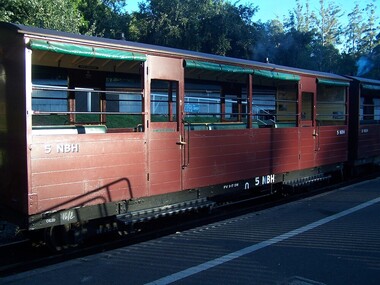 Puffing Billy Railway
5 NBH - Passenger Carriage - Excursion Car, 1975
... These had steel frames, padded seats, and a wide "window sill". At first glance they look the same as the previous NBHs. ...These had steel frames, padded seats, and a wide "window sill". At first glance they look the same as the previous NBHs. ...5NBH - Excursion Car Replica body built by Puffing Billy Preservation Society, Emerald – 1975. Puffing Billy Service History or Notes : Oct 2009 - In for repairs and a lift. Oct 2016 - In for repairs and repaint. Nov 2016 - Repainted NBH SECOND-CLASS EXCURSION CAR. The H was recognising their use for "Holiday" traffic. 15 of these cars were built in 1919 and numbered 1-15. Two more were built in 1981, and numbered 16 & 17. Two extended versions for wheelchair passengers were built in 1981 & 1983. These were numbered 51 & 52 - a separate number series due to the different type of vehicle. Six, numbered 18-23, were built in 1997-98. These had steel frames, padded seats, and a wide "window sill". At first glance they look the same as the previous NBHs. There are other minor construction differences due to the use of steel framing. 18NBH entered traffic 19/4/1997; 19NBH on 5/12/1997; 20NBH on 19/12/1997, the others added in 1998. Historic - Puffing Billy Railways Narrow Gauge - Passenger Rolling Stock: Excursion Car 5 NBH -Passenger Carriage - Excursion Car made of wrought iron and timber5NBHpuffing billy, 5nbh, 5nbh - excursion car -
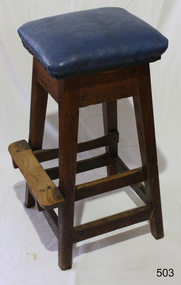 Flagstaff Hill Maritime Museum and Village
Furniture - Stool, 20th century
... Medical stool, strong wooden construction, with four legs and wooden foot rest. Seat is padded. Stool is handmade....Flagstaff Hill Warrnambool Maritime Museum Maritime Village medical furniture office furniture stool Medical stool, strong wooden construction, with four legs and wooden foot rest. Seat is padded. Stool is handmade. Furniture Stool ...Medical stool, strong wooden construction, with four legs and wooden foot rest. Seat is padded. Stool is handmade.flagstaff hill, warrnambool, maritime museum, maritime village, medical furniture, office furniture, stool -
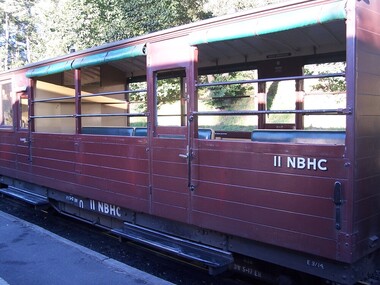 Puffing Billy Railway
11 NBHC - Passenger Carriage - Excursion Car and Guard's Van, 8/12/1919
... One end of a standard NBH had windows and a hand brake fitted. A padded seat replaced the standard back to back seating, and a partition separated the guard from the passenger compartment. ...One end of a standard NBH had windows and a hand brake fitted. A padded seat replaced the standard back to back seating, and a partition separated the guard from the passenger compartment. ...11NBHC Passenger Carriage - Excursion Car and Guard's Van Excursion Car 11 NBH which has been converted by the addition of a Guard's Van compartment by Puffing Billy Railway and re classed & numbered 11 NBHC The NBHC is a conversion from the standard NBH. This was a temporary, but long term, conversion to overcome lack of suitable guard's vans on the Puffing Billy railway. One end of a standard NBH had windows and a hand brake fitted. A padded seat replaced the standard back to back seating, and a partition separated the guard from the passenger compartment. VR Service History *NBH 11.VA - 8/12/1919 NWS Built new - / 1/1929 - Modified AC Malco BO circa 1955 - Condemned - Puffing Billy Service History or Notes Body Length 25 feet 2 inches ( 7671 mm) Coupled Length 27 feet 4 inches (8330 mm) Width 6 feet 3 inches (1905 mm) Height 9 feet 2 inches (2794 mm) Weight 8 tons Capacity 22 passengers Number Built 1 In use 1 Historic - Victorian Railways Narrow Gauge - Passenger Rolling Stock: Passenger Carriage - Excursion Car 11 NBH which has been converted by the addition of a Guard's Van compartment by Puffing Billy Railway and re classed & numbered 11 NBHC 11 NBHC - Passenger Carriage - Excursion Car and Guard's Van made of wrought iron and timber11NBHCpuffing billy, pbr, rolling stock , 11 nbhc, victorian railways, passenger carriage - excursion car and guard's van, 11nbh -
 Puffing Billy Railway
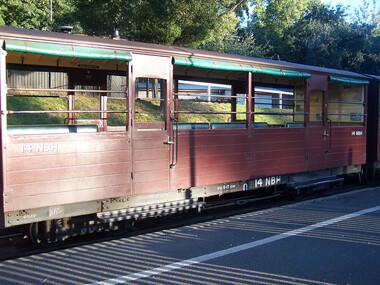
14 NBH - Passenger Carriage - Excursion Car, 8/12/1919
... These had steel frames, padded seats, and a wide "window sill". At first glance they look the same as the previous NBHs. ...These had steel frames, padded seats, and a wide "window sill". At first glance they look the same as the previous NBHs. ...14NBH - Excursion Car NBH SECOND-CLASS EXCURSION CAR. The H was recognising their use for "Holiday" traffic. 15 of these cars were built in 1919 and numbered 1-15. Two more were built in 1981, and numbered 16 & 17. Two extended versions for wheelchair passengers were built in 1981 & 1983. These were numbered 51 & 52 - a separate number series due to the different type of vehicle. Six, numbered 18-23, were built in 1997-98. These had steel frames, padded seats, and a wide "window sill". At first glance they look the same as the previous NBHs. There are other minor construction differences due to the use of steel framing. 18NBH entered traffic 19/4/1997; 19NBH on 5/12/1997; 20NBH on 19/12/1997, the others added in 1998. VR Service History : 8/12/1919 NWS Built new *NBH 14.VA - 8/12/1919 NWS Built new - / 7/1928 - Modified AC Malco BO circa 1955 - Condemned Puffing Billy Service History or Notes 8 Dec 1919 - Nos 7 to 15 NBH (new) delivered to UPPER FERN TREE GULLY after this date. Historic - Victorian Railways Narrow Gauge - Passenger Rolling Stock: Excursion Car14 NBH - Passenger Carriage - Excursion Car made of wrought iron and timber14NBHpuffing billy railway, pbr, rolling stock , 14nbh, victorian railways narrow gauge - passenger rolling stock,, victorian railways, nbh - excursion car, -
 Puffing Billy Railway
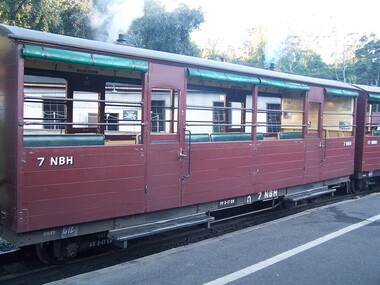
7 NBH - Passenger Carriage - Excursion Car, 8/12/1919
... These had steel frames, padded seats, and a wide "window sill". At first glance they look the same as the previous NBHs. ...These had steel frames, padded seats, and a wide "window sill". At first glance they look the same as the previous NBHs. ...7NBH - Excursion Car 8/12/1919 NWS Built new NBH SECOND-CLASS EXCURSION CAR. The H was recognising their use for "Holiday" traffic. 15 of these cars were built in 1919 and numbered 1-15. Two more were built in 1981, and numbered 16 & 17. Two extended versions for wheelchair passengers were built in 1981 & 1983. These were numbered 51 & 52 - a separate number series due to the different type of vehicle. Six, numbered 18-23, were built in 1997-98. These had steel frames, padded seats, and a wide "window sill". At first glance they look the same as the previous NBHs. There are other minor construction differences due to the use of steel framing. 18NBH entered traffic 19/4/1997; 19NBH on 5/12/1997; 20NBH on 19/12/1997, the others added in 1998. VR Service History *NBH 7.VA - 8/12/1919 NWS Built new - / 1/1929 - Modified AC Malco BO circa 1955 - Condemned - Puffing Billy Service History or Notes 8 Dec 1919 - Nos 7 to 15 NBH (new) delivered to UPPER FERN TREE GULLY after this date. Oct 2009 - Lifted. Mar 2013 - LiftHistoric - Victorian Railways Narrow Gauge - Passenger Rolling Stock: Excursion Car7 NBH - Passenger Carriage - Excursion Car made of wrought iron and timber7NBHpuffing billy railway, pbr, rolling stock , 7nbh, victorian railways narrow gauge - passenger rolling stock,, victorian railways, nbh - excursion car, -
 Puffing Billy Railway
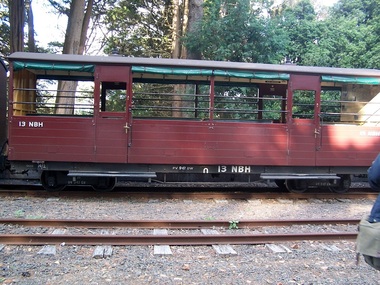
13 NBH - Passenger Carriage - Excursion Car, 8/12/1919
... These had steel frames, padded seats, and a wide "window sill". At first glance they look the same as the previous NBHs. ...These had steel frames, padded seats, and a wide "window sill". At first glance they look the same as the previous NBHs. ...13NBH - Excursion Car NBH SECOND-CLASS EXCURSION CAR. The H was recognising their use for "Holiday" traffic. 15 of these cars were built in 1919 and numbered 1-15. Two more were built in 1981, and numbered 16 & 17. Two extended versions for wheelchair passengers were built in 1981 & 1983. These were numbered 51 & 52 - a separate number series due to the different type of vehicle. Six, numbered 18-23, were built in 1997-98. These had steel frames, padded seats, and a wide "window sill". At first glance they look the same as the previous NBHs. There are other minor construction differences due to the use of steel framing. 18NBH entered traffic 19/4/1997; 19NBH on 5/12/1997; 20NBH on 19/12/1997, the others added in 1998. VR Service History : 8/12/1919 NWS Built new VR Service History *NBH 13.VA - 8/12/1919 NWS Built new - / 4/1928 - Modified AC Malco BO circa 1955 - Condemned - Puffing Billy Service History or Notes 8 Dec 1919 - Nos 7 to 15 NBH (new) delivered to UPPER FERN TREE GULLY after this date.Historic - Victorian Railways Narrow Gauge - Passenger Rolling Stock: Excursion Car13 NBH - Passenger Carriage - Excursion Car13NBHpuffing billy railway, pbr, rolling stock , 13nbh, victorian railways narrow gauge - passenger rolling stock,, victorian railways, nbh - excursion car, -
 Puffing Billy Railway
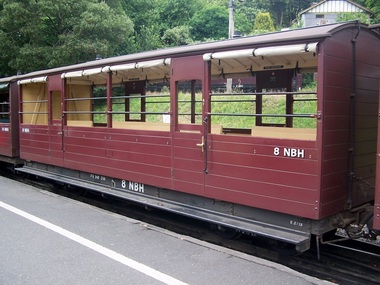
8 NBH - Passenger Carriage - Excursion Car, 8/12/1919
... These had steel frames, padded seats, and a wide "window sill". At first glance they look the same as the previous NBHs. ...These had steel frames, padded seats, and a wide "window sill". At first glance they look the same as the previous NBHs. ...8 NBH - Excursion Car (28) In Active Service - Belgrave Station Yard 8NBH - Excursion carriage. This car has been restored to original condition with white canvas weather blinds,Full carriage length side steps, timber tongue and groove boards,coupling centering springs and some pinch gas lighting equipment. NBH SECOND-CLASS EXCURSION CAR. The H was recognising their use for "Holiday" traffic. 15 of these cars were built in 1919 and numbered 1-15. Two more were built in 1981, and numbered 16 & 17. Two extended versions for wheelchair passengers were built in 1981 & 1983. These were numbered 51 & 52 - a separate number series due to the different type of vehicle. Six, numbered 18-23, were built in 1997-98. These had steel frames, padded seats, and a wide "window sill". At first glance they look the same as the previous NBHs. There are other minor construction differences due to the use of steel framing. 18NBH entered traffic 19/4/1997; 19NBH on 5/12/1997; 20NBH on 19/12/1997, the others added in 1998. VR Service History : *NBH 8.VA - 8/12/1919 NWS Built new - / 1/1929 - Modified AC Malco BO circa 1955 - Condemned Historic - Victorian Railways Narrow Gauge - Passenger Rolling Stock: Excursion Car 8NBH - Passenger Carriage - Excursion Car made of steel and timber8NBHpuffing billy, victorian railways, 8 nbh, passenger carriage, excursion car, narrow gauge -
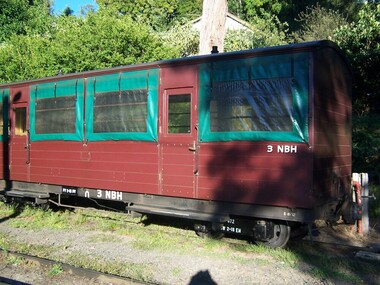 Puffing Billy Railway
3 NBH - Passenger Carriage - Excursion Car, 12/ 4/1919
... These had steel frames, padded seats, and a wide "window sill". At first glance they look the same as the previous NBHs. ...These had steel frames, padded seats, and a wide "window sill". At first glance they look the same as the previous NBHs. ...3NBH - Excursion Car NBH SECOND-CLASS EXCURSION CAR. The H was recognising their use for "Holiday" traffic. 15 of these cars were built in 1919 and numbered 1-15. Two more were built in 1981, and numbered 16 & 17. Two extended versions for wheelchair passengers were built in 1981 & 1983. These were numbered 51 & 52 - a separate number series due to the different type of vehicle. Six, numbered 18-23, were built in 1997-98. These had steel frames, padded seats, and a wide "window sill". At first glance they look the same as the previous NBHs. There are other minor construction differences due to the use of steel framing. 18NBH entered traffic 19/4/1997; 19NBH on 5/12/1997; 20NBH on 19/12/1997, the others added in 1998. VR Service History : as 36 NQR converted & renumbered to 12/ 4/1919 - To NBH 3 VR Service History NQR 36.VA - 12/ 4/1919 - To NBH 3.VA - *NBH 3.VA - / 3/1929 - Modified AC Malco BO circa 1955 - Condemned - / 5/1967 BEL Photograph #9.2: part view Puffing Billy Service History or Notes 12 Apr 1919 - Nos 1 to 6 NBH (new) delivered to UPPER FERN TREE GULLY after this date. April 2016 - LiftedHistoric - Victorian Railways Narrow Gauge - Passenger Rolling Stock: Excursion Car Passenger Carriage - Excursion Car made of steel and timber3NBHpuffing billy -
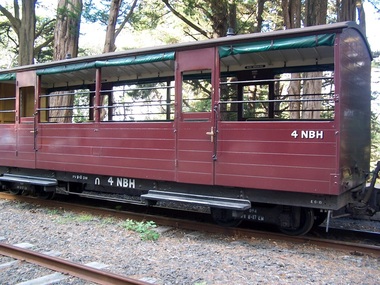 Puffing Billy Railway
4 NBH - Passenger Carriage - Excursion Car, 12/ 4/1919
... These had steel frames, padded seats, and a wide "window sill". At first glance they look the same as the previous NBHs. ...These had steel frames, padded seats, and a wide "window sill". At first glance they look the same as the previous NBHs. ...4NBH - Excursion Car (28) NBH SECOND-CLASS EXCURSION CAR. The H was recognising their use for "Holiday" traffic. 15 of these cars were built in 1919 and numbered 1-15. Two more were built in 1981, and numbered 16 & 17. Two extended versions for wheelchair passengers were built in 1981 & 1983. These were numbered 51 & 52 - a separate number series due to the different type of vehicle. Six, numbered 18-23, were built in 1997-98. These had steel frames, padded seats, and a wide "window sill". At first glance they look the same as the previous NBHs. There are other minor construction differences due to the use of steel framing. 18NBH entered traffic 19/4/1997; 19NBH on 5/12/1997; 20NBH on 19/12/1997, the others added in 1998. VR Service History : as 38 NQR converted & renumbered to 12/ 4/1919 - To NBH 4. VR Service History NQR 38.VA - 12/ 4/1919 - To NBH 4.VA - *NBH 4.VA - / 5/1928 - Modified AC Malco BO circa 1955 - Condemned - Puffing Billy Service History or Notes 12 Apr 1919 - Nos 1 to 6 NBH (new) delivered to UPPER FERN TREE GULLY after this date.Historic - Victorian Railways Narrow Gauge - Passenger Rolling Stock: Excursion Car4 NBH - Passenger Carriage - Excursion Car made of wrought iron and timber4NBHpuffing billy railway, pbr, rolling stock , 4nbh, victorian railways narrow gauge - passenger rolling stock,, victorian railways, nbh - excursion car, -
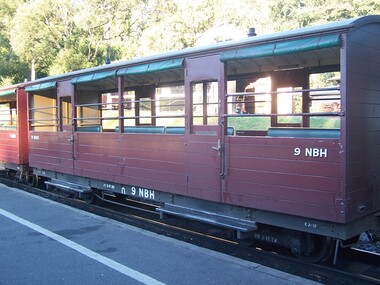 Puffing Billy Railway
9 NBH - Passenger Carriage - Excursion Car, 8/12/1919
... These had steel frames, padded seats, and a wide "window sill". At first glance they look the same as the previous NBHs. ...These had steel frames, padded seats, and a wide "window sill". At first glance they look the same as the previous NBHs. ...9NBH - Excursion Car NBH SECOND-CLASS EXCURSION CAR. The H was recognising their use for "Holiday" traffic. 15 of these cars were built in 1919 and numbered 1-15. Two more were built in 1981, and numbered 16 & 17. Two extended versions for wheelchair passengers were built in 1981 & 1983. These were numbered 51 & 52 - a separate number series due to the different type of vehicle. Six, numbered 18-23, were built in 1997-98. These had steel frames, padded seats, and a wide "window sill". At first glance they look the same as the previous NBHs. There are other minor construction differences due to the use of steel framing. 18NBH entered traffic 19/4/1997; 19NBH on 5/12/1997; 20NBH on 19/12/1997, the others added in 1998. VR Service History : 8/12/1919 NWS Built new VR Service History *NBH 9.VA - 8/12/1919 NWS Built new - / 6/1928 - Modified AC Malco BO circa 1955 - Condemned - Puffing Billy Service History or Notes 8 Dec 1919 - Nos 7 to 15 NBH (new) delivered to UPPER FERN TREE GULLY after this date. Aug 2016 - Tread plates replaced Sept 2016 - Tread plates replacedHistoric - Victorian Railways Narrow Gauge - Passenger Rolling Stock: Excursion Car9 NBH - Passenger Carriage - Excursion Car made of wrought iron and timber9NBHpuffing billy railway, pbr, rolling stock , 9nbh, victorian railways narrow gauge - passenger rolling stock,, victorian railways, nbh - excursion car -
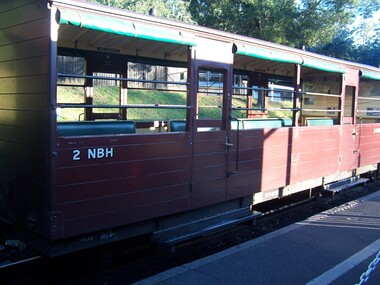 Puffing Billy Railway
2 NBH - Passenger Carriage - Excursion Car, 14/ 5/1900
... These had steel frames, padded seats, and a wide "window sill". At first glance they look the same as the previous NBHs. ...These had steel frames, padded seats, and a wide "window sill". At first glance they look the same as the previous NBHs. ...2NBH - Excursion Car NBH SECOND-CLASS EXCURSION CAR. The H was recognising their use for "Holiday" traffic. 15 of these cars were built in 1919 and numbered 1-15. Two more were built in 1981, and numbered 16 & 17. Two extended versions for wheelchair passengers were built in 1981 & 1983. These were numbered 51 & 52 - a separate number series due to the different type of vehicle. Six, numbered 18-23, were built in 1997-98. These had steel frames, padded seats, and a wide "window sill". At first glance they look the same as the previous NBHs. There are other minor construction differences due to the use of steel framing. 18NBH entered traffic 19/4/1997; 19NBH on 5/12/1997; 20NBH on 19/12/1997, the others added in 1998. VR Service History : 14/ 5/1900 NWS Built new as 33 NQR converted & renumbered to 12/ 4/1919 - To NBH 2 VR Service History NQR 33.VA - 14/ 5/1900 NWS Built new - 12/ 4/1919 - To NBH 2.VA - *NBH 2.VA - / 4/1929 - Modified Malco BO circa 1955 - Condemned Puffing Billy Service History or Notes 12 Apr 1919 - Nos 1 to 6 NBH (new) delivered to UPPER FERN TREE GULLY after this date. Mar 2013 - In for a hot box againHistoric - Victorian Railways Narrow Gauge - Passenger Rolling Stock: Excursion Car Passenger Carriage - Excursion Car made of steel and timber2NBH puffing billy railway, pbr, rolling stock , 2nbh, victorian railways narrow gauge - passenger rolling stock,, victorian railways, nbh - excursion car, 2nbh
