
Showing 58 items matching "pain family"
-
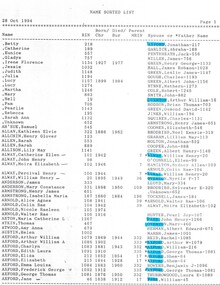 Mont De Lancey
Document - Genealogy Index, 28.10.1994
... ...Pain Family...Index of Wandin family history names including their birth, death and marriage information and their spouse/parents, spanning 1807-1983 - only includes pages A-C and M-O Family trees Family History Clegg Family Overton Family Axford Family Ah'Sue Family Allan Family Allchin Family Allen Family Allison Family Alway Family Anderson Family Armstrong Family Arnold Family Aston Family Atkin Family Atwood Family Austin Family Bailey Family Baker Family Balle Family Barker Family Barkway Family Barr Family Bartlett Family Bawdon Benson Family Berry Family Berryman Family Bews Family Binding Family Bird Family Bishop Family Blood Family Blanksby Family Bolding Family Bonola Family Bosser Family Bott Family Bourke Family Bowers Family Brailsford Family Brandt Family Bray Family Brockenshire Family Brodribb Family Brown Family Bryant Family Burgess Family Burrell Family Burrett Family Burton Family Burwill Family Butterworth Family Byers Family Callaghan Family Carlson Family Carter Family Case Family Chamberlain Family Cherry Family Clarke Family Cocks Family Cole Family Collins Family Conder Family Connor Family Cook Family Coomes Family Cooper Family Cornell Family Cottee Family McKenna Family Meacham Family Mill Family Miller Family Mitchell Family Mits Family Montgomery Family Moodie Family Murray Family Musgrave Family Nagle Family Nall Family Nash Family Neely Family Neville Family Newport Family Norman Family Norton Family Notley Family O'Connell Family O'Mara Family Odgers Family Oliver Family Oneyes Family Orams Family Owen Family Pain Family Papworth Family Garlick Family Penthreath Family Green Family Hall Family Gough Family Byrne Family Smith Family Hodson Family Jinks Family Squires Family Graham Family Holton Family Hamilton Family Lloyd Family Tocknell Family Hunter Family Parr Family Herman Family Marsh Family Read Family Thurrowgood Family Hughes Family Wilson Family Rains Family Hurley Family Farqhuar Family Robinson Family Dennis Family Turner Family Rule Family Vine Family Whittaker Family Stevens Family Heywood Family Jones Family Styles Family Rouget Family Sargeant Family Withers Family Larking Family Keen Family White Family Francis Family Teague Family Fisher Family Winbanks Family Knight Family Vernon Family Wood Family Kennedy Family Crossland Family Upton Family McFarline Family Denman Family Elliot Family Thomas Family Davis Family Parker Family Sies Family Dohrmann Family Heffernan Family Duncan Family Foreman Family Saunders Family Wilmont Family Furphey Family Rawson Family Evans Family Field Family Ellis Family Laing Family Ezart Family Hoare Family Heritage Family Quirk Family Griffin Family Lowry Family Johnstone Family Grundy Family Stock Family Patterson Family Ralph Family Pilbrick Family Ussnig Family Leighman Family Underwood Family Lawrence Family Dawson Family Crossdale Family Shoo Family Lomax Family Paten Family 1800s 1810s 1820s 1830s 1840s 1850s 1860s 1870s 1880s 1890s 1900s 1910s 1920s 1930s 1940s 1950s 1960s 1970s 1980s 8 one sided A4 pages typed in black ink with yellow highlighter Document Genealogy Index ...Index of Wandin family history names including their birth, death and marriage information and their spouse/parents, spanning 1807-1983 - only includes pages A-C and M-O8 one sided A4 pages typed in black ink with yellow highlighterfamily trees, family history, clegg family, overton family, axford family, ah'sue family, allan family, allchin family, allen family, allison family, alway family, anderson family, armstrong family, arnold family, aston family, atkin family, atwood family, austin family, bailey family, baker family, balle family, barker family, barkway family, barr family, bartlett family, bawdon, benson family, berry family, berryman family, bews family, binding family, bird family, bishop family, blood family, blanksby family, bolding family, bonola family, bosser family, bott family, bourke family, bowers family, brailsford family, brandt family, bray family, brockenshire family, brodribb family, brown family, bryant family, burgess family, burrell family, burrett family, burton family, burwill family, butterworth family, byers family, callaghan family, carlson family, carter family, case family, chamberlain family, cherry family, clarke family, cocks family, cole family, collins family, conder family, connor family, cook family, coomes family, cooper family, cornell family, cottee family, mckenna family, meacham family, mill family, miller family, mitchell family, mits family, montgomery family, moodie family, murray family, musgrave family, nagle family, nall family, nash family, neely family, neville family, newport family, norman family, norton family, notley family, o'connell family, o'mara family, odgers family, oliver family, oneyes family, orams family, owen family, pain family, papworth family, garlick family, penthreath family, green family, hall family, gough family, byrne family, smith family, hodson family, jinks family, squires family, graham family, holton family, hamilton family, lloyd family, tocknell family, hunter family, parr family, herman family, marsh family, read family, thurrowgood family, hughes family, wilson family, rains family, hurley family, farqhuar family, robinson family, dennis family, turner family, rule family, vine family, whittaker family, stevens family, heywood family, jones family, styles family, rouget family, sargeant family, withers family, larking family, keen family, white family, francis family, teague family, fisher family, winbanks family, knight family, vernon family, wood family, kennedy family, crossland family, upton family, mcfarline family, denman family, elliot family, thomas family, davis family, parker family, sies family, dohrmann family, heffernan family, duncan family, foreman family, saunders family, wilmont family, furphey family, rawson family, evans family, field family, ellis family, laing family, ezart family, hoare family, heritage family, quirk family, griffin family, lowry family, johnstone family, grundy family, stock family, patterson family, ralph family, pilbrick family, ussnig family, leighman family, underwood family, lawrence family, dawson family, crossdale family, shoo family, lomax family, paten family, 1800s, 1810s, 1820s, 1830s, 1840s, 1850s, 1860s, 1870s, 1880s, 1890s, 1900s, 1910s, 1920s, 1930s, 1940s, 1950s, 1960s, 1970s, 1980s -
 City of Moorabbin Historical Society (Operating the Box Cottage Museum)
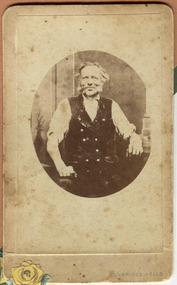
Photograph, black & white George Box 1808- 1867, c1855
... pain with cold water from a waterhole. It is supposed that Elizabeth helped him raise the children while he established his market garden. George died from Tetanus following an infected broken leg caused by falling from his dray in 1867. George and Mary were both buried in the Brighton Cemetery. Box Cottage Museum, a reconstruction of an early settler hut, is named after the Box family ...George Box 1808-1867 an 'agricultural labourer', of Sussex England, married Mary Cripps in 1831 and with 3 three of their 4 four sons and 3 three of their 4 four daughters left Liverpool in the Sailing Ship 'Atlanta' in March 1856 to begin a new life in Melbourne, Victoria , Australia. George and son Henry paid their own fares while sons , Francis and John, were 'assisted passengers'. Their baby daughter Cecilia Lydia died a few days into the voyage.. Caroline Box, the eldest daughter, remained in England working as a cook until she joined the family in Australia in 1863. William Box 1834-1902, the eldest son of George Box, married Elizabeth Avis 1833- 1914 and they resided in Box Cottage 1865 -1914 where they established a market garden and raised 13 children. William and Elizabeth had emigrated in 1854 so George and sons probably worked on their market garden before setting up in Tucker Road and Patterson Road. Sadly Mary drowned in a water hole only 4 months after their arrival in Brighton. Mary suffered from headaches and had occasional fits and the coroner found she passed out and died while trying to ease the pain with cold water from a waterhole. It is supposed that Elizabeth helped him raise the children while he established his market garden. George died from Tetanus following an infected broken leg caused by falling from his dray in 1867. George and Mary were both buried in the Brighton Cemetery. Box Cottage Museum, a reconstruction of an early settler hut, is named after the Box family who resided there 1865 -1913 . George Box was the father of William Box who with his wife Elizabeth Avis Box and 13 children lived and farmed on the block of land in Jasper Road, East Brighton ( now McKinnon / Ormond) that was part of the Henry Dendy Special Survey 1841 Inscribed in Album : “ The early photos in this album were found by Mr (Laurie) Lewis when he was demolishing the Old Box Cottage. He gave them to Mrs Avis Box Eldridge who in turn gave them to me. They were not identified. I believe they rightly belong in the Cottage. I have attempted to identify them and present them in a way they can be preserved as a historical record of the era.” A B Leigh A black and white photograph of George Box taken in Tunbridge Wells, England c1855Photo at base ; TUNBRIDGE WELLS Album inside cover ; Donated to / Moorabbin / Historical Society / by / Avis Box Leigh box george, box mary, box william, box elizabeth, box alonzo, box mary louisa, dendy henry, were j b, dendy's special survey 1841, brighton, moorabbin, bentleigh, mckinnon, ormond, market gardeners, dairy farms, early settlers, pioneers, jasper road, gurr jabez, gurr eliza, pay henry, pay anna, ward willam, box henry, ward elizabeth emma, box john, sheldrake martha, rushall eleanor, box caroline, tetanus -
 Orbost & District Historical Society
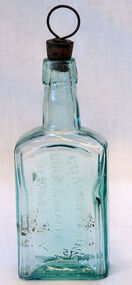
bottle, Early 20th century
... pain relief balm and lotion. Chamberlain’s Colic, Cholera and Diarrhea Remedy was one of many thousands of patent medicines that made incredible, and often false, claims about their effectiveness, and became tremendously profitable. Eventually government regulations were put in place to prevent medicine manufacturers from making unfounded claims about their products. This item is an example of a typical "over the counter" patented medicine commonly used by families ...Brothers Davis and Lowell Chamberlain, along with their sister Izanna, established what became known as the Chamberlain Medicine Company in 1873. The Des Moines, Iowa-based company eventually stretched to Australia, Canada and South Africa. Chamberlains Colic and Diarrhea Remedy used alcohol, ether, and chloroform to soothe upset stomachs. The company also sold a cough remedy, liniment, pain relief balm and lotion. Chamberlain’s Colic, Cholera and Diarrhea Remedy was one of many thousands of patent medicines that made incredible, and often false, claims about their effectiveness, and became tremendously profitable. Eventually government regulations were put in place to prevent medicine manufacturers from making unfounded claims about their products.This item is an example of a typical "over the counter" patented medicine commonly used by families. It reflect the changes in public health, medical practice and research over the last century.Small green tinted medicine bottle. Writing on front. Cork is attached with wire handle.Front-Chamberlain's Colic & diarrhea Remedy Side- Sydney NSW Side Chamberlain's Ltd Bottom-1185bottle chamberlain's medicine remedies -
 Flagstaff Hill Maritime Museum and Village
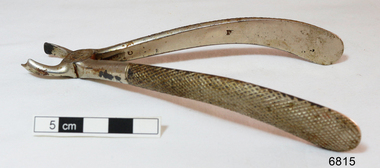
Equipment - Tooth Extractor, Late 19th - early 20th century
... pain and local anesthetics were introduced in the early 1900s. Modern dentists no longer have to seat their patients on the floor and have helpers to hold them down. Dentistry is as close to painless as possible now. There is no excuse to suffer the agony of a toothache these days. And extracting teeth is no longer dangerous. https://arizonadentalspecialists.com/the-surprising-history-of-extracting-teeth/ This tooth extractor was donated to Flagstaff Hill Maritime Village by the family...pain and local anesthetics were introduced in the early 1900s. Modern dentists no longer have to seat their patients on the floor and have helpers to hold them down. Dentistry is as close to painless as possible now. There is no excuse to suffer the agony of a toothache these days. And extracting teeth is no longer dangerous. https://arizonadentalspecialists.com/the-surprising-history-of-extracting-teeth/ This tooth extractor was donated to Flagstaff Hill Maritime Village by the family ...Toothaches have been with us since the evolution of teeth and extracting teeth. I wonder what poor Homo erectus did when suffering with a toothache. He probably just suffered and probably became very bad tempered. Ancient Dentistry Significant tooth decay did not appear until hunter-gatherer societies became agrarian. The change in diet included a large increase in carbohydrates which then led to tooth decay. Early man was primitive but he was also pretty smart. Some time around 8000 years ago someone in the area that is now Pakistan was using a drill to remove tooth decay. Examination of Neolithic skulls have revealed the handiwork of at least one very early dentist. A Sumerian text in about 5000 B.C. taught that the cause of tooth decay was tooth worms. Proposed cures for toothache were numerous. Early Egyptians wore amulets. An Egyptian named Hesy-Re, is known as the first dentist. Praise for his dentistry is inscribed on his tomb. Unfortunately it doesn’t delineate what he did to earn the praise. Pliny, the Elder, recommended finding a frog at midnight and asking it to take away the pain. The doctor to Emperor Claudius around 50 A.D. had his toothache patients inhale smoke produced by scattering certain seeds on burning charcoal and then rinsing the mouth with hot water. This was to expel the tooth worms. On the more practical side Aristotle and Hippocrates both wrote about the treatment of tooth decay. A primitive forceps was used for extracting teeth. Some dentists at that time were able to weave wire in the teeth to stabilize loose teeth. Medieval Torture From about 500 A.D. to 1100 A.D. monks were well educated and well trained and did some of the surgical procedures of the time. Barbers handled the rest of the operations, especially blood letting and tooth extractions. In 1163 the Pope put a stop to all surgeries by monks and the field was left open to the barbers. Barbers were, after all, very skilled with knives and razors. In fact, the barber pole, red and white spiraling stripes, is a symbol of the blood letting; red for blood. white for bandages. In the 1300s a Barbers’ Guild was established which divided the barbers into two groups: those with the skills and training to do procedures and those who were relegated to blood letting and tooth extractions. Pliers from a blacksmith’s foundry were the only device available. Barbers would often go to fairs and advertise painless tooth pulling. A shill in the audience would come on the stage, feigning severe toothache. The barber would pretend to extract tooth, pulling out a bloody molar he had palmed earlier. The supposed sufferer would jump for joy. The barbers set up near the bands at the fairs so that the music would drown out the screams of their patients. If the tooth was loose enough, the barber would tie a string around the tooth and yank hard to extract the tooth. This was a much less painful and dangerous procedure than the pliers. The pliers often fractured other teeth and sometimes the jaw. The procedure was far from sterile and infection was a common problem and some people bled to death. The Renaissance and the Rise of Tooth Decay In the 1400s refined sugar was introduced into Europe but only reached the tables of the wealthy. While their betters were munching on sweets, the poorer folk suffered fewer toothaches. Queen Elizabeth I was known for her blackened teeth. George Washington had a tooth extraction every year after age 22. He supposedly had a set of wooden false teeth but his dentures were actually ivory. The earliest instrument designed for tooth extraction was the dental pelican, which was shaped something like a pelican’s beak. The pelican was replaced in the 1700s by the dental key, which was fitted down over the affected tooth and was better able to grip the tooth. Both still often caused more damage than relief. The Development of Modern Dentistry Modern dental equipment began to be introduced in the 1800s about the time when dentistry became a profession and dental schools began to open. Ether was used starting in 1846 to anesthetize the pain and local anesthetics were introduced in the early 1900s. Modern dentists no longer have to seat their patients on the floor and have helpers to hold them down. Dentistry is as close to painless as possible now. There is no excuse to suffer the agony of a toothache these days. And extracting teeth is no longer dangerous. https://arizonadentalspecialists.com/the-surprising-history-of-extracting-teeth/ This tooth extractor was donated to Flagstaff Hill Maritime Village by the family of Doctor William Roy Angus, Surgeon and Oculist. It is part of the “W.R. Angus Collection” that includes historical medical equipment, surgical instruments and material once belonging to Dr Edward Ryan and Dr Thomas Francis Ryan, (both of Nhill, Victoria) as well as Dr Angus’ own belongings. The Collection’s history spans the medical practices of the two Doctors Ryan, from 1885-1926 plus that of Dr Angus, up until 1969. ABOUT THE “W.R.ANGUS COLLECTION” Doctor William Roy Angus M.B., B.S., Adel., 1923, F.R.C.S. Edin.,1928 (also known as Dr Roy Angus) was born in Murrumbeena, Victoria in 1901 and lived until 1970. He qualified as a doctor in 1923 at University of Adelaide, was Resident Medical Officer at the Royal Adelaide Hospital in 1924 and for a period was house surgeon to Sir (then Mr.) Henry Simpson Newland. Dr Angus was briefly an Assistant to Dr Riddell of Kapunda, then commenced private practice at Curramulka, Yorke Peninsula, SA, where he was physician, surgeon and chemist. In 1926, he was appointed as new Medical Assistant to Dr Thomas Francis Ryan (T.F. Ryan, or Tom), in Nhill, Victoria, where his experiences included radiology and pharmacy. In 1927 he was Acting House Surgeon in Dr Tom Ryan’s absence. Dr Angus had become engaged to Gladys Forsyth and they decided he would take time to further his studies overseas in the UK in 1927. He studied at London University College Hospital and at Edinburgh Royal Infirmary and in 1928, was awarded FRCS (Fellow from the Royal College of Surgeons), Edinburgh. He worked his passage back to Australia as a Ship’s Surgeon on the on the Australian Commonwealth Line’s T.S.S. Largs Bay. Dr Angus married Gladys in 1929, in Ballarat. (They went on to have one son (Graham 1932, born in SA) and two daughters (Helen (died 12/07/1996) and Berenice (Berry), both born at Mira, Nhill ) Dr Angus was a ‘flying doctor’ for the A.I.M. (Australian Inland Ministry) Aerial Medical Service in 1928 . The organisation began in South Australia through the Presbyterian Church in that year, with its first station being in the remote town of Oodnadatta, where Dr Angus was stationed. He was locum tenens there on North-South Railway at 21 Mile Camp. He took up this ‘flying doctor’ position in response to a call from Dr John Flynn; the organisation was later known as the Flying Doctor Service, then the Royal Flying Doctor Service. A lot of his work during this time involved dental surgery also. Between 1928-1932 he was surgeon at the Curramulka Hospital, Yorke Peninsula, South Australia. In 1933 Dr Angus returned to Nhill where he’d previously worked as Medical Assistant and purchased a share of the Nelson Street practice and Mira hospital from Dr Les Middleton one of the Middleton Brothers, the current owners of what was once Dr Tom Ryan’s practice. Dr L Middleton was House Surgeon to the Nhill Hospital 1926-1933, when he resigned. [Dr Tom Ryan’s practice had originally belonged to his older brother Dr Edward Ryan, who came to Nhill in 1885. Dr Edward saw patients at his rooms, firstly in Victoria Street and in 1886 in Nelson Street, until 1901. The Nelson Street practice also had a 2 bed ward, called Mira Private Hospital ). Dr Edward Ryan was House Surgeon at the Nhill Hospital 1884-1902 . He also had occasions where he successfully performed veterinary surgery for the local farmers too. Dr Tom Ryan then purchased the practice from his brother in 1901. Both Dr Edward and Dr Tom Ryan work as surgeons included eye surgery. Dr Tom Ryan performed many of his operations in the Mira private hospital on his premises. He too was House Surgeon at the Nhill Hospital 1902-1926. Dr Tom Ryan had one of the only two pieces of radiology equipment in Victoria during his practicing years – The Royal Melbourne Hospital had the other one. Over the years Dr Tom Ryan gradually set up what was effectively a training school for country general-practitioner-surgeons. Each patient was carefully examined, including using the X-ray machine, and any surgery was discussed and planned with Dr Ryan’s assistants several days in advance. Dr Angus gained experience in using the X-ray machine there during his time as assistant to Dr Ryan. Dr Tom Ryan moved from Nhill in 1926. He became a Fellow of the Royal Australasian College of Surgeons in 1927, soon after its formation, a rare accolade for a doctor outside any of the major cities. He remained a bachelor and died suddenly on 7th Dec 1955, aged 91, at his home in Ararat. Scholarships and prizes are still awarded to medical students in the honour of Dr T.F. Ryan and his father, Dr Michael Ryan, and brother, John Patrick Ryan. ] When Dr Angus bought into the Nelson Street premises in Nhill he was also appointed as the Nhill Hospital’s Honorary House Surgeon 1933-1938. His practitioner’s plate from his Nhill surgery states “HOURS Daily, except Tuesdays, Fridays and Saturday afternoons, 9-10am, 2-4pm, 7-8pm. Sundays by appointment”. This plate is now mounted on the doorway to the Port Medical Office at Flagstaff Hill Maritime Village, Warrnambool. Dr Edward Ryan and Dr Tom Ryan had an extensive collection of historical medical equipment and materials spanning 1884-1926 and when Dr Angus took up practice in their old premises he obtained this collection, a large part of which is now on display at the Port Medical Office at Flagstaff Hill Maritime Village in Warrnambool. During his time in Nhill Dr Angus was involved in the merging of the Mira Hospital and Nhill Public Hospital into one public hospital and the property titles passed on to Nhill Hospital in 1939. In 1939 Dr Angus and his family moved to Warrnambool where he purchased “Birchwood,” the 1852 home and medical practice of Dr John Hunter Henderson, at 214 Koroit Street. (This property was sold in1965 to the State Government and is now the site of the Warrnambool Police Station. ). The Angus family was able to afford gardeners, cooks and maids; their home was a popular place for visiting dignitaries to stay whilst visiting Warrnambool. Dr Angus had his own silk worm farm at home in a Mulberry tree. His young daughter used his centrifuge for spinning the silk. Dr Angus was appointed on a part-time basis as Port Medical Officer (Health Officer) in Warrnambool and held this position until the 1940’s when the government no longer required the service of a Port Medical Officer in Warrnambool; he was thus Warrnambool’s last serving Port Medical Officer. (The duties of a Port Medical Officer were outlined by the Colonial Secretary on 21st June, 1839 under the terms of the Quarantine Act. Masters of immigrant ships arriving in port reported incidents of diseases, illness and death and the Port Medical Officer made a decision on whether the ship required Quarantine and for how long, in this way preventing contagious illness from spreading from new immigrants to the residents already in the colony.) Dr Angus was a member of the Australian Medical Association, for 35 years and surgeon at the Warrnambool Base Hospital 1939-1942, He served as a Surgeon Captain during WWII1942-45, in Ballarat, Victoria, and in Bonegilla, N.S.W., completing his service just before the end of the war due to suffering from a heart attack. During his convalescence he carved an intricate and ‘most artistic’ chess set from the material that dentures were made from. He then studied ophthalmology at the Royal Melbourne Eye and Ear Hospital and created cosmetically superior artificial eyes by pioneering using the intrascleral cartilage. Angus received accolades from the Ophthalmological Society of Australasia for this work. He returned to Warrnambool to commence practice as an ophthalmologist, pioneering in artificial eye improvements. He was Honorary Consultant Ophthalmologist to Warrnambool Base Hospital for 31 years. He made monthly visits to Portland as a visiting surgeon, to perform eye surgery. He represented the Victorian South-West subdivision of the Australian Medical Association as its secretary between 1949 and 1956 and as chairman from 1956 to 1958. In 1968 Dr Angus was elected member of Spain’s Barraquer Institute of Barcelona after his research work in Intrasclearal cartilage grafting, becoming one of the few Australian ophthalmologists to receive this honour, and in the following year presented his final paper on Living Intrasclearal Cartilage Implants at the Inaugural Meeting of the Australian College of Ophthalmologists in Melbourne In his personal life Dr Angus was a Presbyterian and treated Sunday as a Sabbath, a day of rest. He would visit 3 or 4 country patients on a Sunday, taking his children along ‘for the ride’ and to visit with him. Sunday evenings he would play the pianola and sing Scottish songs to his family. One of Dr Angus’ patients was Margaret MacKenzie, author of a book on local shipwrecks that she’d seen as an eye witness from the late 1880’s in Peterborough, Victoria. In the early 1950’s Dr Angus, painted a picture of a shipwreck for the cover jacket of Margaret’s book, Shipwrecks and More Shipwrecks. She was blind in later life and her daughter wrote the actual book for her. Dr Angus and his wife Gladys were very involved in Warrnambool’s society with a strong interest in civic affairs. Their interests included organisations such as Red Cross, Rostrum, Warrnambool and District Historical Society (founding members), Wine and Food Society, Steering Committee for Tertiary Education in Warrnambool, Local National Trust, Good Neighbour Council, Housing Commission Advisory Board, United Services Institute, Legion of Ex-Servicemen, Olympic Pool Committee, Food for Britain Organisation, Warrnambool Hospital, Anti-Cancer Council, Boys’ Club, Charitable Council, National Fitness Council and Air Raid Precautions Group. He was also a member of the Steam Preservation Society and derived much pleasure from a steam traction engine on his farm. He had an interest in people and the community He and his wife Gladys were both involved in the creation of Flagstaff Hill, including the layout of the gardens. After his death (28th March 1970) his family requested his practitioner’s plate, medical instruments and some personal belongings be displayed in the Port Medical Office surgery at Flagstaff Hill Maritime Village, and be called the “W. R. Angus Collection”. The W.R. Angus Collection is significant for still being located at the site it is connected with, Doctor Angus being the last Port Medical Officer in Warrnambool. The collection of medical instruments and other equipment is culturally significant, being an historical example of medicine from late 19th to mid-20th century. Dr Angus assisted Dr Tom Ryan, a pioneer in the use of X-rays and in ocular surgery. Tooth extractor, dental surgical instrument. Metal with cross hatched pattern on handle. Stamped with maker's mark on hinge. Other stamps inside handles. Part of the W.R. Angus Collection.Stamped on hinge 'CASH & SONS ENGLAND'. Inside handles are 'C', 'P' and '27'.flagstaff hill, warrnambool, shipwrecked coast, flagstaff hill maritime museum, maritime museum, shipwreck coast, flagstaff hill maritime village, great ocean road, dr w r angus, dr ryan, surgical instrument, t.s.s. largs bay, warrnambool base hospital, nhill base hospital, mira hospital, flying doctor, dental surgical instrument, tooth extractor -
 Flagstaff Hill Maritime Museum and Village
Instrument - Syringe set, 20th century
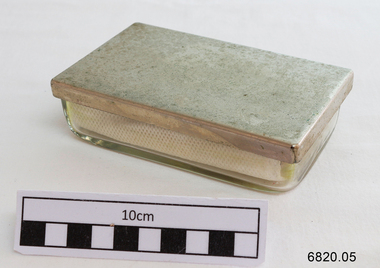
... pain relief, penicillin, insulin, immunisation and blood transfusions, needles became a staple of medicine. By 1946, the Chance Brothers’ Birmingham glassworks factory began mass-producing the first all-glass syringe with interchangeable parts. Then, a decade later, after sterilisation issues in re-used glass syringes had plagued the industry for years, a Kiwi inventor called Colin Murdoch applied for a patent of a disposable plastic syringe. Several patents followed, and the disposable syringe is now widespread. https://www.medibank.com.au/livebetter/be-magazine/wellbeing/the-history-of-the-hypodermic-needle/ This syringe set was donated to Flagstaff Hill Maritime Village by the family...pain relief, penicillin, insulin, immunisation and blood transfusions, needles became a staple of medicine. By 1946, the Chance Brothers’ Birmingham glassworks factory began mass-producing the first all-glass syringe with interchangeable parts. Then, a decade later, after sterilisation issues in re-used glass syringes had plagued the industry for years, a Kiwi inventor called Colin Murdoch applied for a patent of a disposable plastic syringe. Several patents followed, and the disposable syringe is now widespread. https://www.medibank.com.au/livebetter/be-magazine/wellbeing/the-history-of-the-hypodermic-needle/ This syringe set was donated to Flagstaff Hill Maritime Village by the family ...Whether it’s an anaesthetic, blood test, insulin, vitamin shot or vaccination, at a base human level something feels instinctively wrong about having a long thin piece of metal stuck deep into your flesh. And yet, in allowing physicians to administer medicine directly into the bloodstream, the hypodermic needle has been one of the most important inventions of medical science. In the beginning… Typically, it was the Romans. The word ‘syringe’ is derived from Greek mythology. Chased to the edge of a river by the god Pan, a rather chaste nymph by the name of Syrinx magically disguised herself as water reeds. Determined, Pan chopped the hollow reeds off and blew into them to create a musical whistling sound, thereby fashioning the first of his fabled pipes. Taking that concept of ‘hollow tubes’, and having observed how snakes could transmit venom, the practice of administering ointments and unctions via simple piston syringes is originally described in the writings of the first-century Roman scholar Aulus Cornelius Celsus and the equally famous Greek surgeon Galen. It’s unclear if the Egyptian surgeon Ammar bin Ali al-Mawsili was a fan of either of their scribblings, but 800 years later he employed a hollow glass tube and simple suction power to remove cataracts from his patients’ eyes – a technique copied up until the 13th century, but only to extract blood, fluid or poison, not to inject anything. Syringes get modern Then, in 1650, while experimenting with hydrodynamics, the legendary French polymath Blaise Pascal invented the first modern syringe. His device exemplified the law of physics that became known as Pascal’s Law, which proposes “when there is an increase in pressure at any point in a confined fluid, there is an equal increase at every other point in the container.” But it wasn’t until six years later that a fellow Renaissance man, the English architect Sir Christopher Wren took Pascal’s concept and made the first intravenous experiment. Combining hollow goose quills, pig bladders, a kennel of stray dogs and enough opium to fell a herd of elephants, Wren started injecting the hapless mutts with the ‘milk of the poppy’. By the mid-1660s, thinking this seemed like a great idea, two German doctors, Johann Daniel Major and Johann Sigismund Elsholtz, decided to try their hand at squirting various stuff into human subjects. Things didn’t end well, and people died. Consequently, injections fell out of medical favour for 200 years. Let's try again… Enter the Irish doctor Francis Rynd in 1844. Constructing the first-ever hollow steel needle, he used it to inject medicine subcutaneously and then bragged about it in an issue of the Dublin Medical Press. Then, in 1853, depending on who you believe, it was either a Frenchman or a Scot who invented the first real hypodermic needle. The French physician Charles Pravaz adapted Rynd’s needle to administer a coagulant in order to stem bleeding in a sheep by using a system of measuring screws. However, it was the Scottish surgeon Alexander Wood who first combined a hollow steel needle with a proper syringe to inject morphine into a human. Thus, Wood is usually credited with the invention. Sharp advancements Over the following century, the technology was refined and intravenous injections became commonplace – whether in the administering of pain relief, penicillin, insulin, immunisation and blood transfusions, needles became a staple of medicine. By 1946, the Chance Brothers’ Birmingham glassworks factory began mass-producing the first all-glass syringe with interchangeable parts. Then, a decade later, after sterilisation issues in re-used glass syringes had plagued the industry for years, a Kiwi inventor called Colin Murdoch applied for a patent of a disposable plastic syringe. Several patents followed, and the disposable syringe is now widespread. https://www.medibank.com.au/livebetter/be-magazine/wellbeing/the-history-of-the-hypodermic-needle/ This syringe set was donated to Flagstaff Hill Maritime Village by the family of Doctor William Roy Angus, Surgeon and Oculist. It is part of the “W.R. Angus Collection” that includes historical medical equipment, surgical instruments and material once belonging to Dr Edward Ryan and Dr Thomas Francis Ryan, (both of Nhill, Victoria) as well as Dr Angus’ own belongings. The Collection’s history spans the medical practices of the two Doctors Ryan, from 1885-1926 plus that of Dr Angus, up until 1969. ABOUT THE “W.R.ANGUS COLLECTION” Doctor William Roy Angus M.B., B.S., Adel., 1923, F.R.C.S. Edin.,1928 (also known as Dr Roy Angus) was born in Murrumbeena, Victoria in 1901 and lived until 1970. He qualified as a doctor in 1923 at University of Adelaide, was Resident Medical Officer at the Royal Adelaide Hospital in 1924 and for a period was house surgeon to Sir (then Mr.) Henry Simpson Newland. Dr Angus was briefly an Assistant to Dr Riddell of Kapunda, then commenced private practice at Curramulka, Yorke Peninsula, SA, where he was physician, surgeon and chemist. In 1926, he was appointed as new Medical Assistant to Dr Thomas Francis Ryan (T.F. Ryan, or Tom), in Nhill, Victoria, where his experiences included radiology and pharmacy. In 1927 he was Acting House Surgeon in Dr Tom Ryan’s absence. Dr Angus had become engaged to Gladys Forsyth and they decided he would take time to further his studies overseas in the UK in 1927. He studied at London University College Hospital and at Edinburgh Royal Infirmary and in 1928, was awarded FRCS (Fellow from the Royal College of Surgeons), Edinburgh. He worked his passage back to Australia as a Ship’s Surgeon on the on the Australian Commonwealth Line’s T.S.S. Largs Bay. Dr Angus married Gladys in 1929, in Ballarat. (They went on to have one son (Graham 1932, born in SA) and two daughters (Helen (died 12/07/1996) and Berenice (Berry), both born at Mira, Nhill ) Dr Angus was a ‘flying doctor’ for the A.I.M. (Australian Inland Ministry) Aerial Medical Service in 1928 . The organisation began in South Australia through the Presbyterian Church in that year, with its first station being in the remote town of Oodnadatta, where Dr Angus was stationed. He was locum tenens there on North-South Railway at 21 Mile Camp. He took up this ‘flying doctor’ position in response to a call from Dr John Flynn; the organisation was later known as the Flying Doctor Service, then the Royal Flying Doctor Service. A lot of his work during this time involved dental surgery also. Between 1928-1932 he was surgeon at the Curramulka Hospital, Yorke Peninsula, South Australia. In 1933 Dr Angus returned to Nhill where he’d previously worked as Medical Assistant and purchased a share of the Nelson Street practice and Mira hospital from Dr Les Middleton one of the Middleton Brothers, the current owners of what was once Dr Tom Ryan’s practice. Dr L Middleton was House Surgeon to the Nhill Hospital 1926-1933, when he resigned. [Dr Tom Ryan’s practice had originally belonged to his older brother Dr Edward Ryan, who came to Nhill in 1885. Dr Edward saw patients at his rooms, firstly in Victoria Street and in 1886 in Nelson Street, until 1901. The Nelson Street practice also had a 2 bed ward, called Mira Private Hospital ). Dr Edward Ryan was House Surgeon at the Nhill Hospital 1884-1902 . He also had occasions where he successfully performed veterinary surgery for the local farmers too. Dr Tom Ryan then purchased the practice from his brother in 1901. Both Dr Edward and Dr Tom Ryan work as surgeons included eye surgery. Dr Tom Ryan performed many of his operations in the Mira private hospital on his premises. He too was House Surgeon at the Nhill Hospital 1902-1926. Dr Tom Ryan had one of the only two pieces of radiology equipment in Victoria during his practicing years – The Royal Melbourne Hospital had the other one. Over the years Dr Tom Ryan gradually set up what was effectively a training school for country general-practitioner-surgeons. Each patient was carefully examined, including using the X-ray machine, and any surgery was discussed and planned with Dr Ryan’s assistants several days in advance. Dr Angus gained experience in using the X-ray machine there during his time as assistant to Dr Ryan. Dr Tom Ryan moved from Nhill in 1926. He became a Fellow of the Royal Australasian College of Surgeons in 1927, soon after its formation, a rare accolade for a doctor outside any of the major cities. He remained a bachelor and died suddenly on 7th Dec 1955, aged 91, at his home in Ararat. Scholarships and prizes are still awarded to medical students in the honour of Dr T.F. Ryan and his father, Dr Michael Ryan, and brother, John Patrick Ryan. ] When Dr Angus bought into the Nelson Street premises in Nhill he was also appointed as the Nhill Hospital’s Honorary House Surgeon 1933-1938. His practitioner’s plate from his Nhill surgery states “HOURS Daily, except Tuesdays, Fridays and Saturday afternoons, 9-10am, 2-4pm, 7-8pm. Sundays by appointment”. This plate is now mounted on the doorway to the Port Medical Office at Flagstaff Hill Maritime Village, Warrnambool. Dr Edward Ryan and Dr Tom Ryan had an extensive collection of historical medical equipment and materials spanning 1884-1926 and when Dr Angus took up practice in their old premises he obtained this collection, a large part of which is now on display at the Port Medical Office at Flagstaff Hill Maritime Village in Warrnambool. During his time in Nhill Dr Angus was involved in the merging of the Mira Hospital and Nhill Public Hospital into one public hospital and the property titles passed on to Nhill Hospital in 1939. In 1939 Dr Angus and his family moved to Warrnambool where he purchased “Birchwood,” the 1852 home and medical practice of Dr John Hunter Henderson, at 214 Koroit Street. (This property was sold in1965 to the State Government and is now the site of the Warrnambool Police Station. ). The Angus family was able to afford gardeners, cooks and maids; their home was a popular place for visiting dignitaries to stay whilst visiting Warrnambool. Dr Angus had his own silk worm farm at home in a Mulberry tree. His young daughter used his centrifuge for spinning the silk. Dr Angus was appointed on a part-time basis as Port Medical Officer (Health Officer) in Warrnambool and held this position until the 1940’s when the government no longer required the service of a Port Medical Officer in Warrnambool; he was thus Warrnambool’s last serving Port Medical Officer. (The duties of a Port Medical Officer were outlined by the Colonial Secretary on 21st June, 1839 under the terms of the Quarantine Act. Masters of immigrant ships arriving in port reported incidents of diseases, illness and death and the Port Medical Officer made a decision on whether the ship required Quarantine and for how long, in this way preventing contagious illness from spreading from new immigrants to the residents already in the colony.) Dr Angus was a member of the Australian Medical Association, for 35 years and surgeon at the Warrnambool Base Hospital 1939-1942, He served as a Surgeon Captain during WWII1942-45, in Ballarat, Victoria, and in Bonegilla, N.S.W., completing his service just before the end of the war due to suffering from a heart attack. During his convalescence he carved an intricate and ‘most artistic’ chess set from the material that dentures were made from. He then studied ophthalmology at the Royal Melbourne Eye and Ear Hospital and created cosmetically superior artificial eyes by pioneering using the intrascleral cartilage. Angus received accolades from the Ophthalmological Society of Australasia for this work. He returned to Warrnambool to commence practice as an ophthalmologist, pioneering in artificial eye improvements. He was Honorary Consultant Ophthalmologist to Warrnambool Base Hospital for 31 years. He made monthly visits to Portland as a visiting surgeon, to perform eye surgery. He represented the Victorian South-West subdivision of the Australian Medical Association as its secretary between 1949 and 1956 and as chairman from 1956 to 1958. In 1968 Dr Angus was elected member of Spain’s Barraquer Institute of Barcelona after his research work in Intrasclearal cartilage grafting, becoming one of the few Australian ophthalmologists to receive this honour, and in the following year presented his final paper on Living Intrasclearal Cartilage Implants at the Inaugural Meeting of the Australian College of Ophthalmologists in Melbourne In his personal life Dr Angus was a Presbyterian and treated Sunday as a Sabbath, a day of rest. He would visit 3 or 4 country patients on a Sunday, taking his children along ‘for the ride’ and to visit with him. Sunday evenings he would play the pianola and sing Scottish songs to his family. One of Dr Angus’ patients was Margaret MacKenzie, author of a book on local shipwrecks that she’d seen as an eye witness from the late 1880’s in Peterborough, Victoria. In the early 1950’s Dr Angus, painted a picture of a shipwreck for the cover jacket of Margaret’s book, Shipwrecks and More Shipwrecks. She was blind in later life and her daughter wrote the actual book for her. Dr Angus and his wife Gladys were very involved in Warrnambool’s society with a strong interest in civic affairs. Their interests included organisations such as Red Cross, Rostrum, Warrnambool and District Historical Society (founding members), Wine and Food Society, Steering Committee for Tertiary Education in Warrnambool, Local National Trust, Good Neighbour Council, Housing Commission Advisory Board, United Services Institute, Legion of Ex-Servicemen, Olympic Pool Committee, Food for Britain Organisation, Warrnambool Hospital, Anti-Cancer Council, Boys’ Club, Charitable Council, National Fitness Council and Air Raid Precautions Group. He was also a member of the Steam Preservation Society and derived much pleasure from a steam traction engine on his farm. He had an interest in people and the community He and his wife Gladys were both involved in the creation of Flagstaff Hill, including the layout of the gardens. After his death (28th March 1970) his family requested his practitioner’s plate, medical instruments and some personal belongings be displayed in the Port Medical Office surgery at Flagstaff Hill Maritime Village, and be called the “W. R. Angus Collection”. The W.R. Angus Collection is significant for still being located at the site it is connected with, Doctor Angus being the last Port Medical Officer in Warrnambool. The collection of medical instruments and other equipment is culturally significant, being an historical example of medicine from late 19th to mid-20th century. Dr Angus assisted Dr Tom Ryan, a pioneer in the use of X-rays and in ocular surgery. Syringe set (5 pieces) in container, from W.R. Angus Collection. Rectangular glass container with separate stainless steel lid, syringe cylinder, end piece and angle-ended tweezers. Container is lined with gauze and fabric. Scale on syringe is in "cc". Printed on Syringe "B-D LUER-LOK MULTIFIT, MADE IN U.S.A." Stamped into tweezers "STAINLESS STEEL" and "WEISS LONDON"flagstaff hill, warrnambool, shipwrecked coast, flagstaff hill maritime museum, maritime museum, shipwreck coast, flagstaff hill maritime village, great ocean road, dr w r angus, dr ryan, surgical instrument, t.s.s. largs bay, warrnambool base hospital, nhill base hospital, mira hospital, flying doctor, medical treatment, syringe, b d syringe, luer-lok multifit, weiss london, surgical tweezers, hypodermic syringe, injections -
 Flagstaff Hill Maritime Museum and Village
Instrument - Syringe set, c. 1940s
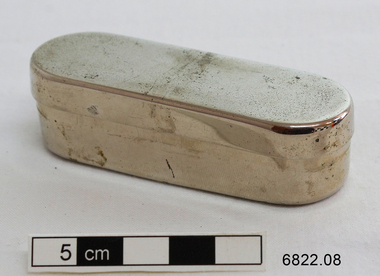
... pain relief, penicillin, insulin, immunisation and blood transfusions, needles became a staple of medicine. By 1946, the Chance Brothers’ Birmingham glassworks factory began mass-producing the first all-glass syringe with interchangeable parts. Then, a decade later, after sterilisation issues in re-used glass syringes had plagued the industry for years, a Kiwi inventor called Colin Murdoch applied for a patent of a disposable plastic syringe. Several patents followed, and the disposable syringe is now widespread. https://www.medibank.com.au/livebetter/be-magazine/wellbeing/the-history-of-the-hypodermic-needle/ This syringe set was donated to Flagstaff Hill Maritime Village by the family...pain relief, penicillin, insulin, immunisation and blood transfusions, needles became a staple of medicine. By 1946, the Chance Brothers’ Birmingham glassworks factory began mass-producing the first all-glass syringe with interchangeable parts. Then, a decade later, after sterilisation issues in re-used glass syringes had plagued the industry for years, a Kiwi inventor called Colin Murdoch applied for a patent of a disposable plastic syringe. Several patents followed, and the disposable syringe is now widespread. https://www.medibank.com.au/livebetter/be-magazine/wellbeing/the-history-of-the-hypodermic-needle/ This syringe set was donated to Flagstaff Hill Maritime Village by the family ...Whether it’s an anaesthetic, blood test, insulin, vitamin shot or vaccination, at a base human level something feels instinctively wrong about having a long thin piece of metal stuck deep into your flesh. And yet, in allowing physicians to administer medicine directly into the bloodstream, the hypodermic needle has been one of the most important inventions of medical science. In the beginning… Typically, it was the Romans. The word ‘syringe’ is derived from Greek mythology. Chased to the edge of a river by the god Pan, a rather chaste nymph by the name of Syrinx magically disguised herself as water reeds. Determined, Pan chopped the hollow reeds off and blew into them to create a musical whistling sound, thereby fashioning the first of his fabled pipes. Taking that concept of ‘hollow tubes’, and having observed how snakes could transmit venom, the practice of administering ointments and unctions via simple piston syringes is originally described in the writings of the first-century Roman scholar Aulus Cornelius Celsus and the equally famous Greek surgeon Galen. It’s unclear if the Egyptian surgeon Ammar bin Ali al-Mawsili was a fan of either of their scribblings, but 800 years later he employed a hollow glass tube and simple suction power to remove cataracts from his patients’ eyes – a technique copied up until the 13th century, but only to extract blood, fluid or poison, not to inject anything. Syringes get modern Then, in 1650, while experimenting with hydrodynamics, the legendary French polymath Blaise Pascal invented the first modern syringe. His device exemplified the law of physics that became known as Pascal’s Law, which proposes “when there is an increase in pressure at any point in a confined fluid, there is an equal increase at every other point in the container.” But it wasn’t until six years later that a fellow Renaissance man, the English architect Sir Christopher Wren took Pascal’s concept and made the first intravenous experiment. Combining hollow goose quills, pig bladders, a kennel of stray dogs and enough opium to fell a herd of elephants, Wren started injecting the hapless mutts with the ‘milk of the poppy’. By the mid-1660s, thinking this seemed like a great idea, two German doctors, Johann Daniel Major and Johann Sigismund Elsholtz, decided to try their hand at squirting various stuff into human subjects. Things didn’t end well, and people died. Consequently, injections fell out of medical favour for 200 years. Let's try again… Enter the Irish doctor Francis Rynd in 1844. Constructing the first-ever hollow steel needle, he used it to inject medicine subcutaneously and then bragged about it in an issue of the Dublin Medical Press. Then, in 1853, depending on who you believe, it was either a Frenchman or a Scot who invented the first real hypodermic needle. The French physician Charles Pravaz adapted Rynd’s needle to administer a coagulant in order to stem bleeding in a sheep by using a system of measuring screws. However, it was the Scottish surgeon Alexander Wood who first combined a hollow steel needle with a proper syringe to inject morphine into a human. Thus, Wood is usually credited with the invention. Sharp advancements Over the following century, the technology was refined and intravenous injections became commonplace – whether in the administering of pain relief, penicillin, insulin, immunisation and blood transfusions, needles became a staple of medicine. By 1946, the Chance Brothers’ Birmingham glassworks factory began mass-producing the first all-glass syringe with interchangeable parts. Then, a decade later, after sterilisation issues in re-used glass syringes had plagued the industry for years, a Kiwi inventor called Colin Murdoch applied for a patent of a disposable plastic syringe. Several patents followed, and the disposable syringe is now widespread. https://www.medibank.com.au/livebetter/be-magazine/wellbeing/the-history-of-the-hypodermic-needle/ This syringe set was donated to Flagstaff Hill Maritime Village by the family of Doctor William Roy Angus, Surgeon and Oculist. It is part of the “W.R. Angus Collection” that includes historical medical equipment, surgical instruments and material once belonging to Dr Edward Ryan and Dr Thomas Francis Ryan, (both of Nhill, Victoria) as well as Dr Angus’ own belongings. The Collection’s history spans the medical practices of the two Doctors Ryan, from 1885-1926 plus that of Dr Angus, up until 1969. ABOUT THE “W.R.ANGUS COLLECTION” Doctor William Roy Angus M.B., B.S., Adel., 1923, F.R.C.S. Edin.,1928 (also known as Dr Roy Angus) was born in Murrumbeena, Victoria in 1901 and lived until 1970. He qualified as a doctor in 1923 at University of Adelaide, was Resident Medical Officer at the Royal Adelaide Hospital in 1924 and for a period was house surgeon to Sir (then Mr.) Henry Simpson Newland. Dr Angus was briefly an Assistant to Dr Riddell of Kapunda, then commenced private practice at Curramulka, Yorke Peninsula, SA, where he was physician, surgeon and chemist. In 1926, he was appointed as new Medical Assistant to Dr Thomas Francis Ryan (T.F. Ryan, or Tom), in Nhill, Victoria, where his experiences included radiology and pharmacy. In 1927 he was Acting House Surgeon in Dr Tom Ryan’s absence. Dr Angus had become engaged to Gladys Forsyth and they decided he would take time to further his studies overseas in the UK in 1927. He studied at London University College Hospital and at Edinburgh Royal Infirmary and in 1928, was awarded FRCS (Fellow from the Royal College of Surgeons), Edinburgh. He worked his passage back to Australia as a Ship’s Surgeon on the on the Australian Commonwealth Line’s T.S.S. Largs Bay. Dr Angus married Gladys in 1929, in Ballarat. (They went on to have one son (Graham 1932, born in SA) and two daughters (Helen (died 12/07/1996) and Berenice (Berry), both born at Mira, Nhill ) Dr Angus was a ‘flying doctor’ for the A.I.M. (Australian Inland Ministry) Aerial Medical Service in 1928 . The organisation began in South Australia through the Presbyterian Church in that year, with its first station being in the remote town of Oodnadatta, where Dr Angus was stationed. He was locum tenens there on North-South Railway at 21 Mile Camp. He took up this ‘flying doctor’ position in response to a call from Dr John Flynn; the organisation was later known as the Flying Doctor Service, then the Royal Flying Doctor Service. A lot of his work during this time involved dental surgery also. Between 1928-1932 he was surgeon at the Curramulka Hospital, Yorke Peninsula, South Australia. In 1933 Dr Angus returned to Nhill where he’d previously worked as Medical Assistant and purchased a share of the Nelson Street practice and Mira hospital from Dr Les Middleton one of the Middleton Brothers, the current owners of what was once Dr Tom Ryan’s practice. Dr L Middleton was House Surgeon to the Nhill Hospital 1926-1933, when he resigned. [Dr Tom Ryan’s practice had originally belonged to his older brother Dr Edward Ryan, who came to Nhill in 1885. Dr Edward saw patients at his rooms, firstly in Victoria Street and in 1886 in Nelson Street, until 1901. The Nelson Street practice also had a 2 bed ward, called Mira Private Hospital ). Dr Edward Ryan was House Surgeon at the Nhill Hospital 1884-1902 . He also had occasions where he successfully performed veterinary surgery for the local farmers too. Dr Tom Ryan then purchased the practice from his brother in 1901. Both Dr Edward and Dr Tom Ryan work as surgeons included eye surgery. Dr Tom Ryan performed many of his operations in the Mira private hospital on his premises. He too was House Surgeon at the Nhill Hospital 1902-1926. Dr Tom Ryan had one of the only two pieces of radiology equipment in Victoria during his practicing years – The Royal Melbourne Hospital had the other one. Over the years Dr Tom Ryan gradually set up what was effectively a training school for country general-practitioner-surgeons. Each patient was carefully examined, including using the X-ray machine, and any surgery was discussed and planned with Dr Ryan’s assistants several days in advance. Dr Angus gained experience in using the X-ray machine there during his time as assistant to Dr Ryan. Dr Tom Ryan moved from Nhill in 1926. He became a Fellow of the Royal Australasian College of Surgeons in 1927, soon after its formation, a rare accolade for a doctor outside any of the major cities. He remained a bachelor and died suddenly on 7th Dec 1955, aged 91, at his home in Ararat. Scholarships and prizes are still awarded to medical students in the honour of Dr T.F. Ryan and his father, Dr Michael Ryan, and brother, John Patrick Ryan. ] When Dr Angus bought into the Nelson Street premises in Nhill he was also appointed as the Nhill Hospital’s Honorary House Surgeon 1933-1938. His practitioner’s plate from his Nhill surgery states “HOURS Daily, except Tuesdays, Fridays and Saturday afternoons, 9-10am, 2-4pm, 7-8pm. Sundays by appointment”. This plate is now mounted on the doorway to the Port Medical Office at Flagstaff Hill Maritime Village, Warrnambool. Dr Edward Ryan and Dr Tom Ryan had an extensive collection of historical medical equipment and materials spanning 1884-1926 and when Dr Angus took up practice in their old premises he obtained this collection, a large part of which is now on display at the Port Medical Office at Flagstaff Hill Maritime Village in Warrnambool. During his time in Nhill Dr Angus was involved in the merging of the Mira Hospital and Nhill Public Hospital into one public hospital and the property titles passed on to Nhill Hospital in 1939. In 1939 Dr Angus and his family moved to Warrnambool where he purchased “Birchwood,” the 1852 home and medical practice of Dr John Hunter Henderson, at 214 Koroit Street. (This property was sold in1965 to the State Government and is now the site of the Warrnambool Police Station. ). The Angus family was able to afford gardeners, cooks and maids; their home was a popular place for visiting dignitaries to stay whilst visiting Warrnambool. Dr Angus had his own silk worm farm at home in a Mulberry tree. His young daughter used his centrifuge for spinning the silk. Dr Angus was appointed on a part-time basis as Port Medical Officer (Health Officer) in Warrnambool and held this position until the 1940’s when the government no longer required the service of a Port Medical Officer in Warrnambool; he was thus Warrnambool’s last serving Port Medical Officer. (The duties of a Port Medical Officer were outlined by the Colonial Secretary on 21st June, 1839 under the terms of the Quarantine Act. Masters of immigrant ships arriving in port reported incidents of diseases, illness and death and the Port Medical Officer made a decision on whether the ship required Quarantine and for how long, in this way preventing contagious illness from spreading from new immigrants to the residents already in the colony.) Dr Angus was a member of the Australian Medical Association, for 35 years and surgeon at the Warrnambool Base Hospital 1939-1942, He served as a Surgeon Captain during WWII1942-45, in Ballarat, Victoria, and in Bonegilla, N.S.W., completing his service just before the end of the war due to suffering from a heart attack. During his convalescence he carved an intricate and ‘most artistic’ chess set from the material that dentures were made from. He then studied ophthalmology at the Royal Melbourne Eye and Ear Hospital and created cosmetically superior artificial eyes by pioneering using the intrascleral cartilage. Angus received accolades from the Ophthalmological Society of Australasia for this work. He returned to Warrnambool to commence practice as an ophthalmologist, pioneering in artificial eye improvements. He was Honorary Consultant Ophthalmologist to Warrnambool Base Hospital for 31 years. He made monthly visits to Portland as a visiting surgeon, to perform eye surgery. He represented the Victorian South-West subdivision of the Australian Medical Association as its secretary between 1949 and 1956 and as chairman from 1956 to 1958. In 1968 Dr Angus was elected member of Spain’s Barraquer Institute of Barcelona after his research work in Intrasclearal cartilage grafting, becoming one of the few Australian ophthalmologists to receive this honour, and in the following year presented his final paper on Living Intrasclearal Cartilage Implants at the Inaugural Meeting of the Australian College of Ophthalmologists in Melbourne In his personal life Dr Angus was a Presbyterian and treated Sunday as a Sabbath, a day of rest. He would visit 3 or 4 country patients on a Sunday, taking his children along ‘for the ride’ and to visit with him. Sunday evenings he would play the pianola and sing Scottish songs to his family. One of Dr Angus’ patients was Margaret MacKenzie, author of a book on local shipwrecks that she’d seen as an eye witness from the late 1880’s in Peterborough, Victoria. In the early 1950’s Dr Angus, painted a picture of a shipwreck for the cover jacket of Margaret’s book, Shipwrecks and More Shipwrecks. She was blind in later life and her daughter wrote the actual book for her. Dr Angus and his wife Gladys were very involved in Warrnambool’s society with a strong interest in civic affairs. Their interests included organisations such as Red Cross, Rostrum, Warrnambool and District Historical Society (founding members), Wine and Food Society, Steering Committee for Tertiary Education in Warrnambool, Local National Trust, Good Neighbour Council, Housing Commission Advisory Board, United Services Institute, Legion of Ex-Servicemen, Olympic Pool Committee, Food for Britain Organisation, Warrnambool Hospital, Anti-Cancer Council, Boys’ Club, Charitable Council, National Fitness Council and Air Raid Precautions Group. He was also a member of the Steam Preservation Society and derived much pleasure from a steam traction engine on his farm. He had an interest in people and the community He and his wife Gladys were both involved in the creation of Flagstaff Hill, including the layout of the gardens. After his death (28th March 1970) his family requested his practitioner’s plate, medical instruments and some personal belongings be displayed in the Port Medical Office surgery at Flagstaff Hill Maritime Village, and be called the “W. R. Angus Collection”. The W.R. Angus Collection is significant for still being located at the site it is connected with, Doctor Angus being the last Port Medical Officer in Warrnambool. The collection of medical instruments and other equipment is culturally significant, being an historical example of medicine from late 19th to mid-20th century. Dr Angus assisted Dr Tom Ryan, a pioneer in the use of X-rays and in ocular surgery. Syringe set (8 pieces),part of the W.R. Angus Collection. Pocket syringe kit in oval stainless steel container with separate lid. Container holds syringe cylinder, plunger, 2 needles, blade and cap. Printed on syringe cylinder "FIVEPOINT BRITISH" and symbol of a red star. One needle stamped "22"flagstaff hill, warrnambool, shipwrecked coast, flagstaff hill maritime museum, maritime museum, shipwreck coast, flagstaff hill maritime village, great ocean road, dr w r angus, dr ryan, surgical instrument, t.s.s. largs bay, warrnambool base hospital, nhill base hospital, mira hospital, flying doctor, medical treatment, medical history, medical education, medical text book, fivepoint syringe, general surgical co., injections -
 Flagstaff Hill Maritime Museum and Village
Equipment - Syringe, Late 19th - early 20th century
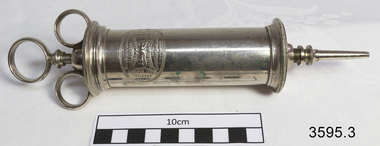
... pain or if bleeding occurs. Mechanical jet irrigators are available and some allow better control of water pressure and direction of spray. After syringing, examine the external canal and tympanic membrane. Document the patient’s consent, procedure, and pre- and post-examination findings. https://www.racgp.org.au/afp/2015/october/ear-wax-management This ear syringe was donated to Flagstaff Hill Maritime Village by the family...pain or if bleeding occurs. Mechanical jet irrigators are available and some allow better control of water pressure and direction of spray. After syringing, examine the external canal and tympanic membrane. Document the patient’s consent, procedure, and pre- and post-examination findings. https://www.racgp.org.au/afp/2015/october/ear-wax-management This ear syringe was donated to Flagstaff Hill Maritime Village by the family ...How to safely syringe ear wax Irrigation, or ear syringing, should be performed only after taking a full history, doing an ear examination and explaining the potential complications to the patient. It is also important to ensure appropriate assembly and use of equipment. Gentle irrigation of the ear canal can be performed with a large syringe (20 mL) and warm water. The use of sterile water or saline as opposed to tap water or bacteriostatic agent (eg dilute hydrogen peroxide) can decrease the risk of infection. Direct visualisation of the ear canal is not necessary for safe and effective syringing. The tip of the syringe should not pass the outer one-third of the ear canal (approximately 8 mm) – the use of a rounded nozzle may assist with this. The jet of water should be aimed towards the edge of the cerumen to enable the debris to flow out of the ear canal. Cease immediately if the patient experiences pain or if bleeding occurs. Mechanical jet irrigators are available and some allow better control of water pressure and direction of spray. After syringing, examine the external canal and tympanic membrane. Document the patient’s consent, procedure, and pre- and post-examination findings. https://www.racgp.org.au/afp/2015/october/ear-wax-management This ear syringe was donated to Flagstaff Hill Maritime Village by the family of Doctor William Roy Angus, Surgeon and Oculist. It is part of the “W.R. Angus Collection” that includes historical medical equipment, surgical instruments and material once belonging to Dr Edward Ryan and Dr Thomas Francis Ryan, (both of Nhill, Victoria) as well as Dr Angus’ own belongings. The Collection’s history spans the medical practices of the two Doctors Ryan, from 1885-1926 plus that of Dr Angus, up until 1969. ABOUT THE “W.R.ANGUS COLLECTION” Doctor William Roy Angus M.B., B.S., Adel., 1923, F.R.C.S. Edin.,1928 (also known as Dr Roy Angus) was born in Murrumbeena, Victoria in 1901 and lived until 1970. He qualified as a doctor in 1923 at University of Adelaide, was Resident Medical Officer at the Royal Adelaide Hospital in 1924 and for a period was house surgeon to Sir (then Mr.) Henry Simpson Newland. Dr Angus was briefly an Assistant to Dr Riddell of Kapunda, then commenced private practice at Curramulka, Yorke Peninsula, SA, where he was physician, surgeon and chemist. In 1926, he was appointed as new Medical Assistant to Dr Thomas Francis Ryan (T.F. Ryan, or Tom), in Nhill, Victoria, where his experiences included radiology and pharmacy. In 1927 he was Acting House Surgeon in Dr Tom Ryan’s absence. Dr Angus had become engaged to Gladys Forsyth and they decided he would take time to further his studies overseas in the UK in 1927. He studied at London University College Hospital and at Edinburgh Royal Infirmary and in 1928, was awarded FRCS (Fellow from the Royal College of Surgeons), Edinburgh. He worked his passage back to Australia as a Ship’s Surgeon on the on the Australian Commonwealth Line’s T.S.S. Largs Bay. Dr Angus married Gladys in 1929, in Ballarat. (They went on to have one son (Graham 1932, born in SA) and two daughters (Helen (died 12/07/1996) and Berenice (Berry), both born at Mira, Nhill ) Dr Angus was a ‘flying doctor’ for the A.I.M. (Australian Inland Ministry) Aerial Medical Service in 1928 . The organisation began in South Australia through the Presbyterian Church in that year, with its first station being in the remote town of Oodnadatta, where Dr Angus was stationed. He was locum tenens there on North-South Railway at 21 Mile Camp. He took up this ‘flying doctor’ position in response to a call from Dr John Flynn; the organisation was later known as the Flying Doctor Service, then the Royal Flying Doctor Service. A lot of his work during this time involved dental surgery also. Between 1928-1932 he was surgeon at the Curramulka Hospital, Yorke Peninsula, South Australia. In 1933 Dr Angus returned to Nhill where he’d previously worked as Medical Assistant and purchased a share of the Nelson Street practice and Mira hospital from Dr Les Middleton one of the Middleton Brothers, the current owners of what was once Dr Tom Ryan’s practice. Dr L Middleton was House Surgeon to the Nhill Hospital 1926-1933, when he resigned. [Dr Tom Ryan’s practice had originally belonged to his older brother Dr Edward Ryan, who came to Nhill in 1885. Dr Edward saw patients at his rooms, firstly in Victoria Street and in 1886 in Nelson Street, until 1901. The Nelson Street practice also had a 2 bed ward, called Mira Private Hospital ). Dr Edward Ryan was House Surgeon at the Nhill Hospital 1884-1902 . He also had occasions where he successfully performed veterinary surgery for the local farmers too. Dr Tom Ryan then purchased the practice from his brother in 1901. Both Dr Edward and Dr Tom Ryan work as surgeons included eye surgery. Dr Tom Ryan performed many of his operations in the Mira private hospital on his premises. He too was House Surgeon at the Nhill Hospital 1902-1926. Dr Tom Ryan had one of the only two pieces of radiology equipment in Victoria during his practicing years – The Royal Melbourne Hospital had the other one. Over the years Dr Tom Ryan gradually set up what was effectively a training school for country general-practitioner-surgeons. Each patient was carefully examined, including using the X-ray machine, and any surgery was discussed and planned with Dr Ryan’s assistants several days in advance. Dr Angus gained experience in using the X-ray machine there during his time as assistant to Dr Ryan. Dr Tom Ryan moved from Nhill in 1926. He became a Fellow of the Royal Australasian College of Surgeons in 1927, soon after its formation, a rare accolade for a doctor outside any of the major cities. He remained a bachelor and died suddenly on 7th Dec 1955, aged 91, at his home in Ararat. Scholarships and prizes are still awarded to medical students in the honour of Dr T.F. Ryan and his father, Dr Michael Ryan, and brother, John Patrick Ryan. ] When Dr Angus bought into the Nelson Street premises in Nhill he was also appointed as the Nhill Hospital’s Honorary House Surgeon 1933-1938. His practitioner’s plate from his Nhill surgery states “HOURS Daily, except Tuesdays, Fridays and Saturday afternoons, 9-10am, 2-4pm, 7-8pm. Sundays by appointment”. This plate is now mounted on the doorway to the Port Medical Office at Flagstaff Hill Maritime Village, Warrnambool. Dr Edward Ryan and Dr Tom Ryan had an extensive collection of historical medical equipment and materials spanning 1884-1926 and when Dr Angus took up practice in their old premises he obtained this collection, a large part of which is now on display at the Port Medical Office at Flagstaff Hill Maritime Village in Warrnambool. During his time in Nhill Dr Angus was involved in the merging of the Mira Hospital and Nhill Public Hospital into one public hospital and the property titles passed on to Nhill Hospital in 1939. In 1939 Dr Angus and his family moved to Warrnambool where he purchased “Birchwood,” the 1852 home and medical practice of Dr John Hunter Henderson, at 214 Koroit Street. (This property was sold in1965 to the State Government and is now the site of the Warrnambool Police Station. ). The Angus family was able to afford gardeners, cooks and maids; their home was a popular place for visiting dignitaries to stay whilst visiting Warrnambool. Dr Angus had his own silk worm farm at home in a Mulberry tree. His young daughter used his centrifuge for spinning the silk. Dr Angus was appointed on a part-time basis as Port Medical Officer (Health Officer) in Warrnambool and held this position until the 1940’s when the government no longer required the service of a Port Medical Officer in Warrnambool; he was thus Warrnambool’s last serving Port Medical Officer. (The duties of a Port Medical Officer were outlined by the Colonial Secretary on 21st June, 1839 under the terms of the Quarantine Act. Masters of immigrant ships arriving in port reported incidents of diseases, illness and death and the Port Medical Officer made a decision on whether the ship required Quarantine and for how long, in this way preventing contagious illness from spreading from new immigrants to the residents already in the colony.) Dr Angus was a member of the Australian Medical Association, for 35 years and surgeon at the Warrnambool Base Hospital 1939-1942, He served as a Surgeon Captain during WWII1942-45, in Ballarat, Victoria, and in Bonegilla, N.S.W., completing his service just before the end of the war due to suffering from a heart attack. During his convalescence he carved an intricate and ‘most artistic’ chess set from the material that dentures were made from. He then studied ophthalmology at the Royal Melbourne Eye and Ear Hospital and created cosmetically superior artificial eyes by pioneering using the intrascleral cartilage. Angus received accolades from the Ophthalmological Society of Australasia for this work. He returned to Warrnambool to commence practice as an ophthalmologist, pioneering in artificial eye improvements. He was Honorary Consultant Ophthalmologist to Warrnambool Base Hospital for 31 years. He made monthly visits to Portland as a visiting surgeon, to perform eye surgery. He represented the Victorian South-West subdivision of the Australian Medical Association as its secretary between 1949 and 1956 and as chairman from 1956 to 1958. In 1968 Dr Angus was elected member of Spain’s Barraquer Institute of Barcelona after his research work in Intrasclearal cartilage grafting, becoming one of the few Australian ophthalmologists to receive this honour, and in the following year presented his final paper on Living Intrasclearal Cartilage Implants at the Inaugural Meeting of the Australian College of Ophthalmologists in Melbourne In his personal life Dr Angus was a Presbyterian and treated Sunday as a Sabbath, a day of rest. He would visit 3 or 4 country patients on a Sunday, taking his children along ‘for the ride’ and to visit with him. Sunday evenings he would play the pianola and sing Scottish songs to his family. One of Dr Angus’ patients was Margaret MacKenzie, author of a book on local shipwrecks that she’d seen as an eye witness from the late 1880’s in Peterborough, Victoria. In the early 1950’s Dr Angus, painted a picture of a shipwreck for the cover jacket of Margaret’s book, Shipwrecks and More Shipwrecks. She was blind in later life and her daughter wrote the actual book for her. Dr Angus and his wife Gladys were very involved in Warrnambool’s society with a strong interest in civic affairs. Their interests included organisations such as Red Cross, Rostrum, Warrnambool and District Historical Society (founding members), Wine and Food Society, Steering Committee for Tertiary Education in Warrnambool, Local National Trust, Good Neighbour Council, Housing Commission Advisory Board, United Services Institute, Legion of Ex-Servicemen, Olympic Pool Committee, Food for Britain Organisation, Warrnambool Hospital, Anti-Cancer Council, Boys’ Club, Charitable Council, National Fitness Council and Air Raid Precautions Group. He was also a member of the Steam Preservation Society and derived much pleasure from a steam traction engine on his farm. He had an interest in people and the community He and his wife Gladys were both involved in the creation of Flagstaff Hill, including the layout of the gardens. After his death (28th March 1970) his family requested his practitioner’s plate, medical instruments and some personal belongings be displayed in the Port Medical Office surgery at Flagstaff Hill Maritime Village, and be called the “W. R. Angus Collection”. Ear wax is an ongoing problem for many people, and its safe and easy removal is important. The W.R. Angus Collection is significant for still being located at the site it is connected with, Doctor Angus being the last Port Medical Officer in Warrnambool. The collection of medical instruments and other equipment is culturally significant, being an historical example of medicine from late 19th to mid-20th century. Dr Angus assisted Dr Tom Ryan, a pioneer in the use of X-rays and in ocular surgery. Ear syringe from the W.R. Angus Collection with barrel, plunger and tip. Inscription on oval shaped plaque on barrel. Inscription on oval shaped plaque on barrel "10th / UNIVERSITY COLLEGE HOSPITAL" & "MAYER & MELTZER / MAKERS, LONDON" & " TO THE / HOSPITAL OF DESEASES (SIC) OF THE THROAT"" & "TO THE / HOSPITAL / FOR WOMEN" & "TO THE / MIDDLESEX / HOSPITAL" plus "R" inscribed on each side of the handlewarrnambool, shipwreck coast, great ocean road, flagstaff hill maritime village, maritime museum, dr angus, w.r. angus, dr t f ryan, medical instrument, surgical equipment, warrnambool base hospital, nhill base hospital, mira hospital, flying doctor, medical treatment, syringe, ear syringe, ear wax -
 Warrnambool and District Historical Society Inc.
Domestic object - Sloan's family liniment bottle with Sticker Paterson Chemist, Warrnambool, Manufactured in late 1800s and early 20th century
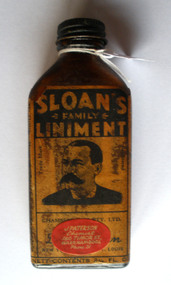
... FAMILY/LINIMENT/(text obscured)/NEW YORK (obscured) ST LOUIS/NETT CONTENTS 2½ FL. OZS Left side: INSTRUCTIONS-Massage (obscured) gently with/fingers. Then (obscured) liberally with a soft/ flannel cloth or a piece of absorbent cotton. If skin is tender,/do not use./ CAUTION:-COMBUSTIBLE MIXTURE./Do not Use near Fire or Flame./Regd Vic 1173 Right side: EXTERNALLY: Recommended by us in the treatment of Muscu-/lar Congestion and Muscular Pain...FAMILY/LINIMENT/(text obscured)/NEW YORK (obscured) ST LOUIS/NETT CONTENTS 2½ FL. OZS Left side: INSTRUCTIONS-Massage (obscured) gently with/fingers. Then (obscured) liberally with a soft/ flannel cloth or a piece of absorbent cotton. If skin is tender,/do not use./ CAUTION:-COMBUSTIBLE MIXTURE./Do not Use near Fire or Flame./Regd Vic 1173 Right side: EXTERNALLY: Recommended by us in the treatment of Muscu-/lar Congestion and Muscular Pain ...Sloan's liniment was used in the late19th and early to mid 20th century. Originally used for horses but later advertised as good for Man and Beast.While the bottle of Sloan's liniment has historical value, the link with Warrnambool lies in the chemist's label of J Paterson who operated a business at 186 Timor Street, Warrnambool around the 1930s.Brown glass bottle with black metal screw-top lid. Bottle has a short neck. The indented rear has the maker's name imprinted. The black and white printed paper label has a picture of a man's head and wraps across the front and sides and has a red sticker with the Warrnambool retailer's name..Front: SLOAN'S/FAMILY/LINIMENT/(text obscured)/NEW YORK (obscured) ST LOUIS/NETT CONTENTS 2½ FL. OZS Left side: INSTRUCTIONS-Massage (obscured) gently with/fingers. Then (obscured) liberally with a soft/ flannel cloth or a piece of absorbent cotton. If skin is tender,/do not use./ CAUTION:-COMBUSTIBLE MIXTURE./Do not Use near Fire or Flame./Regd Vic 1173 Right side: EXTERNALLY: Recommended by us in the treatment of Muscu-/lar Congestion and Muscular Pain due to the exposure and fatigue or/of rheumatic origin, Lumbago, S--- and sc--- and s--- of/Muscles and Tendons, Neuralgia, (obscured), Stiff Neck, Backache, Bruises, Chilblains, Mosquito Bites and/stings of major non-poisonous insects. An Excellent Counter (obscured) Back: THIS BOTTLE ALWAYS REMAINS/ THE PROPERTY OF/CHAMBERLAIN'S PTY LTD/SYDNEY warrnambool, chemists, timor st, sloan's liniment, paterson j -
 Geoffrey Kaye Museum of Anaesthetic History
Decorative object - Vase, Glassware, Robert Wynne, c.2012
... Pain Medicine in 2008 and gifted the vase at the end of her term in 2010. Dr Briscoe was the first woman to be appointed Dean of the Faculty. The artist Robert Wynne is an accomplished glass artist in Australia. His artworks are held in significant public and private collections nation wide and overseas. Public collections include the Tasmanian Museum and Art Gallery, Artbank and the Queensland Contemporary Art Gallery. Wynne's artworks are also part of the private collections of Bill Clinton, Sir Elton John and the Royal Family...Pain Medicine in 2008 and gifted the vase at the end of her term in 2010. Dr Briscoe was the first woman to be appointed Dean of the Faculty. The artist Robert Wynne is an accomplished glass artist in Australia. His artworks are held in significant public and private collections nation wide and overseas. Public collections include the Tasmanian Museum and Art Gallery, Artbank and the Queensland Contemporary Art Gallery. Wynne's artworks are also part of the private collections of Bill Clinton, Sir Elton John and the Royal Family ...Dr Briscoe was appointed Dean of the Faculty of Pain Medicine in 2008 and gifted the vase at the end of her term in 2010. Dr Briscoe was the first woman to be appointed Dean of the Faculty. The artist Robert Wynne is an accomplished glass artist in Australia. His artworks are held in significant public and private collections nation wide and overseas. Public collections include the Tasmanian Museum and Art Gallery, Artbank and the Queensland Contemporary Art Gallery. Wynne's artworks are also part of the private collections of Bill Clinton, Sir Elton John and the Royal Family Collection of Japan.Tear shaped, emerald green, hand-blown glassEtched on base - DENIZENdr briscoe, penelope (penny), wynne, robert, dean, faculty of pain medicine, fpm -
 City of Greater Geelong
Painting - Acrylic on Canvas, Billy-Jay O'Toole, Wadawurrung Country and Connection, 2019
... paining represents our amazing ocean, bays, rivers, creeks and wetlands. The white creamy section represents our coastline with the footprints imbedded into the sand tells the story of our old people who have been so connected to this coastline for many thousands of years, the mountain represents the You Yangs which holds a special part of our history here on Wadawurrung country, the 7 gathering circles in the mountain represents the 7 family groups within Wadawurrung, WAA the crow he is our protector here on country and Bundjil is our creator which is why I have implemented these 2 birds into my painting, the u shape people symbols represents my family of 5 generations still living on Wadawurrung country, my great grandmother Joye Eccles my pop norm Eccles my mum Corrina Eccles myself and my beautiful daughter Alira, the eucalyptus leaves up the top is a part of cleansing I have incorporated therese leaves because this country is cleansed everyday by he family when conducting a smoking ceremony....paining represents our amazing ocean, bays, rivers, creeks and wetlands. The white creamy section represents our coastline with the footprints imbedded into the sand tells the story of our old people who have been so connected to this coastline for many thousands of years, the mountain represents the You Yangs which holds a special part of our history here on Wadawurrung country, the 7 gathering circles in the mountain represents the 7 family groups within Wadawurrung, WAA the crow he is our protector here on country and Bundjil is our creator which is why I have implemented these 2 birds into my painting, the u shape people symbols represents my family of 5 generations still living on Wadawurrung country, my great grandmother Joye Eccles my pop norm Eccles my mum Corrina Eccles myself and my beautiful daughter Alira, the eucalyptus leaves up the top is a part of cleansing I have incorporated therese leaves because this country is cleansed everyday by he family when conducting a smoking ceremony. ...The blue section of the paining represents our amazing ocean, bays, rivers, creeks and wetlands. The white creamy section represents our coastline with the footprints imbedded into the sand tells the story of our old people who have been so connected to this coastline for many thousands of years, the mountain represents the You Yangs which holds a special part of our history here on Wadawurrung country, the 7 gathering circles in the mountain represents the 7 family groups within Wadawurrung, WAA the crow he is our protector here on country and Bundjil is our creator which is why I have implemented these 2 birds into my painting, the u shape people symbols represents my family of 5 generations still living on Wadawurrung country, my great grandmother Joye Eccles my pop norm Eccles my mum Corrina Eccles myself and my beautiful daughter Alira, the eucalyptus leaves up the top is a part of cleansing I have incorporated therese leaves because this country is cleansed everyday by he family when conducting a smoking ceremony.Painting of Eagle and Crow with water and footprints below. Brown, orange, blue, green, black used.bundjil, you yangs, wadawurrung -
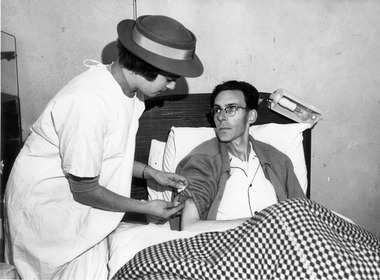 Royal District Nursing Service (now known as Bolton Clarke)
Photograph - Photograph, black and white, c.1956
... Palliative Care was given including pain relief with the use of syringe drivers, personal care as needed, and advice and support to both patient and family. ...This photograph is taken in the bedroom of the man's home in the suburbs of Melbourne. It depicts one of the types of nursing care given by Melbourne District Nursing Society (MDNS) Sisters in the community. The Sister is visiting the man's home and is administering an injection which has been ordered by a doctor. Glass syringes were used by the Society until the mid 1960s and were re sterilized for future use. After this time plastic disposable syringes were used.The Trained nurses of the Melbourne District Nursing Society (MDNS), later known as Royal District Nursing Service (RDNS), visited patients in their home and gave best practice care in many fields of nursing and to people of many cultures throughout its 130 years of expansion. Initial visits not only assessed the specific nursing situation but the situation as a whole. Their patients ranged in age from babes, children, adults to the elderly and referrals were taken from Hospitals, General Practitioners and allied Health facilities. Some of the care provided was: – Post-Natal care given to mother and babe, Wound Care following various types of surgery, accidents, burns, cancer, leg ulcers etc. Supervising and teaching Diabetic Care, including teaching and supervising people with Diabetes to administer their own Insulin, and administering Insulin to those unable to give their own injections. Administering other injections and setting up weekly medication boxes. The Sisters performed Catheterizations on adults suffering from conditions such as Quadriplegia, Paraplegia, Multiple Sclerosis (MS), Motor Neurone Disease (MND) and Guillan-Barre Syndrome, and when required at school on children for e.g. those with Spina Bifida. The Sisters visited those requiring Cystic Fibrosis support and care; those requiring Haemo-Oncology care, including visiting children at school; those requiring Home Enteral Feeding care, and those requiring IV therapy at home and home Dialysis. Palliative Care was given including pain relief with the use of syringe drivers, personal care as needed, and advice and support to both patient and family. RDNS provided Stoma management to those needing Urostomy, Ileostomy and Colostomy care and those requiring Continence care. HIV/AIDS nursing care was provided; visits to Homeless Persons were made. Personal care was given to patients ranging in age and with varying mobility problems, such as those with MS, MND, Guillan-Barre Syndrome, Quadriplegia, Paraplegia, Acquired Brain Injury, following a Cerebrovascular Accident (Stroke), those with severe Arthritis and those with a form of Dementia. When necessary the elderly were assisted with personal care and advice given on safety factors with the use of hand rails, bath or shower seats, and hand showers. Rehabilitation with an aim towards independence remained at the forefront of the Sister’s minds and when possible using aids and instruction on safe techniques enabled the person to become fully independent. All care included giving advice and support to the patient and their Carers. The Sisters liaised with the persons Doctor, Hospital and allied Health personal when necessary.On the left of this black and white photograph, is a Melbourne District Nursing Society Sister who is standing side-on and leaning slightly forward as she administers an injection into the right upper arm of a gentleman to her right who is sitting up in bed resting against two white covered pillows. The male patient has short dark hair; is wearing glasses, and is looking up at the Sister. He is wearing a thick grey cardigan over a pale colour pyjama top which has dark piping; the lower part of his body is covered by a dark and light coloured check bed cover. The bed has a solid wooden headrest with a bed lamp attached to its upper right. The Sister who is wearing her uniform grey brimmed hat over her dark short hair, is wearing a white gown over her grey uniform, the collar of which is seen. Three fingers of her left hand are holding back the pushed up sleeve of the man's cardigan and she is holding a white swab between her thumb and first finger. She has a glass syringe resting in her right hand with her thumb and forefinger resting against the lower glass and metal section of the syringe; part of the metal needle is seen, the rest is inserted in the mans upper arm. On the far left of the photograph part of a dressing table mirror can be seen.' Rough Proof' Latrobe Studios Ref No. 59134-8melbourne district nursing service, mdns, royal district nursing service, rdns, rdns - injection -
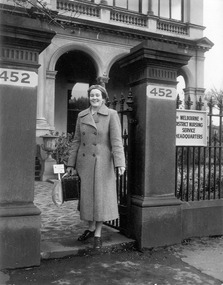 Royal District Nursing Service (now known as Bolton Clarke)
Photograph - Photograph, black and white, c.1960
... Palliative Care was given including pain relief with the use of syringe drivers, personal care as needed, and advice and support to both patient and family. ...Sister Beryl Hawker is a District Nurse working for the Melbourne District Nursing Service (MDNS) and is leaving their Headquarters at 452 St. Kilda Road, Melbourne to give nursing care to a patient in their home situated in a Melbourne suburb. She is wearing the MDNS winter uniform grey wool coat over her grey cotton dress with white collar. A red Maltese cross is attached to the centre of her grey wool beret. Her nursing case contains an apron, hand towel, thermometer, instruments, dressings and lotions.The Trained nurses of the Melbourne District Nursing Society (MDNS), later known as Royal District Nursing Service (RDNS), visited patients in their home and gave best practice care in many fields of nursing and to people of many cultures throughout its 130 years of expansion. Initial visits not only assessed the specific nursing situation but the situation as a whole. Their patients ranged in age from babes, children, adults to the elderly and referrals were taken from Hospitals, General Practitioners and allied Health facilities. Some of the care provided was: – Post-Natal care given to mother and babe, Wound Care following various types of surgery, accidents, burns, cancer, leg ulcers etc. Supervising and teaching Diabetic Care, including teaching and supervising people with Diabetes to administer their own Insulin, and administering Insulin to those unable to give their own injections. Administering other injections and setting up weekly medication boxes. The Sisters performed Catheterizations on adults suffering from conditions such as Quadriplegia, Paraplegia, Multiple Sclerosis (MS), Motor Neurone Disease (MND) and Guillan-Barre Syndrome, and when required at school on children for e.g. those with Spina Bifida. The Sisters visited those requiring Cystic Fibrosis support and care; those requiring Haemo-Oncology care, including visiting children at school; those requiring Home Enteral Feeding care, and those requiring IV therapy at home and home Dialysis. Palliative Care was given including pain relief with the use of syringe drivers, personal care as needed, and advice and support to both patient and family. RDNS provided Stoma management to those needing Urostomy, Ileostomy and Colostomy care and those requiring Continence care. HIV/AIDS nursing care was provided; visits to Homeless Persons were made. Personal care was given to patients ranging in age and with varying mobility problems, such as those with MS, MND, Guillan-Barre Syndrome, Quadriplegia, Paraplegia, Acquired Brain Injury, following a Cerebrovascular Accident (Stroke), those with severe Arthritis and those with a form of Dementia. When necessary the elderly were assisted with personal care and advice given on safety factors with the use of hand rails, bath or shower seats, and hand showers. Rehabilitation with an aim towards independence remained at the forefront of the Sister’s minds and when possible using aids and instruction on safe techniques enabled the person to become fully independent. All care included giving advice and support to the patient and their Carers. The Sisters liaised with the persons Doctor, Hospital and allied Health personal when necessary.Sister Beryl Hawker, who has short dark hair, is smiling as she is leaving Melbourne District Nursing Service (MDNS) Headquarters. She is wearing the MDNS uniform of an ankle length double breasted grey wool coat and wool beret with a central Maltese cross. Part of the MDNS insignia is seen at the top of her left sleeve. In her right hand she is carrying a rectangular nursing case and a light colour soft material bag. She is standing in front of the open metal spike gate between the two square grey concrete pillars of the gateway; the black numbers '452' are written on a white background on the top section of each pillar. A spiked metal fence is attached and running to the right of the right pillar; attached to this and close to the pillar, is a white plaque with black capital letters reading: 'Melbourne District Nursing Service Headquarters'. In the background is a paved path leading to part of a building with part of three arches seen and above this some concrete balustrade. A large pedestal concrete flower urn sits next to the partially seen steps leading up to the building. Some low bushes are seen behind the fence and in front of the building.59134-11melbourne district nursing service, mdns, mdns uniform, mdns headquarters, sister beryl hawker, royal district nursing service, rdns -
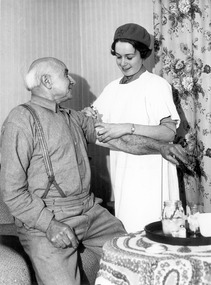 Royal District Nursing Service (now known as Bolton Clarke)
Photograph - Photograph, black and white, 1958
... Palliative Care was given including pain relief with the use of syringe drivers, personal care as needed, and advice and support to both patient and family. ...This photograph depicts a Melbourne District Nursing Service (MDNS) Sister administering an injection to a gentleman in his own home in the suburbs of Melbourne. The Sister is wearing the MDNS winter grey uniform short sleeve dress and grey wool beret with a central red Maltese cross. Glass syringes were used until the mid 1960s when plastic disposable syringes were then used.The Trained nurses of the Melbourne District Nursing Society (MDNS), then Melbourne District Nursing Service from 1957, and from 1966 known as Royal District Nursing Service (RDNS), visited patients in their home and gave best practice care in many fields of nursing and to people of many cultures throughout its 130 years of expansion. Initial visits not only assessed the specific nursing situation but the situation as a whole. Their patients ranged in age from babes, children, adults to the elderly and referrals were taken from Hospitals, General Practitioners and allied Health facilities. Some of the care the Sisters provided is as follows: – Post-Natal care given to mother and babe, Wound Care following various types of surgery, accidents, burns, cancer, leg ulcers etc. Supervising and teaching Diabetic Care, including teaching and supervising people with Diabetes to administer their own Insulin, and administering Insulin to those unable to give their own injections. Administering other injections and setting up weekly medication boxes. The Sisters performed Catheterizations on adults suffering from conditions such as Quadriplegia, Paraplegia, Multiple Sclerosis (MS), Motor Neurone Disease (MND) and Guillan-Barre Syndrome, and when required at school on children for e.g. those with Spina Bifida. The Sisters visited those requiring Cystic Fibrosis support and care; those requiring Haemo-Oncology care, including visiting children at school; those requiring Home Enteral Feeding care, and those requiring IV therapy at home and home Dialysis. Palliative Care was given including pain relief with the use of syringe drivers, personal care as needed, and advice and support to both patient and family. The Sisters provided Stoma management to those needing Urostomy, Ileostomy and Colostomy care and those requiring Continence care. HIV/AIDS nursing care was provided; visits to Homeless Persons were made. Personal care was given to patients ranging in age and with varying mobility problems, such as those with MS, MND, Guillan-Barre Syndrome, Quadriplegia, Paraplegia, Acquired Brain Injury, to those following a Cerebrovascular Accident (Stroke), those with severe Arthritis and those with a form of Dementia. When necessary the elderly were assisted with personal care and advice given on safety factors with the use of hand rails, bath or shower seats, and hand showers. Rehabilitation with an aim towards independence remained at the forefront of the Sister’s minds and when possible using aids and instruction on safe techniques enabled the person to become fully independent. All care included giving advice and support to the patient and their Carers. The Sisters liaised with the persons Doctor, Hospital and allied Health personal when necessary. This photograph depicts Melbourne District Nursing Service (MDNS) Sister Mary Maxwell administering an injection into the left upper arm of Mr Cannestra. On the left of the photograph Mr Cannestra is sitting on the padded arm of his patterned couch; he has his left arm extended. His head, which is bald with some white hair at the side and rear, is turned towards the Sister who is standing on his right. He is wearing a grey shirt and his grey trousers are held up with braces. Sister Maxwell is wearing a white gown over her grey uniform with the collar seen. She is wearing a grey wool beret with central Maltese cross, over her short, dark hair. She is standing beside the patient and her left hand is holding his left arm with his shirt sleeve rolled up to expose his upper arm. She is holding the angled barrel of a glass and metal syringe in her right hand and some of the needle can be seen against Mr. Cannestra's arm. In the background the wall is covered with a striped wallpaper, and to the right part of a long floral curtain can be seen. To the right in the foreground, a round dark tray with jar, small bottle containing the medication for injection, a glass and a white cloth, sit on a small round table with a white and patterned tablecloth.La Trobe Street Studios. Reference number 59134-21melbourne district nursing service, mdns, mdns - injection, royal district nursing service, rdns, sister mary maxwell, mr cannestra -
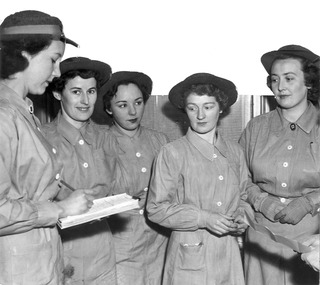 Royal District Nursing Service (now known as Bolton Clarke)
Photograph - Photograph, black and white, 17.10.1952
... Palliative Care was given including pain relief with the use of syringe drivers, personal care as needed, and advice and support to both patient and family. ...The Melbourne District Nursing Society (MDNS) Trained nurses (Sisters) are receiving their morning briefing from Matron D. Tupper before leaving their Headquarters at 39 Victoria Parade, Collingwood to go to their areas (districts) in the Melbourne suburbs to give nursing care to patients in their homes The Sisters averaged 30 calls a day each, mainly wound dressings; personal care, mostly sponges in bed; and injections (insulin and diabetes management). The Trained nurses of the Melbourne District Nursing Society (MDNS), later known as Royal District Nursing Service (RDNS), visited patients in their home and gave best practice care in many fields of nursing, and to people of many cultures, throughout its 130 years of expansion. Initial visits not only assessed the specific nursing situation but the situation as a whole. Their patients ranged in age from babes, children, adults to the elderly and referrals were taken from Hospitals, General Practitioners and allied Health facilities. Some of the care the Sisters provided is as follows: – Post-Natal care given to mother and babe, Wound Care following various types of surgery, accidents, burns, cancer, leg ulcers etc. Supervising and teaching Diabetic Care, including teaching and supervising people with Diabetes to administer their own Insulin, and administering Insulin to those unable to give their own injections. Administering other injections and setting up weekly medication boxes. The Sisters performed Catheterizations on adults suffering from conditions such as Quadriplegia, Paraplegia, Multiple Sclerosis (MS), Motor Neurone Disease (MND) and Guillan-Barre Syndrome, and when required at school on children for e.g. those with Spina Bifida. The Sisters visited those requiring Cystic Fibrosis support and care; those requiring Haemo-Oncology care, including visiting children at school; those requiring Home Enteral Feeding care, and those requiring IV therapy at home and home Dialysis. Palliative Care was given including pain relief with the use of syringe drivers, personal care as needed, and advice and support to both patient and family. The Sisters provided Stoma management to those needing Urostomy, Ileostomy and Colostomy care and those requiring Continence care. HIV/AIDS nursing care was provided; visits to Homeless Persons were made. Personal care was given to patients ranging in age and with varying mobility problems, such as those with MS, MND, Guillan-Barre Syndrome, Quadriplegia, Paraplegia, Acquired Brain Injury, to those following a Cerebrovascular Accident (Stroke), those with severe Arthritis and those with a form of Dementia. When necessary the elderly were assisted with personal care and advice given on safety factors with the use of hand rails, bath or shower seats, and hand showers. Rehabilitation with an aim towards independence remained at the forefront of the Sister’s minds and when possible using aids and instruction on safe techniques enabled the person to become fully independent. All care included giving advice and support to the patient and their Carers. The Sisters liaised with the persons Doctor, Hospital and allied Health personal when necessary.This photograph depicts five Melbourne District Nursing Society (MDNS) Sisters of varying heights standing in a row. They are wearing their grey long sleeve uniform dresses which have peaked collars, a pocket on the upper left and lower right, and white buttons down the centre. They are all wearing their grey brimmed hats over their short dark curled hair. From left to right is Sister (Sr) J Faust, who is looking down at a clipboard she is holding in her left hand which has paper held on it by a black bulldog clip. There is writing on the top sheet of white paper and she is holding a pen in her right hand poised near a section of writing on the paper. Next is Sr. M Sexton who is looking at the camera, then Sr. B Nunn who is looking towards a mainly hidden person on the far right. The next two are Sr E Blair, who has items in her lower pocket, and Sr B White who are both looking at the clipboard and paper held by Sr. Faust. In the far lower right corner of the photograph you can see the fingers of hands holding a sheet of paper. There is no further vision of this person.Operator 59. Finisher 30melbourne district nursing society, mdns, mdns uniforms, royal district nursing service, rdns, sister j. faust, sister m. sexton, sister b. nunn, sister e. blair, sister b. white -
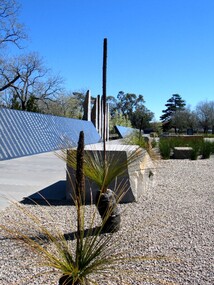 Ballarat Heritage Services
Photograph, L.J. Gervasoni, Ballarat Prisoner of War Memorial, 2006, 12/09/2006
... The Ballarat Prisoner of War Memorial was dedicated on 06 February 2004 t acknowledge the pain and suffering that all Prisoners of War endured during their time in captivity, to commemorate the thousands of mates left behind and to acknowledge the sacrifice of families during wartime. ...The Ballarat Prisoner of War Memorial was dedicated on 06 February 2004 t acknowledge the pain and suffering that all Prisoners of War endured during their time in captivity, to commemorate the thousands of mates left behind and to acknowledge the sacrifice of families during wartime. ...The Ballarat Prisoner of War Memorial was dedicated on 06 February 2004 t acknowledge the pain and suffering that all Prisoners of War endured during their time in captivity, to commemorate the thousands of mates left behind and to acknowledge the sacrifice of families during wartime. The memorial was designed by sculptor Peter Blizzard and is made of natural stone-basalt and granite. 55,000 names are etched onto the 130 metre long granite wall.Photograph of the Ballarat Prisoner of War Memorial ballarat prisoner of war memorial, peter blizzard, pow -
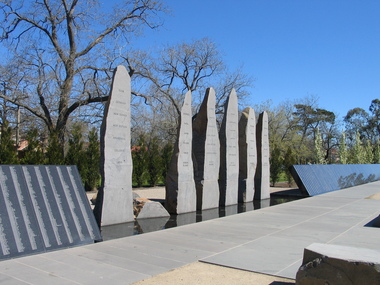 Ballarat Heritage Services
Photograph - War Memorial, L.J. Gervasoni, Ballarat Prisoner of War Memorial, 2006, 12/09/2006
... The Ballarat Prisoner of War Memorial was dedicated on 06 February 2004 t acknowledge the pain and suffering that all Prisoners of War endured during their time in captivity, to commemorate the thousands of mates left behind and to acknowledge the sacrifice of families during wartime. ...The Ballarat Prisoner of War Memorial was dedicated on 06 February 2004 t acknowledge the pain and suffering that all Prisoners of War endured during their time in captivity, to commemorate the thousands of mates left behind and to acknowledge the sacrifice of families during wartime. ...The Ballarat Prisoner of War Memorial was dedicated on 06 February 2004 t acknowledge the pain and suffering that all Prisoners of War endured during their time in captivity, to commemorate the thousands of mates left behind and to acknowledge the sacrifice of families during wartime. The memorial was designed by sculptor Peter Blizzard and is made of natural stone-basalt and granite. 55,000 names are etched onto the 130 metre long granite wall.Photograph of the Ballarat Prisoner of War Memorial ballarat prisoner of war memorial, peter blizzard, pow -
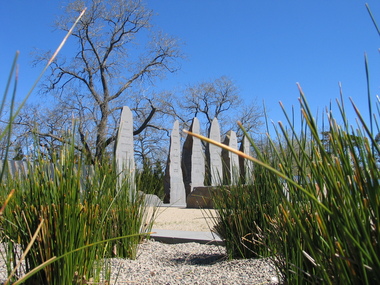 Ballarat Heritage Services
Photograph, L.J. Gervasoni, Ballarat Prisoner of War Memorial, 2006, 12/09/2006
... The Ballarat Prisoner of War Memorial was dedicated on 06 February 2004 t acknowledge the pain and suffering that all Prisoners of War endured during their time in captivity, to commemorate the thousands of mates left behind and to acknowledge the sacrifice of families during wartime. ...The Ballarat Prisoner of War Memorial was dedicated on 06 February 2004 t acknowledge the pain and suffering that all Prisoners of War endured during their time in captivity, to commemorate the thousands of mates left behind and to acknowledge the sacrifice of families during wartime. ...The Ballarat Prisoner of War Memorial was dedicated on 06 February 2004 t acknowledge the pain and suffering that all Prisoners of War endured during their time in captivity, to commemorate the thousands of mates left behind and to acknowledge the sacrifice of families during wartime. The memorial was designed by sculptor Peter Blizzard and is made of natural stone-basalt and granite. 55,000 names are etched onto the 130 metre long granite wall.Photograph of the Ballarat Prisoner of War Memorial ballarat prisoner of war memorial, peter blizzard, pow -
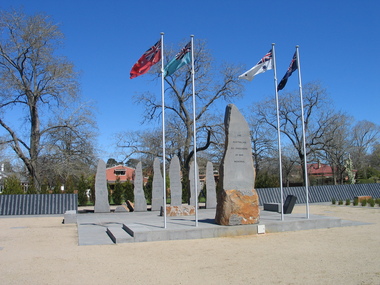 Ballarat Heritage Services
Photograph, L.J. Gervasoni, Ballarat Prisoner of War Memorial, 2006, 12/09/2006
... The Ballarat Prisoner of War Memorial was dedicated on 06 February 2004 t acknowledge the pain and suffering that all Prisoners of War endured during their time in captivity, to commemorate the thousands of mates left behind and to acknowledge the sacrifice of families during wartime. ...The Ballarat Prisoner of War Memorial was dedicated on 06 February 2004 t acknowledge the pain and suffering that all Prisoners of War endured during their time in captivity, to commemorate the thousands of mates left behind and to acknowledge the sacrifice of families during wartime. ...The Ballarat Prisoner of War Memorial was dedicated on 06 February 2004 t acknowledge the pain and suffering that all Prisoners of War endured during their time in captivity, to commemorate the thousands of mates left behind and to acknowledge the sacrifice of families during wartime. The memorial was designed by sculptor Peter Blizzard and is made of natural stone-basalt and granite. 55,000 names are etched onto the 130 metre long granite wall.Photograph of the Ballarat Prisoner of War Memorial ballarat prisoner of war memorial, peter blizzard, pow -
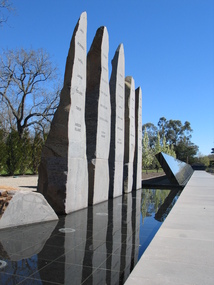 Ballarat Heritage Services
Photograph, L.J. Gervasoni, Ballarat Prisoner of War Memorial, 2006, 12/09/2006
... The Ballarat Prisoner of War Memorial was dedicated on 06 February 2004 t acknowledge the pain and suffering that all Prisoners of War endured during their time in captivity, to commemorate the thousands of mates left behind and to acknowledge the sacrifice of families during wartime. ...The Ballarat Prisoner of War Memorial was dedicated on 06 February 2004 t acknowledge the pain and suffering that all Prisoners of War endured during their time in captivity, to commemorate the thousands of mates left behind and to acknowledge the sacrifice of families during wartime. ...The Ballarat Prisoner of War Memorial was dedicated on 06 February 2004 t acknowledge the pain and suffering that all Prisoners of War endured during their time in captivity, to commemorate the thousands of mates left behind and to acknowledge the sacrifice of families during wartime. The memorial was designed by sculptor Peter Blizzard and is made of natural stone-basalt and granite. 55,000 names are etched onto the 130 metre long granite wall.Photograph of the Ballarat Prisoner of War Memorial ballarat prisoner of war memorial, peter blizzard, pow -
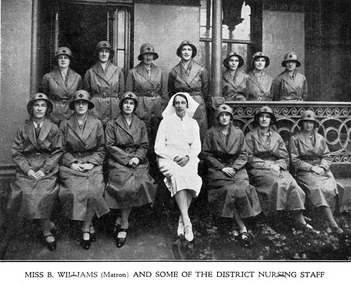 Royal District Nursing Service (now known as Bolton Clarke)
Photograph - Photograph, black and white, 1933
... Palliative Care was given including pain relief with the use of syringe drivers, personal care as needed, and advice and support to both patient and family. ...This photograph is a record of Matron Beatrice Williams with some of the Trained nurses (Sisters) who worked in the District division of Melbourne District Nursing Society After Care Home in 1933, just prior to Matron Williams resigning to be married. It was taken in front of the Nurses Home at 39 Victoria Parade, Collingwood and shows part of the District nursing uniform worn by the MDNS Sisters in the 1930s. At that time their uniform dresses, worn under their coats, were grey cotton and their brimmed hats were made of felt and had a red Maltese cross applied to the centre front of the hatband.Miss Beatrice Williams worked as a Trained Nurse (Sister) with the Melbourne District Nursing Society (MDNS) before going to England to gain her Midwifery certificate. After qualifying, she worked as a Tutor sister and a District Superintendent at the University College Hospital in London. On returning to Australia she was appointed, in April 1929, Matron of the District division of the MDNS After-Care Home (Hospital from 1934). She convinced the Committee of the need for Ante Natal care and in 1930 the Ante Natal Clinic was opened at the After-Care. She continued as Matron until 1933 when she married Dr. J.P Major, and was invited to join the Committee of Management. In the early 1950s when the Government requested the Society separate and it take over the After Care Hospital, she became President of the now named Melbourne District Nursing Service with its Headquarters and Nursing Home moving to 452 St. Kilda Road, Melbourne. Beatrice had an understanding of the poor, the sick and the aged, and was known for her kindness and sympathy. Her foresight, leadership and enthusiasm brought forth the expansion of District nursing. She died on the 15th of August 1958. The Trained nurses of the Melbourne District Nursing Society (MDNS), later known as Royal District Nursing Service (RDNS), visited patients in their home and gave best practice care in many fields of nursing, and to people of many cultures, throughout its 130 years of expansion. Initial visits not only assessed the specific nursing situation but the situation as a whole. Their patients ranged in age from babes, children, adults to the elderly and referrals were taken from Hospitals, General Practitioners and allied Health facilities. Some of the care the Sisters provided is as follows: – Post-Natal care given to mother and babe, Wound Care following various types of surgery, accidents, burns, cancer, leg ulcers etc. Supervising and teaching Diabetic Care, including teaching and supervising people with Diabetes to administer their own Insulin, and administering Insulin to those unable to give their own injections. Administering other injections and setting up weekly medication boxes. The Sisters performed Catheterizations on adults suffering from conditions such as Quadriplegia, Paraplegia, Multiple Sclerosis (MS), Motor Neurone Disease (MND) and Guillan-Barre Syndrome, and when required at school on children for e.g. those with Spina Bifida. The Sisters visited those requiring Cystic Fibrosis support and care; those requiring Haemo-Oncology care, including visiting children at school; those requiring Home Enteral Feeding care, and those requiring IV therapy at home and home Dialysis. Palliative Care was given including pain relief with the use of syringe drivers, personal care as needed, and advice and support to both patient and family. The Sisters provided Stoma management to those needing Urostomy, Ileostomy and Colostomy care and those requiring Continence care. HIV/AIDS nursing care was provided; visits to Homeless Persons were made. Personal care was given to patients ranging in age and with varying mobility problems, such as those with MS, MND, Guillan-Barre Syndrome, Quadriplegia, Paraplegia, Acquired Brain Injury, to those following a Cerebrovascular Accident (Stroke), those with severe Arthritis and those with a form of Dementia. When necessary the elderly were assisted with personal care and advice given on safety factors with the use of hand rails, bath or shower seats, and hand showers. Rehabilitation with an aim towards independence remained at the forefront of the Sister’s minds and when possible using aids and instruction on safe techniques enabled the person to become fully independent. All care included giving advice and support to the patient and their Carers. The Sisters liaised with the persons Doctor, Hospital and allied Health personal when necessary.Black and white photograph showing Matron, Miss Beatrice Williams, wearing a white uniform and veil over her short dark hair, and a group of thirteen Melbourne District Nursing Society Trained nurses (Sisters) outside the front of their Nurses Home. The Sisters are wearing grey coats over their grey uniforms and grey brimmed hats with a Maltese cross applied to the white headband. Matron is sitting in the centre of six Sisters and there are seven Sisters standing behind them on the veranda; a round column is seen to the right between the 4th and 5th Sisters. Part of the grey building behind shows an open door to the left and a long window to the right. A scrolled metal safety rail, running from the round column, is seen in front of the three nurses on the right. The seated Sisters and Matron have their legs crossed at the ankles, melbourne district nursing society, mdns nurses, mdns, rdns, royal district nursing service, mdns uniforms, matron beatrice mary williams -
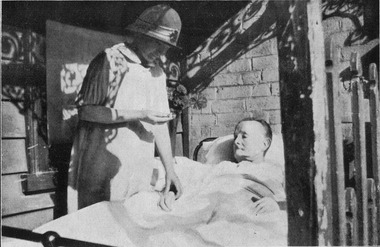 Royal District Nursing Service (now known as Bolton Clarke)
Photograph - Photograph, black and white, c.1930
... Palliative Care was given including pain relief with the use of syringe drivers, personal care as needed, and advice and support to both patient and family. ...This photograph shows a Melbourne District Nursing Society (MDNS) Sister visiting a patient in his home. The photograph shows her taking his temperature and pulse and carrying out basic nursing observations. The Sister kept a record of this information in the man's Nursing History at MDNS Headquarters and conveyed it to the patient's Doctor as required.The Trained nurses of the Melbourne District Nursing Society (MDNS), later known as Royal District Nursing Service (RDNS), visited patients in their home and gave best practice care in many fields of nursing, and to people of many cultures, throughout its 130 years of expansion. Initial visits not only assessed the specific nursing situation but the situation as a whole. Their patients ranged in age from babes, children, adults to the elderly and referrals were taken from Hospitals, General Practitioners and allied Health facilities. Some of the care the Sisters provided is as follows: – Post-Natal care given to mother and babe, Wound Care following various types of surgery, accidents, burns, cancer, leg ulcers etc. Supervising and teaching Diabetic Care, including teaching and supervising people with Diabetes to administer their own Insulin, and administering Insulin to those unable to give their own injections. Administering other injections and setting up weekly medication boxes. The Sisters performed Catheterizations on adults suffering from conditions such as Quadriplegia, Paraplegia, Multiple Sclerosis (MS), Motor Neurone Disease (MND) and Guillan-Barre Syndrome, and when required at school on children for e.g. those with Spina Bifida. The Sisters visited those requiring Cystic Fibrosis support and care; those requiring Haemo-Oncology care, including visiting children at school; those requiring Home Enteral Feeding care, and those requiring IV therapy at home and home Dialysis. Palliative Care was given including pain relief with the use of syringe drivers, personal care as needed, and advice and support to both patient and family. The Sisters provided Stoma management to those needing Urostomy, Ileostomy and Colostomy care and those requiring Continence care. HIV/AIDS nursing care was provided; visits to Homeless Persons were made. Personal care was given to patients ranging in age and with varying mobility problems, such as those with MS, MND, Guillan-Barre Syndrome, Quadriplegia, Paraplegia, Acquired Brain Injury, to those following a Cerebrovascular Accident (Stroke), those with severe Arthritis and those with a form of Dementia. When necessary the elderly were assisted with personal care and advice given on safety factors with the use of hand rails, bath or shower seats, and hand showers. Rehabilitation with an aim towards independence remained at the forefront of the Sister’s minds and when possible using aids and instruction on safe techniques enabled the person to become fully independent. All care included giving advice and support to the patient and their Carers. The Sisters liaised with the persons Doctor, Hospital and allied Health personal when necessary.This black and white photograph shows a Melbourne District Nursing Society (MDNS) Trained nurse (Sister) standing on the left of a man who is in his bed on the veranda of his home. She is wearing a white gown over her uniform and her grey uniform hat, which has a hatband showing a Maltese cross in the centre; she has her left hand on the man's right wrist and is looking down at a watch she is holding in her right hand. The man, who has short dark hair, is holding a thermometer in his mouth. He is partly propped up with his head resting on a white covered pillow; part of the iron frame of the bed is seen to its left. Most of his body is covered with light coloured bedclothes; part of his pyjamas can be seen. Part of a vase of flowers is seen just behind the Sister's left arm. In the left of the photograph, part of the weatherboards of the house can be seen with a window, partly obscured with a blind. To the right of the man is a veranda post and some pickets of a wooden fence; behind him part of a brick wall is seen.melbourne district nursing society, mdns, mdns uniforms, rdns, royal district nursing service -
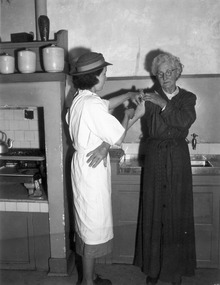 Royal District Nursing Service (now known as Bolton Clarke)
Photograph - Photograph, black and white:, 1952
... Palliative Care was given including pain relief with the use of syringe drivers, personal care as needed, and advice and support to both patient and family. ...This photograph is taken in the home of the lady and shows MDNS Sister J. Faust giving an injection, using a glass syringe, into the right upper arm of the lady. This type of syringe was re sterilized. These syringes remained in use until the mid 1960s when disposable plastic syringes took their place. This photograph was used in a video on the history of RDNS which is held by the organization. It is a record of the type of care given by Melbourne District Nursing Society (MDNS) Trained nurses in a patient's home.The Trained nurses of the Melbourne District Nursing Society (MDNS), later known as Royal District Nursing Service (RDNS), visited patients in their home and gave best practice care in many fields of nursing, and to people of many cultures, throughout its 130 years of expansion. Initial visits not only assessed the specific nursing situation but the situation as a whole. Their patients ranged in age from babes, children, adults to the elderly and referrals were taken from Hospitals, General Practitioners and allied Health facilities. Some of the care the Sisters provided is as follows: – Post-Natal care given to mother and babe, Wound Care following various types of surgery, accidents, burns, cancer, leg ulcers etc. Supervising and teaching Diabetic Care, including teaching and supervising people with Diabetes to administer their own Insulin, and administering Insulin to those unable to give their own injections. Administering other injections and setting up weekly medication boxes. The Sisters performed Catheterizations on adults suffering from conditions such as Quadriplegia, Paraplegia, Multiple Sclerosis (MS), Motor Neurone Disease (MND) and Guillan-Barre Syndrome, and when required at school on children for e.g. those with Spina Bifida. The Sisters visited those requiring Cystic Fibrosis support and care; those requiring Haemo-Oncology care, including visiting children at school; those requiring Home Enteral Feeding care, and those requiring IV therapy at home and home Dialysis. Palliative Care was given including pain relief with the use of syringe drivers, personal care as needed, and advice and support to both patient and family. The Sisters provided Stoma management to those needing Urostomy, Ileostomy and Colostomy care and those requiring Continence care. HIV/AIDS nursing care was provided; visits to Homeless Persons were made. Personal care was given to patients ranging in age and with varying mobility problems, such as those with MS, MND, Guillan-Barre Syndrome, Quadriplegia, Paraplegia, Acquired Brain Injury, to those following a Cerebrovascular Accident (Stroke), those with severe Arthritis and those with a form of Dementia. When necessary the elderly were assisted with personal care and advice given on safety factors with the use of hand rails, bath or shower seats, and hand showers. Rehabilitation with an aim towards independence remained at the forefront of the Sister’s minds and when possible using aids and instruction on safe techniques enabled the person to become fully independent. All care included giving advice and support to the patient and their Carers. The Sisters liaised with the persons Doctor, Hospital and allied Health personal when necessary.Black and white photograph of Melbourne District Nursing Society (MDNS), Sister J. Faust who is wearing her grey brimmed uniform hat over her dark curled hair and is wearing a white gown over her grey uniform which is seen below her gown. In her right hand, she is holding a syringe, with needle against the lady's skin, and her left hand is on the upper right arm of the lady above the needle site. The lady, who has light coloured curled hair and is wearing a dark coloured long frock, is standing to the right of the Sister and is holding the right sleeve of her dress up with her left hand. A metal sink with cupboards below is behind the lady. To the left is fireplace which is now tiled at the rear and has a gas stove with kettle on a jet in the space. A row of three pale coloured kitchen canisters in decreasing size sit on the mantle piece. On a shelf above these sit a dark coloured box and a tall thin vase. Staff members name is written on the back of the photograph.melbourne district nursing society, nursing care, royal district nursing service, rdns, mdns, nursing care - medications, mdns uniforms, j. faust -
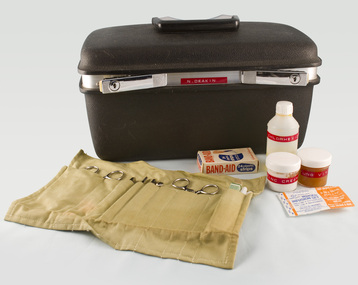 Royal District Nursing Service (now known as Bolton Clarke)
Equipment - Photograph, colour, c.1970
... Palliative Care was given including pain relief with the use of syringe drivers, personal care as needed, and advice and support to both patient and family. ...This is style of nursing case and type of equipment used by the Sisters of the Royal District Nursing Service (RDNS) in the 1970s. The Sisters worked throughout the Melbourne inner and outer suburbs visiting patients to administer nursing care in their homes and other arranged venues. The Trained nurses of the Melbourne District Nursing Society (MDNS), later known as Royal District Nursing Service (RDNS), visited patients in their home and gave best practice care in many fields of nursing, and to people of many cultures, throughout its 130 years of expansion. Initial visits not only assessed the specific nursing situation but the situation as a whole. Their patients ranged in age from babes, children, adults to the elderly and referrals were taken from Hospitals, General Practitioners and allied Health facilities. Some of the care the Sisters provided is as follows: – Post-Natal care given to mother and babe, Wound Care following various types of surgery, accidents, burns, cancer, leg ulcers etc. Supervising and teaching Diabetic Care, including teaching and supervising people with Diabetes to administer their own Insulin, and administering Insulin to those unable to give their own injections. Administering other injections and setting up weekly medication boxes. The Sisters performed Catheterizations on adults suffering from conditions such as Quadriplegia, Paraplegia, Multiple Sclerosis (MS), Motor Neurone Disease (MND) and Guillan-Barre Syndrome, and when required at school on children for e.g. those with Spina Bifida. The Sisters visited those requiring Cystic Fibrosis support and care; those requiring Haemo-Oncology care, including visiting children at school; those requiring Home Enteral Feeding care, and those requiring IV therapy at home and home Dialysis. Palliative Care was given including pain relief with the use of syringe drivers, personal care as needed, and advice and support to both patient and family. The Sisters provided Stoma management to those needing Urostomy, Ileostomy and Colostomy care and those requiring Continence care. HIV/AIDS nursing care was provided; visits to Homeless Persons were made. Personal care was given to patients ranging in age and with varying mobility problems, such as those with MS, MND, Guillan-Barre Syndrome, Quadriplegia, Paraplegia, Acquired Brain Injury, to those following a Cerebrovascular Accident (Stroke), those with severe Arthritis and those with a form of Dementia. When necessary the elderly were assisted with personal care and advice given on safety factors with the use of hand rails, bath or shower seats, and hand showers. Rehabilitation with an aim towards independence remained at the forefront of the Sister’s minds and when possible using aids and instruction on safe techniques enabled the person to become fully independent. All care included giving advice and support to the patient and their Carers. The Sisters liaised with the persons Doctor, Hospital and allied Health personal as necessary.Black deep case made of man made material. it has a raised lid with attached handle. The metal section between the lid and body of the case has metal clasps attached to it which open and close within this section. The deep section contains a cotton bag sewn in sections which contain artery forceps, dissecting forceps, scissors, thermometer, wooden spatula. Shown are a packet of Band-Aids, plastic bottle containing chlorhexidine, jar containing soft-soap and jar containing Saf-sol which were carried within the body of the case.rdns, royal district nursing service, rdns equipment, melbourne district nursing society -
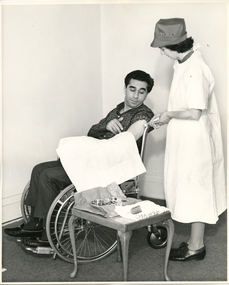 Royal District Nursing Service (now known as Bolton Clarke)
Photograph - Photograph, black and white, 1967
... Palliative Care was given including pain relief with the use of syringe drivers, personal care as needed, and advice and support to both patient and family. ...This photograph depicts a Royal District Nursing Service, (RDNS), Sister administering an injection, which has been ordered by a Doctor, into the left arm of a gentleman who is sitting in a wheelchair in his home. This photograph depicts one of the types of nursing care given by the trained nurses working at RDNS in the late 1960s. The syringe being used is a disposable type which came into use in the middle 1960s.The Trained nurses of the Melbourne District Nursing Society (MDNS), later known as Royal District Nursing Service (RDNS), visited patients in their home and gave best practice care in many fields of nursing, and to people of many cultures, throughout its 130 years of expansion. Initial visits not only assessed the specific nursing situation but the situation as a whole. Their patients ranged in age from babes, children, adults to the elderly and referrals were taken from Hospitals, General Practitioners and allied Health facilities. Some of the care the Sisters provided is as follows: – Post-Natal care given to mother and babe, Wound Care following various types of surgery, accidents, burns, cancer, leg ulcers etc. Supervising and teaching Diabetic Care, including teaching and supervising people with Diabetes to administer their own Insulin, and administering Insulin to those unable to give their own injections. Administering other injections and setting up weekly medication boxes. The Sisters performed Catheterizations on adults suffering from conditions such as Quadriplegia, Paraplegia, Multiple Sclerosis (MS), Motor Neurone Disease (MND) and Guillan-Barre Syndrome, and when required at school on children for e.g. those with Spina Bifida. The Sisters visited those requiring Cystic Fibrosis support and care; those requiring Haemo-Oncology care, including visiting children at school; those requiring Home Enteral Feeding care, and those requiring IV therapy at home and home Dialysis. Palliative Care was given including pain relief with the use of syringe drivers, personal care as needed, and advice and support to both patient and family. The Sisters provided Stoma management to those needing Urostomy, Ileostomy and Colostomy care and those requiring Continence care. HIV/AIDS nursing care was provided; visits to Homeless Persons were made. Personal care was given to patients ranging in age and with varying mobility problems, such as those with MS, MND, Guillan-Barre Syndrome, Quadriplegia, Paraplegia, Acquired Brain Injury, to those following a Cerebrovascular Accident (Stroke), those with severe Arthritis and those with a form of Dementia. When necessary the elderly were assisted with personal care and advice given on safety factors with the use of hand rails, bath or shower seats, and hand showers. Rehabilitation with an aim towards independence remained at the forefront of the Sister’s minds and when possible using aids and instruction on safe techniques enabled the person to become fully independent. All care included giving advice and support to the patient and their Carers. The Sisters liaised with the persons Doctor, Hospital and allied Health personal when necessary.To the right in the black and white photograph is a Royal District Nursing Service (RDNS), Sister who is wearing a white gown over her uniform frock, and wearing a peaked grey uniform hat and black shoes. She is standing side-on facing a man on her left who is sitting in a wheelchair. She is holding the barrel of a syringe in her right hand and has her left hand on the end of the plunger of the syringe; the needle of the syringe is in the left upper arm of a gentleman. He is on the left of the photograph and has short dark hair; is wearing dark trousers and a dark patterned shirt and is watching as the Sister gives the injection. A white towel is draped over part of his left arm,. A small table, with nursing equipment on the top, stands beside the wheelchair and in front of the Sister.Photographers stamp and the word 'Publicity'rdns, royal district nursing service, rdns treatment - injection -
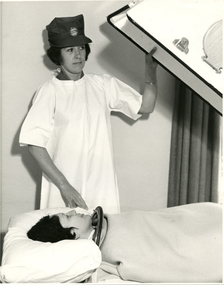 Royal District Nursing Service (now known as Bolton Clarke)
Photograph - Photograph, black and white, c.1960
... Palliative Care was given including pain relief with the use of syringe drivers, personal care as needed, and advice and support to both patient and family. ...This photograph depicts one of the forms of nursing care given by Melbourne District Nursing Service (MDNS), Sisters in the home of a patient. In this photograph, the Sister is visiting the home of a lady who is confined to a Negative Pressured Ventilator, also known as an 'Iron Lung', which assists her to breathe. The Sister gave both physical and emotional care to the patient, as well as support and advice to those who were caring for her.The Trained nurses of the Melbourne District Nursing Society (MDNS), later known as Royal District Nursing Service (RDNS), visited patients in their home and gave best practice care in many fields of nursing, and to people of many cultures, throughout its 130 years of expansion. Initial visits not only assessed the specific nursing situation but the situation as a whole. Their patients ranged in age from babes, children, adults to the elderly and referrals were taken from Hospitals, General Practitioners and allied Health facilities. Some of the care the Sisters provided is as follows: – Post-Natal care given to mother and babe, Wound Care following various types of surgery, accidents, burns, cancer, leg ulcers etc. Supervising and teaching Diabetic Care, including teaching and supervising people with Diabetes to administer their own Insulin, and administering Insulin to those unable to give their own injections. Administering other injections and setting up weekly medication boxes. The Sisters performed Catheterizations on adults suffering from conditions such as Quadriplegia, Paraplegia, Multiple Sclerosis (MS), Motor Neurone Disease (MND) and Guillan-Barre Syndrome, and when required at school on children for e.g. those with Spina Bifida. The Sisters visited those requiring Cystic Fibrosis support and care; those requiring Haemo-Oncology care, including visiting children at school; those requiring Home Enteral Feeding care, and those requiring IV therapy at home and home Dialysis. Palliative Care was given including pain relief with the use of syringe drivers, personal care as needed, and advice and support to both patient and family. The Sisters provided Stoma management to those needing Urostomy, Ileostomy and Colostomy care and those requiring Continence care. HIV/AIDS nursing care was provided; visits to Homeless Persons were made. Personal care was given to patients ranging in age and with varying mobility problems, such as those with MS, MND, Guillan-Barre Syndrome, Poliomyelistis, Quadriplegia, Paraplegia, Acquired Brain Injury, to those following a Cerebrovascular Accident (Stroke), those with severe Arthritis and those with a form of Dementia. When necessary the elderly were assisted with personal care and advice given on safety factors with the use of hand rails, bath or shower seats, and hand showers. Rehabilitation with an aim towards independence remained at the forefront of the Sister’s minds and when possible using aids and instruction on safe techniques enabled the person to become fully independent. All care included giving advice and support to the patient and their Carers. The Sisters liaised with the persons Doctor, Hospital and allied Health personal when necessary.Black and white photograph showing a Melbourne District Nursing Service (MDNS) Sister, who has short dark hair; is wearing a white gown over her uniform and her grey peaked hat with attached RDNS badge. She is attending to a female patient who is lying in a Negative Pressure Ventilator in her home. The Sister is standing behind the Negative Pressure Ventilator, known as an 'Iron Lung', with her left arm extended holding the lid open. The lady is in the foreground, and is lying with her head towards the left of the photograph. She has short dark hair and lies on the bed of the Ventilator with a neck ring visible. Her head is resting on a white covered pillow. Part of a dark coloured pleated curtain can be seen in the right hand side background of the photographPhotographer's stamprdns, royal district nursing service, patient care, mdns, melbourne district nursing service, mdns nursing care - negative pressure ventilator, 'iron lung' -
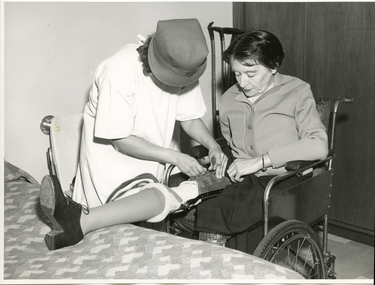 Royal District Nursing Service (now known as Bolton Clarke)
Photograph - Photograph, black and white, c. 1967
... Palliative Care was given including pain relief with the use of syringe drivers, personal care as needed, and advice and support to both patient and family. ...The RDNS Sister is applying a splint to the lady's leg after attending to any other nursing care required. This photograph depicts one of the types of nursing care carried out by the Royal District Nursing Service (RDNS). The Trained nurses of the Melbourne District Nursing Society (MDNS), later known as Royal District Nursing Service (RDNS), visited patients in their home and gave best practice care in many fields of nursing, and to people of many cultures, throughout its 130 years of expansion. Initial visits not only assessed the specific nursing situation but the situation as a whole. Their patients ranged in age from babes, children, adults to the elderly and referrals were taken from Hospitals, General Practitioners and allied Health facilities. Some of the care the Sisters provided is as follows: – Post-Natal care given to mother and babe, Wound Care following various types of surgery, accidents, burns, cancer, leg ulcers etc. Supervising and teaching Diabetic Care, including teaching and supervising people with Diabetes to administer their own Insulin, and administering Insulin to those unable to give their own injections. Administering other injections and setting up weekly medication boxes. The Sisters performed Catheterizations on adults suffering from conditions such as Quadriplegia, Paraplegia, Multiple Sclerosis (MS), Motor Neurone Disease (MND) and Guillan-Barre Syndrome, and when required at school on children for e.g. those with Spina Bifida. The Sisters visited those requiring Cystic Fibrosis support and care; those requiring Haemo-Oncology care, including visiting children at school; those requiring Home Enteral Feeding care, and those requiring IV therapy at home and home Dialysis. Palliative Care was given including pain relief with the use of syringe drivers, personal care as needed, and advice and support to both patient and family. The Sisters provided Stoma management to those needing Urostomy, Ileostomy and Colostomy care and those requiring Continence care. HIV/AIDS nursing care was provided; visits to Homeless Persons were made. Personal care was given to patients ranging in age and with varying mobility problems, such as those with MS, MND, Guillan-Barre Syndrome, Poliomyelistis, Quadriplegia, Paraplegia, Acquired Brain Injury, to those following a Cerebrovascular Accident (Stroke), those with severe Arthritis and those with a form of Dementia. When necessary the elderly were assisted with personal care and advice given on safety factors with the use of hand rails, bath or shower seats, and hand showers. Rehabilitation with an aim towards independence remained at the forefront of the Sister’s minds and when possible using aids and instruction on safe techniques enabled the person to become fully independent. All care included giving advice and support to the patient and their Carers. The Sisters liaised with the persons Doctor, Hospital and allied Health personal when necessary.On the left of this black and white photograph is a Royal District Nursing Service, (RDNS), Sister wearing a white gown over her grey uniform. She is bending over and slightly towards her right; her face is not visible, only the crown of her grey peaked hat is seen. On her right is a lady sitting in a wheelchair with her right leg extended resting on a bed. The Sister has her left hand on, with her fingers holding the strap, and her right hand on the strap below, of a Splint on the upper right leg of the lady who is watching the procedure. The lady has short dark hair and is wearing a grey buttoned up cardigan and dark skirt; she is wearing a black shoe on the foot of her extended leg. Her left leg is bent at the knee and the top of a splint with some of the straps are visible. Part of the bedspread covering the bed has a grey and white pattern. A pair of crutches and a dark drape can be seen behind the Sister and wheelchair. photographer stamprdns, royal district nursing service, rdns patient care -
 Royal District Nursing Service (now known as Bolton Clarke)
Photograph - Photograph, black and white, 15. 05.1967
... Palliative Care was given including pain relief with the use of syringe drivers, personal care as needed, and advice and support to both patient and family. ...Sister McDonald is visiting a patient to give them nursing care as requested. The photograph depicts the RDNS uniform in 1967. Her coat with the blue background Royal District Nursing Service material badge attached to the top of each sleeve, is worn over a grey cotton uniform dress.The Trained nurses of the Melbourne District Nursing Society (MDNS), later known as Royal District Nursing Service (RDNS), visited patients in their home and gave best practice care in many fields of nursing, and to people of many cultures, throughout its 130 years of expansion. Initial visits not only assessed the specific nursing situation but the situation as a whole. Their patients ranged in age from babes, children, adults to the elderly and referrals were taken from Hospitals, General Practitioners and allied Health facilities. Some of the care the Sisters provided is as follows: – Post-Natal care given to mother and babe, Wound Care following various types of surgery, accidents, burns, cancer, leg ulcers etc. Supervising and teaching Diabetic Care, including teaching and supervising people with Diabetes to administer their own Insulin, and administering Insulin to those unable to give their own injections. Administering other injections and setting up weekly medication boxes. The Sisters performed Catheterizations on adults suffering from conditions such as Quadriplegia, Paraplegia, Multiple Sclerosis (MS), Motor Neurone Disease (MND) and Guillan-Barre Syndrome, and when required at school on children for e.g. those with Spina Bifida. The Sisters visited those requiring Cystic Fibrosis support and care; those requiring Haemo-Oncology care, including visiting children at school; those requiring Home Enteral Feeding care, and those requiring IV therapy at home and home Dialysis. Palliative Care was given including pain relief with the use of syringe drivers, personal care as needed, and advice and support to both patient and family. The Sisters provided Stoma management to those needing Urostomy, Ileostomy and Colostomy care and those requiring Continence care. HIV/AIDS nursing care was provided; visits to Homeless Persons were made. Personal care was given to patients ranging in age and with varying mobility problems, such as those with MS, MND, Guillan-Barre Syndrome, Poliomyelistis, Quadriplegia, Paraplegia, Acquired Brain Injury, to those following a Cerebrovascular Accident (Stroke), those with severe Arthritis and those with a form of Dementia. When necessary the elderly were assisted with personal care and advice given on safety factors with the use of hand rails, bath or shower seats, and hand showers. Rehabilitation with an aim towards independence remained at the forefront of the Sister’s minds and when possible using aids and instruction on safe techniques enabled the person to become fully independent. All care included giving advice and support to the patient and their Carers. The Sisters liaised with the persons Doctor, Hospital and allied Health personal when necessary.Black and white photograph of Royal District Nursing Service, (RDNS,) Sister B. McDonald, wearing her grey uniform coat with the words 'Royal District Nursing Service' written in white on a dark curved material badge attached to the left upper sleeve; she is wearing her grey peaked uniform hat over her dark short hair. She is carrying her rectangular nursing case in her left hand and is opening the gate of a tall white picket fence before entering a patient's home. Number '19' is on the right hand side gate post. Trees can be seen behind the fence on either side of the gate. A two storey white attached house is in the background. The grey front door with white surround, can be seen on the ground floor. Two posts are supporting a balcony which protrudes from the top storey; a safety rail runs around its outer edge. A closed colonial door can be seen behind the balcony on the upper storey.Photographers stamp. Quote No. GE 42rdns, royal district nursing service, rdns uniform, sister betty mcdonald -
 Royal District Nursing Service (now known as Bolton Clarke)
Photograph - Photograph, black and white, 15 05 1967
... Palliative Care was given including pain relief with the use of syringe drivers, personal care as needed, and advice and support to both patient and family. ...RDNS Sister, Betty. McDonald, is about to enter the home of a patient to administer nursing care.The Trained nurses of the Melbourne District Nursing Society (MDNS), later known as Royal District Nursing Service (RDNS), visited patients in their home and gave best practice care in many fields of nursing, and to people of many cultures, throughout its 130 years of expansion. Initial visits not only assessed the specific nursing situation but the situation as a whole. Their patients ranged in age from babes, children, adults to the elderly and referrals were taken from Hospitals, General Practitioners and allied Health facilities. Some of the care the Sisters provided is as follows: – Post-Natal care given to mother and babe, Wound Care following various types of surgery, accidents, burns, cancer, leg ulcers etc. Supervising and teaching Diabetic Care, including teaching and supervising people with Diabetes to administer their own Insulin, and administering Insulin to those unable to give their own injections. Administering other injections and setting up weekly medication boxes. The Sisters performed Catheterizations on adults suffering from conditions such as Quadriplegia, Paraplegia, Multiple Sclerosis (MS), Motor Neurone Disease (MND) and Guillan-Barre Syndrome, and when required at school on children for e.g. those with Spina Bifida. The Sisters visited those requiring Cystic Fibrosis support and care; those requiring Haemo-Oncology care, including visiting children at school; those requiring Home Enteral Feeding care, and those requiring IV therapy at home and home Dialysis. Palliative Care was given including pain relief with the use of syringe drivers, personal care as needed, and advice and support to both patient and family. The Sisters provided Stoma management to those needing Urostomy, Ileostomy and Colostomy care and those requiring Continence care. HIV/AIDS nursing care was provided; visits to Homeless Persons were made. Personal care was given to patients ranging in age and with varying mobility problems, such as those with MS, MND, Guillan-Barre Syndrome, Poliomyelistis, Quadriplegia, Paraplegia, Acquired Brain Injury, to those following a Cerebrovascular Accident (Stroke), those with severe Arthritis and those with a form of Dementia. When necessary the elderly were assisted with personal care and advice given on safety factors with the use of hand rails, bath or shower seats, and hand showers. Rehabilitation with an aim towards independence remained at the forefront of the Sister’s minds and when possible using aids and instruction on safe techniques enabled the person to become fully independent. All care included giving advice and support to the patient and their Carers. The Sisters liaised with the persons Doctor, Hospital and allied Health personal when necessary.Black and white photograph of Royal District Nursing Service, (RDNS), Sister B. McDonald, who is wearing her grey uniform coat, with RDNS insignia on the upper sleeve, and her peaked grey hat over her dark short hair. She is holding her rectangular nursing case in her left hand. Her right arm is through the long handles of a black bag which is hanging under it, and her hand is on the top of the gate; Number '39' is attached to the top of the gate post. A tall broken paling fence, with many gaps between the palings, can be seen running along the edge of the footpath to the left and right of the gate. The fence is leaning over in places. Bushes can be seen behind the fence and part of a white building is seen in the background.Photographers stamp. Quote No. GE 5rdns, royal district nursing service, rdns uniform, rdns patient care, sister betty mcdonald -
 Royal District Nursing Service (now known as Bolton Clarke)
Photograph - Photograph, black and white, 15 05 1967
... Palliative Care was given including pain relief with the use of syringe drivers, personal care as needed, and advice and support to both patient and family. ...Sister McDonald is visiting a patient in her home to administer nursing care. The Trained nurses of the Melbourne District Nursing Society (MDNS), later known as Royal District Nursing Service (RDNS), visited patients in their home and gave best practice care in many fields of nursing, and to people of many cultures, throughout its 130 years of expansion. Initial visits not only assessed the specific nursing situation but the situation as a whole. Their patients ranged in age from babes, children, adults to the elderly and referrals were taken from Hospitals, General Practitioners and allied Health facilities. Some of the care the Sisters provided is as follows: – Post-Natal care given to mother and babe, Wound Care following various types of surgery, accidents, burns, cancer, leg ulcers etc. Supervising and teaching Diabetic Care, including teaching and supervising people with Diabetes to administer their own Insulin, and administering Insulin to those unable to give their own injections. Administering other injections and setting up weekly medication boxes. The Sisters performed Catheterizations on adults suffering from conditions such as Quadriplegia, Paraplegia, Multiple Sclerosis (MS), Motor Neurone Disease (MND) and Guillan-Barre Syndrome, and when required at school on children for e.g. those with Spina Bifida. The Sisters visited those requiring Cystic Fibrosis support and care; those requiring Haemo-Oncology care, including visiting children at school; those requiring Home Enteral Feeding care, and those requiring IV therapy at home and home Dialysis. Palliative Care was given including pain relief with the use of syringe drivers, personal care as needed, and advice and support to both patient and family. The Sisters provided Stoma management to those needing Urostomy, Ileostomy and Colostomy care and those requiring Continence care. HIV/AIDS nursing care was provided; visits to Homeless Persons were made. Personal care was given to patients ranging in age and with varying mobility problems, such as those with MS, MND, Guillan-Barre Syndrome, Poliomyelistis, Quadriplegia, Paraplegia, Acquired Brain Injury, to those following a Cerebrovascular Accident (Stroke), those with severe Arthritis and those with a form of Dementia. When necessary the elderly were assisted with personal care and advice given on safety factors with the use of hand rails, bath or shower seats, and hand showers. Rehabilitation with an aim towards independence remained at the forefront of the Sister’s minds and when possible using aids and instruction on safe techniques enabled the person to become fully independent. All care included giving advice and support to the patient and their Carers. The Sisters liaised with the persons Doctor, Hospital and allied Health personal when necessary.Black and white photograph of Royal District Nursing Sister, (RDNS), Sister B. McDonald, wearing her grey uniform coat, and her grey peaked hat over her dark short hair and is carrying her rectangular nursing case in her left hand. She is standing on the wooden veranda between the open wire door and the house; her right hand is knocking on the main door of a patient's home. Behind her, an electricity meter can be seen on the wall of the house behind the wire door. The door of the house sits near the corner of the horizontal weatherboard house, whose weatherboards can be seen to the left and right of Sister McDonald. Part of a fluted veranda post can be seen to the right of the photograph and two sheets of corrugated iron can be seen in the foreground.Photographers stamp. 'Quote No. GE 55rdns, royal district nursing service, rdns uniform, rdns patient care, sister betty mcdonald -
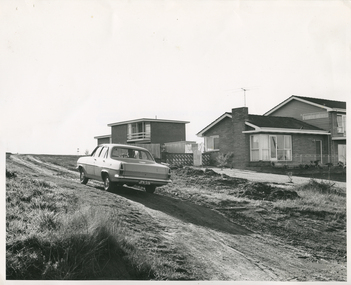 Royal District Nursing Service (now known as Bolton Clarke)
Photograph - Photograph, black and white, 23.05.1967
... Palliative Care was given including pain relief with the use of syringe drivers, personal care as needed, and advice and support to both patient and family. ...The photograph shows a RDNS Sister driving her RDNS car along a dirt road to reach a patient to administer nursing care. It shows the typical conditions of the roads the RDNS trained nurses encountered in some districts. The photograph also depicts an Australian made Holden car of the mid 1960s Melbourne District Nursing Society, later Royal District Nursing Service (RDNS) has had various modes of transport over the last 130 years. At first their Trained nurses (Nurses) walked the streets and lane ways amid the slums of central Melbourne. As the Society expanded bicycles, public transport, District cars, the use of a Motor Auxiliary, the Trained nurses (Sisters) own cars, and even a motorcycle were used, and all these forms were intermingled until RDNS had its own fleet of vehicles. By 2009 there were 598 cars in the fleet and the Sisters travelled 9 million 200,000 kilometres – this is equivalent to 12 trips to the moon and back. The Trained nurses of the Melbourne District Nursing Society (MDNS), later known as Royal District Nursing Service (RDNS), visited patients in their home and gave best practice care in many fields of nursing, and to people of many cultures, throughout its 130 years of expansion. Initial visits not only assessed the specific nursing situation but the situation as a whole. Their patients ranged in age from babes, children, adults to the elderly and referrals were taken from Hospitals, General Practitioners and allied Health facilities. Some of the care the Sisters provided is as follows: – Post-Natal care given to mother and babe, Wound Care following various types of surgery, accidents, burns, cancer, leg ulcers etc. Supervising and teaching Diabetic Care, including teaching and supervising people with Diabetes to administer their own Insulin, and administering Insulin to those unable to give their own injections. Administering other injections and setting up weekly medication boxes. The Sisters performed Catheterizations on adults suffering from conditions such as Quadriplegia, Paraplegia, Multiple Sclerosis (MS), Motor Neurone Disease (MND) and Guillan-Barre Syndrome, and when required at school on children for e.g. those with Spina Bifida. The Sisters visited those requiring Cystic Fibrosis support and care; those requiring Haemo-Oncology care, including visiting children at school; those requiring Home Enteral Feeding care, and those requiring IV therapy at home and home Dialysis. Palliative Care was given including pain relief with the use of syringe drivers, personal care as needed, and advice and support to both patient and family. The Sisters provided Stoma management to those needing Urostomy, Ileostomy and Colostomy care and those requiring Continence care. HIV/AIDS nursing care was provided; visits to Homeless Persons were made. Personal care was given to patients ranging in age and with varying mobility problems, such as those with MS, MND, Guillan-Barre Syndrome, Poliomyelistis, Quadriplegia, Paraplegia, Acquired Brain Injury, to those following a Cerebrovascular Accident (Stroke), those with severe Arthritis and those with a form of Dementia. When necessary the elderly were assisted with personal care and advice given on safety factors with the use of hand rails, bath or shower seats, and hand showers. Rehabilitation with an aim towards independence remained at the forefront of the Sister’s minds and when possible using aids and instruction on safe techniques enabled the person to become fully independent. All care included giving advice and support to the patient and their Carers. The Sisters liaised with the persons Doctor, Hospital and allied Health personal when necessary.In the centre of this black and white photograph is a Royal District Nursing Service, (RDNS), Sister at the wheel of her RDNS Holden car, which has a black rear Victorian number plate with 'JPH - 516' written in white letters. Through the back window you can see part of the Sister's uniform and her peaked hat worn over her short curled hair. Her left hand is on the upper part of the steering wheel. The dirt road on which she is travelling has mud and some grass tufts either side of it. On the right of the car is a hip roof brick house which has a single storey front area with attached two storey section at the rear. A short open Besser brick fence, with a white wooden gate, is seen running from the front of the property to the house, and beyond this a clothes line and shed. Beyond this, part of a tall paling fence is seen from the front of the property to the shed. The top section of the next brick house is seen beyond the fence; it has a white railed veranda along part of it and the house has a flat roof.Photographers stamp. Quote No. GE 90rdns, royal district nursing service, rdns transport, rdns patient care
