
Showing 6 items matching "parades - new south wales - sydney"
-
 National Vietnam Veterans Museum (NVVM)
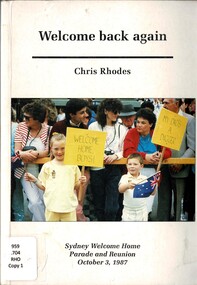
Book, Rhodes, Chris, Welcome back again: Sydney Welcome Home Parade and Reunion October 3, 1987 (Copy 1)
... ...Parades - New South Wales - Sydney...Vietnam War 1961-1975 - Social aspects - Australia Parades - New South Wales - Sydney Welcome Home Parade 1987 Australia's Vietnam veterans were finally 'Welcomed Home' in Sydney during the first weekend in October, 1987, with civic ceremonies, a Sawn service, a concert and, most importantly, a parade or march. ...Australia's Vietnam veterans were finally 'Welcomed Home' in Sydney during the first weekend in October, 1987, with civic ceremonies, a Sawn service, a concert and, most importantly, a parade or march.Australia's Vietnam veterans were finally 'Welcomed Home' in Sydney during the first weekend in October, 1987, with civic ceremonies, a Sawn service, a concert and, most importantly, a parade or march.vietnam war, 1961-1975 - social aspects - australia, parades - new south wales - sydney, welcome home parade 1987 -
 National Vietnam Veterans Museum (NVVM)
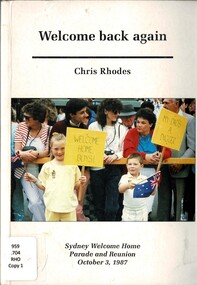
Book, Rhodes, Chris, Welcome back again: Sydney Welcome Home Parade and Reunion October 3, 1987 (Copy 2)
... ...Parades - New South Wales - Sydney...Vietnam War 1961-1975 - Social aspects - Australia Parades - New South Wales - Sydney Vietnam veterans march Welcome Home Parade 1987 Australia's Vietnam veterans were finally 'Welcomed Home' in Sydney during the first weekend in October, 1987, with civic ceremonies, a Sawn service, a concert and, most importantly, a parade or march. ...Australia's Vietnam veterans were finally 'Welcomed Home' in Sydney during the first weekend in October, 1987, with civic ceremonies, a Sawn service, a concert and, most importantly, a parade or march.Australia's Vietnam veterans were finally 'Welcomed Home' in Sydney during the first weekend in October, 1987, with civic ceremonies, a Sawn service, a concert and, most importantly, a parade or march.vietnam war, 1961-1975 - social aspects - australia, parades - new south wales - sydney, vietnam veterans march, welcome home parade 1987 -
 Flagstaff Hill Maritime Museum and Village
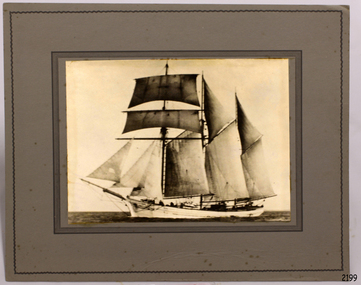
Photograph - Ship, Alma Doepel, 1931-1934
... The photograph is also significant in its representation of the the sailing ships that traded around Australia in the 1930s. flagstaff hill warrnambool shipwreck coast maritime museum maritime village photograph alma doepel frederick doepel henry jones and co harry heather eric droscoll alma doepel supporters club elders ixl parade of sail bicentenary day alma doepel voyagers club last top sail schooner in bass strait trade square-rigged fore-and-aft rigged Photograph (marked incorrectly on back) "Amy Doepel / ketch / Amy Doepel". Sticker with "91" in pencil. Information provided (dated incorrectly) "1943, Sydney, New South Wales ...This photograph is of the square-rigged schooner "Alma Doepel". Details added to the back of the photograph incorrectly describe the vessel as "Amy Doepel / ketch / Amy Doepel". The rigging on the vessel dates the photograph to sometime between 1931-1933. The location is yet to be determined. Frederick Doepel was a shipping agent in Bellinger Valley, NSW. He employed an experienced shipwright to build Alma Doepel, which was made from local timber. He named the ship “Alma Doepel” after his baby daughter Alma. The ship was registered in Sydney and launched 19th October 1903, and her first sea voyage was in December. She traded in timber Port Macquarie/Bellinger River and New Zealand. “Alma Doepel” was purchased by Henry Jones & Co., Hobart jam makers, in partnership with Harry Heather, her new captain, in 1916. The ship was then registered in Hobart. She carried jam and timber to the mainland, particularly Melbourne, and brought back cargo for Tasmania. She even carried the piles for the building of Portland Harbour. When Harry Heather passed away in 1937 he was succeeded by Eric Droscoll. Before the square-rigged "Alma Doepel" left for Tasmania on March 8th 1937 she was fitted with a new set of sails, becoming a fore-and-aft rigged schooner. She had been the last 'top sail' schooner in Bass Strait trade! "Alma Doepel" continued her coastal trading until 1942, when she was requisitioned by the Army. In January 1943 she was left in Melbourne by her crew and the Army took her over, taking her to Sydney in February, 1943. She was relaunched by the Army in 1944 minus two of her masts and her small 1936 engine, and was fitted with three large bus engines. In March 1945 she headed for the war zone, delivering cargo up and down the coast of New Guinea, at one time carrying over 400 troops. In 1946 she returned to Hobart where the Army re-converted her back for Bass Strait trading and returned her. In January 1947 Eric Driscoll took “Alma Doepel” to the eastern Tasmanian coastal port of St. Helens, trading cargo of local mountain ash timber to Melbourne on the mainland until 1959. She was then stripped down to her hull with only a single mast and two engines, and fitted with wooden bins on rails in her hold. From 1961 to 1975 she carried limestone to a factory to make carbide. Michael Wood and David Boykett, two of the governors of "Sail and Adventure", then bought her for the price of her two Gardiner engines and in 1976 they brought her to Melbourne. An Alma Doepel Supporters Club was formed to support the ship’s major restoration to a topsail schooner. In 1987 she was overhauled in Adelaide, with the support of Elders IXL and she returned to Sydney to lead the Parade of Sail on Bicentenary Day, 25th January 1988. She returned to Melbourne in February and began sail training voyages in Port Phillip Bay, operating from an office on Station Pier. The Alma Doepel Voyagers Club was started. Trainees joined the crew in sailing the ship over nine or ten days of instruction in sailing and seamanship. These trips plus chartered trips and fund raisers continued until early 1999, when she was no longer in a condition to operate; she needed a lot of attention. She lay idle in Victoria Dock for quite some time. In April 2001 “Alma Doepel” was taken to Port Macquarie’s Lady Nelson Wharf where she became a museum ship maintained by volunteers. In 2008 she had time in dry-dock and after sea-trials headed off to Victoria Harbour, Docklands, in Melbourne, where she is currently being restored with the help of The Supporters.This phot graph is significant for its connection with the Bass Strait trade, being the last top-sail schooner to brade across the strait. The photograph is also significant in its representation of the the sailing ships that traded around Australia in the 1930s.Photograph of "Alma Doepel " a wooden, 3 masted, square rigged sailing schooner built in Sydney, launched in 10/10/1903. Photograph is sepia coloured, mounted on card, inscription on the back. Information also provided with photograph. Photograph (marked incorrectly on back) "Amy Doepel / ketch / Amy Doepel". Sticker with "91" in pencil. Information provided (dated incorrectly) "1943, Sydney, New South Wales"flagstaff hill, warrnambool, shipwreck coast, maritime museum, maritime village, photograph, alma doepel, frederick doepel, henry jones and co, harry heather, eric droscoll, alma doepel supporters club, elders ixl, parade of sail, bicentenary day, alma doepel voyagers club, last top sail schooner in bass strait trade, square-rigged, fore-and-aft rigged -
 National Vietnam Veterans Museum (NVVM)
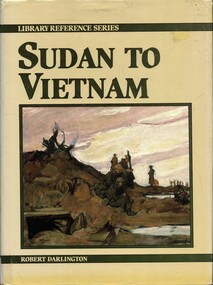
Book, Darlington, Robert, Sudan to Vietnam (Copy 1)
... War photography Australia - History Military - Pictorial works Colonial Wars Sudan South Africa China First World War Second World War Korea Malaya Borneo Vietnam Fall of Saigon In 1985 Australians had cause to remember two events in their history. On Sunday 3 March troops paraded through Sydney commemoraing the century of the departure of the New South Wales Coningent, Australia's first overseas force, to the Sudan War. ...In 1985 Australians had cause to remember two events in their history. On Sunday 3 March troops paraded through Sydney commemoraing the century of the departure of the New South Wales Coningent, Australia's first overseas force, to the Sudan War. Anzac Day 1985 also coincided with the tenth anniversary of the Fall of Saigon and the end of the most recent war in which Australia had been involved, the Vietnam War.In 1985 Australians had cause to remember two events in their history. On Sunday 3 March troops paraded through Sydney commemoraing the century of the departure of the New South Wales Coningent, Australia's first overseas force, to the Sudan War. Anzac Day 1985 also coincided with the tenth anniversary of the Fall of Saigon and the end of the most recent war in which Australia had been involved, the Vietnam War.war photography, australia - history, military - pictorial works, colonial wars, sudan, south africa, china, first world war, second world war, korea, malaya, borneo, vietnam, fall of saigon -
 Wangaratta RSL Sub Branch
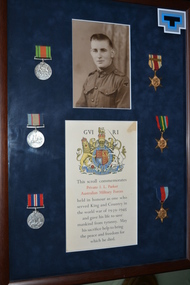
Mixed media - Framed Photo and Medals, Private J L Parker
... New South Wales in August 1940, as part of the 26th Brigade. Initially the brigade belonged to the 7th Division but in early 1941 moved to the 9th Division. The battalion did its initial training in Albury before moving to Bonegilla, Victoria, before sailing for the Middle East in November. The 2/23rd left Alamein on 2 December and headed back to Gaza in Palestine, where it participated in the 9th Division parade on 22 December. The battalion left Palestine in the third week of January 1943 and reached Sydney...New South Wales in August 1940, as part of the 26th Brigade. Initially the brigade belonged to the 7th Division but in early 1941 moved to the 9th Division. The battalion did its initial training in Albury before moving to Bonegilla, Victoria, before sailing for the Middle East in November. The 2/23rd left Alamein on 2 December and headed back to Gaza in Palestine, where it participated in the 9th Division parade on 22 December. The battalion left Palestine in the third week of January 1943 and reached Sydney ...Photograph and medals belonging to Private John Leonard PARKER VX56265 2/23 Battalion AIF Killed in Action on 24/11/1943 during WW2. Buried at Lae cemetery in New Guinea. The 2/23rd Infantry Battalion was raised at the Albury Showgrounds in New South Wales in August 1940, as part of the 26th Brigade. Initially the brigade belonged to the 7th Division but in early 1941 moved to the 9th Division. The battalion did its initial training in Albury before moving to Bonegilla, Victoria, before sailing for the Middle East in November. The 2/23rd left Alamein on 2 December and headed back to Gaza in Palestine, where it participated in the 9th Division parade on 22 December. The battalion left Palestine in the third week of January 1943 and reached Sydney at the end of February. Reorganised for jungle operations, on 4 September the 2/23rd participated in the division's amphibious landing at Red Beach, north west of Lae. Shortly before the landing occurred, the invasion fleet was attacked by six Japanese fighters and three bombers. Most of the Japanese bombs missed the Allied ships but one bomb hit the landing craft carrying the 2/23rd headquarters - killing the battalion commander and the ship's captain. The landing craft, however, made it to shore and the 2/23rd participated in the subsequent fighting around Lae, Finschhafen, and Sattelberg. After Sattelberg, the 2/23rd continued to move inland, capturing Masangkoo, Kuanko, and finally on 9 December, Wareo. Brown timber frame with dark blue background containing photograph of soldier, three round and three star shaped medals and document with coloured crest."This scroll commemorates Private J. L Parker Australian Military Forces held in honour as one who served King and Country in the world war of 1939-1945 and gave his life to save mankind from tyranny. May his sacrifice help to bring the peace and freedom for which he died."private john leonoard parker, 2/23rd battalion, ww2, new guinea -
 Ararat Gallery TAMA
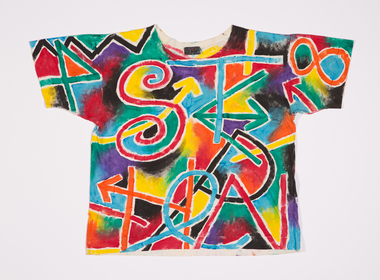
David McDiarmid, Untitled (T-shirt), 1984
... New York at the time, witnessing the forefront of epidemic and with his community deeply affected, and friends and lovers dying, he “suspected he was HIV-Positive…[and] would be dead with two years”. McDiarmid was an important figure in gay activism in Melbourne and Sydney-based protests for gay rights and was one of the original activists for of the first Sydney Mardi Gras Parade in 1978. Later he served as designer and then artistic director for the Sydney Gay and Lesbian Mardi Gras (1988-1990) and, in 1992, produced a series of posters for the AIDS Council of New South Wales...New York at the time, witnessing the forefront of epidemic and with his community deeply affected, and friends and lovers dying, he “suspected he was HIV-Positive…[and] would be dead with two years”. McDiarmid was an important figure in gay activism in Melbourne and Sydney-based protests for gay rights and was one of the original activists for of the first Sydney Mardi Gras Parade in 1978. Later he served as designer and then artistic director for the Sydney Gay and Lesbian Mardi Gras (1988-1990) and, in 1992, produced a series of posters for the AIDS Council of New South Wales ...David McDiarmid was a queer artist, designer and activist, born in Hobart, and lived between Melbourne, Sydney and New York. McDiarmid’s art practice was kaleidoscopic, celebratory and political. This artwork, Untitled (T-shirt), was presented to Stephen Allkins, a pioneering Sydney DJ, as a gift of the artist. The front of the t-shirt includes the letters for the word, STEPHEN, and the numbers for the year it was made, 84, while the back of the t-shirt includes the letters for the word, SYDNEY. The period in which this artwork was produced was a particularly tumultuous time. The HIV/AIDS epidemic emerged in the early 1980s and rapidly became a global public health emergency. McDiarmid was living in New York at the time, witnessing the forefront of epidemic and with his community deeply affected, and friends and lovers dying, he “suspected he was HIV-Positive…[and] would be dead with two years”. McDiarmid was an important figure in gay activism in Melbourne and Sydney-based protests for gay rights and was one of the original activists for of the first Sydney Mardi Gras Parade in 1978. Later he served as designer and then artistic director for the Sydney Gay and Lesbian Mardi Gras (1988-1990) and, in 1992, produced a series of posters for the AIDS Council of New South Wales. McDiarmid advocated for artists’ intellectual property, presenting at Sydney Writers' Festival and the Arts Law Centre of Australia on the management of artists’ estates in the face of HIV/AIDS epidemic.
