
Showing 1301 items matching "passchendaele"
-
 Monbulk RSL Sub Branch
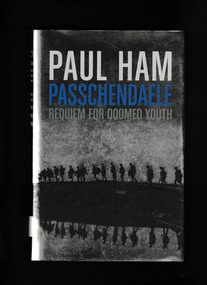
Book, Paul Ham, Passchendaele : requiem for doomed youth, 2016
... Passchendaele : requiem for doomed youth...world war 1914-1918 - campaigns - western front france - campaigns - passchaendaele Passchendaele epitomises everything that was most terrible about the Western Front. ...Passchendaele epitomises everything that was most terrible about the Western Front. The photographs never sleep of this four-month battle, fought from July to November 1917, the worst year of the war- blackened tree stumps rising out of a field of mud, corpses of men and horses drowned in shell holes, terrified soldiers huddled in trenches awaiting the whistle. The intervening century, the most violent in human history, has not disarmed these pictures of their power to shock. At the very least they ask us, on the 100th anniversary of the battle, to see and to try to understand what happened here. Yes, we commemorate the event. Yes, we adorn our breasts with poppies. But have we seen? Have we understood? Have we dared to reason why? What happened at Passchendaele was the expression of the 'wearing-down war', the war of pure attrition at its most spectacular and ferocious. Paul Ham's Passchendaele- Requiem for Doomed Youth shows how ordinary men on both sides endured this constant state of siege, with a very real awareness that they were being gradually, deliberately, wiped out. Yet the men never broke- they went over the top, when ordered, again and again and again. And if they fell dead or wounded, they were casualties in the 'normal wastage', as the commanders described them, of attritional war. Only the soldier's friends at the front knew him as a man, with thoughts and feelings. His family back home knew him as a son, husband or brother, before he had enlisted. By the end of 1917 he was a different creature- his experiences on the Western Front were simply beyond their powers of comprehension. The book tells the story of ordinary men in the grip of a political and military power struggle that determined their fate and has foreshadowed the destiny of the world for a century. Passchendaele lays down a powerful challenge to the idea of war as an inevitable expression of the human will, and examines the culpability of governments and military commanders in a catastrophe that destroyed the best part of a generation. Collapse summaryIndex, bibliography, notes, ill (maps), p.565.non-fictionPasschendaele epitomises everything that was most terrible about the Western Front. The photographs never sleep of this four-month battle, fought from July to November 1917, the worst year of the war- blackened tree stumps rising out of a field of mud, corpses of men and horses drowned in shell holes, terrified soldiers huddled in trenches awaiting the whistle. The intervening century, the most violent in human history, has not disarmed these pictures of their power to shock. At the very least they ask us, on the 100th anniversary of the battle, to see and to try to understand what happened here. Yes, we commemorate the event. Yes, we adorn our breasts with poppies. But have we seen? Have we understood? Have we dared to reason why? What happened at Passchendaele was the expression of the 'wearing-down war', the war of pure attrition at its most spectacular and ferocious. Paul Ham's Passchendaele- Requiem for Doomed Youth shows how ordinary men on both sides endured this constant state of siege, with a very real awareness that they were being gradually, deliberately, wiped out. Yet the men never broke- they went over the top, when ordered, again and again and again. And if they fell dead or wounded, they were casualties in the 'normal wastage', as the commanders described them, of attritional war. Only the soldier's friends at the front knew him as a man, with thoughts and feelings. His family back home knew him as a son, husband or brother, before he had enlisted. By the end of 1917 he was a different creature- his experiences on the Western Front were simply beyond their powers of comprehension. The book tells the story of ordinary men in the grip of a political and military power struggle that determined their fate and has foreshadowed the destiny of the world for a century. Passchendaele lays down a powerful challenge to the idea of war as an inevitable expression of the human will, and examines the culpability of governments and military commanders in a catastrophe that destroyed the best part of a generation. Collapse summary world war 1914-1918 - campaigns - western front, france - campaigns - passchaendaele -
 Ringwood RSL Sub-Branch
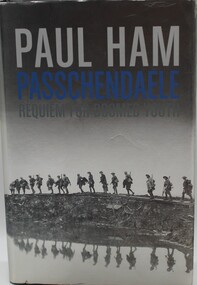
Book - Requiem for a doomed youth, Passchendaele by Paul Ham
... Passchendaele by Paul Ham...Passchendaele by Paul Ham Book Requiem for a doomed youth ... -
 Mrs Aeneas Gunn Memorial Library
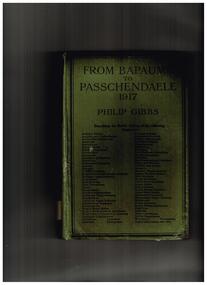
Book, Heinnemann, From Bapaume to Passchendaele, 1917, 1918
... From Bapaume to Passchendaele, 1917...From Bapaume to Passchendaele, 1917 Book Heinnemann Phillip Gibbs ...Account of the pointless battles in France in 1917Ill,maps, p.384.non-fictionAccount of the pointless battles in France in 1917world war 1914-1918 - campaigns - france, world war 1914-1917 - passchendaele -
 Bendigo Military Museum
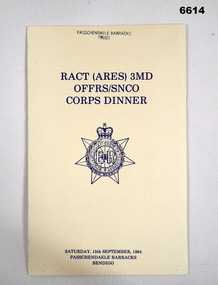
Programme - MENU, RACT 3MD OFFRS/SNCO CORPS DINNER, RACT, 1984
... At the bottom of the front is printed:- Saturday, 15th September 1984, Passchendaele Barracks Bendigo....Stamped at top of front cover is:- "Passchendaele Barracks Trust" ....RACT Formal Dinner 1984 Passchendaele Barracks Trust Stamped at top of front cover is:- "Passchendaele Barracks Trust" . ...The Dining President was MAJ. R. A. Hattam. The programme shows toasts and the menu.This is an off white cardboard sheet folded once to form a booklet. Printing is in blue ink. In the centre of front cover is the RACT Badge. Above that is the title as above. At the bottom of the front is printed:- Saturday, 15th September 1984, Passchendaele Barracks Bendigo.Stamped at top of front cover is:- "Passchendaele Barracks Trust" .ract, formal dinner, 1984, passchendaele barracks trust -
 Bendigo Military Museum
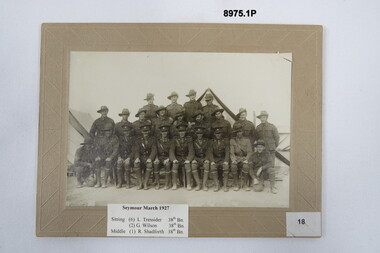
Photograph - PHOTOGRAPHS, 38TH BATTALION, 1927
... Tressider (38th Infantry Battalion) Passchendaele Barracks Trust in blue ink. 3. Capt S.O. ...Seymour March 1927. Passchendaele Barracks Trust in blue ink No. 81, Seymour March 1927. 2. ...Tressider (38th Infantry Battalion) Passchendaele Barracks Trust in blue ink. 3. Capt S.O. ...1. Sitting (6) L. Tressider 38th BN (2) G. Wilson 38 Bn. Middle (1) R. Shadforth 38 Bn. 2. Middle Row (1) R. Shadforth (2) Seated G. Wilson, (6) Seated L. Tressider (38th Infantry Battalion) Passchendaele Barracks Trust in blue ink. 3. Capt S.O. (Golly) Wilson (later Major) on horse at 38th Battalion Camp. The 38th Battalion was a local Bendigo based CMF Unit located at Passchendale Barracks, Mollison St.Three black and white photographs; 1. Seymour March 1927, 23 soldiers in group photo. 2. Seymour March 1927, 21 soldiers in group photo. 3. Capt. S.O. (Golly) Wilson, later Major, on horseback at 38th Battalion Camp.1. Seymour March 1927. Passchendaele Barracks Trust in blue ink No. 81, Seymour March 1927. 2. Seymour March 1927, Passchendaele Barracks Trust in blue ink. 3. Nil.passchendaele barracks trust, pbt18 17 31 -
 Bendigo Military Museum
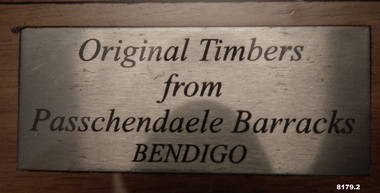
Furniture - TABLES, MEETING ROOM BDRSL, Red Dog Furniture, Post 2008
... The centre Timbers under the glass tops came from the old Passchendaele Barracks building in Mollison Street Bendigo. ...On the small plaques, “ Original Timbers from Passchendaele Barracks Bendigo”....The centre Timbers under the glass tops came from the old Passchendaele Barracks building in Mollison Street Bendigo. ...The centre Timbers under the glass tops came from the old Passchendaele Barracks building in Mollison Street Bendigo. The old building dated back to 1916. The building Depot was closed down and dismantled with the unit based there moved out to the new “Multi User Depot in Junortoun”. The tables were made in Bendigo and placed in the new Meeting Room of the Bendigo District RSL in Havilah Road which was named “Kokoda Room”. In another round of renovations to the Club the two tables were placed in the Soldier's Memorial Museum Pall Mall now Bendigo Military Museum. One was placed in the old Meeting room which at that time was part of the Museum, the second was placed in the old kitchen which had been converted into an BDRSL Office. With more renovations the two tables were returned to the Bendigo District RSL in a new meeting room. The two computer insets for cabling was then put into the tables. .1) .2) Two tables solid construction brown stain colour, the top has in inset of Timbers narrow a lighter brown stain laying across the width dimension, a glass top sits over these Timbers level with the heavy outside frame. Each table has an inset centre to accomodate computer cabling. There is a small plaque on each table.On the small plaques, “ Original Timbers from Passchendaele Barracks Bendigo”.brsl, smirsl, bdrslinc -
 Bendigo Military Museum
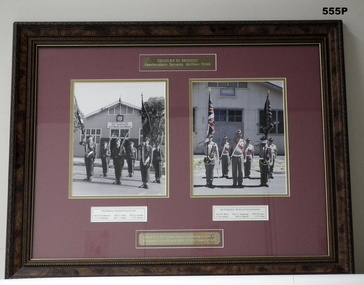
Photograph - PHOTOGRAPHS, FRAMED, Colours in Bendigo
... "Colours in Bendigo" Passchendaele Barracks, Mollison Street....Engraved brass plates - top - "Colours in Bendigo/Passchendaele, Mollison Street" Below - "Presented to Mr. ..."Colours in Bendigo" Passchendaele Barracks, Mollison Street. photography-photographs/frame accessories passchendaele barracks trust Engraved brass plates - top - "Colours in Bendigo/Passchendaele, Mollison Street" Below - "Presented to Mr. ..."Colours in Bendigo" Passchendaele Barracks, Mollison Street.Photographs - 2 copies of a " Colour Party" at Passchendale Barracks, Mollison Street. Bendigo, Vic Left - black and white C1960's. Right - colour C1980's. Two engraved brass plates above and below photographs. Printed names on white card below photographs. Frame - timber with decorative moulding, brown stain, pink colour mount glass front, Engraved brass plates - top - "Colours in Bendigo/Passchendaele, Mollison Street" Below - "Presented to Mr. Cliff Richards, President of the Bendigo & District RSL/ and its members by the Officers and Soldiers of Charlie Company 8/7 RVR." Black print on white card below photographs; Left "38 Battalion, Australian Imperial Force". Right "8th/7th Battalion, The Royal Victoria Regiment" with 6 names listed below.photography-photographs/frame accessories, passchendaele barracks trust -
 Bendigo Military Museum
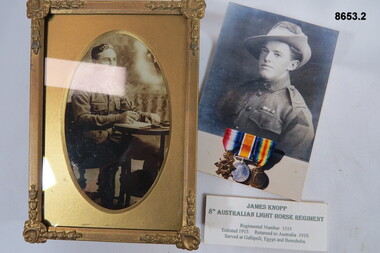
Photograph - FRAMED PHOTOGRAPH OF JAMES KNOPP + PHOTOGRAPH, WW1
... On rear of photograph - Passchendaele Barracks Trust....Returned to Australia 1919. Passchendaele Barracks Trust PBT 7 8 Photographs James Knopp 1. ...James Knopp - 8th AUSTRALIAN LIGHT HORSE REGIMENT. r/n 1515. Enlisted 1915, Served at Gallipoli, Egypt and Beersheba. Returned to Australia 1919.1. Photograph of James Knopp in uniform with medals. 2. Photograph in frame of James Knopp sitting at a writing desk.1. On rear of photograph - Passchendaele Barracks Trust.passchendaele barracks trust, pbt 7 8, photographs, james knopp -
 Bendigo Military Museum
Photograph - PHOTOGRAPH, FRAMED, 1939
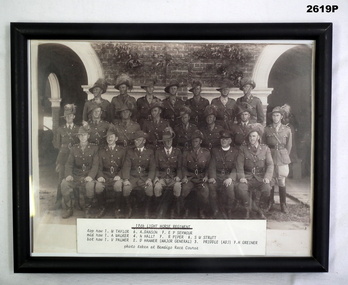
... On frame cardboard back in blue ink: “Passchendaele Barracks / Trust”...H GREINER photography-photographs frame accessories passchendaele barracks trust On frame cardboard back in blue ink: “Passchendaele Barracks / Trust” Photograph, black white colour, group portrait of 22 uniformed Officers of the 17th Light Horse Regiment. ...List of names printed on card on photograph: 17th Light Horse Regiment Photograph taken at Bendigo Racecourse Top row: 1. W TAYLOR 6. A DANSON 7. E P SEYMOUR Mid row: 1. A WALKER 4. N HALL? 7. R PIPER 8. W STRUTT Bottom row: 1. V PALMER 2. D HAMMER (MAJOR GENERAL) 3. P RIDDLE 7. H GREINERPhotograph, black white colour, group portrait of 22 uniformed Officers of the 17th Light Horse Regiment. Wooden frame painted black. Label on photograph, black print on white cardboard showing list of names.On frame cardboard back in blue ink: “Passchendaele Barracks / Trust”photography-photographs, frame accessories, passchendaele barracks trust -
 Bendigo Military Museum
Photograph - 38th BN PHOTOGRAPHS, Unknown
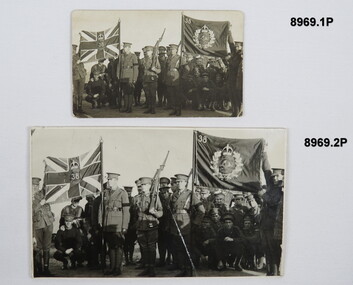
... On rear "Postcard" stamped in blue on rear "Passchendaele Barraks Trust"....The Presentation of the 38th Battalion AIF Unit and Kings Colours were presented to the Battalion on the 14th of June 1916 by the Citizens of Bendigo. Passchendaele Barracks Trust PBT11 Photographs 38th Bn Colours 1. ...The Presentation of the 38th Battalion AIF Unit and Kings Colours were presented to the Battalion on the 14th of June 1916 by the Citizens of Bendigo. 1. Postcard sized photo in black and white showing the 38th Battalion presentation of the Colours. 2. Enlarged photo of the original black and white on a card backing.1. On rear "Postcard" stamped in blue on rear "Passchendaele Barraks Trust".passchendaele barracks trust, pbt11, photographs, 38th bn, colours -
 Bendigo Military Museum
Print - PRINT, FRAMED, COAT of ARMS, Unknown
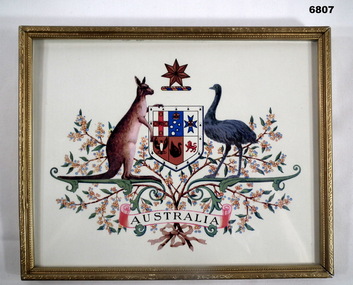
... Stamp on back stating "Passchendaele Barracks Trust"....Wreath colours of gold and blue are colours of Australia's livery and shield held up by native animals of Kangaroo and Emu. Coat of Arms Passchendaele Barracks Trust Coat of Arms with "Australia" at bottom. ...Seven point star represents 6 states and 7th for Territorial shield has 6 symbols for each of 6 states. Wreath colours of gold and blue are colours of Australia's livery and shield held up by native animals of Kangaroo and Emu.Gold ornate metallic frame with a coloured print of Australian Coat of Arms (Wreath of gold and blue with Kangaroo and Emu holding a shield and at top a 7 pointed star). Is in colour on a white background. Image has glass protection and frame has hard cardboard backing with a hook on either side connected with a length of copper hanging wire. Coat of Arms with "Australia" at bottom. Stamp on back stating "Passchendaele Barracks Trust".coat of arms, passchendaele barracks trust -
 Bendigo Military Museum
Photograph - GAURD OF HONOUR 1957, 1957
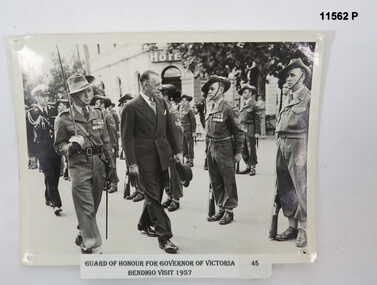
... On rear - "AC148 Passchendaele Barracks Trust" 45....Passchendaele Barracks Trust PBT45 Photograph 1957 Governor of Victoria On front - "Guard of Honour for Governor of Victoria Bendigo visit 1957". ...His Excellency The Governor of Victoria inspecting Guard of Honour of troops at attention, C.O. and Aide-de-Campe escort with hotel and trees in background.On front - "Guard of Honour for Governor of Victoria Bendigo visit 1957". On rear - "AC148 Passchendaele Barracks Trust" 45.passchendaele barracks trust, pbt45, photograph, 1957, governor of victoria -
 Bendigo Military Museum
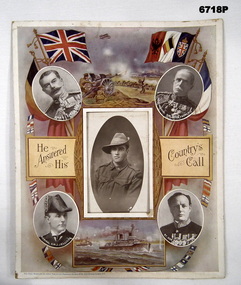
Photograph - PORTRAIT IN A PATRIOTIC FRAME, 1914-1918
... Passchendaele Barracks Trust...Passchendaele Barracks Trust Passchendaele Barracks Trust WW1 Soldier Portrait Picture - This is a black and white "chest up" portrait of an Australian soldier. ...Passchendaele Barracks TrustPicture - This is a black and white "chest up" portrait of an Australian soldier. He is in uniform wearing a slouch hat, Rising sun badges are on his collar. The photo is oval shaped. Mount - This is a cardboard sheet. It has a rectangular hole in the centre. On top LHS is the Union flag, RHS has places of various allies. The top shows a small primitive bi-plane. Top Centre is an 18 Pdr Cannon firing. Photos of Kitchener, French, Jellicoe and Churchill are in each corner. A ship is at the bottom centre. The photo has detached from the frame.passchendaele barracks trust, ww1, soldier portrait -
 Bendigo Military Museum
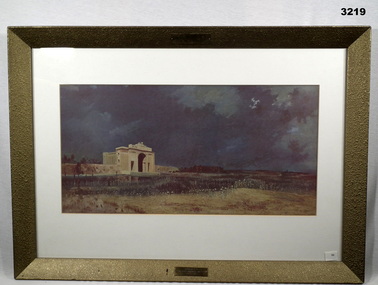
Painting - PAINTING MENIN GATE, FRAMED, post WW1
... Black & white stick RHS front bottom & LHS bottom of backing: "No 70" Stamp on back: "Passchendaele Barracks Trust" ...Passchendaele Barracks Trust painting menin gate Black & white stick RHS front bottom & LHS bottom of backing: "No 70" Stamp on back: "Passchendaele Barracks Trust" Colour painting of Menin Gate, Ypres Belgium at midnight by Will Longstaff, Australian Painter & War Artist. ...Colour painting of Menin Gate, Ypres Belgium at midnight by Will Longstaff, Australian Painter & War Artist. Printing mounted on white background with gold painted wooden frame, glass front & white cardboard backing.Black & white stick RHS front bottom & LHS bottom of backing: "No 70" Stamp on back: "Passchendaele Barracks Trust" passchendaele barracks trust, painting, menin gate -
 Bendigo Military Museum
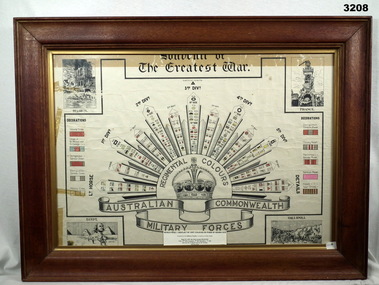
Poster - POSTER WW1,FRAMED, Bendigo Art Framing, Post WW1
... Printed top: “Souvenir of the Greatest War” Printed at bottom: “Australian Commonwealth Military Forces” Stamped on back: “Passchendaele Barracks Trust”...Saw service in Egypt and on the Somme 1915 - 1919. military history-army documents-posters Passchendaele Barracks Trust Printed top: “Souvenir of the Greatest War” Printed at bottom: “Australian Commonwealth Military Forces” Stamped on back: “Passchendaele Barracks Trust” Display of unit colours of WWI in the form of a Rising Sun. ...Item donated in the memory of Regt No 3188 Sgt John Joseph MILBURN, Unit 15th M G Company, 5th M G Battalion, 1st AIF. Saw service in Egypt and on the Somme 1915 - 1919.Display of unit colours of WWI in the form of a Rising Sun. Printed on white background with drawings of Belgium, France, Gallipoli & Egypt in each corner. Decorations are listed each side of display. All decorations & unit badges are in regimental colours. Display has glass front & brown wooden frame with gold inner edge, fawn cardboard backing.Printed top: “Souvenir of the Greatest War” Printed at bottom: “Australian Commonwealth Military Forces” Stamped on back: “Passchendaele Barracks Trust”military history-army, documents-posters, passchendaele barracks trust -
 Bendigo Military Museum
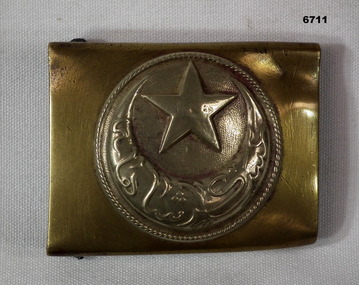
Uniform - BELT BUCKLE - OTTOMAN (Turkish), 1910 - 1918
... Passchendaele Barracks Trust NR 22 - 663T....Passchendaele Barracks Trust NR 22 - 663T. Passchendaele Barracks Trust Belt Buckle Turkish This is a brass belt buckle. ...Passchendaele Barracks Trust NR 22 - 663T.This is a brass belt buckle. The front has a round 3D badge displaying a star and half moon. On the half moon appears to have raised Turkish writing. On the rear, is a small rectangular coup, and, a rod that pivots. On that Rod are two metal prongs.passchendaele barracks trust, belt buckle, turkish -
 Bendigo Military Museum
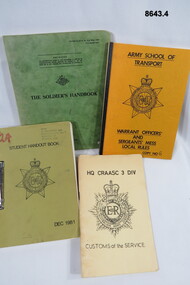
Manual - TRAINING VARIOUS, 15 TRANSPORT SQN, 1981
... 3. 68896 15 Transport SQN, Passchendaele Barracks, Mollison St. BENDIGO 3550 24. 4. 397883 CPL N.S. ...Passchendaele Barracks Trust Handbook Rules Customs Army 3. 68896 15 Transport SQN, Passchendaele Barracks, Mollison St. ...Four Soldiers training and instruction manuals. 1. The Soldiers handbook has been written primarily for the newly joined recruit. 2. Army School of Transport Warrant Officers and Sergeants Mess Local Rules No. 6. 3. Army School of Transport Student Handout Book. 4. Customs of the Service printed for the issue to all Officers and NCO's in the Column.3. 68896 15 Transport SQN, Passchendaele Barracks, Mollison St. BENDIGO 3550 24. 4. 397883 CPL N.S. FULLARTON.passchendaele barracks trust, handbook, rules, customs, army -
 Bendigo Military Museum
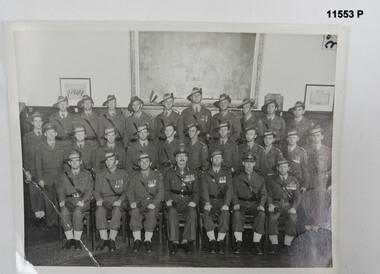
Photograph - 38th BATTALION, Unknown
... The 38th Battalion was a local Bendigo based Unit located at Passchendaele Barracks, Mollison St....The 38th Battalion was a local Bendigo based Unit located at Passchendaele Barracks, Mollison St. Passchendaele Barracks Trust PBT 0 Photograph Officers 38th Battalion. ...The 38th Battalion was a local Bendigo based Unit located at Passchendaele Barracks, Mollison St.Black and white photo of 38th Battalion Officers, some carrying swords, Officers sitting and standing.passchendaele barracks trust, pbt 0, photograph, officers, 38th battalion. -
 Rutherglen RSL Sub-Branch
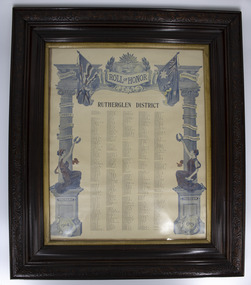
Memorabilia - Roll of honour, c. 1920
... Right column reads: ARMENTIERES / BULLECOURT / PASSCHENDAELE / VILLERS-BRETONNEUX / FREEDOM / 1919. ...WWI First World War Honor Boards Rutherglen Right column reads: ARMENTIERES / BULLECOURT / PASSCHENDAELE / VILLERS-BRETONNEUX / FREEDOM / 1919. ...Printed poster, Roll of Honor, higlighting all the names of those who served in the Great War from the Rutherglen District. Black ornate wooden frame.Right column reads: ARMENTIERES / BULLECOURT / PASSCHENDAELE / VILLERS-BRETONNEUX / FREEDOM / 1919. Left column reads: POZIERES / YPRES / SOMME / MESSINES / VICTORY / 1914wwi, first world war, honor boards, rutherglen -
 Bendigo Military Museum
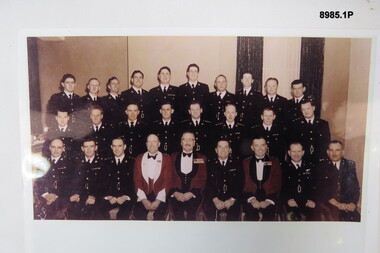
Photograph - 38TH BATTALION PHOTOGRAPHS
... The 38th Battalion was a local Bendigo based CMF unit located at Passchendaele Barracks, Mollison Street....The 38th Battalion was a local Bendigo based CMF unit located at Passchendaele Barracks, Mollison Street. Passchendaele Barracks Trust PBT0 Freedom of Entry City of Bendigo IP BKS 30 July 13. 2. ...The 38th Battalion was a local Bendigo based CMF unit located at Passchendaele Barracks, Mollison Street.1. Coloured photograph showing a group of Officers, seated and standing in 2 rows. 2. Printed list of Officer's attending Freedom of Entry to City of Bendigo 24/8/58.IP BKS 30 July 13. 2. List of names of Officers attending.passchendaele barracks trust, pbt0, freedom of entry, city of bendigo -
 Bendigo Military Museum
Photograph - 38th BATTALION 1938, 1938
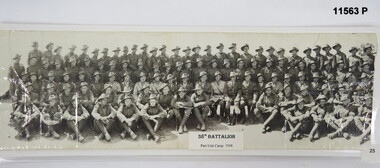
... The 38th Battalion was a local Bendigo based CMF unit located at Passchendaele Barracks, Mollison Street....The 38th Battalion was a local Bendigo based CMF unit located at Passchendaele Barracks, Mollison Street. Passchendaele Barracks Trust PBT25 Photograph Photograph of 38th Battalion, Part Unit Camp 1938. ...The 38th Battalion was a local Bendigo based CMF unit located at Passchendaele Barracks, Mollison Street.Photograph of 38th Battalion, Part Unit Camp 1938.passchendaele barracks trust, pbt25, photograph -
 Bendigo Military Museum
Photograph - 38th BATTALION, Unknown
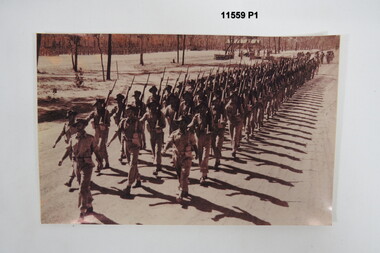
... The 38th Battalion was a local Bendigo based CMF unit located at Passchendaele Barracks, Mollison Street....The 38th Battalion was a local Bendigo based CMF unit located at Passchendaele Barracks, Mollison Street. Passchendaele Barracks Trust PBT 0 Photographs 38th Battalion 1. ...The 38th Battalion was a local Bendigo based CMF unit located at Passchendaele Barracks, Mollison Street.1. Sepia photograph of Troops marching with basic webbing and rifles, band at rear. 2. Sepia Photograph of soldiers sitting in dress uniform. 3. Black and white Photograph of Inspection of soldiers on parade.passchendaele barracks trust, pbt 0, photographs, 38th battalion -
 Bendigo Military Museum
Photograph - 38th BATTALION, Unknown
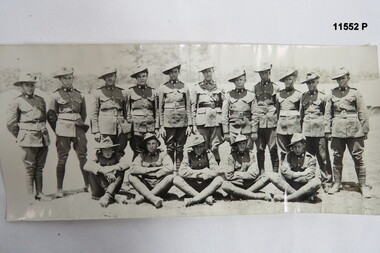
... The 38th Battalion was a local Bendigo based CMF unit located at Passchendaele Barracks, Mollison Street....The 38th Battalion was a local Bendigo based CMF unit located at Passchendaele Barracks, Mollison Street. Passchendaele Barracks Trust PBT 0 Photograph 38th Battalion Black and white photograph of 16 soldiers, pre WW2, 38th Battalion. ...The 38th Battalion was a local Bendigo based CMF unit located at Passchendaele Barracks, Mollison Street.Black and white photograph of 16 soldiers, pre WW2, 38th Battalion.passchendaele barracks trust, pbt 0, photograph, 38th battalion -
 Bendigo Military Museum
Photograph - 38TH BATTALION PHOTOGRAPH
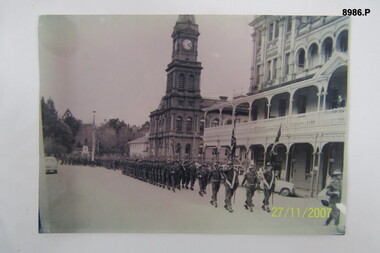
... The 38th battalion was a local Bendigo based CMF unit located at Passchendaele Barracks, Mollison St....The 38th battalion was a local Bendigo based CMF unit located at Passchendaele Barracks, Mollison St. Passchendaele Barracks Trust PBT0 38th battalion Photograph FRONT OF PHOTO 27/11/2007 (Highly debatable). ...The 38th battalion was a local Bendigo based CMF unit located at Passchendaele Barracks, Mollison St.Black and white photograph of 38th Battalion marching into Williamson St from Pall Mall in the 1950's.FRONT OF PHOTO 27/11/2007 (Highly debatable). passchendaele barracks trust, pbt0, 38th battalion, photograph -
 Bendigo Military Museum
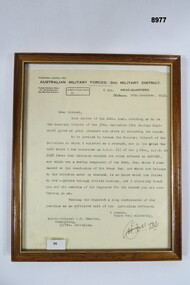
Document - FRAMED DOCUMENT, LT.COL J.W. Swatton, 16 Sep 1932
... The 38th Battalion was a local Bendigo based CMF Unit located at Passchendaele Barracks, Mollison Street. Bendigo....The 38th Battalion was a local Bendigo based CMF Unit located at Passchendaele Barracks, Mollison Street. Bendigo. ...The 38th Battalion was a local Bendigo based CMF Unit located at Passchendaele Barracks, Mollison Street. Bendigo.Typewritten letter from Lieut-Colonel J.W. Swatton acknowledging to become an Honorary Colonel of the 38th Battalion (Bendigo Regiment dated 16 November 1932).passchendaele barracks trust, pbt26, framed letter -
 Bendigo Military Museum
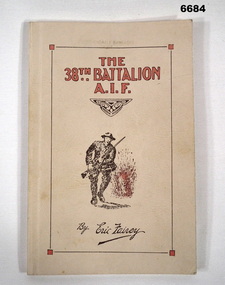
Book - BOOK, 38th BATTALION AIF, Bendigo Advertiser Pty Ltd, 1920
... Presented to the Officers and Sergeant Mess Passchendaele Barracks, Mollison Street, Bendigo. ...Presented to the Officers and Sergeant Mess Passchendaele Barracks, Mollison Street, Bendigo. ...Presented to the Officers and Sergeant Mess Passchendaele Barracks, Mollison Street, Bendigo. By Major R. A. HATTAM Aug 1955.Book - cream coloured medium weight cardboard cover. Red and black print script, black print soldier. 110 pages.The 38th Battalion AIF by ERIC FAIREY.passchendaele barracks trust, book, 38th battalion -
 Bendigo Military Museum
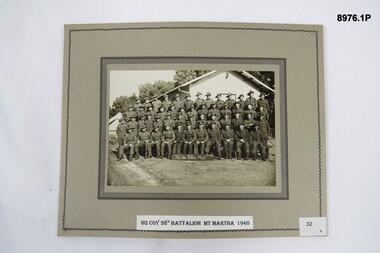
Photograph - PHOTOGRAPHS, 38TH BATTALION, 2) C Fitch & Sons, Photographers, 1940
... The 38th Battalion was a local Bendigo Based CMF Unit located at Passchendaele Barracks, Mollison St....The 38th Battalion was a local Bendigo Based CMF Unit located at Passchendaele Barracks, Mollison St. Passchendaele Barracks Trust PBT32.33.38.39 Photographs 1. ...1. to 4. The 38th Battalion was a local Bendigo Based CMF Unit located at Passchendaele Barracks, Mollison St.Four black and white photographs on grey coloured card backing. 1. Shows group of soldiers, 4 rows, building and tent background. 2. Shows group of soldiers, 5 rows, building and tent background. 3. Shows group of soldiers, 5 rows, building and tent background. 4. Shows group of soldiers, 4 rows, building background.1. On front, HQ Coy, 38th Battalion, Mt Martha 1940. 2. A. Coy 38th Battalion, Mt Martha 1940. 3. B. Coy, 38th Battalion, Mt Martha 1940. 4. D. Coy, 38th Battalion Mt. Martha 1940. On all four photos; “On loan from The Estate of Colonel J.W. Swatton” 1. Ref No. JWS P/-/13. 2. Ref No. JWS P/-/14, 3. Ref No. JWS P/-/15, 4. P/-/16.passchendaele barracks trust, pbt32.33.38.39, photographs -
 Bendigo Military Museum
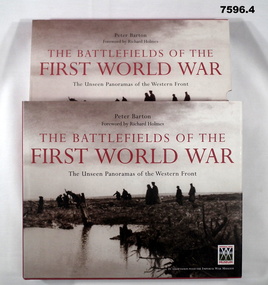
Book - BOOK, WW1, PICTORIAL, Peter BARTON, "THE BATTLEFIELDS OF THE FIRST WORLD WAR", 2005
... Passchendaele". 376 pages, cut plain, white paper. ...Passchendaele". 376 pages, cut plain, white paper. ...From front cover- "THE BATTLEFIELDS OF THE FIRST WORLD WAR". "The Unseen Panoramas of the Western front".Box with hard cover book, dust cover and two CD's. 1. Cover - cardboard, with adhered buckram, red colour, white print on spine. Dust cover - paper, with red, black and white print, front, spine and back. Illustrated, black and white photographs. Front cover - "German prisoners and wounded Canadians crossing the battlefield, Passchendaele 1917". Back cover - "Canadian soldiers carrying trench mats. Passchendaele". 376 pages, cut plain, white paper. Illustrated black and white, sepia and colour photographs, maps and diagrams. 2. Box for book - Cardboard, duplicate of print and photographs as per dust cover. Box is open one end. 3. & 4. CD's. - two, plastic CD's in clear plastic storage envelopes adhered to back and paper cardboard cover.books, ww1, pictorial -
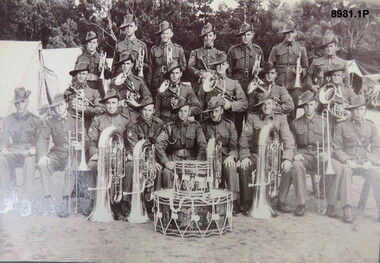 Bendigo Military Museum
Photograph - 38TH BATTALION PHOTOGRAPHS, 1933-1940
... The 38th Battalion was a local Bendigo based CMF unit located at Passchendaele Barracks, Mollison St. Bendigo....The 38th Battalion was a local Bendigo based CMF unit located at Passchendaele Barracks, Mollison St. Bendigo. Passchendaele Barracks Trust Mounted photos 38th Battalion PBT1.2.3. "38th Bendigo Military Band dated 1933-1940". ...1. to 3. The 38th Battalion was a local Bendigo based CMF unit located at Passchendaele Barracks, Mollison St. Bendigo.Three black and white photographs mounted on green card backing of the 38th Bendigo Military Band. 1. "Band members with instruments, seated and standing, tents and cars in background. 2. Band members with instruments seated and standing in front of a buildings with mascot. 3. Band members with instruments, seated and standing behind 'garden' surrounded by white stoned "38th BAND"."38th Bendigo Military Band dated 1933-1940".passchendaele barracks trust, mounted photos, 38th battalion, pbt1.2.3. -
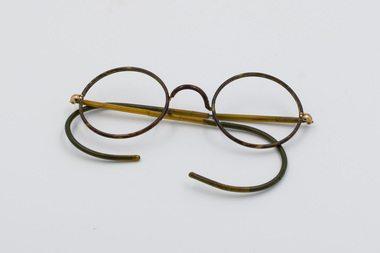 Emerald Museum & Nobelius Heritage Park
Functional object - Glasses case containing broken pair of spectacles (no lenses), Coles & Garrard Opticians, Glasses case containing broken pair of spectacles with no lenses, Early 20th century
... Authur lost an eye at Passchendaele in 1917. Arthur was born in Hammersmith, London, England. ...Authur lost an eye at Passchendaele in 1917. Arthur was born in Hammersmith, London, England. ...This glasses case may have belonged to Arthur Ayers (nee Casement) 1887-1964. Arthur and his wife, Nina Ayers lived in Avonsleigh 1929-1964. Authur lost an eye at Passchendaele in 1917. Arthur was born in Hammersmith, London, England. Emigrated to Australia in 1911.Enlisted in the Australian Imperial Force 1914. Served at Gallipoli and the western front in WWI, wounded at Passchendaele in 1917. Glasses case and spectacles belonged to a WWI veteran, Arthur Ayres, who served at Gallipoli and the western front and was wounded at Passchendaele in 1917 Brown coloured glasses case containing a broken pair of spectacles with no lensesOn the outside of the glasses case is printed 'COLES & GARRARD OPTICIANS Pty.Ltd. PHONE CENT. 10595, 370-2 BOURKE ST MELBnina casement, arthur ayers, blanche casement, avonsleigh, wwi
