
Showing 9 items matching "pat vaughan"
-
 Eltham District Historical Society Inc
Document - Folder, Vaughan, Pat
... Vaughan, Pat...Pat Vaughan...Hurstbridge resident Pat Vaughan stood for the Greens in the Van Yean seat. ...Hurstbridge resident Pat Vaughan stood for the Greens in the Van Yean seat. ...Hurstbridge resident Pat Vaughan stood for the Greens in the Van Yean seat. Contents Newspaper article: "Greens keen on their chanes", Diamond Valley Leader, 21 August 2002. Pat Vaughan, candidate for Greens in Yan Yean.Newspaper clippings, A4 photocopies, etcpat vaughan, la trobe university -
 Eltham District Historical Society Inc
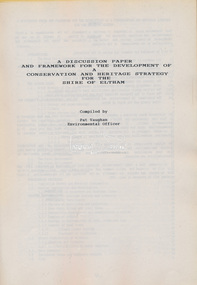
Book, Pat Vaughan, A discussion paper and framework for the development of a Conservation and Heritage Strategy for the Shire of Eltham
... Pat Vaughan...Soft cover bound, A4, 107 pages A discussion paper and framework for the development of a Conservation and Heritage Strategy for the Shire of Eltham Book Book Pat Vaughan Shire of Eltham ... -
 Eltham District Historical Society Inc
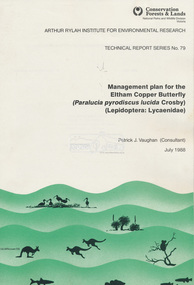
Book, Pat Vaughan, Management plan for the Eltham Copper Butterfly (Paralucia pyrodiscus lucida Crosby), (Lepidoptera: Lycasenidae); Arthur Rylah Institute for Environmental Researcg, Technical Report Series No. 79, July 1988
... Pat Vaughan...Soft cover bound A4, 54 pages Management plan for the Eltham Copper Butterfly (Paralucia pyrodiscus lucida Crosby), (Lepidoptera: Lycasenidae); Arthur Rylah Institute for Environmental Researcg, Technical Report Series No. 79 Book Book Pat Vaughan Conservation Forests & Lands, National Parks and Wildlife Division, Victoria ... -
 Eltham District Historical Society Inc
Film - Video (VHS), Phil Burke et al, Shire of Eltham Grants Commsission Submission (Series 69, Item 7), 1993
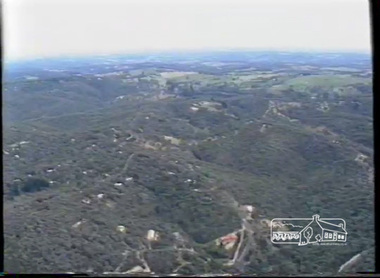
... ...pat vaughan...Short interview with Pat Vaughan, Environmental Officer for the Shire discussing the Eltham Copper Butterfly who also mentions many other species in the Shire of high significance from bats to mammals to plants as well as the importance of the Green Wedge to Melbourne – the lungs of Melbourne - and ensuring the protection of very important habitat which requires a great deal of planning and management to look after. ...Short interview with Pat Vaughan, Environmental Officer for the Shire discussing the Eltham Copper Butterfly who also mentions many other species in the Shire of high significance from bats to mammals to plants as well as the importance of the Green Wedge to Melbourne – the lungs of Melbourne - and ensuring the protection of very important habitat which requires a great deal of planning and management to look after. ...Shire of Eltham Archives: Series 69, Item 7 Opens with aerial views of the Shire, 85% of the shire covered by the Green wedge principal. Discusses the obligations required of the Shire to maintain the Green Wedge. The Shire covers over 27,000 hectares with a population in excess of 45,000 residents, more than 70% living in the southern 10% of the Shire in suburbs of Eltham, Montmorency, Lower Plenty and Research. 85% of the Shire in the more sparsely populated northern area which is covered by the Green Wedge. Council is committed to providing a parity of services to all residents such as garbage collection and maintenance of roads. Views of rubbish collection trucks in Montmorency. It is emphasised that the cost of these services in highly populated areas is relatively low whereas in the sparsely populated Green Wedge areas, considerable. There are hundreds of kilometres of roads throughout the Shire, many unmade and maintenance is high to check overhanging trees and erosion especially on the steep hills is expensive and disproportionate to servicing the population in the dense urban areas. Shows views of hilly gravel roads and graders at work maintaining them. Shows scenes of assessing planning applications in these rural areas which takes significantly more time as well as other services provided such as Meals on Wheels, building permits, Ranger services. Provision of recreational facilities in hilly areas requires the acquisition of expensive river flats (views of cricket ground surrounded by hills) and where not possible, costly earthmoving required. Also, views highlighting extensive tracks of natural habitat home to significant bird, animal and plant life. Shire emphasises its commitment highlighted by the Eltham Copper Butterfly which the Shire maintains small pockets of bushland to ensure its survival at significant expense (views of Pauline Toner Copper Butterfly Reserve.) Short interview with Pat Vaughan, Environmental Officer for the Shire discussing the Eltham Copper Butterfly who also mentions many other species in the Shire of high significance from bats to mammals to plants as well as the importance of the Green Wedge to Melbourne – the lungs of Melbourne - and ensuring the protection of very important habitat which requires a great deal of planning and management to look after. Views of Wingrove Park to emphasise this maintenance by machinery in some areas is too damaging and introduced species, etc must be removed by hand. Balancing the services and facilities expected by the community with the needs of the environment requires careful planning demands requires careful planning and the principals of the Green Wedge require constant attention in the face of growing need for housing. Director of Planning & Environment, Richard Allen advises there are approximately 1,300 planning permits and development applications each year ranging from simple subdivision, boundary realignments to further complicated non-urban developments for agricultural pursuits and the level of expertise required from architectural and engineering to land degradation, flora and fauna. Video finishes with aerial views and parklands, streetscapes and rural areas. VHS Video cassette Converted to MP4 file format 00:07:39; 89MBshire of eltham, video recording, shire of eltham archives, eltham shire council, eltham, building permits, cricket ground, development applications, eltham copper butterfly, garbage collection, graders, green wedge, lower plenty, meals on wheels, montmorency, pat vaughan, pauline toner reserve, planning applications, planning permits, ranger services, recreational facilities, research, richard allen, roads, rural areas, wingrove park, victoria grants commission -
 Eltham District Historical Society Inc
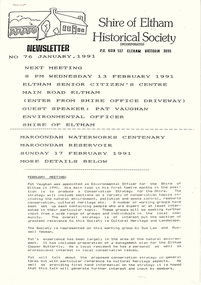
Newsletter, Newsletter, No. 76 January 1991
... Contents: • Next meeting, guest speaker; Pat Vaughan, Environmental Officer, Shire of Eltham • February Meeting • Maroondah Aqueduct Centenary • Annual General Meeting • Eltham, England • ‘Watershed’ Jackson • Kangaroo Ground Fire Brigade • Other News ...Contents: • Next meeting, guest speaker; Pat Vaughan, Environmental Officer, Shire of Eltham • February Meeting • Maroondah Aqueduct Centenary • Annual General Meeting • Eltham, England • ‘Watershed’ Jackson • Kangaroo Ground Fire Brigade • Other News The Shire of Eltham Historical Society was formed in October 1967. ...Contents: • Next meeting, guest speaker; Pat Vaughan, Environmental Officer, Shire of Eltham • February Meeting • Maroondah Aqueduct Centenary • Annual General Meeting • Eltham, England • ‘Watershed’ Jackson • Kangaroo Ground Fire Brigade • Other News The Shire of Eltham Historical Society was formed in October 1967. The first newsletter of the Society was issued May 1978 and has been published continuously ever since on a bi-monthly basis. With the cessation of the Shire of Eltham in late 1994, the Society's name was revised to Eltham District Historical Society and this name first appeared with issue No. 103, July 1995. The collection of the Society's newsletters provides a valuable resource on the history of the Society's activities, office bearers and committee members, guest speakers and subjects of historical interest pertinent to the former Shire of Eltham and the Eltham District.A4 photocopied newsletter distributed to membersnewsletter, eltham district historical society, shire of eltham historical society -
 Flagstaff Hill Maritime Museum and Village
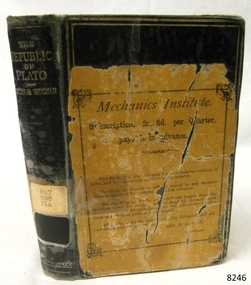
Book, The Republic of Plato
... The Warrnambool Mechanics' Institute’s publication collection is of both local and state significance. flagstaff hill warrnambool shipwrecked coast flagstaff hill maritime museum maritime museum shipwreck coast flagstaff hill maritime village great ocean road book pattison collection warrnambool library warrnambool mechanics’ institute ralph eric pattison corangamite regional library service warrnambool city librarian mechanics’ institute library victorian library board warrnambool books and records warrnambool children’s library john llewlyn davies david james vaughan the republic of plato The label on spine cover with typed text PAT 888 PLA Pastedown front endpaper has a sticker from Warrnambool Mechanics Institute and Free Library Front loose endpaper has a sticker from Corangamite Regional Library Service Front loose endpaper has a stamp from Corangamite Regional Library Service The Republic of Plato Translated into English, with an analysis and notes by John Llewlyn Davies and David James Vaughan Publisher: Macmillan And Co Date: 1872 The Republic of Plato Book ...This book was part of a large group of books referred to as the Pattison Collection, which belonged to the Warrnambool Public Library, part of the Warrnambool Mechanics’ Institute. About RALPH ERIC PATTISON and the ‘PATTISON COLLECTION’ The ‘Pattison Collection’ is a collection of books and records that was originally owned by the Warrnambool Mechanics’ Institute, founded in Warrnambool in 1853. By 1886 the Warrnambool Mechanics’ Institute (WMI) had grown to have a Library, Museum and Fine Arts Gallery, with a collection of “… choice productions of art and valuable specimens in almost every branch and many wonderful national curiosities are now to be seen there, including historic relics of the town and district.” It later included a School of Design. Although it was very well patronised, the WMI was led to ask the City Council to take it over in 1911 due to lack of financial support. In 1935 Ralph Pattison was appointed as City Librarian to establish and organise the Warrnambool Public Library as it was then called. Ralph Eric Pattison was born in Rockhampton, Queensland, in 1891. He married Maude Swan from Warrnambool in 1920 and they set up home in Warrnambool. In 1935 when Pattison accepted the position as City Librarian for the Warrnambool City Council his huge challenge was to make a functional library within two rooms of the Mechanics’ Institute. He tirelessly cleaned, cleared and sorted a disarrayed collection of old books, jars of preserved specimens and other items reserved for exhibition in the city’s museum. He developed and updated the library with a wide variety of books for all tastes, including reference books for students; a difficult task to fulfil during the years following the Depression. He converted all of the lower areas of the building into a library, reference room and reading room for members and the public. The books were sorted and stored using a cataloguing and card index system that he had developed himself. He also prepared the upper floor of the building and established the Art Gallery and later the Museum, a place to exhibit the many old relics that had been stored for years for this purpose. One of the treasures he found was a beautiful ancient clock, which he repaired, restored and enjoyed using in his office during the years of his service there. Ralph Pattison was described as “a meticulous gentleman whose punctuality, floorless courtesy and distinctive neat dress were hallmarks of his character, and ‘his’ clock controlled his daily routine and his opening and closing of the library’s large heavy doors to the minute.” Pattison took leave from 1942 to 1945 to serve in the Royal Australian Navy, Volunteer Reserve as Lieutenant. A few years later he converted one of the Museum’s rooms into a Children’s Library, stocking it with suitable books for the younger generation. This was an instant success. In the 1950’s he had the honour of being appointed to the Victorian Library Board and received more inspiration from the monthly conferences in Melbourne. He was sadly retired in 1959 after over 23 years of service, due to the fact that he had gone over the working age of council officers. However, he continued to take a very keen interest in the continual development of the Library until his death in 1969. THE NEW WARRNAMBOOL LIBRARY When the WMI building was pulled down in 1963 a new civic building was erected on the site and the new Warrnambool Library, on behalf of the City Council, took over all the holdings of the WMI. At this time some of the items were separated and identified as the ‘Pattison Collection’, named after Pattison. Eventually, the components of the WMI were distributed from the Warrnambool Library to various places, including the Art Gallery, Historical Society and Flagstaff Hill. Later some were even distributed to other regional branches of Corangamite Regional Library and passed to and fro. It is difficult now to trace just where all of the items have ended up. The books at Flagstaff Hill Maritime Village generally display stamps and markings from Pattison as well as a variety of other institutions including the Mechanics’ Institute itself. WARRNAMBOOL MECHANICS’ INSTITUTE Warrnambool's Mechanics' Institute (or Institution as it was sometimes called) was one of the earliest in Victoria. On 17th October 1853, a meeting was held where it was resolved to request the Lieutenant Governor of the Colony to grant land for the erection of a Mechanics' Institutes building. A committee was formed at the meeting and Richard Osburne chaired the first meeting of this committee. The land on the North West corner of Banyan and Merri Streets was granted but there were no funds to erect the building. The Formal Rights of the Warrnambool Mechanics' Institute's encompassed its aims and these were officially adopted in1859; "This Institution has for its object the diffusion of literary, scientific, and other useful knowledge amongst its members, excluding all controversial subjects, religious or political. These objects are sought to be obtained by means of a circulating library, a reading room, the establishment of classes, debates, and the occasional delivery of lectures on natural and experimental philosophy, mechanics, astronomy, chemistry, natural history, literature, and the useful and ornamental arts, particularly those which have a more immediate reference to the colony." The Warrnambool Mechanics' Institute opened its first reading room in November 1884 in the National School building at the corner of Banyan and Timor Streets. The Institute was funded by member subscription, payable on a quarterly, half-yearly or yearly basis. Samuel Hannaford, the Manager of the Warrnambool Bank of Australasia, was the first Honorary Secretary of the Mechanics' Institutes, and an early President and Vice-President. He also gave several of the early lectures in the Reading Room. Another early Secretary, Librarian and lecturer was Marmaduke Fisher, the teacher at the National School. Lecture topics included The Poets and Poetry of Ireland', 'The Birth and Development of the Earth', 'The Vertebrae - with Remarks on the pleasures resulting from the study of Natural History' and 'Architecture'. In 1856 the Reading Room was moved to James Hider's shop in Timor Street, and by 1864 it was located in the bookshop of Davies and Read. In the 1860's the Mechanics' Institute struggled as membership waned but in 1866, after a series of fundraising efforts, the committee was able to purchase land in Liebig Street, on a site then called Market Square, between the weighbridge and the fire station. A Mechanics' Institute building was opened at this site in August 1871. The following year four more rooms were added to the main Reading Room and in 1873 the Artisan School of Design was incorporated into the Institute. The same year Joseph Archibald established a Museum; however, it deteriorated when he was transferred to Bendigo in 1877. In 1880, with Archibald's return to Warrnambool, the Museum was re-established, and in 1885 a new building was built at the back of the Institute to accommodate the re-created School of Design, the Art Gallery and the Museum. In 1887 the Museum section was moved to the former courthouse in Timor Street (for some time the walls of the building formed part of the TAFE cafeteria but all is now demolished)). In 1911 the Museum was transferred back to the original building and the management of the Mechanics' Institute was handed over to the Warrnambool City Council. The Museum and Art Gallery became one and housed many fine works of art, and the Library continued to grow. The building was well patronised, with records showing that at the beginning of the 20th century there were between 500 and 800 visitors. During World War One the monthly figures were in the thousands, with 3,400 people visiting in January 1915. The Museum was a much - loved Institution in Warrnambool until the contents of the Museum and Art Gallery were removed to make room for the Warrnambool City Council Engineers' Department. The contents were stored but many of the items were scattered or lost. When the original building was demolished the site became occupied by the Civic Centre, which included the new City Library. (The library was temporarily located in the old Palais building in Koroit Street.) In the process of reorganisation the Collection was distributed amongst the community groups: -The new City Library took some of the historical books and some important documents, historic photographs and newspapers. -The Art Gallery kept the 19th Century art collection and some of the artefacts from the museum. -The Historical Society has some items -The State Museum has some items -Some items were destroyed -Flagstaff Hill Maritime Village has old newspapers, Government Gazettes, most of the Mechanics' Institute Library, ledgers and documents connected to the Mechanics' Institute Library, some framed and unframed artworks and some photographs. The Warrnambool Mechanics' Institute Library book collection is deemed to be of great importance because it is one of the few collections in an almost intact state, and many of the books are now very rare and of great value. The Pattison Collection, along with other items at Flagstaff Hill Maritime Village, was originally part of the Warrnambool Mechanics' Institute’s collection. The Warrnambool Mechanics’ Institute Collection is primarily significant in its totality, rather than for the individual objects it contains. Its contents are highly representative of the development of Mechanics' Institute libraries across Australia, particularly Victoria. A diversity of publications and themes has been amassed, and these provide clues to our understanding of the nature of and changes in the reading habits of Victorians from the 1850s to the middle of the 20th century. The collection also highlights the Warrnambool community’s commitment to the Mechanics’ Institute, reading, literacy and learning in the regions, and proves that access to knowledge was not impeded by distance. These items help to provide a more complete picture of our community’s ideals and aspirations. The Warrnambool Mechanics Institute book collection has historical and social significance for its strong association with the Mechanics Institute movement and the important role it played in the intellectual, cultural and social development of people throughout the latter part of the nineteenth century and the early twentieth century. The collection of books is a rare example of an early lending library and its significance is enhanced by the survival of an original collection of many volumes. The Warrnambool Mechanics' Institute’s publication collection is of both local and state significance. The Republic of Plato Translated into English, with an analysis and notes by John Llewlyn Davies and David James Vaughan Publisher: Macmillan And Co Date: 1872 The label on spine cover with typed text PAT 888 PLA Pastedown front endpaper has a sticker from Warrnambool Mechanics Institute and Free Library Front loose endpaper has a sticker from Corangamite Regional Library Service Front loose endpaper has a stamp from Corangamite Regional Library Service flagstaff hill, warrnambool, shipwrecked coast, flagstaff hill maritime museum, maritime museum, shipwreck coast, flagstaff hill maritime village, great ocean road, book, pattison collection, warrnambool library, warrnambool mechanics’ institute, ralph eric pattison, corangamite regional library service, warrnambool city librarian, mechanics’ institute library, victorian library board, warrnambool books and records, warrnambool children’s library, john llewlyn davies, david james vaughan, the republic of plato -
 Murrumbeena Cricket Club
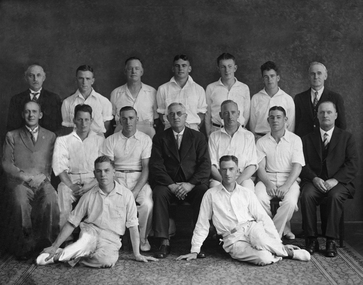
Photograph, 1935-36 C Team Premiership, c. 1936
... Pat Brophy...Wally Grant...J Tormey...Alf Wood...S Vaughan...Murrumbeena Murrumbeena Cricket Club Cricket Cricket Clubs Cricketers Peter Robertson Pat Brophy Wally Grant J Tormey Alf Wood S Vaughan Jim Watson Charlie Parker V Frankland Albert Bristowe T J Riley Dr Buntine R Kelly Percy Love Jack Corran Albert Forscutt Photograph of 1935-36 C Team premiership 1935-36 C Team Premiership Photograph Photograph ...Photograph of 1935-36 C Team premiershipmurrumbeena, murrumbeena cricket club, cricket, cricket clubs, cricketers, peter robertson, pat brophy, wally grant, j tormey, alf wood, s vaughan, jim watson, charlie parker, v frankland, albert bristowe, t j riley, dr buntine, r kelly, percy love, jack corran, albert forscutt -
 Bendigo Military Museum
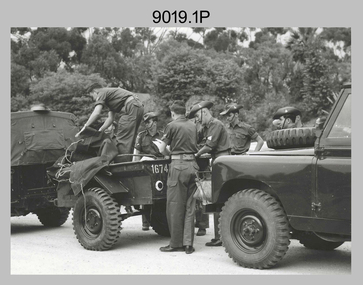
Photograph - Field Trip Preparations, AHQ Survey Regiment, 1960
... Other personnel included on the trip, but not exclusively are; Capt Clem Sargent, WO1 Des Moore, WO1 Ron Newman; Sgt Len Davies, Sgt Norm Vaughan, Sgt Joe Farrington (Laplace), Sgt Tony Slattery, Sgt John Van de Graaff (Laplace), Sgt Harry Wright (MT), Sgt Jack Waller (QM) Cpl Lou Sommer, Cpl Bob Skitch (later Sgt), Spr Don Cocker, Spr Ian Bryan, Spr Leo Bub, Spr Bruce Cockburn, Spr Pat Cox, Spr Jim Fitzhenry, Spr Bill Hills, Spr Noel Humphreys, Spr Dennis Woods, Spr Richard Jackson-Hope, Spr Bill Jeffery, Spr Andy Millar, Spr Dave Owen, Spr Blue Rogers, Spr Tom Royle, Spr Bob (Lofty) Thompson, Spr Peter Strandly and Spr Mick Symmons. ...Other personnel included on the trip, but not exclusively are; Capt Clem Sargent, WO1 Des Moore, WO1 Ron Newman; Sgt Len Davies, Sgt Norm Vaughan, Sgt Joe Farrington (Laplace), Sgt Tony Slattery, Sgt John Van de Graaff (Laplace), Sgt Harry Wright (MT), Sgt Jack Waller (QM) Cpl Lou Sommer, Cpl Bob Skitch (later Sgt), Spr Don Cocker, Spr Ian Bryan, Spr Leo Bub, Spr Bruce Cockburn, Spr Pat Cox, Spr Jim Fitzhenry, Spr Bill Hills, Spr Noel Humphreys, Spr Dennis Woods, Spr Richard Jackson-Hope, Spr Bill Jeffery, Spr Andy Millar, Spr Dave Owen, Spr Blue Rogers, Spr Tom Royle, Spr Bob (Lofty) Thompson, Spr Peter Strandly and Spr Mick Symmons. ...Field Trip Preparations - Tellurometer traverse, Wyndham, Western Australia to Borroloola, Northern Territory 1960. This was a Tellurometer Traverse undertaken to establish 1st order EDM traverse (geodetic survey of Australia) from Mt Isa to Borroloola with airborne barometric altimetry in the Camooweal area. Followed by 1:250,000 map control by 4th order astro, airborne barometric altimetry and air photo annotation from Georgetown. Laplace Astro carried out as a separate activity from Camooweal, working north to Borroloola and east to Richmond. Also ‘Leap-frog’ barometer heighting from Croydon to Esmeralda closing on State BM at Croydon. Base camps were established at Camooweal for the traverse and Georgetown for the map control and annotation. Bilby towers were used on the coastal section of the EDM traverse, east and south of Borroloola. Vehicles used were Austin Champs (with Rolls Royce engines) and Humber one-ton trucks with Landrovers used for first time on a field trip. Other personnel included on the trip, but not exclusively are; Capt Clem Sargent, WO1 Des Moore, WO1 Ron Newman; Sgt Len Davies, Sgt Norm Vaughan, Sgt Joe Farrington (Laplace), Sgt Tony Slattery, Sgt John Van de Graaff (Laplace), Sgt Harry Wright (MT), Sgt Jack Waller (QM) Cpl Lou Sommer, Cpl Bob Skitch (later Sgt), Spr Don Cocker, Spr Ian Bryan, Spr Leo Bub, Spr Bruce Cockburn, Spr Pat Cox, Spr Jim Fitzhenry, Spr Bill Hills, Spr Noel Humphreys, Spr Dennis Woods, Spr Richard Jackson-Hope, Spr Bill Jeffery, Spr Andy Millar, Spr Dave Owen, Spr Blue Rogers, Spr Tom Royle, Spr Bob (Lofty) Thompson, Spr Peter Strandly and Spr Mick Symmons. This set of 6 photographs were taken in 1960 of preparations, prior to departure on a field trip to the Northern Territory by elements of the AHQ (Army) Survey Regiment under the command of Major Jim Stedman. Black and white photographs were scanned at 300 dpi. .1) - Photo, black & white, Unidentified personnel loading vehicles (Land Rovers) in preparation for Field trip. .2) - Photo, black & white, Unidentified personnel loading vehicles (Austin Champ front with Humber 1 ton at rear) in preparation for Field trip. .3) - Photo, black & white, Unidentified personnel loading vehicles (Austin Champ front with Humber 1 ton at rear) in preparation for Field trip. .4) - Photo, black & white, Unidentified personnel in a vehicle (Austin Champ preparing to depart on the Field trip. .5) - Photo, black & white, personnel on parade (MAJ Jim Stedman at left, WO1 Des Moore at right, others unidentified) prior to departing on the Field trip with new Land Rovers at back. .6) - Photo, black & white, Personnel on parade prior to departing on the Field trip. This photo is an enlarged, but clipped version of photo .5P. royal australian survey corps, rasvy, army survey regiment, army svy regt, asr, fortuna, field survey -
 Sunbury Family History and Heritage Society Inc.
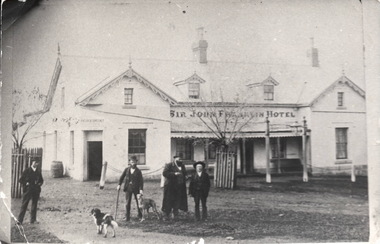
Photograph, Sir John Franklin Hotel
... It stood on the NE corner of Vaughan and Macedon Streets in Sunbury and initially it was a hotel patronised by the middle classes. The manager at the time this photograph was taken was Pat. ...It stood on the NE corner of Vaughan and Macedon Streets in Sunbury and initially it was a hotel patronised by the middle classes. The manager at the time this photograph was taken was Pat. ...The Sir John Franklin Hotel was built by William 'Tulip' Wright in 1854. It stood on the NE corner of Vaughan and Macedon Streets in Sunbury and initially it was a hotel patronised by the middle classes. The manager at the time this photograph was taken was Pat. Sweeney. During the Second World War, in the 1940s a small number of Italian POWs were housed in the Sir John Franklin Hotel. By the 1960s the only evidence of the hotel being on that site were a few bluestone pitchers. Some private houses have been built on the site.In the 1850s five hotels were built along Macedon Street in Sunbury, between Jacksons Creek and Evans Street. The Sir John Franklin Hotel was one of the them. Today the Ballcourt Hotel is the only remaining hotel ion that area.An old black and white photograph with a narrow cream border, of a four men standing outside a single storey hotel building which has a verandah across the front. One of the men has two dogs on leads.sir john franklin hotel, macedon street, vaughan street
