
Showing 16 items matching "peacekeeping forces"
-
 Lakes Entrance Historical Society
Book, Bradley, Joyce et al, A Guide to Genealogical Sources in the Australian War Memorial, 1986
... A guide to the Research Centre of the Australian War Memorial, Canberra, from the 19th. century to the Vietnam War, and involvement in United Nations peacekeeping forces....Military History Stella Rau A guide to the Research Centre of the Australian War Memorial, Canberra, from the 19th. century to the Vietnam War, and involvement in United Nations peacekeeping forces. A Guide to Genealogical Sources in the Australian War Memorial Book Bradley, Joyce et al ...A guide to the Research Centre of the Australian War Memorial, Canberra, from the 19th. century to the Vietnam War, and involvement in United Nations peacekeeping forces.Stella Raumilitary history -
 Monbulk RSL Sub Branch
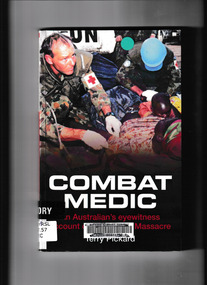
Book, Big Sky Publishing, Combat medic : an eyewitness account of the Kibeho massacre, 2008
... United nations - Peacekeeping forces - Rwanda...United nations - Peacekeeping forces - Rwanda Rwanda - Civil war - Atrocities On the 22nd of April 1995 more than 4,000 Rwandans were massacred and thousands more injured in a place called Kibeho. ...On the 22nd of April 1995 more than 4,000 Rwandans were massacred and thousands more injured in a place called Kibeho. Terry Pickard, a seasoned soldier and medic, was one of a 32-strong force of Australian UN peacekeepers in Kibeho on that terrible Saturday. While the United Nations’ presence prevented the death toll from being even worse than it was, the massacre continues to haunt him. The rules of engagement that stopped him from intervening in the senseless slaughter, and the life and death decisions he was forced to make when dealing with the injured condemned him to more than a decade of recurring nightmares and debilitating flashbacks. The horror and unimaginable tragedy of the Kibeho Massacre still looms large in the lives of Rwandans and the people sent to help the African country. No one who walked away from that day was ever the same again. Combat Medic is a personal account of one Australian soldier who found himself at the centre of events that shocked the world, and the personal toll that he paid. Terry Pickard’s army career spanned nearly 20 years. More than 25 years after Rwanda he continues to struggle with post traumatic stress triggered by his experiences. Collapse summaryIll, maps, plans, p.181.non-fictionOn the 22nd of April 1995 more than 4,000 Rwandans were massacred and thousands more injured in a place called Kibeho. Terry Pickard, a seasoned soldier and medic, was one of a 32-strong force of Australian UN peacekeepers in Kibeho on that terrible Saturday. While the United Nations’ presence prevented the death toll from being even worse than it was, the massacre continues to haunt him. The rules of engagement that stopped him from intervening in the senseless slaughter, and the life and death decisions he was forced to make when dealing with the injured condemned him to more than a decade of recurring nightmares and debilitating flashbacks. The horror and unimaginable tragedy of the Kibeho Massacre still looms large in the lives of Rwandans and the people sent to help the African country. No one who walked away from that day was ever the same again. Combat Medic is a personal account of one Australian soldier who found himself at the centre of events that shocked the world, and the personal toll that he paid. Terry Pickard’s army career spanned nearly 20 years. More than 25 years after Rwanda he continues to struggle with post traumatic stress triggered by his experiences. Collapse summary united nations - peacekeeping forces - rwanda, rwanda - civil war - atrocities -
 Returned Nurses RSL Sub-branch
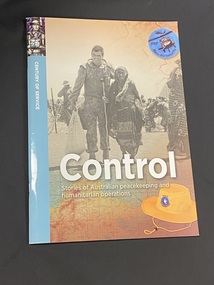
Book - Illustrated paperback book, Department of Veterans' Affairs, Canberra, Control : stories of Australian peacemaking and humanitarian operations, 2019
... ...Peacekeeping Forces...War and peacekeeping Peacekeeping Forces Humanitarian assistance More than 30,000 Australians have served on peacekeeping operations since 1947, and many have delivered humanitarian aid at home and abroad. ...More than 30,000 Australians have served on peacekeeping operations since 1947, and many have delivered humanitarian aid at home and abroad. In complex and dangerous situations they have provided stability along with commitment and compassion, building hope for the future. The following stories are about people who have shown gret self-control, fostering security and safety in exceptionally fragile environments. They have served all over the world, witnessing the struggles and triumphs of the human spirit in the face of conflict and disaster. Some have given their lives in the service of others. - from TroveStaple bound paperback book. There is a blue strip along the left side with a stained glass image of a soldier at the top and 'century of service' printed sideways in white text below. The cover shows a black and white photo of a soldier assisting a civilian down a road and more civilians in the background, covered by a feint overlay of a map. The title is printed in large white print near the bottom of the page and an image of yellow 'peace monitoring group' hat in the bottom right corner.non-fictionMore than 30,000 Australians have served on peacekeeping operations since 1947, and many have delivered humanitarian aid at home and abroad. In complex and dangerous situations they have provided stability along with commitment and compassion, building hope for the future. The following stories are about people who have shown gret self-control, fostering security and safety in exceptionally fragile environments. They have served all over the world, witnessing the struggles and triumphs of the human spirit in the face of conflict and disaster. Some have given their lives in the service of others. - from Trove war and peacekeeping, peacekeeping forces, humanitarian assistance -
 Horsham RSL Sub Branch
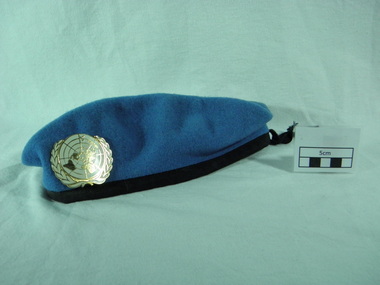
Beret, 1990
... This Beret belongs to my wife Michelle Hutchison, who served with the United Nations Peacekeeping Forces in Cambodia in 1992-1993. She is very proud to have been able to serve in this Peacekeeping Unit....This Beret belongs to my wife Michelle Hutchison, who served with the United Nations Peacekeeping Forces in Cambodia in 1992-1993. She is very proud to have been able to serve in this Peacekeeping Unit. ...This Beret belongs to my wife Michelle Hutchison, who served with the United Nations Peacekeeping Forces in Cambodia in 1992-1993. She is very proud to have been able to serve in this Peacekeeping Unit.The Blue Beret is very signifigant to Peacekeeping Forces throughout the world. Only those people who have served in these units are entilted to wear them with pride.United Nations Peacekeeping Beret (Cambodia).Blue felt Beret with black band,with Gold and White United Nations Badge.F328651 Cpl Pedderforce, beret, united, peacekeeping -
 Bendigo Military Museum
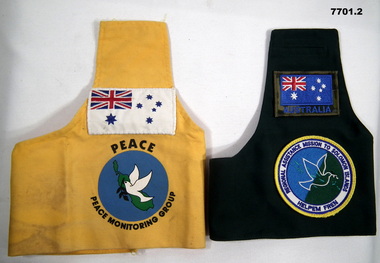
Uniform - BRASSARDS, PEACEKEEPER
... Brassards were worn by Peacekeeping Forces to identify their identity. Belonged to Gary Clift R.127835 M8073771. ...Brassards were worn by Peacekeeping Forces to identify their identity. Belonged to Gary Clift R.127835 M8073771. ...Brassards were worn by Peacekeeping Forces to identify their identity. Belonged to Gary Clift R.127835 M8073771. For RAMSI was deployed as ship's company HMAS BRUNEI. For PNG was deployed from HMAS TARAKAN & BRUNEI.1. PNG Peace Keeping Mission Brassard. Bright yellow brassard. Stitched on white Australian ensign on arm picture of dove carrying a twig overlaid over a map of Bougainville in green. Blue background. 2. RAMSI brassard for Solomon Island Peace Keeping Mission. Dark green with Australian Flag sewn onto sleeve. As is RAMSI emblem (yellow border, white dove over map os islands).1. Embroidered "Peace" & "Peace Monitorial Group". 2. Embroidered patch "Regional Assistance Mission to Solomon Islands" and "Helpen Frew".peace keepers, uniform, brassards, ramsi -
 The 5th/6th Battalion Royal Victoria Regiment Historical Collection
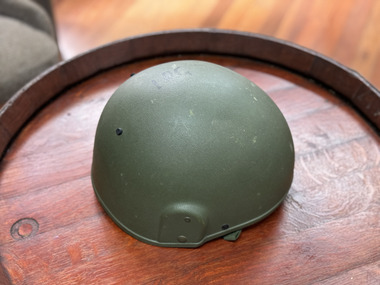
Headwear - Helmet, British Army Helmet Mk6
... The Mk 6 was issued to the British military in 1986.[3] They were known to be used in Operation Desert Storm and Desert Shield.[4] From 1992, the Mk 6 was supplied to the UN alongside the M88, MICH and the M1 to allow for protection of peacekeeping forces. Many military forces used these helmets such as Argentina, Mexico, and most listed UN countries as stated. ...The Mk 6 was issued to the British military in 1986.[3] They were known to be used in Operation Desert Storm and Desert Shield.[4] From 1992, the Mk 6 was supplied to the UN alongside the M88, MICH and the M1 to allow for protection of peacekeeping forces. Many military forces used these helmets such as Argentina, Mexico, and most listed UN countries as stated. ...The Mk 6 was issued to the British military in 1986.[3] They were known to be used in Operation Desert Storm and Desert Shield.[4] From 1992, the Mk 6 was supplied to the UN alongside the M88, MICH and the M1 to allow for protection of peacekeeping forces. Many military forces used these helmets such as Argentina, Mexico, and most listed UN countries as stated. These were either covered with the respective country's camouflage helmet cover, or issued with a blue Mk 6 cover to indicate it as a peacekeeping helmet.[5] From June 2009, the helmet was replaced by the Mk 7 helmet.British Army combat helmet mk 6 made of ballistic nylon, painted olive green. It has a foam and leather liner and an olve green webbing harness to secure the helmet to the soldiers head. "Becca" is written in sharpie on the inside rear right of the helmet forward of the manufactures sizing and serial tag. -
 Lara RSL Sub Branch
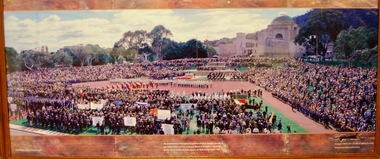
Photograph of Anzac day in the National Capital by Ben Wrigley
... Anzac Day is a national day of remembrance in Australia and New Zealand that broadly commemorates all Australians and New Zealanders "who served and died in all wars, conflicts, and peacekeeping operations" Anzac Day, 25 April, is one of Australia’s most important national occasions. It marks the anniversary of the first major military action fought by Australian and New Zealand forces during the First World War anzac photographs lara r.s.l. ww1 anzac day in the national capitol CAMBERRA Australia's National Capital. ...the establishment of the Capital at Camberra will go far towards intensifying the national spirit which is so strong a feature of Australia's nationhood.Senator the Rt Hon George Pearce,Minister for Home and Territories,1926. ...Anzac Day is a national day of remembrance in Australia and New Zealand that broadly commemorates all Australians and New Zealanders "who served and died in all wars, conflicts, and peacekeeping operations"Anzac Day, 25 April, is one of Australia’s most important national occasions. It marks the anniversary of the first major military action fought by Australian and New Zealand forces during the First World War Rectangular Framed Photograph,(Glass covered) with a wooden frameCAMBERRA Australia's National Capital. ...the establishment of the Capital at Camberra will go far towards intensifying the national spirit which is so strong a feature of Australia's nationhood.Senator the Rt Hon George Pearce,Minister for Home and Territories,1926. Photograph of ANZAC DAY in the National Capital by Ben Wrigley Produced by the National Capitol Authority.anzac, photographs, lara r.s.l., ww1, anzac day in the national capitol -
 Lara RSL Sub Branch
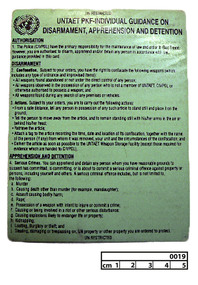
Card, UN Disarmament, Apprehension and Detention Card
... peacekeeping mission in the territory of East Timor, from its establishment on 25 October 1999,[1] until its independence on 20 May 2002, following the outcome of the East Timor Special Autonomy Referendum. This card instructs personnel the correct procedure for the disarmament, apprehension and detention. military army timor east timor united nations un card laminated untaet untaet pkf pkf green card disarmament apprehension detention A green UN Disarmament, Apprehension and Detention Card that has writing on both sides. Used by United Nation Forces ...The United Nations Transitional Administration in East Timor (UNTAET) provided an interim civil administration and a peacekeeping mission in the territory of East Timor, from its establishment on 25 October 1999,[1] until its independence on 20 May 2002, following the outcome of the East Timor Special Autonomy Referendum. This card instructs personnel the correct procedure for the disarmament, apprehension and detention.A green UN Disarmament, Apprehension and Detention Card that has writing on both sides. Used by United Nation Forces in East Timor.military, army, timor, east timor, united nations, un, card, laminated, untaet, untaet pkf, pkf, green card, disarmament, apprehension, detention -
 Lara RSL Sub Branch
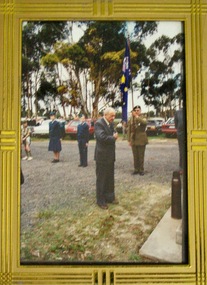
Framed Photograph of Anzac day service at Larea R.S.L, Circa 1980
... peacekeeping operations" and "the contribution and suffering of all those who have served". Observed on 25 April each year, Anzac Day was originally devised to honour the members of the Australian and New Zealand Army Corps who served in the Gallipoli Campaign, their first engagement in the First World War. Wikipedia Anzac Day is one of Australia’s most important national commemorative occasions. It marks the anniversary of the first major military action fought by Australian and New Zealand forces ...Anzac Day is a national day of remembrance in Australia and New Zealand that broadly commemorates all Australians and New Zealanders "who served and died in all wars, conflicts, and peacekeeping operations" and "the contribution and suffering of all those who have served". Observed on 25 April each year, Anzac Day was originally devised to honour the members of the Australian and New Zealand Army Corps who served in the Gallipoli Campaign, their first engagement in the First World War. WikipediaAnzac Day is one of Australia’s most important national commemorative occasions. It marks the anniversary of the first major military action fought by Australian and New Zealand forces during the First World War.Rectangular shaped glass covered photo frame.anzac day service, world war one,lara r.s.l. -
 Waverley RSL Sub Branch
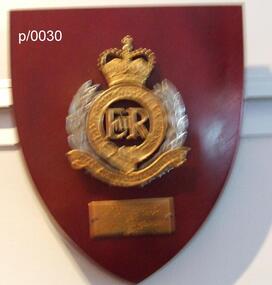
Plaque Royal Australian Engineers, Royal Australian Engineers
... peacekeeping operations and is currently involved in the Australian contribution to the war in Afghanistan. The RAE provides combat engineering, construction and other technical support to the Australian Defence Force. One of the main roles of the Corps is to provide mobility and counter mobility capabilities to the Australian Army and its allies. This means enhancing the ability of friendly forces...peacekeeping operations and is currently involved in the Australian contribution to the war in Afghanistan. The RAE provides combat engineering, construction and other technical support to the Australian Defence Force. One of the main roles of the Corps is to provide mobility and counter mobility capabilities to the Australian Army and its allies. This means enhancing the ability of friendly forces ...The Royal Australian Engineers (RAE) is a corps of the Australian Army (although the word corps does not appear in their name or on their badge). The RAE is ranked fourth in seniority of the corps of the Australian Army, behind the Staff Cadets, Armoured and Artillery Corps. The Corps was formed by the amalgamation of the various colonial engineer corps of the States and territories of Australia in 1902[2] and since then has served in various conflicts including World War I, World War II and the Vietnam War. The Corps has also served on numerous peacekeeping operations and is currently involved in the Australian contribution to the war in Afghanistan. The RAE provides combat engineering, construction and other technical support to the Australian Defence Force. One of the main roles of the Corps is to provide mobility and counter mobility capabilities to the Australian Army and its allies. This means enhancing the ability of friendly forces to move while denying movement to enemy forces. In order to provide these capabilities, engineers are required to conduct many tasks including penetrating minefields, locating and disarming booby traps, purifying water and building roads and bridges. The Corps also performs the majority of the Australian Army's demolition tasks and is trained to fight as infantry if needed. http://en.wikipedia.org/wiki/Royal_Australian_EngineersWooden Plaque 15cm x 13cmRoyal Australian Engineers -
 Bendigo Military Museum
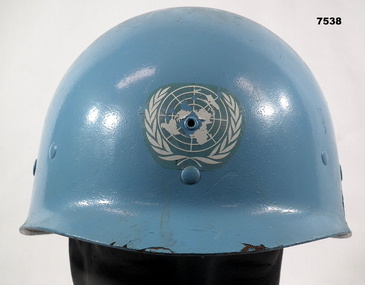
Headwear - HELMET, UNITED NATIONS
... Forces - Nov 1965 to April 1979. Army Reserve Aug 1980 - Oct 1984. Part of this time was spent in Cyprus with United Nations Peacekeeping. ...Forces - Nov 1965 to April 1979. Army Reserve Aug 1980 - Oct 1984. Part of this time was spent in Cyprus with United Nations Peacekeeping. ...Helmet belonged to "Gordon Bruce Bearman". Served in the Citizen Military Forces - Nov 1965 to April 1979. Army Reserve Aug 1980 - Oct 1984. Part of this time was spent in Cyprus with United Nations Peacekeeping. Blue painted helmet with United Nations insignia on front. Initials "UN" on right hand side. Inside of helmet is brown in colour. Adjustable webbing is attached with rivets to inside to fit wearer's head. Chin strap missing.On transfer on right hand side "UN" , united nations peacekeeping, uniform, helmet, gordon bruce bearman -
 Lilydale RSL Sub Branch
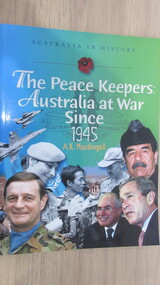
Book, Samone Bos, The Peacekeepers: Australia at War since 1945, 2009 reprint
... (1) Vietnamese conflict 1961-1975, (2) Iraq War 2003, (3) Persian Gulf War 1991, (4) Peacekeeping forces, (5) East Timor - History, Autonomy and Independence movements. ...(1) Vietnamese conflict 1961-1975, (2) Iraq War 2003, (3) Persian Gulf War 1991, (4) Peacekeeping forces, (5) East Timor - History, Autonomy and Independence movements.Booknon-fiction(1) Vietnamese conflict 1961-1975, (2) Iraq War 2003, (3) Persian Gulf War 1991, (4) Peacekeeping forces, (5) East Timor - History, Autonomy and Independence movements. -
 Returned Nurses RSL Sub-branch
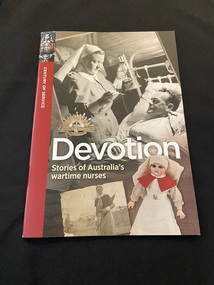
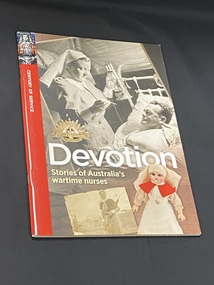
Book - Illustrated paperback book, Department of Veterans' Affairs, Canberra, Devotion: stories of Australia's wartime nurses, 2013
... Australian Army - military life Military Nursing women in war women soldiers Australian Armed Forces - Nurses This education resource is the first book in the Century of Service series and is aimed at primary and lower secondary schools students. It explores the contribution and courage of Australian nurses in conflicts and peacekeeping operations from the Boer War to the present. ...This education resource is the first book in the Century of Service series and is aimed at primary and lower secondary schools students. It explores the contribution and courage of Australian nurses in conflicts and peacekeeping operations from the Boer War to the present.--Dept. of Veteran's Affairs website.Staple-bound paperback book. It has a red strip along the left side with a stained glass image of a nurse at the top and 'century of service' printed sideways in white text below the image. The cover shows a black and white image of a nurse tending a patient in a military tent. The title is printed in large white print below the centre of the page and beneath it is a photo of a nurse in a miltary base and of an old doll dressed as a nurse. The symbol for Australian Commonwealth Military Forces is in the middle of the page.non-fictionThis education resource is the first book in the Century of Service series and is aimed at primary and lower secondary schools students. It explores the contribution and courage of Australian nurses in conflicts and peacekeeping operations from the Boer War to the present.--Dept. of Veteran's Affairs website.australian army - military life, military nursing, women in war, women soldiers, australian armed forces - nurses -
 Returned Nurses RSL Sub-branch
Book - Illustrated paperback book, Department of Veterans' Affairs, Canberra, Devotion: stories of Australia's wartime nurses, 2013
... Australian Army - military life Military Nursing women in war women soldiers Australian Armed Forces - Nurses This education resource is the first book in the Century of Service series and is aimed at primary and lower secondary schools students. It explores the contribution and courage of Australian nurses in conflicts and peacekeeping operations from the Boer War to the present. ...This education resource is the first book in the Century of Service series and is aimed at primary and lower secondary schools students. It explores the contribution and courage of Australian nurses in conflicts and peacekeeping operations from the Boer War to the present.--Dept. of Veteran's Affairs website.Staple-bound paperback book. It has a red strip along the left side with a stained glass image of a nurse at the top and 'century of service' printed sideways in white text below the image. The cover shows a black and white image of a nurse tending a patient in a military tent. The title is printed in large white print below the centre of the page and beneath it is a photo of a nurse in a miltary base and of an old doll dressed as a nurse. The symbol for Australian Commonwealth Military Forces is in the middle of the page.non-fictionThis education resource is the first book in the Century of Service series and is aimed at primary and lower secondary schools students. It explores the contribution and courage of Australian nurses in conflicts and peacekeeping operations from the Boer War to the present.--Dept. of Veteran's Affairs website.australian army - military life, military nursing, women in war, women soldiers, australian armed forces - nurses -
 Returned Nurses RSL Sub-branch
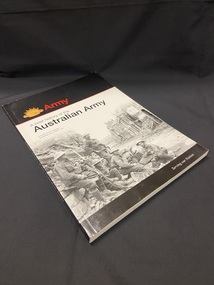
Book - Illustrated paperback book, Major Ian Finlayson, A brief history of the Australin Army: serving our nation, 2017
... Forces military history medals insignia Part 1. European Settlement and the Aboriginal resistance 1788-1920s -- Part 2. Colonial Security, the Sudan and the Bower War 1788-1902 -- Part 3. From Federation through the World Wars: 1901 - 1945 -- Part 4. War, Peacekeeping ...Part 1. European Settlement and the Aboriginal resistance 1788-1920s -- Part 2. Colonial Security, the Sudan and the Bower War 1788-1902 -- Part 3. From Federation through the World Wars: 1901 - 1945 -- Part 4. War, Peacekeeping and community assistance 1945 - 1998 -- Part 5. War, Peacekeeping and community assistance 1999 - 2015 -- Part 6. History and traditions. [From Trove]Paperbook book with a black cover and spine. There is a black and white photo on the cover showing a group of five soldiers resting in a bombed out street. The top panel of the cover has 'Army' in red text and a picture of the Australin Army emblem next to it.non-fictionPart 1. European Settlement and the Aboriginal resistance 1788-1920s -- Part 2. Colonial Security, the Sudan and the Bower War 1788-1902 -- Part 3. From Federation through the World Wars: 1901 - 1945 -- Part 4. War, Peacekeeping and community assistance 1945 - 1998 -- Part 5. War, Peacekeeping and community assistance 1999 - 2015 -- Part 6. History and traditions. [From Trove]australian army, australian army history, armed forces, military history, medals, insignia -
 Returned Nurses RSL Sub-branch
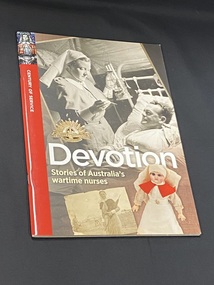
Book - Illustrated paperback book, Department of Veterans' Affairs, Canberra, Devotion: stories of Australia's wartime nurses, 2013
... Australian Army - military life Military Nursing women in war women soldiers Australian Armed Forces - Nurses This education resource is the first book in the Century of Service series and is aimed at primary and lower secondary schools students. It explores the contribution and courage of Australian nurses in conflicts and peacekeeping operations from the Boer War to the present. ...This education resource is the first book in the Century of Service series and is aimed at primary and lower secondary schools students. It explores the contribution and courage of Australian nurses in conflicts and peacekeeping operations from the Boer War to the present.--Dept. of Veteran's Affairs website.Staple-bound paperback book. It has a red strip along the left side with a stained glass image of a nurse at the top and 'century of service' printed sideways in white text below the image. The cover shows a black and white image of a nurse tending a patient in a military tent. The title is printed in large white print below the centre of the page and beneath it is a photo of a nurse in a miltary base and of an old doll dressed as a nurse. The symbol for Australian Commonwealth Military Forces is in the middle of the page.non-fictionThis education resource is the first book in the Century of Service series and is aimed at primary and lower secondary schools students. It explores the contribution and courage of Australian nurses in conflicts and peacekeeping operations from the Boer War to the present.--Dept. of Veteran's Affairs website.australian army - military life, military nursing, women in war, women soldiers, australian armed forces - nurses
