
Showing 4 items matching "peasant art"
-
 Federation University Historical Collection
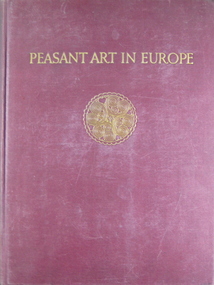
Book, H. Th. Bossert, Peasant Art in Europe, 1927 (exact)
... Peasant Art in Europe......peasant art..."Peasant Art in Europe" is an art book selected and arranged by H. ...peasant handicraft. The book includes table of content, index, bibliography and a library due date card inside back cover, it was borrowed by Donald Ferguson(an art lecturer)on 13 May 1957. ..."Peasant Art in Europe" is an art book selected and arranged by H. ...Red cloth large hardcover book. Title is written on the front cover and on spine in gold. Small gold circle pattern on front cover. The book contains 100 coloured plates, 32 b/w plates with images of peasant handicraft. The book includes table of content, index, bibliography and a library due date card inside back cover, it was borrowed by Donald Ferguson(an art lecturer)on 13 May 1957. Page numbers written in roman numerals. embroidery, europe, ceramics, ornaments, peasant art, h th bossert, folk art, embroideries, handicraft, decorative arts, textile fabrics -
 Duldig Studio museum + sculpture garden
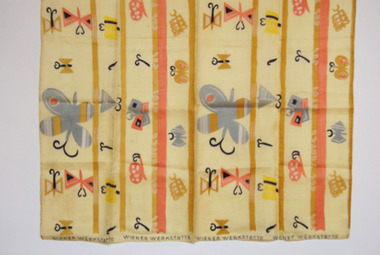
Fabric, Mathilda Flogl, Falter designed by Mathilda Flogl 1924-31, 1924-31
... The designs were characterised by simplified forms and vivid colours, and inspired by Eastern European peasant art and geometric motifs in contemporary painting. ...The designs were characterised by simplified forms and vivid colours, and inspired by Eastern European peasant art and geometric motifs in contemporary painting. ...This piece of fabric, known Fälter (butterfly), was designed by Mathilda Flögl (1893-1958), who worked in the textile department of the Wiener Werkstätte in Vienna. It is a remnant of the fabric that was used to make a bedspread for Karl and Slawa’s bed in their Vienna apartment where it lay decoratively over a gold brocade eiderdown. The purchase demonstrated Slawa’s interest in and knowledge of modern design and her commitment to the idea of enriching everyday life with beautiful objects, a principal of the Viennese Secession. Following the Duldigs removal from Vienna, the original bedspread and remnant were safeguarded and preserved by Slawa’s sister, Rella, in the basement of her Paris apartment. In 1948 the bedspread and this remnant were sent to Australia. The bedspread was a much-loved item but deteriorated over the years. In 1955 it was made into curtains, which are held in the Duldig Studio Collection. The Photographs of the bedspread in its original location are also held in the collection. The remnant is in pristine condition. The Wiener Werkstätte (Vienna Workshop) was a guild of designers and craftsmen that was founded by the architect Josef Hoffman (1879-1956) and the designer Koloman Moser (1868-1918). The firm manufactured a range of interior furnishings between 1903 and 1932. The textile department opened in 1900, and produced about 1,800 designs, mainly for printed fabrics for furnishings and apparel. The designs were characterised by simplified forms and vivid colours, and inspired by Eastern European peasant art and geometric motifs in contemporary painting. The workshop had a profound impact of European art and design, and its work is still celebrated today. Mathilde Flögl was born in the Czech Republic in 1893, and studied at the Kunstgerwerbeschule in Vienna. In 1916 she began working at the Weiner Werkstätte, and where she designed more than 120 textile patterns. This fabric Fälter or Butterfly was designed in 1924. The butterfly was a favourite motif of Flögl. In this design she plays with a variety of whimsical abstractions and arrangement of both the butterfly and the snail on a background of abstract colour stripes and blocks. Ann Carew 2016The fabric is of great aesthetic interest as an example of the work of the Viennese workshops, and the noted designer textile designer Mathilde Flögl. The original pencil drawings, pencil and gouache designs, and fabric swatches for Fälter are held in the MAK Museum in Vienna, and the Victorian and Albert Museum in London have a sample of piece of the silk fabric in an alternate colour wave. The Museum of Applied Arts in Sydney holds a swatch book of textiles from the Wiener Werkstätte, however Flögl’s work is not represented. The National Gallery of Victoria holds a similar swatch book. The remnant has an excellent provenance, is associated with a powerful personal narrative, and is significant and rare item relating to history of the Wiener Werkstätte in Vienna, and the oeuvre of Matilda Flögl. Ann Carew 2016Remnant of a block-printed silk fabric used to make the bedspread for Karl Duldig and Slawa Horowitz-Duldig's bed in Vienna. -
 Federation University Art Collection
Work on paper - Printmaking, Returning Ducks, 1999
... art...artwork...yang deliang...chinese...silkscreen...jinshan peasant...Yang Deliang was from the Jinshan Peasant Painting Academy where Chinese folk art of southeastern Yangtze River area of Shanghai is undertaken. ...Yang Deliang was from the Jinshan Peasant Painting Academy where Chinese folk art of southeastern Yangtze River area of Shanghai is undertaken. ...Yang Deliang was from the Jinshan Peasant Painting Academy where Chinese folk art of southeastern Yangtze River area of Shanghai is undertaken. The paintings integrate the folk arts of printing and dyeing, embroidery, paper cutting, wood carving, and cook stove painting, and depict the peasant's colorful customs and daily life. This style of folk art was born in 1972, under the guidance of a professional painter Wu Tongzhang. Jinshan Peasant Painting made its international debut in the Expo 1980 in Brussels, Belgium. This item is part of the Federation University Art Collection. The Art Collection features over 1000 works and was listed as a 'Ballarat Treasure' in 2007.Framed silkcreen An artist's 'chop' is evident on the lower right cornerart, artwork, yang deliang, chinese, silkscreen, jinshan peasant painting academy, j -
 Flagstaff Hill Maritime Museum and Village
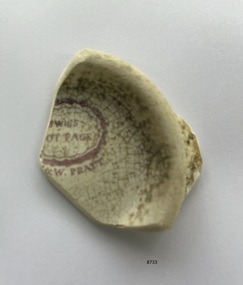
Ceramic - China Fragment, J&W Pratt/F&R Pratt, c mid nineteenth century
... peasant woman in local Swiss dress. The Fragment "OT PAGE" could be FOOTPAGE which suggests that the design was adapted from a specific 19th-century travel book or travel chronicle featuring steel-plate engravings with FOOTPAGE, indicating where the publisher found the original art. ...peasant woman in local Swiss dress. The Fragment "OT PAGE" could be FOOTPAGE which suggests that the design was adapted from a specific 19th-century travel book or travel chronicle featuring steel-plate engravings with FOOTPAGE, indicating where the publisher found the original art. ...J & W Pratt was an earthenware manufacturing firm operating in Lane Delph (Fenton), Stoke-on-Trent, England, from 1836 to 1859. The company produced traditional domestic earthenware and tableware, including hand-painted items like the Oriental-inspired "Indiana" pattern plates. J & W Pratt ceased operations in 1859 following a period of financial difficulty. The family's broader pottery legacy continued through F & R Pratt & Co. The object appears to be a 19th-century Victorian transferware pot lid featuring the pattern "The Swiss Cottage" (sometimes catalogued as Swiss Riverside Scene or The Alpine Cottage). The "Swiss Cottage" pattern typically features a rustic, asymmetric two-story Alpine chalet or cottage. In the foreground or mid-ground, a small wooden footbridge which spans a stream, and traveling figures or a peasant woman in local Swiss dress. The Fragment "OT PAGE" could be FOOTPAGE which suggests that the design was adapted from a specific 19th-century travel book or travel chronicle featuring steel-plate engravings with FOOTPAGE, indicating where the publisher found the original art. Pot lids were originally manufactured to seal ceramic pots that contained every day commodities like bear's grease (a popular Victorian hair pomade), cold creams, or toothpastes. Because the graphics were so beautifully detailed, Victorians would wash and save the lids once the pot was empty, often framing or mounting them. This object is significant as it represents a rare fragment of earthenware in common use in the mid nineteenth century. The popular Swiss Chalet design on the lid is an example of transfer which made decorative ceramic items more affordable and the product more appealing. Earthenware fragment with smooth edges worn by emersion in the sea. The top has red transferware design showing a two story cottage and footbridge. The underneath has crazed glazing and a partial manufacture stamp indicating J & W Pratt. The piece has a partially raised flange.Bottom partial - "SWISS/OT PAGE/(inside a red scalloped border)/&W. PRATT"flagstaff hill maritime museum and village, earthenware, pot lid, transferware, j & w pratt, china fragment, great ocean rd, red transferware, swiss cottage design
