Flagstaff Hill Maritime Museum and Village
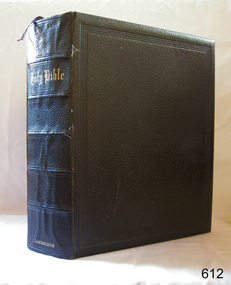
Book - Religious Book, Cambridge University Press, The Holy Bible containing the Old and New Testaments, circa 1942
... ...PEMBENA...Inscribed on spine "HOLY BIBIE" and "CAMBRIDGE"
Inscription inside "Presented by R J Ewart in memory of the fallen as sea, 1942"
INSCRIPTIONS on the pages within include signatures, names, occupations and ship names:
"(-) Service held in St Nicholas Seamen Church"
"NOTABLE EVENTS" "MIV "Centaur" " MV Centaur" SS Fort "Pembena" " MV JOLTEN'" "SS Kooringa" "SS Nairana" "SS Hobart" "...The connection of this Bible to the Mission to Seamen highlights the strong community awareness of the life of people at sea, their dangers and hardships, and their need for physical, financial, spiritual and moral support. flagstaff hill warrnambool shipwrecked-coast flagstaff-hill flagstaff-hill-maritime-museum maritime-museum shipwreck-coast flagstaff-hill-maritime-village the holy bible containing the old and new testaments book bible the bible R J Ewart Cambridge bible Holy Bible St Nicholas Seamen’s Church Williamstown CENTAUR PEMBENA JOLTEN KOORINGA NIRIANA HOBART Inscribed on spine "HOLY BIBIE" and "CAMBRIDGE"
Inscription inside "Presented by R J Ewart in memory of the fallen as sea, 1942"
INSCRIPTIONS on the pages within include signatures, names, occupations and ship names:
"(-) Service held in St Nicholas Seamen Church"
"NOTABLE EVENTS" "MIV "Centaur" " MV Centaur" SS Fort "Pembena" " MV JOLTEN'" "SS Kooringa" "SS Nairana" "SS Hobart" " Book with black textured leather cover, ribbed spine, gold embossed letters, and logo on spine. ...
This Bible was presented to the St Nicholas Mission to Seamen's St Nicholas Church in Williamstown by Mrs R J Ewart in 1942 according to the inscription on the inside page. She also presented a table desktop, candlesticks and a religious cross. The Bible was part of the original furnishings of St Nicholas Seamen's Church, Williamstown, Victoria. The church was operated by the Missions to Seamen organisation.
Within the Bible are three pages of inscriptions and signatures under the heading of NOTABLE EVENTS, including the hospital ship HMHS Centaur..
THE MISSIONS TO SEAMEN (Brief History): -
The Missions to Seamen was an Anglican charity in Great Britain that has served the world's seafarers since 1856. Its symbol is a Flying Angel, inspired by a Bible verse. Today, there are centres in over 200 ports worldwide where seamen of all backgrounds are offered a warm welcome and provided with a wide range of facilities.
In Victoria, the organisation began in Williamstown in 1857 as a Sailors’ Church, also known as ‘Bethel’ or the ‘Floating Church’ in an old hulk floating in Hobson’s Bay, Port of Melbourne. It soon became part of the Missions to Seamen, Victoria. In 2000, the organisation, now named Mission to Seafarers, still operated locally in Melbourne, Portland, Geelong and Hastings.
The Ladies’ Harbour Lights Guild was formed in 1906 to support the Missions to Seamen in Melbourne and other centres, such as Williamstown. Two of the most significant ladies of the Guild were founder Ethel Augusta Godfrey and foundation member Alice Sibthorpe Tracy (who established a branch of the Guild in Warrnambool in 1920). The Guild continued its work until the 1960s.
In 1943, a former Williamstown bank was purchased for the Missions to Seamen Club. The chapel was named St Nicholas’ Seamen’s Church and was supported by the Ladies’ Harbour Lights Guild, the Williamstown Lightkeepers’ Auxiliary and the League of Soldiers’ and Sailors’ Friends. It ceased operation in 1966.
A Missions to Seamen Chapel and Recreation Room was a significant feature of ports during the late 1800s and 1900s. It seemed appropriate for Flagstaff Hill to include such a representation within the new Maritime Village, and the Melbourne Board of Management of Missions to Seamen Victoria gave its permission on 21st May 1979 for the entire furnishings of the Williamstown chapel to be transferred to Flagstaff Hill. The St Nicholas Seamen’s Church was officially opened on October 11, 1981, and resembles the Williamstown chapel.
This Bible is significant historically for its origin in the St Nicholas Mission to Seamen's Church in Williamstown, established in 1857 to cater for the physical, social, and spiritual needs of seafarers. It originated in Bristol, England when a Seamen's Mission was formed in 1837.
The Bible is historically significant for its connection to the Ladies Lightkeepers’ Auxiliary, an organisation of women, formed to support seafarers.
The connection of this Bible to the Mission to Seamen highlights the strong community awareness of the life of people at sea, their dangers and hardships, and their need for physical, financial, spiritual and moral support. Book with black textured leather cover, ribbed spine, gold embossed letters, and logo on spine. Titled The Holy Bible containing the Old and New Testaments. The inside section has a list of signatures (after page 872). An inscription is written inside the front opening and three pages of inscriptions within the pages. The book was presented by R.J. Ewart in 1942. The book now forms part of the St. Nicholas Seamen's Church Collection. Inscribed on spine "HOLY BIBIE" and "CAMBRIDGE"
Inscription inside "Presented by R J Ewart in memory of the fallen as sea, 1942"
INSCRIPTIONS on the pages within include signatures, names, occupations and ship names:
"(-) Service held in St Nicholas Seamen Church"
"NOTABLE EVENTS" "MIV "Centaur" " MV Centaur" SS Fort "Pembena" " MV JOLTEN'" "SS Kooringa" "SS Nairana" "SS Hobart" "flagstaff hill, warrnambool, shipwrecked-coast, flagstaff-hill, flagstaff-hill-maritime-museum, maritime-museum, shipwreck-coast, flagstaff-hill-maritime-village, the holy bible containing the old and new testaments, book, bible, the bible, r j ewart, cambridge bible, holy bible, st nicholas seamen’s church williamstown, centaur, pembena, jolten, kooringa, niriana, hobart