
Showing 9 items matching "peninsular and oriental steam navigation company"
-
 Mission to Seafarers Victoria
Photograph - Photograph, Sepia, P. O. Maloja, 1928
... Named after another ship operating from 1911, RMS Maloja was a passenger liner of the Peninsular and Oriental Steam Navigation Company, operating between 1923 and 1954. ...Named after another ship operating from 1911, RMS Maloja was a passenger liner of the Peninsular and Oriental Steam Navigation Company, operating between 1923 and 1954. ...Named after another ship operating from 1911, RMS Maloja was a passenger liner of the Peninsular and Oriental Steam Navigation Company, operating between 1923 and 1954. In 1924: London/Colombo/Melbourne/Sydney service. During WWII the ship was requisitioned by the Admiralty for service as an Armed Merchant Cruiser.One of two photographs in the collection of a vessel named Maloja, which operated between London and Sydney via Ceylon (Sri Lanka as it later became).small landscape sepia photograph adhered to an album page. Depicts 2 vessels an ocean going 2 stack ship in the distance and a smaller vessel (ferry or coaster) moored against a pier.Hand-written on album page along lower edge in black ink: " PO Maloja"steam ships, world war 2, fan album, ships, piers, port melbourne -
 Mission to Seafarers Victoria
Print - Reproduction, Johnston, P&O 'Iberia' - 29,600 Tons, c.1960
... ...peninsular and oriental steam navigation company...SS Iberia was an ocean liner completed in 1954 for the Peninsular and Oriental Steam Navigation Company (P&O). ...SS Iberia was an ocean liner completed in 1954 for the Peninsular and Oriental Steam Navigation Company (P&O). ...SS Iberia was an ocean liner completed in 1954 for the Peninsular and Oriental Steam Navigation Company (P&O). Along withother liners, Iberia mainly provided passenger service between the United Kingdom and Australia. In the Annual Report 1954, Padre Oliver mentions: " Two fine new P & O ships made their maiden voyages during the year: "Arcadia" and "Iberia". In each case I was privileged to help to represent the Mission at the official luncheon."Marine artColour printed reproduction of a painting or lithograph print featuring 20th C passenger liner, hull and superstructure primarily painted white, under steam at sea. Small tug/fishing vessel in foreground. Larger steam ship on horizon. Print on plain board backing with plain mitred timber frame. Eyelet screws with wire.Printed signature lower right. 'JOHNSTON'iberia, passenger ship, p&o, marine painting, passenger ships, artwork-paintings, peninsular and oriental steam navigation company -
 Wangaratta RSL Sub Branch
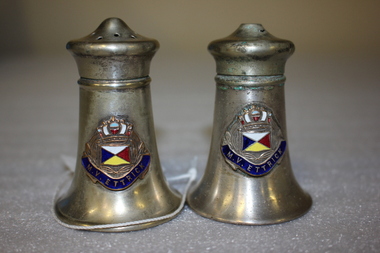
Souvenir - Silver metal salt and pepper shakers with decorative emblem attached, Unknown
... MV ETTRICK was a British Passenger Motor Vessel of 11,279 tons built in 1938 by Barclay Curle & Company, Glasgow, for the Peninsular & Oriental Steam Navigation Company. ...MV ETTRICK was a British Passenger Motor Vessel of 11,279 tons built in 1938 by Barclay Curle & Company, Glasgow, for the Peninsular & Oriental Steam Navigation Company. ...MV ETTRICK was a British Passenger Motor Vessel of 11,279 tons built in 1938 by Barclay Curle & Company, Glasgow, for the Peninsular & Oriental Steam Navigation Company. The Vessel was on charter to the Admiralty as a Troopship. On the 15th November 1942 she was torpedoed by German submarine U-155 at 0315, 150 miles W of Gibraltar. She sank at 0836. She was on a voyage from Gibraltar to the Clyde in ballast, with a crew of 204, 66 naval ratings, and 41 gunners. 18 naval ratings and 5 Asian crew were lost; another Asian seaman died of his injuries. Survivors were taken to Gibraltar by the Norwegian destroyer Glaisdal and returned to the UK in P&O´s Mooltan the following day.White metal salt and pepper shakers with an emblem attachedSalt and pepper shakers with embossing showing Flag and M.V. ETTRICK.mv ettrick, ww2, troopship -
 Emerald Museum & Nobelius Heritage Park
Memorabilia - Ship voyage souvenir, Unknown maker, 1900s
... ...peninsular and oriental steam navigation company...Mongolia, operated as part of the Peninsular and Oriental Steam Navigation Company ("P&O"). ...Mongolia, operated as part of the Peninsular and Oriental Steam Navigation Company ("P&O"). ...The lifebuoy postcard frame was given to Ethel Ruby Nobelius to commemorate her nineteenth birthday on board the S.S. Mongolia during a trip to Ceylon with her parents, Carl and Emily Nobelius. Ethel Ruby Nobelius was born on 27 October 1887 in Emerald and died on 2 August 1965 in Mildura at the age of 77. She was the Nobelius family's second oldest daughter. In total there were eleven children, including three girls, though three sons died in infancy. Ruby's father, Carl Axel Nobelius, was born in Finland in 1851 to a Swedish horticulturalist family and emigrated to Melbourne from Sweden in 1871. He worked at nurseries in Toorak and South Yarra before purchasing sixty-three acres of land in the new settlement of Emerald where he grew plant stock including fruit and ornamental trees which were sold to Australian and international clients for public parks, municipal landscaping projects and private gardens. These included the Fitzroy Gardens and Royal Botanic Gardens in Melbourne and buyers in Europe, the Americas, Asia and New Zealand. Nobelius sourced plants from many countries, and in some instances was the first nurseryman in Australia to do so. Locally, Gembrook Nurseries were an important industry and major employer in Emerald and the surrounding area and had a profound influence on the development of the township, including in the development of infrastructure such as the narrow-gauge railway used to transport stock to the main line in Ferntree Gully, which is now known as the Puffing Billy railway. It is not known where the lifebuoy postcard frame was made. It appears to be official merchandise for the ship S.S. Mongolia, operated as part of the Peninsular and Oriental Steam Navigation Company ("P&O"). P&O were one of the first passenger voyage companies, incorporating in 1840 by Royal Charter and beginning passenger services in 1844. P&O were successful initially because they obtained contracts to carry official mail, which is indicated on the designation 'R.M.S.' or Royal Mail Ship on the lifebuoy. The line was originally formed to operate between England, Spain and Portugal; the colours of the Portuguese and Spanish flags were used to form the P&O company or house flag which can be seen on the item. Services to and from Australia directly did not begin until 1932, indicating that the Nobelius family may have travelled to board the ship at an international port prior to their journey to Ceylon. On the 23rd of June, 1917, the S.S. Mongolia struck a mine laid by a German ship entitled 'Wolf', eighty kilometres from the port of Bombay, India, en route to Australia. Twenty-one people died in the initial explosion or from wounds sustained in the blast and two crew members drowned during the evacuation, but more than 450 people were successfully evacuated in the thirteen minutes it took the ship to sink.The item is significant as it provides evidence of a trip to Ceylon made by Carl Axel Nobelius in 1906 which may have influenced stock available in the Gembrook nurseries, commonly known as the Nobelius nurseries. The Nobelius nurseries exported stock to many parks and municipalities and private buyers throughout the world in the early 20th Century so an international trip made by the proprietor potentially influenced the distribution of plant species during this period. In addition, the item commemorates the ship S.S. Mongolia which was sunk by Germany in 1917, during World War 1.The item is a wooden photo frame in the shape of a lifebuoy with attached cord. It is painted a cream colour, with decoration featuring two flags and the names of the ship and shipping line, one in each of four sections around the edges. On the item's left is a version of the Australian flag without the Federation Star or Southern Cross elements. On the item's right is the white, blue, red and yellow company flag of the P&O shipping line. Both flags are paired with an additional anchor design element. The top section contains the initials P.&O. R.M.S. and the lower section the word Mongolia. The frame contains a black and white postcard depicting the S.S. Mongolia.Obverse: P.&O. R.M.S. / S S ong ." P O / MONGOLIA Reverse: THE BOAT Ruby Carl & Emily / Travelled to Ceylon / 1906 / Given to Ruby / on her 19th birthday / 24/10/06 /1906, p&o, peninsular and oriental steam navigation company, carl axel nobelius, ruby nobelius, ethel ruby nobelius, gembrook nurseries, nobelius nurseries, lifebuoy, memorabilia, souvenir, ship, ceylon, s.s. mongolia, royal mail ship, world war 1, ww1, first world war -
 Mission to Seafarers Victoria
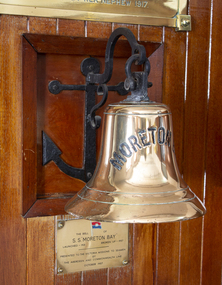
Equipment - Ship bell, Vickers, Barrow, SS Moreton Bay, 1920-1921
... ...peninsular and oriental steam navigation company...In the Annual Report 1957, Padre Oliver mentioned "the bell was found unsuited for the chapel belfry, it is to be mounted on a bracket and placed in the Celia Little lounge." bell anchor brass ss moreton bay ship's bell plaque celia little room bracket p&o peninsular and oriental steam navigation company passengers liners passenger ships emigrants emigration Bell inscribed with upper case capital letters MORETON BAY. / Also brass presentation wall plaque (see image) Cast brass bell with wrought iron anchor and hook design wall mount: decoratively plaited cord in maritime knot pattern to resemble chain, sealed with a varnish and attached to cast iron clapper. ...The Bell was presented to the Mission by the Aberdeen and Commonwealth Line in October 1957, after the ship made her final voyage to Australia in 1956 and it was broken up in Barrow in April 1957 by Thomas W Ward (UK). In the Annual Report 1957, Padre Oliver mentioned "the bell was found unsuited for the chapel belfry, it is to be mounted on a bracket and placed in the Celia Little lounge."Cast brass bell with wrought iron anchor and hook design wall mount: decoratively plaited cord in maritime knot pattern to resemble chain, sealed with a varnish and attached to cast iron clapper. Wrought iron hook secured by metal bolt. Bell is inscribed in upper case capital letters with MORETON BAY. Anchor attached with four flat headed hexagonal bolts with mighted wooden frame. Bell inscribed with upper case capital letters MORETON BAY. / Also brass presentation wall plaque (see image)bell, anchor, brass, ss moreton bay, ship's bell, plaque, celia little room, bracket, p&o, peninsular and oriental steam navigation company, passengers liners, passenger ships, emigrants, emigration -
 Mission to Seafarers Victoria
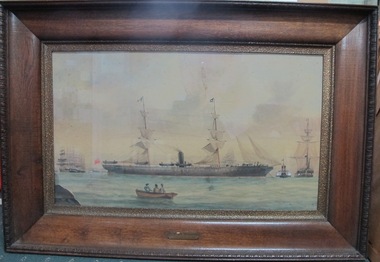
Painting, George Frederick Gregory (1821-1887), P&O S.S. Bangalore, 1867 - 1886
... ...peninsular and oriental steam navigation company...The painting may have been purchased during one of these two events. s.s. bangalore marine painting sailing ships 1867 william denny artwork-paintings peninsular and oriental steam navigation company steamship p&o sandridge port melbourne hobson's bay charles dickson gregory centenary maritime exhibition george frederick gregory (1821-1887) ss bangalore Painted in black on plaque and coloured black: "P & O S.S. ...This ship was number 1 of 2 ships named Bangalore and run by P & O. This ship has listed the same tonnage as that on the inscription on the frame of this work. The ship was subsequently sold in 1886 sold to Hajee Cassum Joosub and used for passengers on pilgrimage into Jeddah. Another view of the history of the Bangalore is that to be found at the Maritime Museums of Sydney listing of another painting of the Bangalore which provides a somewhat different history. It is possible that the story of Bangalore 1 and Bangalore 2 have become conflated further research is needed to verify. see Links field. SS BANGALORE was built in 1867 by William Denny of Dumbarton. Owned by P&O, SS BANGALORE operated from Bombay and Galle to Melbourne and Sydney from 1872 to 1886 as a passenger and mail ship. In 1891 BANGALORE was sold to Wilh. Wilhelmsen, Norway and renamed SS CORINGA.Marine art, Maritime artP&O S.S. Bangalore by George Frederick Gregory (1821-1887)Thinly painted image on board featuring centrally a moored, at anchor, 19th C dual masted steamship with black funnel and flying at the stern a red ensign. To either side are conventional rigged clippers or sailing ships. Near the bow of the steamship there seems to be a tug or paddle steamer face on. In the foreground is a small rowing boat with boatman and two passengers, a male and a female. The painting on board is mounted in a large polished or varnished cedarwood frame with edge carving and a decorative pitted slip which holds in place a thin piece of glazing. Backing paper and seal has all been removed except for hanging wire. Central at front lower edge of frame is a small chipped wood plaque with inscription.Painted in black on plaque and coloured black: "P & O S.S. "BANGALORE" / 2342 tons Built 1867"s.s. bangalore, marine painting, sailing ships, 1867, william denny, artwork-paintings, peninsular and oriental steam navigation company, steamship, p&o, sandridge, port melbourne, hobson's bay, charles dickson gregory, centenary maritime exhibition, george frederick gregory (1821-1887), ss bangalore -
 Mission to Seafarers Victoria
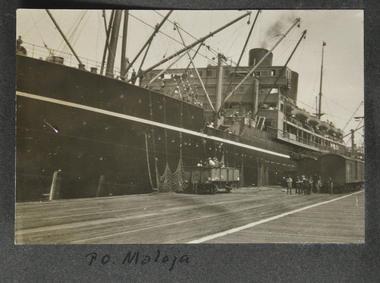
Photograph - Photograph, Sepia, P.O. Maloja, 1928
... ...peninsular and oriental steam navigation company...The SS Maloja was a passenger liner operated by The Peninsular and Oriental Steam Navigation between 1923 and 1954. ...The SS Maloja was a passenger liner operated by The Peninsular and Oriental Steam Navigation between 1923 and 1954. The ship was requisitioned by the Admiralty for service as an Armed Merchant Cruiser upon her arrival at AdenB & W landscape photograph with view from the dock of nearside port bow and superstructure of a moored ship. Men at dockside level are loading or unloading with net in foreground. railway vehicles are lined alongside under a shed. A faint series of letters can be made out near the portholes towards top of bow. This could be name of the vessel. Handwritten in black ink beneath lower edge of image on album page as "P O Maloja" (this may be misnamed) see notes belowsteam ships, world war 2, p.o. maloja, ss maloja, p & o, peninsular and oriental steam navigation company, fan album -
 Mission to Seafarers Victoria
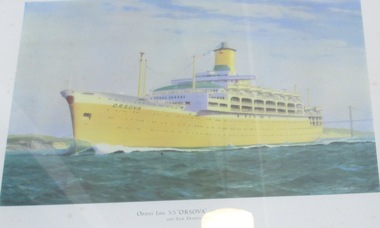
Print - Print, framed, William Howard Jarvis (1903-1964), Orient Line S.S. Orsova off San Francisco, 1954-1966
... ...peninsular and oriental steam navigation company...Crew of the Orsova are recorded as regularly visiting the Mission to Seamen. s.s. orsova passengers ships steamship emigration greece italy australia passenger liner melbourne port phillip bay artwork-paintings w. howard jarvis orient line p and o peninsular and oriental steam navigation company ocean liner passengers liners passenger ships Printed inscription on border of print at lower centre edge: "Orient Line S.S. ...British painter Howard Jarvis was best known for his maritime landscape paintings. An early member of the Society of Marine Artists (UK), formed in 1939, he went to sea on merchant ships and served in the Royal Navy during World War II. His works were influenced by marine artist Kenneth Shoesmith. Jarvis was commissioned by the Cunard-White Star Cruises to create a stone litho poster, which was quite well known, giving passengers a birds-eye view of a cruise ship.SS Orsova, built in 1954, was a British ocean liner for the Orient Steam Navigation Company until 1960, then P&O Orient Lines between 1960-1966, although the Orient ships retained their corn-coloured hulls and sailed under their own house flag. The colour of the hull on the print indicates it was made between 1954 and 1966. On 24 May 1956, Orsova ran aground off Port Phillip Bay, Melbourne, for twelve hours. In 1966 P&O acquired the balance of the Orient Line shares and all their ships were painted white. In the 1960s, Orsova carried many thousands of emigrants from Greece and Italy to Australia. It was staffed by approximately 600 crew and carried over a 1000 passengers. Maritime Art, Marine artColour printed reproduction of a painting or lithograph print featuring 20th C passenger liner, hull and superstructure primarily painted pale yellow, under steam at sea. Print is mounted glazed with thin gilded and moulded frame.Printed inscription on border of print at lower centre edge: "Orient Line S.S. Orsova / Off San Francisco"s.s. orsova, passengers ships, steamship, emigration, greece, italy, australia, passenger liner, melbourne, port phillip bay, artwork-paintings, w. howard jarvis, orient line, p and o, peninsular and oriental steam navigation company, ocean liner, passengers liners, passenger ships -
 Queenscliffe Maritime Museum
Memorabilia - Ship Menus
... The increase in migration to Australia led Britain’s leading shipping line to the Far East, the Peninsular and Oriental Steam Navigation Company (P&O;), to invest in a fleet of new ships of around 20,000 tonnes each to handle the business coming their way. ...Menus used on P&O liners SS Himalaya and SS Arcadia 1955-56. After the Great war of 1914-18, Australia experienced what up until then had been its biggest surge in immigration from Europe. Australia was seen as the great land of opportunity and became one of the top places to migrate to, particularly from Britain. The increase in migration to Australia led Britain’s leading shipping line to the Far East, the Peninsular and Oriental Steam Navigation Company (P&O;), to invest in a fleet of new ships of around 20,000 tonnes each to handle the business coming their way.29 Cruise Ship Menus from P&O cruises 1955-56Peninsula & Oriental Steam Navigation Companycruise liners, migrants, menus, p&o
