
Showing 8 items matching "people movers"
-
 Wodonga & District Historical Society Inc
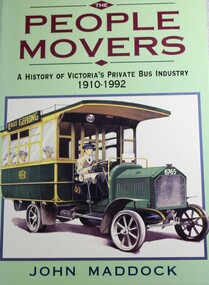
Book - The People Movers - A History of Victoria's Private Bus Industry 1910 - 1992, John Maddock
... The People Movers - A History of Victoria's Private Bus Industry 1910 - 1992...The People Movers - A History of Victoria's Private Bus Industry 1910 - 1992...Chapters deal with inner-suburban services, the large country towns, country services, tour and charter buses, and subsidised school bus services. The People Movers - A History of Victoria's Private Bus Industry 1910 - 1992 Book The People Movers - A History of Victoria's Private Bus Industry 1910 - 1992 John Maddock Kangaroo Press ...This is a history of the private bus companies of Victoria from the "dinosaur days" of the first motor buses early this century through expansion as effective and economical people movers through to their current and somewhat different status. Chapters deal with inner-suburban services, the large country towns, country services, tour and charter buses, and subsidised school bus services.non-fictionThis is a history of the private bus companies of Victoria from the "dinosaur days" of the first motor buses early this century through expansion as effective and economical people movers through to their current and somewhat different status. Chapters deal with inner-suburban services, the large country towns, country services, tour and charter buses, and subsidised school bus services.buses -- victoria -- history, bus lines -- victoria -- history -
 Ballarat Tramway Museum
Document - Photocopy, Handwritten Notes, Alan Bradley, Extract from "The People Movers - A History of Victoria's Private Bus Industry 1910-1992", 1995
... Extract from "The People Movers - A History of Victoria's Private Bus Industry 1910-1992"....Extract from "The People Movers - A History of Victoria's Private Bus Industry 1910-1992". ...512.1 - Seven page photocopy of parts of book by John Maddock on Victorian bus industry. p68 - Notes on Geelong and photograph of SECV Geelong 34 being transported to Ballarat in 1956. p81-85 0 Notes on Ballarat Bus services in particular Davis' bus services and others including demise of Ballarat tramways, with photographs. Parts of text have been marked with yellow highlighter by Donor. 512.2 - handwritten note to W.Doubleday from Alan Bradley in 1995 with comments including corrections on the text. Written on line A4 paper. Reference to the "Gunzel shop" refers to the Association of Railway Enthusiasts "Railfan Shop" in Melbourne. trams, tramways, davis bus lines, ballarat, ballarat trams -
 Ballarat Tramway Museum
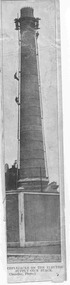
Document - Illustration/s, Chandler, Extract from "The People Movers - A History of Victoria's Private Bus Industry 1910-1992", 1930's?
... Extract from "The People Movers - A History of Victoria's Private Bus Industry 1910-1992"....(item within plastic folder within book container) Extract from "The People Movers - A History of Victoria's Private Bus Industry 1910-1992". ...Illustration was loose within Reg. Item 2488, opposite page 99, of a photo of three steeplejacks working on the ESCo power station chimney stack. Has some support scaffolding near the top of the tower. Caption to the photo on the bottom has part missing but would have been "Steeplejack on the Electric Supply Co.'s Stack." in capitals and notes "Chandler, Photo". Has been glued to another sheet of paper. (item within plastic folder within book container)Written notes in pencil.trams, tramways, esco, power station, chimney stack -
 Unions Ballarat
The People Movers: A History of Victoria's Private Bus Industry 1910 - 1992, Maddock, John, 1992
... The People Movers: A History of Victoria's Private Bus Industry 1910 - 1992...Front cover: light green background; artistic impression of a male driving a Geelong bus; black lettering. The People Movers: A History of Victoria's Private Bus Industry 1910 - 1992 Maddock, John ...A history of private bus services in Victoria. Includes many anecdotal accounts as well as illustrations.Relevant to history and development of industry and employment possibilities in Victoria.Paper; book. Front cover: light green background; artistic impression of a male driving a Geelong bus; black lettering. Front cover: author's name and title.btlc, ballarat trades hall, ballarat trades and labour council, public transport, buses, buses - private, businesses, employment, history -
Moorabbin Air Museum
Book - Experimental aircraft, Aircraft 2000 The Future of Aerospace Technology
... ...People movers...Experimental aircraft Building blocks Computers Space 2000 Military aircraft Missiles People movers Personal aircraft Overview of current ideas & experimental aircraft ideas for the year 2000, circa 1984 Possible duplicate item Aircraft 2000 The Future of Aerospace Technology Book Experimental aircraft ...Overview of current ideas & experimental aircraft ideas for the year 2000, circa 1984Possible duplicate itemnon-fictionOverview of current ideas & experimental aircraft ideas for the year 2000, circa 1984building blocks, computers, space 2000, military aircraft, missiles, people movers, personal aircraft -
 Narre Warren and District Family History Group
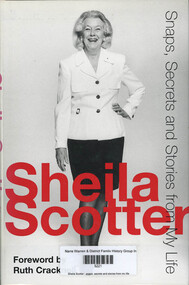
Book, Sheila Scotter, Sheila Scotter : snaps, secrets and stories from my life, 1998
... mover and shaker who inspires fear in some, awe and respect in others, and admiration and loyalty in most. No matter what you think of her, you simply cannot ignore her. Friends and enemies alike are awaiting this book with bated breath for one reason: when Sheila Scotter speaks, people listen. ...There is no other store like David Jones... and there is no other consultant like Sheila Scotter! Known variously as the Kangaroo editor (by Diana Vreeland), the black and white lady from Albert Park, and the Silver Duchess, this is the autobiography, scrapbook-style, of one of Australia's doyennes of style. For Sheila Scotter's seventeenth birthday her parents put on a 'coming out ball' in the United Services Club in Calcutta, where they lived at the time. The teenager wore a pale turquoise silk taffeta ball gown. Sheila no longer remembers what happened to that dress, but she does know that it is responsible for the black-and-white wardrobe that has been her hallmark ever since, with the exception of one occasion and one occasion only. For her seventieth birthday party, close friend John Truscott conned her into wearing red, insisting that the theme for the event was all red. And what did the guests all wear? Black and white! This anecdote lite, stylish, idiosyncratic is typical of the many that make up Sheila Scotter's autobiographical assortment. Most Australian women know Sheila Scotter through her Women's Weekly column 'Sheila Scotter Suggests' which ran between 1975 and 1980 and totalled some 235 instalments. The fact that this column is still vividly remembered 17 years later attests to the sacred place it held in every Australian household. A feminist before the word was invented, Sheila has had a formidable career. Two chapters are devoted to her career in fashion, including her time as the editor-in-chief of Vogue and founding editor of Vogue Living. The art of fundraising is also treated in some depth. In snippets, we hear of her love of cricket (which she once played); we find out how she came to live in Australia in the first place and why she has made Melbourne her home. Not surprisingly, the book reflects the personal contradictoriness of its author/subject on the one hand an aristocrat, on the other a rogue who does not respect rank; blithely mixing innate feminism with blatant coquettishness; outrageous yet scrupulously stylish; in the know yet discrete; courting notoriety while at the same time needing solitude a Like all celebrity autobiographers Sheila reserves her right to privacy while basking in the limelight. But she has used this book to set the record straight on a number of issues, including why she left Vogue, her many romantic involvements, her much-publicised spat with socialite Lillian Frank, and what was wrong with David Jones, to whom she consulted during 1994-95. The book contains the expected wining, dining and partying, as well as the inside story on some recent scandals. Sheila Scotter is glamorous and alluring, a forthright mover and shaker who inspires fear in some, awe and respect in others, and admiration and loyalty in most. No matter what you think of her, you simply cannot ignore her. Friends and enemies alike are awaiting this book with bated breath for one reason: when Sheila Scotter speaks, people listen. Contents Foreword (by Ruth Cracknell, a personal friend) Before I Begin a (explaining the rationale for the book) 1 Thursday's Child (birthdays) 2 Christmases to Remember 3 In Fashion (career in fashion) 4 A Matter of Style (Vogue Living and its influence) 5 Marriage and Other Liaisons 6 A Mixed Salad of Letters (letters, personal and business, from prominent people) 7 Fundraising: Are Committees Really Necessary? 8 Loved Ones Departed (or Why I Envy the Angels) 9 Disappointments and Other Disasters (scandals and inside stories) 10 London, Paris, Sydney, Melbourne (the places she has lived) 11 Not the Last Instalment (a look ahead) Postscript (a tribute to some special men read between the lines) Source: Publisher253 p.; 25 cmnon-fictionThere is no other store like David Jones... and there is no other consultant like Sheila Scotter! Known variously as the Kangaroo editor (by Diana Vreeland), the black and white lady from Albert Park, and the Silver Duchess, this is the autobiography, scrapbook-style, of one of Australia's doyennes of style. For Sheila Scotter's seventeenth birthday her parents put on a 'coming out ball' in the United Services Club in Calcutta, where they lived at the time. The teenager wore a pale turquoise silk taffeta ball gown. Sheila no longer remembers what happened to that dress, but she does know that it is responsible for the black-and-white wardrobe that has been her hallmark ever since, with the exception of one occasion and one occasion only. For her seventieth birthday party, close friend John Truscott conned her into wearing red, insisting that the theme for the event was all red. And what did the guests all wear? Black and white! This anecdote lite, stylish, idiosyncratic is typical of the many that make up Sheila Scotter's autobiographical assortment. Most Australian women know Sheila Scotter through her Women's Weekly column 'Sheila Scotter Suggests' which ran between 1975 and 1980 and totalled some 235 instalments. The fact that this column is still vividly remembered 17 years later attests to the sacred place it held in every Australian household. A feminist before the word was invented, Sheila has had a formidable career. Two chapters are devoted to her career in fashion, including her time as the editor-in-chief of Vogue and founding editor of Vogue Living. The art of fundraising is also treated in some depth. In snippets, we hear of her love of cricket (which she once played); we find out how she came to live in Australia in the first place and why she has made Melbourne her home. Not surprisingly, the book reflects the personal contradictoriness of its author/subject on the one hand an aristocrat, on the other a rogue who does not respect rank; blithely mixing innate feminism with blatant coquettishness; outrageous yet scrupulously stylish; in the know yet discrete; courting notoriety while at the same time needing solitude a Like all celebrity autobiographers Sheila reserves her right to privacy while basking in the limelight. But she has used this book to set the record straight on a number of issues, including why she left Vogue, her many romantic involvements, her much-publicised spat with socialite Lillian Frank, and what was wrong with David Jones, to whom she consulted during 1994-95. The book contains the expected wining, dining and partying, as well as the inside story on some recent scandals. Sheila Scotter is glamorous and alluring, a forthright mover and shaker who inspires fear in some, awe and respect in others, and admiration and loyalty in most. No matter what you think of her, you simply cannot ignore her. Friends and enemies alike are awaiting this book with bated breath for one reason: when Sheila Scotter speaks, people listen. Contents Foreword (by Ruth Cracknell, a personal friend) Before I Begin a (explaining the rationale for the book) 1 Thursday's Child (birthdays) 2 Christmases to Remember 3 In Fashion (career in fashion) 4 A Matter of Style (Vogue Living and its influence) 5 Marriage and Other Liaisons 6 A Mixed Salad of Letters (letters, personal and business, from prominent people) 7 Fundraising: Are Committees Really Necessary? 8 Loved Ones Departed (or Why I Envy the Angels) 9 Disappointments and Other Disasters (scandals and inside stories) 10 London, Paris, Sydney, Melbourne (the places she has lived) 11 Not the Last Instalment (a look ahead) Postscript (a tribute to some special men read between the lines) Source: Publishersheila scotter, fashion -
Southern Sherbrooke Historical Society Inc.
Helen Coulson collection
... Helen Coulson was one of the prime movers of the restoration of the Port of Echuca as a heritage precinct which remains open (and popular) today. Helen Coulson celebrated her 100th birthday at Echuca in December 2018. The event was attended by more than 100 people...Helen Coulson was one of the prime movers of the restoration of the Port of Echuca as a heritage precinct which remains open (and popular) today. Helen Coulson celebrated her 100th birthday at Echuca in December 2018. The event was attended by more than 100 people ...Obituary, Ferntree Gully News, 1st June 2022 Helen Coulson, regarded as the finest historian of the Dandenong Ranges, passed away at the age of 103 years at Echuca on the Easter weekend. Ray Peace, Knox Historical Society researcher, reports: Helen Carlyle Duncan was born in December 1918 at Tecoma, then a tiny township in the Dandenong Ranges. Helen was the only daughter of Vincent Duncan, the East Riding member of Ferntree Gully shire council in 1930-32. The young Helen was involved in community affairs early in life, taking part in a community fair at Upwey in December 1928. In February 1946 Helen married Max Coulson of Mornington, and had two sons, Graeme and Richard; in later life she became a grandmother and great-grandmother. From her early years, Helen was aware of the district’s rich history. She started work for the shire of Ferntree Gully as a typist in January 1936. In the latter 1940s, Helen was writing regular feature articles for the metro media, such as The Argus and the Weekly Times. Helen’s two interests came together in February 1952 when she was commissioned by the shire council to create a comprehensive history of the district. In a 1953 article in the Ferntree Gully & District Times, Helen described herself as ‘an everyday housewife who enjoys writing’; Helen made good use of the local media to trace some of her more elusive contacts. The project took years of meticulous research and writing to complete. Helen was doubly fortunate, not only having the support of the shire council, but also in having the book published by a major publishing house, Longman Cheshire. The Story of the Dandenongs was published in 1959 and was an immediate success. The book was reprinted in 1968 and 1982, and is now considered a collector’s item. More than six decades after publication, Helen’s book remains a standard reference for the history of the district and is considered by many to be the finest work of its type. Helen was also commissioned to create a private family history for the Chandler family in the 1970s. Helen’s love of local history did not end with Ferntree Gully. In 1959 Helen moved to Horsham in western Victoria, a city to which she was closely linked for many years, then in 1977 to the port town of Echuca on the Murray River. Once the largest inland port in Victoria, by the 1970s the river port was dilapidated, and at risk of demolition. Helen Coulson was one of the prime movers of the restoration of the Port of Echuca as a heritage precinct which remains open (and popular) today. Helen Coulson celebrated her 100th birthday at Echuca in December 2018. The event was attended by more than 100 people from all over Victoria. At the time Helen attributed the success of her first book to being the right person in the right place at the right time. Helen spent her final years in a retirement village in Echuca but remained lucid, active and engaged with the local community to the end of her life. Helen’s dedication to the cause of local history, and the published works she leaves behind, will remain as a lasting legacy in Ferntree Gully, and other areas of Victoria where she lived and worked. Ray Peace, Knox Historical Society -
 Wodonga & District Historical Society Inc
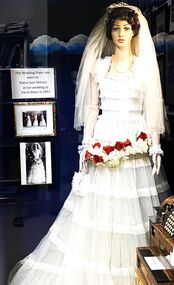
Costume - Wedding dress- Elaine Mann nee Milnes 1957
... people. He continued to head the business until it was sold in 2006. He was a leader in many other fields in the Wodonga community, from leading the Wodonga Chamber of Commerce to Scouting, Apex and Rotary and was a prime mover in establishing Aware Industries for people with disabilities. ...people. He continued to head the business until it was sold in 2006. He was a leader in many other fields in the Wodonga community, from leading the Wodonga Chamber of Commerce to Scouting, Apex and Rotary and was a prime mover in establishing Aware Industries for people with disabilities. ...Elaine Margaret Milnes of Tallangatta married David Ernest Mann of Wodonga on 30 March 1957. At the time of their first meeting, Elaine was living in Tallangatta where her father had moved as a bank manager. She was a member of the Drama Club. She and David met at the Rutherglen Town Hall whilst attending an Arts Festival. David was attending as a member of the Wodonga Music Club. David Mann was the son of Ernest and Evelyn Mann of Wodonga who had operated the family business since 1921. David joined the business in 1945 and became the Managing Director of Mann Wodonga from 1965. Under his management and leadership, it expanded to become one of Australia’s largest regional shopping centres, with a Supermarket, Hardware Store, Steel Store, Plumbing and Industrial supplies store, at one stage employing over 100 people. He continued to head the business until it was sold in 2006. He was a leader in many other fields in the Wodonga community, from leading the Wodonga Chamber of Commerce to Scouting, Apex and Rotary and was a prime mover in establishing Aware Industries for people with disabilities. He chaired the Wodonga Chamber of Commerce on several occasions. David was a man of vision who was involved in many charitable and community organisations. These included membership of the hospital board and President of the Wodonga High School Council. was a prime mover in establishing Aware Industries for people with disabilities. Elaine also played an active role in the business. She developed and managed a quality giftware department from 1969 to 1987. Some of her local involvements included the School Mothers’ Club and Kindergarten, Girl Guides, the Quota and Penguin Clubs and Meals on Wheels. David also advocated passionately for the development of a university and TAFE to be established in Wodonga. In 1993 he inaugurated the Jonathan Mann lectures series at La Trobe University in honour of his grandfather. The university honoured Mr Mann in two significant ways, giving him an honorary degree of Doctorate of Law in 1998 and in 2002 named its new library the David Mann Library. David Mann died in Albury in June 2012. Elaine now (2024) lives in Melbourne. “The little I have done for Wodonga and district is only in return for what Wodonga and district has done for me.” David MannThis dress was worn by Elaine Milnes at her marriage to David Mann who became a prominent businessman and contributor to many aspects of the Wodonga community.A wedding dress dating from 30 March 1957. The dress consists of a fitted bodice with tulle frills around the body. The bodice has a square neckline decorated with tiny seeded pearls and blue stones. The long sleeves are made of sheer tulle with lace and a frill at the wrist. The skirt is made of two layers of white tulle with five lace and tulle frills around the body. Under the tulle is a pale blue satin slip with two more layers of white tulle underneath it. It was worn with a fingertip length veil held in place by a lace coronet. The bridal bouquet consisted of red and white roses. The bride also wore a single string of pearls. The dress was made by Olive Ferris Wedding Dresses of Sydney.mann wodonga, david mann, elaine mann, wodonga businesses
