
Showing 7 items matching "period decor."
-
 Buninyong & District Historical Society
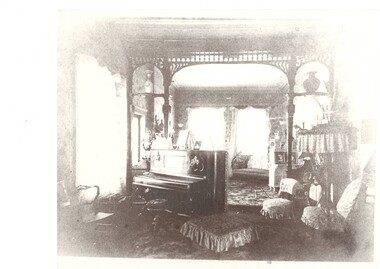
Photograph - Interior view of the drawing room at the Fisken home, Lal Lal, Interior of the Fisken home, Lal Lal
... ...Period decor....House interior. Furnishings. Period decor. Piano and stool. Good, but faded and not a very sharp image Interior of the Fisken home, Lal Lal Photograph Interior view of the drawing room at the Fisken home, Lal Lal. ...Good, but faded and not a very sharp imagehouse interior., furnishings., period decor., piano and stool. -
 Flagstaff Hill Maritime Museum and Village
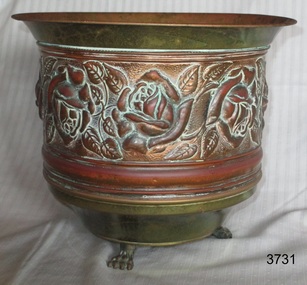
Container - Jardiniere, ca 1920
... The Jardinière is a good example of late Victorian memorabilia that was to be found in many homes of the period. flagstaff hill warrnambool shipwrecked coast flagstaff hill maritime museum flagstaff hill maritime village great ocean road emigrants from ireland giles collection henry giles tower hill cooramook warrnambool breakwater mailor’s flat wangoom 19th century household goods brass jardinière plant pot potted plant domestic decor copperware lion paw feet rose design Handwritten: "$85" Plant container: brass and copper jardinière, with tooled and pressed ornamental rose design on a band of copper around the planter and braised seam joins. ...This jardinière is one of many 19th and early 20th-century items donated to Flagstaff Hill Maritime Village by the Giles Family. It would have been used to contain a potted plant or similar foliage to decorate a room. Donated to Flagstaff Hill Maritime Village by Vera and Aurelin Giles, this item is associated with Warrnambool and the Giles Family history. Many items have been donated by the family and have come to be known as the “Giles Collection”. Many items in the Lighthouse Keeper’s Cottage that were donated by Vera and Aurelin Giles mostly came from the home of Vera’s parents-in-law, Henry Giles and his wife Mary Jane (nee Freckleton), who married in 1880 and whose photos are on display in the parlour. Henry was born at Tower Hill in 1858 and was a labourer on the construction of the Warrnambool Breakwater before leaving in 1895 for around seven years to build bridges in NSW. Mary Jane was born in 1860 at Cooramook, and she attended Mailor’s Flat State School and where she eventually became a student teacher. After which she became a governess at “Injemiara”, where her grandfather, Francis Freckleton, had once owned land. Henry and Mary’s family consisted of six; some of the children were born at Mailor’s Flat, and later, some children were born at Wangoom. They lived with their parents at Wangoom and Purnim west, and this is where Henry died in 1933 and Mary Jane died in 1940. The Giles family collection has social significance at a local level, because it illustrates the level of material support the Warrnambool community gave to Flagstaff Hill when the Museum was established. It also represents typical furniture and household goods owned by settlers in the Warrnambool District in the late 19th and early 20th century. The Jardinière is a good example of late Victorian memorabilia that was to be found in many homes of the period.Plant container: brass and copper jardinière, with tooled and pressed ornamental rose design on a band of copper around the planter and braised seam joins. Three short lion paw feet support the base. Part of the Giles Collection. An inscription is on a sticker under the base.Handwritten: "$85"flagstaff hill, warrnambool, shipwrecked coast, flagstaff hill maritime museum, flagstaff hill maritime village, great ocean road, emigrants from ireland, giles collection, henry giles, tower hill, cooramook, warrnambool breakwater, mailor’s flat, wangoom, 19th century household goods, brass jardinière, plant pot, potted plant, domestic decor, copperware, lion paw feet, rose design -
 Tramway Heritage Centre
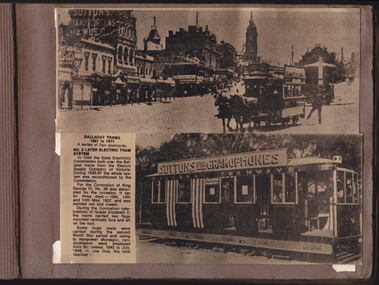
Photograph Album (part of), Ray Pearson's Photo Album - Trams of Victorian Railways, Ballarat, Bendigo, Geelong
... decor- / ated for the occasion. It ran / for three days – 12th, 13th / and 14th May, 1937, and was / painted red and cream. / During the Coronation cele- / brations of Queen Elizabeth II, / the trams carried two flags / mounted vertically fore and aft / on the roof. / Some huge loads were / carried during the second / World War period and owing / to man power shortages, con- / doctresses were employed / from September, 1942 to July, 1946. ...decor- / ated for the occasion. It ran / for three days – 12th, 13th / and 14th May, 1937, and was / painted red and cream. / During the Coronation cele- / brations of Queen Elizabeth II, / the trams carried two flags / mounted vertically fore and aft / on the roof. / Some huge loads were / carried during the second / World War period and owing / to man power shortages, con- / doctresses were employed / from September, 1942 to July, 1946. ...Page 3 of Ray Pearson's Photo Album. Brown card page with two metallic look postcards (landscape format) placed on page using clear plastic photo corners. Both postcard images depict trams in Ballarat. The bottom postcard has come loose of two of it's photo corners (top and bottom on the right) and is not secure on the page. A hand written inscription is written in pencil behind the bottom photograph.Hand written inscription in pencil behind postcard at base of page: W.4. Printed text to left of image on bottom postcard: BALLARAT TRAMS / 1887 to 1971 / A series of four postcards. / NO. 3 LATER ELECTRIC TRAM SYSTEM / In 1934 the State Electricity / Commission took over the Bal- / larat trams from the Electric / Supply Company of Victoria. / During 1935-37 the whole sys- / tem was reconditioned by the / Commission. / For the Coronation of King / George VI, No. 28 was decor- / ated for the occasion. It ran / for three days – 12th, 13th / and 14th May, 1937, and was / painted red and cream. / During the Coronation cele- / brations of Queen Elizabeth II, / the trams carried two flags / mounted vertically fore and aft / on the roof. / Some huge loads were / carried during the second / World War period and owing / to man power shortages, con- / doctresses were employed / from September, 1942 to July, 1946. At one time, the total / reached 23. Printed text to back of bottom postcard: BALLARAT TRAMS / 1887 to 1971 / A series of four postcards. / In the early fifties, loading / on the trams was heavy. When / the lag in housing was over- / taken, however, breadwinners / started to leave the trams and / travel to work in cars. Increas- / ing affluence in the sixties ac- / centuated the trend. Soon the / trams were running with mount- / ing annual losses. Most of the / passengers travelling in these / times were concession holders: / students, pensioners, deserted / wives and T.P.I.'s A fine printed vertical line runs down the centre of the blank writing space to the left of the body text. Above is written: POSTCARD postcard, coronation, ray pearson, vintage trams, ballarat tramway, tram postcard, female conductors, suttons, ballarat tram -
 Villa Alba Museum
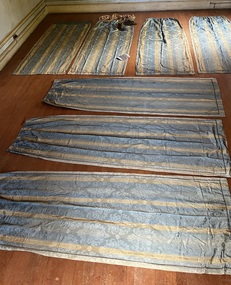
Decorative object - Suite of seven curtain panels, 1850s-90s
... The curtains are significant for their comparative rarity of survival, and at the same time, are highly representative of opulent colonial taste in interior decor in the boom period. The curtain panels are of high quality materials and in unusually good condition, indicating they were used in a window with relatively little sunlight shining on them. ...The curtains are significant for their comparative rarity of survival, and at the same time, are highly representative of opulent colonial taste in interior decor in the boom period. The curtain panels are of high quality materials and in unusually good condition, indicating they were used in a window with relatively little sunlight shining on them. They can be imagined in a grand room with one or more matching dressed windows.7 curtain panels, all the same size, possibly to fit a 3-light bay window; or alternately, to fit 3 windows in the same room (or something else altogether, if this is not the original total number of panels). Fabric: silk-wool mix, sky blue ground with narrow vertical gold stripes. The fabric is a damask weave with a watered (moiré) finish; the large, woven motif depicts an urn filled with stylised flowers, leaves and curlicues; the spacing of the motifs is more 19thC than older styles using much the same motif. Each curtain drop is decorated with an applied band of narrow, colour-matched gimp braid around the sides and lower end. The bottom hems are weighted with what feels like lead shot. The curtains are lined with sturdy brown cotton. They are gathered at the top edge on drawstring tape; and hand-sewn with small metal hanging rings. Faded vertical bands of sun exposure are visible on most of the curtains, and one panel has a mended tear on a lower side. Otherwise they are in excellent, sound condition.interior decoration-19th century, curtains-19th century, colonial taste-victoria, gold boom melbourne -
 Villa Alba Museum
Collection of curtains and curtain accessories
... The curtains are significant for their comparative rarity of survival in Melbourne, and at the same time, are highly representative of opulent colonial taste in interior decor in the boom period. The curtain panels are of high quality materials and in unusually good condition, indicating they were used in a window with relatively little sunlight shining on them. ...In the nineteenth century, Australian interiors reflected European styles and models. In the second half of the century opulent hanging and free-flowing curtains were augmented by elaborate pelmets, fringes, braids, and tie-backs with tassels. In wealthier homes, imported silks and bullion were the fabrics of choice. This set of curtains and curtain accessories, probably originally fromn a drawing room, are believed to have adorned a mansion in Brighton. The curtains are significant for their comparative rarity of survival in Melbourne, and at the same time, are highly representative of opulent colonial taste in interior decor in the boom period. The curtain panels are of high quality materials and in unusually good condition, indicating they were used in a window with relatively little sunlight shining on them. They can be imagined in a grand room with one or more matching dressed windows.Collection of 7 panels of a sky blue and gold figured silk/wool damask curtain set; 6 tiebacks (3 pairs) with bullion tassels; padded and braided silk "rope" for draping; and 2 cards wound with detached braids and bullion fringe from further curtains and decorations which have not survived. The items appear to be the remains of very fine bay window decoration of the later 19th century, almost certainly used in a Melbourne mansion of the boom period, likely in the 1880s. The 3 sets of curtain tiebacks are particularly grand, featuring tassels made with gold ? bullion fringe. The original bright gold ? finish is still evident in the card on which many metres of detached fringe are wound - the inner layers have been protected from oxidation by the outer layers and are still bright. It is not known on what curtain part this fringe was used (it is clear that nothing has been removed from the 7 damask panels surviving). There may have been pelmets or further sets of curtains decorated with the fringe. The materials and workmanship of all items are of high quality, and would have looked magnificent, fulfilling the tastes of the richest inhabitants of Marvellous Melbourne.curtains, curtain furnishings, 19th century, tassels, window furnishings, gold boom melbourne, interior decoration - melbourne, upholstery trimmings, colonial taste-victoria -
 Kew Historical Society Inc
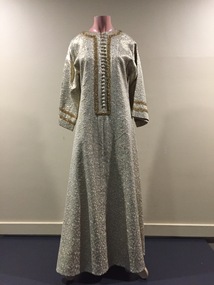
Clothing - Gold Silk Brocade Caftan, Decor, 1960s
... period. The collection is also significant in that it includes the work of a large number of Melbourne designers from the 1960s to the 1990s. australian fashion - 1960s women's clothing evening wear mcintyre collection caftans fashion designers - decor Label: DECOR Full length brocade caftan highlighted on the long sleeves and the front with bands of gold brocade. ...The Fashion & Design collection of the Kew Historical Society includes examples of women’s, men’s, children’s and infants’ clothing from the 18th, 19th and 20th centuries. Items in the collection were largely produced for, or purchased by women in Melbourne, and includes examples of outerwear, protective wear, nightwear, underwear and costume accessories. This caftan is one of a number of evening dresses donated to the Fashion Collection by Dione McIntyre.The McIntyre Collection of clothing and clothing accessories forms one of the largest single donations to our Fashion & Design collection. It includes clothing and clothing accessories worn by four women in the Cohen and McIntyre families across three generations. The items worn by Melbourne architect, and Kew resident, Dione McIntyre date from the 1960s and 1970s, and include evening wear, day wear, hats and shoes. As Dione McIntyre often accompanied her husband, fellow architect Peter McIntyre, to formal events, there are a number of pieces of evening wear among the items. The McIntyre Collection also includes items worn by women of an earlier generation: by Lilian Cohen, Dione McIntyre's mother, and by her mother-in-law, the wife of the architect Robert McIntyre. At the other end of the chronological spectrum are a number of outfits belonging to, worn and donated by Annie McIntyre. These include outfits created by notable late 20th century Australian and/or international fashion designers. The McIntyre Collection is significant historically and artistically as it includes examples of design that demonstrate changing tastes in fashion over an 80-year period. The collection is also significant in that it includes the work of a large number of Melbourne designers from the 1960s to the 1990s. Full length brocade caftan highlighted on the long sleeves and the front with bands of gold brocade.Label: DECORaustralian fashion - 1960s, women's clothing, evening wear, mcintyre collection, caftans, fashion designers - decor -
 Hymettus Cottage & Garden Ballarat
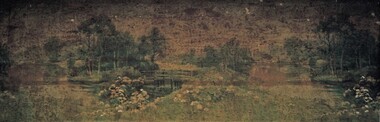
Decorative object - wall paper frieze
... Although in poor condition this wallpaper frieze from 1900-1901 depicting a rustic lakeside scene is rare in that it survives in situ in this Ballarat cottage itself a rare survivor of its period with much of its early and original interior decor retained. Rustic scene Wallpaper Frieze Hymettus Ballarat Repeat pattern wallpaper print of a lakeside scene used as a frieze. ...Although in poor condition this wallpaper frieze from 1900-1901 depicting a rustic lakeside scene is rare in that it survives in situ in this Ballarat cottage itself a rare survivor of its period with much of its early and original interior decor retained.Repeat pattern wallpaper print of a lakeside scene used as a frieze.rustic scene, wallpaper, frieze, hymettus, ballarat
